



药物研发是一个高度复杂、耗时漫长且成本高昂的过程, 涉及科学、经济、监管、技术、伦理、市场、新技术等多个学科和环节的紧密协作, 学术界与业界用“三个十(十年时间、十亿美元成本、十分之一成功率)”简明概述了药物研发到上市时间周期长、资金投入大、失败率高的三大特征[1a-1c]. 2024年诺贝尔生理学与医学奖颁发给microRNA(微小RNA)发现及其转录后基因调控, 标志着药物研发进入个性化“精准治疗”时代, 而“精准化学”是实现“精准治疗”的重要手段和方法.
“精准化学”是21世纪初兴起的分子科学范式, 其核心在于通过理性设计以实现反应位点、能量传递路径及立体构型等原子级精准操控[2a-2c]. “精准化学”的概念起源于多学科交叉, 超分子化学家Lehn的自组织理论则提供了分子精准组装的蓝图[2d]; 中国化学会2011年就提出“化学需要走向‘精准’化”[2e], 此后, “精准化学”作为系统化的学科概念由中国化学会率先提出并推广; 2016年诺贝尔化学奖授予分子机器研究则标志着精确操控分子运动的技术突破[2f]; 2022年诺贝尔化学奖授予点击化学与生物正交化学标志着精确操控分子功能的技术突破[2g]. 现有的上市药物, 不管是小分子药物(第一类)、生物大分子药物(第二类), 还是小核酸药物(第三类), 其药物发现与合成都离不开有机合成[3]. “精准化学”在药物发现中的应用旨在基于疾病机制、靶点结构与作用模式, 结合化合物本身电性特征、空间特性进行精准改造, 以实现药物分子的定向设计与合成, 从而提高药物研发效率、缩短药物上市时间、减少药物研发成本, 从而更快、更好地惠及患者, 造福人类.
药效基团(Pharmacophore)[4]是药物产生药理活性所必需的关键化学特征及其空间排列, 通常包括具有特定物理化学性质的原子、官能团或片段, 这些特征原子、官能团或片段通常以氢键供体/受体、疏水区域、电荷分布来影响药效. 药效团作为连接化学结构与生物活性的桥梁, 贯穿了从靶标验证到临床前研究的全过程, 是现代药物发现不可或缺的理性设计工具. 精准化学的实施大多利用药效基团作为导向基团进行精准改造, 进而以平衡靶点选择性、增强药效、改变药物代谢与吸收等, 从而加速药物发现(图1).

本文将结合创新案例与经典案例, 对“精准化学”在药物发现中的应用进行具体阐述. 为方便理解精准化学的原子级精准操控, 改造位点与区域通过高亮标注.
1 靶向抗癌药物Trodelvy®、佳泰莱®: 喜树碱的持续优化
癌症是全球范围内导致死亡的主要疾病之一, 根据世界卫生组织(WHO, World Health Organization)和Cancer Statistics 2025的数据[5], 癌症在近年造成约1000万人死亡, 是全球居于前列的疾病死亡原因. “精准化学”通过分子层面的精准设计, 提高了喜树碱的药物药效、改善了药代动力学(PK, Pharmacokinetics), 并推动其从“广谱杀伤”向“精准打击”(靶向药物)转变.
喜树碱自从被发现具备广谱抗癌活性后, 直至1985年Hsiang等[6a]阐明广谱抗癌活性天然产物喜树碱的作用机制, 才将喜树碱的临床应用推向更高的阶段. DNA拓扑异构酶I (Topo I, Topoisomerase I)是催化DNA链断裂和重新连接的关键酶, 抑制Topo I容易导致DNA断裂; 而喜树碱与Topo I/DNA形成三元复合物, 通过抑制Topo I以阻止DNA复制和转录, 最终导致癌细胞死亡[6a]. 其中, 喜树碱通过N1、C20位羟基、C21位酯基、C17位羰基与拓扑异构酶/DNA形成的氢键作用发挥药理药效(图2a)[6b]. 但是喜树碱不溶于水和酸性溶液, 且仅微溶于有机溶剂, 从而导致其成药困难[6]. 基于其作用机制和作用模式, 研究人员对喜树碱的E环和A、B环进行了大量结构修饰与优化, 并最终获得了水溶性较好的喜树碱类抗癌药物Irinotecan (伊立替康)、Topotecan (拓扑替康)、Belotecan (贝洛替康)等, 而喜树碱N1作为导向基团进行的精准改造, 是获得这些抗癌喜树碱药物的关键(图2c).

1991年, Sawada等[7]利用喜树碱N1作为导向基团, 经Minisci反应(在C7位引入乙基)、氧化/光照重排反应(在C10位引入羟基), 三步转化获得SN38, C7位点乙基的引入屏蔽了C7位代谢位点, 而C10位羟基的引入使SN38抗肿瘤活性较喜树碱提高100~1000倍. 由于C10位羟基使SN38更易代谢清除且并未使水溶性提高, 因此SN38通过C10位羟基进行[4']联哌啶-1'-甲酰化获得Irinotecan(伊立替康), 从而使代谢稳定性和水溶性得到极大提高, 伊立替康于1994年被日本批准以用于非小细胞肺癌的治疗. 基于类似策略, 喜树碱经氧化(C10位引入羟基)、C9位Mannich反应两步转化获得Topotecan (拓扑替康)[8], 1996年拓扑替康于美国获得批准以用于卵巢癌、小细胞肺癌和宫颈癌的二线治疗. 基于类似策略, 喜树碱经Minisci反应(在C7位引入甲基)、C7'位Mannich反应两步转化获得Belotecan (贝洛替康)[9], 2003年贝洛替康于韩国获批, 以用于卵巢癌、小细胞肺癌的治疗.
早期的喜树碱的精准改造, 多围绕改善喜树碱的水溶性、降低毒副作用、增加内酯环稳定性进行. 已有研究获得的明确结构活性关系如下(图2b)[10a]: E环内酯水解导致失活, C=O替换为C=S、C=N导致失活; (S)-C20是活性所必须环, 且(R)-C20导致抗癌活性失去, C20位OH可以修饰为前体药物; 吡啶酮是抗癌活性所必须, 且C/D环改造使抗癌活性完全失去; A/B环改造比较集中, C7、C9修饰可以增强药效、提高代谢稳定性, 并且C7、C9可修饰为前体药物, C10修饰可以增强药效并且修饰为前体药物. 考虑到喜树碱的无差别杀伤能力导致严重的骨髓抑制、胃肠道毒性等副作用[10b], 研究人员基于其已有结构活性关系研究, 将优异广谱抗肿瘤活性的喜树碱衍生物作为有效载荷应用到ADC药物(Antibody-Drug Conjugate, 抗体偶联药物), 利用抗体的高特异性识别能力实现精准治疗, 并促进了靶向抗癌药物Trodelvy® (Sacituzumab govitecan, 戈沙妥珠单抗)和佳泰莱® (Sacituzumab tirumotecan, 芦康沙妥珠单抗)的发现[11] (图3).
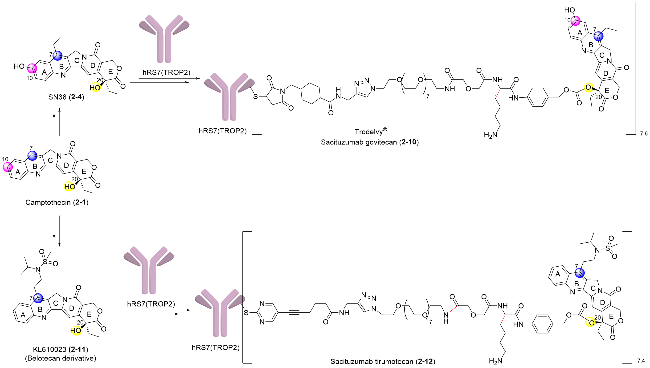
Trodelvy® (Sacituzumab govitecan)是由lmmuno- medics研发的TROP2 (Trophoblast cell surface antigen 2, 人滋养细胞表面抗原2)靶向ADC药物[11], 通过可裂解CL2A连接子将靶向癌细胞表面TROP2的人源化单克隆抗体hRS7与SN38的C20位OH进行偶联, 平均DAR (Drug-to-Antibody Ratio, 药物/抗体比率)为7.6, 2020年4月获得美国食品药品监督管理局(FDA, U.S. Food and Drug Administration)批准以用于局部晚期或转移性乳腺癌及局部晚期或转移性尿路上皮癌的治疗. 佳泰莱® (Sacituzumab tirumotecan)是科伦博泰(中国药企)研发的一款TROP2靶向ADC药物, 通过优化的可裂解CL2A连接子将靶向癌细胞表面TROP2的人源化单克隆抗体hRS7与SN38衍生物KL610023 (T030)的C20位OH偶联, 平均DAR为7.4, 2024年12月获得中国国家药品监督管理局(NMPA, National Medical Products Administration)批准以用于既往至少接受过两种系统治疗的不可切除的局部晚期或转移性三阴性乳腺癌治疗[12].
Trodelvy®和佳泰莱®药物的作用机理如下[13]: 肿瘤细胞表面的TROP2抗原特异性识别抗体后, 将ADC药物内吞进肿瘤细胞, 随后ADC药物在溶酶体低pH条件下切割CL2A连接子, 并释放有效载荷喜树碱衍生物(SN38或SN38衍生物KL610023), 喜树碱衍生物(SN38或SN38衍生物KL610023)通过抑制Topo I阻止DNA复制和转录, 从而杀伤肿瘤细胞; 与此同时, 释放的喜树碱衍生物穿透肿瘤细胞膜, 发挥旁观者效应, 进一步杀伤周围肿瘤细胞.
综上所述, 喜树碱的精准改造早期是以提高药物的水溶性和活性为主, 进而提高生物利用度, 获得伊立替康、拓扑替康、贝洛替康等抗肿瘤广谱上市药物, 但美中不足的是毒副作用较大. 最近, 精准改造获得的喜树碱类新药通过与抗体结合获得ADC药物实现靶向治疗, 不仅提高疗效, 而且还减少了毒副作用, 获批的Trodelvy®、佳泰莱®是通过“精确化学”手段实现“精准治疗”的典型药物研发案例.
2 靶向蛋白降解药物ARV-471、CC-92480等: 沙利度胺的改头换面

2014年, 进一步的机制研究阐明, 度胺类药物通过分子胶水机制与CRBN (Cereblon, E3连接酶泛素复合物中的底物识别蛋白)、靶标蛋白形成三元复合物, 并介导靶标蛋白的泛素化, 继而诱导靶标蛋白经泛素-蛋白酶体系统进行降解, 其中含有锌指结构域(ZF, Zinc Finger)的转录因子优先被CRBN招募并进行靶向降解[16]. 自此之后, 基于度胺类药物招募CRBN进行靶标蛋白降解, 度胺类药物被精准改造为CRBN配体, 应用于PROTACs (Proteolysis-Targeting Chimera, 蛋白降解靶向嵌合体)和分子胶水(Molecular glues)的药物发现[17] (图4b).
依赖“事件驱动”模式, PROTACs作为一种双功能分子, 主要由“E3泛素酶配体”、“连接链”、“靶标蛋白配体”三部分组成; “E3泛素酶配体”招募E3泛素酶, 靶标蛋白配体用于识别靶标蛋白, 通过形成E3泛素酶/PROTACs/靶蛋白三元复合物, 进而促进靶蛋白泛素化, 继而经泛素-蛋白酶体系统进行靶向蛋白降解[18]. 在发现度胺类药物是CRBN配体之前, 应用于PROTACs的E3泛素酶配体主要为更复杂的VHL (von Hippel-Lindau, 希佩尔-林道)配体、cIAP (cellular inhibitor of apoptosis protein 1, 细胞凋亡蛋白抑制剂)配体、MDM2 (mouse double minute 2 homolog, 小鼠双微体同源基因2)配体等[19]. 由于度胺类分子合成简单、分子量更小, 且利于精准改造, 进而促进了PROTACs的药物发现, 其中多个药物分子已经进入临床[20]. ARV-471是第一个进入III期临床的PROTACs药物, 通过哌啶-哌嗪衍生物将来那度胺(CRBN配体)与雌激素配体链接获得, 从而实现雌激素受体的靶向降解[20] (图4b).
基于抗体的特异性识别能力, 将抗体与PROTACs结合, 进一步开发出靶向蛋白降解剂-抗体偶联药物(Degrader-Antibody Conjugates, DAC)[23]. 例如, 2019年, 生物技术开发中心(Development Center for Biotechnology)与DCB-USA-LLC共同公开了一项基于度胺类(CRBN配体)的BRD4-DAC药物发现相关专利[24]: 基于泊马度胺(CRBN配体)精准改造获得的BRD4 (Bromodomain-containing protein 4, 溴结构域蛋白4)降解剂, 通过Val-Cit可切割连接子与HER2 (Human epidermal growth factor receptor-2)抗体进行链接, 获得精准改造的BRD4-DAC分子. BRD4-DAC通过 HER2抗体精准识别并被内吞进入肿瘤细胞, 随后在溶酶体酸性环境下切割Val-Cit以释放BRD4降解剂, 使BRD4-DAC分子在纳摩尔浓度下实现BRD4靶向降解(图5).

同样, 基于抗体的特异性识别能力, 将抗体与分子胶水靶向蛋白降解剂结合, 研究人员进一步开发出分子胶水-抗体偶联(Molecular Glue-antibody Conjugate, MAC)药物[25]. 例如, 2024年, Medilink/Suzhou Kintor Therapeutics公开了基于度胺类(CRBN配体)的c-Myc- MAC药物研发的相关专利[26]: 基于来那度胺(CRBN配体)精准改造获得的c-Myc (Myelocytomatosis viral oncogene homolog)降解剂, 通过优化的Val-Cit可切割连接子与PSMA (Prostate-Specific Membrane Antigen, 前列腺特异性膜抗原)抗体进行链接, 获得精准改造的c-Myc-MAC分子. c-Myc-MAC分子通过抗体精准识别PSMA, 并被内吞进入肿瘤细胞, 随后在溶酶体酸性环境下切割Val-Cit以释放c-Myc降解剂, 从而使获得的c-Myc-DAC分子在几百皮摩尔浓度下即可实现c-Myc及关联GSPT1 (G1 to S phase transition 1, G1到S相变1翻译终止因子)的靶向降解(图6).

总的来说, 沙利度胺精准改造早期是通过TNF-α/ VEGF机制发掘, 将具有致畸性作用的药物分子应用于多发性骨髓瘤治疗, 并开发出小分子新药来那度胺与泊马度胺. 随后, 通过沙利度胺及其类似药物招募CRBN的机制发掘, 度胺类药物经精准改造拓展到靶向蛋白降解剂PROTACs和分子胶水药物的研发. 将PROTACs、分子胶水与精准识别能力的抗体偶联, 充分利用“精确化学”实现了“精准治疗”, 使沙利度胺进入特异性靶向蛋白降解并应用于肿瘤治疗临床应用的新阶段.
3 靶向抗癌药物泽布替尼及BTK靶向降解剂: 伊布替尼的迭代升级
酪氨酸激酶的酪氨酸残基与ATP (adenosine triphosphate, 三磷酸腺苷)结合并磷酸化, 从而激活下游信号通路, 酪氨酸激酶抑制剂(Tyrosine Kinase Inhibitors, TKIs)作为一类靶向治疗药物, 通过选择性抑制酪氨酸激酶活性, 阻断异常信号传导, 从而抑制肿瘤细胞生长、增殖或促进其凋亡[27]. Ibrutinib(伊布替尼)作为全球第一个首创BTK (Bruton’s tyrosine kinase, 布鲁顿酪氨酸激酶)抑制剂[28], 最早于2013年获得FDA批准以用于套细胞淋巴瘤(MCL, myeloid cell leukemia)的治疗. 伊布替尼与BTK酪氨酸激酶ATP活性位点的特异性不可逆共价结合, 从而不可逆地阻断BTK-BCR (B-cell receptor, B细胞受体)信号通路, 最终诱导B细胞死亡[27].
基于共晶结构(PDB: 5P9J), 伊布替尼与BTK酪氨酸激酶的具体作用模式如下[29]: 伊布替尼的ATP类似物骨架与BTK铰链区的Glu475(谷氨酸残基475)、Met477(蛋氨酸残基477)以及W919(结构水分子919)、W933(结构水分子933)不仅形成氢键, 而且BTK铰链区的Glu475、Met477氢键作用至关重要; W915(结构水分子915)与Gly480(甘氨酸残基480)形成氢键后, 通过Gly480与酰胺羰基氧形成的氢键活化共价弹头, 从而促进Cys481(半胱氨酸残基481)与哌啶酰胺共价弹头的Michael加成; 而伊布替尼的二苯醚结构则处于BTK铰链区后袋结构Val458(缬氨酸残基458)、Met449(蛋氨酸残基449)、Phe540(苯丙氨酸540)、Leu542(亮氨酸残基)的疏水区, 并且Phe540与苯环形成Π-Π作用(图7).

鉴于Cys481(半胱氨酸残基481)突变为Ser481(丝氨酸残基481), 伊布替尼与BTK酪氨酸激酶作用力大幅下降从而产生耐药[30]. 基于伊布替尼的结构及作用模式, AstraZeneca(阿斯利康)的研究人员利用2-丁炔基酰胺替换哌啶酰胺共价弹头, 以增强481位置氨基酸残基(Cys481或Ser481)的共价结合能力, 同时利用N-苯甲酰替苯胺替换二苯醚结构, 以增强BTK铰链区后袋结构的相互作用, 从而开发出第二代BTK酪氨酸激酶抑制剂Acalabrutinib(阿卡替尼)[31]. 该药物于2017年获得FDA批准以用于套细胞淋巴瘤治疗. 但是对于哌啶酰胺共价弹头进行替换并不止步于炔基酰胺, Baud与Packham课题组[32]于2024年报道了另外一种策略: 利用2-甲磺酰基嘧啶作为共价弹头, 与Cys481通过SNAr (Nucleophilic Aromatic Substitution reaction, 芳香族亲核取代反应)进行不可逆共价结合, 从而获得化合物4-3, 此外4-3对突变Ser481也表现出潜在不可逆共价结合能力(图8).
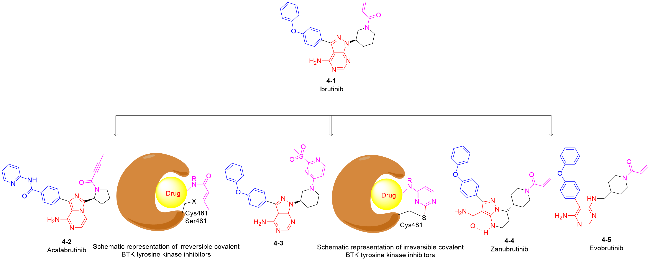
不同于阿卡替尼的开发策略, 百济神州的研究人员对伊布替尼精准改造, 侧重于ATP类似物骨架, 从而开发出第二代BTK酪氨酸激酶抑制剂Zanubrutinib(泽布替尼)[33]. 利用五元环取代酰胺分子内氢键的假环结构, 以替代伊布替尼的ATP类似物骨架的5/6稠环, 并保持与Glu475、Met477的氢键作用; 与此同时, 利用五元环成环结构的构象限制, 促进哌啶酰胺共价弹头与Cys481、Ser481的Michael加成, 从而获得泽布替尼. 泽布替尼作为同类最优药物, 于2019年获FDA批准上市以用于套细胞淋巴瘤(MCL)的治疗, 且2024年全年销售额突破20亿美金. 基于类似策略, 默克公司的研究人员开发出Evobrutinib(埃沃布鲁替尼)[34]. 不幸的是, 由于肝损伤毒副作用, 埃沃布鲁替尼应用于多发性硬化症(MS, Multiple Sclerosis)的临床III期研究于2024年被迫终止. 由此可见, “精准化学”在药物研发中的应用, 国际第一梯队药企也面临着失败的风险(图8).
不同于传统酪氨酸激酶抑制剂的“占据驱动”, PROTACs的“事件驱动”机制在突破靶点突变耐药具有优势. 许多基于BTK酪氨酸激酶抑制剂的PROTACs被开发, 且对C481S(半胱氨酸残基481突变为丝氨酸残基481)、T474I(苏氨酸残基474突变为异亮氨酸残基474)、L528W(亮氨酸残基528突变为色氨酸残基528)等多种突变BTK酪氨酸激酶具有靶向降解效果, 例如饶燏课题组[35]深耕于靶向BTK的PROTACs, 自2018年以来, 报道了许多基于伊布替尼的PROTACs. 而且靶向BTK的PROTACs药物已经有多款进入临床研 究[36a]: 例如百济神州的BGB-16673[36b]已于2025年5月13日进入临床III期, Nurix Therapeutics的NX- 2127[36c]和NX-5948[36d-36f]进入临床I期, 海思科药业的HSK29116[36g-36j]进入临床I期(药物结构暂未披露), 和正医药的HZ-Q1070[36k-36l]进入临床I期(药物结构暂未披露), Ubix Therapeutics的UBX-303[36m-36n]进入临床I期(药物结构暂未披露)(图9).

概括而言, 伊布替尼的精准改造早期策略是通过替换哌啶酰胺共价弹头以实现新药发现, 并获得上市药物阿卡替尼; 随后利用分子内氢键形成假环替换伊布替尼的ATP类似物骨架进行精准改造, 获得药物泽布替尼. 而基于BTK酪氨酸激酶抑制剂开发的PROTACs靶向降解剂, 具有突破靶点突变耐药的优势, 是“精准化学”手段实现“精准治疗”的创新案例.
4 超级抗生素来法莫林: 截短侧耳素的演进
感染性疾病一直是全球健康的主要威胁之一, 尤其是在医疗资源有限的发展中国家, 感染性疾病占死亡总数的比例超30%[37]. “精准化学”通过分子层面的精准设计可以提高药效、改善PK, 并推动抗感染药物快速研发, 促进抗生素耐药问题的解决.
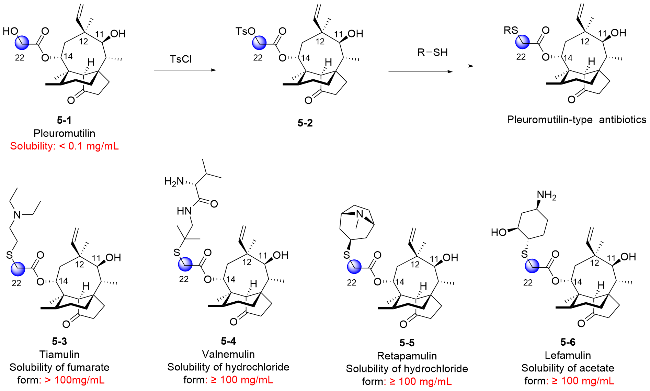
截短侧耳素(Pleuromutilin)是一种二萜类抗生素, 最早于1951年从侧耳属真菌Pleurotus Multilus (Fr.) Sacc.、Pleurotus Passeckerianus中分离鉴定[38]. 由于三环稠合二萜骨架, 截短侧耳素脂溶性较高而限制其使用(溶解度<0.1 mg/mL). 为提高其水溶性, 许多半合成截短侧耳素类似物被获得, 其中C22位定点修饰取得巨大成功[38](图10). 对截短侧耳素的C22进行含有叔胺的硫醇取代获得Tiamullin(泰妙菌素), 由于碱性氨基在生物体内质子化成盐, 其盐酸盐水溶性大幅提高; 缬氨酸是PepT1 (Proton Coupled Oligopeptide Transporter 1, 靶向寡肽转运体1)的底物, 可促进跨膜运输以提高生物利用度, 对截短侧耳素的C22进行含有缬氨酸的硫醇取代获得Valnemulin(沃尼妙林); 其中泰妙菌素、沃尼妙林是兽用截短侧耳素类抗生素. 利用泰妙菌素类似策略, 获得Retapamulin(瑞他莫林), 该药物最早于2007年获FDA批准以用于皮肤和软组织感染, 是首个人用截短侧耳素类抗生素. 而基于相似策略提高水溶性获得Lefamulin (来法莫林), 来法莫林对多种革兰氏阳性菌有效, 于2021年获FDA批准以用于细菌性肺炎治疗.
来法莫林抗菌机制研究表明[39]: 三环截短侧耳素核心结构定位于PTC (Peptidyl Transferase Center, 肽基转移酶中心)的A位点(红色圆, Acceptor site, 氨酰基位点), 而其C14取代基(乙醇酸酯修饰衍生物, 水蓝色椭圆)则延伸至P位点(Peptidyl site, 肽酰位点), A位点和P位点的空间占位效应诱导tRNA构象变化, 影响其结合与精确定位, 抑制肽键形成过程A位点→P位点位移, 从而抑制细菌蛋白质合成. 由于截短侧耳素类抗生素的结合位点位于核糖体50S大亚基隧道出口的PTC, 因此可降低与其他结合于50S大亚基的抗生素之间的交叉耐药性. 在来法莫林的抗菌机制作用模式中, C11羟基与核糖体G2505(鸟嘌呤碱基G2505)的磷酸根氢键作用、C21羰基与G2061(鸟嘌呤碱基G2061)的氢键作用、C22取代基团上的氨基与核糖体A2062(腺嘌呤碱基2062)的核苷2'位羟基氢键作用发挥关键作用(图11a).
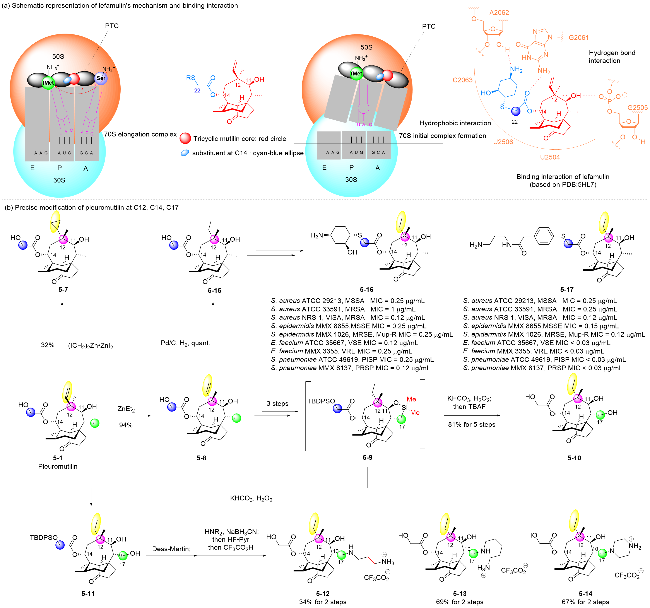
基于来法莫林的抗菌机制和作用模式, Herzon课题组[40a]自2017年发表截短侧耳素全合成文章以来, 2018年[40b]和2022年[40c]相继报道了截短侧耳素的精准定点改造, 并对其抗菌活性进行了研究. 基于截短侧耳素进行Simmons-Smith反应的C12异构[41], 利用ZnEt2对其截短侧耳素进行C12位异构化获得化合物5-8; 5-8利用Hartwig开发的羟基诱导远程官能化为关键反应, 经三步衍生获得化合物5-9; 5-9进行Fleming-Tamo氧化、硅保护基脱除, 获得C12异构化及C12取代烯烃氢化、C17位羟基化产物5-10; 5-9进行Fleming-Tamo获得5-11, 5-11进行Dess-Martin氧化、还原氨化、硅保护基脱除, 获得C12异构化及C12取代烯烃氢化、C17位氨基化产物5-12、5-13、5-14, 该类化合物的水溶性及抗菌活性未披露[40b]; 5-8经衍生获得5-15后, 对C22进行取代衍生, 获得C12异构化及C12取代烯烃氢化、C22位巯基化产物5-16、5-17, 且5-16、5-17对多种革兰氏阳性菌及其相关耐药菌有效[40c](图11b).
总体来看, 截短侧耳素的精准改造早期侧重于C22位取代以提高水溶性和生物利用度, 并将截短侧耳素发展到兽用抗生素泰妙菌素、沃尼妙林; 随后, 截短侧耳素经C22位进一步精准改造, 将其从兽用发展到人类皮肤局部, 使用的瑞塔莫林以及人类口服使用的超级抗生素来法莫林; 继而截短侧耳素利用C12位手性异构与C11羟基导向的C—H官能化作为关键反应, 获得多种对耐药菌有效的来法莫林类似物.
5 对抗耐药菌感染的泰利霉素、索利霉素: 红霉素的升级迭代
自1946年红霉素被发现以来, 14元环大环内酯类抗生素通过精准改造已经研发出三代14元环大环内酯抗生素[42]. 14元环大环内酯类抗生素通过特异性结合细菌核糖体50S大亚基23S rRNA(核糖体催化功能的核心, 其结构域Ⅴ具有肽酰转移酶活性), 抑制新生肽链的延长, 从而阻断细菌蛋白质合成[42]. 其中红霉素与细菌核糖体50S大亚基23S rRNA的作用模式中, 红霉素C5位氨基糖对发挥药效非常重要[42], 其中氨基糖的二甲基氨通过结构水分子与核糖体的A2058(腺嘌呤碱基2058)、G2505(鸟嘌呤碱基2505)形成氢键[43], 氨基糖的羟基与核糖体的A2058(腺嘌呤碱基2058)、A2059(腺嘌呤碱基2059)形成氢键(图12).
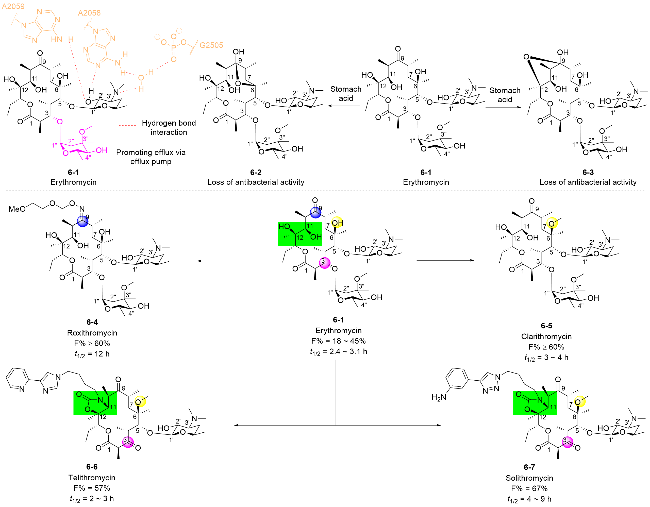
第一代14元环大环内酯药物主要为天然产物红霉素[42], 由于红霉素口服后, 胃酸使其C6位羟基、C12位羟基与C9位羰基发生反应, 生成不具备抗菌活性并且具有促进肠胃蠕动作用的化合物6-2和6-3, 因而红霉素的口服吸收生物利用度偏低(F=18%~45%, F为口服生物利用度)且具有胃肠道副反应. 通过屏蔽C9位羰基的反应活性或者C6位羟基的反应活性, 从而改善红霉素的药代动力学并减少胃肠道副反应, 开发出第二代大环内酯类抗生素克拉霉素(F≥60%)、罗红霉素(F≥60%)[31]. 但是由于C3位克拉定糖的存在, 红霉素、克拉霉素、罗红霉素均能被细菌外排产生耐药. 此外, 由于细菌50S大亚基23SrRNAA2058G突变(A2058突变为G2058、A2058的N6位氨基二甲基化形成N6-Me2- A2058), 结构水分子与核糖体的A2058、G2505形成的氢键消失, 从而使突变后的细菌50S大亚基23SrRNA与红霉素、克拉霉素、罗红霉素结合力减弱, 产生碱基突变耐药[42]. 基于这些耐药因素, 在克拉霉素基础上, 通过删除C3位克拉定糖来减少相关外排泵引起耐药,在C11和C12位形成五元环固定构象并引入边链以增强作用力, 克服碱基突变耐药, 开发出ketolide型的大环内酯类抗生素Telithromycin(泰利霉素)[44]和Solithro- mycin(索利霉素)[45], 其中泰利霉素和索利霉素对多种耐药细菌感染有效. 泰利霉素于2006年获FDA批准上市, 但因与急性肝损伤风险相关被FDA黑框警告, 并撤销了多项适应症[46]; 索利霉素已经进入临床三期, 2016年在注册上市时, 因肝脏毒性问题[47]被FDA要求进行更多的临床III期研究(图12).
红霉素的精准改造早期侧重于改善药代动力学与胃肠道副作用, 从而获得克拉霉素、罗红霉素; 继而侧重于突破克拉定糖引起的外排泵耐药和核糖体碱基突变引起的耐药, 从而获得泰利霉素和索利霉素.
6 抗丙肝药物磷酸依米他韦: 拥有中国自主知识产权的NS5A抑制剂
HCV (Hepatitis C Virus, 丙型肝炎病毒)是一种高度遗传变异的RNA病毒, 其引起的慢性肝炎容易发展为肝硬化乃至肝癌[48]. 根据HCV病毒基因组变异性特点分为基因型I/II/III/IV/V/VI/VII, 这7种主要基因型又可细分为67种已确定基因亚型和20种未确定基因亚 型[49]. 自1989年Houghton成功分离HCV病毒以来, 其结构与机制研究趋向明确, NS5A [Non-Structural protein 5A, 非结构蛋白5A, NS是Non-Structural protein(非结构蛋白)的缩写]通过影响HCV的RNA复制与病毒颗粒组装以调节HCV生命周期[50].
BMS (Bristol-Myers Squibb, 百时美施贵宝)公司的Daclatasvir(达卡他韦)[51]于2008年被证明是第一个对HCV病毒临床有效的NS5A抑制剂[52], 并最终于2015年获批上市, 与索菲布韦(NS5B聚合酶抑制剂)联合用于治疗基因型Ia/Ib HCV感染[53]. NS5A以二聚体形式存在, C2对称性的达卡他韦与NS5A作用力如下[53]: NS5A的A:Q62 (NS5A的A链谷氨酰胺残基62)与B:Q62 (NS5A的B链谷氨酰胺残基62)与达卡他韦咪唑结构的N原子形成关键氢键作用, NS5A的A:L31 (NS5A的A链亮氨酸残基31)、B:F37 (NS5A的B链苯丙氨酸残基37)、A:P58 (NS5A的A链脯氨酸残基58)与B:L31 (NS5A的B链亮氨酸残基31)、A:F37 (NS5A的A链苯丙氨酸残基37)、B:P58 (NS5A的B链脯氨酸残基58)的疏水空腔与达卡他韦联苯结构形成疏水作用, NS5A的A:L28 (NS5A的A链亮氨酸残基28)与达卡他韦脯氨酸结构的烷基部分、A:P29 (NS5A的A链脯氨酸残基29)与达卡他韦缬氨酸结构的烷基部分形成疏水作用(图13). 但是达卡他韦只覆盖基因型Ia/Ib, 半衰期较短(t1/2=10~14 h)且存在一定肝毒性(肝功能不全者慎用).

基于Daclatasvir(达卡他韦)的作用机制和作用模式, Gilead(吉利德)公司通过脯氨酸和联苯刚性化以提高结合效力, 屏蔽脯氨酸和联苯的I相代谢位点, 获得活性更佳(对基因Ia、Ib型HCV感染有效)和半衰期更长 (t1/2=47 h)的Ledipasvir(雷迪帕韦)[54-55]; 雷迪帕韦于2014年获批, 是第一个获批的NS5A抑制剂. 与吉利德策略不同, AbbVie(艾伯维)公司基于C2轴对称性策略, 利用“2,5-二苯基四氢吡咯”取代联苯调节取代咪唑的距离和取向, 以增强结合力, 获得的泛基因型NS5A抑制剂Ombitasvir(奥比他韦, 对基因型I/II/III/IV/V/VI HCV感染有效)[56-57]于2014年上市; 虽然Ombitasvir(奥比他韦)实现了全基因型覆盖, 但四联疗法限制了其使用范围[须与帕瑞他韦(NS3/4A蛋白酶抑制剂)、达拉他韦(NS5B聚合酶抑制剂)、利托那韦(药物增强剂)联合使用]. Merck(默沙东)公司利用“四环稠合取代吲哚”取代联苯, 调节关键作用力咪唑的距离和取向, 以增强结合力, 获得活性更佳(对基因Ia、Ib型HCV感染有效)和半衰期更长(t1/2=24 h)的Elbasvir(艾尔巴司韦)[58-59], Elbasvir(与NS3/4A蛋白酶抑制剂格拉瑞韦联用)于2015年获批.
基于Ledipasvir(雷迪帕韦), 吉利德公司利用“四环稠合取代萘”取代联苯以调节关键作用力咪唑的距离和取向以增强结合力, 利用甲基/甲氧基甲基屏蔽脯氨酸I相代谢位点, 从而研发出泛基因型NS5A抑制剂Velpatasvir(维帕他韦, 对基因型I/II/III/IV/V/VI HCV感染有效)[60-61]; 维帕他韦(与NS5B抑制剂索非布韦联用)于2016年获批. 基于Ombitasvir(奥比他韦), 艾伯维公司利用甲氧基取代缬氨酸异丙基中的一个甲基以减少脂溶性、利用“4-(4-氟苯基)哌啶”取代叔丁基以提高水溶性、引入氟原子以提高代谢稳定性, 从而获得泛基因型NS5A抑制剂Pibrentasvir(哌仑他韦, 对基因型I/II/III/IV/V/VI HCV感染有效)[62-63,57e]; 哌仑他韦(与NS3/4A抑制剂格卡瑞韦联用)于2017年获批(图14). 除了覆盖基因型更广, Velpatasvir(维帕他韦)和Pibrentasvir (哌仑他韦)相比于Daclatasvir(达卡他韦)具有更高的耐药屏障.
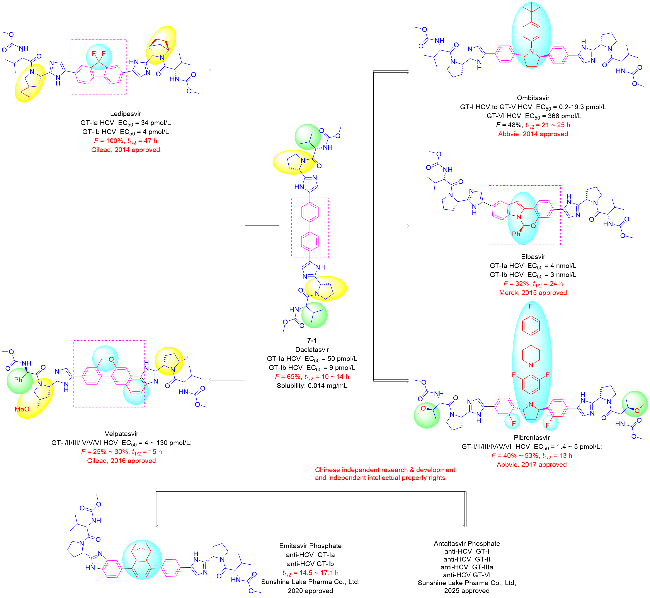
中国的HCV存在以下特点[64]: (1)存量基数大, 截至2020年, 我国HCV感染患者约948.7万; (2)基因型多样性高, 涵盖基因型Ia、Ib、IIa、IIIa、IIIb、VIa、VIb等, 其中基因型Ib占比最高; (3)基因型分布广且差异显著, 例如广东与福建主要基因型为Ib与VIa, 重庆与云南主要基因型为IIIa、IIa合并IIIb, 长江以北省份主要基因型为Ib和IIa; (4)多基因型合并感染的比例呈上升趋势. 针对中国HCV患者的基因型特点, 东阳光药业(中国药企)的研究人员对NS5A抑制剂进行了持续自主研发: 利用苯并咪唑稠合调节关键作用力咪唑的距离和取向以增强结合力, 利用“5,8-二芳基-1,2,3,4-四氢-1,4-亚甲基萘”屏蔽苯环I相代谢位点, 获得中国自主知识产权的第一代NS5A抑制剂Emitasvir Phosphate(磷酸依米他韦, 对基因Ia、Ib型HCV感染有效)[65-66]; 磷酸依米他韦(与NS5B抑制剂索非布韦联用)于2020年12月获得NMPA批准上市, 该药物较达卡他韦半衰期提升(t1/2=14.5~17.1 h)且安全性改善(肝毒性转氨酶上升比例更低); 基于磷酸依米他韦, 东阳光药业进一步获得中国自主知识产权的第二代NS5A抑制剂Netanasvir Phosphate(磷酸萘坦司韦)[67]; 磷酸萘坦司韦(与东阳光自主研发的NS5B抑制剂艾考磷布韦联用)于2025年2月获得NMPA批准上市, 该药物对中国所有基因型HCV感染有效, 不仅支持每日一次口服给药, 而且安全性与耐药性比磷酸依米他韦更好(数据暂未披露)(图14).
综上所述, 从达卡他韦的精准改造发现吉利德公司基于脯氨酸和联苯刚性化以调节结合力和分子取向、屏蔽I相代谢位点, 相继开发出基因型I的NS5A抑制剂雷迪帕韦和泛基因型NS5A抑制剂维帕他韦; 默沙东利用“四环稠合取代萘”取代联苯获得基因型I的NS5A抑制剂艾尔巴司韦; 艾伯维公司基于“2,5-二芳基四氢吡咯”取代联苯核心策略, 相继开发出泛基因型NS5A抑制剂奥比他韦、哌仑他韦; 基于“5,8-二芳基-1,2,3,4-四氢-1,4-亚甲基萘”取代和苯并咪唑稠合以调节结合力和分子取向, 东阳光药业获得基因型I的NS5A抑制剂磷酸依米他韦; 基于磷酸依米他韦的成功, 东阳光药业获得覆盖中国所有基因型HCV的NS5A抑制剂磷酸萘坦司韦, 为消除慢性丙型肝炎贡献了中国力量.
7 药物的后期官能化-精准改造与老药的重新开发
由于已有的药物已经进行过临床验证, 其重新开发利用比原创新药研究更安全可靠、成功率更高、研发周期更短. 而后期官能化精准改造[68]或对已有药物进行后期多样化修饰以突破专利, 或平衡已有药物的靶点选择性提高药物安全性, 或改变药物靶点以拓展适应症, 或改善已有药物的物化特性以改变代谢分布等, 从而为老药重新利用找到突破点.
7.1 心血管与代谢药物匹伐他汀后期官能化与药物发现
血液中过高的胆固醇含量和动脉粥样硬化间存在密切联系[69], 而HMG-CoAR (hydroxy-3-methyl glutaryl coenzyme A reductase, 羟甲戊二酰辅酶A还原酶)催化HMG-CoA (hydroxy-3-methyl glutaryl coenzyme A, 羟甲戊二酰辅酶A)还原是内源性胆固醇生物合成的关键限速步骤[70], 因此HMG-CoAR抑制剂具有降血脂作用(图15). 自1976年日本科学家Akira Endo[71]报道了ML-236B (Mevastatin, 美伐他汀)以来, 研究人员通过对美伐他汀的C3位和C1位取代酯基的C2'位的精准改造, 获得第一代他汀药物Lovastatin(洛伐他汀)[72-73]、Simvastatin(辛伐他汀)[74-75]、Pravastatin(普伐他汀)[76]; 而第一代他汀类药物的HMG-CoA相似片段与HMG-CoA还原酶N271(天冬酰胺残基271)、E83(谷氨酸残基83)、R261(精氨酸残基261)、W1001(结构水分子1001)及W1002(结构水分子1002)的氢键作用是发挥药效的关键, 而氢化萘环骨架与HMG-CoA还原酶主要为疏水作用[77](图15).


7.2 抗炎镇痛药物塞莱昔布、艾托昔布后期官能化与药物发现
COX-2 (Cyclooxygenase-2, 环氧合酶-2)是催化花生四烯酸转变为前列腺素PGE2 (Prostaglandin E2)的限速酶, 而PGE2是炎症产生疼痛的主要原因之一[84]; COX-1 (Cyclooxygenase-1, 环氧合酶-1)是形成PGE1 (Prostaglandin E1)的限速酶, PGE1抑制胃液的分泌以保护胃壁细胞. 早期的非甾体类药物由于未能选择性抑制COX-2, 从而导致呕吐、胃溃疡、胃出血等胃肠道不良反应, 因此选择性抑制COX-2可用于抗炎镇痛并减少胃肠道副反应[85]. Celecoxib(塞来昔布)是首个上市COX-2抑制剂, 其中COX-2的Arg120(精氨酸残基120)、Tyr355(酪氨酸残基355)、Arg513(精氨酸残基513)、Val523(缬氨酸残基523)与塞来昔布的氢键作用对实现COX-2选择性非常重要[86], 而取代甲苯结构则处于COX-2的疏水空腔[86] (图18).

后续研究发现: 由于炎性前列腺素具有舒张血管的作用, COX-2选择性抑制过高, 患者患心血管疾病如心肌梗死风险增加(特别是罗非昔布和伐地昔布); 此外, COX-1催化产生的前列腺素可促进血小板聚集形成血栓, 部分抑制COX-1有利于保护心脏和防止血栓形成. 基于此, 需要平衡COX-2/COX-1抑制以减少心血管相关副作用[88]. 对已有上市昔布类药物进行后期官能化修饰, 实现对COX-2/COX-1抑制、药物代谢/吸收/分布的调节, 可以加速新型昔布类药物研发.
以塞来昔布为例, 2011年余金权课题组[89]利用磺酰胺导向邻位选择性C—H活性实现后期官能化, 快速获得常规反应很难合成的塞来昔布类似物, 从而实现专利突破(图19a). 基于该策略实现了塞来昔布类似物的多样性合成: 例如基于羧基化实现化合物8-25的合成; 基于羰基化实现化合物8-26的合成, 基于烯基化实现化合物8-27的合成, 基于碘基化实现化合物8-28的合成, 基于甲基化实现化合物8-29的合成, 基于芳基化实现化合物8-30的合成; 获得的这些塞来昔布类似物基于 C—H活化引入的官能团又可以继续衍生, 从而实现基于底物的塞来昔布类似物多样性合成. 而且磺酰基邻位引入的官能团, 通过空间位阻、电性调控、氢键给受体调控, 从而影响其与COX-2的Arg513氢键作用, 进而实现COX-2/COX-1选择性调节. 由于磺酰基是昔布药物的药效官能团[4c], 利用药效基团作为导向基团进行 C—H活化, 可以为更多昔布类药物类似合成提供参考. 基于类似策略, 2017年, 余金权课题组[90]利用醛基原位生成亚胺的无痕导向C—H活化, 对塞来昔布实现了疏水区苯环的精准定点改造.

以艾托昔布为例, 其后期官能化多样见图19b: 2014年, Hartwig课题组[91]利用AgF2介导吡啶的邻位氟化, 以中等产率获得化合物8-37; 随后8-37利用亲核试剂经SNAr反应(芳香族亲核取代反应)进行衍生, 以中等收率获得8-38、8-39、8-40、8-41; 2020年, 汤平平课题组[92]利用AgF2介导的吡啶邻位三氟甲氧基化, 以较低收率获得8-42; 2021年, Pilarski课题组[93]报道了一种机械力无溶剂Rh催化, 该反应通过螯合控制实现了吡啶邻位甲基化修饰, 以中等产率获得8-44; McNally课题组[94]通过三氟甲磺酸酐与吡啶衍生物反应, 在吡啶的N原子对位形成季膦盐8-45, 随后季膦盐8-45经SNAr实现吡啶官能化, 基于此, 以中等产率获得8-46、8-47、8-48、8-49、8-50、8-51. 由于官能化的吡啶部分处于COX-2或COX-1的疏水空腔, 通过在N原子的邻位或者对位引入官能团, 不仅可以实现专利突破, 还可以通过影响吡啶的空间位阻与电性实现COX-2/COX-1的选择性调节; 而且还可以通过引入官能团调节化合物的物化特性以及代谢, 从而为新型COX-2选择性抑制的高效药物发现提供开发工具.
7.3 后期官能化实现已有药物的诊疗一体化
PET (Positron Emission Computed Tomography, 正电子发射型计算机断层显像)现在已经广泛应用于肿瘤、中枢神经系统、心血管等疾病的诊断, 具备灵敏度高、特异性高、安全性高、全身显影成像等特点[95]. 对已有药物进行后期官能化, 引入可以进行PET显影的正电子核素18F、11C等, 从而可以实现诊断与治疗一体化, 从而为后续治疗效果及病情判断提供方便.
Fenofibrate(非诺贝特)[96]作为一种选择性PPARα (Peroxisome Proliferator-Activated Receptor-Alpha, 过氧化物酶体增殖激活受体α)激动剂于1974年获批上市, 单独使用或者与他汀类药物联用以降低血脂胆固醇及心血管疾病风险. 18F具有较长的半衰期(t1/2=110 min), 因而被广泛应用于PET. 2019年, Nicewicz课题组与李子博课题组[97]合作报道了有机光催化剂在蓝光作用下使芳环C—H键进行氟化, 并以约5%放射化学产率在非诺贝特引入18F. PPARα在心脏、血管壁以及肝脏中高表达, 因此含有18F-非诺贝特的药物作为PPARα激动剂, 不仅可以用于降低胆固醇, 还可以在心脏、血管壁和肝脏中富集, 并有潜力作为PET探针进行显影, 以判断动脉粥样硬化的病情和药物治疗效果(图20).


Nilotinib(尼洛替尼)[98]是基于伊马替尼改造而得, 作为一种Bcr-Abl (Breakpoint Cluster Region-Abelson) 酪氨酸激酶抑制剂于2007年获批上市, 用于治疗慢性髓性白血病(CML, chronic myelogenous leukemia), 且对多种伊马替尼耐药突变有效. 11C的半衰期较短(t1/2=20 min), 从而在PET的安全性高, 但是其极短的半衰期导致11C的引入极具挑战. 2021年, MacMillan课题组[99]报道了铱光催化剂促进的镍催化偶联, 短短5 min就以26%的放射化学产率获得11C-尼洛替尼. 95%的CML患者存在Bcr-Abl1突变, 从而使Bcr-Abl相关酪氨酸激酶信号通路异常激活. 尼洛替尼靶向抑制CML患者的Bcr-Abl1激酶, 进而可以在Bcr-Abl融合蛋白上富集, 因此含有11C的尼洛替尼药物不仅可以用于治疗, 还有潜力利用PET对CML患者进行全身显影成像, 以诊断治疗效果(图20).
Pretomanid(普托马尼)是硝基咪唑类抗结核药 物[100], 其硝基被抗结核分枝杆菌(mycobacterium tuberculosis, MTB)辅酶F420还原活化, 通过抑制甲氧基分枝菌酸、酮基分枝菌酸合成, 进而发挥杀菌作用[101], 该药物于2019年获批上市, 与贝达喹啉、利奈唑胺联用治疗广泛耐药结核或无法耐受治疗/治疗欠佳的耐多药结核. 2022年, Jain课题组[102]利用SN1反应(unimolecular nucleophilic substitution, 单分子亲核取代反应), 以5%左右的放射化学产率获得引入18F的普托马尼, 并基于此进行了药物代谢动力学和药效动力学研究. 基于普托马尼的药物机制, 含有18F的普托马尼药物, 不仅可以用于治疗, 还有潜力利用PET对肺结核患者进行显影成像, 以诊断治疗效果(图20).
8 总结与展望
“精准化学”在药物发现中的应用的核心在于结合靶点结构和疾病机制, 基于化合物本身电性特征、空间特性进行定点精准改造, 以实现药物分子的定向设计与合成, 达到平衡靶点选择性、增强药效、改变药物代谢与吸收、靶向治疗或者靶向递送等目的, 进而加速抗癌药物、分子胶水药物、抗感染药物、心血管与代谢药物等药物发现. “精准化学”在药物发现中的成功, 有赖于药物机制发掘、药物-靶标结合模式确证、新兴技术融合与创新以进行的精准分子设计与合成, 其中多样化修饰、后期官能化、骨架编辑是最常用的方法, 而酶定向进化与合成生物学将进一步提升药物合成效率. 2024年诺贝尔化学奖颁发给蛋白质设计以及蛋白质结构预测, 该技术结合计算科学与大数据、人工智能与机器学习, 将加速疾病机制研究、靶标分析与筛选、分子设计与合成分析, 从而使药物研发以“数据驱动+计算模 拟+实验验证”研发范式向更高效且更精准化方面进化. 基因与转录组学/蛋白质组学/代谢组学等多组学提供的多维度疾病机制研究、靶点挖掘与验证、药物筛选与优化, 类器官及器官芯片/单细胞测试等促进的疾病亚群精准分类, 基因编辑实现的个性化精准治疗, 将使药物发现向更高效、更精准方向发展, 并促进“精准化学”手段实现“精准治疗”. 中国在药物研发领域的能力和水平正在稳步而持久地崛起, 未来, 更多因精准化学促进药物发现的中国新药, 将以研发成本更低、研发速度更快、药效更好、结构更精细更合理的优势引领世界药物研发浪潮.
(Cheng, F.)