



有机荧光诊疗分子凭借其高时空分辨率、优异生物相容性及精准靶向治疗能力, 已广泛应用于生物成像、手术导航和肿瘤光热治疗领域. 然而, 随着精细化诊疗需求的日益增长, 生物荧光探针成像的特异性、光敏剂三重激发态寿命延长策略以及光毒性控制等关键科学问题仍未得到有效解决, 设计新型荧光诊疗分子显得尤为重要. 传统分子设计方法存在显著局限性: 高度依赖试错实验与研究经验, 周期冗长. 而基于量子化学与分子力学理论的计算方法, 如密度泛函理论(Density Functional Theory, DFT)在复杂体系应用中面临计算成本高昂、预测精度有限等瓶颈, 难以实现高效筛选.
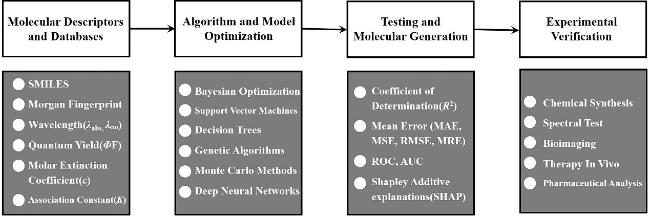
近年来, 人工智能(Artificial Intelligence, AI)与机器学习(Machine Learning, ML)的快速发展为突破传统分子设计瓶颈提供了全新范式. 1991年, Andrea等[1]将ML策略应用于分子构效关系(Quantitative Structure-Activity Relationship, QSAR)研究. 此后, 基于ML的有机分子从头设计(De novo design)算法相继问世[2]. 2010年, ML技术已拓展至荧光分子激发态释能设计及调控领域[3]. 基于ML的荧光分子设计的核心流程包括以下步骤: (1)将荧光分子性质转化为分子描述符以构建数据集; (2)基于目标属性训练模型; (3)模型测试与评估, 生成候选分子结构; (4)进行化学生物实验验证. 与传统方法依赖研究者经验与物化机理不同, ML的优势在于通过大数据驱动揭示复杂构效关系, 显著降低了对先验知识的依赖, 推动了分子设计从“经验驱动”向“数据驱动”的范式转变.
鉴于此, 基于机器学习的分子设计已成为智能化工材料与医学等交叉领域的前沿研究方向. 本文系统综述了ML在有机荧光诊疗分子设计中的研究进展: 阐释分子激发态释能机制及诊疗作用机理; 梳理当前荧光分子设计流程, 并根据不同算法模型详细解析; 进一步地, 结合近期研究, 重点探讨基于激发态能隙、膜通透性、系间窜跃(Intersystem Crossing, ISC)过程等多种诊疗特征属性的ML设计策略; 最后, 针对数据稀缺性、模型泛化能力不足等挑战, 提出未来荧光诊疗分子设计的发展方向.
1 激发态释能和诊疗机理
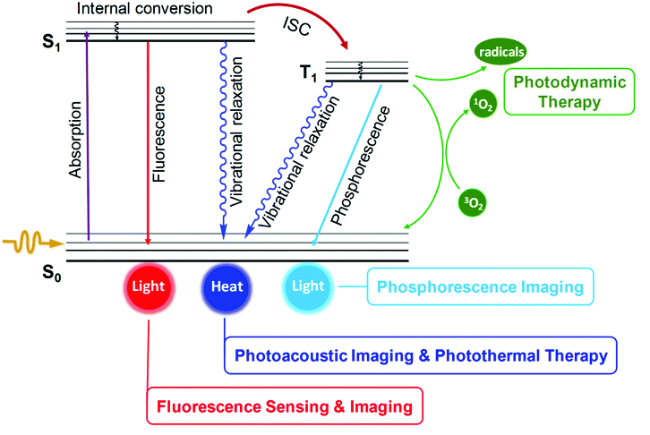
有机荧光分子吸收光子跃迁至激发态(如S1或Sn)后, 其能量通过多种竞争性途径释放, 最终返回基态(S0). 经辐射跃迁返回S0产生荧光; 部分分子到达S1后, 经系间窜跃(Intersystem Crossing, ISC)与内转换(Internal Conversion, IC)过程至长寿命三重态激发T1, 随后辐射跃迁至S0, 产生磷光. 由于荧光/磷光的高分辨率时空响应性, 多种高生物相容性荧光染料广泛应用于生命活动成像与动态追踪领域. 另一方面, 在T1态也会与O2作用产生活性氧(Reactive Oxygen Species, ROS)从而杀伤肿瘤细胞. 其中产生超氧阴离子(•O2-)和羟基自由基(•OH)等过程称为I型机理, 通过氧化损伤杀伤肿瘤细胞. 产生单线态氧(1O2)的过程则被称为II型机理, 直接诱导细胞凋亡. 基于上述机理的光动力治疗(Photody- namic Therapy, PDT)相较于传统放、化疗具有非侵入性、时空可控性, 已成为肿瘤治疗领域的研究热点. 处于激发态的分子还通过振动弛豫(Vibrational Relaxation, VR)或IC等方式回到基态释放热能. 光热疗法(Photothermal Therapy, PTT)利用辐射跃迁诱导肿瘤热消融. 此外, 辐射跃迁释放的组织压力波, 可实现光声成像(Photo- acoustic Imaging, PAI), 从而实现精确诊疗, 基于上述三种激发态释能的诊疗机理如图1所示. 相较于传统材料, 有机荧光分子因代谢可控、毒性低等优势, 在一体化诊疗中展现突出潜力.
2 荧光分子设计模型简介
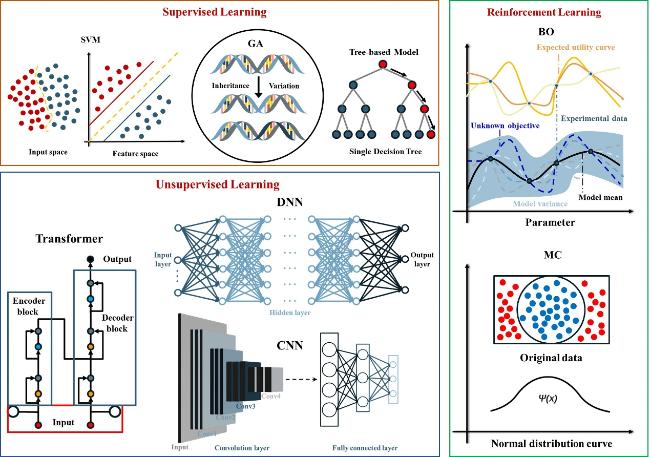
ML算法是模型设计的核心, 目前ML算法可归纳为以下三类: 有监督学习: 依赖标签化数据, 通过输入-输出映射训练模型, 适用于性质预测任务; 无监督学习: 从无标签数据中挖掘潜在模式, 常用于探索未知构效关系; 强化学习: 通过试错机制与动态反馈优化策略, 在分子优化中展现优势. 在有机荧光诊疗分子设计中主要采用的算法如图3所示.
2.1 分子特征描述符
有机结构描述符作为荧光分子性质预测与设计的核心输入, 其标准化应用体系已日趋成熟. 目前主流描述符主要包括以下两类: (1) SMILES (Simplified Molecular Input Line Entry System, SMILES), 由Weininger 等[8]在1988年提出, 采用ASCII字符串编码分子的原子、键序及拓扑结构, 可精准描述有机分子的结构属性, 是应用最广泛的线性表示方法. (2)分子指纹(Molecular Fingerprints)以Morgan指纹最具代表性, 其基于H. L. Morgan (1965)[9]的同名算法, 通过提取原子及其邻域的拓扑特征生成二进制向量, 兼具结构敏感性与计算高效性, 尤其适用于大规模数据集构建.
荧光分子的物理性质描述符作为反应其激发态释能及诊疗应用的本征属性, 其中吸收波长(λabs)和发射波长(λₑₘ)为反应其光学性质的核心参数; 斯托克斯位移 (Δλ=λₑₘ−λₐbₛ)定义为发射与吸收波长之差, 大的斯托克斯位移是降低背景干扰的关键; 荧光量子产率(ΦF)定义为发射量子数与吸收量子数之比, ΦF越大, 荧光效率越高; 摩尔消光系数(ε)表示物质在特定波长下对光的吸收能力, ε越大, 吸光能力越强. 目前多种描述符已与算法深度耦合, 推动分子设计从“试错式”向“数据驱动式”转变.
2.2 基于BO算法的荧光分子设计
贝叶斯优化(Bayesian Optimization, BO)是一种基于贝叶斯定理的全局优化算法, 其核心是通过构建目标函数的概率代理模型(如高斯过程)并动态更新后验分布, 结合获取函数高效定位全局最优解. 该算法在超参数调优及强化学习策略搜索中表现突出.
2.3 基于SVM算法的荧光分子设计
支持向量机(Support Vector Machine, SVM)是一种监督学习算法, 其核心原理是构造最大间隔超平面实现最优分离, 针对线性可分数据采用硬间隔最大化, 而对近似线性可分或非线性数据引入软间隔与松弛变量平衡分类误差与泛化能力, 适用于多种描述符的复杂场 景[14].
2.4 基于树模型的荧光分子设计
决策树(Decision Tree, DT)是一种基于树形结构的监督学习算法, 决策树采用自上而下的树形结构: 根节点表示输入数据, 内部节点表示特征选择与分支, 叶节点输出结果, 形成从根节点到叶节点的决策路径. 单一决策树可能针对个别异常样本生成冗余分支, 误将噪声作为分裂依据导致过拟合, 多种集成学习框架的协作可有效降低过拟合, 基于树模型的各种算法流程如图4所示.
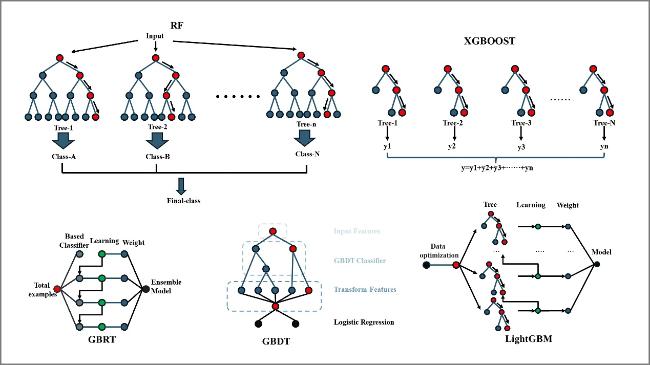
随机森林(Random Forest, RF)通过集成学习策略将大量决策树并行组合以降低过拟合风险. 其构建过程包含双重随机性[15]: (1)通过自助采样法(Bootstrap)为每棵树提供差异化训练数据; (2)在节点分裂时随机选取特征子集进行信息增益评估, 确保子树多样性. Chen等[18]首次建立了基于RF算法预测荧光分子λabs/λem的模型 (R2=0.979). Kang等[19]建立起预测荧光染料的振子强度(Oscillator Strength, f)与激发能量(Excitation Energy, ∆E)的RF模型. Ksenofontov团队[20]基于超过20000个分子的数据集, 使用变体RF算法高准确性地预测了吖啶、蒽醌、二芳基甲烷和二吡咯烷染料的摩尔吸光系数. 此外, RF算法还广泛应用于荧光图像领域如细胞荧光图像识别[21]、荧光信息的后处理[22⇓-24]、X射线荧光数据处理[25-26]等多个方面.
梯度提升回归树(Gradient Boosting Regression Tree, GBRT)为Boosting框架与决策树结合的集成学习算法. 其核心为通过限制树深度与学习率调节过拟合问题[27]. XGBoost (eXtreme Gradient Boosting)在上述算法基础上引入二阶泰勒展开, 更好地优化了过拟合问题. 而LightGBM (Light Gradient Boosting Machine)则针对XG- Boost的计算瓶颈, 增加基于梯度单侧采样(Gradient- based One-Side Sampling, GOSS)与互斥特征捆绑(Exc- lusive Feature Bundling, EFB)函数, 通过减少叶片复杂度实现模型的快速化预测.
卢文聪等[28]使用XGBoost算法建立起预测偶氮染料最大吸收波长的模型, 在模型新生成的19096个新分子中寻找到26个吸收波长大于610 nm的荧光分子. Ju等[29]使用GBRT与LightGBM模型成功预测了部分荧光染料的激发波长与量子产率(R2=0.891, MAE=0.080 eV). Zhao等[30]使用LightGBM算法基于包含6064个荧光分子结构的15987个斯托克斯位移值的数据集构建模型, 设计并合成了具有大斯托克斯位移值(183 nm)的荧光分子PXZ-F. Li等[31]使用GBRT算法基于564个热激活延迟荧光(Thermally Activated Delayed Fluorescence, TADF)分子数据集成功预测其ISC/RISC速率. 综上, 经改进后的树模型算法GBRT、XGBoost、LightGBM因其更好的过拟合限制与分子预测速度广泛应用于大数据库中.
2.5 基于GA算法的荧光分子设计
遗传算法(Genetic Algorithm, GA)是一种基于进化论的启发式全局优化算法, 其核心机制模拟了自然选择、遗传变异与突变等进化过程, 通过交叉和变异生成新个体探索解空间, 逐步优化候选解.
Caruso等[32]在合成BODIPY分子后使用GA算法进行荧光染料的性质分析. Wang等[33]使用GA模型设计出了新型TADF分子. Jensen[34]和Brown[35]开发了一种方法图引导遗传算法(Graph-Based Genetic Algorithm, GB-GA), 通过融合蒙特卡洛树搜索(Monte Carlo Tree Search, MCTS), 对图表示的分子进行交叉和重组, 用于荧光分子设计. Moon等[36]将GPR和GB-GA结合起来进行近红外D-荧光素类似物设计. 这些研究表明了GA算法在分子设计中的应用的显著优势, 能够有效提高分子设计的效率和准确性.
2.6 基于蒙特卡洛方法的荧光分子设计
蒙特卡洛方法(Monte Carlo Method, MC)是一种基于概率的无监督学习算法, 其核心在于无需预定义目标函数, 而是通过生成服从概率分布的随机样本, 利用大数定律渐进逼近目标量, 尤其擅长解决数据稀缺的情况.
单分子FRET (Single-molecule Fluorescence Resonance Energy Transfer, smFRET)通过将供体与受体荧光探针特异性标记于单个生物大分子位点, 实时监测转移效率、位置、构象变化等信息. Trusova团队[37]基于该技术与蒙特卡洛算法, 建立了膜蛋白动态行为的定量解析模型. 该研究采用苯并蒽衍生物ABM作为供体荧光团、方酰亚胺染料SQ-1作为受体, 通过特异性标记策略将受、供体对精准锚定于膜界面, 成功解析了蛋白质-脂质相互作用与多肽构象、脂质分布等动态过程. Ingargiola团队[38]开发的蒙特卡洛扩散增强光子推断(Monte Carlo Diffusion-Enhanced Photon Inference, MC-DEPI)算法, 通过动态重标定FRET光子时序信息实现了单分子荧光数据的超高精度解析, 拓展了算法在荧光数据解析领域的应用.
2.7 基于DNN算法的荧光分子设计
深度神经网络(Deep Neural Networks, DNN)是近年来发展最迅速, 拟合效果最优异的热门算法之一, 通常包含输入层及多个隐藏层, 从而实现多重复杂特征的学习. 相较于传统算法, DNN的核心优势在于其能够直接处理原始数据, 显著减少了对特征描述符转化的依赖[39].
DNN起源于隐藏层是单层的ANN (Artificial Neural Network), 1997年, Baskin等[40]率先利用ANN成功预测了乙醇中花菁染料的吸收波长, 是最早在荧光分子设计领域引入机器学习算法的研究. 针对BODIPY染料, Shao、Lim等[41-42]通过DNN预测了荧光分子的吸收波长与RISC速率, 相关性高于传统算法. 此外, DNN还被广泛应用于多种荧光分子新描述符分析. Ghosh等[43]依据GA、循环神经网络(Recurrent Neural Network, RNN)、DNN等多种算法进行了分子描述符完善从而完成了对分子的“进化设计”. 在该模型中, DNN识别结构与材料属性之间的关系, 而RNN则从隐藏的构效关系中数据化可识别的分子结构以便后续分析.
3 基于多种构效关系的荧光成像及诊疗分子设计
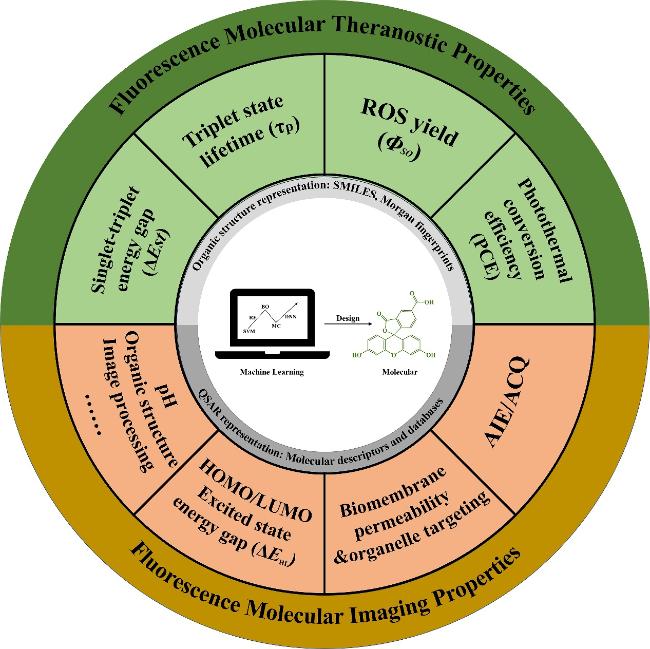
当前, 随着荧光诊疗分子种类的快速扩充, 其设计目标已从基础成像与治疗转向高精细化、高特异性及诊疗一体化的多维需求. 相较于传统依赖试错实验与经验的分子设计范式, 基于ML的数据驱动策略展现出显著优势: 通过挖掘分子描述符与目标特性间的非线性关联, ML可直接构建“结构-性能”映射模型, 如图5所示, 规避对复杂物化机理的先验依赖, 从而高效设计出具有特异成像功能与诊疗属性的新型有机荧光分子.


3.1 基于膜通透性的荧光成像分子设计
细胞膜作为细胞内外环境的分隔屏障, 在信号传导与离子稳态维持中发挥核心作用[46]. 其功能异常与多种疾病如癌症、神经退行性疾病密切相关, 开发特异性膜荧光探针对于揭示膜动态行为至关重要. 传统探针设计依赖分子与脂质、膜蛋白及糖类的相互作用研究, 需通过大量试错实验优化亲脂性、电荷分布等参数, 耗时且效率低下. 基于ML的分子设计通过量化膜通透性描述符(log P等), 可显著提升探针开发效率与准确性.
辛醇-水分配系数对数与分配系数等(log P、log D)是评估分子跨膜能力的重要指标, Lipinski规则建议理想膜探针的Log P范围为-0.5至5[47]. Nina、Kim等[48-49]基于深度消息传递神经网络(D-MPNN)构建了log P与log D的联合预测模型, 为荧光分子的亲脂性优化提供了新工具. 目前, 多种基于传统算法的log P计算模型(miLog P、cLog P、iLOG P等)被用于有机分子膜通透性计算[50⇓⇓-53]. Soliman等[54]则基于DNN算法开发了新的DeepFI-Log P计算模型(R2=0. 892). 他们的研究认为膜通透性探针的log P值(≥1)远大于非通透性探针(<1), 为膜通透性的研究提供了新思路. Alamudi等[55]针对BODIPY类探针构建起用于活细胞成像荧光分子的预测模型. 基于高通量筛选(High-Throughput Screening, HTS)他们认为理想的细胞成像荧光分子应具有足够亲脂性(Slog P=1~4), 表面带适度负电荷(Q_VSA_FNEG=0.15~0.35)和良好的水溶性(log S=-2~6). 随后在该模型指导下合成了细胞荧光成像分子CO-1和AzG-1显著降低了无铜离子点击化学(Strain-promoted Azide- alkyne Cycloaddition, SPAAC)探针的非特异性结合, 细胞内蛋白标记的特异性证明了模型的可靠.
通过观察靶向到各种内部细胞器的荧光分子可以推动各类疾病发展的特定关键分子的可视化跟踪研究. 由于各种细胞器膜通透性存在差异, 探针的细胞器靶向高度依赖其与器膜的相互作用机制. 通过ML算法预测探针的靶向能力能够促进特异性靶向探针分类与开发, 缩短设计周期. Park等[56]提出了一种基于多种ML算法的荧光分子细胞器靶向预测模型, 该模型可以预测荧光染料的8个靶向位点分布(胞质溶胶、内质网、高尔基体、脂滴、溶酶体、线粒体、细胞核和质膜). 他们通过350个分子的有机结构的786个pKa, log D等关键描述符以75%的成功率预测了这些荧光探针的靶向细胞器. Dong等[57]提出了一种多层次预测框架以进行线粒体靶向荧光探针的设计. 具体来说, 他们构建了四个层次的预测模型: B-PvsC模型用于区分线粒体探针和普通化合物, B-MvsP模型区分靶向不同亚细胞器的探针, M-PvsP模型预测探针的具体靶向器官, B-McoL模型则评估探针的共定位效果. 随后, 基于此策略筛选出的3个最佳分子(P1-ALP、P2-VIS、P3-ROS)被合成并证实靶向线粒体, 分别可用于检测ALP、线粒体粘度和ROS. Yang 等[58]通过整合合成实验, 高通量筛选与ML算法建立了一种细胞器靶向分子的筛选策略. 具体来说, 1536种三嗪衍生物荧光分子被合成, 并经过高通量筛选评估它们的活细胞靶向能力. 随后基于上述分子的数据库构建靶向内质网分子的构效关系模型, 预测准确率高达84%.
3.2 基于聚集诱导发光机理(AIE)的荧光成像分子设计
聚集诱导发光(Aggregation-Induced Emission, AIE)是一种分子在聚集状态下荧光显著增强的现象. 与传统荧光分子在聚集态发生猝灭(Aggregation-Caused Quenching, ACQ)的特性相反, AIE发光体(AIEgens)在生物成像与光热治疗中展现出独特优势[59]. 早期研究证实, 具有分子内可旋转结构如四苯乙烯(TPE)、四苯基硅醇(TPS)的AIEgens可通过聚集态下的运动受限机制(Restricted Intramolecular Motion, RIM)抑制非辐射跃迁, 从而增强辐射发光[60-61]. 然而, 随着更多机理不明的AIEgens被报道, ML通过数据驱动的“黑箱”模式, 绕开复杂机理解析, 直接建立分子特征与AIE活性间的关联, 成为AIEgens理性设计的新范式[62⇓-64].
张衿潇等[65]采用多种ML算法, 成功预测带有转动结构AIEgens的量子产率与吸收/发射波长(R²=0.91). 王笑楠等[66]进一步突破结构限制, 基于356个AIE/ACQ分子的多维描述符如拓扑极性表面积、偶极矩等, 构建了普适性AIE特性分类模型, 并指导了三种新型AIEgens的合成. 朱维等[67]整合1245个AIEgens的结构、溶剂化参数及光谱数据, 建立起预测框架. 相较于含时密度泛函理论(Time-dependent Density Functional Theory, TD-DFT), ML模型的计算速度提升300倍以上, 且预测误差降低20%. 基于模型筛选的AIEgens经纳米封装后, 成功实现溶酶体靶向成像.
ML算法与量子化学、分子力学等经典计算化学理论的结合也成为AIEgens构效关系预测与分子设计的新方向. 秦安军等[68]结合量子化学计算与SVM, 提出扭曲分子内电荷转移(Twisted Intramolecular Charge Transfer, TICT)是AIE活性的关键机制, 并发现分子局部偶极矩如三苯胺(TPA)核心可有效调控AIE强度. 李竞白等[69]则联合DNN算法与分子激发态动力学提出了AIEgens聚集状态下非辐射跃迁被抑制诱导发光的新机制. 作者揭示了六苯基噻咯(HPS)的AIE活性源于聚集态对C=C键扭转的抑制, 而缺乏外侧苯环支链的结构类似物如四苯基噻咯(TPS)、环辛四噻吩(COTh)由于无法抑制非辐射跃迁导致荧光猝灭. 该研究认为引入更多的苯环等具有大π-π共轭的基团可能促进分子AIE活性的提高, 为新型AIEgens设计提供了思路.
3.3 基于激发态能隙与pH的近红外荧光成像分子设计
近红外荧光分子(650~950 nm)因其深层组织穿透能力, 在生物诊疗中具有重要价值. 根据分子轨道理论, 其吸收能量由HOMO-LUMO能隙(ΔEHL)决定, 较小的ΔEHL (<2.0 eV)是实现近红外响应的关键. 然而, 低能隙通常导致分子骨架柔性增加, 易受生物环境干扰. 为此, ML通过建立ΔEHL与分子骨架稳定性的映射关系, 成为优化近红外染料的新策略. Choi等[70]使用图形卷积神经网络(Graph Convolutional Neural Networks, GCNN)预测了多种分子的ΔEHL, 相较传统算法快了4.2倍. Zheng等[71]基于极端随机树回归(Extra Trees Regressor, ETR)算法建立起近红外荧光分子结构与ΔEHL的相关性模型(R2=0.93). Dhakal等[72]基于XGBoost模型, 以多种有机结构描述符预测了咪唑分子衍生物的ΔEHL, 具有较高的准确性(MAE=0.2~0.4 eV).
氧杂蒽类近红外荧光染料包含荧光素类、罗丹明类等, 因其优异的生物相容性、低毒性、可调水溶性与亲脂性, 被广泛用于生物荧光成像领域. 通过ML算法构建结构修饰模型如引入磺酸基、硅烷基, 可进一步优化其光学特性与靶向能力. Wang等[73]基于注意力循环神经网络算法(Attention-based Recurrent Neural Network, ATTRNN)与TD-DFT精准预测了该类染料的激发波长, 并据此合成了硫化氢与半胱氨酸特异性成像探针. 氧杂蒽染料的荧光开关行为受环境pH调控, 其分子在闭环(荧光关闭)与开环(荧光开启)状态间转换. 因此, 研究该类分子在开/闭环时的pH即pKcycl成为设计特异性成像染料的关键. 李坤等[74]基于ML算法设计出一例具有癌细胞(pH=3.8~4.7)靶向能力的Si-Rhodamine探针. 研究者们首先构建了一个包含113种Si-Rhodamine探针的有机结构及pKcycl数据库, 随后使用多种ML算法构建起pKcycl的预测模型(R2=0.7984). 最后作者成功预测并合成了两种探针SiR-pH (pKcycl=3.95)和SiR-IapH (pKcycl=4.10)应用于肿瘤成像.
3.4 基于ISC过程的荧光诊疗分子设计
多数有机荧光分子的诊疗功能与其ISC过程相关, 通过重原子效应、D-A分子结构设计等传统手段可增大分子的ISC效率, 延长三重态寿命, 从而提高光敏剂等分子的诊疗功能. 基于ML的设计模型能够直接建立相关构效关系, 从而精准提高分子的诊疗功能, 缩短设计周期.
光敏剂(Photosensitizer, PS)是PDT治疗的核心, 其治疗效率与分子的系间窜跃速率(kISC)与单线态氧量子产率(ΦSO)极为相关. ML算法通过关联ΔEst与光物理性质, 大幅提升PS设计及治疗效率. 王笑楠等[10]基于BO算法建立起一种光敏剂发现的模型, 以ΔEst为核心稳定性指标进行全局优化. 首先由分子生成算法生成了14164个有机荧光分子, 接着采用DFT计算ΔEst形成大的数据库. 随后进行多轮BO迭代筛选, 以ΔEst<0.2 eV为阈值, 筛选出2479个分子高性能光敏剂. 最后合成了其中4种分子进行验证, 系间窜跃效率>90%, 光稳定性>500 h. 刘旭杰等[75]建立模型结合结构、溶剂、波长等多种描述符揭示C=S双键与碘取代基对ΦSO的显著影响, 指导了高效II型光敏剂合成.
TADF材料因其理论上100%的荧光量子产率在生物成像、光催化、OLED等领域的应用备受关注[76]. TADF材料通过反向系间窜跃(Reverse Intersystem Crossing, RISC)实现高荧光量子产率, 其设计需平衡ΔEst与热稳定性. 本课题组[77]基于ML算法建立了一个TADF分子热稳定性筛选模型. 该模型以热分解温度为筛选条件, 从2533个荧光分子数据集中筛选出16个新TADF分子, 其中包含3个已被报道的高性能TADF分子, 为TADF分子的热稳定性优化提供了新的思路. 陈润锋等[31]基于ML算法, 以564个TADF分子的多种激发态能隙作为描述符, 构建了一个ISC/RISC速率的预测模型, 并从中筛选出9个具有快速ISC/RISC过程 (kISC>7×10⁷ s-1, kRISC>2×10⁵ s-1)的TADF分子, 为设计高动力学性能的TADF材料提供了重要参考. Shi 等[78]建立起一个基于变分自编码器(Variational Autoencoder, VAE)算法的TADF分子生成及PLQY预测筛选模型, 成功迭代出新型高性能TADF分子.
有机室温磷光(Room Temperature Phosphorescence, RTP)材料因其长寿命发光(μs-s级)备受关注[2]. 其性能与ΔEst密切相关, 较小的ΔEst可延长三重态寿命(τp), 并增强磷光效率(Φp). ML算法在将ΔEst与分子结构相关联过程中发挥着重要作用. Sifain等[79]开发了一个基于层次交互粒子神经网络(Hierarchically Interacting Particle Neural Network, HIPNN)预测荧光分子ΔEst的模型, 相较于量子计算方法缩短了设计进程约60%. Yam等[80]基于集成学习方法进行了磷光铂(II)配合物光物理性质预测. Mao等[81]将ML算法与前线分子轨道(Frontier Molecular Orbital, FMO)描述符结合, 从19295个分子的数据库中筛选出287个既具有长寿命(τp>100 μs)又具有高效率Φp (>30%)的候选分子. 随后两种新型RTP材料的发现证明了该模型的可靠性. Permatasari等[82]的工作则通过ML模型预测了具有RTP的多种碳量子点的τp.
3.5 基于其他性质的荧光诊疗分子设计
PTT是一种基于光热剂(Photothermal Agent, PTA)非辐射跃迁的肿瘤热消融策略, 其疗效核心取决于光热转换效率(Photothermal Conversion Efficiency, PCE). ML通过高通量筛选加速了高性能PTA的开发. 刘旭杰 等[83]整合多个PTA的分子描述符, 构建起PCE预测模型(R²=0.761), 但由于训练集仅含200个分子, 模型泛化能力受限. 此外, 金属酚醛网络(Metal-Phenolic Network, MPN)近期被发现具有优异的光热性能, 陈陶团 队[84]基于多种ML算法研发了一个用于MPN光热性能预测的模型, 成功依据温度分类在4万多种MPN材料中预测出1654种高光热MPN材料.
随着医学诊疗手段的增加, 荧光图像处理在手术导航, 治疗辅助监控, 药物递送等领域显得极为重要. ML在荧光图像处理中也发挥着重大作用. Kim等[85]在ML算法的辅助下实现了35种环境中不同挥发性有机物的实时荧光检测, 准确率高达97%; Zeune等[86]基于DL算法以超过96%的准确率实现了血液循环肿瘤细胞(Circulating Tumor Cell, CTC)的荧光图像识别, 其速度远超手动计数法; Copp等[87]通过模式识别荧光信号提高了选择稳定荧光银团簇的DNA模板的概率; Wong 等[88]通过荧光显微镜图像的学习进行阿尔茨海默症治疗药物筛选随着传统ML算法的不断完善与精细化, 新算法的不断开发, 生物荧光图像处理将会朝着低噪声高诊断率, 智能诊疗一体化发展.
4 总结与展望
基于上述构效关系的荧光诊疗分子设计策略总结在表1 中.本文详细阐述了基于ML算法诊疗分子设计流程、多种算法的设计原理以及基于多种构效关系的荧光分子设计策略. 通过数据驱动策略与构效关系研究, ML将分子结构、激发态释能过程与诊疗功能直接关联, 不仅大幅缩短了开发周期, 还突破了人类经验的局限性, 实现了多维度的分子性能优化, 证明了ML在荧光成像及诊疗分子设计中展现出的显著优势. 此外, ML与量子化学、分子动力学等传统计算化学的联合分析, 为解析复杂光物理机制提供了新工具. 然而, ML驱动的荧光分子设计仍面临以下核心挑战, 应在未来发展过程中予以解决.
表1 基于ML与多种构效关系的荧光诊疗分子设计Table 1 Molecular design of fluorescent theranostic molecules based on ML with QSAR |
| Structure-function relationship | Material category | Theranostic Attribute | Algorithm | Advantage |
|---|---|---|---|---|
| Membrane perme- ability descriptor | BODIPY, etc. | Bioimaging | D-MPNN, DNN, B-PvsC, HTS, etc. | Increase of membrane permeability and biocompatibility |
| AIE/ACQ | Molecules with extended conjugation | Bioimaging, theranostic of multiple diseases | SVM, DNN, TD-DFT, etc. | Acceleration of the molecule discovery cycle, proposal of new mechanisms |
| ΔEHL | Near-infrared fluore- scent molecules | Deep-tissue bioimaging | GCNN, ETR, XGBoost, etc. | Increase of molecular backbone stability |
| pH | Oxazene, etc. | Deep-tissue bioimaging | ATTRNN, TD-DFT, etc. | PH-regulated fluorescence switching, disease-specific imaging |
| ISC | PS, TADF, RTP, etc. | PDT, Bioimaging | BO, VAE, HIPNN, etc. | Prolongation of material triplet-state lifetime, acceleration of materials discovery, Enhancement of precision theranostic performance |
| PTT | PTA, etc. | PTT, PAI | RF, GAN, GA, etc. | Reduction of the photothermal agent deve- lopment cycle, increase of photothermal efficiency |
数据库标准化: 现有荧光分子数据库规模有限, 且描述符体系尚未统一, 导致模型泛化能力受限. 统计并建立相对完善的多种统一化、标准化描述符的荧光分子数据库是分子设计的重点. 算法适配与革新: 传统ML算法多针对通用数据科学问题, 缺乏对光物理机制的针对性建模. 开发融合激发态理论的专用算法、探索生成式AI在分子逆向设计中的潜力, 将成为重要方向. 多问题模型整合: 现有研究多聚焦荧光分子的单一问题, 缺乏系统性设计框架. 因此, 构建连贯性多任务学习模型, 建立一个模型解决多个实际问题应成为未来发展方向. 实验验证与可靠性: 模型的提出势必伴随着其预测分子的生物实验可靠性, 应将该项作为分子设计的起点, 提高诊疗问题研究的真实性.
(Cheng, F.)