



1 Introduction
Aldehydes serve as pivotal intermediates with broad applications in pharmaceutical synthesis, fragrance production, and the development of functional materials.[1] Owing to the high chemical reactivity of the aldehyde group (CHO), they readily undergo various transformations, including nucleophilic additions, condensations, and redox reactions, making them essential building blocks for constructing functionalized organic frameworks.[2] As a result, the efficient and selective synthesis of aldehyde groups has attracted sustained attention from both academia and industry. Since its initial report in 1918, the Rosenmund reduction (Scheme 1a) has been widely employed for the selective conversion of acyl chlorides to aldehydes.[3] However, this classical method presents several practical limitations: it requires flammable and explosive hydrogen gas as the reducing agent, necessitates catalyst activity regulation through organic poisons, and demands strict temperature control.[3a] These constraints significantly limit its applicability in modern laboratory and industrial settings. In this context, alternative reduction strategies (Scheme 1b) using reagents, such as aluminum hydrides,[4] HSnBu3,[5] sodium borohydride[6] and HSiR3[7] have been developed for the conversion of acyl chlorides to aldehydes. However, these methods often suffer from over- reduction to alcohols, limited substrate scope, low yields, and poor functional group tolerance. In addition, the use of tributyltin hydride raises toxicity and environmental concerns. Thus, the development of efficient, operationally simple, functionally tolerant, and low-toxicity strategies for the selective reduction of acyl chlorides to aldehydes remains a central challenge in contemporary organic synthesis.
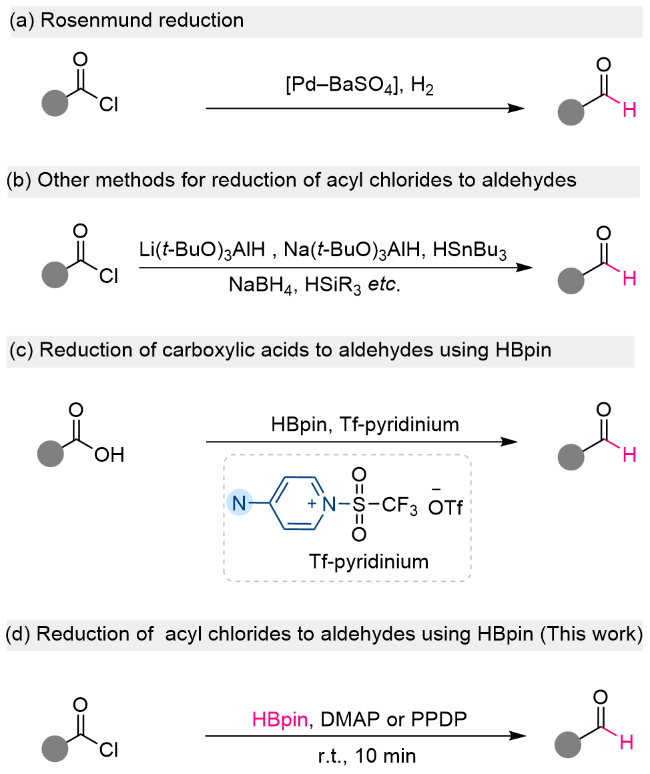
The organoboron reagent HBpin offers significant advantages in selective reduction reactions due to its low toxicity, excellent thermal stability, and operational convenience.[8] Recently, our group reported a method that utilizes HBpin as a reductant for the rapid, modular, and scalable controlled reduction of carboxylic acids activated via Tf-pyridinium to aldehydes (Scheme 1c).[9] Based on our previous work, we have now applied the HBpin-me- diated aldehyde synthesis strategy to achieve the precise reductive transformation of acyl chlorides (Scheme 1d). Under room temperature and atmospheric pressure, HBpin efficiently promotes the conversion of acyl chlorides to the desired aldehydes within short reaction times, achieving excellent yields. This method exhibits high selectivity and broad substrate compatibility, including compatibility with readily reducible functional groups such as cyano, alkenes, ketones, and esters.
2 Results and discussion
To assess the feasibility of the reaction, benzoyl chloride was used as the starting substrate under room temperature, with 1.0 equiv. of HBpin as the reductant (Table 1). However, the reaction results showed that no target product was generated (Table 1, Entry 1), suggesting that HBpin has limited reducing capacity and is unable to directly reduce acyl chlorides. Previous studies have shown that the hydrogen transfer capability of HBpin can be enhanced in the presence of a base, thereby increasing its reducing efficiency.[10] Consequently, 4-dimethylaminopyridine (DM- AP) was introduced into the reaction system as a base. Notably, the addition of just 0.5 equiv. of DMAP resulted in a 24% yield (Table 1, Entry 2). Incrementally increasing the DMAP loading from 0.5 equiv. to 2.0 equiv. (Table 1, Entries 2~5) led to a maximum aldehyde gas chromatography (GC) yield of 96% (85% isolated yield). Further increasing the DMAP amount slightly decreased the yield. Based on previously reported studies,[9,11] we propose that the reaction proceeds via a mechanism similar to that of our previously reported reduction of carboxylic acids to aldehydes, in which the activated HBpin reduces the in situ generated acyl-DMAP intermediate to the corresponding aldehyde.[9]
Table 1 Optimization of the reaction conditionsa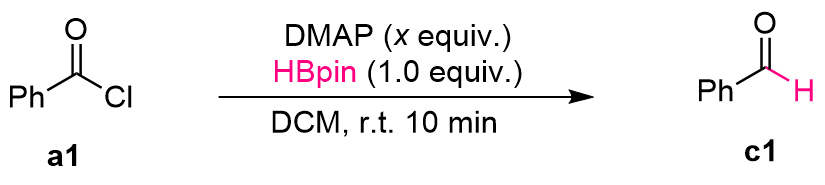 |
| Entry | x | Yieldb/% |
|---|---|---|
| 1 | 0.0 | N.D. |
| 2 | 0.5 | 24 |
| 3 | 1.0 | 41 |
| 4 | 1.5 | 93 |
| 5 | 2.0 | 96 |
| 6 | 2.2 | 93 |
| 7 | 2.5 | 94 |
a Reactions conditions: a1 (1.0 mmol, 1.0 equiv.), DMAP (x equiv.), HBpin (1.0 mmol, 1.0 equiv.). b The yields were determined by GC analysis using naphthalene as the internal standard. |
Under the optimized conditions, the reduction of various acyl chlorides to aldehydes was evaluated (Scheme 2). 2-Naphthoyl chloride afforded the corresponding aldehyde (c2) in 87% yield. 4-Methoxybenzoyl chloride containing an electron-donating group produced the desired product (c3) in 88% yield. Electron-withdrawing groups, such as cyano, ester, and acetyl groups were well tolerated, delivering the corresponding aldehydes in 51% (c4), 87% (c5), and 70% (c6) yields, respectively. 4-tert-Butylbenzoyl chloride afforded the target aldehyde (c7) in 86% yield. Aryl chlorides and alkenyl groups were also compatible under the reaction conditions, and provided the desired products in 86% (c8) and 75% (c9) yields, respectively. Additionally, aliphatic phenylpropionyl chloride yielded the corresponding aldehyde in 50% (c10) yield. For substrates, bearing ortho- and meta-substituents (c11 and c12), the isolated yields were nearly identical to this para-substi- tuted substrate (c13), indicating that steric hindrance at the ortho- and meta-positions exerts only a minor influence on the reaction outcome.
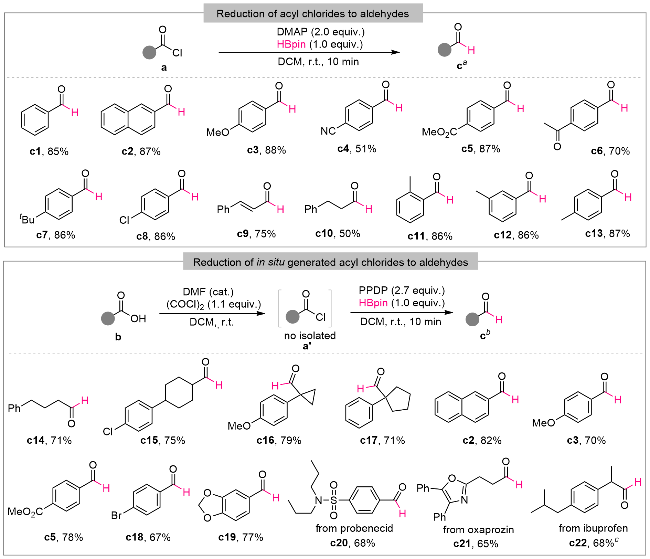
Scheme 2 Substrate scopea Reaction conditions: a (1.0 mmol, 1.0 equiv.), DMAP (2.0 mmol, 2.0 equiv.), HBpin (1.0 mmol, 1.0 equiv.), yields are based on isolated products. b Reaction conditions: b (1.0 mmol, 1.0 equiv.), N,N-dimethylformamide (DMF) (cat. 2 drops), (COCl)2 (1.1 mmol, 1.1 equiv.), 4-(piperidin-1-yl)pyridine (PPDP) (2.7 mmol, 2.7 equiv.), HBpin (1.0 mmol, 1.0 equiv.), yields are based on isolated products. c Reaction conditions: b (0.5 mmol, 1.0 equiv.), yields are based on isolated products. |
The subsequent investigation focused on the one-pot reduction of in situ generated acyl chlorides to aldehydes (Scheme 2). Notably, replacing DMAP with the more soluble 4-(piperidin-1-yl)pyridine (PPDP) enabled in situ ge-nerated acyl chlorides bearing α-primary, secondary, and tertiary substituents to be efficiently converted into the corresponding aldehydes (c14~c17) in good yields. The reaction demonstrated good functional group tolerance, accommodating neutral (c2), electron-rich (c3, c19), and electron-deficient (c5) aryl groups, as well as aryl bromides (c18), with good to excellent isolated yields. We performed derivatization of drug molecules and the derivatization of drug molecules efficiently converted them into the corresponding aldehydes (c20~c22).
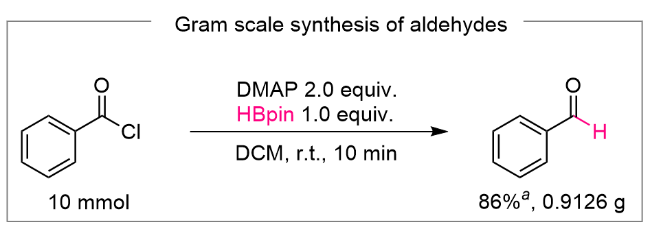
To further demonstrate the potential of HBpin for the reduction of acyl chlorides to aldehydes, the gram-scale synthesis of aldehydes was performed (Scheme 3). Benzoyl chloride afforded 0.9126 g of product in 86% isolated yield.


3 Conclusions
In conclusion, we have developed a method that utilizes HBpin as a reducing agent for the rapid conversion of acyl chlorides to aldehydes. Substrates with diverse functional groups were efficiently converted into the corresponding aldehydes under room temperature and atmospheric pressure. This method was characterized by mild reaction conditions, excellent selectivity, broad functional group compatibility, rapid conversion, and operational simplicity, and it was suitable for gram-scale synthesis. Additionally, HBpin is commercially available in bulk, non-toxic, and environmentally friendly. This method provides a convenient new pathway for the synthesis of aldehydes, significantly improving the efficiency of aldehyde preparation.
4 Experimental section
4.1 General information
All glassware was oven dried at 110 ℃ for hours and cooled down under vacuum. Unless otherwise noted, materials were obtained from commercial suppliers and used without further purification. Thin layer chromatography (TLC) employed glass 0.25 mm silica gel plates. Flash chromatography columns were packed with 100~200 mesh silica gel or through SepaBeamTM Machine SPB- 3006012. Gas chromatographic analysis was performed on GC-2010 Plus gas chromatography instrument with an FID detector. GC-MS spectra were recorded on a GCMS- QP2010 SE. NMR spectra were recorded on a 400 MHz for 1H NMR and 101 MHz for 13C NMR, using tetramethylsilane as an internal reference and CDCl3 as the solvent. Chemical shift values for protons are reported downfield from tetramethylsilane and are referenced to residual proton of tetramethylsilane (TMS) (δ 0.00). Chemical shifts for carbons are reported downfield from tetramethylsilane and are referenced to the carbon resonance of CDCl3 (δ 77.0).
4.2 General procedure for the reduction of acyl chlorides to aldehydes (GPA)
To a 20 mL reaction tube equipped with a magnetic stirring bar, DMAP (2.0 equiv.), CH2Cl2 (3.0~6.0 mL) and acyl chlorides (1.0 mmol, 1.0 equiv.) were added under air, and the reaction mixture was stirred for 3 min. Then the HBpin (1.0 equiv.) was added to the reaction mixture. After the reaction was stirred for 10 min, the crude mixture was quenched by H2O and extracted by CH2Cl2 (3.0 mL×3). The combined organic layers were dried over anhydrous Na2SO4. After the solvent was removed under reduced pressure, the resulting residue was purified by flash column chromatography on silica gel and eluted with petroleum ether/ethyl acetate to afford the desired aldehydes.
4.3 General procedure for the reduction of in situ generated acyl chlorides to aldehydes (GPB)
To a 25 mL Schlenk tube equipped with a magnetic stirring bar, carboxylic acid (0.5~1.0 mmol, 1.0 equiv.), CH2Cl2 (2.0 mL), DMF (2 drops) and (COCl)2 (1.1 equiv.) were added under a dry nitrogen atmosphere. After stirring at room temperature for 5~12 h, CH2Cl2 (4.0 mL) and PPDP (2.7 equiv.) were added under air, and the reaction mixture was stirred for 3 min. Then the HBpin (1.0 equiv.) was added to the reaction mixture. After the reaction was stirred for 10 min, the crude mixture was quenched by H2O and extracted by CH2Cl2 (3.0 mL×3). The combined organic layers were dried over anhydrous Na2SO4. After the solvent was removed under reduced pressure, the resulting residue was purified by flash column chromatography on silica gel and eluted with petroleum ether/ethyl acetate to afford the desired aldehydes.
4.4 General procedure for the gram-scale experiments
To a 100 mL reaction tube equipped with a magnetic stirring bar, DMAP (2.0 equiv.), CH2Cl2 (30 mL) and acyl chlorides (10 mmol, 1.0 equiv.) were added under air, and the reaction mixture was stirred for 3 min. Then the HBpin (1.0 equiv.) was added to the reaction mixture. After the reaction was stirred for 10 min, the crude mixture was quenched by H2O and extracted by CH2Cl2 (30 mL×3). The combined organic layers were dried over anhydrous Na2SO4. After the solvent was removed under reduced pressure, the resulting residue was purified by flash column chromatography on silica gel and eluted with petroleum ether/ethyl acetate to afford the desired aldehydes.
4.5 Characterization data
Benzaldehyde[12] (c1): Following GPA for aldehyde synthesis, colorless oil was obtained with 85% isolated yield, 90.1 mg. 1H NMR (400 MHz, CDCl3) δ: 10.02 (s, 1H), 7.90~7.87 (m, 2H), 7.66~7.61 (m, 1H), 7.55~7.52 (m, 2H); 13C NMR (101 MHz, CDCl3) δ: 192.3, 136.4, 134.4, 129.7, 129.0.
2-Naphthaldehyde[13] (c2): Following general procedure for aldehyde synthesis, white solid was obtained with GP A: 135.8 mg, 87% isolated yield; GPB: 128.1 mg, 82% isolated yield. m.p. 61~63 ℃; 1H NMR (400 MHz, CDCl3) δ: 10.15 (s, 1H), 8.33 (s, 1H), 8.01~7.89 (m, 4H), 7.66~7.57 (m, 2H); 13C NMR (101 MHz, CDCl3) δ: 192.3, 136.4, 134.6, 134.0, 132.6, 129.5, 129.0(9), 129.0 (6), 128.0, 127.1, 122.7.
4-Methoxybenzaldehyde[14] (c3): Following general procedure for aldehyde synthesis, colorless oil was obtained with GPA: 119.8 mg, 88% isolated yield; GPB: 95.3 mg, 70% isolated yield. 1H NMR (400 MHz, CDCl3) δ: 9.89 (s, 1H), 7.86~7.82 (m, 2H), 7.02~6.99 (m, 2H), 3.89 (s, 3H); 13C NMR (101 MHz, CDCl3) δ: 190.8, 164.6, 131.9, 129.9, 114.3, 55.5.
4-Formylbenzonitrile[12] (c4): Following GPA for aldehyde synthesis, white solid was obtained with 51% isolated yield, 66.9 mg. m.p. 93~94 ℃; 1H NMR (400 MHz, CDCl3) δ: 10.10 (s, 1H), 8.01~7.99 (m, 2H), 7.87~7.85 (m, 2H); 13C NMR (101 MHz, CDCl3) δ: 190.6, 138.7, 132.9, 129.9, 117.7, 117.6.
Methyl 4-formylbenzoate[15] (c5): Following general procedure for aldehyde synthesis, white solid was obtained with GPA: 142.8 mg, 87% isolated yield; GPB: 128.0 mg, 78% isolated yield. m.p. 58~60 ℃; 1H NMR (400 MHz, CDCl3) δ: 10.11 (s, 1H), 8.21~8.20 (m, 2H), 7.97~7.95 (m, 2H), 3.97 (s, 3H); 13C NMR (101 MHz, CDCl3) δ: 191.6, 166.0, 139.1, 135.1, 130.2, 129.5, 52.6.
4-Acetylbenzaldehyde[16] (c6): Following GPA for aldehyde synthesis, colorless oil was obtained with 70% isolated yield, 103.7 mg. 1H NMR (400 MHz, CDCl3) δ: 10.12 (s, 1H), 8.12~8.10 (m, 2H), 8.00~7.97 (m, 2H), 2.67 (s, 3H); 13C NMR (101 MHz, CDCl3) δ: 197.3, 191.5, 141.2, 139.0, 129.8, 128.8, 26.9.
4-(tert-Butyl)benzaldehyde[17] (c7): Following GPA for aldehyde synthesis, colorless oil was obtained with 86% isolated yield, 139.5 mg. 1H NMR (400 MHz, CDCl3) δ: 9.98 (s, 1H), 7.83~7.80 (m, 2H), 7.56~7.54 (m, 2H), 1.35 (s, 9H); 13C NMR (101 MHz, CDCl3) δ: 191.9, 158.4, 134.0, 129.6, 125.9, 35.3, 31.0.
4-Chlorobenzaldehyde[12] (c8): Following GPA for aldehyde synthesis, white solid was obtained with 86% isolated yield, 120.9 mg. m.p. 46~48 ℃; 1H NMR (400 MHz, CDCl3) δ: 9.99 (s, 1H), 7.84~7.81 (m, 2H), 7.53~7.50 (m, 2H); 13C NMR (101 MHz, CDCl3) δ: 190.8, 140.9, 134.7, 130.8, 129.4.
Cinnamaldehyde[12] (c9): Following GPA for aldehyde synthesis, light yellow oil was obtained with 75% isolated yield, 99.1 mg. 1H NMR (400 MHz, CDCl3) δ: 9.71 (d, J=7.6 Hz, 1H), 7.60~7.54 (m, 2H), 7.48 (d, J=16.0 Hz, 1H), 7.46~7.41 (m, 3H), 6.73 (dd, J=16.0, 7.6 Hz, 1H); 13C NMR (101 MHz, CDCl3) δ: 193.7, 152.8, 134.0, 131.3, 129.1, 128.6, 128.5.
3-Phenylpropanal[12] (c10): Following GPA for aldehyde synthesis, colorless oil was obtained with 50% isolated yield, 67.1 mg. 1H NMR (400 MHz, CDCl3) δ: 9.80 (t, J=1.2 Hz, 1H), 7.31~7.26 (m, 2H), 7.22~7.17 (m, 3H), 2.97~2.93 (m, 2H), 2.79~2.74 (m, 2H); 13C NMR (101 MHz, CDCl3) δ: 201.5, 140.3, 128.5, 128.2, 126.2, 45.2, 28.0.
2-Methylbenzaldehyde[18] (c11): Following GPA for aldehyde synthesis, colorless oil was obtained with 86% isolated yield, 103.3 mg. 1H NMR (400 MHz, CDCl3) δ: 10.27 (s, 1H), 7.81~7.79 (m, 1H), 7.50~7.46 (m, 1H), 7.38~7.34 (m, 1H), 7.27~7.25 (d, J=7.6 Hz, 1H), 2.67 (s, 3H); 13C NMR (101 MHz, CDCl3) δ: 192.8, 140.6, 134.1, 133.6, 132.0, 131.7, 126.3, 19.6.
3-Methylbenzaldehyde[18] (c12): Following GPA for aldehyde synthesis, colorless oil was obtained with 86% isolated yield, 103.7 mg. 1H NMR (400 MHz, CDCl3) δ: 9.99 (s, 1H), 7.69~7.67 (m, 2H), 7.46~7.40 (m, 2H), 2.43 (s, 3H); 13C NMR (101 MHz, CDCl3) δ: 192.6, 138.9, 136.4, 135.3, 130.0, 128.8, 127.2, 21.1.
4-Methylbenzaldehyde[18] (c13): Following GPA for aldehyde synthesis, colorless oil was obtained with 87% isolated yield, 104.6 mg. 1H NMR (400 MHz, CDCl3) δ: 9.96 (s, 1H), 7.79~7.76 (m, 2H), 7.33 (d, J=8.0 Hz, 2H), 2.44 (s, 3H); 13C NMR (101 MHz, CDCl3) δ: 192.0, 145.5, 134.2, 129.8, 129.7, 21.8.
4-Phenylbutanal[19] (c14): Following GPB for aldehyde synthesis, colorless oil was obtained with 71% isolated yield, 105.2 mg. 1H NMR (400 MHz, CDCl3) δ: 9.75 (s, 1H), 7.31~7.27 (m, 2H), 7.22~7.16 (m, 3H), 2.65 (t, J=7.6 Hz, 2H), 2.47~2.43 (m, 2H), 2.00~1.92 (m, 2H); 13C NMR (101 MHz, CDCl3) δ: 202.3, 141.2, 128.4, 126.0, 43.1, 34.9, 23.6.
4-(4-Chlorophenyl)cyclohexane-1-carbaldehyde[15] (c15): Following GPB for aldehyde synthesis, white solid was obtained with 75% isolated yield, 167.0 mg. m.p. 40~42 ℃; 1H NMR (400 MHz, CDCl3) δ: 9.67 (d, J=1.6 Hz, 1H), 7.28~7.25 (m, 2H), 7.14~7.12 (m, 2H), 2.51~2.44 (m, 1H), 2.33~2.25 (m, 1H), 2.15~2.10 (m, 2H), 2.04~1.96 (m, 2H), 1.52~1.37 (m, 4H); 13C NMR (101 MHz, CDCl3) δ: 204.2, 145.0, 131.7, 128.5, 128.1, 49.8, 43.2, 32.9, 26.2.
1-(4-Methoxyphenyl)cyclopropane-1-carbaldehyde[20] (c16): Following GPB for aldehyde synthesis, colorless oil was obtained with 79% isolated yield, 139.2 mg. 1H NMR (400 MHz, CDCl3) δ: 9.22 (s, 1H), 7.25~7.21 (m, 2H), 6.92~6.88 (m, 2H), 3.81 (s, 3H), 1.56~1.53 (m, 2H), 1.38~1.35 (m, 2H); 13C NMR (101 MHz, CDCl3) δ: 201.4, 159.0, 131.2, 129.4, 114.0, 55.3, 36.8, 16.0.
1-Phenylcyclopentane-1-carbaldehyde[21] (c17): Following GPB for aldehyde synthesis, colorless oil was obtained with 71% isolated yield, 123.7 mg. 1H NMR (400 MHz, CDCl3) δ: 9.40 (s, 1H), 7.37~7.33 (m, 2H), 7.28~7.25 (m, 3H), 2.56~2.49 (m, 2H), 1.92~1.83 (m, 2H), 1.80~1.71 (m, 2H), 1.70~1.59 (m, 2H); 13C NMR (101 MHz, CDCl3) δ: 200.7, 140.3, 128.7, 127.6, 127.1, 63.7, 32.3, 24.2.
4-Bromobenzaldehyde (c18):[15] Following GPB for aldehyde synthesis, white solid was obtained with 67% isolated yield, 124.0 mg. m.p. 51~53 ℃; 1H NMR (400 MHz, CDCl3) δ: 9.98 (s, 1H), 7.77~7.75 (m, 2H), 7.70~7.68 (m, 2H); 13C NMR (101 MHz, CDCl3) δ: 191.1, 135.0, 132.4, 131.0, 129.8.
Benzo[d][1,3]dioxole-5-carbaldehyde (c19):[12] Following GPB for aldehyde synthesis, white solid was obtained with 77% isolated yield, 115.6 mg. m.p. 37~38 ℃; 1H NMR (400 MHz, CDCl3) δ: 9.81 (s, 1H), 7.41 (dd, J=8.0, 1.6 Hz, 1H), 7.33 (d, J=1.6 Hz, 1H), 6.93 (d, J=8.0 Hz, 1H), 6.08 (s, 2H); 13C NMR (101 MHz, CDCl3) δ: 190.2, 153.0, 148.6, 131.8, 128.6, 108.3, 106.8, 102.1.
4-Formyl-N,N-dipropylbenzenesulfonamide (c20):[16] Following GPB for aldehyde synthesis, colorless oil was obtained with 68% isolated yield, 183.2 mg. 1H NMR (400 MHz, CDCl3) δ: 10.10 (s, 1H), 8.03~7.97 (m, 4H), 3.14~3.10 (m, 4H), 1.61~1.51 (m, 4H), 0.88 (t, J=7.2 Hz, 6H); 13C NMR (101 MHz, CDCl3) δ: 190.9, 145.5, 138.5, 130.1, 127.6, 49.9, 21.9, 11.1.
3-(4,5-Diphenyloxazol-2-yl)propanal (c21):[16] Following GPB for aldehyde synthesis, white solid was obtained with 65% isolated yield, 180.3 mg. m.p. 79~83 ℃; 1H NMR (400 MHz, CDCl3) δ: 9.92 (s, 1H), 7.63~7.60 (m, 2H), 7.58~7.55 (m, 2H), 7.39~7.30 (m, 6H), 3.21~3.17 (m, 2H), 3.10~3.06 (m, 2H); 13C NMR (101 MHz, CDCl3) δ: 199.9, 161.7, 145.5, 135.1, 132.3, 128.9, 128.6(4), 128.5(6), 128.5, 128.1, 127.9, 126.4, 40.3, 20.8.
2-(4-Isobutylphenyl)propanal (c22):[22] Following GPB for aldehyde synthesis, colorless oil was obtained with 68% isolated yield, 64.7 mg. 1H NMR (400 MHz, CDCl3) δ: 9.67 (d, J=1.6 Hz, 1H), 7.17~7.10 (m, 4H), 3.63~3.57 (m, 1H), 2.47 (d, J=7.2 Hz, 2H), 1.91~1.81 (m, 1H), 1.43 (d, J=7.2 Hz, 3H), 0.90 (d, J=6.4 Hz, 6H); 13C NMR (101 MHz, CDCl3) δ: 201.3, 141.0, 134.8, 129.8, 128.0, 52.6, 45.0, 30.2, 22.3, 14.5.
Supporting Information Optimization of reaction conditions and NMR spectra of all products. The Supporting Information is available free of charge via the Internet at http://sioc-journal.cn.
(Lu, Y.)