


1 Introduction
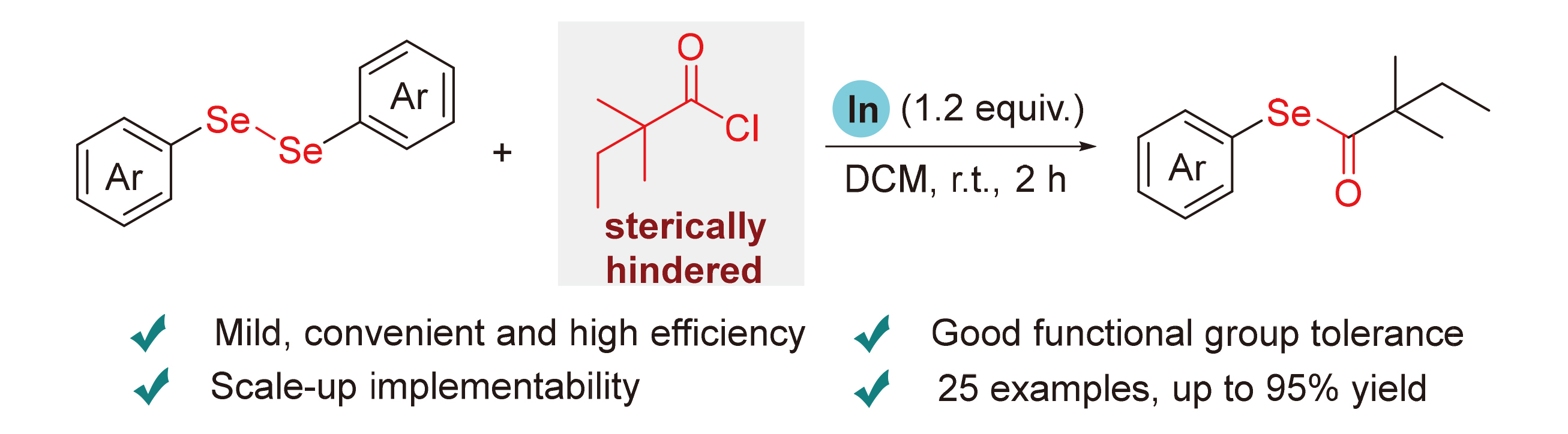
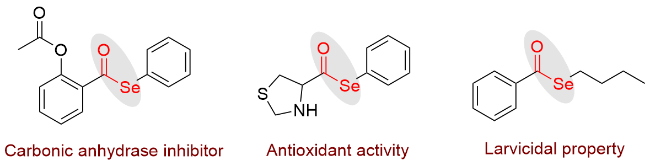
Selenium (Se) is a unique chalcogen element with a wide range of applications and is also a crucial trace element for human health.[1] Selenium-containing compounds have attracted much attention in biomedicine, material science, organic synthesis and other fields due to the unique physical and chemical properties (Figure 1).[2] Among them, selenoester compounds exhibited important bioactive functions, such as inhibiting carbonic anhydrase, antioxidation and insecticidal. In addition, they have been successfully used as precursors of acyl groups and are widely used in the synthesis of natural products, protein intermediates, and superconducting materials.[3] Therefore, it is of great significance to develop efficient methods for the synthesis of selenoester compounds.
At present, there are mainly the following methods to synthesize selenoester using acyl halides as acyl sources (Figure 2): (a) Diphenyl diselenides are converted into the desired nucleophilic selenium species in situ through the reductive cleavage of selenium-selenium bonds, which react with acyl chloride;[4] (b) Selenium forms nucleophilic selenium species under the action of strong reductants and alkyl bromide, which react with acyl chloride;[5] (c) Selenol undergoes nucleophilic reaction with acyl chloride under the promotion of weak base;[6] (d) Transition-metal- catalyzed.[7] Although the above methods can construct selenoester compounds well, there are still many drawbacks, such as multi-steps, high cost, and poor reactivity to large sterically hindered acyl chloride.
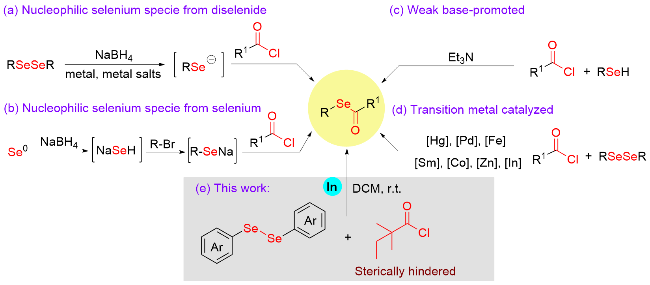
In the past decades, as the core driving force in the field of organometallic chemistry, transition-metal-catalyzed reactions have been continuously developed and innovated, providing a powerful tool for organic synthesis.[8] Among them, the synthesis of selenium esters catalyzed by [Hg], [Pd], [Fe], [Sm], [Co], [Zn] has also made great progress, but there are still some defects such as noble catalyst required, high toxicity, inefficient for acyl chloride with large sterically hindered and harsh reaction conditions. Indium and its derivatives, as a relatively cheap, easy to obtain, less toxic and stable reagent, are commonly used as the catalyst for the synthesis of a variety of reaction intermediates and natural biological products.[9] Meanwhile, the simple reaction system and the straightforward post- treatment of indium catalytic reactions give it an advantage both in laboratory and industrial large-scale production. However, there are few reports on its use in the synthesis of selenoester. From 2003 to 2004, Ranu’s group[7j-7k] reported two cases of InI-mediated synthesis of selenoester compounds at room temperature; In 2009, Braga and co-workers[7i] developed a method for the synthesis of selenoester compounds under reflux condition mediated by In. The above research filled the gap in this field, but the efficiency for the acyl chloride with large sterically hindered remained relatively low. Besides, the harsh reaction conditions of Braga’s work (2.0 equiv. of In, under reflux condition for 12 h) also limited its application. To the best of our knowledge, the synthesis of Se-aryl-2,2-dimethyl- butaneselenoates has not been reported yet. Therefore, the development of mild conditions, efficient and economical methods to construct this kind of compounds is significant.
2 Results and discussion
Inspired by the work of Braga, our study was initiated by investigating the reaction of diphenyl diselenide 1a with 2,2-dimethylbutyryl chloride 2a. A solution of 1a (1.0 equiv), 2a (2.0 equiv), and indium powder (325 mesh, 1.2 equiv) in 1.0 mL of dichloromethane (DCM) was stirred at 40 ℃ for 2 h. As a result, the target compound 3a could only be obtained in 32% yield (Table 1, Entry 1). However, using Fe (325 mesh) or Sm (325 mesh) as the catalysts, only trace amounts of 3a were produced (Table 1, Entries 2, 3). While using Zn (325 mesh) as the catalysts, the yield of 3a was 52% (Table 1, Entry 4). And other metals such as Cu (400 mesh), Sn (325 mesh) could not facilitate the occurrence of the reaction (Table 1, Entries 5, 6). Then, when indium particles with diameters of 1~3 mm and 1~5 mm were used, the yields of 3a decreased to 27% and 21%, respectively (Table 1, Entries 7, 8). Considering the instability of selenoesters, an attempt was made to decrease the reaction temperature to room temperature. Surprisingly, the yield of 3a was as high as 95% (Table 1, Entry 9). Based on this, the solvents were screened. When the solvent was changed to 1,2-dichloroethane (DCE), the yield of 3a was 82% (Table 1, Entry 10), but the efficiency decreased sharply when using tetrahydrofuran (THF) and N,N-dimethylformamide (DMF) (Table 1, Entries 11, 12). To reduce the equivalent of indium, 0.2 equiv. of In and 1.2 equiv. of Zn were used as the catalysts, but the yield of 3a was decreased rapidly (Table 1, Entry 13). Considering that alkaline conditions might be conducive to promoting the reaction, 1.0 equiv. of NaOH was added to the reaction system. However, the reaction outcome was not satisfactory (Table 1, Entries 14,15). Thus, the optimal reaction conditions were finally established as shown in Table 1 Entry 9.
Table 1 Optimization of reaction conditionsa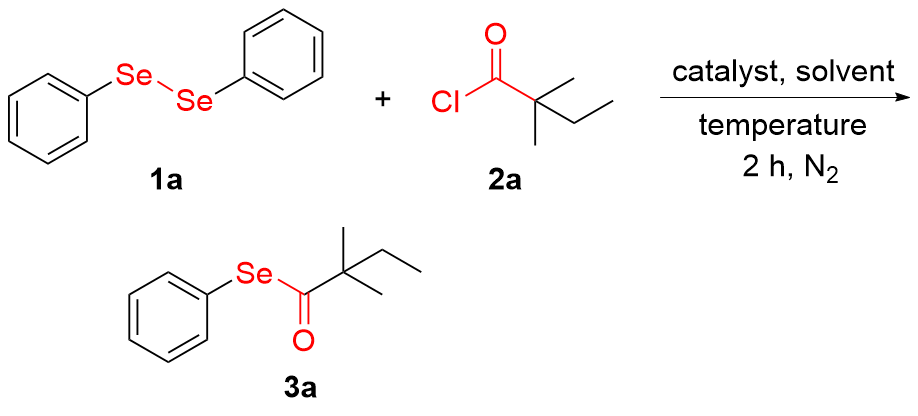 |
| Entry | Catalyst | Solvent | Temp./ oC | Yield b/% |
|---|---|---|---|---|
| 1 | In (325 mesh powder) | DCM | 40 | 32 |
| 2 | Fe (325 mesh powder) | DCM | 40 | Trace |
| 3 | Sm (325 mesh powder) | DCM | 40 | Trace |
| 4 | Zn (325 mesh powder) | DCM | 40 | 52 |
| 5 | Cu (400 mesh powder) | DCM | 40 | 0 |
| 6 | Sn (325 mesh powder) | DCM | 40 | 0 |
| 7 | In (1-3 mm granular) | DCM | 40 | 27 |
| 8 | In (1-5 mm granular) | DCM | 40 | 21 |
| 9 | In (325 mesh powder) | DCM | r.t. | 95 |
| 10 | In (325 mesh powder) | DCE | r.t. | 82 |
| 11 | In (325 mesh powder) | THF | r.t. | 30 |
| 12 | In (325 mesh powder) | DMF | r.t. | 15 |
| 13 | In (0.2 equiv, 325 mesh powder)/ Zn (1.2 equiv, 325 mesh powder) | DCM | r.t. | 35 |
| 14 | Zn (1.2 equiv, 325 mesh powder)/ NaOH (1.0 equiv) | DCM | r.t. | 27 |
| 15 | In (0.2 equiv, 325 mesh powder)/ Zn (1.2 equiv, 325 mesh powder)/ NaOH (1.0 equiv) | DCM | r.t. | 34 |
a Reaction conditions: 1a (0.2 mmol), 2a (0.40 mmol), catalyst (0.24 mmol), solvent (1.0 mL), r.t.~40 ℃, 2 h, N2; b Isolated yields. |
With the optimized reaction conditions in hand, the scope of diphenyl diselenides and several acyl chlorides with large sterically hindered for this reaction was explored. As shown in Table 2, this method exhibited good reaction performance, and the target products could be obtained in moderate to excellent yields (42%~95%). Compound 1a also reacted smoothly at a 4 mmol scale under this mild conditions and offered 3a in 91% yield. In addition, the method showed good functional group tolerance. The substrates bearing methyl, isopropyl, tert-butyl, halogen (fluorine, chlorine, bromine), trifluoro-methyl and trifluoromethoxy groups on the benzene ring could react well in this system. In general, the yield of the substrate containing electron-donating group was higher than that of the substrate with electron-withdrawing group. It might be due to that the electron-donating group could increase the electron cloud density on the benzene ring and promoted the nucleophilic.[10] Moreover, the para-substitution patterns were more conducive to the reaction than meta-sub- stitution patterns and ortho-substitution patterns. Notably, when the benzene ring containing two electron-donating groups or one electron-donating group and one electron- withdrawing group, the desired compounds 3q and 3r could be also generated in excellent yields. Furthermore, 1,2-di(naphthalen-1-yl)diselane (1s) and 1,2-di(naphthalen- 2-yl)diselane (1t) were applicable in this reaction system, but the yield of 3s was low, probably because the large steric hindrance, which effected the nucleophilic reaction.
Table 2 Substrate scope for this reactiona,b |
 |
a Reaction conditions: 1 (0.2 mmol), 2 (0.40 mmol), In (0.24 mmol, 325 mesh powder), DCM (1.0 mL), r.t., 2 h, N2; b Isolated yields; c 1a (4.0 mmol, 1.02 g), 2a (8.0 mmol), In (4.8 mmol, 325 mesh powder), DCM (25.0 mL), r.t., 2 h, N2. |
In order to evaluate the reaction performance of other acyl chlorides with large sterically hindered, 1-adaman- tanecarbonyl chloride, dimethylcarbamoyl chloride and 4-morpholinecarbonyl chloride were tested. Satisfactorily, compared to Chavasiri’s work, the yield of 3u was significantly increased (74% vs 59%). Additionally, both compounds 3v and 3w could be obtained in excellent yields.
In order to gain insight into the reaction mechanism, several competition and control experiments were carried out. Treatment of the electronically biased compounds 1b and 1c (1∶1) with 2a under the standard conditions, the ratio of 3b and 3c was 1.35∶1, indicating that the electron-donating group was beneficial to the reaction (Figure 3a). To explore whether the reaction occurred through the free radical pathway, the radical trapping reactions were performed (Figure 3b). When 3.0 equiv. of 2,2,6,6-tetra- methylpiperidin-1-oxyl (TEMPO) or butylated hydroxytoluene (BHT) were added under the standard conditions, the yield of the desired compound 3a had hardly decreased, excluding the free radical pathway. Furthermore, the In 3d X-ray photoelectron spectroscopy (XPS) shown in Figure 3c confirmed the presence of In3+in the reaction system.[11]
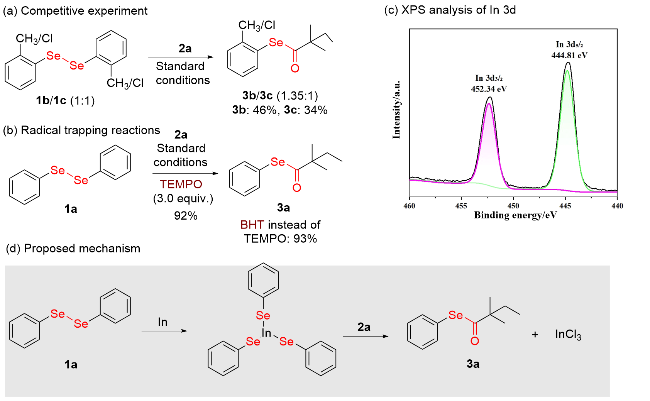


Based on the above experimental results and the relevant literature reports,[6i-6k] the possible reaction mechanism is proposed as shown in Figure 3c. Firstly, the metal indium forms the intermediate In(SePh)3 with 1a. Then the intermediate undergoes nucleophilic substitution reaction with 2a to produce InCl3 and the target selenoester compound 3a.
3 Conclusions
In summary, we have successfully developed an indium-promoted efficient method to synthesize Se-aryl-2,2- dimethylbutaneselenoates. This protocol features broad substrate scope, mild reaction conditions and simple operation, providing a practical tool for the synthesis of aryl selenoesters and their analogues.
4 Experimental section
4.1 General information
All reagents were obtained from commercial sources and used as received without further purification unless otherwise stated. All solvents were dried over 4 Å molecular sieves. Reaction products were purified via column chromatography on silica gel (300~400 mesh). NMR spectra were recorded on a Bruker AV400 in CDCl3 with tetramethylsilane (TMS) as an internal standard. HRMS were measured on a QSTAR Pulsar I LC/TOF MS mass spectrometer. XPS were measured on a Thermo Fisher Scientific K-Alpha.
4.2 General procedure for the synthesis of 3
To a solution of 1 (0.2 mmol, 1.0 equiv.) and indium (0.24 mmol, 325 mesh powder, 1.2 equiv.) in dried DCM (1.0 mL) in a 15 mL round bottom flask, 2 (0.40 mmol, 2.0 equiv) was slowly added under N2 atmosphere. The mixture was stirred at room temperature for 2 h. After completion of the reaction (as monitored by TLC), the reaction mixture was diluted with 10 mL of DCM, then successively washed with water and brine (15 mL×3), dried over anhydrous sodium sulfate, and filtered. The solvent was evaporated under vacuum. Purification was performed by a column chromatography on silica gel (eluents: petroleum ether/ethyl acetate, V∶V=60∶1) to afford the desired compounds 3.
Se-Phenyl-2,2-dimethylbutaneselenoate (3a): Colorless oil, 48.6 mg, 95% yield. 1H NMR (400 MHz, CDCl3) δ: 7.50~7.48 (m, 2H), 7.39~7.36 (m, 3H), 1.72 (q, J=7.6 Hz, 2H), 1.27 (s, 6H), 0.96 (t, J=7.6 Hz, 3H); 13C NMR (100 MHz, CDCl3) δ: 207.8, 136.5 (2C), 129.3 (2C), 128.8, 126.4, 53.5, 33.6, 24.6 (2C), 9.1; HRMS (ESI) calcd for C12H17OSe [M+H]+ 257.0445, found 257.0443
Se-(o-Tolyl)-2,2-dimethylbutaneselenoate (3b): Colorless oil, 46.5 mg, 86% yield. 1H NMR (400 MHz, CDCl3) δ: 7.49 (d, J=7.6 Hz, 1H), 7.29 (d, J=5.2 Hz, 2H), 7.15~7.12 (m, 1H), 2.35 (s, 3H), 1.70 (q, J=8.4 Hz, 2H), 1.24 (s, 6H), 0.94 (t, J=7.2 Hz, 3H); 13C NMR (100 MHz, CDCl3) δ: 207.3, 142.5, 138.0, 130.3, 129.6, 127.4, 126.6, 53.5, 33.6, 24.6 (2C), 23.0, 9.1; HRMS (ESI) calcd for C13H19OSe [M+H]+ 271.0601, found 271.0584
Se-(2-Chlorophenyl)-2,2-dimethylbutaneselenoate (3c): Colorless oil, 42.9 mg, 74% yield. 1H NMR (400 MHz, CDCl3) δ: 7.60 (d, J=6.8 Hz, 1H), 7.52 (d, J=8.0 Hz, 1H), 7.36 (t, J=8.8 Hz, 1H), 7.26~7.22 (m, 1H), 1.73 (q, J=7.6 Hz, 2H), 1.28 (s, 6H), 0.97 (t, J=7.2 Hz, 3H); 13C NMR (100 MHz, CDCl3) δ: 205.9, 139.5, 139.1, 130.7, 129.9, 127.3, 127.2, 53.7, 33.6, 24.5 (2C), 9.1; HRMS (ESI) calcd for C12H16ClOSe [M+H]+ 291.0055, found 291.0038
Se-(2-bromophenyl)-2,2-dimethylbutaneselenoate (3d): Colorless oil, 50.8 mg, 76% yield. 1H NMR (400 MHz, CDCl3) δ: 7.64 (s, 1H), 7.52 (d, J=8.0 Hz, 1H), 7.42 (d, J=7.6 Hz, 1H), 7.26 (td, J=8.0, 2.0 Hz, 1H), 1.70~1.65 (m, 2H), 1.26 (d, J=1.2 Hz, 6H), 0.95 (td, J=7.6, 1.6 Hz, 3H); 13C NMR (100 MHz, CDCl3) δ: 206.8, 138.8, 135.0, 131.8, 130.5, 128.1, 122.7, 53.7, 33.6, 24.6 (2C), 9.1; HRMS (ESI) calcd for C12H16BrOSe [M+H]+ 334.9550, found 334.9543
Se-(m-Tolyl)-2,2-dimethylbutaneselenoate (3e): Colorless oil, 48.1 mg, 89% yield. 1H NMR (400 MHz, CDCl3) δ: 7.33 (s, 1H), 7.30 (d, J=6.8 Hz, 2H), 7.22 (d, J=6.8 Hz, 1H), 2.38 (s, 3H), 1.73 (q, J=7.6 Hz, 2H), 1.28 (s, 6H), 0.97 (t, J=7.2 Hz, 3H); 13C NMR (100 MHz, CDCl3) δ: 208.1, 139.1, 137.1, 133.5, 129.6, 129.1, 126.1, 53.6, 33.6, 24.7 (2C), 21.4, 9.1; HRMS (ESI) calcd for C13H19O- Se [M+H]+ 271.0601, found 271.0584
Se-(3-Isopropylphenyl)-2,2-dimethylbutaneselenoate (3f): Colorless oil, 54.3 mg, 91% yield. : 1H NMR (400 MHz, CDCl3) δ: 7.40 (d, J=8.0 Hz, 2H), 7.25 (d, J=8.0 Hz 2H), 2.97~2.87 (m, 1H), 1.70 (q, J=7.6 Hz, 2H), 1.27 (d, J=6.0 Hz, 12H), 0.95 (t, J=7.6 Hz, 3H); 13C NMR (100 MHz, CDCl3) δ: 208.4, 149.7, 136.5 (2C), 127.6 (2C), 123.2, 53.5, 34.1, 33.7, 24.7 (2C), 24.0 (2C), 9.1; HRMS (ESI) calcd for C15H23OSe [M+H]+ 299.0914, found 299.0918
Se-(3-(tert-butyl)phenyl)-2,2-dimethylbutaneselenoate (3g): Colorless oil, 51.8 mg, 83% yield. 1H NMR (400 MHz, CDCl3) δ: 7.48 (s, 1H), 7.41~7.38 (m, 1H), 7.32~7.28 (m, 2H), 1.71 (q, J=7.6 Hz, 2H), 1.33 (s, 9H), 1.26 (s, 6H), 0.95 (t, J=7.2 Hz, 3H); 13C NMR (100 MHz, CDCl3) δ: 207.9, 152.2, 133.5, 133.4, 128.9, 126.1, 125.9, 53.6, 34.9, 33.7, 31.4 (3C), 24.7 (2C), 9.1; HRMS (ESI) calcd for C16H25OSe [M+H]+ 313.1071, found 313.1097
Se-(3-(Trifluoromethyl)phenyl)-2,2-dimethylbutaneselenoate (3h): Colorless oil, 52.5 mg, 81% yield. 1H NMR (400 MHz, CDCl3) δ: 7.75 (s, 1H), 7.67 (t, J=8.4 Hz, 2H), 7.50 (t, J=8.0 Hz, 1H), 1.72 (q, J=7.2 Hz, 2H), 1.27 (s, 6H), 0.96 (t, J=7.6 Hz, 3H); 13C NMR (100 MHz, CDCl3) δ: 208.5, 137.8, 137.6, 137.5, 134.0, 130.6, 122.9, 53.5, 33.7, 24.7 (2C), 9.0; HRMS (ESI) calcd for C13H16F3OSe [M+H]+ 325.0318, found 325.0311
Se-(3-Fluorophenyl)-2,2-dimethylbutaneselenoate (3i): Colorless oil, 47.7 mg, 87% yield. 1H NMR (400 MHz, CDCl3) δ: 7.36~7.30 (m, 1H), 7.26~7.21 (m, 2H), 7.09~7.05 (m, 1H), 1.70 (q, J=7.6 Hz, 2H), 1.25 (s, 6H), 0.94 (t, J=7.6 Hz, 3H); 13C NMR (100 MHz, CDCl3) δ: 207.0, 163.8 (d, 1JCF=247.8 Hz), 132.1 (d, 4JCF=3.1 Hz), 130.4 (d, 3JCF=7.9 Hz), 127.8 (d, 3JCF=7.2 Hz), 123.5 (d, 2JCF=21.8 Hz), 116.0 (d, 2JCF=20.8 Hz), 53.7, 33.6, 24.6 (2C), 9.1; HRMS (ESI) calcd for C12H16FOSe [M+H]+ 275.0350, found 275.0369
Se-(3-Chlorophenyl)-2,2-dimethylbutaneselenoate (3j): Colorless oil, 47.6 mg, 82% yield. 1H NMR (400 MHz, CDCl3) δ: 7.48 (s, 1H), 7.36 (d, J=7.6 Hz, 2H), 7.29 (t, J=7.6 Hz, 1H), 1.69 (q, J=7.6 Hz, 2H), 1.24 (s, 6H), 0.94 (t, J=7.6 Hz, 3H); 13C NMR (100 MHz, CDCl3) δ: 206.8, 136.1, 134.6, 134.5, 130.2, 129.0, 127.8, 53.7, 33.6, 24.6 (2C), 9.1; HRMS (ESI) calcd for C12H16ClOSe [M+H]+ 291.0055, found 291.0038
Se-(3-Bromophenyl)-2,2-dimethylbutaneselenoate (3k): Colorless oil, 52.1 mg, 78% yield. 1H NMR (400 MHz, CDCl3) δ: 7.64 (t, J=1.6 Hz, 1H), 7.52~7.49 (m, 1H), 7.41(dt, J=7.6, 1.2 Hz, 1H), 7.25 (t, J=8.0 Hz, 1H), 1.70 (q, J=7.2 Hz, 2H), 1.25 (s, 6H), 0.94 (t, J=7.6 Hz, 3H); 13C NMR (100 MHz, CDCl3) δ: 206.9, 138.8, 135.0, 131.8, 130.6, 128.1, 122.7, 53.7, 33.6, 24.6 (2C), 9.1; HRMS (ESI) calcd for C12H16BrOSe [M+H]+ 334.9550, found 334.9574
Se-(p-Tolyl)-2,2-dimethylbutaneselenoate (3l): Colorless oil, 48.6 mg, 90% yield. 1H NMR (400 MHz, CDCl3) δ: 7.36 (dt, J=8.4, 2.0 Hz, 2H), 7.17 (d, J=7.6 Hz, 2H), 2.35 (s, 3H), 1.68 (q, J=7.6 Hz, 2H), 1.23 (s, 6H), 0.92 (t, J=7.6 Hz, 3H); 13C NMR (100 MHz, CDCl3) δ: 208.1, 138.8, 136.4 (2C), 130.1 (2C), 122.7, 53.4, 33.6, 24.6 (2C), 21.4, 9.1; HRMS (ESI) calcd for C13H19OSe [M+H]+ 271.0601, found 271.0584
Se-(4-(tert-Butyl)phenyl)-2,2-dimethylbutaneselenoate (3m): Colorless oil, 53.7 mg, 86% yield. 1H NMR (400 MHz, CDCl3) δ: 7.40 (s, 4H), 1.70 (q, J=7.6 Hz, 2H), 1.32 (s, 9H), 1.25 (s, 6H), 0.94 (t, J=7.2 Hz, 3H); 13C NMR (100 MHz, CDCl3) δ: 208.5, 151.9, 136.2 (2C), 126.5 (2C), 122.9, 53.5, 34.8, 33.7, 31.4 (3C), 24.7 (2C), 9.1; HRMS (ESI) calcd for C16H25OSe [M+H]+ 313.1071, found 313.1060
Se-(4-(Trifluoromethoxy)phenyl)-2,2-dimethylbutanese-lenoate (3n): Colorless oil, 60.5 mg, 89% yield. 1H NMR (400 MHz, CDCl3) δ: 7.50 (d, J=8.4 Hz, 2H), 7.22 (d, J=8.4 Hz, 2H), 1.70 (q, J=7.2 Hz, 2H), 1.25 (s, 6H), 0.94 (t, J=7.2 Hz, 3H); 13C NMR (100 MHz, CDCl3) δ: 207.3, 149.7, 138.0 (2C), 124.7, 121.7 (2C), 119.3, 53.7, 33.6, 24.6 (2C), 9.1; HRMS (ESI) calcd for C13H16F3O2Se [M+H]+ 341.0268; found:341.0276
Se-(4-(Trifluoromethoxy)phenyl)-2,2-dimethylbutanese-lenoate (3o): Colorless oil, 51.6 mg, 89% yield. 1H NMR (400 MHz, CDCl3) δ: 7.40 (d, J=8.4 Hz, 2H), 7.34 (d, J=8.4 Hz, 2H), 1.70 (q, J=7.6 Hz, 2H), 1.25 (s, 6H), 0.93 (t, J=7.2 Hz, 3H); 13C NMR (100 MHz, CDCl3) δ: 207.3, 137.8 (2C), 135.3, 129.5 (2C), 124.6, 53.7, 33.6, 24.6 (2C), 9.1; HRMS (ESI) calcd for C12H16ClOSe [M+H]+ 291.0055, found 291.0068
Se-(4-Bromophenyl)-2,2-dimethylbutaneselenoate (3p): Colorless oil, 55.4 mg, 83% yield. 1H NMR (400 MHz, CDCl3) δ: 7.50 (dd, J1=8.4 Hz, J2=2.4 Hz, 2H), 7.34 (dd, J1=8.4 Hz, J2=2.4 Hz, 2H), 1.69~1.63 (m, 2H), 1.24 (d, J=2.0 Hz, 6H), 0.94 (td, J1=10.0 Hz, J2=2.4Hz, 3H); 13C NMR (100 MHz, CDCl3) δ: 207.2, 138.0 (2C), 132.5 (2C), 125.3, 123.5, 53.7, 33.6, 24.6 (2C), 9.1; HRMS (ESI) calcd for C12H16BrOSe [M+H]+ 334.9550, found 334.9532
Se-(3,5-Dimethylphenyl)-2,2-dimethylbutaneselenoate (3q): Colorless oil, 49.4 mg, 87% yield. 1H NMR (400 MHz, CDCl3) δ: 7.11 (s, 2H), 7.00 (s, 1H), 2.32 (s, 6H), 1.70 (q, J=7.6 Hz, 2H), 1.25 (s, 6H), 0.95 (t, J=7.2 Hz, 3H); 13C NMR (100 MHz, CDCl3) δ: 208.4, 138.9, 134.1 (2C), 130.7 (2C), 125.7, 53.5, 33.7, 24.7 (2C), 21.3 (2C), 9.1; HRMS (ESI) calcd for C14H21OSe [M+H]+ 285.0758, found 285.0737
Se-(4-chloro-3-methylphenyl)-2,2-dimethylbutanesele-noate (3r): Colorless oil, 50.5 mg, 83% yield. 1H NMR (400 MHz, CDCl3) δ: 7.34 (d, J=10.4 Hz, 2H), 7.24 (d, J=8.0 Hz, 1H), 2.38 (s, 3H), 1.70 (q, J=7.2 Hz,2H), 1.25 (s, 6H), 0.99 (t, J=7.6 Hz, 3H); 13C NMR (100 MHz, CDCl3) δ: 207.6, 138.7, 137.2, 135.5, 135.1, 129.8, 124.3, 53.6, 33.6, 24.6 (2C), 20.1, 9.1; HRMS (ESI) calcd for C13H18ClOSe [M+H]+ 305.0211, found 305.0208
Se-(Naphthalen-1-yl)-2,2-dimethylbutaneselenoate (3s): Colorless oil, 25.7 mg, 42% yield. 1H NMR (400 MHz, CDCl3) δ: 8.19 (d, J=7.6 Hz, 1H), 7.94 (d, J=8.4 Hz, 1H), 7.87~7.78 (m, 2H), 7.55~7.44 (m, 3H), 1.77 (q, J=7.6 Hz,2H), 1.32 (s, 6H), 0.99 (t, J=7.2 Hz, 3H); 13C NMR (100 MHz, CDCl3) δ: 207.2, 137.0, 135.2, 134.2, 133.1, 130.4, 128.8, 127.9, 127.0, 126.3, 126.0, 53.8, 33.7, 24.7 (2C), 9.2; HRMS (ESI) calcd for C16H19OSe [M+ H]+ 307.0601, found 307.0591
Se-(Naphthalen-2-yl)-2,2-dimethylbutaneselenoate (3t): Colorless oil, 41.0 mg, 67% yield. 1H NMR (400 MHz, CDCl3) δ: 8.04 (s, 1H), 7.87 (t, J=8.4 Hz, 3H), 7.55~7.50 (m, 3H), 1.75 (q, J=7.6 Hz,2H), 1.30 (s, 6H), 0.99 (t, J=7.6 Hz, 3H); 13C NMR (100 MHz, CDCl3) δ: 207.9, 136.2, 134.0, 133.1 (2C), 128.6, 127.9 (2C), 126.8, 126.4, 123.8, 53.6, 33.6, 24.6 (2C), 9.1; HRMS (ESI) calcd for C16H19O- Se [M+H]+ 307.0601, found 307.0590
Se-Phenyl (3R,5R,7R)-adamantane-1-carboselenoate (3u): Colorless oil, 47.4 mg, 74% yield. 1H NMR (400 MHz, CDCl3) δ: 7.50~7.48 (m, 2H), 7.38~7.34 (m, 3H), 2.11 (s, 3H), 2.00 (d, J=2.4 Hz, 6H), 1.80 (m, 6H); 13C NMR (100 MHz, CDCl3) δ: 207.8, 136.5 (2C), 129.2 (2C), 128.7, 126.2, 52.1, 39.2 (3C), 36.5 (3C), 28.3 (3C); HRMS (ESI) calcd for C17H21OSe [M+H]+ 321.0758, found 321.0746
Se-Phenyl dimethylcarbamoselenoate (3v): Colorless oil, 42.1 mg, 92% yield. 1H NMR (400 MHz, CDCl3) δ: 7.62 (dd, J1=7.6 Hz, J2=1.6 Hz, 2H), 7.41~7.34 (m, 3H), 3.01 (s, 6H); 13C NMR (100 MHz, CDCl3) δ: 164.3, 136.6 (2C), 129.0 (2C), 128.7, 126.8, 37.2, 36.8; HRMS (ESI) calcd for C9H12NOSe [M+H]+ 230.0084, found 230.0076
Se-Phenyl morpholine-4-carboselenoate (3w): Colorless oil, 47.2 mg, 87% yield. 1H NMR (400 MHz, CDCl3) δ: 7.61 (d, J=6.4 Hz, 2H), 7.43~7.35 (m, 3H), 3.70~3.46 (m, 8H); 13C NMR (100 MHz, CDCl3) δ: 163.9, 136.8 (2C), 129.2 (2C), 129.1, 126.2, 66.6 (4C); HRMS (ESI) calcd for C11H14NO2Se [M+H]+ 272.0190, found 272.0201
Se-Phenyl benzoselenoate (3x): Colorless oil, 48.7 mg, 93% yield. 1H NMR (400 MHz, CDCl3) δ: 7.96 (d, J=7.2 Hz, 2H), 7.63~7.60 (m, 2H), 7.52 (t, J=8.0 Hz, 3H), 7.45~7.42 (m, 3H); 13C NMR (100 MHz, CDCl3) δ: 193.5, 138.6, 136.5 (2C), 134.0, 129.5 (2C), 129.2, 129.1 (2C), 127.5 (2C), 125.9; HRMS (ESI) calcd for C13H11OSe [M+H]+ 262.9975, found 262.9973
Se-Phenyl 2-phenylethaneselenoate (3y): Colorless oil, 50.2 mg, 91% yield. 1H NMR (400 MHz, CDCl3) δ: 7.49~7.47 (m, 2H), 7.41~7.33 (m, 8H), 3.94 (s, 2H); 13C NMR (100 MHz, CDCl3) δ: 198.9, 135.9 (2C), 132.7, 130.2 (2C), 129.4 (2C), 129.0, 128.9 (2C), 128.0, 126.7, 53.7; HRMS (ESI) calcd for C14H13OSe [M+H]+ 277.0132, found 277.0134.
4.3 Reaction mechanism studies
4.3.1 Competitive experiment
To a solution of 1b (0.1 mmol), 1c (0.1 mmol) and indium (0.24 mmol, 325 mesh powder, 1.2 equiv.) in dried DCM (1.0 mL) in a 15 mL round bottom flask, 2a (0.4 mmol, 54.9 μL, 2.0 equiv.) was slowly added under N2 atmosphere. The mixture was stirred at room temperature for 2 h. After completion of the reaction (as monitored by TLC), the reaction mixture was diluted with 10 mL of DCM, then successively washed with water and brine (15 mL×3), dried over anhydrous sodium sulfate, and filtered. The solvent was evaporated under vacuum. Purification was performed by a column chromatography on silica gel (eluents: petroleum ether/ethyl acetate, V∶V=60∶1) to afford the desired 2,2-dimethylbutyric acid phenyl selenoesters 3b and 3c. The yields of 3b and 3c were determined by 1H NMR analysis (see the Supporting Information).
4.3.2 Radical trapping reactions
To a solution of 1a (0.2 mmol), TEMPO or BHT (0.6 mmol) and indium (0.24 mmol, 325 mesh powder, 1.2 equiv.) in dried DCM (1.0 mL) in a 15 mL round bottom flask, 2a (0.4 mmol, 54.9 μL, 2.0 equiv) was slowly added under N2 atmosphere. The mixture was stirred at room temperature for 2 h. After completion of the reaction (as monitored by TLC), the reaction mixture was diluted with 10 mL of DCM, then successively washed with water and brine (15 mL×3), dried over anhydrous sodium sulfate, and filtered, and the solvent was evaporated under vacuum. Purification was performed by a column chromatography on silica gel (eluents: petroleum ether/ethyl acetate=60:1) to afford the desired 2,2-dimethylbutyric acid phenyl selenoester 3a.
Supporting Information The supporting information includes 1H NMR, 13C NMR spectra of target compounds and it can be downloaded at http://sioc-journal.cn/.
(Li, L.)