


1 Introduction
The introduction of a methyl group at specific sites in small molecule compounds can markedly enhance their pharmacological activity, target selectivity, and metabolic stability together with improving solubility and reducing toxicity, namely “magic methyl effect” in drug discovery.[1] In an extreme example, a 208-fold increase in potency of an inhibitor of p38α MAP3 kinase was observed upon simple methylation (Scheme 1A).[2] Owing to the wide existence of arenes in pharmacophores and the moderate yields of the simple methylation reaction between aryl organometallic reagents with methyl electrophiles, mild, catalytic methylation methods for arenes and heteroarenes are particularly important to develop.[3] The classic strategies mostly proceed via either a lithium-halide exchange or an ortho-meta- lation of aryl halide, followed by reacting with a methyl electrophile.[4] It requires the absence of auxiliary electrophilic and protic functional groups. Alternatively, preparation of methylarenes and heteroarenes can be achieved by transition-metal complex catalyzed methylation of aryl halides with a methyl nucleophile.[5] Moreover, several strategies for methylation of C—H bonds in arenes were developed as well. Minisci-type C—H methylation of electron-deficient heteroarenes with methyl radicals leads to reaction at the electron-poor positions.[6]
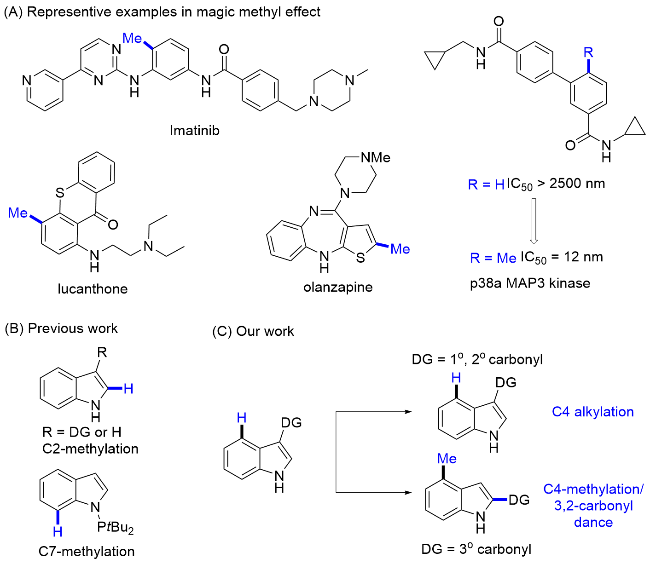
Owing to its wide prevalence in the natural products and pharmacophores, the indole scaffold has attracted intensive attentions from pharmaceutical and organic chemist. Despite great advances in site selective C—H functionalization of indoles,[7] C—H methylation remains limited. Current examples normally restricted to C2 or C3 methylation, which occurred at electron rich pyrrole rings (Scheme 1B).[8] Shi and coworkers[9] disclosed rhodium-catalyzed C7 C—H methylation and trideuteromethylation of indole. An isolated example for C4, C6 dimethylation of indoles was reported by Zhang’s group.[10] In contrast to these elegant progresses, C4 methylation remains unsolved.
Aromatic rearrangement reactions can help access ring positions that are otherwise elusive. The well-known aromatic rearrangements such as the Smiles, Claisen, and Bamberger rearrangements normally leave a functional group at the carbon atom that was originally substituted in the starting material. In contrast, a rarer aromatic rearrangement, namely translocation of a functional group, involves the complete detachment of a functional group from its original carbon atom and reattaches to a different carbon on the aromatic ring. A classic example is transalkylation in petrochemical industry to migrate an alkyl group under Friedel-Crafts alkylation conditions.[11] However, it requires harsh conditions and unpredictably generates a mixture of isomers. Another classic example is called the “halogen dance” reaction of haloarenes induced by a strong base to provide a regioisomer via a sequence of halogen-metal exchange processes.[12] Besides these classic examples, aryl dance reaction,[13] ester dance reaction,[14] and transposition of a silyl group[15] were developed to extend the field. Recently, photochemical permutation of meta-substituted phenols was also devised to access ortho- and para-substituted phenols by Ruffoni and Leonori.[16]
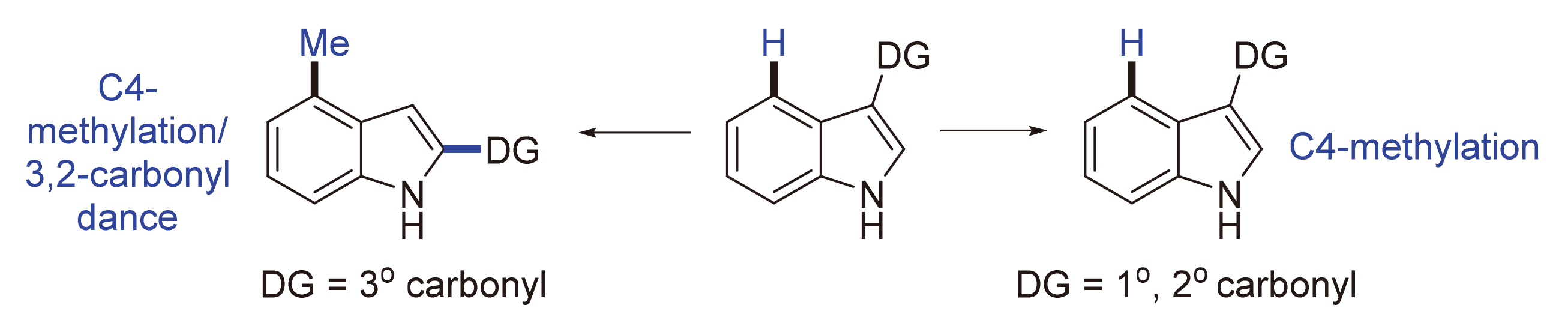
Despite these advances, combination of the translocation strategies with C—H functionalization remains especially rare. Saracoglu[17] and our group[18] successfully combine the C—H arylation of indoles with carbonyl group dancing, achieving facile construction of 2,4-disubstituted indole from readily available 3-carbonyl indoles. Ball’s group[19] disclosed meta-selective C—H arylation of phenols via a sequence of reactions including a Bi(V)-mediated electrophilic arylation and a subsequent aryl translocation/rearo-matization. Ashfeld and coworkers[20] developed catalyst-controlled directing group translocation in the site selective C—H functionalization of 3-carboxamide indoles. To the best of our knowledge, there are currently no reports for combination of a catalytic carbonyl group rearrangement with C—H methylation. During our recent efforts in the development of regioselective C—H functionalization,[21] we found that the C—H arylation of indoles can be followed by carbonyl group dancing, achieving facile construction of 2,4-disubstituted indole from readily available 3-carbonyl indoles.[17] We hypothesize that the appropriate selection of C—H methylation conditions would accommodate with subsequent carbonyl group dancing reaction. Herein, we reported the C4 methylation of indoles and the steric controlled C4-methylation/carbonyl group dancing reaction (Scheme 1C). The large steric hindrance at carbonyl group facilitates the carbonyl group migration, which provides a straightforward protocol for the synthesis of C2/C4 disubstituted indoles.
2 Results and discussion
To commence our study, S-methyldibenzothiophenium salt (DMT) was employed as the methyl surrogate for C4- methylation of 1-(1H-indol-3-yl)ethan-1-one (1a) (Table 1). C4-methylated product 3a was successfully obtained in 74% yield using Pd(OAc)2 as catalyst and trifluoroacetic acid (TFA) as acid additive (Table 1, Entry 1). Switching the catalyst to Pd(TFA)2 resulted in similar yields (Table 1, Entry 2). Notably, the reaction vanished in the absence of Pd catalyst (Table 1, Entry 3). Switching or removing the acid additives led to sharply decreased yield, indicating the crucial role of TFA (Table 1, Entries 4~6). Although elevating the reaction temperature afforded lower reaction efficiency for 3a, the yield of C4-methylation/carbonyl group migration product 4a simultaneously increased (Table 1, Entries 7~9). As reported in the literature, copper salts can accelerate the reaction and inhibit the decomposition of DMT during the catalytic process.[22] Therefore, Cu(OAc)2 was employed, and it improved the reaction yield to 86% (Table 1, Entry 10). Ultimately, the reaction time was reduced to 3 h with 88% yield, suggesting the role of Cu(OAc)2 to enhance the reaction efficiency (Table 1, Entry 11).
Table 1 Optimization of the reaction conditionsa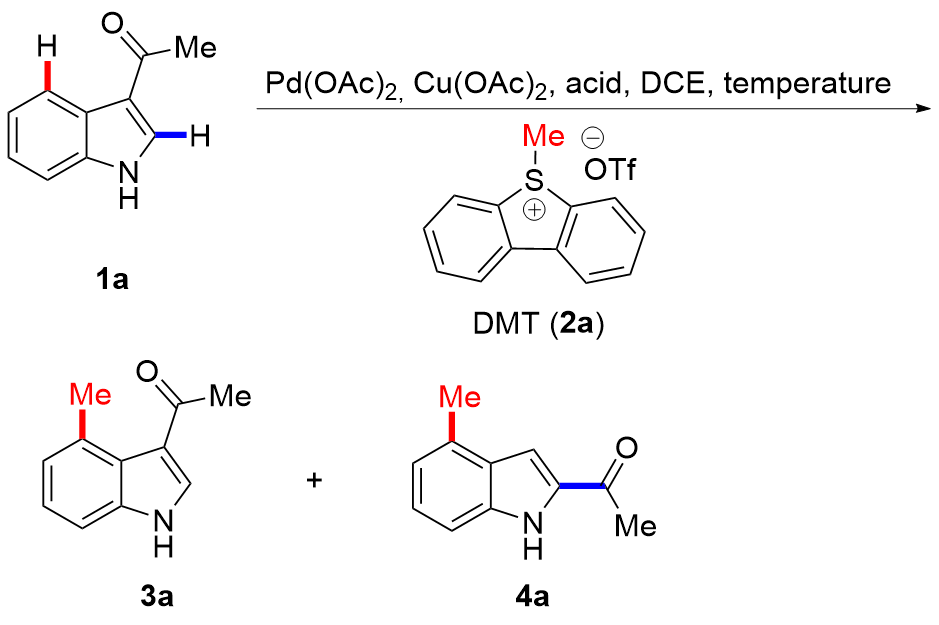 |
| Entry | Catalyst | Acid | Temp/℃ | Yieldb/% | |
|---|---|---|---|---|---|
| 3a | 4a | ||||
| 1 | Pd(OAc)2 | TFA | 50 | 74 | — |
| 2 | Pd(TFA)2 | TFA | 50 | 72 | — |
| 3 | — | TFA | 50 | — | — |
| 4 | Pd(OAc)2 | HOAc | 50 | 16 | — |
| 5 | Pd(OAc)2 | TsOH•H2O | 50 | — | — |
| 6 | Pd(OAc)2 | — | 50 | — | — |
| 7 | Pd(OAc)2 | TFA | 60 | 53 | 4 |
| 8 | Pd(OAc)2 | TFA | 70 | 26 | 8 |
| 9 | Pd(OAc)2 | TFA | 80 | 19 | 12 |
| 10c | Pd(OAc)2 | TFA | 50 | 86 | — |
| 11c,d | Pd(OAc)2 | TFA | 50 | 88 | — |
a Standard conditions: 1a (0.2 mmol, 1.0 equiv.), 2a (3.0 equiv.), Pd(OAc)2 (10 mol%), acid (2.0 equiv.), DCE (2.0 mL), air, 12 h. b Isolated yields. c Cu(OAc)2 (20 mol%) was used. d 3 h. DMT=S-methyldibenzothiophenium salt, DCE=1,2-dichloroethane, TsOH•H2O=p-toluenesulfonic acid monohydrate, HOAc=acetic acid, TFA=trifluoroacetic acid. |
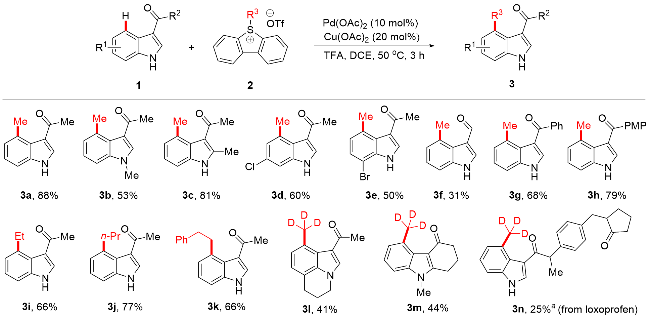
Under the optimal condition, diverse indole derivatives were explored (Scheme 2). Various functional groups were accommodated at different positions on the indole ring, including a N-methyl (3b), a 2-methyl (3c), a 6-chloro (3d), and a 7-bromo (3e) substituent. Moreover, aldehyde and aromatic carbonyl group at C3 position proved to be viable for directed methylation, yielding 3f~3h in 31%~79% yields. Encouraging by these results, the application of the C4-methylation to alkylation using different S-alkyldiben- zothiophenium salts was next extended. Ethyl, n-propyl and phenylethyl groups were successfully introduced to the C4 position of indole with 66%~77% yields (3i~3k). As the importance of deuterated compounds in pharmacopho- res, the trideuteromethylation was also investigated. The lilolidine derivative (3l), 4-oxocarbazoles (3m) and loxoprofen derivative (3n) were synthesized, further proving robustness of this protocol.
Further investigation of aliphatic carbonyl group on indole derivatives resulted in C4-methylation/carbonyl group migration products 5a and 6a (Scheme 3). By switching methyl group at carbonyl moiety to iso-propyl and tert- butyl groups, steric hindrance around carbonyl group increases. Simultaneously, the yield of C4-methylation/car- bonyl group dance product increases as well. Therefore, these results indicate steric hindrance around carbonyl group would benefit the carbonyl group dance and control the chemoselectivity. Hence, we began the optimization to obtain C4- methylation/3,2-pivaloyl migration of indole 6a (Table 2). As indicated in Table 1, elevating temperature would increase the carbonyl group dance product. Therefore, reaction temperature was first screened (Table 2, Entries 1~3). Increasing the temperature to 60 ℃ resulted in similar yields with that at 50 ℃. Further investigation of diverse acidic conditions revealed TFA as best additive (Table 2, Entry 1 vs. Entries 4~6). Interestingly, addition of KOAc further increased the yield to 65% (Table 2, Entry 7). Finally, extension of the reaction time to 6 h gave 6a in 75% yield (Table 2, Entry 8).
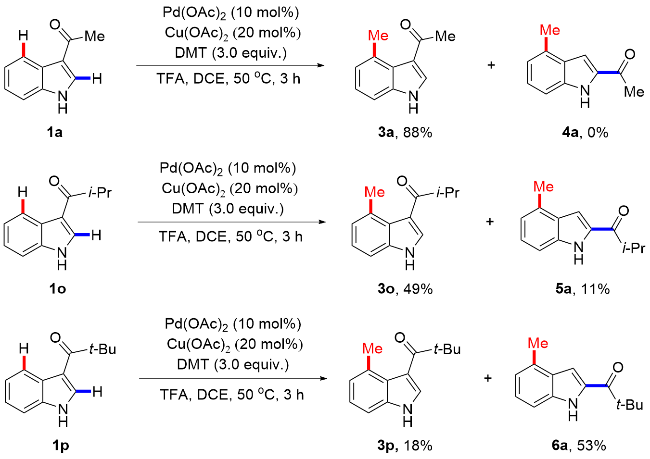
Table 2 Optimization of the reaction conditionsa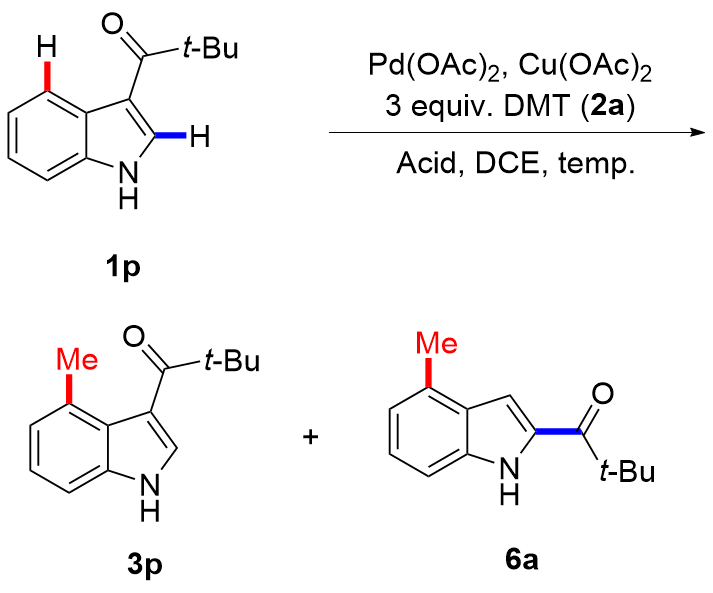 |
| Entry | Acid | Temp./℃ | Yieldb/% | |
|---|---|---|---|---|
| 3p | 6a | |||
| 1 | TFA | 50 | 18 | 53 |
| 2 | TFA | 40 | 15 | 25 |
| 3 | TFA | 60 | 16 | 52 |
| 4 | PivOH | 50 | 0 | 0 |
| 5 | TsOH•H2O | 50 | 0 | 0 |
| 6 | — | 50 | 0 | 0 |
| 7c | TFA | 50 | 9 | 65 |
| 8c,d | TFA | 50 | 0 | 75 |
a Standard conditions: 1a (0.2 mmol, 1.0 equiv.), 2a (3 equiv.), Pd(OAc)2 (10 mol%), Cu(OAc)2 (20 mol%), acid (2.0 equiv.), DCE (2.0 mL), air, 3 h. b Isolated yields. c KOAc (1.0 equiv.). d 6 h. |
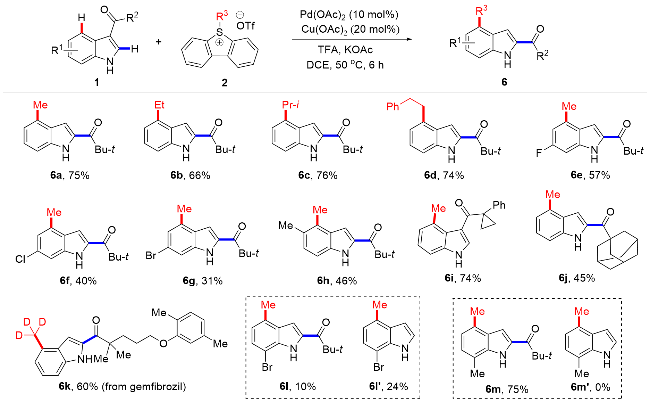
With optimization conditions, the range of this cascade processes (Scheme 4) was investigated. Diverse S-alkyldi-benzothiophenium salts as the coupling partners were investigated to afford the corresponding products 6b~6d with 66%~76% yields. Substitution at the C5 (6h) and C6 positions (6e~6g) of the indole core was well tolerated with alkyl and halide substituents. Notably, with (1H-indol-3-yl)(1-phenylcyclopropyl)methanone as substrates, carbonyl group dance reaction unexpectedly failed, but C4-alkylation product 6i was generated in 74%. It may be attributed to the less steric hindrance of cyclopropyl group. In contrast, carbonyl group with adamantyl substituent successfully afforded 2,4-disubstituted indole products 6j. The robustness and synthetic utility of this protocol were further demonstrated by application in late-stage trideu-teromethylation of gemifibrozil derivative, affording 6k with 60% yield. The indole derivative with C7-bromo group not only afforded the migration product 6l, but also unexpectedly generated C4-methylation/directing-group-removal product 6l'. Further examination of this phenomenon with electron-donating group at C7 position resulted in 6m without directing-group-removal (6m').
To confirm the factor triggering carbonyl dance, a series of control experiments were carried out for 3p (Table 3). The reactions without acid additive failed to generate carbonyl dance product (Table 3, Entries 1~3). In contrast, TFA can efficiently trigger the dance reaction and extend the reaction time would increase the reaction outcome (Table 3, Entries 4~6). These results suggest acid additive TFA would be the key factor for the reaction. Notably, addition of KOAc improved the reaction yields, indicating its potential role for regulation of the reaction pH environment.
Table 3 Control reactionsa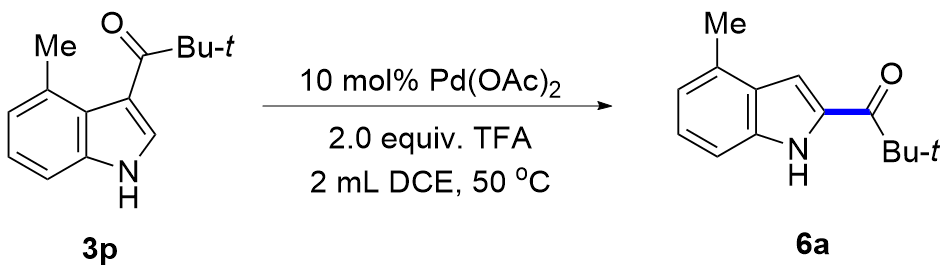 |
| Entry | Catalyst | Additive | Acid | Time/h | Yieldb/% |
|---|---|---|---|---|---|
| 1 | — | — | — | 6 | 0 |
| 2 | Pd(OAc)2 | — | — | 6 | 0 |
| 3 | — | Cu(OAc)2 | — | 6 | 0 |
| 4 | — | — | TFA | 6 | 79 |
| 5c | — | — | TFA | 6 | 88 |
| 6c | TFA | 12 | 90 |
a Standard conditions: 3p (0.2 mmol, 1 equiv.), Pd(OAc)2 (10 mol%), Cu(OAc)2 (20 mol%), TFA (2.0 equiv.), DCE (2.0 mL), air, 50 ℃, 6 h. b Isolated yields. c KOAc (1.0 equiv.). |
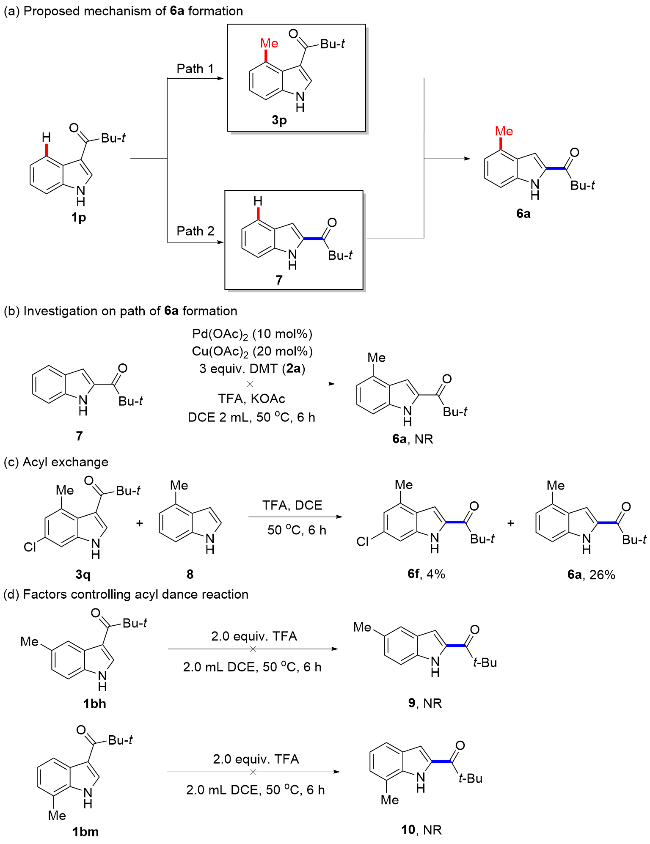
For the mechanism of C4-alkylation/carbonyl dance reaction of indoles, two pathways were proposed (Scheme 5a). Pathway 1 might undergo carbonyl dance reaction, followed by C4 alkylation. The other would proceed via C4 alkylation, followed by carbonyl dance reaction. To elucidate these two pathways, 7 was subjected to the standard conditions and failed to give the desired 6a (Scheme 5b), ruling out path 1. Furthermore, 3q and 8 were combined in equimolar ratio and subjected to the carbonyl dance conditions (Scheme 5c). Besides normal carbonyl dance product 6f, carbonyl group danced from electron-poor indoles 3q to electron-rich 8, providing intermolecular carbonyl dance product 6a in 26% yield. It implied an intermolecular carbonyl dance rather than an intramolecular dance process. To probe the plausible role of steric hindrance, C5 and C7- methyl indole derivatives 1bh and 1bm were tested, of which the carbonyl dance reactions vanished, suggesting the steric hindrance between C4-alkyl group and C3-piva- loyl might trigger the carbonyl dance process (Scheme 5d).
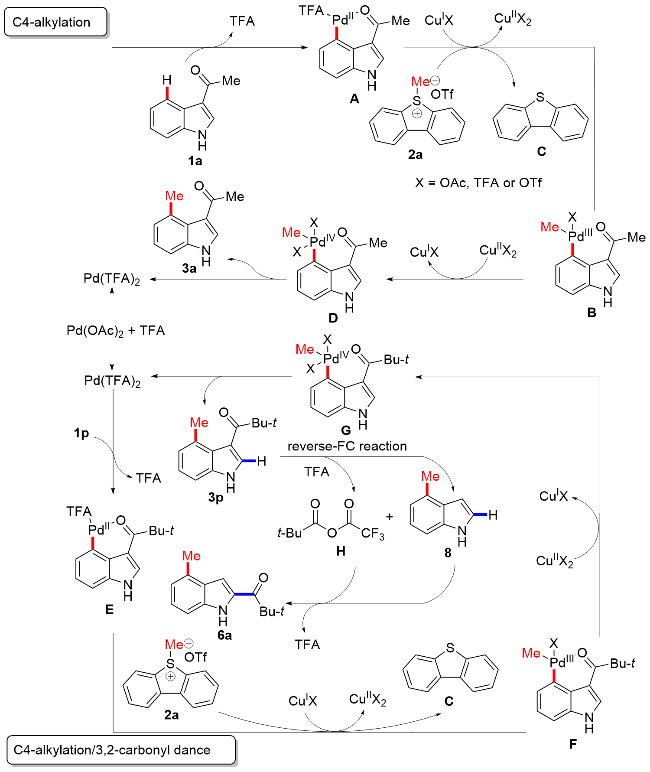
Based on the experimental results and literature,[18] two catalytic cycles for the aforementioned reactions were proposed (Scheme 6). In the C4 alkylation cycle, Pd(OAc)2 and trifluoroacetic acid afforded Pd(TFA)2, followed by its C—H activation with indole to generate A. 2a undergoes oxidation addition with A and in situ generated Cu(I) species to afford Pd(III) B. B undergoes oxidation with CuX2, followed by reductive elimination to produce 3a and regenerates the palladium catalyst. In the domino C4-alky- lation/carbonyl dance process, in situ formed Pd(TFA)2 undergoes similar C—H activation with indole 1p gave E. The oxidation addition of E with 2a and Cu(I) species gives F, which undergoes similar process to aforementioned C4 alkylation cycle to produce 3p and regenerate Pd catalyst. The steric hindrance between acyl group and C4-methyl enables the subsequent reverse Friedel-Crafts reactions of 3p, which is followed by Friedel-Crafts reactions with H ultimately afforded 6a.


3 Conclusions
In summary, we have developed the C4-alkylation and domino C4-alkylation/3,2-carbonyl migration of indoles. The former route enables C4-arylation in a highly efficient and mild manner employing TFA as acid additive and the latter route provides an alternative straightforward protocol for the synthesis of C2/C4 disubstituted indoles. Given the importance of 3,4- and 2,4-disubstituted indoles in materials science and active pharmaceutical ingredients, it is expected that the reactions will have wide application in organic chemistry, chemical materials and pharmaceutical research.
4 Experimental section
4.1 General experimental information
Unless otherwise noted, all reagents were obtained from commercial suppliers (Adamas-beta, Energy Chemical and Innochem and used without further purification. The substrates of 3-acyl indoles,[23] 1-(1H-indol-2-yl)-2,2-dimethyl-propan-1-one,[24] Pd(TFA)2[25] and sulfonium salts[26] were prepared according to previously described procedures. 1,2-Dichloroethane (DCE) was dried over calcium hydride and freshly distilled under air. The reaction product was isolated by column chromatography on a silica gel (236~400 mesh) column using petroleum ether (PE) with a boiling range from 60 ℃ to 90 ℃ and EtOAc. 1H NMR, 13C NMR and 19F NMR spectra were recorded on 400, 100, 376 MHz NMR spectrometers using CDCl3 or DMSO-d6 as solvent. 1H NMR and 13C NMR spectra used tetramethylsilane as the internal standard and 19F NMR spectra are reported relative to trifluoroacetic acid (δ -76.55) as an external reference. HRMS were made by means of ESI. Unless otherwise noted, all reagents were weighed and handled in air, and all reactions were carried out in argon.
4.2 General procedure for C4-methylation
A reaction tube (15 mL) with magnetic stir bar was charged with 1 (0.2 mmol), 2 (3.0 equiv.), Pd(OAc)2 (10 mol%), Cu(OAc)2 (20 mol%), TFA (2.0 equiv.) and DCE (2.0 mL). The reaction mixture was stirred at 50 ℃ for 3 h. Upon completion, the reaction mixture was cooled to ambient temperature, filtered through a silica gel plug, and concentrated in vacuo. The crude reaction mixture was purified on silica gel using petroleum ether (PE)/EtOAc as the eluent to afford the desired product 3.
1-(4-Methyl-1H-indol-3-yl)ethan-1-one (3a): Eluent: PE/EtOAc (V∶V=2∶1). Yellow solid, 88% yield, 30.4 mg. m.p. 184~186 ℃; 1H NMR (400 MHz, DMSO-d6) δ: 11.86 (s, 1H), 8.27 (s, 1H), 7.25 (d, J=8.1 Hz, 1H), 7.06 (t, J=7.6 Hz, 1H), 6.89 (d, J=7.2 Hz, 1H), 2.71 (s, 3H), 2.46 (s, 3H); 13C NMR (101 MHz, DMSO-d6) δ: 192.3, 138.1, 135.8, 132.2, 124.3, 123.8, 123.4, 119.1, 110.1, 40.6, 40.4, 40.2, 40.0, 39.8, 39.6, 39.4, 28.9, 23.4. HRMS (ESI) calcd for C11H12NO [M+H]+ 174.0913, found 174.0910.
1-(4-Methyl-1H-indol-2-yl)ethan-1-one (4a): Eluent: PE/EtOAc (V∶V=9∶1). Yellow solid, 12% yield, 4.1 mg. m.p. 177~179 ℃; 1H NMR (400 MHz, DMSO-d6) δ: 11.66 (s, 1H), 7.39 (d, J=2.2 Hz, 1H), 7.23 (d, J=8.3 Hz, 1H), 7.19~7.11 (m, 1H), 6.84 (d, J=6.9 Hz, 1H), 2.54 (s, 3H), 2.48 (s, 3H); 13C NMR (101 MHz, DMSO-d6) δ: 190.5, 138.1, 135.6, 132.3, 127.7, 126.0, 120.4, 110.7, 108.8, 26.5, 18.9. HRMS (ESI) calcd for C11H12NO [M+H]+ 174.0913, found 174.0910.
1-(1,4-Dimethyl-1H-indol-3-yl)ethan-1-one (3b): Eluent: PE/EtOAc (V∶V=2∶1). Yellow solid, 53% yield, 19.8 mg. m.p. 112~113 ℃; 1H NMR (400 MHz, DMSO-d6) δ: 8.30 (s, 1H), 7.29 (d, J=8.1 Hz, 1H), 7.14 (t, J=7.6 Hz, 1H), 6.94 (d, J=7.2 Hz, 1H), 3.80 (s, 3H), 2.71 (s, 3H), 2.44 (s, 3H); 13C NMR (101 MHz, DMSO-d6) δ: 191.6, 139.6, 138.7, 132.4, 124.8, 124.2, 123.5, 117.9, 108.5, 40.6, 40.4, 40.2, 40.0, 39.8, 39.6, 39.4, 33.6, 28.8, 23.3. HRMS (ESI) calcd for C12H14NO [M+H]+ 188.1070, found 188.1069.
(2,4-Dimethyl-1H-indol-3-yl)ethan-1-one (3c): Eluent: PE/EtOAc (V∶V=2∶1). Yellow solid, 81% yield, 30.3 mg. m.p. 165~167 ℃; 1H NMR (400 MHz, DMSO-d6) δ: 11.56 (s, 1H), 7.13 (d, J=8.1 Hz, 1H), 6.98 (t, J=7.6 Hz, 1H), 6.82 (d, J=7.2 Hz, 1H), 2.58 (s, 3H), 2.47 (s, 3H), 2.46 (s, 3H); 13C NMR (101 MHz, DMSO-d6) δ: 195.3, 141.3, 135.7, 130.7, 125.9, 123.4, 122.3, 117.1, 109.1, 40.6, 40.4, 40.2, 40.0, 39.8, 39.6, 39.4, 32.1, 22.8, 15.2. HRMS (ESI) calcd for C12H14NO [M+H]+ 188.1070, found 188.1067.
1-(6-Chloro-4-methyl-1H-indol-3-yl)ethan-1-one (3d): Eluent: PE/EtOAc (V∶V=2∶1). Yellow solid, 60% yield, 24.9 mg. m.p. >200 ℃; 1H NMR (400 MHz, DMSO-d6) δ: 11.98 (s, 1H), 8.31 (d, J=3.1 Hz, 1H), 7.29 (s, 1H), 6.93 (s, 1H), 2.68 (s, 3H), 2.46 (s, 3H); 13C NMR (101 MHz, DMSO-d6) δ: 192.3, 138.5, 136.6, 134.3, 127.7, 123.6, 123.2, 119.1, 109.7, 40.6, 40.4, 40.2, 40.0, 39.8, 39.6, 39.4, 28.9, 23.0. HRMS (ESI) calcd for C11H11ClNO [M+H]+ 208.0524, found 208.0520.
(7-Bromo-4-methyl-1H-indol-3-yl)ethan-1-one (3e): Eluent: PE/EtOAc (V∶V=2∶1). Yellow solid, 50% yield, 25.2 mg. m.p. 194~195 ℃; 1H NMR (400 MHz, DMSO-d6) δ: 12.00 (s, 1H), 8.25 (s, 1H), 7.28 (d, J=7.8 Hz, 1H), 6.84 (d, J=7.8 Hz, 1H), 2.64 (s, 3H), 2.48 (s, 3H); 13C NMR (101 MHz, DMSO-d6) δ: 190.04, 140.90, 137.87, 136.13, 132.12, 131.92, 129.83, 128.88, 128.74, 125.39, 123.72, 123.66, 117.46, 110.35, 22.49. HRMS (ESI) calcd for C11H11BrNO [M+H]+ 252.0019, found 252.0019.
4-Methyl-1H-indole-3-carbaldehyde (3f): Eluent: PE/EtOAc (V∶V=2∶1). Yellow solid, 31% yield, 10.0 mg. m.p. 179~181 ℃; 1H NMR (400 MHz, DMSO-d6) δ: 12.17 (s, 1H), 9.87 (s, 1H), 8.19 (s, 1H), 7.29 (d, J=8.1 Hz, 1H), 7.11 (t, J=7.6 Hz, 1H), 6.96 (d, J=7.2 Hz, 1H), 2.74 (s, 3H); 13C NMR (101 MHz, DMSO-d6) δ: 184.9, 139.6, 138.3, 131.7, 129.5, 123.9, 123.9, 120.2, 110.5, 22.7. HRMS (ESI) calcd for C10H10NO [M+H]+ 160.0757, found 160.0755.
(4-Methyl-1H-indol-3-yl)(phenyl)methanone (3g): Eluent: PE/EtOAc (V∶V=2∶1). Yellow solid, 68% yield, 32.0 mg. m.p. 194~195 ℃;1H NMR (400 MHz, DMSO- d6) δ: 11.95 (s, 1H), 7.81 (d, J=7.2 Hz, 2H), 7.69 (d, J=3.1 Hz, 1H), 7.61 (t, J=7.5 Hz, 1H), 7.51 (t, J=7.5 Hz, 2H), 7.33 (d, J=8.1 Hz, 1H), 7.14 (t, J=7.6 Hz, 1H), 6.95 (d, J=7.2 Hz, 1H), 2.61 (s, 3H); 13C NMR (101 MHz, DMSO-d6) δ: 190.0, 140.9, 137.9, 136.1, 132.1, 131.9, 129.8, 128.9, 128.7, 125.4, 123.7, 123.7, 117.5, 110.4, 22.5. HRMS (ESI) calcd for C16H14NO [M+H]+ 236.1070, found 236.1066.
(4-Methoxyphenyl)(4-methyl-1H-indol-3-yl)methanone (3h): Eluent: PE/EtOAc (V∶V=2∶1). Yellow solid, 79% yield, 42.0 mg. m.p. 126~128 ℃; 1H NMR (400 MHz, DMSO-d6) δ: 11.85 (s, 1H), 7.82 (d, J=5.7 Hz, 2H), 7.68 (s, 1H), 7.32 (d, J=7.2 Hz, 1H), 7.12 (t, J=6.7 Hz, 1H), 7.04 (d, J=6.9 Hz, 2H), 6.92 (d, J=7.1 Hz, 1H), 3.83 (dd, J=5.6, 3.5 Hz, 3H), 2.55 (s, 3H); 13C NMR (101 MHz, DMSO-d6) δ: 189.1, 162.7, 137.7, 134.7, 133.3, 132.1, 131.7, 130.3, 125.5, 123.4, 117.4, 114.0, 110.3, 55.9, 22.2. HRMS (ESI) calcd for C17H16NO2 [M+H]+ 266.1176, found 266.1172.
1-(4-Ethyl-1H-indol-3-yl)ethan-1-one (3i): Eluent: PE/ EtOAc (V∶V=2∶1). Yellow solid, 66% yield, 24.7 mg. m.p. 171~172 ℃; 1H NMR(400 MHz, CDCl3) δ: 8.87 (s, 1H), 7.89 (d, J=3.20 Hz, 1H), 7.29~7.23 (m, 2H), 7.12 (dd, J=6.02, 2.37 Hz, 1H), 3.35 (q, J=7.40 Hz, 2H), 2.60 (s, 3H), 1.25 (t, J=7.41 Hz, 3H); 13C NMR (101 MHz, CDCl3) δ: 192.8, 140.1, 137.6, 133.1, 124.2, 123.2, 123.0, 120.1, 109.1, 29.0, 28.7, 16.6. HRMS (ESI) calcd for C12H14NO [M+H]+ 188.1070, found 188.1067.
1-(4-Propyl-1H-indol-3-yl)ethan-1-one (3j): Eluent: PE/EtOAc (V∶V=2∶1). Yellow solid, 77% yield, 31.0 mg. m.p. 103~105 ℃; 1H NMR (400 MHz, DMSO-d6) δ: 11.94 (s, 1H), 8.32 (d, J=3.21 Hz, 1H), 7.29 (d, J=8.06 Hz, 1H), 7.11 (t, J=7.62 Hz, 1H), 6.92 (d, J=7.18 Hz, 1H), 3.19 (t, J=7.67 Hz, 2H), 2.50 (s, 3H), 1.38~1.54 (m, 2H), 0.87 (t, J=7.29 Hz, 3H); 13C NMR (101 MHz, DMSO-d6) δ: 192.2, 138.4, 137.2, 136.3, 123.6, 123.3, 123.3, 118.7, 110.3, 38.0, 29.0, 25.7, 14.3. HRMS (ESI) calcd for C13H16NO [M+H]+ 202.1226, found 202.1224.
1-(4-Phenethyl-1H-indol-3-yl)ethan-1-one (3k): Eluent: PE/EtOAc (V∶V=2∶1). Yellow solid, 66% yield, 34.7 mg. m.p. 118~119 ℃; 1H NMR (400 MHz, DMSO-d6) δ: 11.99 (s, 1H), 8.35 (d, J=3.18 Hz, 1H), 7.35~7.29 (m, 3H), 7.26 (t, J=7.41 Hz, 2H), 7.18~7.10 (m, 2H), 6.97 (d, J=7.25 Hz, 1H), 3.49 (d, J=8.31 Hz, 2H), 2.78~2.72 (m, 2H), 2.54 (s, 3H); 13C NMR (101 MHz, DMSO-d6) δ: 192.7, 142.9, 138.4, 136.5, 136.5, 129.0, 128.5, 126.0, 123.6, 123.5, 123.5, 118.7, 110.6, 39.1, 38.4, 28.9. HRMS (ESI) calcd for C18H18NO [M+H]+ 264.1383, found 264.1382.
1-(9-(Methyl-d3)-5,6-dihydro-4H-pyrrolo[1-ij]-quinolin-1-yl)ethan-1-one (3l): Eluent: PE/EtOAc (V∶V=2∶1). Yellow solid, 41% yield, 17.8 mg. m.p. 109~110 ℃; 1H NMR (400 MHz, CDCl3) δ: 7.72 (s, 1H), 6.94 (q, J=7.24 Hz, 2H), 4.23~4.13 (m, 2H), 2.97 (t, J=6.16 Hz, 2H), 2.53 (s, 3H), 2.23 (p, J=5.97 Hz, 2H); 13C NMR (101 MHz, CDCl3) δ: 192.0, 135.4, 134.3, 131.1, 124.4, 123.2, 121.0, 119.3, 118.8, 45.0, 28.3, 24.4, 22.6. HRMS (ESI) calcd for C14H13D3NO [M+H]+ 217.1415, found 217.1413.
9-Methyl-5-(methyl-d3)-1,2,3,9-tetrahydro-4H-carbazol-4-one (3m): Eluent: PE/EtOAc (V∶V=2∶1). Yellow solid, 44% yield, 19.0 mg. m.p. 174~175 ℃; 1H NMR (400 MHz, DMSO-d6) δ: 7.30 (dd, J=8.18, 1.08 Hz, 1H), 7.16~7.08 (m, 1H), 6.94 (dd, J=7.22, 1.05 Hz, 1H), 3.68 (s, 3H), 2.96 (t, J=6.24 Hz, 2H), 2.46~2.39 (m, 2H), 2.08 (p, J=6.33 Hz, 2H); 13C NMR (101 MHz, DMSO-d6) δ: 191.8, 153.5, 138.2, 131.6, 124.2, 123.2, 113.1, 108.0, 39.2, 30.3, 22.8, 22.5. HRMS (ESI) calcd for C14H13D3NO [M+H]+ 217.1415, found 217.1412.
2-(4-(1-(4-(Methyl-d3)-1H-indol-3-yl)-1-oxopropan-2-yl)benzyl)cyclopentan-1-one (3n): Eluent: PE/EtOAc (V∶V=2∶1). Yellow oil, 25% yield, 18.2 mg. 1H NMR (400 MHz, CDCl3) δ: 8.87 (s, 1H), 7.73 (d, J=3.15 Hz, 1H), 7.25~7.20 (m, 2H), 7.12 (d, J=6.11 Hz, 2H), 7.05 (d, J=7.72 Hz, 2H), 6.99 (dd, J=6.19, 2.20 Hz, 1H), 4.43 (q, J=6.87 Hz, 1H), 3.05 (dd, J=13.88, 4.17 Hz, 1H), 2.49~2.37 (m, 1H), 2.30 (dd, J=19.32, 8.24 Hz, 2H), 2.13~2.01 (m, 2H), 1.90 (dt, J=12.81, 4.31 Hz, 1H), 1.69 (s, 1H), 1.53 (d, J=6.87 Hz, 3H), 1.25 (t, J=7.10 Hz, 1H); 13C NMR (101 MHz, CDCl3) δ: 196.2, 140.5, 138.3, 138.3, 137.2, 133.2, 131.9, 129.3, 129.3, 127.7, 124.6, 124.3, 123.9, 119.4, 109.1, 51.0, 49.6, 38.2, 35.2, 29.3, 29.2, 20.5, 19.4. HRMS (ESI) calcd for C24H23D3NO2 [M+H]+ 363.2146, found 363.2143.
2-Methyl-1-(4-methyl-1H-indol-3-yl)propan-1-one (3o): Eluent: PE/EtOAc (V∶V=2∶1). Yellow solid, 49% yield, 19.7 mg. m.p. 133~134 ℃; 1H NMR (400 MHz, DMSO-d6) δ: 11.79 (s, 1H), 8.22 (d, J=3.2 Hz, 1H), 7.25 (d, J=8.1 Hz, 1H), 7.06 (t, J=7.6 Hz, 1H), 6.87 (d, J=7.2 Hz, 1H), 3.37~3.48 (m, 1H), 2.62 (s, 3H), 1.08 (d, J=6.7 Hz, 6H); 13C NMR (101 MHz, DMSO-d6) δ: 199.9, 138.1, 134.1, 132.1, 124.8, 123.8, 123.4, 117.7, 110.2, 37.3, 23.0, 20.4. HRMS (ESI) calcd for C13H16NO [M+H]+ 202.1226, found 202.1225.
2,2-Dimethyl-1-(4-methyl-1H-indol-3-yl)propan-1-one (3p): Eluent: PE/EtOAc (V∶V=2∶1). Yellow solid, 18% yield, 7.8 mg. m.p. 150~152 ℃; 1H NMR (400 MHz, DMSO-d6) δ: 11.6 (s, 1H), 7.9 (d, J=3.0 Hz, 1H), 7.3 (d, J=8.1 Hz, 1H), 7.1~7.0 (m, 1H), 6.9~6.8 (m, 1H), 2.4 (s, 3H), 1.3 (s, 9H); 13C NMR (101 MHz, DMSO-d6) δ: 205.0, 136.6, 131.1, 128.8, 125.8, 122.8, 122.8, 115.9, 110.0, 44.5, 28.6, 21.8. 216.1383. HRMS (ESI) calcd for C14H18NO [M+H]+ 216.1383, found 216.1380.
4.3 General procedure for C4-methylation/carbonyl group dancing reaction
A reaction tube (15 mL) with magnetic stir bar was charged with 1 (0.2 mmol), 2 (3.0 equiv.), Pd(OAc)2 (10 mol%), Cu(OAc)2 (20 mol%), TFA (2.0 equiv.), KOAc (1.0 equiv.) and DCE (2.0 mL). The reaction mixture was stirred at 50 ℃ for 6 h. Upon completion, the reaction mixture was cooled to ambient temperature, filtered through a silica gel plug, and concentrated in vacuo. The crude reaction mixture was purified on silica gel using petroleum ether (PE)/EtOAc as the eluent to afford the desired product.
2-Methyl-1-(4-methyl-1H-indol-2-yl)propan-1-one (5a): Eluent: PE/EtOAc (V∶V=9∶1). Yellow solid, 11% yield, 4.5 mg. m.p. 109~111 ℃; 1H NMR (400 MHz, DMSO-d6) δ: 11.6 (s, 1H), 7.4 (d, J=2.2 Hz, 1H), 7.3 (d, J=8.2 Hz, 1H), 7.2 (dd, J=6.9, 8.3 Hz, 1H), 6.9 (d, J=7.0 Hz, 1H), 3.6 (p, J=6.8 Hz, 1H), 2.5 (s, 3H), 1.2 (d, J=6.8 Hz, 6H); 13C NMR (101 MHz, DMSO-d6) δ: 197.2, 138.2, 134.3, 132.3, 127.7, 126.0, 120.4, 110.7, 108.0, 35.7, 20.1, 18.9. HRMS (ESI) calcd for C13H16NO [M+H]+ 202.1226, found 202.1224.
2,2-Dimethyl-1-(4-methyl-1H-indol-2-yl)propan-1-one (6a): Eluent: PE/EtOAc (V∶V=9∶1). Yellow solid, 75% yield, 32.3 mg. m.p. 115~117 ℃; 1H NMR (400 MHz, DMSO-d6) δ: 11.40 (s, 1H), 7.33 (d, J=2.28 Hz, 1H), 7.25 (d, J=8.30 Hz, 1H), 7.11 (dd, J=6.96, 8.34 Hz, 1H), 6.81 (d, J=6.91 Hz, 1H), 2.48 (s, 3H), 1.35 (s, 9H); 13C NMR (101 MHz, DMSO-d6) δ: 198.7, 136.7, 132.4, 132.1, 127.8, 125.8, 120.5, 110.5, 107.6, 43.3, 28.7, 18.8. HRMS (ESI) calcd for C14H18NO [M+H]+ 216.1383, found 216.1382.
1-(4-Ethyl-1H-indol-2-yl)-2,2-dimethylpropan-1-one (6b): Eluent: PE/EtOAc (V∶V=9∶1). Yellow solid, 66% yield, 30.3 mg. m.p. 115~116 ℃; 1H NMR (400 MHz, DMSO-d6) δ: 11.48 (s, 1H), 7.37 (s, 1H), 7.26 (d, J=8.3 Hz, 1H), 7.17~7.11 (m, 1H), 6.84 (d, J=7.0 Hz, 1H), 2.88 (q, J=7.6 Hz, 2H), 1.36 (s, 9H), 1.25 (t, J=7.6 Hz, 3H); 13C NMR (101 MHz, DMSO-d6) δ: 198.5, 138.5, 137.0, 132.1, 126.9, 125.8, 118.6, 110.7, 107.3, 43.4, 39.2, 28.7, 25.9, 15.3. HRMS (ESI) calcd for C15H20NO [M+H]+ 230.1539, found 230.1535.
2,2-Dimethyl-1-(4-propyl-1H-indol-2-yl)propan-1-one (6c): Eluent: PE/EtOAc (V∶V=9∶1). Yellow solid, 76% yield, 37.0 mg. m.p. 80~82 ℃;1H NMR (400 MHz, DMSO-d6) δ: 11.48 (s, 1H), 7.37 (d, J=2.32 Hz, 1H), 7.29 (d, J=8.28 Hz, 1H), 7.18~7.12 (m, 1H), 6.83 (d, J=7.00 Hz, 1H), 2.84 (t, J=7.48 Hz, 2H), 1.68 (h, J=7.38 Hz, 2H), 1.38 (s, 10H), 0.92 (t, J=7.34 Hz, 3H); 13C NMR (101 MHz, DMSO-d6) δ: 198.5, 137.0, 136.9, 132.1, 127.3, 125.7, 119.6, 110.7, 107.4, 43.3, 34.9, 28.7, 23.8, 14.4. HRMS (ESI) calcd for C16H22NO [M+H]+ 244.1696, found 244.1693.
2,2-Dimethyl-1-(4-phenethyl-1H-indol-2-yl)propan-1-one (6d): Eluent: PE/EtOAc (V∶V=9∶1). Yellow solid, 74% yield, 45.3 mg. m.p. 113~115 ℃; 1H NMR (400 MHz, CDCl3) δ: 9.42 (s, 1H), 7.34 (d, J=7.59 Hz, 2H), 7.32~7.30 (m, 2H), 7.28 (d, J=4.68 Hz, 1H), 7.27 (s, 1H), 7.25~7.24 (m, 1H), 7.22 (d, J=1.88 Hz, 1H), 6.99 (d, J=6.77 Hz, 1H), 3.31~3.24 (m, 2H), 3.15~3.07 (m, 2H), 1.49 (s, 9H); 13C NMR (101 MHz, CDCl3) δ: 199.1, 142.0, 136.4, 136.1, 131.9, 128.5, 128.4, 127.4, 126.1, 126.1, 119.7, 110.0, 107.2, 43.4, 36.8, 35.0, 28.7. HRMS (ESI) calcd for C21H24NO [M+H]+ 306.1852, found 306.1848.
1-(6-Fluoro-4-methyl-1H-indol-2-yl)-2,2-dimethylpro-pan-1-one (6e): Eluent: PE/EtOAc (V∶V=9∶1). Yellow solid, 57% yield, 26.7 mg. m.p. 93~95 ℃; 1H NMR (400 MHz, DMSO-d6) δ: 11.59 (s, 1H), 7.41 (s, 1H), 6.98 (d, J=9.8 Hz, 1H), 6.75 (d, J=10.6 Hz, 1H), 2.53 (s, 3H), 1.38 (s, 9H); 13C NMR (101 MHz, DMSO-d6) δ: 198.1, 162.5, 160.2, 136.7(d, J=12.5 Hz), 135.1(d, J=10.0 Hz), 132.8(d, J=10.0 Hz), 124.7, 109.8(d, J=22.2 Hz), 108.0, 95.7(d, J=24.2 Hz), 43.3, 28.6, 18.7; 19F NMR (376 MHz, CDCl3) δ: -23.7. HRMS (ESI) calcd for C14H17FNO [M+H]+ 234.1289, found 234.1288.
1-(6-Chloro-4-methyl-1H-indol-2-yl)-2,2-dimethylpro-pan-1-one (6f): Eluent: PE/EtOAc (V∶V=9∶1). Yellow solid, 40% yield, 20.1 mg. m.p. 103~105 ℃; 1H NMR (400 MHz, DMSO-d6) δ: 11.61~11.52 (m, 1H), 7.36 (d, J=2.22 Hz, 1H), 7.29 (d, J=1.81 Hz, 1H), 6.86~6.83 (m, 1H), 2.47 (s, 3H), 1.33 (s, 9H); 13C NMR (101 MHz, DMSO-d6) δ: 198.8, 136.8, 134.8, 132.9, 130.2, 126.6, 120.9, 109.8, 107.8, 43.4, 28.5, 18.5. HRMS (ESI) calcd for C14H17ClNO [M+H]+ 250.0993, found 250.0991.
1-(6-Bromo-4-methyl-1H-indol-2-yl)-2,2-dimethylpro-pan-1-one (6g): Eluent: PE/EtOAc (V∶V=9∶1). Yellow solid, 31% yield, 18.2 mg. m.p. 151~152 ℃; 1H NMR (400 MHz, DMSO-d6) δ: 11.64 (s, 1H), 7.45 (s, 1H), 7.42~7.40 (m, 1H), 7.01 (s, 1H), 2.52 (s, 3H), 1.38 (s, 9H); 13C NMR (101 MHz, DMSO-d6) δ: 198.5, 137.3, 135.0, 132.7, 126.9, 123.3, 118.4, 112.9, 107.8, 43.4, 28.6, 18.5. HRMS (ESI) calcd for C14H17BrNO [M+H]+ 294.0488, found 294.0487.
1-(4,5-Dimethyl-1H-indol-2-yl)-2,2-dimethylpropan-1-one (6h): Eluent: PE/EtOAc (V∶V=20∶1). Yellow solid, 46% yield, 21.1 mg. m.p. 142~143 ℃; 1H NMR (400 MHz, CDCl3) δ: 9.34 (s, 1H), 7.26 (d, J=2.20 Hz, 1H), 7.21 (d, J=8.44 Hz, 1H), 7.16 (d, J=8.39 Hz, 1H), 2.51 (s, 3H), 2.39 (s, 3H), 1.51 (s, 9H); 13C NMR (101 MHz, CDCl3) δ: 199.1, 134.7, 131.9, 129.7, 129.0, 128.6, 127.3, 109.0, 107.4, 43.4, 28.7, 19.2, 15.4. HRMS (ESI) calcd for C15H20NO [M+H]+ 230.1539, found 230.1536.
(4-Methyl-1H-indol-3-yl)(1-phenylcyclopropyl)-methanone (6i): Eluent: PE/EtOAc (V∶V=2∶1). Yellow solid, 74% yield, 40.9 mg. m.p. >200 ℃; 1H NMR (400 MHz, DMSO-d6) δ: 11.63 (s, 1H), 7.69 (d, J=3.14 Hz, 1H), 7.34 (d, J=6.78 Hz, 2H), 7.26 (t, J=7.67 Hz, 2H), 7.22 (d, J=8.05 Hz, 1H), 7.14 (t, J=7.29 Hz, 1H), 7.06 (t, J=7.63 Hz, 1H), 6.91 (d, J=7.18 Hz, 1H), 2.67 (s, 3H), 1.53 (q, J=4.04 Hz, 2H), 1.28 (q, J=4.15 Hz, 2H); 13C NMR (101 MHz, DMSO-d6) δ: 194.2, 143.1, 137.1, 134.4, 131.7, 128.9, 128.6, 126.6, 125.1, 123.5, 123.2, 117.0, 110.1, 36.3, 22.7, 15.6. HRMS (ESI) calcd for C19H18NO [M+H]+ 276.1383, found 276.1380.
((3R,5R,7R)-Adamantan-1-yl)(4-methyl-1H-indol-2-yl) methanone (6j): Eluent: PE/EtOAc (V∶V=9∶1). Yellow solid, 45% yield, 26.4 mg. m.p. 153~155 ℃; 1H NMR (400 MHz, DMSO-d6) δ: 11.47 (s, 1H), 7.45 (s, 1H), 7.26 (d, J=8.28 Hz, 1H), 7.13 (t, J=7.62 Hz, 1H), 6.84 (d, J=7.00 Hz, 1H), 2.54 (s, 3H), 2.09 (s, 9H), 1.79 (d, J=17.09 Hz, 6H); 13C NMR (101 MHz, DMSO-d6) δ: 198.0, 136.7, 132.4, 132.2, 127.8, 125.6, 120.4, 110.5, 107.3, 45.9, 36.6, 28.3, 18.9. HRMS (ESI) calcd for C20H24NO [M+H]+ 294.1852, found 294.1851.
5-(2,5-Dimethylphenoxy)-2,2-dimethyl-1-(4-(methyl-d3)-1H-indol-2-yl)pentan-1-one (6k): Eluent: PE/EtOAc (V∶V=9∶1). Yellow solid, 60% yield, 44.1 mg. m.p. 106~107 ℃; 1H NMR (400 MHz, DMSO-d6) δ: 11.53 (s, 1H), 7.41 (s, 1H), 7.29 (d, J=8.31 Hz, 1H), 7.17~7.12 (m, 1H), 6.92 (d, J=7.45 Hz, 1H), 6.84 (d, J=6.96 Hz, 1H), 6.61~6.55 (m, 2H), 3.85 (t, J=6.10 Hz, 2H), 2.18 (s, 3H), 2.12~2.05 (m, 2H), 2.00 (s, 3H), 1.65~1.55 (m, 2H), 1.39 (s, 6H); 13C NMR (101 MHz, DMSO-d6) δ: 198.2, 156.9, 136.8, 136.5, 132.5, 132.2, 130.4, 127.9, 125.7, 122.8, 120.9, 120.4, 112.2, 110.6, 107.2, 67.7, 46.7, 38.3, 26.6, 25.1, 21.4. HRMS (ESI) calcd for C24H27D3NO2 [M+H]+ 367.2459, found 367.2458.
1-(7-Bromo-4-methyl-1H-indol-2-yl)-2,2-dimethylpro-pan-1-one (6l): Eluent: PE/EtOAc (V∶V=20∶1). Yellow solid, 10% yield, 6.0 mg. m.p. 182~183 ℃; 1H NMR (400 MHz, CDCl3) δ: 9.21 (s, 1H), 7.38 (d, J=7.62 Hz, 1H), 7.28 (d, J=5.20 Hz, 1H), 6.85~6.81 (m, 1H), 2.59~2.54 (m, 3H), 1.48 (s, 9H); 13C NMR (101 MHz, CDCl3) δ: 198.6, 134.4, 132.1, 128.8, 128.0, 121.9, 108.0, 102.3, 43.5, 28.4, 18.3. HRMS (ESI) calcd for C14H17BrNO [M+H]+ 294.0488, found 294.0486.
7-Bromo-4-methyl-1H-indole (6l'): Eluent: PE/EtOAc (V∶V=20∶1). Yellow oil, 24% yield, 10.1 mg. 1H NMR (400 MHz, DMSO-d6) δ: 11.25 (s, 1H), 7.35 (t, J=2.85 Hz, 1H), 7.16 (d, J=7.61 Hz, 1H), 6.75~6.71 (m, 1H), 6.56 (dd, J=3.11, 1.98 Hz, 1H), 2.42 (s, 3H); 13C NMR (101 MHz, DMSO-d6) δ: 134.1, 129.7, 129.2, 126.3, 123.9, 120.9, 101.8, 101.6, 18.6. HRMS (ESI) calcd for C9H9BrN [M+H]+ 209.9913, found 209.9911.
1-(4,7-Dimethyl-1H-indol-2-yl)-2,2-dimethylpropan-1-one (6m): Eluent: PE/EtOAc (V∶V=20∶1); White solid, 75% yield, 34.6 mg. m.p. 130~132 ℃; 1H NMR (400 MHz, CDCl3) δ: 9.14 (s, 1H), 7.26 (d, J=2.21 Hz, 1H), 7.01 (d, J=7.12 Hz, 1H), 6.84 (d, J=7.14 Hz, 1H), 2.56 (s, 3H), 2.46 (s, 3H), 1.51 (s, 1H), 1.48 (s, 9H); 13C NMR (101 MHz, CDCl3) δ: 199.1, 135.6, 131.6, 130.1, 127.6, 126.2, 120.9, 118.7, 108.0, 43.4, 28.7, 18.5, 16.5. HRMS (ESI) calcd for C15H20NO 230.1539, found 230.1535.
1-(1H-Indol-2-yl)-2,2-dimethylpropan-1-one (7)[27]: Compound 7 is synthesized according to Xiao’s method. White solid, m.p. 109~111 ℃; 1H NMR (400 MHz, CDCl3) δ: 9.40 (s, 1H), 7.74~7.68 (m, 1H), 7.44 (dd, J=1.20, 8.26 Hz, 1H), 7.33 (ddd, J=1.17, 6.95, 8.30 Hz, 1H), 7.26 (dd, J=1.00, 2.15 Hz, 1H), 7.14 (ddd, J=1.00, 6.93, 8.03 Hz, 1H), 1.47 (s, 9H). HRMS (ESI) calcd for C13H16NO [M+H]+ 202.1226, found 202.1223.
Supporting Information Detailed X-ray crystallographic data, copies of 1H NMR and 13C NMR spectra 3a~3p, 4a, 5a, 6a~6m and 7. The Supporting Information is available free of charge via the Internet at http://sioc-journal.cn.
(Lu, Y.)