


1 Introduction
The conversion of nitrogen-containing heterocycles, including quinoxalines and indoles, into corresponding saturated compound is a transformation of considerable significance in organic synthesis, providing useful intermediates for the production of pharmaceuticals, dyes, agrochemicals, alkaloids, and other bioactive molecules.[1,2] Furthermore, partially saturated heterocyclic compounds have become highly important in the field of liquid organic hydrogen storage carriers (LOHCs) due to their potential in hydrogen storage and transportation.[3] Significant progress has been made in the transition metal-catalyzed reduction of indoles and quinoxalines to their partially saturated heterocycles, utilizing metals such as Ir, Pd, Pt, Ru, Rh, Co and Ni with hydrogen as the reductant.[4] Notably, these reactions involve the use of flammable and explosive hydrogen gas, necessitating specialized equipment and often requiring elevated temperatures and/or high pressures (Scheme 1a).[5]
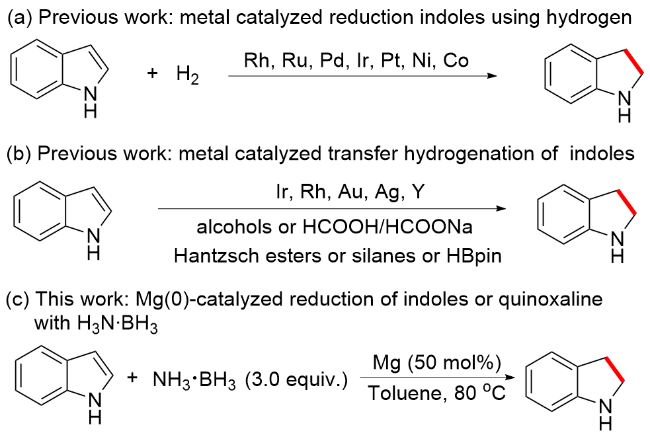
Therefore, transfer hydrogenation reactions that utilize hydrogen equivalents instead of molecular hydrogen provide cost-effective and operationally simpler alternatives, offering enhanced safety and improved selectivity.[6] Over the past two decades, a variety of hydrogen donors, including alcohols,[7] HCOOH/HCOONa,[8] Hantzsch esters,[9] silanes,[10] and pinacolborane (HBpin)[2b,11] have been employed for the catalytic transfer hydrogenation of indoles (Scheme 1b). Ammonia borane (NH3•BH3, AB), a crystalline hydrogen storage material, has attracted significant research interest because of its exceptional physicochemical properties.[12] This compound features a high gravimetric hydrogen capacity (19.6 wt%) while exhibiting non-flammability and stability at room temperature under standard conditions.[13] These properties make AB an attractive candidate for catalytic processes, particularly transfer hydrogenation (TH), where its efficiency has been confirmed in recent investigations. AB has been broadly applied as a hydrogen donor for the reduction of a wide range of unsaturated substrates, including alkenes,[14] alkynes,[15] nitriles,[16] ketones,[17] carboxylic acids,[18] imines,[19] pyridines,[20] azoarenes,[21] and nitroarenes.[22] Nevertheless, the catalytic reduction of indoles and quin- oxalines using AB has rarely been explored.[23] In 2020, Han’s group[24] reported the synthesis of saturated heterocycles via palladium(II) complex-catalyzed reduction of indoles with NH3•BH3 and provided three indole substrates. In 2021, Wu et al.[25] reported the zirconium-cata- lyzed transfer hydrogenation of indoles with AB as a proton and hydride source. Recently, Kishore Natteʼs group developed a method to selectively reduce quinoxalines and indole derivatives to the corresponding saturated heterocyclic compounds using commercially available RuCl3•xH2O as a precatalyst and ammonia borane as a hydrogen source.[26]
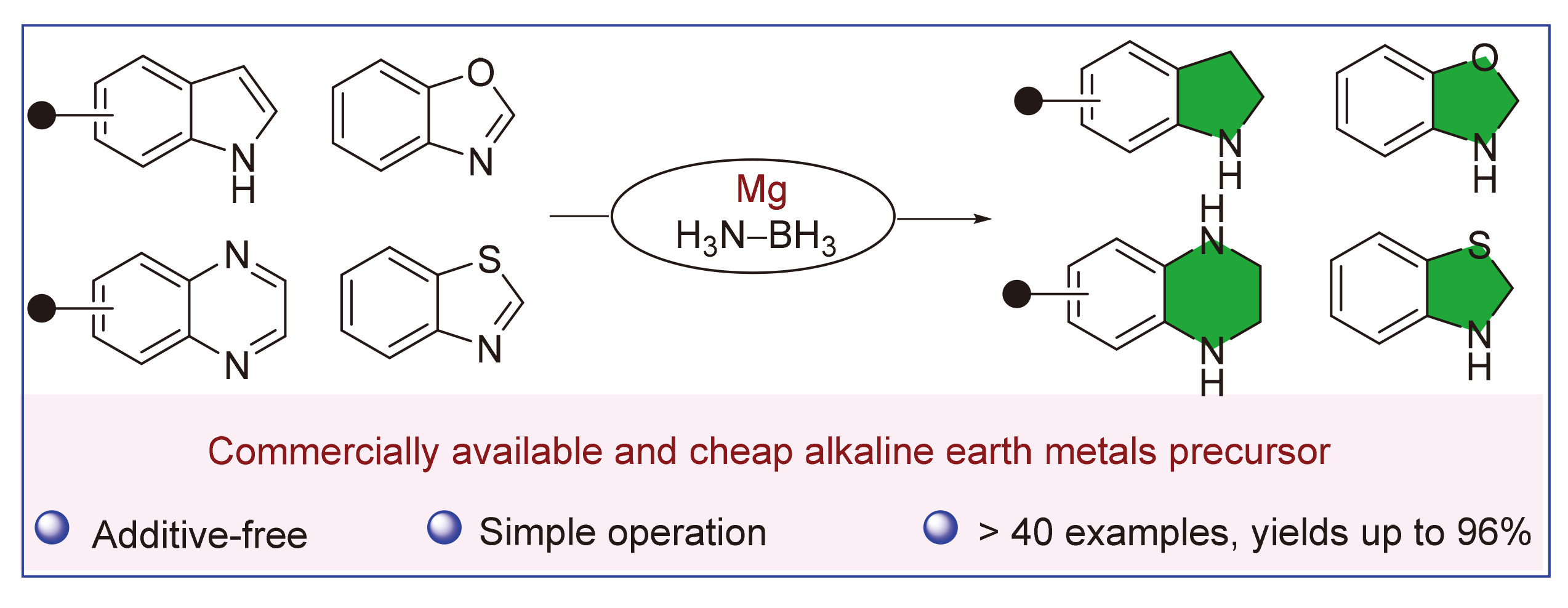
The use of earth-abundant alkaline earth metals as alternatives to transition metals for chemical bond transformations in organic synthesis, consistent with the goals of sustainable chemistry, has attracted growing interest in recent years.[27,28] Among these metals, magnesium stands out as the earliest adopted and most widely employed in organic synthesis.[29] In this context, magnesium catalysis has been limited to the hydrogen functionalization of substrates containing polarized and nonpolarized unsaturated bonds.[30-32] However, there are few reports on the use of magnesium in the reduction of aldehydes and ketones. In 2019, Rueping’s group[33] reported the magnesium(II)- catalyzed asymmetric hydroboration of ketones, and a series of chiral secondary alcohols were constructed with high yields. In addition, the research group have developed MgBu2/HBpin system for the chemoselective reduction of α,β-unsaturated ketones to form a wide range of ketones.[34] In 2023, a method was developed for synthesizing alcohols through the reduction of aldehydes, ketones, and α,β-unsaturated aldehydes/ketones, employing low-cost and commercially available MgCl2 as an effective catalyst.[35] A method for preparing partially saturated heterocyclic compounds via the low catalyst loading of magnesium-catalyzed chemoselective reduction of indoles and quinoxalines using ammonia borane as the hydrogen source has not been reported. Herein, a novel magnesium(0)-catalyzed reduction method for a variety of indoles and quinoxalines is presented, affording partially saturated aromatic heterocyclic compounds using ammonia borane as a H2 equivalent (Scheme 1c).
2 Results and discussion
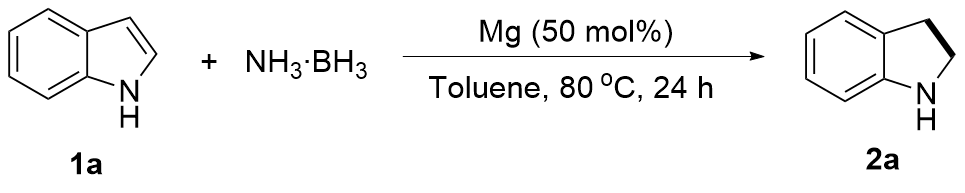
In our preliminary study, 0.2 mmol of indole (1a) was employed as the model substrate with 2 equiv. of ammonia borane as the hydrogen source and 10 mol% MgCl2 as the catalyst. The transfer hydrogenation reaction was conducted in 2.5 mL of toluene at 80 ℃ for 24 h, affording indoline (2a) in 49% yield (Table 1, Entry 1), while a large quantity of starting material remained. Different Mg(II) salts or zero-valent magnesium were subsequently investigated in the presence of 2 equiv. of ammonia borane at 80 ℃ (Table 1, Entries 2~5). The results show that the effect of zero-valent magnesium as a catalyst is better than that of MgSO4, Mg(OTf)2, MgI2 and MgCl2, and the isolated yield of the hydrogenation product indoline reaches 75%. Encouraged by the above experimental results, several well-known metal reducing agents, such as zinc (Zn), aluminum (Al) and manganese (Mn), as catalysts instead of magnesium, were selected, but they did not effectively promote the hydrogenation reaction (Table 1, Entries 6~8). Next, a few solvents, such as Et2O, tetrahydrofuran (THF), CH2Cl2 and CH3CN, were examined and it was found to be ineffective (Table 1, Entries 9~12). When the reaction was carried out at 100 ℃ or 120 ℃, yields of 2a were 77% and 78%, respectively (Table 1, Entries 13 and 14). While raising the temperature to 100 ℃ or 120 ℃ resulted in a modest increase in yield, the improvement was not pronounced. The effect of ammonia borane loading was then assessed by adjusting its amount from 3 equiv. to 4 equiv. (Table 1, Entries 15~16). The findings suggest that increasing the equivalents of ammonia borane facilitates the transfer hydrogenation reaction. However, using 4 equiv. did not lead to a notable enhancement in yield. Therefore, 3 equiv. of ammonia borane was identified as optimal. Although lowering the catalyst loading slightly affected the hydrogenation outcome, it also made the experimental procedure more difficult to handle (Table 1, Entries 18~19). Without Mg(0) as the catalyst, the isolated yield of the hydrogenation product was limited to 14% (Table 1, Entry 20).
Table 1 Optimization of the Mg-catalyzed hydrogenation of 1aa |
| Entry | Catalyst (mol%) | AB/equiv. | Solvent | Temp./℃ | 2a/% |
|---|---|---|---|---|---|
| 1 | MgCl2 (10) | 2.0 | Toluene | 80 | 49 |
| 2 | MgSO4 (10) | 2.0 | Toluene | 80 | 52 |
| 3 | Mg(OTf)2 (10) | 2.0 | Toluene | 80 | 40 |
| 4 | MgI2 (10) | 2.0 | Toluene | 80 | 37 |
| 5 | Mg (50) | 2.0 | Toluene | 80 | 75 |
| 6 | Zn (50) | 2.0 | Toluene | 80 | 50 |
| 7 | Al (50) | 2.0 | Toluene | 80 | 40 |
| 8 | Mn (50) | 2.0 | Toluene | 80 | 45 |
| 9 | Mg (50) | 2.0 | Et2O | 80 | 24 |
| 10 | Mg (50) | 2.0 | THF | 80 | ndb |
| 11 | Mg (50) | 2.0 | CH2Cl2 | 80 | 43 |
| 12 | Mg (50) | 2.0 | CH3CN | 80 | Trace |
| 13 | Mg (50) | 2.0 | Toluene | 100 | 77 |
| 14 | Mg (50) | 2.0 | Toluene | 120 | 78 |
| 15 | Mg (50) | 3.0 | Toluene | 80 | 85 |
| 16 | Mg (50) | 4.0 | Toluene | 80 | 83 |
| 17c | Mg (50) | 3.0 | Toluene | 80 | 71 |
| 18 | Mg (40) | 3.0 | Toluene | 80 | 80 |
| 19 | Mg (30) | 3.0 | Toluene | 80 | 77 |
| 20 | — | 3.0 | Toluene | 80 | 14 |
a Unless otherwise noted, all reactions were performed with 1a (0.2 mmol), AB=ammonia borane, solvent (2.5 mL), 24 h. Isolated yields are given. b Not detected. c The time is 12 h. |
After determining the optimal reaction conditions, a substrate universality study was conducted. First, the scope of indole substrates was studied. It was observed that indole derivatives containing electron-donating groups (such as Me, Et, or OMe) as well as electron-withdrawing groups (such as F, Cl, or Br) at various positions on the indole aromatic ring underwent the reaction successfully. The corresponding indolines (Table 2, 2b~2q) were produced in moderate to good yields ranging from 55% to 95%. Notably, for the halogen-substituted indole derivatives, no dehalogenation byproducts were observed among the hydrogenation products; the lower yields obtained for these substrates were attributed to the substantial amount of unreacted starting material (Table 2, 2i~2o). The presence of electron-withdrawing groups in multiply halogenated indole derivatives did not adversely affect the reaction, with 1p and 1q being converted to the corresponding indolines in 78% and 75% yields, respectively. Introduction of a hydroxyl group at the 7-position of indole was also well tolerated, affording indoline in 64% yield (Table 2, 2r). In addition, the introduction of aryl or substituted aryl groups at other positions of the indole aromatic ring was well tolerated, affording a series of indoline derivatives in 71%~96% yields (Table 2, 2s~2ab).
Table 2 Substrate scope for magnesium(0)-catalyzed hydrogenation of indolesa |

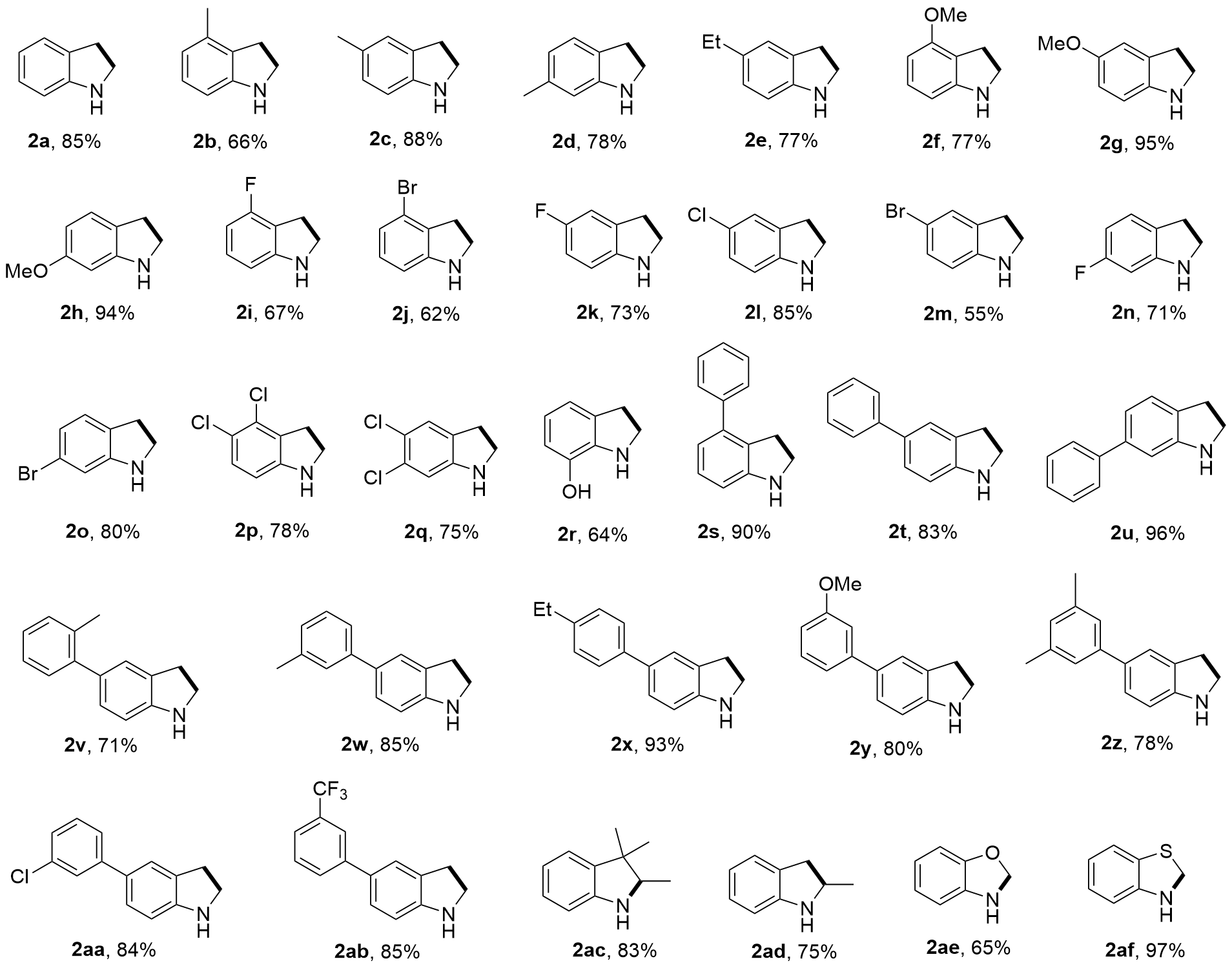 |
a All reactions were performed with 1 (0.2 mmol), Mg (0.1 mmol, 50 mol%), ammonia borane (3.0 equiv.), toluene (2.5 mL), at 80 ℃ under N2 atmosphere for 24 h. Isolated yields were given based on 1. |
Next, the effects of the substituents on the indole heterocyclic skeleton on the reaction were investigated. When the α and β positions of the indole heterocycle are substituted with groups, such as methyl groups, the reaction proceeds smoothly, affording the target compounds in yields of 83% and 75%, respectively (Table 2, 2ac~2ad). Additionally, other heterocyclic compounds, such as benzoxazole and benzothiazole derivatives, did not cause catalyst poisoning and successfully underwent the reaction (65%~97%, 2ae~2af).
Tetrahydroquinoxalines are important structural components that are widely present in natural products and in biological or pharmaceutically active molecules. Thus, their synthesis has received widespread attention and has been significantly improved.[36] Therefore, a magnesium/ ammonia borane catalytic system for the selective hydrogenation of quinoxalines was used. Notably, quinoxaline derivatives substituted with either electron-donating groups (e.g., methyl) or electron-withdrawing groups (e.g., Cl, Br) at different positions underwent efficient conversion, affording the corresponding tetrahydroquinoxaline derivatives in high yields (78%~95%) (Table 3, Entries 4b~4d). Notably, when the ortho-position of quinoxaline contains two phenyl groups in the large conjugated quinoxaline derivative, the reaction proceeds smoothly, and the isolated yield can reach 84% (Table 3, 4e). Other representative aromatic heterocyclic compounds, such as acridine, 1,8-naphthyridine, and quinoline, were tested. When acridine was used as the substrate, 9,10-dihydroacridine was obtained in an isolated yield of 85% (Table 3, 4f). For 1,8-naphthyridine, the product is only one C=N bond reduced under standard conditions, accompanied by a small amount of an unknown compound (Table 3, 4g). Quinoline has been used many times in this catalytic system, but the yield of the detected tetrahydroquinoline derivative products is low, and follow-up research is still in progress (Table 3, 4h).
Table 3 Scope for the Mg(0)-catalyzed reduction of quinoxalinesa |

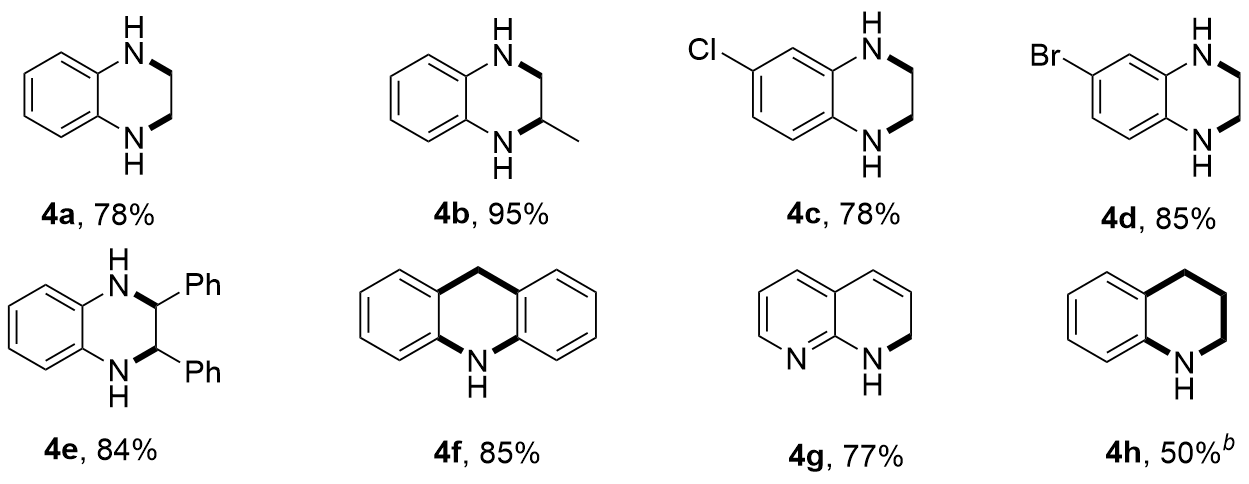 |
a All reactions were performed with 3 (0.2 mmol), Mg (0.1 mmol, 50 mol%), ammonia borane (3.0 equiv.), toluene (2.5 mL), at 80 ℃ under N2 atmosphere for 24 h. Isolated yields were given based on 3. b 1.0 equiv. of ammonia borane was used. |
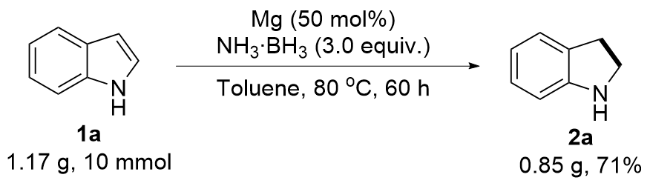
To evaluate the scalability of the Mg/NH3•BH3 system, 1a (1.17 g, 10 mmol) was subjected to the optimized conditions with longer reaction time of 60 h at 80 ℃, affording the target compound 2a in 72% isolated yield (0.85 g). The amount of catalyst (10 mol%) and ammonia borane (2.0 equiv.) were reduced, and the yield of the target compound was 65% (Scheme 2).
The kinetic profile of the Mg-catalyzed reduction of 1a was also investigated to understand the reaction mechanism. The reaction curve for the magnesium(0)-catalyzed reduction of indole indicates that the hydrogenation proceeds slowly with no detectable product formation in the first hour, during which only starting material is present. After 2.5 h of reaction, the conversion rate was close to 50%, and the yield of product 2a was 45%. After reaction time 12 h, the yield of the target compound was 71% (Figure 1a).
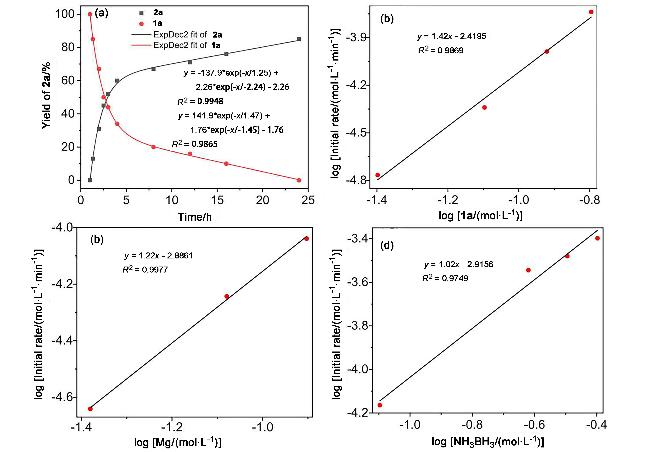
The kinetic profile of 1a hydrogenation at various concentrations of 1a, Mg(0), or NH3•BH3 was observed. The reaction orders with respect to the substrate and catalyst were 1.42 and 1.22, respectively, indicating that the rate of hydrogenation enhances with alleviating initial concentration of Mg/indole (Figures 1b and 1c). The findings suggest that the indole substrate and the Mg(0) catalyst are likely involved in the initial phase of the reduction process. The initial reaction rate (Δ[2a]/Δt) displayed a first-order dependence on the content of NH3•BH3, as its initial concentration was varied from 0.08 mol/L to 0.4 mol/L. This observation implies that NH3•BH3 may participate in the rate-determining step or at least influence the early stage of the hydrogenation reaction (Figure 1d).
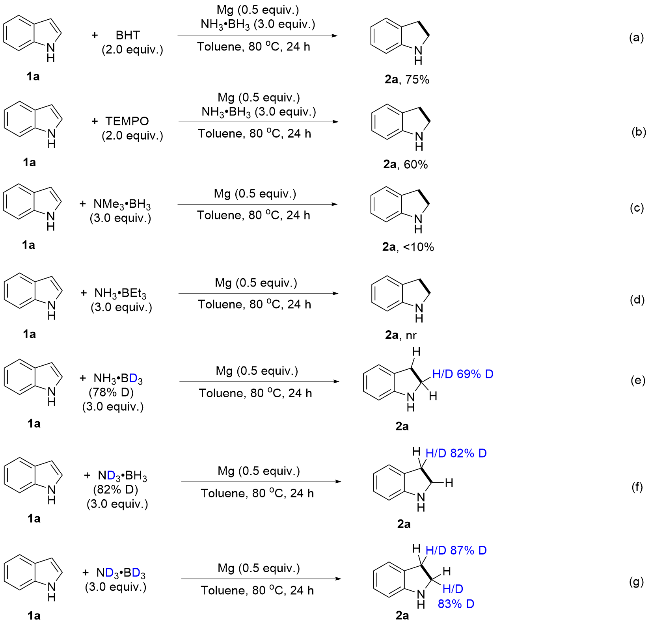
To further investigate the mechanism of magnesium- catalyzed reduction of indole to indoline, a series of control experiments were performed. Indole 1a was reduced successfully, though with a slightly lower yield, in the presence of 2.0 equiv. of 2,6-di-tert-butyl-4-methylphenol (BHT) and 2,2,6,6-tetramethylpiperidin-1-oxyl (TEMPO), indicating that the reaction does not proceed via a free radical pathway (Schemes 3a and 3b). When Me3NBH3 was employed as a substitute for ammonia borane under the standard conditions, the reaction proceeded poorly, yielding less than 10% the product, which was consistent with the results obtained using NH3BEt3 (Sche- mes 3c and 3d). Next, indole was selected as the substrate for deuterium labeling experiments. It was found that 82% and 69% of the D atoms were embedded in the 3rd and 2nd positions of the indole when ND3•BH3 and NH3•BD3 were used to replace ammonia borane, respectively (Scheme 3e and 3f). Considering the hydrogen atoms that may be introduced by the catalyst and other proton sources in the system, this D-atom embedding ratio is reasonable.


3 Conclusions
In summary, an alkaline earth metal-catalyzed transfer hydrogenation protocol for N-heteroarenes has been developed, using ammonia borane as the hydrogen source. This system enables high yields (up to 96%) in the reduction of unprotected indoles and quinoxalines. Using a low loading of Mg(0) catalyst and ammonia borane, the reaction efficiently produces the reduced products while tolerating various sensitive functional groups, including halogens (F, Cl, Br), trifluoromethyl, and hydroxyl groups. Preliminary mechanistic insights have been gained through deuteration experiments and kinetic studies. Further investigations, including detailed mechanistic studies via DFT calculations and expanded applications of this system, are currently in progress.
4 Experimental section
4.1 Instruments and reagents
All reactions dealing with air or moisture-sensitive compounds were carried out in a dried Schlenk tube under atmosphere of nitrogen. Analytical thin-layer chromato- graphy was performed on glass plates coated with 0.25 mm 230~400 mesh silica gel containing a fluorescent indicator (Merck). Flash silica gel column chromatography was performed on silica gel 60N (spherical and neutral, 140~325 mesh) as described by Still. 1H NMR spectra were measured on a JNM-ECZ400S (JEOL, Japan) spectrometer. 1H NMR spectra were recorded at 400 MHz in CDCl3 or DMSO-d6, and internally referenced to tetramethylsilane as a standard, while 13C NMR spectra were recorded at 100 MHz and referenced to the solvent resonance. Melting points were determined with a X-5 (Beijing Tech Instrument Co., Ltd).
Unless otherwise noted, materials were purchased from Tokyo Chemical Industry Co., Aldrich Inc., Titan, Adamas-beta. and other commercial suppliers, and used as received. Solvents were dried over sodium (for THF, toluene) by refluxing for overnight and freshly distilled prior to use. The magnesium strip was polished with sandpaper and cut into magnesium chips.
4.2 General procedure for Mg-catalyzed hydrogenation of indoles
A mixture of indoles (0.2 mmol), Mg (0.0024 g, 50 mol%) and NH3•BH3 (0.0185 g, 3.0 equiv.) were added to an oven dried Schlenk tube under atmosphere of nitrogen. Toluene (2.5 mL) were added by syringe. The reaction mixture was stirred at 80 ℃ for 24 h. After quenching with saturated NH4Cl/H2O (10 mL), the crude product was extracted with EtOAc (10 mL×3). The combined organic phases were dried over anhydrous Na2SO4 and concentrated under vacuum. The crude product was purified by column chromatography to afford the desired hydrogenation compound.
Indoline (2a):[25] The general procedure was applied to indole (23.4 mg, 0.2 mmol) under an atmosphere of N2 at 80 ℃ for 24 h. The crude product was purified by column chromatography on silica gel (petroleum ether/EtOAc, V∶V=5∶1) to afford the title compound as pale yellow liquid (20.3 mg, 85% yield). 1H NMR (400 MHz, CDCl3) δ: 7.14 (d, J=7.3 Hz, 1H), 7.03 (t, J=7.5 Hz, 1H), 6.72 (t, J=7.4 Hz, 1H), 6.67 (d, J=7.8 Hz, 1H), 3.56 (t, J=8.3 Hz, 2H), 3.33 (s, 1H), 3.04 (t, J=8.4 Hz, 2H); 13C NMR (100 MHz, CDCl3) δ: 151.5, 129.3, 127.2, 124.6, 118.7, 109.4, 47.3, 29.8.
4-Methylindoline (2b):[25] The general procedure was applied to 4-methylindole (26.2 mg, 0.2 mmol) under an atmosphere of N2 at 80 ℃ for 24 h. The crude product was purified by column chromatography on silica gel (petroleum ether/EtOAc, V∶V=5∶1) to afford the title compound as pale yellow liquid (17.5 mg, 66% yield). 1H NMR (400 MHz, CDCl3) δ: 6.95 (t, J=7.6 Hz, 1H), 6.55 (d, J=7.5 Hz, 1H), 6.51 (d, J=7.8 Hz, 1H), 3.57 (t, J=8.4 Hz, 2H), 2.97 (t, J=8.4 Hz, 2H), 2.23 (s, 3H); 13C NMR (100 MHz, CDCl3) δ: 151.3, 134.2, 128.1, 127.2, 119.8, 106.9, 47.0, 28.5, 18.8.
5-Methylindoline (2c):[25] The general procedure was applied to 5-methylindole (26.2 mg, 0.2 mmol) under an atmosphere of N2 at 80 ℃ for 24 h. The crude product was purified by column chromatography on silica gel (petroleum ether/EtOAc, V∶V=5∶1) to afford the title compound as pale yellow liquid (23.5 mg, 88% yield). 1H NMR (400 MHz, CDCl3) δ: 6.97 (s, 1H), 6.85 (d, J=7.8 Hz, 1H), 6.59 (d, J=7.8 Hz, 1H), 3.54 (t, J=8.3 Hz, 2H), 3.01 (t, J=8.3 Hz, 2H), 2.27 (s, 3H); 13C NMR (100 MHz, CDCl3) δ: 149.1, 129.7, 128.0, 127.4, 125.4, 109.4, 47.5, 29.9, 20.7.
6-Methylindoline (2d):[25] The general procedure was applied to 6-methylindole (26.2 mg, 0.2 mmol) under an atmosphere of N2 at 80 ℃ for 24 h. The crude product was purified by column chromatography on silica gel (petroleum ether/EtOAc, V∶V=5∶1) to afford the title compound as pale yellow liquid (20.7 mg, 78% yield). 1H NMR (400 MHz, CDCl3) δ: 7.02 (d, J=7.4 Hz, 1H), 6.57~6.50 (m, 2H), 3.55 (t, J=8.3 Hz, 2H), 3.00 (t, J=8.3 Hz, 2H), 2.28 (s, 3H); 13C NMR (100 MHz, CDCl3) δ: 151.8, 137.0, 126.3, 124.2, 119.3, 110.3, 47.5, 29.4, 21.4.
5-Ethylindoline (2e): The general procedure was applied to 5-ethylindole (29.0 mg, 0.2 mmol) under an atmosphere of N2 at 80 ℃ for 24 h. The crude product was purified by column chromatography on silica gel (petroleum ether/EtOAc, V∶V=5∶1) to afford the title compound as pale yellow liquid (22.6 mg, 77% yield). 1H NMR (400 MHz, CDCl3) δ: 7.00 (s, 1H), 6.87 (d, J=7.9 Hz, 1H), 6.61 (d, J=7.9 Hz, 1H), 3.55 (t, J=8.3 Hz, 2H), 3.05~3.00 (m, 2H), 2.57 (q, J=7.6 Hz, 2H), 1.22 (t, J=7.6 Hz, 3H); 13C NMR (100 MHz, CDCl3) δ: 149.4, 134.9, 129.6, 126.4, 124.2, 109.4, 47.5, 29.9, 28.3, 16.2. HRMS (ESI) calcd for C10H14N [M+H]+ 148.1126, found 148.1124.
4-Methoxyindoline (2f):[37a] The general procedure was applied to 4-methoxyindole (29.4 mg, 0.2 mmol) under an atmosphere of N2 at 80 ℃ for 24 h. The crude product was purified by column chromatography on silica gel (petroleum ether/EtOAc, V∶V=5∶1) to afford the title compound as pale yellow liquid (23.1 mg, 77% yield). 1H NMR (400 MHz, CDCl3) δ: 7.01 (t, J=8.0 Hz, 1H), 6.35~6.30 (m, 2H), 3.83 (s, 3H), 3.57 (t, J=8.5 Hz, 2H), 3.00 (t, J=8.5 Hz, 2H); 13C NMR (100 MHz, CDCl3) δ: 156.4, 153.3, 128.5, 115.7, 103.1, 101.5, 55.2, 47.4, 26.8.
5-Methoxyindoline (2g):[25] The general procedure was applied to 5-methoxyindole (29.4 mg, 0.2 mmol) under an atmosphere of N2 at 80 ℃ for 24 h. The crude product was purified by column chromatography on silica gel (petroleum ether/EtOAc, V∶V=5∶1) to afford the title compound as yellow liquid (28.2 mg, 95% yield). 1H NMR (400 MHz, CDCl3) δ: 6.77 (s, 1H), 6.61 (s, 2H), 3.75 (s, 3H), 3.54 (t, J=8.3 Hz, 2H), 3.02 (t, J=8.3 Hz, 2H); 13C NMR (100 MHz, CDCl3) δ: 153.4, 145.2, 131.1, 112.0, 111.5, 110.1, 55.9, 47.8, 30.4.
6-Methoxyindoline (2h):[2b] The general procedure was applied to 6-methoxyindole (29.4 mg, 0.2 mmol) under an atmosphere of N2 at 80 ℃ for 24 h. The crude product was purified by column chromatography on silica gel (petroleum ether/EtOAc, V∶V=5∶1) to afford the title compound as pale yellow liquid (28.0 mg, 94% yield). 1H NMR (400 MHz, CDCl3) δ: 7.00 (d, J=8.6 Hz, 1H), 6.27~6.24 (m, 2H), 3.76 (s, 3H), 3.56 (t, J=8.3 Hz, 2H), 2.96 (t, J=8.3 Hz, 2H); 13C NMR (100 MHz, CDCl3) δ: 159.8, 152.9, 124.6, 121.5, 103.2, 96.3, 55.3, 47.9, 28.9.
4-Fluoroindoline (2i): The general procedure was applied to 4-fluoroindole (27.0 mg, 0.2 mmol) under an atmosphere of N2 at 80 ℃ for 24 h. The crude product was purified by column chromatography on silica gel (petroleum ether/EtOAc, V∶V=5∶1) to afford the title compound as pale yellow liquid (18.3 mg, 67% yield). 1H NMR (400 MHz, CDCl3) δ: 7.00~6.94 (m, 1H), 6.42~6.37 (m, 2H), 3.61 (t, J=8.5 Hz, 2H), 3.07 (t, J=8.4 Hz, 2H); 13C NMR (100 MHz, CDCl3) δ: 159.9 (d, J=242.8 Hz), 154.5 (d, J=8.8 Hz), 129.0 (d, J=8.6 Hz), 114.7 (d, J=21.3 Hz), 105.5 (d, J=21.0 Hz), 105.0 (d, J=2.7 Hz), 47.5, 26.1; 19F NMR (376 MHz, CDCl3) δ: -118.94. HRMS (ESI) calcd for C8H9FN [M+H]+ 138.0719, found 138.0717.
4-Bromoindoline (2j):[26] The general procedure was applied to 4-bromoindole (39.2 mg, 0.2 mmol) under an atmosphere of N2 at 80 ℃ for 24 h. The crude product was purified by column chromatography on silica gel (petroleum ether/EtOAc, V∶V=5∶1) to afford the title compound as pale yellow liquid (24.7 mg, 62% yield). 1H NMR (400 MHz, CDCl3) δ: 6.87 (t, J=7.5 Hz, 1H), 6.81 (d, J=6.9 Hz, 1H), 6.52 (d, J=7.5 Hz, 1H), 3.90 (s, 1H), 3.59 (t, J=8.6 Hz, 2H), 3.05 (t, J=8.5 Hz, 2H); 13C NMR (100 MHz, CDCl3) δ: 152.6, 129.7, 128.9, 121.2, 119.7, 107.7, 46.3, 31.1.
5-Fluoroindoline (2k):[37b] The general procedure was applied to 5-fluoroindole (27.0 mg, 0.2 mmol) under an atmosphere of N2 at 80 ℃ for 24 h. The crude product was purified by column chromatography on silica gel (petroleum ether/EtOAc, V∶V=5∶1) to afford the title compound as pale yellow liquid (20.0 mg, 73% yield). 1H NMR (400 MHz, CDCl3) δ: 6.84 (d, J=7.2 Hz, 1H), 6.74~6.68 (m, 1H), 6.54 (dd, J=8.5, 4.4 Hz, 1H), 3.56 (t, J=8.4 Hz, 2H), 3.02 (t, J=8.4 Hz, 2H); 13C NMR (100 MHz, CDCl3) δ: 157.0 (d, J=233.6 Hz), 147.4, 131.2 (d, J=8.2 Hz), 113.1 (d, J=23.0 Hz), 112.0 (d, J=23.8 Hz), 109.5 (d, J=8.3 Hz), 47.9, 30.1; 19F NMR (376 MHz, CDCl3) δ: -126.53.
5-Chloroindoline (2l):[2b] The general procedure was applied to 5-chloroindole (30.3 mg, 0.2 mmol) under an atmosphere of N2 at 80 ℃ for 24 h. The crude product was purified by column chromatography on silica gel (petroleum ether/EtOAc, V∶V=5∶1) to afford the title compound as pale yellow liquid (26.0 mg, 85% yield). 1H NMR (400 MHz, CDCl3) δ: 7.06 (s, 1H), 6.96 (d, J=8.2 Hz, 1H), 6.53 (d, J=8.2 Hz, 1H), 3.56 (t, J=8.4 Hz, 2H), 3.01 (t, J=8.4 Hz, 2H); 13C NMR (100 MHz, CDCl3) δ: 150.2, 131.2, 126.9, 124.7, 123.0, 109.9, 47.6, 29.7.
5-Bromoindoline (2m):[37b] The general procedure was applied to 5-bromoindole (39.2 mg, 0.2 mmol) under an atmosphere of N2 at 80 ℃ for 24 h. The crude product was purified by column chromatography on silica gel (petroleum ether/EtOAc, V∶V=5∶1) to afford the title compound as pale yellow liquid (21.6 mg, 55% yield). 1H NMR (400 MHz, CDCl3) δ: 7.19 (s, 1H), 7.09 (d, J=8.7 Hz, 1H), 6.50 (d, J=8.2 Hz, 1H), 3.56 (t, J=8.5 Hz, 2H), 3.01 (t, J=8.5 Hz, 2H); 13C NMR (100 MHz, CDCl3) δ: 150.7, 131.7, 129.8, 127.5, 110.5, 110.0, 47.5, 29.7.
6-Fluoroindoline (2n):[25] The general procedure was applied to 6-fluoroindole (27.0 mg, 0.2 mmol) under an atmosphere of N2 at 80 ℃ for 24 h. The crude product was purified by column chromatography on silica gel (petroleum ether/EtOAc, V∶V=5∶1) to afford the title compound as pale yellow liquid (19.4 mg, 71% yield). 1H NMR (400 MHz, CDCl3) δ: 6.99 (t, J=6.7 Hz, 1H), 6.39~6.30 (m, 2H), 3.68 (s, 1H), 3.59 (t, J=8.4 Hz, 2H), 2.98 (t, J=8.4 Hz, 2H); 13C NMR (100 MHz, CDCl3) δ: 163.0 (d, J=239.6 Hz), 153.0 (d, J=11.8 Hz), 124.8 (d, J=10.5 Hz), 124.5 (d, J=2.2 Hz), 104.3 (d, J=22.4 Hz), 97.0 (d, J=26.2 Hz), 48.0, 28.9; 19F NMR (376 MHz, CDCl3) δ: -116.44.
6-Bromoindoline (2o):[25] The general procedure was applied to 6-bromoindole (39.2 mg, 0.2 mmol) under an atmosphere of N2 at 80 ℃ for 24 h. The crude product was purified by column chromatography on silica gel (petroleum ether/EtOAc, V∶V=5∶1) to afford the title compound as pale yellow liquid (31.6 mg, 80% yield). 1H NMR (400 MHz, CDCl3) δ: 6.94 (d, J=7.7 Hz, 1H), 6.79 (d, J=7.8 Hz, 1H), 6.74 (s, 1H), 3.76 (s, 1H), 3.57 (t, J=8.5 Hz, 2H), 2.96 (t, J=8.6 Hz, 2H); 13C NMR (100 MHz, CDCl3) δ: 153.1, 128.3, 125.7, 121.1, 120.6, 112.1, 47.6, 29.2.
4,5-Dichloroindoline (2p): The general procedure was applied to 4,5-dichloroindole (37.2 mg, 0.2 mmol) under an atmosphere of N2 at 80 ℃ for 24 h. The crude product was purified by column chromatography on silica gel (petroleum ether/EtOAc, V∶V=5∶1) to afford the title compound as pale yellow solid (29.2 mg, 78% yield). m.p. 65.1~66.6 ℃; 1H NMR (400 MHz, CDCl3) δ: 7.06 (d, J=8.3 Hz, 1H), 6.42 (d, J=8.3 Hz, 1H), 3.84 (s, 1H), 3.63 (d, J=8.6 Hz, 2H), 3.09 (t, J=8.6 Hz, 2H); 13C NMR (100 MHz, CDCl3) δ: 151.2, 129.6, 128.9, 128.7, 120.6, 107.8, 47.2, 30.0. HRMS (ESI) calcd for C8H8Cl2N [M+H]+: 188.0034, found 188.0035.
5,6-Dichloroindoline (2q): The general procedure was applied to 5,6-dichloroindole (37.2 mg, 0.2 mmol) under an atmosphere of N2 at 80 ℃ for 24 h. The crude product was purified by column chromatography on silica gel (petroleum ether/EtOAc, V∶V=5∶1) to afford the title compound as pale yellow solid (28.2 mg, 75% yield). m.p. 66.8~67.3 ℃; 1H NMR (400 MHz, CDCl3) δ: 7.11 (s, 1H), 6.65 (s, 1H), 3.59 (t, J=8.4 Hz, 2H), 2.99 (t, J=7.9 Hz, 2H); 13C NMR (100 MHz, CDCl3) δ: 151.2, 130.4, 129.8, 125.9, 120.6, 110.3, 47.7, 29.2. HRMS (ESI) calcd for C8H8Cl2N [M+H]+: 188.0034, found 188.0030.
7-Hydroxyindoline (2r):[37c] The general procedure was applied to 7-hydroxyindole (26.6 mg, 0.2 mmol) under an atmosphere of N2 at 80 ℃ for 24 h. The crude product was purified by column chromatography on silica gel (petroleum ether/EtOAc, V∶V=5∶1) to afford the title compound as pale yellow liquid (17.3 mg, 64% yield). 1H NMR (400 MHz, DMSO-d6) δ: 8.70 (s, 1H), 6.56 (d, J=7.1 Hz, 1H), 6.47 (d, J=6.7 Hz, 1H), 6.43~6.38 (m, 1H), 4.72 (s, 1H), 3.37 (t, J=8.5 Hz, 2H), 2.87 (t, J=8.5 Hz, 2H); 13C NMR (100 MHz, DMSO-d6) δ: 142.1, 140.0, 130.1, 118.0, 115.6, 113.7, 46.9, 30.1.
4-Phenylindoline (2s): The general procedure was applied to 4-phenylindole (38.6 mg, 0.2 mmol) under an atmosphere of N2 at 80 ℃ for 24 h. The crude product was purified by column chromatography on silica gel (petroleum ether/EtOAc, V∶V=5∶1) to afford the title compound as pale yellow liquid (35.0 mg, 90% yield). 1H NMR (400 MHz, CDCl3) δ: 7.51~7.48 (m, 2H), 7.47~7.42 (m, 2H), 7.39~7.33 (m, 1H), 7.15 (t, J=7.7 Hz, 1H), 6.83 (d, J=7.7 Hz, 1H), 6.69 (d, J=7.7 Hz, 1H), 3.56 (t, J=8.3 Hz, 2H), 3.14 (t, J=8.3 Hz, 2H); 13C NMR (100 MHz, CDCl3) δ: 152.1, 141.0, 138.4, 128.2, 127.7, 126.9, 126.9, 119.2, 108.4, 47.5, 29.8.
5-Phenylindoline (2t):[37d] The general procedure was applied to 5-phenylindole (38.6 mg, 0.2 mmol) under an atmosphere of N2 at 80 ℃ for 24 h. The crude product was purified by column chromatography on silica gel (petroleum ether/EtOAc, V∶V=5∶1) to afford the title compound as pale yellow liquid (32.4 mg, 83% yield). 1H NMR (400 MHz, CDCl3) δ: 7.58~7.56 (m, 2H), 7.45~7.40 (m, 3H), 7.32~7.27 (m, 2H), 6.73 (d, J=8.0 Hz, 1H), 3.62 (t, J=8.4 Hz, 2H), 3.40 (s, 1H), 3.12 (t, J=8.4 Hz, 2H); 13C NMR (100 MHz, CDCl3) δ: 151.1, 141.7, 132.0, 130.0, 128.6, 126.5, 126.3, 126.0, 123.5 109.4, 47.5, 29.7.
6-Phenylindoline (2u): The general procedure was applied to 6-phenylindole (38.6 mg, 0.2 mmol) under an atmosphere of N2 at 80 ℃ for 24 h. The crude product was purified by column chromatography on silica gel (petroleum ether/EtOAc, V∶V=5∶1) to afford the title compound as pale white solid (37.3 mg, 96% yield). m.p. 62.0~63.5 ℃; 1H NMR (400 MHz, CDCl3) δ: 7.59 (d, J=8.3 Hz, 2H), 7.44 (t, J=7.5 Hz, 2H), 7.35 (t, J=6.6 Hz, 1H), 7.21 (d, J=7.6 Hz, 1H), 6.98 (d, J=7.6 Hz, 1H), 6.90 (s, 1H), 3.62 (t, J=8.4 Hz, 2H), 3.10 (t, J=8.3 Hz, 2H); 13C NMR (100 MHz, CDCl3) δ: 152.2, 141.8, 140.8, 128.6, 128.5, 127.1, 126.8, 124.7, 117.9, 108.1, 47.5, 29.5.
5-(o-Tolyl)indoline (2v): The general procedure was applied to 5-(o-tolyl)indole (41.7 mg, 0.2 mmol) under an atmosphere of N2 at 80 ℃ for 24 h. The crude product was purified by column chromatography on silica gel (petroleum ether/EtOAc, V∶V=5∶1) to afford the title compound as pale yellow liquid (29.7 mg, 71% yield). 1H NMR (400 MHz, CDCl3) δ: 7.29~7.22 (m, 4H), 7.12 (s, 1H), 7.01 (d, J=7.9 Hz, 1H), 6.71 (d, J=7.9 Hz, 1H), 3.63 (t, J=8.4 Hz, 2H), 3.10 (t, J=8.3 Hz, 2H), 2.34 (s, 3H); 13C NMR (100 MHz, CDCl3) δ: 150.4, 142.4, 135.4, 132.5, 130.2, 129.9, 129.1, 128.2 126.5, 125.6, 125.6, 108.8, 47.5, 29.8, 20.7. HRMS (ESI) calcd for C15H16N [M+H]+ 210.1283, found 210.1279.
5-(m-Tolyl)indoline (2w): The general procedure was applied to 5-(m-tolyl)indole (41.7 mg, 0.2 mmol) under an atmosphere of N2 at 80 ℃ for 24 h. The crude product was purified by column chromatography on silica gel (petroleum ether/EtOAc, V∶V=5∶1) to afford the title compound as pale yellow liquid (35.6 mg, 85% yield). 1H NMR (400 MHz, CDCl3) δ: 7.43~7.35 (m, 3H), 7.34~ 7.29 (m, 2H), 7.12 (d, J=7.3 Hz, 1H), 6.72 (d, J=8.0 Hz, 1H), 3.62 (t, J=8.4 Hz, 2H), 3.12 (t, J=8.4 Hz, 2H), 2.44 (s, 3H); 13C NMR (100 MHz, CDCl3) δ: 151.0, 141.7, 138.1, 132.1, 129.9, 128.5, 127.3, 126.8, 126.3, 123.6, 123.5 109.3, 47.5, 29.7, 21.5. HRMS (ESI) calcd for C15H16N [M+H]+ 210.1283, found 210.1285.
5-(4-Ethylphenyl)indoline (2x): The general procedure was applied to 5-(4-ethylphenyl)indole (44.5 mg, 0.2 mmol) under an atmosphere of N2 at 80 ℃ for 24 h. The crude product was purified by column chromatography on silica gel (petroleum ether/EtOAc, V∶V=5∶1) to afford the title compound as pale yellow liquid (41.8 mg, 93% yield). 1H NMR (400 MHz, CDCl3) δ: 7.52~7.49 (m, 2H), 7.40 (s, 1H), 7.32~7.26 (m, 3H), 6.73 (d, J=8.0 Hz, 1H), 3.62 (t, J=8.4 Hz, 2H), 3.12 (t, J=8.4 Hz, 2H), 2.72 (q, J=7.6 Hz, 2H), 1.32 (t, J=7.6 Hz, 3H); 13C NMR (100 MHz, CDCl3) δ: 150.9, 142.0, 139.1, 132.0, 129.9, 128.1, 126.4, 126.1, 123.3, 109.4, 47.5, 29.8, 28.4, 15.6. HRMS (ESI) calcd for C16H18N [M+H]+ 224.1439, found 224.1440.
5-(3-Methoxyphenyl)indoline (2y): The general procedure was applied to 5-(3-methoxyphenyl)indole (44.7 mg, 0.2 mmol) under an atmosphere of N2 at 80 ℃ for 24 h. The crude product was purified by column chromatography on silica gel (petroleum ether/EtOAc, V∶V=5∶1) to afford the title compound as pale yellow liquid (35.9 mg, 80% yield). 1H NMR (400 MHz, CDCl3) δ: 7.39 (s, 1H), 7.35~7.28 (m, 2H), 7.16~7.14 (m, 1H), 7.11~7.09 (m, 1H), 6.86~6.83 (m, 1H), 6.71 (d, J=8.1 Hz, 1H), 3.87 (s, 3H), 3.62 (t, J=8.5 Hz, 2H), 3.10 (t, J=8.2 Hz, 2H); 13C NMR (100 MHz, CDCl3) δ: 159.8, 151.3, 143.2, 131.7, 129.9, 129.5, 126.3, 123.5, 119.1, 112.1, 111.5, 109.3, 55.2, 47.5, 29.7. HRMS (ESI) calcd for C15H16NO [M+H]+ 226.1232, found 226.1232.
5-(3,5-Dimethylphenyl)indoline (2z): The general procedure was applied to 5-(3,5-dimethylphenyl)indole (44.5 mg, 0.2 mmol) under an atmosphere of N2 at 80 ℃ for 24 h. The crude product was purified by column chromatography on silica gel (petroleum ether/EtOAc, V∶V=5∶1) to afford the title compound as pale yellow liquid (35.0 mg, 78% yield). 1H NMR (400 MHz, CDCl3) δ: 7.40 (s, 1H), 7.30 (d, J=8.1 Hz, 1H), 7.20 (s, 2H), 6.96 (s, 1H), 6.72 (d, J=8.0 Hz, 1H), 3.62 (t, J=8.4 Hz, 2H), 3.11 (t, J=8.4 Hz, 2H), 2.40 (s, 6H); 13C NMR (100 MHz, CDCl3) δ: 151.0, 141.7, 138.0, 132.2, 129.9, 127.7, 126.3 124.5, 123.5, 109.3, 47.5, 29.7, 21.4. HRMS (ESI) calcd for C16H18N [M+H]+ 224.1434, found 224.1438.
5-(3-Chlorophenyl)indoline (2aa): The general procedure was applied to 5-(3-chlorophenyl)indole (45.5 mg, 0.2 mmol) under an atmosphere of N2 at 80 ℃ for 24 h. The crude product was purified by column chromatography on silica gel (petroleum ether/EtOAc, V∶V=5∶1) to afford the title compound as pale yellow liquid (38.5 mg, 84% yield). 1H NMR (400 MHz, CDCl3) δ: 7.54 (t, J=1.9 Hz, 1H), 7.44~7.40 (m, 1H), 7.38~7.21 (m, 4H), 6.70 (d, J=8.1 Hz, 1H), 3.62 (t, J=8.4 Hz, 2H), 3.10 (t, J=8.4 Hz, 2H); 13C NMR (100 MHz, CDCl3) δ: 151.6, 143.5, 134.4, 130.3, 130.1, 129.8, 126.4, 126.3, 125.9, 124.5, 123.4, 109.3, 47.5, 29.6. HRMS (ESI) calcd for C14H13ClN [M+H]+ 230.0737, found 230.0737.
5-(3-(Trifluoromethyl)phenyl)indoline (2ab): The general procedure was applied to 5-(3-(trifluoromethyl) phenyl)indole (52.3 mg, 0.2 mmol) under an atmosphere of N2 at 80 ℃ for 24 h. The crude product was purified by column chromatography on silica gel (petroleum ether/EtOAc, V∶V=5∶1) to afford the title compound as pale yellow liquid (44.8 mg, 85% yield). 1H NMR (400 MHz, CDCl3) δ: 7.80 (s, 1H), 7.73~7.69 (m, 1H), 7.55~7.46 (m, 2H), 7.40 (s, 1H), 7.31~7.28 (m, 1H), 6.73 (d, J=8.1 Hz, 1H), 3.89 (s, 1H), 3.64 (t, J=8.4 Hz, 2H), 3.12 (t, J=8.4 Hz, 2H); 13C NMR (100 MHz, CDCl3) δ: 151.7, 142.4, 130.9 (q, J=31.7 Hz), 130.3, 130.2, 129.6, 129.0, 126.5, 124.3 (q, J=270.6 Hz), 123.5, 123.1 (q, J=3.7 Hz), 122.6 (q, J=3.7 Hz), 109.4, 47.5, 29.6; 19F NMR (376 MHz, CDCl3) δ: -62.37. HRMS (ESI) calcd for C15H13F3N [M+H]+ 264.1000, found 264.0999.
2,3,3-Trimethylindoline (2ac):[25] The general procedure was applied to 2,3,3-trimethylindole (31.8 mg, 0.2 mmol) under an atmosphere of N2 at 80 ℃ for 24 h. The crude product was purified by column chromatography on silica gel (petroleum ether/EtOAc, V∶V=5∶1) to afford the title compound as pale yellow liquid (26.6 mg, 83% yield). 1H NMR (400 MHz, CDCl3) δ: 7.06~7.02 (m, 2H), 6.78~6.75 (m, 1H), 6.65 (d, J=7.6 Hz, 1H), 3.53 (q, J=6.5 Hz, 1H), 1.30 (s, 3H), 1.20 (d, J=6.5 Hz, 3H), 1.06 (s, 3H); 13C NMR (100 MHz, CDCl3) δ: 149.2, 139.1, 127.1, 122.2, 118.8, 109.4, 65.1, 43.3, 26.1, 22.3, 15.1.
2-Methylindoline (2ad):[26] The general procedure was applied to 2-methylindole (26.2 mg, 0.2 mmol) under an atmosphere of N2 at 80 ℃ for 24 h. The crude product was purified by column chromatography on silica gel (petroleum ether/EtOAc, V∶V=5∶1) to afford the title compound as pale yellow liquid (19.9 mg, 75% yield). 1H NMR (400 MHz, CDCl3) δ: 7.09 (d, J=8.5 Hz, 1H), 7.06~6.99 (m, 1H), 6.71 (t, J=6.9 Hz, 1H), 6.62 (d, J=7.1 Hz, 1H), 4.05~3.96 (m, 1H), 3.16 (dd, J=15.1, 8.1 Hz, 1H), 2.65 (dd, J=15.4, 7.8 Hz, 1H), 1.30 (d, J=6.2 Hz, 3H); 13C NMR (100 MHz, CDCl3) δ: 150.9, 128.9, 127.2, 124.7 118.5, 109.2, 55.2 37.7, 22.2.
2,3-Dihydrobenzo[d]oxazole (2ae):[23] The general procedure was applied to benzo[d]oxazole (23.8 mg, 0.2 mmol) under an atmosphere of N2 at 80 ℃ for 24 h. The crude product was purified by column chromatography on silica gel (petroleum ether/EtOAc, V∶V=2∶1) to afford the title compound as pale colorless liquid (15.7 mg, 65% yield). m.p. 139.5~140.2 ℃; 1H NMR (400 MHz, CDCl3) δ: 6.91 (t, J=7.4 Hz, 1H), 6.70 (d, J=7.8 Hz, 1H), 6.69~6.59 (m, 2H), 4.66 (s, 1H), 2.87 (s, 2H); 13C NMR (100 MHz, CDCl3) δ: 143.5, 138.2, 121.7, 117.6, 114.3, 111.7, 30.9.
2,3-Dihydrobenzo[d]thiazole (2af):[23] The general procedure was applied to benzo[d]thiazole (27.0 mg, 0.2 mmol) under an atmosphere of N2 at 80 ℃ for 24 h. The crude product was purified by column chromatography on silica gel (petroleum ether/EtOAc, V∶V=5∶1) to afford the title compound as pale yellow liquid (26.6 mg, 97% yield). 1H NMR (400 MHz, CDCl3) δ: 7.27 (t, J=8.6 Hz, 1H), 7.21 (d, J=7.6 Hz, 1H), 6.64~6.50 (m, 2H), 4.92 (s, 1H), 2.79 (s, 2H); 13C NMR (100 MHz, CDCl3) δ: 150.3, 137.0, 132.0, 118.3, 116.1, 109.7, 30.3.
1,2,3,4-Tetrahydroquinoxaline (4a):[37b] The general procedure was applied to quinoxaline (26.0 mg, 0.2 mmol) under an atmosphere of N2 at 80 ℃ for 24 h. The crude product was purified by column chromatography on silica gel (petroleum ether/EtOAc, V∶V=2∶1) to afford the title compound as pale white solid (20.9 mg, 78% yield). m.p. 37.8~34.4 ℃; 1H NMR (400 MHz, CDCl3) δ: 6.60 (dd, J=5.8, 3.4 Hz, 2H), 6.51 (dd, J=5.8, 3.4 Hz, 2H), 3.52 (s, 2H), 3.42 (s, 4H); 13C NMR (100 MHz, CDCl3) δ: 133.6, 118.6, 114.6, 41.3.
2-Methyl-1,2,3,4-tetrahydroquinoxaline (4b):[37b] The general procedure was applied to 2-methylquinoxaline (28.8 mg, 0.2 mmol) under an atmosphere of N2 at 80 ℃ for 24 h. The crude product was purified by column chromatography on silica gel (petroleum ether/EtOAc, V∶V=5∶1) to afford the title compound as pale white solid (28.1 mg, 95% yield). m.p. 41.1~42.5 ℃; 1H NMR (400 MHz, CDCl3) δ: 6.65~6.56 (m, 2H), 6.55~6.49 (m, 2H), 3.55~3.46 (m, 2H), 3.32 (dd, J=10.7, 1.7 Hz, 1H), 3.08~3.01 (m, 1H), 1.20 (d, J=6.4 Hz, 3H); 13C NMR (100 MHz, CDCl3) δ: 133.5, 133.1, 118.6, 114.4, 114.4, 48.1, 45.6, 19.8.
6-Chloro-1,2,3,4-tetrahydroquinoxaline (4c):[23] The general procedure was applied to 6-chloroquinoxaline (32.9 mg, 0.2 mmol) under an atmosphere of N2 at 80 ℃ for 24 h. The crude product was purified by column chromatography on silica gel (petroleum ether/EtOAc, V∶V=2∶1) to afford the title compound as pale white solid (26.4 mg, 78% yield). m.p. 84.0~85.3 ℃; 1H NMR (400 MHz, CDCl3) δ: 6.51 (dd, J=8.2, 2.3 Hz, 1H), 6.44 (d, J=2.3 Hz, 1H), 6.38 (d, J=8.3 Hz, 1H), 3.68 (s, 2H), 3.37 (s, 4H); 13C NMR (100 MHz, CDCl3) δ: 134.7, 132.0, 123.0, 117.8, 115.1, 113.8, 41.0, 40.9.
6-Bromo-1,2,3,4-tetrahydroquinoxaline (4d):[23] The general procedure was applied to 6-bromoquinoxaline (41.8 mg, 0.2 mmol) under an atmosphere of N2 at 80 ℃ for 24 h. The crude product was purified by column chromatography on silica gel (petroleum ether/EtOAc, V∶V=2∶1) to afford the title compound as pale white solid (36.2 mg, 85% yield). m.p. 79.2~80.3 ℃; 1H NMR (400 MHz, CDCl3) δ: 6.67~6.57 (m, 2H), 6.36 (d, J=8.2 Hz, 1H), 3.80 (s, 2H), 3.38 (s, 4H); 13C NMR (100 MHz, CDCl3) δ: 135.0, 132.2, 120.9, 116.7, 115.7, 110.3, 40.9.
2,3-Diphenyl-1,2,3,4-tetrahydroquinoxaline (4e): The general procedure was applied to 2,3-diphenylquinoxaline (56.7 mg, 0.2 mmol) under an atmosphere of N2 at 80 ℃ for 24 h. The crude product was purified by column chromatography on silica gel (petroleum ether/EtOAc, V∶V=10∶1) to afford the title compound as pale yellow solid (48.4 mg, 84% yield). m.p. 110.3~111.0 ℃; 1H NMR (400 MHz, CDCl3) δ: 7.18~7.12 (m, 4H), 7.11~7.09 (m, 2H), 6.88 (d, J=7.4 Hz, 4H), 6.73~6.70 (m, 2H), 6.66~6.64 (m, 2H), 4.76 (s, 2H), 4.19 (s, 2H); 13C NMR (100 MHz, CDCl3) δ: 140.5, 133.0, 127.8, 127.6, 127.2, 118.8, 114.1, 59.4. HRMS (ESI) calcd for C20H19N2 [M+H]+: 287.1548, found 287.1549.
9,10-Dihydroacridine (4f):[25] The general procedure was applied to acridine (35.8 mg, 0.2 mmol) under an atmosphere of N2 at 80 ℃ for 24 h. The crude product was purified by column chromatography on silica gel (petroleum ether/EtOAc, V∶V=5∶1) to afford the title compound as pale yellow liquid (30.9 mg, 85% yield). m.p. 125.5~126.1 ℃; 1H NMR (400 MHz, CDCl3) δ: 7.14~7.09 (m, 4H), 6.90~6.86 (m, 2H), 6.68 (d, J=7.8 Hz, 2H), 5.97 (s, 1H), 4.08 (s, 2H); 13C NMR (100 MHz, CDCl3) δ: 140.1, 128.6, 126.9, 120.6, 120.0, 113.4, 31.3.
1,2-Dihydro-1,8-naphthyridine (4g): The general procedure was applied to 1,8-naphthyridine (26.0 mg, 0.2 mmol) under an atmosphere of N2 at 80 ℃ for 24 h. The crude product was purified by column chromatography on silica gel (petroleum ether/EtOAc, V∶V=5∶1) to afford the title compound as pale yellow solid (20.3 mg, 77% yield). m.p. 91.3~92.3 ℃; 1H NMR (400 MHz, CDCl3) δ: 7.08 (d, J=6.6 Hz, 1H), 6.64 (d, J=6.9 Hz, 1H), 6.06 (d, J=10.0 Hz, 1H), 5.97 (t, J=6.7 Hz, 1H), 5.62 (dt, J=9.9, 3.6 Hz, 1H), 4.36 (t, J=3.4 Hz, 2H). 13C NMR (100 MHz, CDCl3) δ: 155.2, 140.7, 132.0, 125.0, 123.5, 119.8, 107.5, 50.7. HRMS (ESI) calcd for C8H9N2 [M+H]+ 133.0766, found 133.0766.
1,2,3,4-Tetrahydroquinoline (4h):[25] The general procedure was applied to quinoline (25.8 mg, 0.2 mmol) under an atmosphere of N2 at 80 ℃ for 24 h. The crude product was purified by column chromatography on silica gel (petroleum ether/EtOAc, V∶V=5∶1) to afford the title compound as pale yellow liquid (13.4 mg, 50% yield). 1H NMR (400 MHz, CDCl3) δ: 6.99~6.95 (m, 2H), 6.63~6.59 (m, 1H), 6.49~6.47 (m, 1H), 3.32~3.28 (m, 2H), 2.77 (t, J=6.4 Hz, 2H), 1.97~1.92 (m, 2H). 13C NMR (100 MHz, CDCl3) δ: 144.7, 129.5, 126.7, 121.4, 116.9, 114.2, 41.9, 26.9, 22.1.
Supporting Information 1H NMR and 13C NMR spectra of all products. The Supporting Information is available free of charge via the Internet at http://sioc-journal.cn.
(Lu, Y.)