



1 Introduction
The benzimidazole group, composed of a six-membered benzene ring fused with a five-membered ring containing two nitrogen atoms at the 1- and 2-positions and a carbon atom at the 3-position, is a heterocyclic structural motif and known as “Master Key”, as well as has a flat and planar conformation.[1] Because benzimidazole moiety has electron-accepting and π-bridging properties,[2] the electronic and steric effects can be adjusted to achieve more significant biological activity.[3] Except for this, due to the benzimidazole unit outstanding electrical and optical properties, its derivatives through different structural modifications are widely used in the fields of pH probe (introducing the electron-donating and the electron-withdrawing groups) in solutions[4] and aramid-film,[5] metal ion recognition (decorating by strong fluorescent and/or coordination groups to constructing Schiff base molecules),[6] chemo- sensor (serving as a part of Schiff base compound)[7] and mechanochromism (acting as a part of a Schiff base derivatives to forming metal complexes).[8] This originated from the intrinsic properties of Schiff bases, including broad spectrum of biological activities, pronounced optical characteristics, and excellent coordination capabilities.[9] There- fore, we envisaged to design two Schiff bases including a benzimidazole group and a phenyl unit, respectively, and then further explored their photophysical properties and practical application.
However, most of conventional fluorescent molecules had strong fluorescence in dilute solution, and emitted a very weak or quenched fluorescence at high concentrations due to their aggregation-caused quenching (ACQ) performances. The molecular architectures could be functional modified by different electron-donating and electron- releasing substituents, or aromatic groups with high steric hindrance to activate their photoluminescence characteristics,[10] such as aggregation-induced emission (AIE). Currently, the compounds with AIE performances had been reported, and the molecular fragments what they possessed mainly included tetraphenylethene,[11-12] triphenylami- ne,[13-14] benzophenone,[15-16] coumarin,[17-18] naphthalimi- de,[19] triazine,[20] and dithienylethene[21] groups.
Among them, it was widely known that the triphenylamine (TPA) moiety had a typical propeller-like nonplanar configuration and electron-donating property, which endowed AIEgens containing TPA units with potential applications in the fields of latent fingerprints (LFPs) detection,[22] data anti-counterfeiting,[23] cellular imaging,[24] and “photosensitization[25] and so on. Compared to the other three applications, the LFPs detection had convenient and fast observation methods using a camera or mobile phone, cheap and easy to handle. Therefore, the LFPs imaging had been received increasing attention through continuously developing new developing materials.[26-29] In general, the synthesized Schiff base compounds were dissolved into a mixed solution to act as the developers,[30,31] or directly used in the solid powder,[32] which made LFPs exhibiting fluorescence under the UV lamp due to Schiff base compounds selectively binding to the amino acids and fatty acids present in the fingerprint residue.[33] However, the ridges of fingerprints could be an unclear visualization or damaged during the process of removing powder. The developer method was preferred for analysis due to its minimal reagent consumption and superior imaging clarity. In our previous report,[34] it was found that the LFPs imaging on the surface of glass was well defined for Schiff base compounds, but the different substrates should be further explored.
Based on the above considerations, the benzimidazole- substituted (TPA-BZI) and phenyl-substituted (TPA-Ph) Schiff base compounds with triphenylamine moieties were synthesized. The optical performance testing exhibited that the intramolecular charge transfer (ICT) processes of TPA-BZI in solutions were worse than those of TPA-Ph due to the electron-withdrawing property of benzimidazole moiety, and the fluorescence spectra of TPA-BZI were red-shifted than those of TPA-Ph due to extensive hydrogen bonding interactions in benzimidazole group. But the two compounds displayed AIE properties in CH3OH/water mixtures, and the solid-states fluorescence were also observed. The experimental results could be well explained through time- dependent density functional theory calculations. Moreover, the developers based on the two compounds could make LFPs imaging on the surfaces of three substrates, and the details of fingerprints from I to III levels including the ridge features and sweat pores could be easily visualized. It provided a reference for potential application of the latent fingerprint visualization of the Schiff base compounds with AIE performances.
2 Results and discussion
2.1 Molecular synthesis and characterization
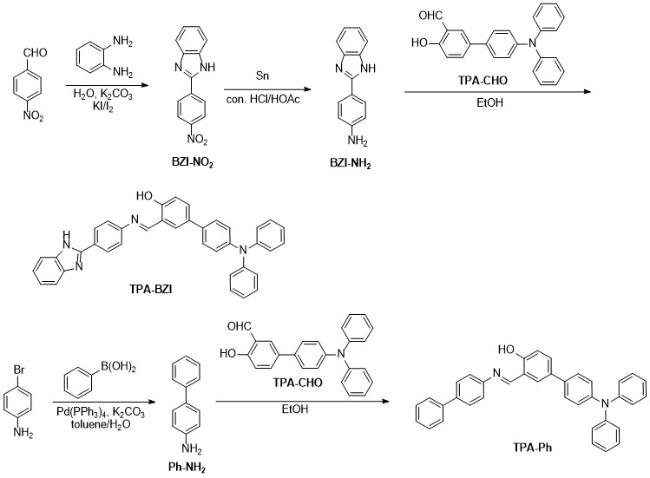
4'-(Diphenylamino)-4-hydroxy-[1,1'-biphenyl]-3-carbal-dehyde (TPA-CHO) was synthesized according to the previously reported methods.[34] Firstly, 4-nitrobenzalde- hyde reacted with o-phenylenediamine by condensation reaction to synthesize BZI-NO2 with benzo[d]imidazole moiety, and the chemical shift (δ) of NH group was observed at 13.31 (in DMSO-d6). Then BZI-NO2 was reduced using Sn powder to prepare BZI-NH2, which the δ of NH2 group appeared at 5.59 (in DMSO-d6), and the δ of NH group was shifted to 12.41 (in DMSO-d6) coming from the electron-donating effect of NH2 group. Finally, TPA-BZI was acquired through condensation reaction between BZI-NH2 and TPA-CHO. At this time, the δ of NH2 group disappeared, and the δ of N=CH and OH groups appeared at 8.99 and 12.98 (in acetone-d6), respectively. As well as the δ of NH group was shifted to high- field of 11.89 (in acetone-d6) due to the electron-donating effect of TPA moiety and solvent effect of deuterated reagents. For target TPA-Ph, 4-bromoaniline reacted with phenylboronic acid by Suzuki coupling reaction to synthesize Ph-NH2, the δ of NH2 group appeared at 5.24 (in DMSO-d6). Then target compound was obtained through condensation reaction, and the δ of N=CH and OH groups appeared at 9.04 and 12.95 (in acetone-d6). Compared with TPA-Ph, the δ of aryl moieties of TPA-BZI were located at down-field owing to the electron-withdrawing effect of benzo[d]imidazole moiety. The detail synthesis procedures were as follows, and the synthetic route was listed in Scheme 1.
2.2 UV-vis absorption and fluorescent emission spe- ctra in solutions
The UV-vis absorption and fluorescent emission spectra of two TPA-based Schiff base compounds were recorded in six organic solvents with different polarities. As depicted in Figure 1(a), a palpable absorption band was observed for both compounds, locating at around 325 nm, which was ascribed to the intramolecular charge transition within the entire conjugate system. And their shifts in absorption spectra were not obvious with increasing solvent polarities. However, the polarities of organic solvents were sensitive to the emission spectra of both compounds, as shown in Figure 1(b), and the solvatochromism phenomena were also observed under a UV lamp. It was observed that the emission spectra of TPA-BZI were red-shifted from 602 nm (in n-hexane) to 628 (in PhCl) and 639 nm (in CH2Cl2), and that of 599, 621 and 633 nm for TPA-Ph, as the polarities of organic solvents increasing from non-polarity to mid-pola- rity, which implied the existence of ICT process. Under the same conditions, the emission wavelengths of TPA-BZI were larger than those of TPA-Ph. It might be caused by imidazole moiety in the benzo[d]imidazole substituent. The imidazole moiety acts as both an H-acceptor (N=) and an H-donor (NH), facilitating extensive hydrogen bonding between TPA-BZI and solvents,[35] which expands the molecular π-conjugated system and leads to a red shift in the fluorescence spectra. But the emission spectra of the two compounds were blue-shifted to 618 and 609 nm in EtOAc, respectively, then they shifted to 631 (in CH3CN) and 626 nm (in CH3OH) for TPA-BZI, as well as 633 and 629 nm for TPA-Ph, respectively, as the polarities of organic solvents increasing to high polarity. The decreased conjugation degrees of both compounds likely resulted from dihedral angles increasing in highly polar solvents.[36] The spectra of TPA-BZI in high polar solvents was shorter than that of TPA-Ph, because of its redundant hydrogen bonds bringing more spatial distortion.
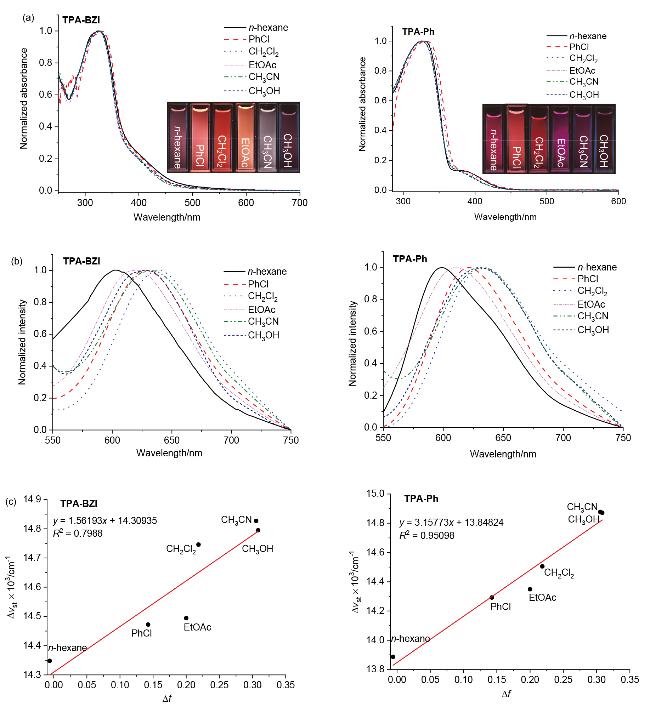
Figure 1 (a) Normalized absorption spectra and (b) normalized emission spectra of compounds TPA-BZI and TPA-Ph in different organic solvents (c=1×10⁻⁵ mol/L, excited at 400 nm), respectively, and (c) the corresponding Lippert-Mataga fitting curvesInset: photos in different organic solvents under 365 nm irradiation |
To better explicate the solvent-dependent behaviors of the two compounds, Lippert-Mataga fitting curves were plotted based on the orientational polarizability (Δf) as the horizontal axis of six organic solvents and Stokes shifts (Δvst) as the vertical axis, respectively. As shown in Figure 1(c), it was observed the notable positive slopes of the fitting curves for the two compounds, which demonstrated that the dipole moment of the ICT excited state was larger than that of the ground state by reason of the substantial charge redistribution, resulting of the relaxation of the initially formed Franck-Condon excited state.[37-38] Meanwhile, the good linear relationship (R2=0.7988 for TPA- BZI and R2=0.95098 for TPA-Ph) suggested that the solvent-dependent fluorescence shifts were mainly derived from the dipole-dipole interaction between two compounds as solutes and organic solvents. And the ICT process of TPA-BZI was worse than that of TPA-Ph due to the electron-withdrawing property of benzo[d]imidazole moiety.
2.3 Aggregation- and solid-states fluorescence
According to the photophysical property tests of six sol- vents mentioned above, it could be easily concluded that CH3OH was good solvent for the two compounds, but their solubility in water was poor, the fluorescence spectra in CH3OH/water mixtures in the different volume percentage of water (fw) were measured. As shown in Figure 2, for TPA-BZI, the emission intensity was weak in mixtures of fw=0% (Фf=0.261%). Then the emission intensity was minimal when fw was below 30%, which could be explained that molecules of TPA-BZI were dispersed in low fw, and the free rotations of single bonds between molecular functional groups weakened the emission intensities through non-radiative relaxation of the excited state.[39] Corresponding, the profiles of absorption spectra were almost unchanged, indicating the existence of mono-molecules in mixtures. When fw was increased to 40%, the emission intensity began to enhance but the profile of absorption spectrum did not evident change, which demonstrated that dispersed mono-molecules began to cluster together, this restricted the intermolecular motions and non-radiative relaxation. And then the emission intensities were continuously "enhanced as fw exceeded 40%. Moreover, the tails of absorption spectra were significantly upward-shifted and the absorption bands of the ICT were sharply intensified in mixtures of fw=50% (Фf=0.595%), which insinuated that the aggregates had been formed,[40] the luminescence colors were also observed to undergo a significant change. The emission intensity reached to its maximum at fw=90% (Фf=1.85%), as the formed aggregates restricted intramolecular rotation, thereby opening the radiative transition pathway. It was the well-known AIE phenomenon. Then emission intensity was again diminished due to rapid molecular aggregation and the shielding of internal molecules in high fw. For TPA-Ph, the emission intensity was also weak in mixtures of fw=0% (Фf=0.0256%), thereafter, the emission intensities were slowly strengthened but the profiles of absorption spectra were almost unchanged. When fw was increased to 60% (Фf=0.9%), there was a noticeable change in the profile of absorption spectrum, indicating the formation of aggregates. A sharp increase in the emission intensity was observed as shown in Figure 2(b). It reached a maximum at fw=70% (Фf=1.45%), and then the intensities were gradually decreased. By and large, the variation trend of the emission intensities and absorption spectra of TPA- Ph was similar to that of TPA-BZI, exhibiting AIE effect.

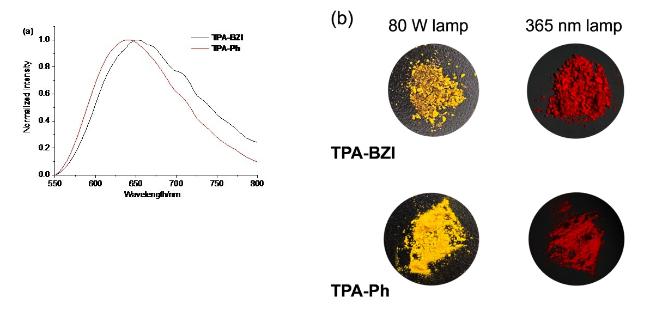
Besides the aggregation states fluorescence behaviors, the photophysical properties in the solid states were also examined, as shown in Figure 3. It was found that the emi- ssion peaks of TPA-BZI and TPA-Ph were located at 651 and 640 nm, respectively. And their yellow color solid powder (in the 80 W lamp) emitted red fluorescence under a 365 nm UV lamp irradiation. The Φf values were 0.0161% and 0.0254% for TPA-BZI and TPA-Ph, and τ values were 0.805 and 0.812 ns. The solid-state photoluminescence indicated that there were no strong intermolecular π-π stacking interactions between various molecular fragments in the solid state for both compounds.[41] Furthermore, the emission wavelength of TPA-BZI in the solid state was longer than that of TPA-Ph, originating from a longer conjugation system due to excess hydrogen bonds between the imidazole moiety and adjacent molecules, as well as between H-acceptor (N=) of the imidazole moiety and OH group.[7] It was also found that the emission spectra of the solid state were red-shifted than those of in CH3OH/water mixtures under the same excitation wavelength, which clearly indicated that a longer wavelength was induced by the existence of weak intermolecular interactions in the solid state.[42] The luminescence both in the aggregation- and solid-states were instrumental in the field of LFPs imaging.
2.4 Quantum chemical calculations
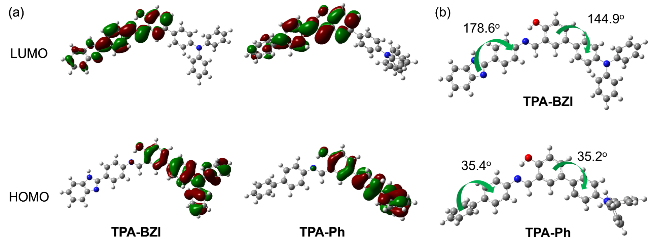
To better understand the above photophysical properties, time-dependent density functional theory (TD-DFT) calculations at the CAM-B3LYP/6-31G(d,p) have been performed (the detailed was listed in Supporting Information). As shown in Figure 4(a), the highest occupied molecular orbital (HOMO) distributions of the two compounds were located at the TPA groups due to excellent electron-dona- ting properties of the TPA groups; the lowest unoccupied molecular orbital (LUMO) distributions were located around the N=CH moiety, with the benzimidazole-substi-tuted unit for TPA-BZI and the phenyl-substituted unit for TPA-Ph, respectively. The clearly separated charge distribution between the HOMO and LUMO confirmed the existence of the ICT process, which was consistent with the measurement results in Figure 1. As shown in Figure 4(b), the dihedral angle between the 1,3-diazole fragment of benzimidazole group and bridged phenyl unit was 178.6° for TPA-BZI, the dihedral angle between the terminal phenyl group and bridged phenyl unit was 35.4° for TPA-Ph. The dihedral angles between the phenyl with OH group and the phenyl of TPA moiety were 144.9° and 35.2° for TPA-BZI and TPA-Ph, respectively, and the TPA moiety had a well-known propeller-like molecular conformation. These results indicated that the two compounds possessed the twisted non-coplanar configurations, which was beneficial for significantly hindering intermolecular π- π stacking. It would endow the two compounds with fluore- scence in both aggregated and solid states, which was congruence with the measurement results of Figures 2 and 3.
2.5 LFPs imaging
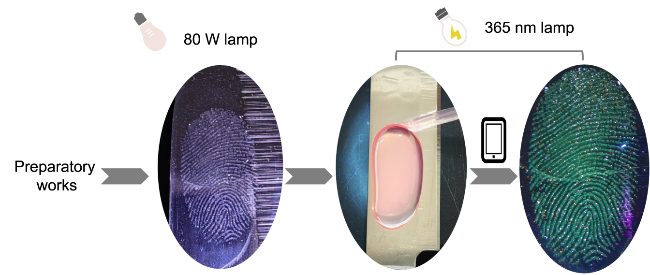
The AIE properties of the two compounds endowed them with a potential application in LFPs detection. A volunteer orderly washed his hands with soap and water, and then dried them. The left and right index fingers were rubbed on the forehead to obtain clear fingerprint contours. The above belonged to the preliminary works. The left index finger was pressed on the clean surface of blade, and the developer containing TPA-BZI (0.5 mL) was dropwise added to LFPs area using disposable plastic dropper. This area was completely covered by developer, as shown in Figure 5, which was labelled as the A-sample. It was labelled as the B- sample for TPA-Ph (0.5 mL) using right index finger. The developer was softly rinsed by distilled water after 10 min. The processed blade was photographed using a Huawei Mate30 phone under irradiation with a 365 nm lamp, and the LFPs imaging was observed. The developers with different fw values and compound concentrations were prepared according to the mixture preparation method for testing performance. We then chose to test the imaging results of several high fw developers for the LFPs detection, because the developers with a high organic solvent content can dissolve the residual organic components in LFPs, resulting in incomplete fingerprint veins of LFPs. After multiple explorations, it was found that the optimal conditions for preparing the developers were in CH3OH/water mixtures with fw=80% for TPA-BZI (c=5×10⁻⁵ mol/L) and fw=70% for TPA-Ph (c=5×10⁻⁵ mol/L), respectively. The prepared developers were stood for 2 h at room temperature. The Φf values were 2.39% for TPA-BZI and 2.93% for TPA-Ph, respectively. Moreover, the morphologies of aggregates were also investigated in developers by scanning electron microscope (SEM). It was detected that the two compounds in developers were self-assembled in the aggregation states, and the formed nano-aggregates both presented irregular block-like. The formed small particle size aggregates provided an effective pathway for the aggregation states of the two compounds in the field of LFPs imaging.
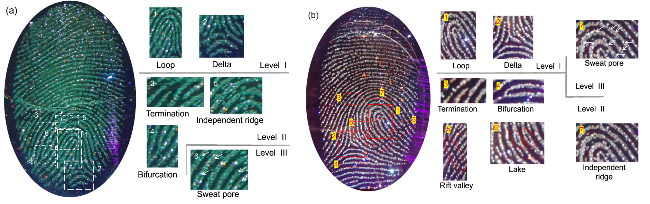
To further explore the universality of two developers, the LFPs images were captured on diverse object surfaces through the same processing conditions, including blade, aluminum sheet, and tinfoil. As shown in Figure 6, the fingerprints were visible under the 80 W lamp after the developers processing them, but the high-contrast and high-resolution fluorescence signals of fingerprint ridges and profiles on three surfaces were clearly observed by the naked-eye under a 365 nm UV lamp. Two developers made the LFPs imaging on three different substrates. The luminescence colors were different on the same substrate. It was connection with intrinsic colors and different fw of developers, as well as the electron-withdrawing groups of compounds.[43] Even if the same compound, the different substrates had an impact on the chromatic aberration of fluorescence colors.[44] In the bargain, the images could be maintained beyond 120 h under ambient condition. It was clearly observed that the clarity and integrity of the imaging based on TPA-BZI developer was better than that of TPA-Ph developer on the surface of blade under atmospheric conditions, suggesting that TPA-BZI developer was more conducive to practical applications. The images displayed the clear ridge-related identities, taking the blade substrate as an example, the details of different levels from I to III were visible, such as loop, delta, termination, independent ridge, bifurcation, lake, rift valley, and sweat pore, as shown in Figure 7. Among them, the sweat pore was a key identifying feature as fingerprint was incomplete and/or damaged, which did not switch from an active state to an inactive state. It was conducive to greatly narrow the iden-tification range.[45] These results could provide the preli- minary evidence to match personal identification, which had a potential application in the fields of criminal investigation and forensic chemistry.
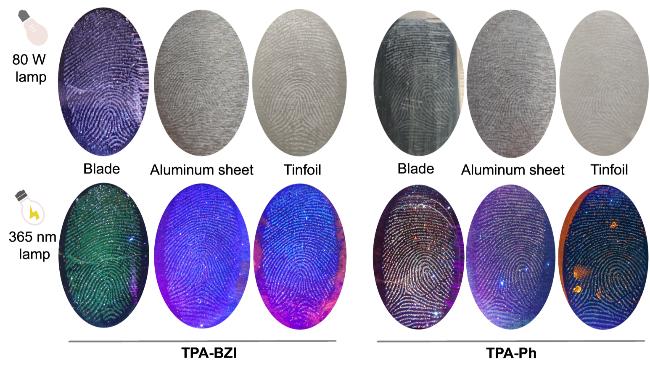
Figure 6 Digital photographs of LFPs stained with TPA-BZI and TPA-Ph developers on three substrates: blade, aluminum sheet and tinfoil under irradiation with an 80 W lamp and a 365 nm lamp, respectively |


3 Conclusions
Two triphenylamine-based Schiff base compounds containing the terminal benzimidazole group (TPA-BZI) and phenyl unit (TPA-Ph), respectively, were synthesized. The results of photophysical testing indicated that the two compounds exhibited solvatochromism phenomena, ICT characteristics, AIE properties, and solid-state fluorescence; these optical properties were well explained by time-depen- dent density functional theory calculations. Surprisingly, the developers prepared by the two compounds could detect LFPs based on their AIE properties, and the characteristic details of fingerprints from I to III levels could be plainly and conveniently discerned on three different substrate surfaces by a phone. It was indicated that the two compounds had a potential application in the field of the LFPs imaging.
4 Experimental section
4.1 General experimental information
4-Nitrobenzaldehyde (98%), 4-bromoaniline (99%), o- phenylenediamine (98%), phenylboronic acid (97%), sodium thiosulfate (99%), KI (99.5%), I2 (99.8%) and Sn powder (99%) were purchased from Shanghai Macklin Bio- Chem Technology Co., Ltd. K2CO3 (99%) and Pd(PPh3)4 (Pd≥8.9%) were purchased from Shanghai Haohong Biomedicine Technology Co., Ltd. All other reagents and solvents were used without further purification.
All 1H and 13C nuclear magnetic resonance (NMR) spectra were recorded using a Bruker Advance II-400 spectrometer with DMSO-d6 and/or acetone-d6 as solvents, respectively, and tetramethylsilane (TMS) was employed as the internal standard. The melting point was determined using an RY-1G melting point apparatus. UV-vis absorption and fluorescence emission spectra were obtained with a Shimadzu UV-2450 visible spectrophotometer and Agilent carry eclipse fluorescence spectrophotometer, respectively. The fluorescence lifetimes (τ) and the absolutely emission quantum yields (Φf) were measured using an Edinburgh FS5 spectrofluorometer. The aggregate behaviors of TPA- BZI and TPA-Ph were investigated via scanning electron microscopy (SEM, Hitachi, S-3400N). High-resolution mass spectrometry (HRMS) data were collected using a Thermo ScientificTM Orbitrap ExplorisTM 120 mass spectrometer.
4.2 Synthesis
4.2.1 Synthesis of 2-(4-nitrophenyl)-1H-benzo[d]imi- dazole (BZI-NO2)
A mixture of 4-nitrobenzaldehyde (1.08 g, 0.01 mol), o-phenylenediamine (1.3 g, 0.012 mol) and distilled water (100 mL) was placed in a flask under a nitrogen atmosphere and then stirred. After 20 min, K2CO3 (2.07 g, 0.015 mol), KI (4.15 g, 0.025 mol), and I2 (2.54 g, 0.01 mol) were added sequentially to the mixture. The reaction mixture was continuously stirred and heated to 90 ℃ for 8 h. After cooling to room temperature, the reaction mixture was poured into a saturated sodium thiosulfate solution and further stirred. Then the crude product was collected by filtration and purified via silica gel column chromatography using a mixture of CH2Cl2 and n-hexane (V/V=1/6) as eluent to obtain 1.83 g (76.6% yield) yellow green solid of BZI-NO2. 1H NMR (400 MHz, DMSO-d6) δ: 13.31 (s, 1H, NH), 8.43 (s, 4H, ArH), 7.68 (t, J=3.6 Hz, 2H, ArH), 7.29 (q, J=3.2 Hz, 2H, ArH); 13C NMR (101 MHz, DMSO-d6) δ: 149.47, 148.28, 145.30, 136.51, 135.70, 127.87, 124.79, 124.07, 122.80, 119.93, 112.29. HRMS calcd for C13H10N3O2 [M+H]+ 240.0768, found 240.0768.
4.2.2 Synthesis of 4-(1H-benzo[d]imidazol-2-yl)aniline (BZI-NH2)
A mixture of BZI-NO2 (2.39 g, 0.01 mol), Sn powder (3.561 g, 0.03 mol), HOAc (40 mL) and concentrated HCl (20 mL) was placed and stirred in a flask under a nitrogen atmosphere, then it was heated to 100 ℃ for 8 h. After cooling to room temperature, the mixture was adjusted to alkalinity with potassium hydroxide solution and filtered after standing for 2 h. The crude product was achieved by suction filtration and purified via column silica gel chromatography using a mixture of ethyl acetate and CH2Cl2 (V/V=1/1) as eluent to obtain 0.94 g (44.9% yield) orange solid of BZI-NH2. 1H NMR (400 MHz, DMSO-d6) δ: 12.41 (s, 1H, NH), 7.85 (d, J=3.6 Hz, 2H, ArH), 7.52 (d, J=33.6 Hz, 2H, ArH), 7.12 (q, J=2.8 Hz, 2H, ArH), 6.68 (d, J=8.4 Hz, 2H, ArH), 5.59 (s, 2H, NH2); 13C NMR (101 MHz, DMSO-d6) δ: 153.05, 151.04, 128.21, 121.68, 118.36, 117.77, 114.00, 111.04. HRMS calcd for C13H12N3 [M+ H]+ 210.1026, found 210.1026.
4.2.3 Synthesis of [1,1'-biphenyl]-4-amine (Ph-NH2)
A mixture of 4-bromoaniline (0.856 g, 4.98 mmol), phenylboronic acid (0.73 g, 5.976 mmol), Pd(PPh3)4 (0.058 g, 0.05 mmol), K2CO3 (1.38 g, 10 mmol), toluene (20 mL) and distilled water (10 mL) was placed in a flask under a nitrogen atmosphere and heated to 100 ℃ for 24 h. After cooling to room temperature, the reaction mixture was extracted by CH2Cl2 (30 mL×3), and the solvent was subsequently removed using a rotary evaporator. The crude product was purified via column silica gel chromatography using a mixture of CH2Cl2 and n-hexane (V/V=1/6) as eluent to obtain 0.42 g (50% yield) milky white solid of Ph-NH2. 1H NMR (500 MHz, DMSO-d6) δ: 7.54 (d, J=8.0 Hz, 2H, ArH), 7.38 (t, J=7.5 Hz, 4H, ArH), 7.22 (t, J=6.5 Hz, 1H, ArH), 6.65 (d, J=7.0 Hz, 2H, ArH), 5.24 (s, 2H, NH2); 13C NMR (126 MHz, DMSO-d6) δ: 148.74, 141.22, 129.12, 128.08, 127.58, 126.08, 125.82, 114.78. HRMS calcd for C12H11N 169.0886, found 169.0892.
4.2.4 Synthesis of 3-(((4-(1H-benzo[d]imidazol-2-yl)- phenyl)imino)methyl)-4'-(diphenylamino)-[1,1'-biphen- yl]-4-ol (TPA-BZI)
A mixture of BZI-NH2 (0.55 g, 2.66 mmol), TPA-CHO (0.94 g, 2.58 mmol) and EtOH (60 mL) was placed in a flask under a nitrogen atmosphere and heated to 80 ℃ for 24 h. After cooling to room temperature, the reaction mixture was filtered to collect orange yellow solid. The crude product was purified via column silica gel chromatography using a mixture of ethyl acetate and n-hexane (V/V=1/6) as eluent to obtain 0.43 g (30.1%, yield) reddish brown solid of TPA-BZI. m.p. 162 ℃; 1H NMR (400 MHz, Acetone-d6) δ: 12.98 (s, 1H, OH), 11.89 (s, 1H, NH), 8.99 (s, 1H, CH=N), 8.22 (d, J=8.0 Hz, 2H, ArH), 7.84 (d, J=2.0 Hz, 1H, ArH), 7.65 (dd, J=8.8, 2.4 Hz, 1H, ArH), 7.50 (d, J=8.8 Hz, 4H, ArH), 7.21 (dd, J=7.6, 0.8 Hz, 5H, ArH), 7.11 (q, J=2.8 Hz, 2H, ArH), 7.00 (q, J=8.4 Hz, 10H, ArH); 13C NMR (101 MHz, Acetone-d6) δ: 164.81, 160.87, 149.95, 148.15, 147.32, 134.52, 132.00, 131.91, 131.13, 129.79, 128.13, 127.50, 124.60, 124.41, 123.43, 122.35, 120.00, 117.79. HRMS calcd for C38H29N4O [M+H]+, 557.2336, found 557.2328.
4.2.5 Synthesis of 3-(([1,1'-biphenyl]-4-ylimino)meth- yl)-4'-(diphenylamino)-[1,1'-biphenyl]-4-ol (TPA-Ph)
The synthesis was conducted analogously to that of TPA- BZI, except that BZI-NH2 was replaced with an equivalent amount of Ph-NH2. All other conditions remained unchanged. The crude product underwent purification via column silica gel chromatography using CH2Cl2 and n- hexane (V/V=1/5) as eluent to obtain 0.74 g (57% yield) orange yellow solid of TPA-Ph. m.p. 235 ℃; 1H NMR (500 MHz, Acetone-d6) δ: 12.95 (s, 1H, OH), 9.04 (s, 1H, CH=N), 7.94 (d, J=1.6 Hz, 1H, ArH), 7.78 (dd, J=6.8, 1.6 Hz, 1H, ArH), 7.68 (d, J=6.8 Hz, 3H, ArH), 7.63 (d, J=6.8 Hz, 3H, ArH), 7.45 (d, J=6.8 Hz, 2H, ArH), 7.35 (dd, J=6.0 Hz, 0.8 Hz, 5H, ArH), 7.14~7.07 (m, 11H, ArH); 13C NMR (126 MHz, Acetone-d6) δ: 160.38, 149.76, 147.80, 132.45, 131.49, 130.69, 129.33, 127.08, 124.22, 124.02, 123.30, 123.01, 119.95, 119.85, 119.51, 117.35, 99.98. HRMS calcd for C37H29N2O [M+H]+ 517.2274, found 517.2284.
Supporting Information 1H NMR and 13C NMR spectra, as well as HRMS results of all compounds, Фf of TPA- BZI and TPA-Ph in CH3OH/water mixtures with different fw, Фf and τ of TPA-BZI and TPA-Ph in the solid-states, SEM images of aggregates in the developers of TPA-BZI and TPA-Ph, photophysical data and computational details of TPA-BZI and TPA-Ph. The Supporting Information is available free of charge via the Internet at http://sioc- journal.cn/.
(Lu, Y.)