


1 Introduction
Organofluorine compounds have been widely used as core structural units in natural products, bioactive compounds, and functional materials due to their ability to confer unique chemical and physical properties to organic molecules.[1-2] The introduction of fluorine atoms can significantly enhance the lipophilicity, permeability, and metabolic stability of organic compounds.[3] Based on the number of C—F bonds attached to the same carbon atom, fluorinated compounds can be broadly classified into trifluoromethyl, gem-difluoro, and monofluoro compounds. Since the trifluoromethyl group (CF3) does not exist in nature, the development of efficient and practical methods for synthesizing organic molecules containing CF3 groups has long been a focus of organic and medicinal chemists. Efficient synthetic methods mainly involve direct trifluoromethylation of organic molecules through electrophilic, nucleophilic, or radical processes.[4-6] For example, 5-CF3- 1,3,4-oxadiazole scaffold[7] has become a highly valuable synthetic target due to its frequent occurrence in many drugs and bioactive molecules. Similarly, gem-difluoro compounds are widely and significantly used in medicinal chemistry,[8] materials chemistry, and organic synthesis. For instance, in HIV-1 reverse transcriptase inhibitors, the gem-difluoro group is an essential pharmacophore.
gem-Difluoro or monofluoro compounds can be synthesized by selective activation of C—F bonds and defluorination of trifluoromethylated substrates.[9] However, the efficient and controlled selective cleavage of a single C—F bond remains a significant challenge. Taking phenyl trifluoromethyl (PhCF3) as an example,[10] the bond dissociation energy (BDE) for the first C—F bond cleavage in the trifluoromethyl group is close to 480 kJ/mol. As the reaction proceeds, the BDE of the remaining C—F bonds gra- dually decreases (for example, the C—F bond in phenyl monofluoromethyl (PhCFH2) has a BDE of 414.2 kJ/mol). Owing to the inherent trade-off between reactivity and selectivity, along with the challenge of excessive over- defluorination of trifluoromethyl groups, considerable efforts have been devoted to developing novel reaction pathways and synthetic methodologies to overcome these limitation.
Despite the widespread interest in fluorinated compounds and the well-recognized significance of C—F bond transformation, we have briefly summarized the latest noteworthy progress in C—F bond defluorination. This review covers reaction design, reaction mechanisms, and future prospects. The content is divided into five sections based on the type of reaction: (i) transition-metal-catalyzed defluorination, (ii) photocatalytic defluorination, (iii) electrocatalytic defluorination, (iv) synergistic catalytic defluo- rination and (v) other types of catalytic defluorination.
2 Transition-metal-catalyzed defluorination
Transition metal catalysis, primarily through mechanisms such as oxidative addition, has successfully enabled the activation and transformation of inert C—F bonds, providing a powerful tool for the precise functionalization of fluorinated molecules. Catalysts based on nickel and palladium can facilitate key reactions such as defluorinative coupling and C—F functionalization, enabling the conversion of inert fluorinated hydrocarbons into high-value fine chemicals and synthetic intermediates, and thus exhibiting promising application prospects in pharmaceutical synthesis and related fields.
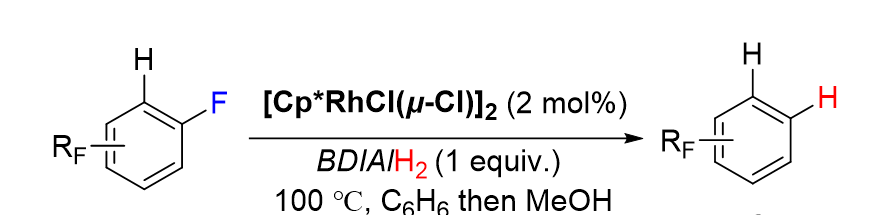
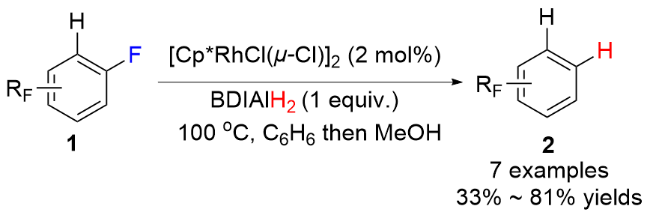
In 2014, Crimmin and co-workers[11] reported an efficient and highly selective precatalytic system based on [Cp*RhCl(μ-Cl)]2, utilizing a hydrocarbon-soluble aluminum dihydride (BDIAlH2) as the terminal reductant (Scheme 1). This system enabled the highly selective hydrodefluorination of fluoroarenes. The study demonstrated that compound 1 was transformed into compound 2 under the influence of the transition metal rhodium. Furthermore, the catalyst system can cleave C—F bonds adjacent to existing C—H bonds with regioselectivity ranging from 98.5% to 99%. Additionally, the authors conducted kinetic experiments to investigate the reaction mechanism and proposed that C—H bond activation may play a critical role in the process.
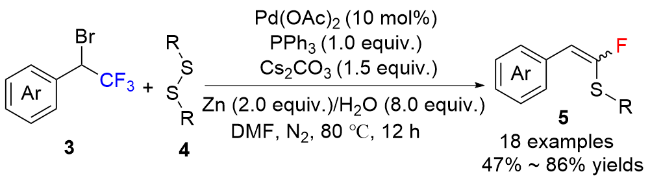
In 2020, Zhang et al.[12] reported a palladium-catalyzed synthesis method for α-fluorovinylthioethers 5 using α-tri- fluoromethylated benzyl bromides 3 and odorless disulfides 4 (Scheme 2). This method utilized Pd(OAc)2 as the catalyst and Zn as the reducing agent, enabling selective C—F bond cleavage through β-fluoride elimination instead of reduction elimination. Zinc powder plays a dual role in promoting β-fluoride elimination and serving as a reducting agent to regenerate Pd(0) from PdBrF. This reaction offers a simple and efficient approach to synthesizing α- fluorovinylthioethers by utilizing an odorless sulfur source where both sulfur atoms of the disulfide are incorporated into the vinyl sulfide.
In 2020, Wang et al.[13] successfully established a controllable catalytic defluorination protocol for silicodifluorocyclopropane, facilitating the ring-opening indolylation reaction, thereby synthesizing α-fluoro-β-indoleacetone. This study delved into the advanced applications of α-fluorone, thereby unveiling a novel and efficient synthetic route for the preparation of carbazole derivatives. The synthesis of α-fluoro-β-indoleacetone 8 could be achieved via the reaction of silicodifluorocyclopropane 6 with indole 7 in the presence of AgBF4 catalyst, which was completed within a mere 1.5 h at ambient temperature (Scheme 3). Subsequently, α-fluorone derivatives underwent cyclization in toluene at room temperature in the presence of trifluoroacetic anhydride. The formation of carbazole occurred through an endocyclic nucleophilic addition of an in situ generated enamine to the keto intermediate, followed by hydrolysis with the elimination of trifluoroacetic acid and hydrogen fluoride.
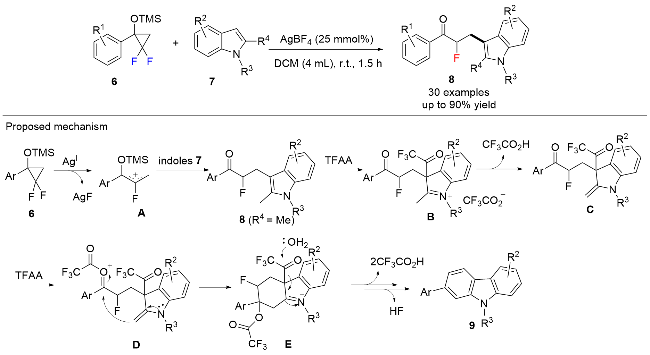
Building on the prior research findings of the group,[14] the Ag(I)-catalyzed defluorination and ring-opening indolylation of compounds 6 and indoles 7 involves the generation of an allylic cation A, followed by a Friedel-Crafts reaction to afford α-fluoro-β-indoleacetone 8. Regarding the cyclization of compound 8, the research team has delineated a proposed reaction mechanism. Initially, in the presence of trifluoroacetic anhydride (TFAA),[15] compound 8 undergoes acylation at the C(3) position of the indole ring to produce 3-trifluoroacetyl indole B, which subsequently isomerizes to the enamine intermediate C. In the subsequent intramolecular nucleophilic addition step, the enamine attacks the activated keto group of C, leading to the formation of intermediates D and E. Intermediate E then undergoes continuous hydrolysis, accompanied by the elimination of CF3CO2H, and HF, ultimately affording carbazole 9.
In 2020, Wang and colleagues[16] reported the open-loop defluorination of a copper-catalyzed 2-bromocarboxylic acid derivative 11 with difluorocyclopropane 10. The γ-fluoro-δ-keto ester 12 was obtained through a CuI/CuII catalytic cycle and coupled with α-bromocarboxylate as a ligand (Scheme 4). The key step in this free radical cross-coupling reaction is the formation of α-fluoroenone. Furthermore, by utilizing α-bromoamide, the open-loop defluoroalkylation is followed by additional intramolecular C—N oxidative coupling to provide lactam intermediates. These intermediates are further cascaded through a CuI/ CuII/CuIII catalytic pathway for defluorination, hydrolysis, ring-opening, and dehydration processes, ultimately resulting in the formation of γ,δ-diketonitriles, which represents an unprecedented achievement.
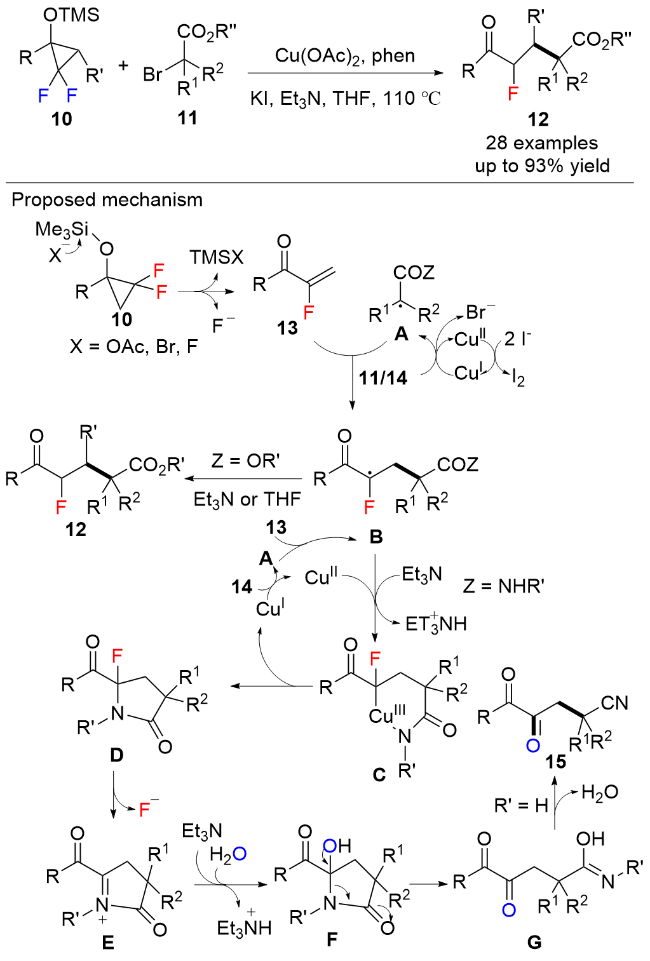
Based on the literature research, the inserted references[14,17] and the above experimental results, the reasonable reaction mechanism is as follows: Under the action of desilylation reagents (such as AcO-, Br- or F-), siloxy difluorocyclopropane 10 undergoes ring-opening and defluorination, generating α-fluoroenone 13. Meanwhile, alkyl bromides 11/14 and CuI catalysts (generated in situ by the reduction of CuII in the presence of KI) form radical A through a single-electron transfer (SET) process. This radical attacks enone 13 to generate alkyl radical species B.[17f] For the radical B derived from α-bromoesters, it generates γ-fluorinated-δ-ketone ester products 12 through hydrogen extraction reaction. As the reaction relies on Et3N for efficient conversion, it is speculated that triethylamine is the hydrogen donor (but the solvent tetrahydrofuran (THF) cannot be ruled out either). On the other hand, the radical B derived from α-bromoamide 14 undergoes intramolecular C—N oxidative coupling catalyzed by CuII in the presence of a base, and generates lactam D through intermediate C.[18] D is defluorinated to form the imine cation E, which then undergoes hydrolysis, ring- opening and dehydration in sequence. Eventually, γ,δ-di- ketonitrile 15 is obtained through F and G.
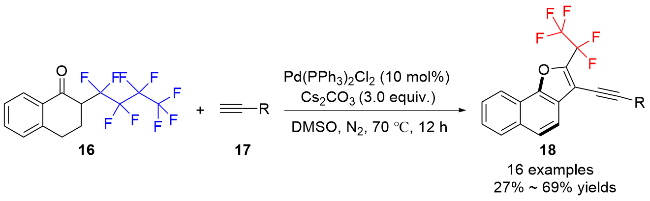
In 2021, Chu et al.[19] investigated the palladium-cata- lyzed alkynylation of polyfluoroalkylones 16 with terminal alkynes 17, leading to the synthesis of a series of modular perfluoroalkyl and acetylene-substituted furan derivatives 18 (Scheme 5). The reaction exhibited moderate yields along with high regional and chemical selectivity. Notably, this unprecedented alkynylation reaction enabled simultaneous deacetylation and closed-loop relay sequences, resulting in the formation of new C—C and C—O bonds while cleaving four C(sp3)—F bonds. The success of this cascade reaction primarily relies on precise sequence con- trol during alkynylation as well as functionalization of multiple C(sp3)—F bonds. Mechanistic studies suggest that chelation-assisted Pd facilitates the oxidation addition of C—F bond. A controlled experiment demonstrated that oxidative addition of Pd(0) to C(sp2)—F bonds could generate vinyl palladium.
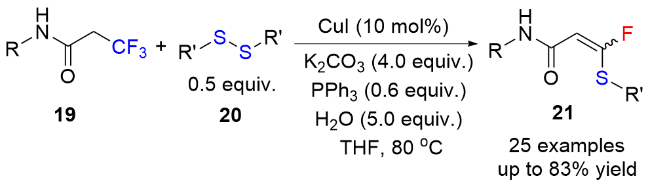
In 2021, Zhang and co-workers[20] successfully developed an efficient and practical method for synthesizing α-fluorothioacrylamide 19 using trifluoropropanamide 20 as the raw material through selective defluorination vulcanization and employing dithioether 21 (Scheme 6). The method utilized N-chelation-assisted copper catalyzed dephosphorization and vulcanization reactions, demonstrating excellent tolerance towards functional groups, effectively introducing two sulfur atoms of disulfide into acrylamide molecules. Various trifluoropropanamides with different odors were successfully defluorinated by CuI, PPh3, H2O, and K2CO3 in the presence of disulfide to yield α-fluorothio-acrylamide with moderate to good yields. This reaction not only exhibits outstanding functional group tolerance and a wide range of substrate applications, but also provides a novel pathway for synthesizing potentially pharmaceutically bioactive alpha-fluorothioacryl- amide products that were previously inaccessible by reported methods.
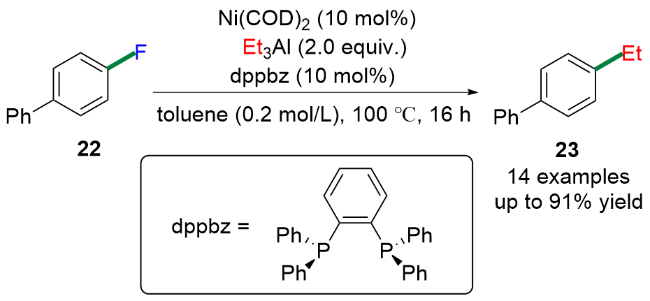
In 2021, Liu et al.[21] reported a nickel-catalyzed transformation using alkylaluminum as a coupling ligand. This facilitated the direct conversion of C(sp2)—F bonds 22 to the corresponding C(sp2)—C(sp3) bonds 23 (Scheme 7). The scope of the reaction was significantly broadened by utilizing aryl fluorides, vinyl monofluorides, and vinyl gem-difluorides as electrophilic reagents. The success of this chemoselective method relies on the fluorophilicity of the aluminum reagents, which act as Lewis acids to activate challenging C—F bonds while also serve as alkylating ligands. In this reaction, selective cleavage of C—F bonds occurs with complete chemoselectivity, whereas C—OMe bonds remain intact or are partially cleaved due to the fluorophilicity of trialkylaluminum reagents. Furthermore, this method is not limited to unactivated aryl fluorides but can also be applied to vinyl monofluorides and even vinyl gem-difluorides. To date, it has been successfully employed for late-stage C—F alkylation of fluorinated drug analogs.
In 2023, Zhang and co-workers[22] successfully developed a novel copper-palladium co-catalytic strategy that facilitated the defluorination coupling reaction between gem-difluoroalkenes 24 and acyl chlorides 25 (Scheme 8). This reaction demonstrated remarkable efficiency in synthesizing α-fluorochalcone compound 26, which serves as a key structural unit in diverse pharmaceutical molecules. Under mild reaction conditions, diverse substrates with different functional groups were effectively converted into the desired products. Further investigations on synthetic applications confirmed that the products of this reaction could serve as versatile intermediates for constructing intricate molecular structures, highlighting its significant potential in organic synthesis.
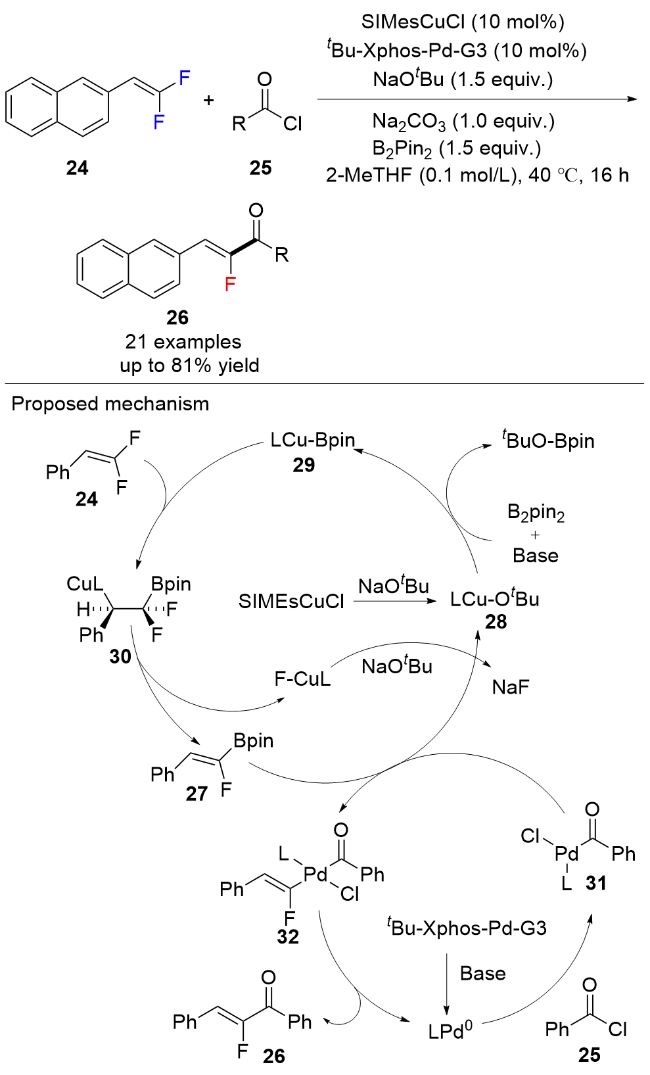
Building upon this research, a hypothesis regarding the cyclic mechanism of copper-palladium co-catalysis was proposed. Through meticulous analysis of control experiments, researchers elucidated the intricate mechanism of this reaction. The specific process is as follows: Under optimal reaction conditions, copper complex 28 is initially formed, followed by the generation of intermediate 29 through a metal transfer process.[23] Intermediate 29 and 24 participate in an insertion reaction to form intermediates 30,[24] which is subsequently transformed into key intermediate 27[25] via fluorine elimination step. Simultaneously, Pd(0) undergoes oxidative addition with 25 to generate intermediate 31.[26] Subsequently, intermediate 31 reacts with intermediate 27 to produce Pd species 32.[27]
In 2023, Wang et al.[28] reported an innovative cobalt- catalyzed allylic defluorination cross-electrophilic coupling strategy. In this reaction, zinc is ingeniously employed as a stoichiometric reducing agent, facilitating the effective coupling between 1,1-difluoroalkyl halides 34 and α-trifluoromethyl styrenes 33 (Scheme 9). This approach demonstrates exceptional substrate compatibility with a broad range of functional groups and remarkable tolerance to various functional groups. It is noteworthy that this reaction process eliminates the need for laborious pre- paration of pre-formed organometallic compounds. Under reducing conditions, this strategy efficiently synthesizes gem-difluoroalkenes rich in functional groups while introducing difluorination characteristics at the allylic position. This technique provides a universal and efficient synthetic route for preparing multifunctional organofluorine compounds that integrate gem-difluoroalkene 35 and gem-di- fluoroalkane structures.
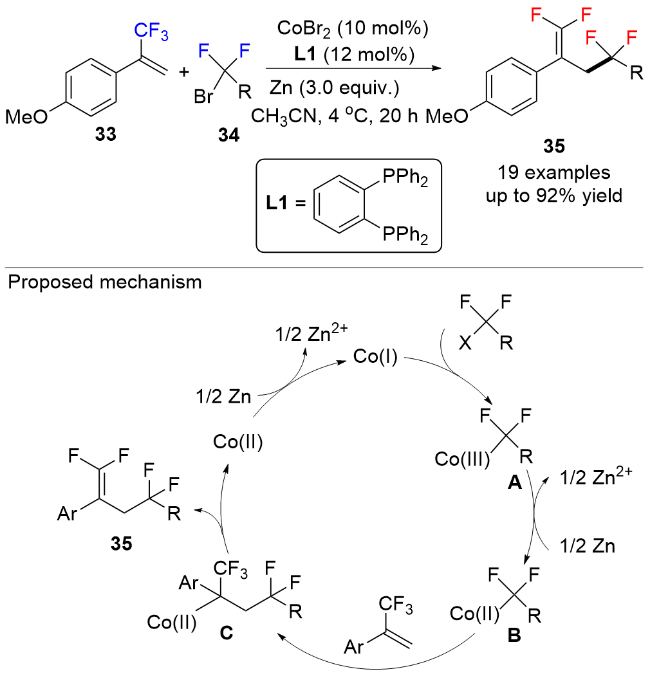
Based on the mechanism investigation, the proposed reaction mechanism is as follows: Initially, under reducing conditions, a Co(I) species is generated. Subsequently, the Co(I) undergoes oxidative addition with 1,1-difluoroalkyl halide 35 to form Co(III) intermediate A. Promptly thereafter, intermediate A is reduced by zinc to form Co(II) intermediate B.[29] Following this reduction step,[30] α-tri- fluoromethylstyrene 33 intermolecularly migrates and inserts into the Co—C bond of complex B. This migration process may proceed via either a two-electron transfer or a radical pathway, however, we favor a non-radical mechanism due to polarity mismatch between the electron- deficient difluorocarbon center radical and the electron- deficient α-trifluoromethylstyrene. After facile elimination of β-fluoride from Co(II) intermediate C, gem-difluoro- alkene is obtained as the product of allylic defluorination cross-electrophilic coupling (XEC). In the final step of the catalytic cycle, zinc mediates reduction of Co(II) to Co(I), thus completing the catalytic cycle.
In 2024, Xu and co-workers[31] reported a study on the defluorinative haloalkylation of unactivated alkenes facilitated by dual photoredox and copper catalysis. The research focuses on developing a novel method for the synthesis of various halogenated compounds 38 through the reaction of unactivated alkenes 37 with fluorinated alkyl halides 36 (Scheme 10).

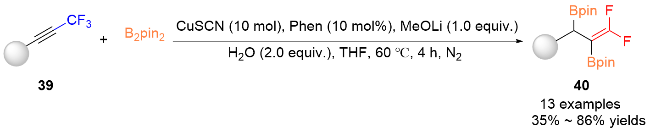
In the same year, they also reported on copper catalysis,[32] highly adjustable defluorination of boron and trifluoromethyl acetylene hydrodefluorination 39 (Scheme 11). The research focuses on the selective synthesis of multiple CF2-containing compounds 40 on a single substrate, which has important implications for drug discovery, organic synthesis and materials science. A notable aspect of this method is that it prevents excessive defluorination of CF3 groups on unsaturated C—C bonds during nucleophilic addition, thereby preserving CF2 groups that have medicinal value.
In 2025, Luo et al.[33] disclosed a chromium(II)- catalyzed defluorinative reductive coupling between acetals 42 and α-trifluoromethyl alkenes 41 (Scheme 12). This strategy leveraged synergistic catalysis to generate α-alk- oxyalkyl radicals from acetals, which subsequently engaged in cross-coupling under ambient conditions. The reaction forged C—C bonds via concurrent C—O and C—F bond cleavage, providing an efficient route to access valuable gem-difluoroalkenes 43 functionalized with a homoallylic alkoxy substituent.
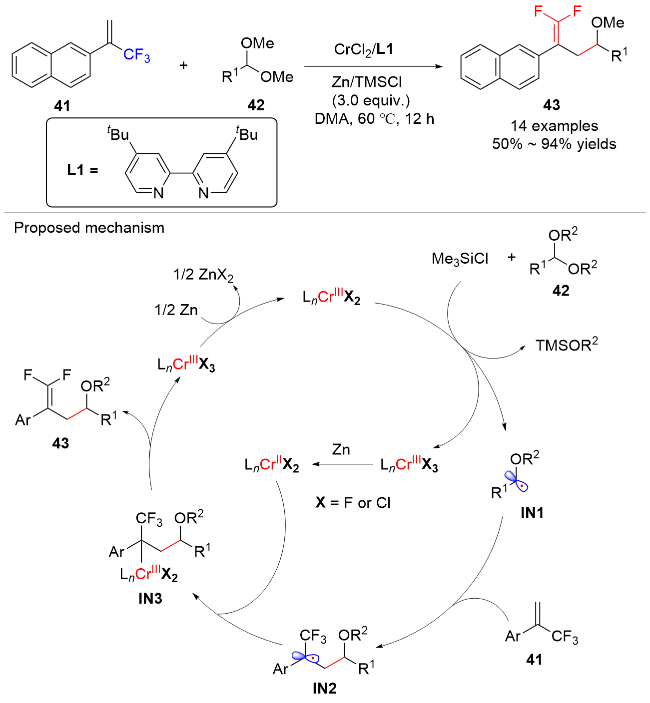
Based on experimental results and previous literature,[34] a plausible mechanistic pathway for the chromium(II)- catalyzed cross-coupling was proposed. The cycle is initiated by the chromium(II) species and chlorotrimethysilane (TMSCl), which mediate the direct formation of an α-alk- oxyalkyl radical (IN1) from acetal 41. This radical subsequently adds to α-trifluoromethyl alkenes 42, affording intermediate IN2. Association of IN2 with chromium(II) then furnishes intermediate IN3, which undergoes β-fluo- rine elimination to deliver the gem-difluoroalkene product 53. Finally, reduction of the resulting LnCr(III)X₃ (X=F or Cl) complex by zinc powder regenerates the active chromium(II) catalyst, closing the catalytic cycle.
In 2025, Xiao et al.[35] developed a novel silver(I)-cata- lyzed cascade reaction involving radical isonitrile insertion and defluorinative cyclization for the efficient synthesis of CF2H- and phosphinoyl-containing quinolines 46 from ortho-isocyanyl α-trifluoromethylstyrenes 44 and diphenylphosphine oxide 45 (Scheme 13). This redox-neutral process enables the simultaneous construction of the quinoline scaffold, introduction of a CF2H group, and incorporation of diverse phosphinoyl moieties in a single transformation, exhibiting high atom- and step-economy, broad substrate scope, and excellent functional group tolerance. Mechanistic studies suggest the involvement of P-centered radicals and key carbanion intermediates, supported by radical inhibition, trapping, and anion trapping experiments. Further synthetic applications of this strategy are under investigation.
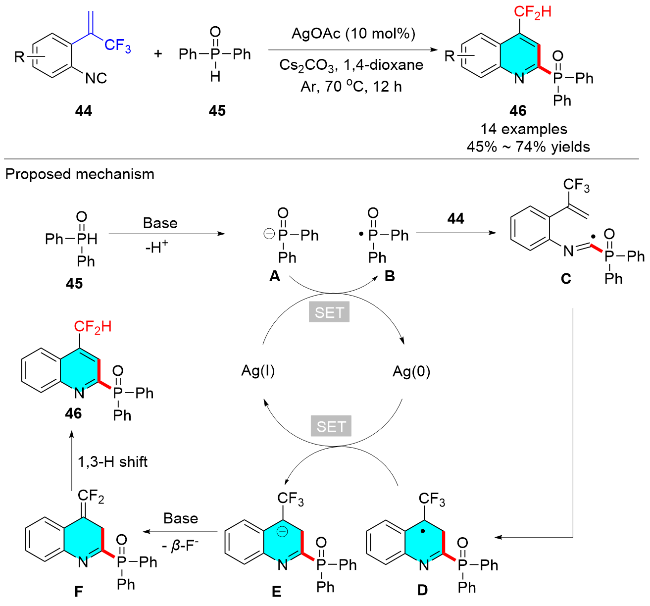
The mechanism is initiated by the base-promoted P—H bond cleavage of 45 to form species A,[36] which is subsequently oxidized by Ag(I) to yield the key P-centered radical B. This radical B then adds to substrate 44, generating the imidoyl radical C. Intramolecular cyclization of C across the α-trifluoromethyl alkene affords the carbon- centered radical D. A single-electron transfer (SET) reduction of D by Ag(0) then occurs, regenerating the Ag(I) catalyst and producing the carbanion intermediate E. Finally, E undergoes β-F- elimination followed by a 1,3-H shift[37] to furnish the final product of 4-CF2H-2-phosphinoyl- quinoline 46.
In 2025, Zhang et al.[38] reported a streamlined and practical method developed for their one-step construction through a defluorinative palladium-catalyzed Suzuki- Miyaura cross-coupling of acyl-protected 3,3,3-trifluoro- DL-alanine derivatives 47 (Scheme 14). By varying the amide protecting groups or boronic acid coupling partners 48, this versatile strategy enabled efficient access to a diverse range of substituted oxazoles. Its synthetic utility was further demonstrated through gram-scale synthesis, the late-stage modification of pharmaceutical molecules such as Clofibrate and Estrone, and the concise one-step preparation of bioactive Almazole D derivatives 49, collectively underscoring its significant potential in synthetic and medicinal chemistry.
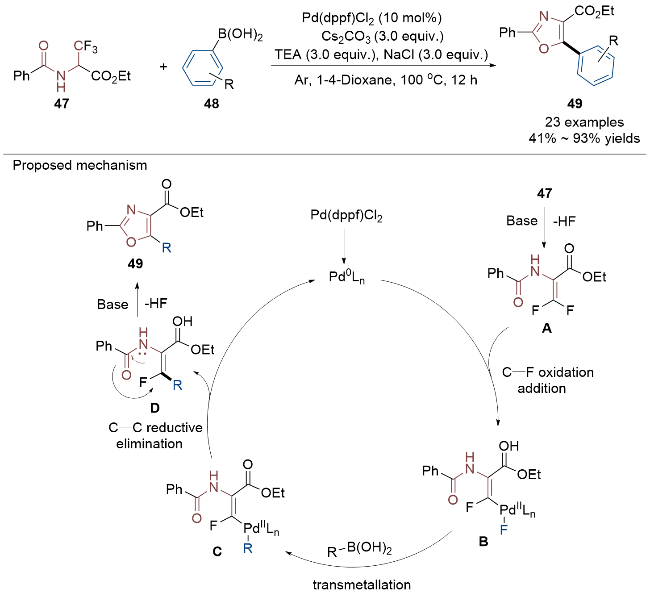
Based on the experimental mechanistic analysis and previous literature reports,[39] a plausible reaction pathway for this transformation is outlined in Scheme 14. The catalytic cycle begins with the reduction of Pd(II) by boronic acid to generate the active Pd(0) species. Concurrently, the benzoyl-protected ethyl alanine derivative 47 undergoes β-fluoride elimination to afford the key difluoroalkene intermediate A. Oxidative addition of the C—F bond in A to Pd(0) then forms the palladium complex B, which subsequently engages in transmetalation with phenylboronic acid to give intermediate C. Reductive elimination from C regenerates the Pd(0) catalyst and releases intermediate D, which finally undergoes base-promoted intramolecular cyclization to furnish the trisubstituted oxazole product 49.
3 Photocatalytic defluorination
Evolving from simple defluorination to selective C—F bond “editing”, visible-light photocatalytic defluorinative reactions now enable precise construction of complex fluorinated architectures, such as pharmacologically relevant heterocycles, via single-electron-transfer mechanisms, offering a powerful and sustainable tool for synthetic and medicinal chemistry.
In 2020, Liu and research collective[40] introduced a groundbreaking photoredox catalytic process utilizing NHC difluoroallyl borane as a precursor for free radicals under benign reaction conditions. This innovative technique successfully accomplishes defluorination and boronation of trifluoromethyl olefins 50 in conjunction with n-heterocyclic carbenboranes 51, culminating in the highly efficient production of amidodifluoroallyl boranes 52 (Scheme 15). This strategic approach boasts a broad substrate versatility and outstanding functional group tolerance, thereby offering new avenues for the advanced functionalization of intricate molecular structures.
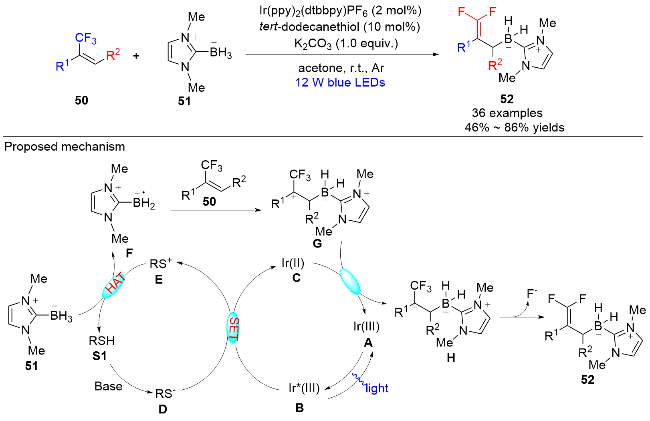
Building on the findings from the free radical trapping experiment,[41] they have elucidated a potential reaction mechanism. Initially, the Ir(III) complex A undergoes an electronic transition from the ground state to an excited state upon exposure to blue light, thereby generating the excited Ir*(III) species B. Following this, species B interacts with the thiolate anion D through a single electron transfer (SET) process, giving rise to the Ir(II) species C and the thiyl radical E. During this phase, the NHC-boryl radical F is produced via a hydrogen atom transfer (HAT) between the thiyl radical RS+ and 51, while simultaneously regenerating the thiol S1. Thereafter, radical F engages in a regionally selective free radical addition to trifluoromethyl olefin 50. The intermediate thus formed is then reduced by SET with the Ir(II) species, leading to the formation of the carbanion H and the reconstitution of the ground-state Ir(III) complex A. In the final step, carbanion H dergoes β-fluoride elimination via the E1cB pathway, culminating in the synthesis of the desired product 52.
In 2020, Sun and co-workers[42] achieved the successful synthesis of monofluoroolefins 62 using difluoroolefins 60 and 4-alkyl-1,4-dihydropyridines 61 as starting materials via photooxidation-reduction catalysis (Scheme 16). This reaction was conducted under mild conditions, devoid of alkali, and at ambient temperature. The developed strategy exhibits exceptional functional group compatibility and is applicable to a diverse array of difluoroalkene substrates, encompassing 4-alkyl-1,4-dihydropyridines with primary, secondary, and tertiary alkyl radicals. Moreover, this approach is also applicable for the assembly of monofluoroalkenylation double-chain architectures.
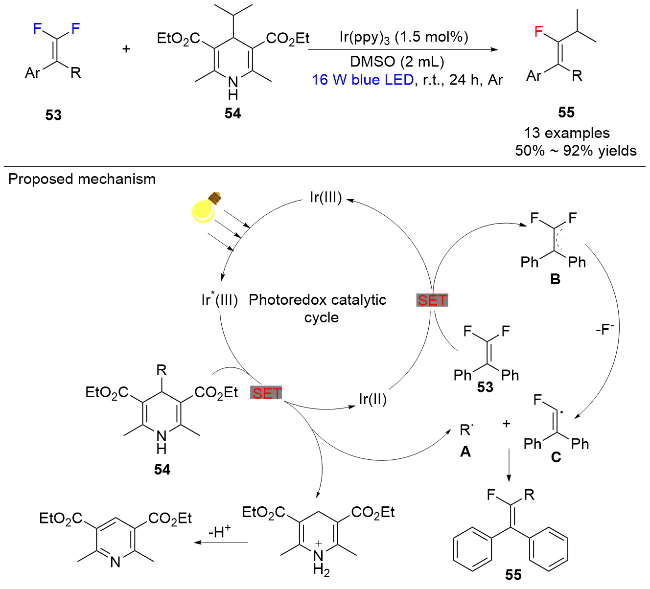
Based on the findings and experimental observations reported in the literature,[43-44] a plausible reaction mechanism is delineated (Scheme 16). Initially, upon exposure to visible light, the iridium catalyst is photoexcited to an excited state (E1/2[IrIII*/IrII]=+0.31 V vs SCE).[45] Subsequently, 4-alkyl-1,4-dihydropyridine (DHP) undergoes single-electron oxidation (E1/2ox=+1.05 V vs SCE),[46] leading to homolytic scission of the Calkyl—CDHP bond, thereby generating an alkyl radical A and the corresponding IrII intermediate (E1/2[IrIII/IrII]=-2.19 V vs SCE).[45] Following this, the single-electron reduction of the difluoroalkene 60 (E1/2red=-1.04 V vs SCE)[43] reacts with IrII, yielding a radical anion B and recycling the IrIII catalyst. The radical anion B then undergoes C—F bond cleavage to form the fluorovinyl group C. In the final step, the cross-recombination of group A with C results in the formation of the desired product 62.
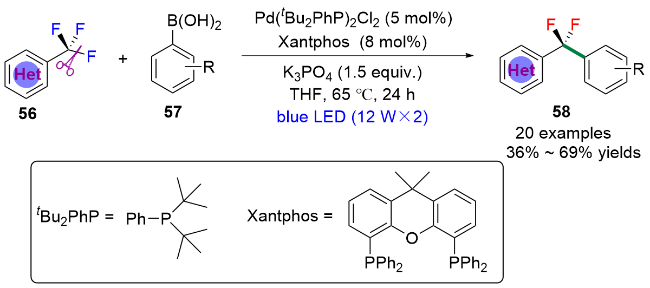
In 2021, Zhang and co-workers[47] disclosed a palladium-catalyzed and vision-induced selective defluorinated arylation of trifluoromethyl aromatics 56 with arylboric acid 57 (Scheme 17). In this reaction, the selective activation and cross-coupling of C(sp3)—F bonds in trifluoromethylaromatic hydrocarbons were accomplished by employing the palladium catalyst Pd(tBu2PhP)2Cl2 and the distinctive phosphine ligand Xantphos under blue light irradiation, generating ArCF2Ar structures 58 with medical value. This approach resolves two crucial issues in the activation of C(sp3)—F bond catalyzed by transition metals: the oxidation addition of C(sp3)—F bond and the suppression of excessive defluorination side reactions.
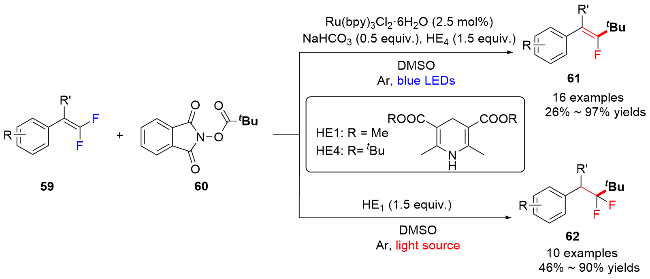
In 2022, Zhang et al.[48] developed an innovative catalytic technology that enables the defluorination, alkylation, or metal-free catalytic hydroalkylation of gem-difluoro- alkenes under visible light irradiation and the action of a Ru(II) catalyst or in the absence of a metal catalyst. This method offers a straightforward and gentle approach for synthesizing monofluoroalkenes 61 and difluoromethyl 62 compounds from gem-difluoroalkenes 59 (Scheme 18). The reaction between readily preparable N-hydroxyphth- alimide (NHP) esters 60 and gem-difluoroalkenes 59 allows for efficient synthesis of monofluoroalkenes or difluoromethyl compounds. These targeted fluorinated compounds are anticipated to hold significant potential in medicinal chemistry and materials science.
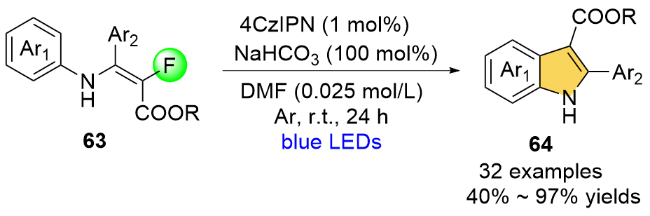
In 2022, Zhao el al.[49] carried out a mild 6π-halogena- tion/dearomatic reaction on n-arylenamine with α-fluoro- β-enylaminoester 63 as substrate and 4-CzIPN as an energy transfer (EnT) photocatalyst under visible light irradiation and without oxidant or transition metal catalyst. The indole compounds 64 were efficiently synthesized (Scheme 19). The method utilizes the readily available and metal-free 4-CzIPN as EnT photocatalyst and α-fluoro- β-enyl aminoester as the substrate oxidant, thus avoiding the use of oxidants or single/double transition metal catalysts such as Ir, Ir/Pd or Ir/Co. The mechanism study reveals that the formation of indole is caused by 4-CzIPN* induced by the energy transfer process of triadic n-aryle- namine.
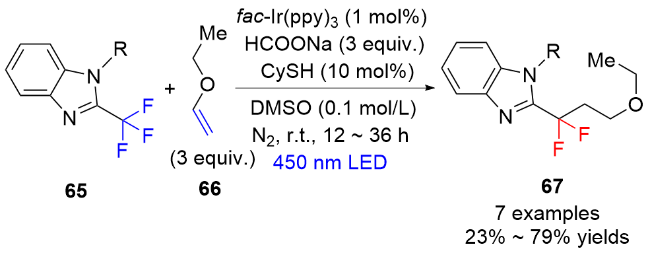
In 2022, Zhu et al.[50] reported a defluoroalkylation reaction of trifluoromethyl benzimidazoles 65 employing the Spin-Center Shift (SCS) strategy (Scheme 20). Utilizing $\text{CO}_{\text{2}}^{\bullet- }$ provided by ethoxyethane 66 as a single-electron reductant, the team achieved the synthesis of a diverse array of potentially bioactive 2-difluoroalkyl benzimidazoles 67 via a synergistic photocatalytic and thiolate catalytic process. This approach offers a mild and scalable synthetic strategy for the production of bioactive molecules that incorporate benzimidazole cores or difluoromethyl moieties.
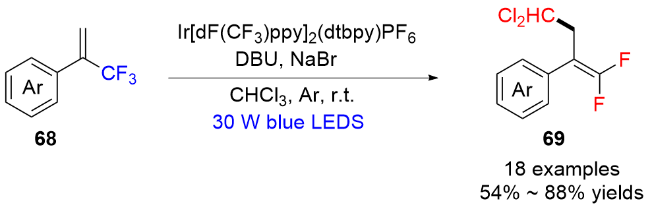
In 2023, Xiang’s team[51] developed a visible light- induced defluorinated dichloromethylation of α-trifluoro- methyl olefin 68 (Scheme 21). The method uses readily available and inexpensive trichloromethane as a dichloromethylation reagent and reaction medium to induce dichloromethylation of α-trifluoromethene, and synthesizes a series of new polyhalogenated scaffolens, namely dichloromethylation of dichloromethane-difluoroolefins, in which the products 69 are easy to obtain with moderate to good yields. It is worth noting that chloroform acts as both a dichloromethylation reagent and a reaction medium in this reaction. In particular, the transition from CHCl3 to CDCl3 provides a direct pathway for the preparation of deuterated analogues with high deuteration degrees. The reaction has the advantages of simple operation, strong expansibility, mild condition and high efficiency. These findings are expected to promote the widespread application of chloroform as an effective dichloromethyl source for the preparation of high value-added organic compounds.
In 2023, Zhou’s team[52] developed a new strategy for photocatalytic defluorination and cyclization of 2-fluoro- benzofuran by using α-trifluoromethyl o-hydroxystyrene 70 as raw material through the double C—F bond breaking reaction triggered by alkyl radicals (Scheme 22). Among them, α-trifluoromethyl styrene with o-hydroxyl group is the only substrate for photocatalytic defluorination. This reaction uses existing aliphatic carboxylic acids and α- heteroatom carboxylic acids as free radical sources to initiate the defluorination process. The intermediates 71 are not separated, thereby achieving the introduction of multiple functional groups at three positions of 2-fluorobenzofuran 72. In previous studies on the cleavage of α-trifluoro- methylolefin double C—F bonds, it is often necessary to pre-install nucleophilic sites on radical precursors to synthesize monofluorinated heterocyclic rings by photocatalytic defluorination/SNV-type cyclization process. This work shows that the nucleophilic sites can also exist in α-trifluoromethyl olefin itself, which greatly expands the application of the double C—F bond cleavage strategy in the construction of monofluorinated heterocyclic compounds.
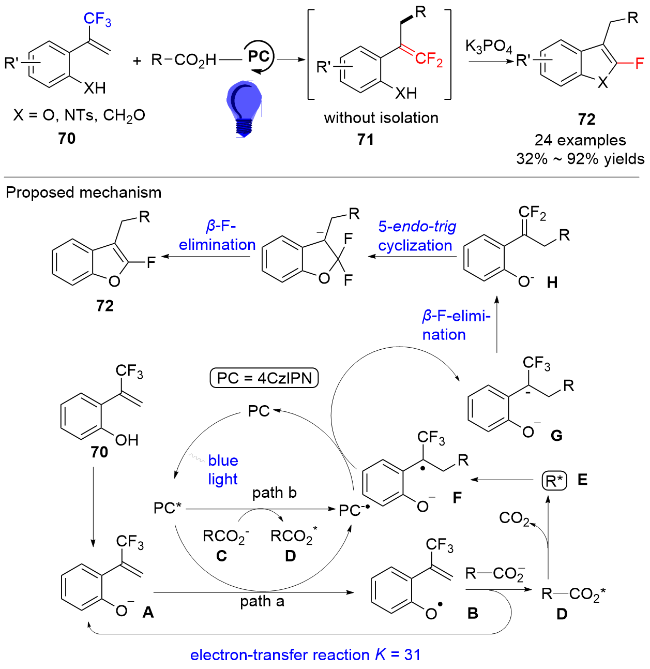
The team conducted an in-depth study of the mechanism of photocatalyzed defluorination coupling and cyclization. Under blue light irradiation, photocatalyst 4CzIPN is excited to form 4CzIPN*, which is subsequently reduced by phenol salt A via single electron transfer (SET) to produce phenoxy radical B and 4CzIPN∙−. Phenoxy radical B and carboxylate radical C undergo electron transfer to form carboxylate radical D (path a). In addition, carboxylate C can also generate carboxylic radical D (path b) by direct SET oxidation of 4CzIPN*. After decarboxylation of carboxyl radical D, alkyl radical E is formed, which reacts with α-trifluoromethyl styrene 72 to obtain carbon center radical F. Next, 4CzIPN∙− reduces F to α-trifluoromethyl carboanion G via SET, followed by a β-fluorine elimination reaction to produce the intermediate H. Under the action of base, H undergoes a 5-endo-exo cyclization reaction, and undergoes a second β-fluorine elimination, and finally forms the target product 2-fluorobenzofuran 70.
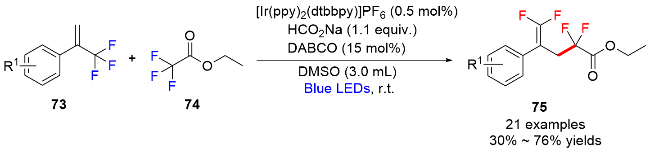
In 2023, Liu et al.[53] documented a visible-light-induced difluoroester radical addition/defluoroalkylation coupling reaction involving trifluoroacetic acid derivatives 74 and α-trifluoromethyl olefins 73 (Scheme 23). Mediated by the CO2 radical ($\text{CO}_{\text{2}}^{\bullet- }$), the spin-center shift in trifluoroacetic acid derivatives is initiated, facilitating the selective cleavage of a single C—F bond within the trifluoromethyl group to yield a range of organic polyfluorinated compounds 75. This methodology is distinguished by its compatibility with various functional groups under exceptionally mild reaction conditions, ease of operation, simplicity of the reaction setup, and brief irradiation duration.
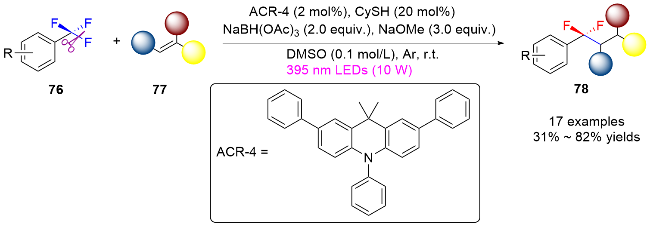
In 2023, Xu et al.[54] reported the selective defluorinated alkylation and hydrogenated defluorination of trifluoromethyl compound 76 with various alkenes 77 catalyzed by photocatalyst of dihydroacridine derivatives (Scheme 24). Through a series of experiments, the authors revealed the mechanism of the reaction and found that the reaction was carried out through the free radical process. The effects of reaction conditions on yield and selectivity were also discussed, and a series of defluorinated derivatives of trifluoromethyl compounds 78 were successfully synthesized.
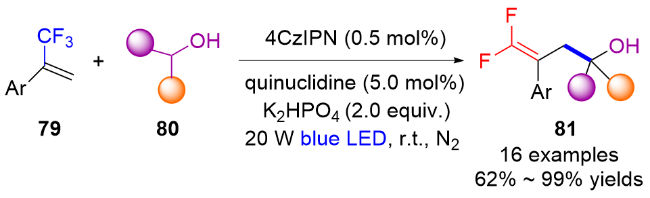
In 2025, Zhou et al.[55] developed a versatile photoredox-catalyzed strategy for the chemoselective hydroxyalkylation of α-CF3 alkenes 79 with alcohols 80 (Scheme 25). This protocol enables divergent access to γ-trifluoro- methyl alcohols and difluorohomoallyl alcohols 81, which can be further transformed via a base-mediated defluorinative cyclization into monofluorinated dihydrofurans in a one-pot manner. Highlighted by its use of inexpensive materials, mild conditions, and controllable C—F bond cleavage, this method provides a streamlined route to diverse fluorinated scaffolds.
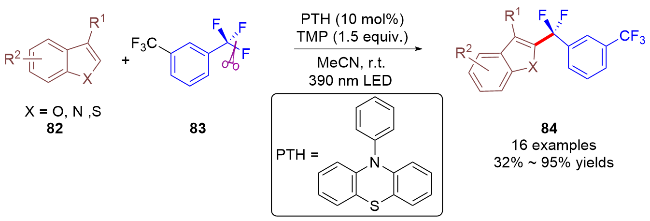
In 2025, Zuo et al.[56] reported a direct synthetic route to (hetero)aryl-difluoromethane-(hetero)aryl scaffolds 84 via a photoredox-catalyzed defluoroarylation (Scheme 26). This method selectively activates inert C(sp³)—F bonds of trifluoromethylarenes 83 and C(sp²)—H bonds of heteroarenes 82 under metal-free conditions, providing a straightforward and step-economical approach to these valuable fluorinated building blocks.
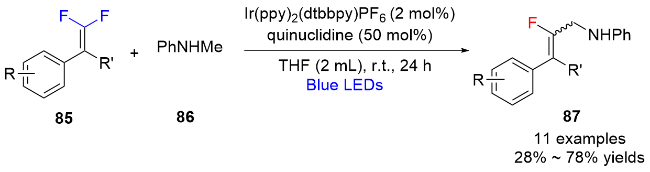
In 2025, Xu et al.[57] developed a visible-light photocatalytic strategy for the C—F/C—H coupling of gem- difluoroalkenes 85 with secondary N-alkylanilines 86 to synthesize fluorinated allylamines 87 (Scheme 27). This protocol proceeds under mild, metal-free conditions with excellent functional group tolerance and a broad substrate scope, enabling the green synthesis of valuable monofluoroalkene derivatives. Mechanistic studies suggest the reaction proceeds via a photoredox-catalyzed radical- radical coupling pathway.
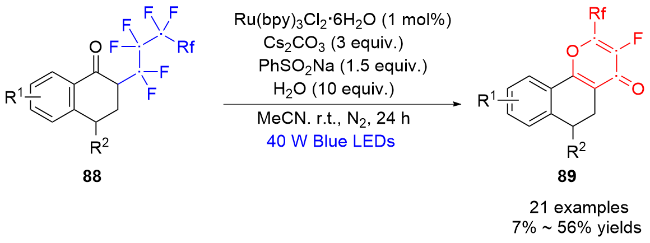
In 2025, Xu et al.[58] reported a ruthenium-catalyzed, visible-light-induced defluorinative cyclization of poly- fluoroalkyl tetralones for the precise synthesis of 3-fluoro- 2-(trifluoromethyl)-γ-pyrones 89 (Scheme 28). This transformation is notable for its selective functionalization of five inert C(sp3)—F bonds at three distinct carbon sites on the perfluoroalkyl chain of compound 88. A key feature is the dual role of the sulfinate salt, which acts simultaneously as an oxygen source for carbonyl formation and as a defluorinating promoter, providing efficient access to valuable fluorinated heterocycles from polyfluorinated precursors.
In 2025, Chen and colleagues[59] successfully developed a visible-light-driven electron donor-acceptor (EDA) complex-enabled, nickel-catalyzed coupling/controllable de- fluorination domino sequence. This methodology provides an efficient access to a series of α-fluoroarylacetic esters and amides 92 from commercially available aryl bromides 90 and chlorodifluoroaryl carboxylic acid derivatives 91 (Scheme 29). Mechanistic investigations indicate that the reaction is initiated by a photoredox EDA/nickel-catalyzed cross-electrophile coupling, followed by a controllable de- fluorination step facilitated by the regeneration of EDA complexes. By integrating EDA complex reactivity with nickel catalysis under mild conditions, this strategy not only advances the exploration of photoredox EDA-nickel catalytic systems but also stimulates broader interest in controllable defluorination processes.

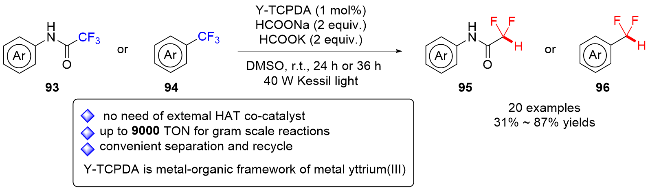
In recently, metal-organic frameworks (MOFs) have also played a significant role in catalytic defluorination reactions. Su et al.[60] developed a stable MOF (Y-TCPDA) from a tailored twisted ligand to overcome the short lifetime of organic photosensitizers. This MOF demonstrated high performance in defluorinative catalysis (93~96) and olefin cross-coupling [turnover number (TON) up to 9000], outperforming its homogeneous counterpart by protecting the active sites and enabling in situ generation of a CH3S∙ co-catalyst from dimethyl sulfoxide (DMSO) (Scheme 30).
4 Electrocatalytic defluorination
Electrocatalytic defluorination has emerged as a powerful and sustainable strategy for the selective activation of inert C—F bonds. By leveraging electron transfer at the electrode interface, this approach enables precise C—F cleavage under mild conditions, circumventing the need for stoichiometric chemical reductants. Current research focuses on the developing efficient catalytic systems, which commonly utilize transition metal catalysts or tailored cathode materials, aiming to transform robust fluorinated groups (e.g., Ar-F, CF3) into valuable partially fluorinated or functionalized structures.
In 2020, Wu and colleagues[61] described a methodology for the direct electrochemical defluorination and carboxylation of gem-difluoroolefins 99 in conjunction with carbon dioxide 97 to produce α-fluoroacrylic acid 98 (Scheme 31). Utilizing a streamlined constant-flow continuous tank reactor, a platinum plate served as the working cathode, while an economical nickel plate was employed as the anode. The reaction was conducted smoothly at ambient temperature, obviating the need for costly transition metal catalysts, ligands, external bases, or reducing agents. The process yielded the desired addition products with a high efficiency of up to 83%, an Z/E isomer ratio of 20∶1, and exhibited robust tolerance to various functional groups. Cyclic voltammetry studies led to the proposal of an innovative electrolysis-chemical reaction-electrolysis-chemical reaction (ECEC) reaction mechanism. This research in electrochemical defluorinated carboxylation holds significant implications for the advancement of green chemistry and sustainable chemical practices.
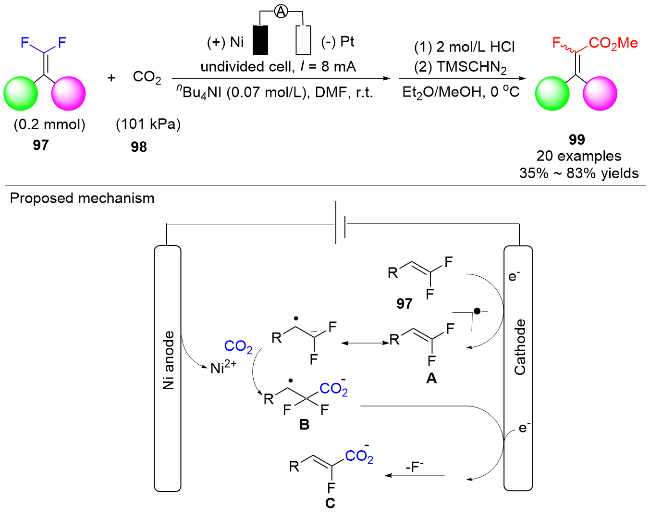
According to the results of cyclic voltammetry (CV) experiment and previous literature reports,[62] a putative ECEC[63] reaction mechanism was speculated. First, gem-difluoroolefins 97 receive an electron at the cathode to undergo A reduction reaction, forming a free radical A. Subsequently, the free radical A rapidly and selectively fixes the carbon dioxide to the difluorocarbon site to obtain the intermediate B. The intermediate B then undergoes a second single-electron reduction process, followed by a defluorination reaction to form the carboxylate anion C. The carboxylate anion C forms the corresponding salt by combining with nickel ions produced by the anode. Finally, the target product α-fluoracrylic acid was obtained through the acidification step.
In 2022, Yang et al.[64] reported an electrochemical defluorinated alkylation method for α-trifluoromethyl olefin 100. This reaction is not only suitable for a variety of α-trifluoromethylolefin, but also can react with different kinds of alkyl precursors, such as organic halides 101, NHP esters 102 and Katritzky salts 103, and other alkyl sources to synthesize functional gem-difluoroalkenes 104~106 (Scheme 32). The method has the advantages of low cost, mild reaction conditions, high efficiency and simple purification and amplification process, which provides a new path for the synthesis of gem-difluoroalkenes.
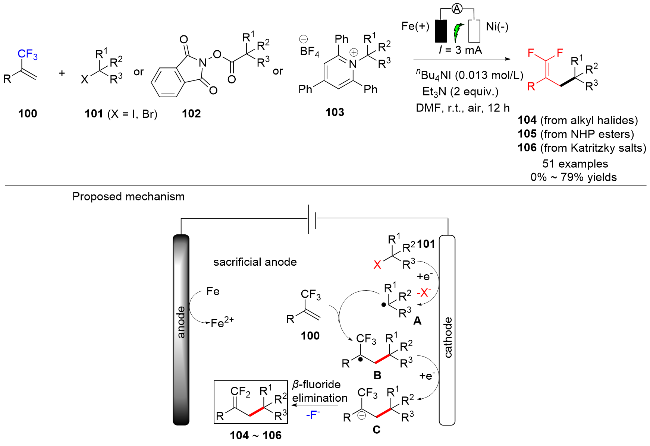
According to the experimental results and existing studies, a reasonable electrochemical reaction mechanism was proposed. Substrate 101~103 (including NHP ester, organohalides and Katritzky salt) undergoes single electron transfer (SET) during cathode electrolysis to form the key aliphatic carbon center radical intermediate A. Intermediate A then reacts with α-trifluoromethylolefin 100 to form α-CF3 carbon-based intermediate B. The radical intermediate B is further reduced at the cathode to form α-CF3 carbanion intermediate C. Finally, the target product gem- difluoroalkenes 104~106 are obtained by the β-fluoride elimination reaction of intermediate.
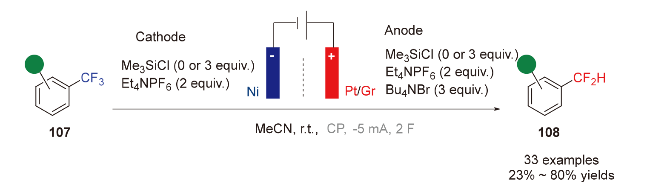
In 2023, Lennox et al.[65] developed a general and electronically ambivalent electrochemical method for the mono-hydrodefluorination of readily available Ar-CF₃ substrates 107. By leveraging a Ni cathode at deeply reducing potentials, their strategy achieves high selectivity for Ar-CF2H products 108 with good to excellent yields, which is scalable to the gram level (Scheme 33). The protocol was also extended to a single-step di-hydrodefluo- rination for the synthesis of benzylic fluorides (Ar-CFH2). This approach enables the late-stage diversification of a single CF3 feedstock into valuable fluoromethyl motifs (CF2H, CFH2), providing a practical route to access functionally diverse building blocks for structure-activity relationship (SAR) studies and library synthesis.
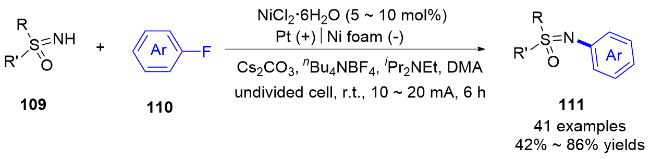
In 2025, Chen and colleagues[66] developed an electrochemical platform for the selective activation of inert C—F bonds in unactivated aryl fluorides at room temperature. By leveraging cathodic reduction to generate key aryl radical intermediates, their strategy enables two distinct defluorinative transformations: nickel-catalyzed sulfoximination and transition metal-free fluorosulfonylation. A series of compounds 111 were synthesized using NH-sul- foximines 109 and various aryl fluorides 110 (Scheme 34). Mechanistic studies suggest the nickel-catalyzed variant proceeds via an aryl radical intermediate followed by nickel-promoted C—N bond formation under paired electrolysis. The protocols exhibit good functional group tolerance and have been successfully applied to the late-stage functionalization of bioactive molecules, demonstrating significant synthetic utility for diversifying inert electrophiles.
5 Synergistic catalytic defluorination
Synergistic catalytic strategies are advancing the field of C—F bond activation by merging complementary activation modes to achieve unprecedented reactivity and selectivity. In photoelectrocatalysis, light and electric potential work in concert to generate highly reactive species under mild conditions, enabling precise defluorination. These cooperative systems are expanding the toolbox for transforming inert fluorinated groups into valuable building blocks, particularly in the late-stage functionalization of complex molecules.
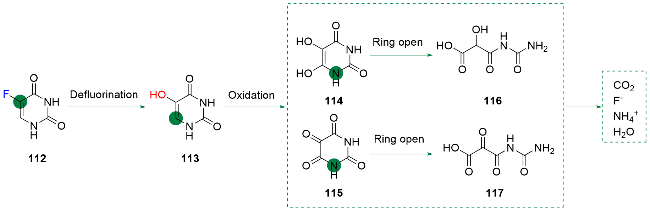
In 2024, Li and co-workers[67] developed a facet- engineered TiO2 photoanode on a 3D Ti mesh for the efficient photoelectrocatalytic (PEC) degradation of fluorinated pharmaceuticals (Scheme 35). Their study proposed a degradation pathway for 5-fluorouracil (5-FU) 112, which is initiated by ∙OH radicals attacking and cleaving the inert C—F bond, subsequently generating 2,4,5-trihydroxy- pyrimidine 113. This critical defluorination step is followed by a series of oxidation reactions that subsequently lead to ring-opening of the pyrimidine structure 114 and 115. The process ultimately mineralizes the pollutant, first into the aliphatic acids 116 and 117, and then ultimately to CO2, H2O, NH4+, and F- ions (Scheme 35). The authors suggested that future integration with advanced reduction processes or photovoltaic cells could further enhance the performance and economic viability of this promising PEC water purification strategy.
In 2025, Kang et al.[68] developed a novel low-tempera- ture, reductive electrophotocatalysis system for the challenging defluorination of inert polytetrafluoroethylene (PTFE) 118 (Scheme 36) and other perfluoroalkyl substances (PFASs). This strategy synergistically combines photochemical and electrochemical energy by employing CBZ6 as a super-reductant to inject electrons into C—F bonds, while a supercapacitor (SC) generates the catalytically active species. The system, validated by comprehensive spectroscopic analyses, is designed to be portable by utilizing sunlight and a supercapacitor as energy sources, demonstrating significant potential for outdoor environmental remediation applications.
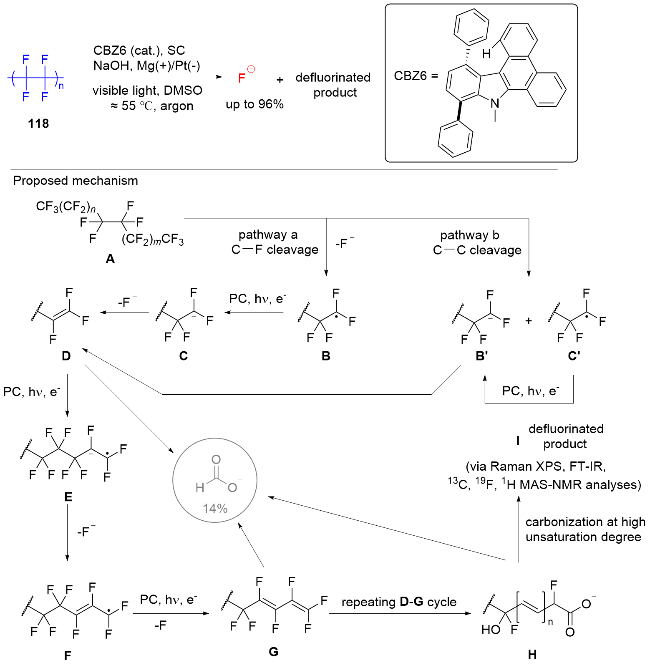
The defluorination of the polytetrafluoroethylene (PTFE) radical anion (A) is proposed to proceed through two distinct pathways. In pathway a, fluoride anion release yields radical intermediate B.[69] A subsequent sequence involving electron injection and fluoride anion elimination leads to the formation of an unsaturated carbon-carbon double bond in D. This is followed by a consecutive single-electron transfer (SET) defluorination cycle, generating the highly unsaturated polymer H. Further cyclization and aromatization of H produce aromatic units, ultimately affording the defluorinated product I.[70] Alternatively, pathway b involves the transformation of A via radical intermediate C' and anionic intermediate B', culminating in C—C bond cleavage to form D, which also contains an unsaturated carbon-carbon double bond. The detection of formate as a side product suggests the potential involvement of hydroxide in facilitating the carbon-carbon bond cleavage step.
6 Other types of defluorination reactions
Metal-free and alkali metal-catalyzed defluorination are advancing towards more precise, efficient, and environmentally benign pathways, serving as crucial complements to conventional chemical methods. While enzymatic and microbial defluorination are still in their nascent stages of development, they hold significant promise for environmental remediation. Future research will focus on discovering or engineering defluorinating enzymes with enhanced activity and broader substrate scope, developing efficient microbial consortia, and leveraging protein engineering, synthetic biology, and hybrid chemo-bio systems to overcome the current limitations of biocatalytic platforms. Ultimately, these efforts are expected to provide innovative solutions for the precise synthesis and efficient degradation of fluorinated compounds.
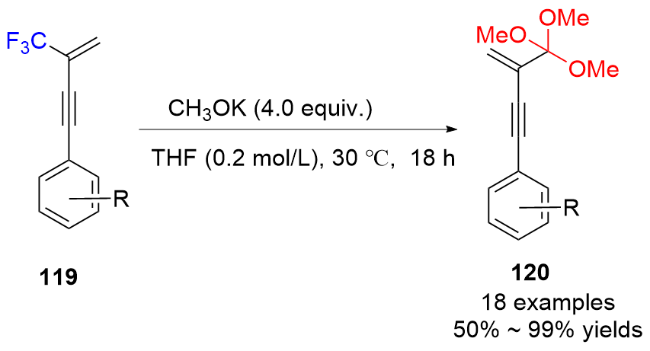
In 2021, Xu et al.[71] successfully elaborated a selective and versatile defluorination methoxylation strategy for the trifluoromethyl substitution in 1,3-enynes 119. This approach enabled the synthesis of allyl esters 120 with high yields under benign reaction conditions (Scheme 37). Furthermore, the investigative team delved into the transformative applications of allyl alkylates, substantiating their role as efficient and adaptable “platform molecules” for the production of diverse functionalized bialenes.
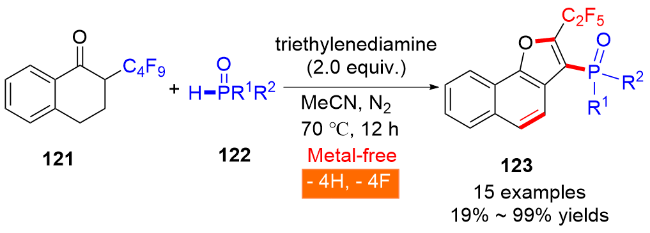
In the same year, Wang et al.[72] synthesized fluoroalkyl triarylphosphonates 123 from perfluoroalkyl ketones 121 and phosphonates 122. This defluorophosphorylation reaction proceeds under mild conditions via the continuous activation of C(sp3)—F bonds (Scheme 38). The synthesis strategy is easy to operate and has wide substrate applicability. The successful implementation of this method is due to the precise control of the continuous functionalization of the C(sp3)—F bond at two different carbon points on the perfluoroalkyl chain. In addition, a variety of fluoroalkylated tri(hetero)arylphosphine compounds have been efficiently synthesized by further reduction or direct use of phosphine oxides and perfluoroalkyl ketones in a single pot process.
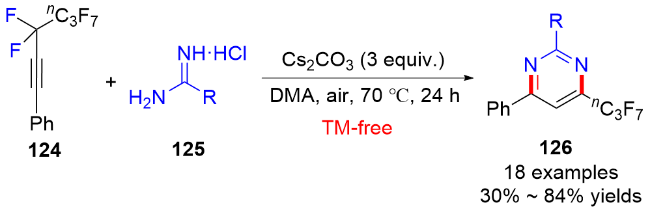
In 2022, Ma and co-workers[73] successfully crafted an efficient net [3+3] defluorination cyclization strategy, tailored for the synthesis of perfluoroalkyl-substituted pyrimidines. This approach utilizes perfluoroalkynes and amides as foundational precursors. This innovative strategy employs a combination of perfluoroalkynes 124 and amides 125 as the principal precursors (Scheme 39). This synthetic approach facilitates the concise construction of two carbon-nitrogen (C—N) bonds and a novel heterocyclic framework through a sequence of reactions, including hydroamination, defluorination, and cyclization, all executed without the necessity of a transition metal catalyst. The methodology demonstrates remarkable tolerance towards a variety of functional groups, culminating in the production of the desired pyrimidines 126 with superior yields.
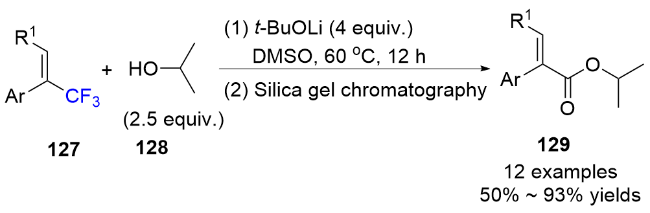
In 2023, Zhu et al.[74] successfully realized the 1,3- dietherification reaction and the purification controlled defluorination of (trifluoromethyl)olefin 127 and alcohol 128, and synthesized a variety of valuable 1,3-diether and α-aryl acrylates 129 with high yield (Scheme 40). In particular, it is worth mentioning that the reaction can break all three C—F bonds in CF3 groups. The whole process does not require catalyst and transition metal, featuring mild reaction conditions, simple operation, good gram- scale feasibility and scalability, excellent functional group tolerance, and broad substrate scope.
In 2023, Shen et al.[75] demonstrated that the carbonyl group plays a crucial auxiliary role in the defluorination- phosphorylation and coordinated defluorination-phosphor- ylation reactions of trifluoromethyl ketones 130 with P(O) compounds 131 (Scheme 41). Under mild reaction conditions, the substitution of one or two fluorine atoms in the trifluoromethyl ketone can be precisely controlled to generate gem-difluoroalkenyl and monofluoroalkenyl phosphorus compounds 132, while maintaining high stereoselectivity and chemical selectivity. This approach enables a diversity-oriented synthesis, leading to the construction of a library of diverse organophosphorus frameworks with broad functional group compatibility.
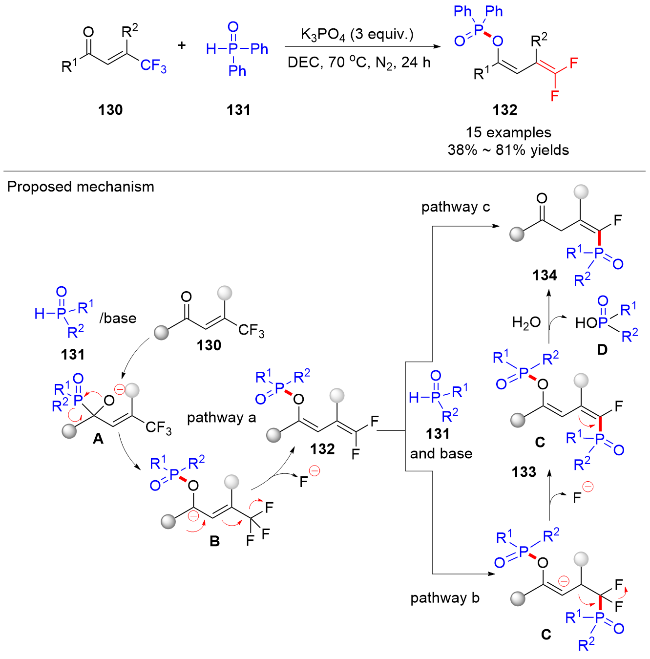
Building on this reaction and prior research findings,[76-79] a plausible mechanism for the formation of each product was elucidated. In an alkaline environment, the initial step is proposed to involve the addition of HP(O)- R1R2 to the carbonyl moiety of the trifluoromethyl ketone 130, followed by a 1,2-phospha-Brook rearrangement that facilitates the transfer of anion B. Following this, the defluorination of the reactive intermediate B yields the desired phosphorylated product 132 (pathway a), which can be selectively transformed into products 133 or 134 by modifying the reaction parameters (e.g., base, solvent, and reaction duration). The formation of product 133 is favored by the interaction of another phosphine oxide molecule 131 with product 132, employing an SNV reaction mechanism to cleave the C—F bond of the olefin, thereby achieving defluorinated phosphorylation (pathway b). When ethyl acetate (EtOAc) is employed as the solvent, product 133 undergoes further dephosphorylation to generate product 134, with the concurrent release of phosphate D. Moreover, product 132 may undergo a sequential addition-defluorination-dephosphorylation process with HP(O)R1R2, leading directly to the monophosphorylated product 134 (pathway c).
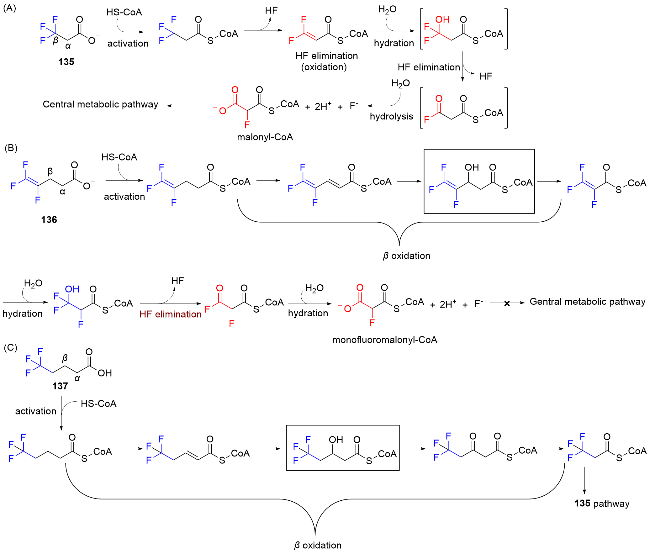
While fluorinated compounds are widely used in industry and materials science, their poor biodegradability leads to environmental accumulation, making novel enzymatic and microbial defluorination a key future research direction. In 2021, Men et al.[80] investigated the aerobic microbial defluorination of short-chain fluorinated carboxylic acids (FCAs) by activated sludge communities to address knowledge gaps on their environmental fate. Their study revealed distinct structure-reactivity relationships, with four C3~C5 FCAs exhibiting over 20% defluorination. Among these, 3,3,3-trifluoropropionic acid (135) and trifluoropentanoic acid (137) were nearly completely defluorinated, and the defluorination rate of the unsaturated structure 136 was 70% (Scheme 42). They identified the underlying pathways and demonstrated that defluorination occurs via cometabolism. These findings advance the understanding of aerobic microbial defluorination and highlight the potential of developing cost-effective chemical- biological treatment trains for PFAS, especially since some short-chain FCAs are byproducts of advanced reduction processes.
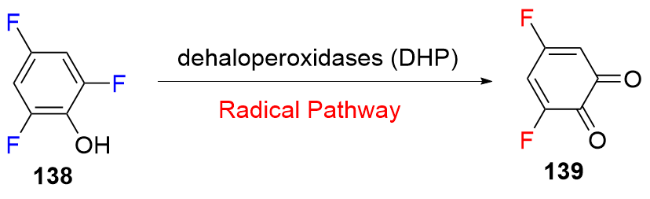
Rather recently, Visser and colleagues[81] investigated the defluorination of fluorinated aromatics by heme dehaloperoxidases (DHP) using MD and QM calculations (138→139) (Scheme 43). They revealed a mechanism where the substrate is first anchored in the binding pocket, followed by a low-barrier (<41.8 kJ∙mol-1) hydrogen abstraction and OH rebound. The subsequent defluorination step, which is rate-determining and can occur inside the protein or in solution, ultimately yields benzoquinones, demonstrating the enzyme’s potential for environmental remediation of fluorophenols.


7 Conclusions
To summarize, this review has summarized the significant progress in catalytic defluorination, spanning transi- tion-metal catalysis, photocatalysis, electrocatalysis, and emerging synergistic and biological strategies. These advancements have enabled precise “editing” of inert C—F bonds, facilitating the construction of complex, high-value fluorinated molecules from simple precursors. Despite these achievements, several specific challenges remain. The generation of toxic byproducts, such as fluoride anions (F-) which can form corrosive hydrofluoric acid (HF), and organotin wastes in certain transition-metal systems, poses environmental and safety concerns. Furthermore, catalyst deactivation—often due to fluoride ion poisoning of metal centers (e.g., in Ni-catalysis) or metal leaching and aggregation—continues to hinder efficiency and scalability.
Looking forward, future research should follow a staged and actionable roadmap. In the short term (1~3 years), efforts should focus on developing low-cost, earth- abundant catalytic systems. This includes engineering Cu- based photocatalysts with tailored ligands to enhance stability and redox properties, and optimizing non-precious metal electrocatalysts. For the long term (beyond 5 years), the exploration of cross-disciplinary synergies holds immense promise. A key direction is the integration of enzyme-electrocatalysis, which could leverage the exquisite selectivity of biocatalysts with the controllable power of electrochemistry for the sustainable degradation and transformation of recalcitrant fluorinated pollutants. By addressing these concrete challenges and pursuing these targeted directions, the field can move decisively towards the overarching goal of achieving efficient, selective, and truly sustainable defluorination processes aligned with the principles of green chemistry.
(Zhao, C.)