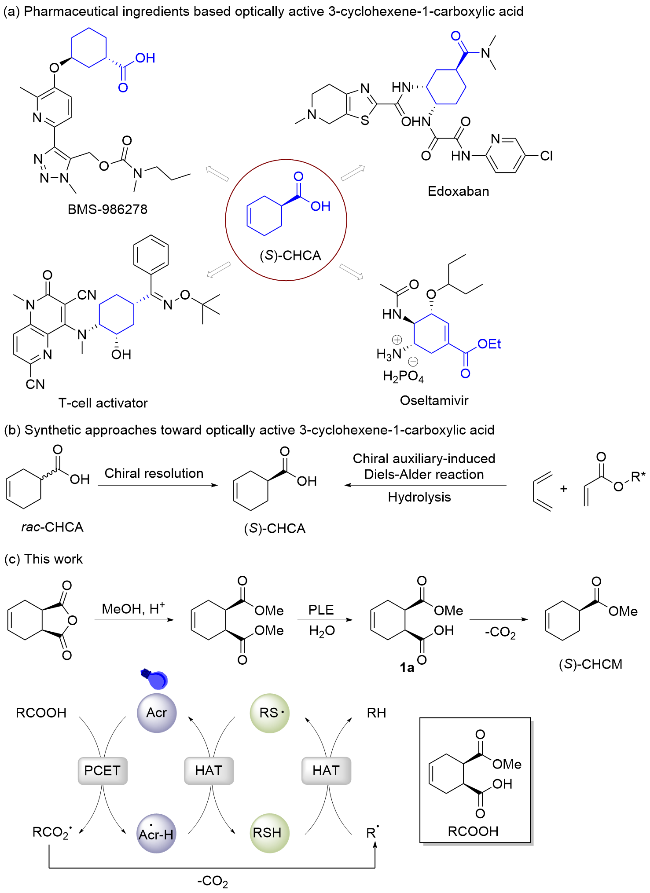
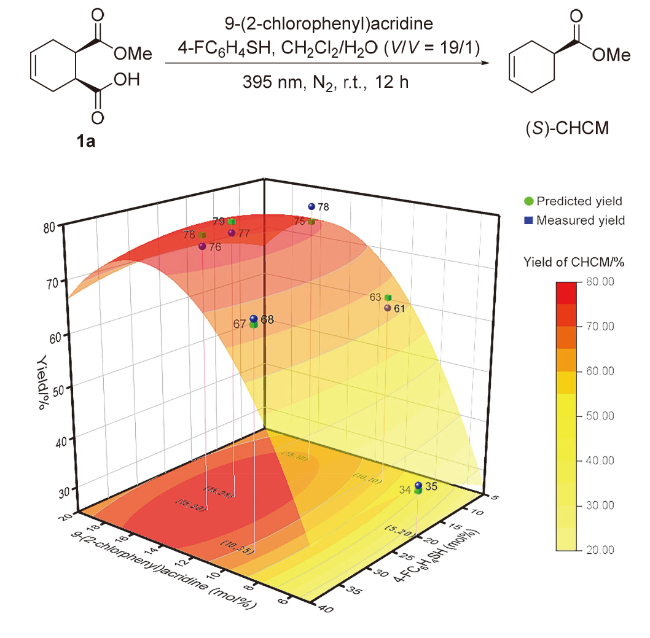
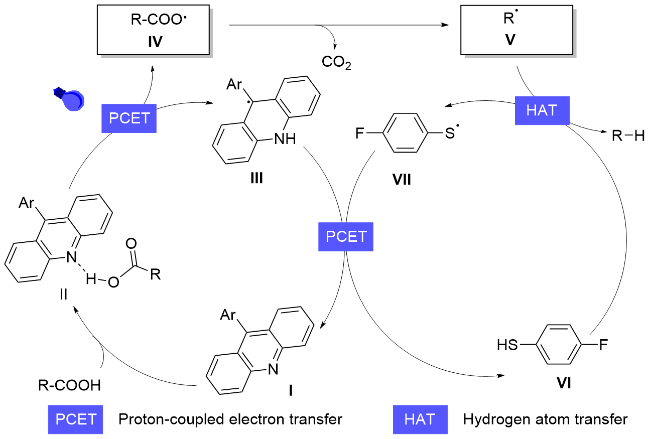
The acridine photosensitizer is the key factor to the performance of this photo-driven hydrodecarboxylation. The previous investigations have revealed that either 9,10-dihydroacridine or 9-alkyl-10-hydroacridine by-product, stemming from the cross termination of the alkyl radical with acridinyl radical, was formed in the photo-driven decarboxylation of carboxylic acid.
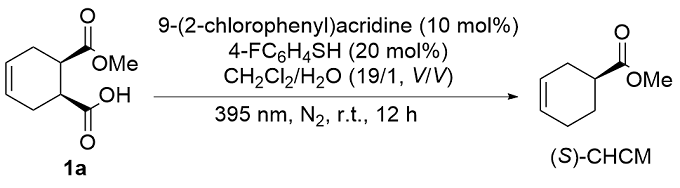
[10] When 9-(2-chloro-phenyl)acridine was employed as the photosensitizer for the hydrodecarboxylation of
1a, the cross termination by-product methyl 6-(9-(2-chlorophenyl)-4a,9,9a,10-tetrahy-droacridin-9-yl)cyclohex-3-ene-1-carboxylate was detected by gas chromatography mass spectrometry in the crude product. Meanwhile, the formation·of thiol-ene reaction product between product·(
S)-CHCM and 4-FC
6H
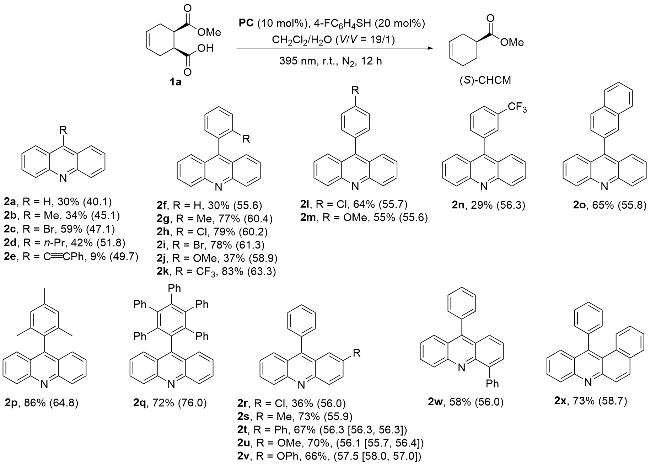
4SH was not detected. Thus, we envision that enlarging the steric hinderance at the C9 position of acridine by introducing bulkier substituent can inhibit the formation of 9,10-dihy-droacridine or 9-alkyl-10-hydroacridine. Thus, a series of 9-substituted acridine photosensitizers were prepared and tested in this hydrodecarboxylative reaction (
Scheme 2). The steric hinderances at the 9-position of these acridine photosensitizers were computationally evaluated with the parameter of percent buried volume (
VBur/%) at the C9 position. Since H, alkyl, halogen or alkynyl-substitute (
2a~
2e) have less steric hinderance at the 9-position of acridine than aryl group, their performance in the hydrodecarboxylation of
1a was poor. Besides 9-(2-chloro- phenyl)acridine (
2h), more acridines bearing
ortho-sub- stituted phenyl group at the 9-position were tested (
2g and
2i~
2k). All of them exhibited better performance than the less sterically hindered 9-phenyl acridine (
2f). Moreover, 9-(2-trifluorome- thylphenyl)acridine (
2k) exhibited better performance than 9-(2-chlorophenyl)acridine (
2h). More 9-aryl acridines with different substituent at different position (
2l~
2w) and 12-phenylbenzo[
a]acridine (
2x) were tested. Overall, the 9-aryl acridines, with the substituent being able to shield the 9-position of acridine, can achieve higher yields (
e.g. 2k,
2p and
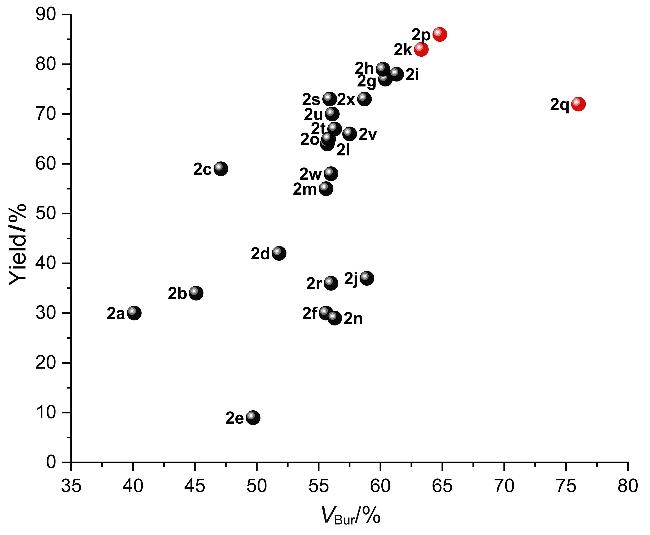
2q) than the other 9-aryl acridines with less steric hindrance. The correlation between the steric hinderance at the 9-position of acridine photosensitizer (
VBur/%) and the yield of decarboxylation product were summarized in
Figure 2. It was proposed that the photoinduced PCET took place in the singlet excited state of the hydrogen bond acridine-carboxylic acid complex.
[10b] We speculate that the substituent variation on the C9 position of acridine also impose influence on the lowest singlet excited state of the hydrogen bond acridine-car- boxylic acid complex, which leads to the distinct catalytic performance among the acridine photosensitizers with similar
Vbur/% values (
e.g.,
2h/
2i vs.
2j/
2k). More than acridine-type organic photosensitizers, the other types of organic photosensitizers, including xanthylium, 2,4,6-tri- phenylpyrylium tetrafluoroborate, anthracene-9,10-dicar- bonitrile, acid red 87, fluorescein, 9-mesityl-10-methylacri- dinium tetrafluoroborate, 10-phenyl-10
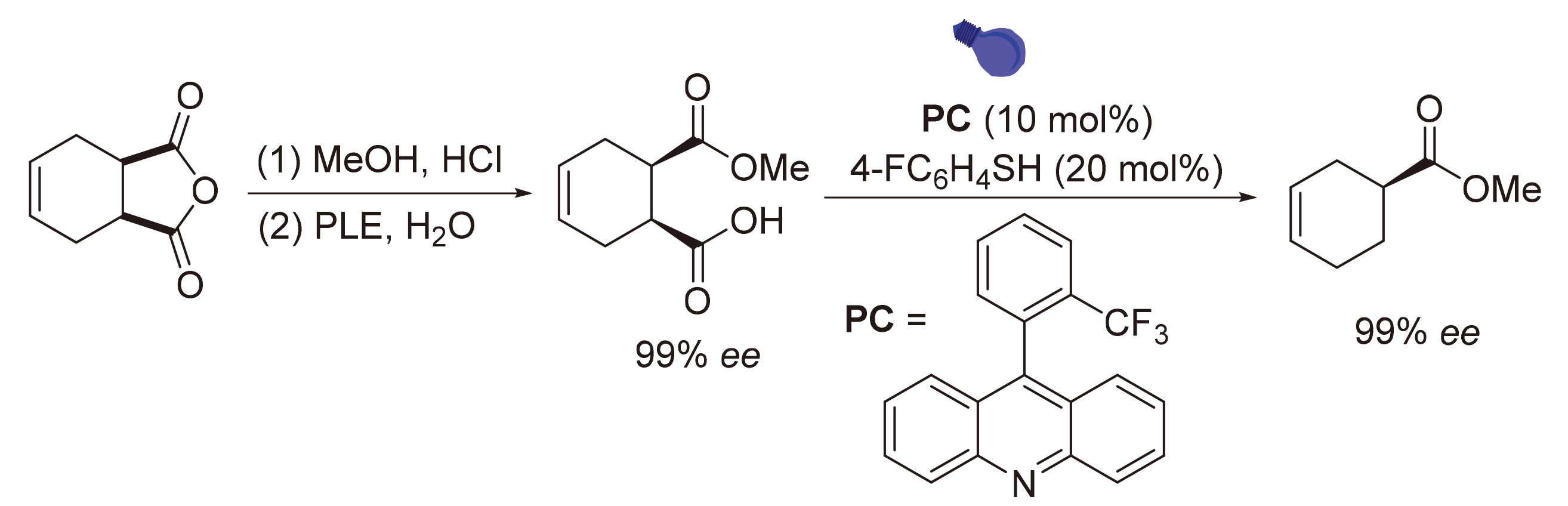
H-phenothiazine and 4CzIPN were also attempted under the base-free conditions, none of them exhibited the performance comparable to 9-(2-trifluoromethylphenyl)acridine photosensitizer. Furthermore, with the tool of flow photo-reactor, the reaction scale for the photo-driven 9-(2-trifluoromethylphenyl)- acridine and 4-fluorothiophenol-catalyzed hydrodecarboxylation of
1a to (
S)-CHCM was successfully enlarged from 0.2 mmol to 50 mmol. The enantiomeric excess of the obtained hydrodecarboxylation product was well retained at 99% with a yield of 57%.