


1 Introduction
Isoxazolidine motifs are important structural units in numerous bioactive and pharmaceutical molecules.[1-4] For instance, isoxazolidine can serve as a versatile precursor to 1,3-amino alcohols, exemplified by sitagliptin.[5] The synthetic methodologies for isoxazolidine include 1,3-dipolar cycloaddition reactions, electrophilic/radical-mediated carboamination/etherification cyclization reactions of unsaturated hydroxylamines and Michael addition reactions.[5-15] However, the development of highly enantioselective asymmetric syntheses remains a significant challenge, owing to the inherent difficulties in constructing chiral centers and achieving precise stereocontrol. In recent years, transition metal-catalyzed difunctionalization, especially carboamination of alkenes has emerged as a powerful method for synthesizing isoxazolidine framework.[16] The Toste group[17] has reported the Au(I)-catalyzed enantioselective synthesis of isoxazolidines from allenic hydroxylamines, with high enantioselectivity. Wolfe and other research groups[18-21] have established palladium-catalyzed highly diastereoselective strategies starting from unsaturated hydroxylamines or unsaturated carbamates. Nevertheless, despite recent advances, the development of broadly applicable asymmetric carboamination methods remains challenging.
From a mechanistic perspective, several density functional theory (DFT) studies have been reported on Pd- catalyzed carboamination and related aminopalladation processes, revealing the feasibility of both cis- and trans- aminopalladation pathways in different catalytic manifolds.[22-29] However, these computational investigations have largely focused on racemic or non-chiral systems, and the stereochemical origin of Pd-catalyzed asymmetric carboamination reactions remains poorly understood, particularly in ligand-controlled catalytic systems.
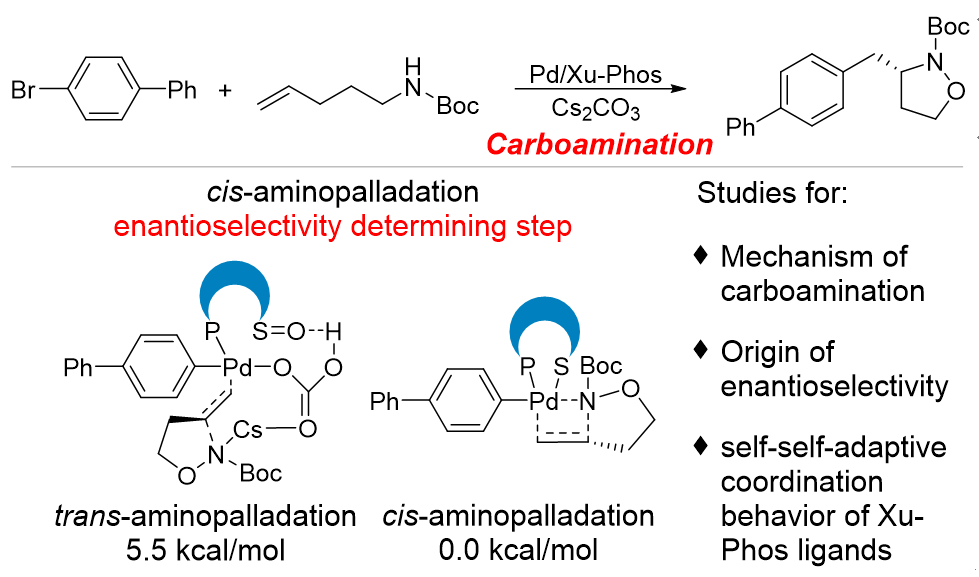
In this context, Zhang and coworkers[30] reported in 2021 a palladium/Xu-Phos-catalyzed asymmetric carboamination reaction that efficiently coupled acyclic unsaturated hydroxylamines with aryl or alkenyl bromides, enabling the construction of isoxazolidine scaffolds with excellent enantioselectivity (Scheme 1a). Despite the synthetic success of this transformation, the mechanistic understanding of the carboamination process remains elusive, particularly regarding the two competing C—N bond-forming pathways, the trans- and cis-aminopalladation, which are especially unclear when terminal alkenes serve as substrates. Moreover, the origin of the enantioselectivity, has yet to be elucidated. To address these issues, we performed a comprehensive computational DFT study to clarify the detailed reaction mechanism and establish a solid theoretical foundation for further experimental exploration.
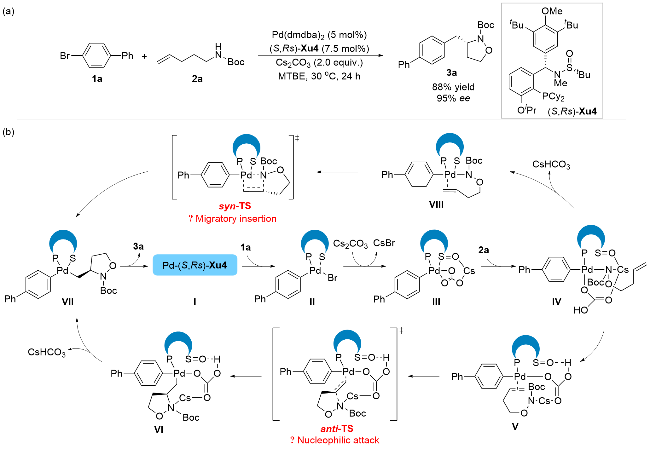
A preliminary reaction pathway is illustrated in Scheme 1b, comprising four main steps: oxidative addition, ligand exchange, aminopalladation, and reductive elimination. Notably, the crucial aminopalladation step may proceed through two distinct modes: the trans-aminopalladation (nucleophilic attack) or cis-aminopalladation (migratory insertion) involving a four-membered-ring transition state. Then the question arises: which of these pathways is energetically favored? Furthermore, an alternative mechanism featuring carbopalladation followed by C—N bond formation has also been proposed.[31] To clarify these mechanistic possibilities, the reaction shown in Scheme 1a was chosen as a model system for detailed DFT (density functional theory) calculations, aiming to identify the rate- and enantio-determining steps, and to differentiate between the competing trans- and cis-aminopalladation pathways.
2 Computational methods
DFT computations were performed using the Gaussian 09 program.[32] All free energy profiles are given in kcal/ mol (1 kcal=4.1828 kJ). The geometry optimizations and single-point energy were calculated at different levels of theory for TS3, TS4, TS5, and IntD, with free-energy barriers reported relative to IntD. This comparison allows evaluation of the sensitivity of the computed barriers to the choice of functional and basis set M06/def2-TZVPP//M06- L/mixed basis set. Unless otherwise noted, the mechanistic discussion in the main text is based on energies obtained at the M06/def2-TZVPP// M06-L/mixed basis set level.
3 Results and discussions
3.1 Reaction mechanism based on free-energy profiles
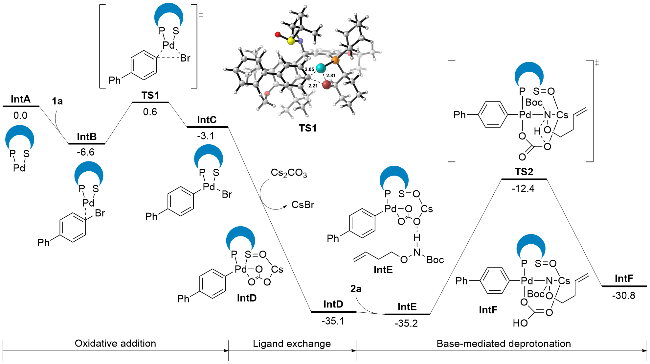
The most stable Xu4-Pd(0) complex (IntA) is identified through conformational searches, featuring P,S-coordination between Pd(0) and the chiral sulfinamide moiety, as shown in Figure 1. Subsequently, substrate 1a enters the reaction system and coordinated with Pd to form IntB, which undergoes oxidative addition through 3-membered-ring TS1 to generate square-planar Pd(II) complex IntC. TS1 is only 7.2 kcal/mol above IntB and proceeds to square-planar four-coordinate Pd(II) intermediate IntC. This oxidative addition step is kinetically feasible while thermodynamically unfavorable (ΔG=3.5 kcal/mol). Then ligand exchange of IntC with Cs2CO3 is computed by approximating CsCO3 and bromide anions as the entering and leaving ligands, which produce the complexes IntD with a large thermodynamic driving force (ΔG=-32.0 kcal/mol). Since then, Cs coordinates not only with the O atom of the carbonate but also with the O atom of the sulfinamide moiety, which contribute to the structural stability. Subsequently, substrate 2a enters the reaction system through an N—H…O hydrogen-bonding interaction, forming intermediate IntE. This is followed by a base-mediated deprotonation step to generate the N-Pd intermediate IntF, with a free-energy barrier of 22.8 kcal/mol relative to IntE. The incorporation of substrate 2a increases the steric congestion around the metal center, thereby inducing a change in the coordination environment from Pd-P,S mode to Pd-P mode.
In the following sections, we examine the detailed C—N bond formation pathway, determining whether it proceeds via the trans- or cis-aminopalladation process based on the Pd(II) intermediate IntF (Figure 2). In the trans-amino- palladation pathway, IntF undergoes isomerization to form IntG, a relatively high-energy intermediate that serves as the precursor to the attack transition state. Unlike intermediate IntF, the Cs—O=S coordination in IntG is substituted by a S=O…H hydrogen bond. The natural population analysis (NPA) charge analysis[33] of IntG reveals that the internal carbon of the C=C bond is more electron-deficient and thus more susceptible to nucleophilic attack by the N-Boc anion. Consequently, IntG undergoes an SN2-type cyclization via a five-membered-ring transition state (TS3), forming the corresponding isoxazolidine framework IntI with an energy barrier of 16.2 and 20.2 kcal/mol, relative to IntE. Subsequently, CsHCO3 departs to generate the intermediate IntJ, along with the recoordination of Pd(II) with S atom of Xu4 because of less intramolecular steric congestion.
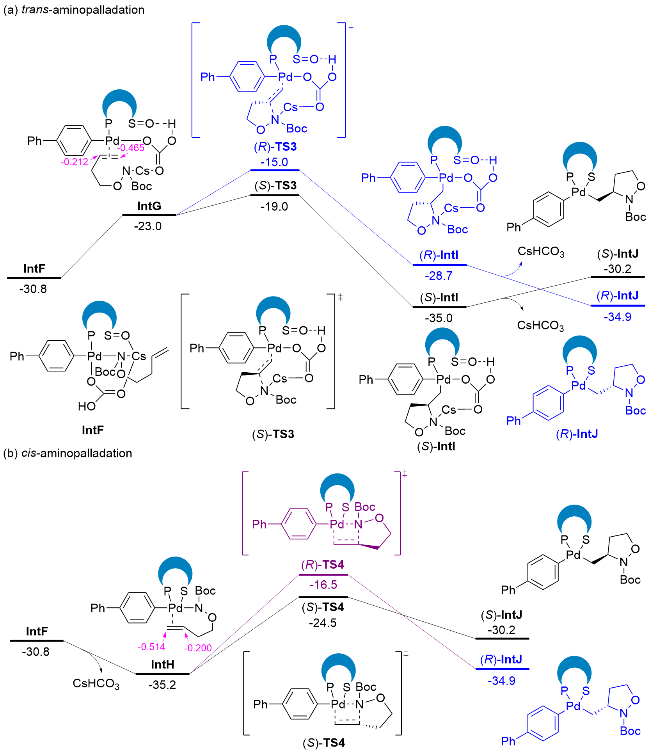
In the cis-aminopalladation pathway (Figure 2b), the departure of CsHCO3 in IntF as a neutral byproduct vacates a coordination site on Pd(II), creating a vacant position around Pd. Then nucleophilic N-Boc anion immediately occupies this vacant site, forming a new Pd—N bond to yield intermediate IntH. Subsequently, the C=C double bond inserts into the Pd—N bond via a four-membered-ring transition state TS4, leading to the formation of intermediate IntJ. The corresponding free-energy barriers for this cis-aminopalladation step are calculated to be 10.7 kcal/mol for (S)-TS4 and 18.7 kcal/mol for (R)-TS4 relative to IntE. By comparison, the trans-aminopalladation pathway exhibits higher barriers of 16.2 and 20.2 kcal/mol for the correponding (S)-TS3 and (R)-TS3. NPA charge analysis also reveals that the internal carbon of the C=C bond is more electron-deficient and thus more susceptible to migratory insertion by the N-Boc anion. It can be seen that the Boc is in close contact with the aryl ring of the Xu4 in (R)-TS4 while Boc stretches to the reverse direction in (S)-TS4, which may be the cause of the lower energy of (S)-TS4. We have systematically investigated the possible conformational features of TS3 and TS4.
Finally, the reaction proceeds via the reductive elimination step (Figure 3), affording the major product 3a and the minor product 3b, while simultaneously regenerating the Xu4-Pd(0) complex. This key step entails cleavage of two Pd—C bonds accompanied by the formation of a new C—C bond. The calculated Gibbs free energy barriers for the corresponding transition states (S)-TS5 and (R)-TS5 are 10.4 and 8.5 kcal/mol relative to IntE, with the stereochemical outcome having been determined earlier at TS4.
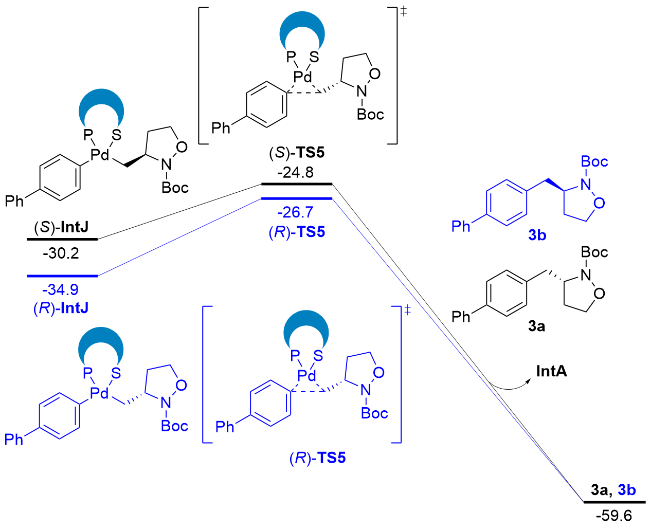
Based on the above DFT studies, a plausible catalytic cycle can be proposed. The Xu4 ligand first coordinates with Pd(0) to form complex IntA, which undergoes oxidative addition with 4-bromobiphenyl (1a) to generate IntC, followed by ligand exchange with Cs2CO3 to give IntD. Substrate 2a then enters a base-mediated deprotonation to form the N-Pd intermediate IntF, which constitutes the rate-determining step with a calculated free-energy barrier of 22.8 kcal/mol relative to IntE. Subsequently, cis-amino- palladation takes place and serves as the enantioselectivity-determining step. The computed free-energy difference between (S)-TS4 and (R)-TS4 is 8.0 kcal/mol, which is consistent with the 95% ee observed experimentally under the applied conditions. Finally, reductive elimination from IntJ delivers the major product 3a (and minor 3b) and regenerates IntA, thereby completing the catalytic cycle.
An alternative pathway involving carbopalladation followed by C—N bond formation was also evaluated.[31] The carbopalladation transition state (TS6 and TS7) lies over 10 kcal/mol higher in relative Gibbs free energy than the aminopalladation transition state (TS3 and TS4), excluding this pathway as a feasible mechanism.
It is noteworthy that the Pd center generally coordinates with both the P and S atoms of Xu4. However, from IntE to IntI, the increased steric hindrance and the relatively weak coordination ability of the sulfinamide S atom leads to its dissociation from Pd, thereby vacating a site for the C=C double bond to coordinate, leaving Pd bound only to P atom of Xu4. Upon subsequent C—N bond formation, the N atom dissociates from Pd and CsHCO3 leaves, creating a new vacant site, which allows the S atom to re-coordinate. This dynamic adjustment highlights the flexible nature of the ligand during the reaction process.
3.2 Origins and analysis of enantioselectivity
To elucidate the origin of enantioselectivity, we examined the cis-aminopalladation step responsible for C—N bond formation, with particular emphasis on the competing transition states (R)-TS4 and (S)-TS4.
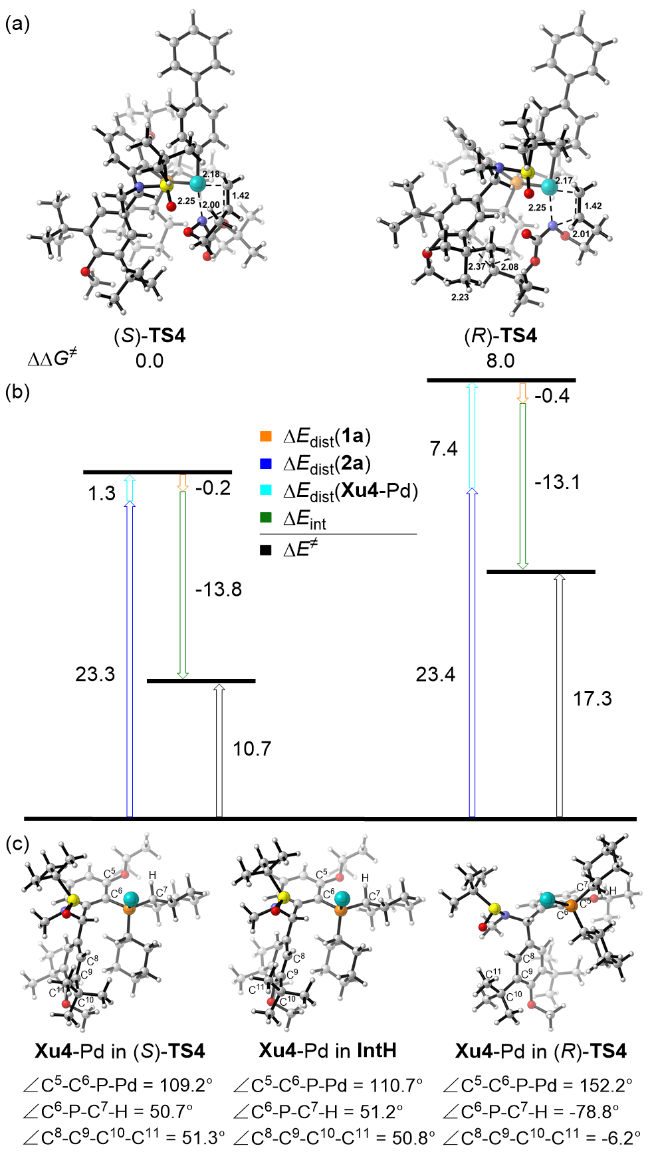


To further understand the origin of the enantioselectivity, we carried out a distortion/interaction analysis (DIA)[37] on (R)-TS4 and (S)-TS4. In this framework, the electronic activation barrier (ΔE≠) is decomposed into distortion (ΔEdist) and interaction (ΔEint) contributions, with each transition state partitioned into substrates 1a, 2a and the Xu4-Pd fragments (Figure 4b), and the reference state is the optimized IntH (Figure 2b). The results clearly show that the dominant contribution to the enantioselectivity originates from the difference of distortion energy of the Xu4-Pd fragment. Specifically, the ΔEdist(Xu4-Pd) in (R)-TS4 is 7.4 kcal/mol, which is 6.1 kcal/mol higher than that in (S)-TS4 (1.3 kcal/mol). This substantial difference in ΔEdist(Xu4-Pd) is the primary factor destabilizing (R)-TS4 relative to (S)- TS4. Further geometric analysis indicates that this increased distortion arises from more pronounced torsional deformation of the Xu4 ligand in (R)-TS4, as reflected by larger changes in key dihedral angles relative to IntH (Figure 4c). In contrast, (S)-TS4 retains a more relaxed ligand conformation, resulting in a substantially lower distortion penalty. In summary, while minor steric repulsions are present, the enantioselectivity in the cis-aminopalla- dation pathway is predominantly governed by differential ligand distortion, with excessive deformation of the Xu4-Pd fragment disfavoring formation of the (R)-configured pro- duct.
4 Conclusions
This study employed DFT calculations to provide an in-depth investigation of the Pd/Xu-Phos-catalyzed asymmetric carboamination of N-Boc-O-homoallylic hydroxylamine. The reaction proceeds through five key steps: oxidative addition, ligand exchange, base-mediated deprotonation, cis-aminopalladation and reductive elimination. Among these elementary steps, the base-mediated deprotonation was identified as the rate-determining step, while cis-aminopalladation was found to govern the enantioselectivity.
Detailed analysis of the cis-aminopalladation pathway, including transition-state geometries and DIA, reveals that the observed enantioselectivity predominantly originates from differences in the distortion energy of the Xu4-Pd complex [ΔΔEdist(Xu4-Pd)] between the competing transition states. Furthermore, our calculations elucidate the dynamic adjustment of the ligand coordination around the Pd center during the reaction process, providing a general mechanistic understanding that could be extended to other Pd-catalyzed asymmetric carboamination systems employ- ing flexible phosphine ligands.
Supporting Information The higher-energy isomers of TS3 and TS4, the discussion on the mechanism of carbopalladation, the benchmark for different functionals and basis sets and the energy and coordination data sets for DFT optimized structures. The Supporting Information is available free of charge via the Internet at http://sioc-journal.cn.
(Zhao, C.)