


1 Introduction
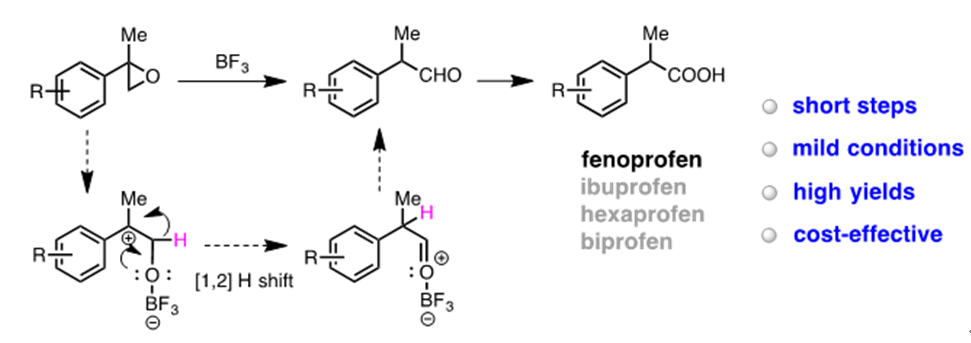
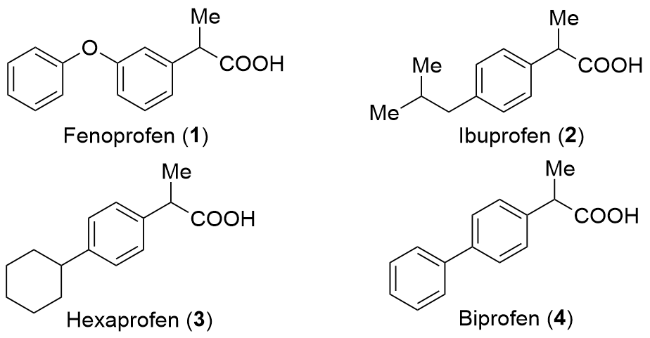
Fenoprofen (1) is a nonsteroidal anti-inflammatory drug (NSAID) that is effective for treating the fever, pain, and swelling caused by inflammation. Like other NSAIDs, fenoprofen binds non-selectively to both cyclooxygenase-1 (COX-1) and cyclooxygenase-2 (COX-2), and inhibits the synthesis of prostaglandins, the chemicals in the body responsible for inflammation.[1] Fenoprofen belongs to the arylpropionic acid family, which also includes ibuprofen (2), hexaprofen (3), biprofen (4), and other members (Figure 1).[2] Fenoprofen is widely utilized in clinical settings to manage rheumatoid arthritis, ankylosing spondylitis, degenerative joint disease, and gout. Interestingly, feno- profen analogues exhibited improved antitumor activity.[3]
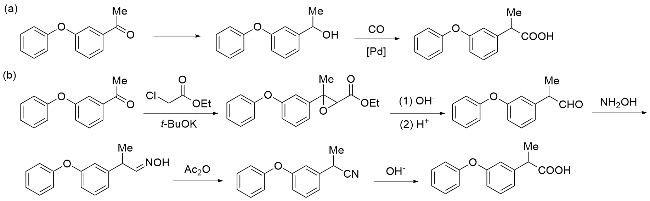
The supply of fenoprofen relies on chemical synthesis and recently a number of novel syntheses of fenoprofen have been reported.[4] One of the expedite synthesis of fenoprofen is characterized by the palladium catalyzed carboxylation of benzyl alcohol under pressurized carbon monoxide (Scheme 1a).[4g] Nevertheless, a practical synthesis entails a thorough contemplation of the synthetic efficiency as well as the production cost. Therefore, it is highly challenging for those synthetic routes involving the utilization of costly reagents, catalysts or demanding conditions to be applied in the industrial process. One example of practical syntheses employs the Boots process that was initially developed for the synthesis of ibuprofen,[4h] and features the Darzens reaction and the subsequent epoxide rearrangement (Scheme 1b).[4i] In this paper, we report an efficient protocol for the synthesis of fenoprofen and its application to the synthesis of related molecules.
2 Results and discussion
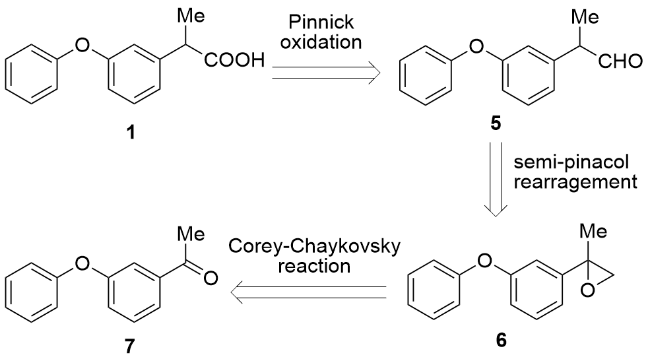
The retrosynthetic analysis is depicted in Scheme 2. The aldehyde 5 was chosen as the precursor to the carboxylic acid, which could be converted to fenoprofen via a Pinnick oxidation reaction. The epoxide 6 was then determined as the key intermediate and a semi-pinacol rearrangement reaction was envisaged to transform 6 to 5. Compound 6 could be traced back to the ketone 7 through the Corey- Chaykovsky reaction.
Our synthesis of fenoprofen commenced with the preparation of the ketone 7. The oxidative coupling reaction between 3-acetophenol (8) and phenylboronic acid (9) was firstly explored (Table 1).[5] Oxygen was found necessary for this reaction to proceed efficiently. When the reaction was conducted under an atmosphere of nitrogen with 2 equiv. of 9/Cu(OAc)2/pyridine in dichloromethane (DCM) at room temperature, 7 was obtained in a meager yield of 19% (Table 1, Entry 1). Switching to an air atmosphere, the yield slightly increased to 24% (Table 1, Entry 2). To our satisfactory, when the reaction was run under oxygen, compound 7 was isolated in an excellent yield of 90% (Table 1, Entry 3). Good yields could still be obtained even with reduced reagent dosages (Table 1, Entries 4, 5).
Table 1 Synthesis of 7 via oxidative couplinga |
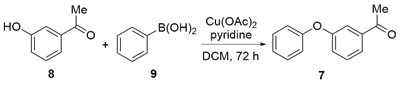
| Entry | 9/ equiv. | Cu(OAc)2/ equiv. | Pyridine/ equiv. | Additive | Yield b/% |
|---|---|---|---|---|---|
| 1 | 2 | 2 | 2 | N2 | 19 |
| 2 | 2 | 2 | 2 | Air | 24 |
| 3 | 2 | 2 | 2 | O2 | 90 |
| 4 | 1.5 | 1.5 | 2 | O2 | 87 |
| 5 | 1.5 | 1.5 | 1.5 | O2 | 79 |
a Reaction conditions: 8 (7.3 mmol), 9 (11.0~14.6 mmol), Cu(OAc)2 (11.0~14.6 mmol), pyridine (11.0~14.6 mmol), 0.37 mol/L, 72 h. b Isolated yields. |
The preparation of 7 via the Ullmann coupling reaction was also explored (Table 2).[6] When 8 and 10 were heated in dimethyl sulfoxide (DMSO) in the presence of CuI and K2CO3, the ether 7 in a yield of 46% was attained (Table 2, Entry 1). When K3PO4 was employed instead of K2CO3, a good yield of 65% was obtained (Table 2, Entry 2). Variations on the copper source, base, or solvent did not give improved results (Table 2, Entries 3~6). Delightfully, when the reaction was carried out with copper powder and potassium carbonate in N,N-dimethylformamide (DMF) at 150 ℃ for 24 h, 7 was isolated in a yield of 83%. These results demonstrated that copper powder was superior to copper salts in promoting this reaction.
Table 2 Synthesis of 7 via Ullmann couplinga |
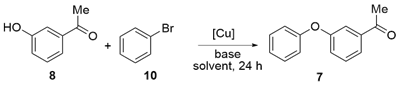
| Entry | [Cu] | Base | Solvent | Yieldb/% |
|---|---|---|---|---|
| 1 | CuI | K2CO3 | DMSO | 46 |
| 2 | CuI | K3PO4 | DMSO | 65 |
| 3 | CuI | K3PO4 | DMF | 36 |
| 4 | CuBr | K3PO4 | DMSO | 49 |
| 5 | CuCl | K2CO3 | DMSO | 42 |
| 6 | Cu powder | K2CO3 | DMSO | 40 |
| 7 | Cu powder | K2CO3 | DMF | 83 |
a Reaction conditions: 8 (2.0 mmol), 10 (6.0 mmol), [Cu] (0.2~1 mmol), base (6~10 mmol), 0.67 mol/L, 24 h. b Isolated yields. |
The Corey-Chaykovsky reaction of 7 was next explored. The reaction conditions were optimized in terms of sulfonium salt, base, solvent and other parameters (Table 3). The results showed that all sulfonium salts afforded moderate to excellent yields under their respective optimized reaction conditions. In particular, when 7 was treated with Me3SI/NaH in DMSO/tetrahydrofuran (THF) at room tem- perature for 2 h, the epoxide 6 was achieved in an excellent yield of 95% (Table 3, Entry 1). The most favorable conditions would involve the usage of Me3SBr/KOH in the solvent of acetonitrile at 60 ℃, which delivered 6 in a yield of 93% without the necessity of anhydrous solvent (Table 3, Entries 7, 8). This operationally simple procedure can be easily carried out on a gram scale to provide 6 in an excellent yield.
Table 3 Corey-Chaykovski reaction of 7a |
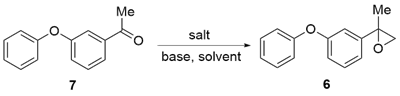
| Entry | Salt | Base | Solvent | T/℃ | t/h | Yieldb/% |
|---|---|---|---|---|---|---|
| 1 | Me3S+I- | NaH | DMSO/THF | r.t. | 2 | 95 |
| 2 | Me3S+I- | KOH | DMSO/THF | r.t. | 15 | 87 |
| 3 | Me3S(O)Br | NaH | DMSO/THF | r.t. | 36 | 71 |
| 4 | Me3S+Br- | KOH | MeCN | r.t. | 32 | 87 |
| 5 | Me3S+Br- | NaOMe | MeCN | r.t. | 32 | 73 |
| 6 | Me3S+Br- | NaOH | MeCN | r.t. | 32 | 66 |
| 7 | Me3S+Br- | KOH | MeCN | 60 | 3 | 93 |
| 8 | Me3S+Br- | KOH | MeCN/H2O | 60 | 3 | 93 |
a Reaction conditions: 7 (0.6~11.7 mmol), salt (0.9~17.6 mmol), base (1.8~35.1 mmol), 0.2~0.78 mol/L, 2~36 h. b Isolated yields. |
With the epoxide 6 in hand, the stage was set for the critical semi-pinacol rearrangement reaction. Various acidic conditions were evaluated (Table 4). Our initial experimentation revealed that oxygen might exert a detrimental effect on this reaction. Thus, when the epoxide 6 was treated with 1 mol% TsOH in THF under an oxygen atmosphere, the desired aldehyde 5 was isolated in a scarce yield of 13%, while the two major products 11 and 7 were obtained in 39% and 43% yields, respectively (Table 4, Entry 1). In contrast, when the reaction was run under nitrogen and otherwise identical conditions, we were able to obtain 5 as the major product in a yield 65% (Table 4, Entry 2). Similar results were achieved with camphorsulfonic acid (CSA) in DCM (Table 4, Entries 3, 4). We then examined boron trifluoride ethereal as the catalyst. To our delight, when 6 was treated with 0.01 equiv. of boron trifluoride ethereal in DCM under a nitrogen atmosphere, 5 was secured in 88% yield (Table 4, Entry 5). Excellent yields of 5 were obtained at increased catalyst loadings with THF as the solvent (Table 4, Entries 6, 7). Aldehyde 5 was converted to fenoprofen (1) via Pinnick oxidation (Scheme 3).
Table 4 Acid-catalyzed rearrangement reaction of 6a |
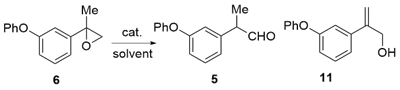
| Entry | Cat. (equiv.) | Solvent | Additive | Yield b/% | ||
|---|---|---|---|---|---|---|
| 5 | 11 | 7 | ||||
| 1 | TsOH (0.01) | THF | O2 | 13 | 39 | 43 |
| 2 | TsOH (0.01) | THF | N2 | 65 | 27 | <5 |
| 3 | CSA (0.01) | DCM | O2 | 9 | 47 | 39 |
| 4 | CSA (0.01) | DCM | N2 | 41 | 33 | 21 |
| 5 | BF3 (0.01) | DCM | N2 | 88 | — | — |
| 6 | BF3 (0.1) | THF | N2 | 90 | — | — |
| 7 | BF3 (0.5) | THF | N2 | 93 | — | — |
a Reaction conditions: 6 (0.4~5.7 mmol), cat (0.004~1 mmol), 0.2~0.5 mol/L, 0.5 h. b Isolated yields. |
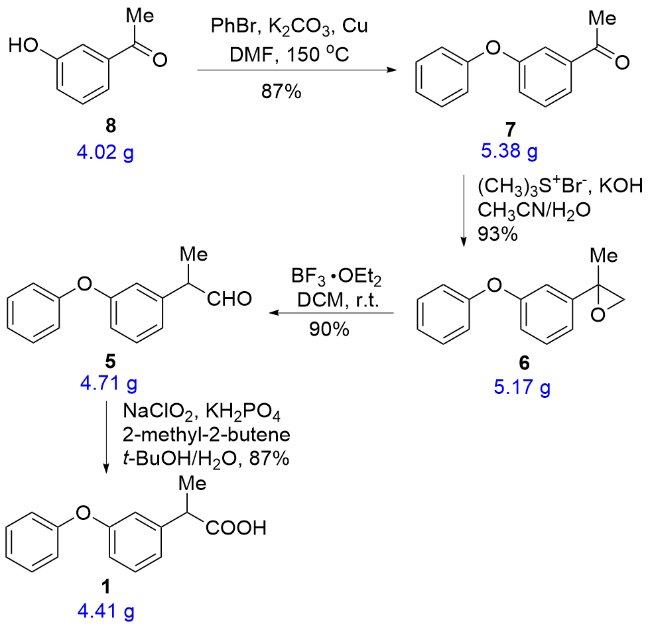
This synthetic procedure was amenable for a multi-gram-scale synthesis of fenoprofen. Thus, starting from 4.02 g of 8, the synthetic sequence delivered 5.38 g of 7, 5.17 g of 6, 4.71 g of 5, and 4.41 g of 1, successively. This synthesis of fenoprofen was completed in four steps from 8 with an overall yield of 62% (Scheme 3).
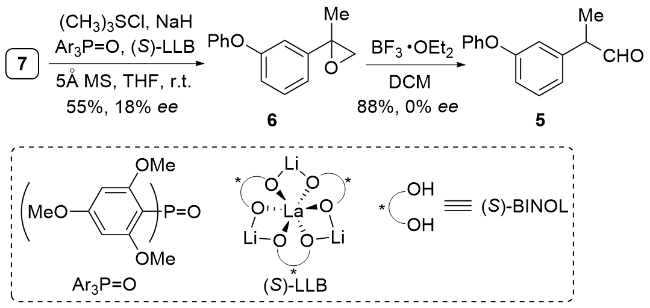
To gain an insight into the mechanism of the semi-pina- col rearrangement, we first explored the asymmetric synthesis of 6 and its rearrangement (Scheme 4). The asymmetric epoxidation of 7 was found challenging. Nevertheless, by using Shibasaki’s method,[7] we were able to obtain 6 with an optical purity of 18% ee, which was then subjected to the BF3-catalyzed semi-pinacol rearrangement. Surprisingly, the rearrangement product 5 was obtained in 88% yield albeit with no enatiomeric excess. These above results ruled out the possibility of any concerted mechanism and indicated that the BF3-catalyzed semi-pinacol rearrangement should proceed through a stepwise process leading to the racemic product.
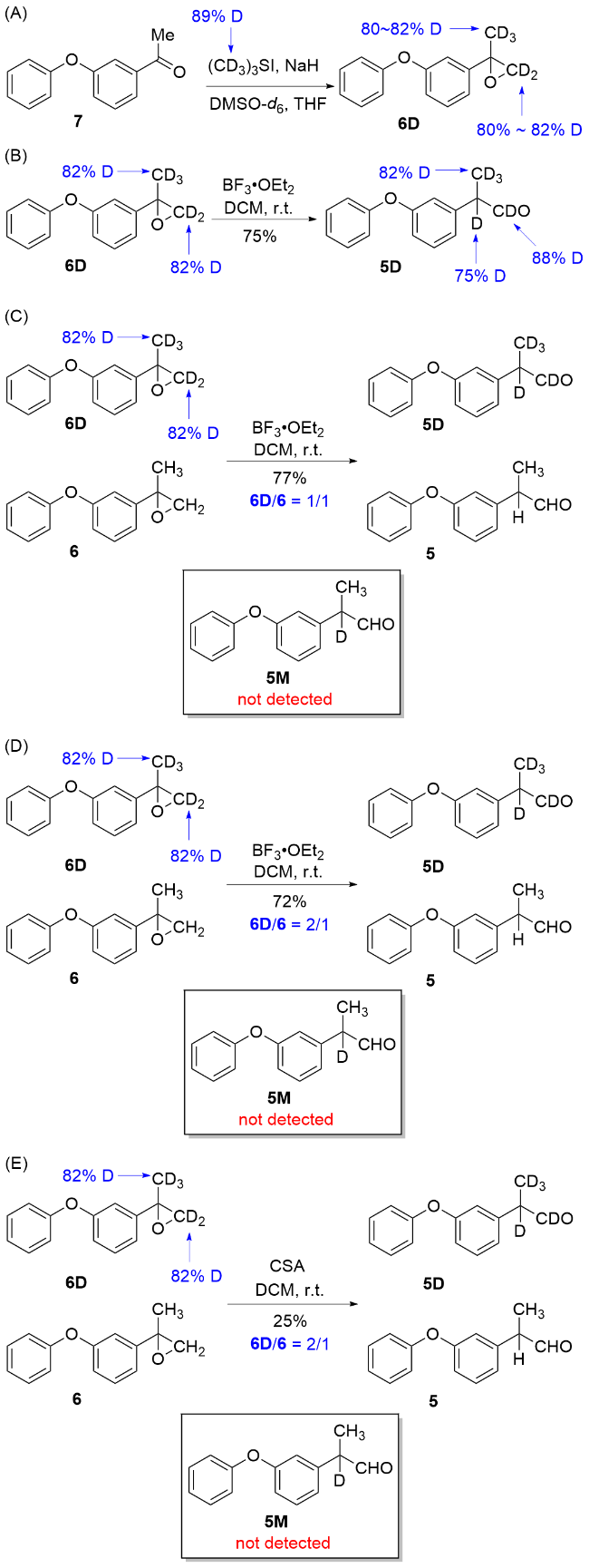
The isotope-labeling experiments were next conducted to gain a deeper insight into the mechanism of the rearrangement. Compound 7 reacted with (CD3)3SI/NaH in THF/DMSO-d6 to provide 6D with 80%~82% D at both the CD3 and CD2 groups as determined by 1H NMR (Scheme 5A). Then, compound 6D with 82% D at both the CD3 and CD2 groups, underwent the rearrangement reaction to furnish 5D with 82% D, 88% D, and 75% D at CD3, CDO, and the benzylic CD, respectively (Scheme 5B). Next, the treatment of the 1/1 mixture of 6D and 6 with BF3 yielded 5D and 5 (77% overall yield). Importantly, 5M was not detected in the 1H NMR of the product (Scheme 5C). Further, the treatment of the 2/1 mixture of 6D and 6 with BF3 yielded 5D and 5 (72% overall yield) and 5M was not detected in the 1H NMR of the product (Scheme 5D). Eventually, the treatment of the 2/1 mixture of 6D and 6 with CSA yielded 5D and 5 (25% overall yield) and 5M was not detected in the 1H NMR of the product. These isotope experiments clearly indicated that the rearrangement reactions took place intramolecularly rather than intermolecularly, otherwise 5M should have been detected.
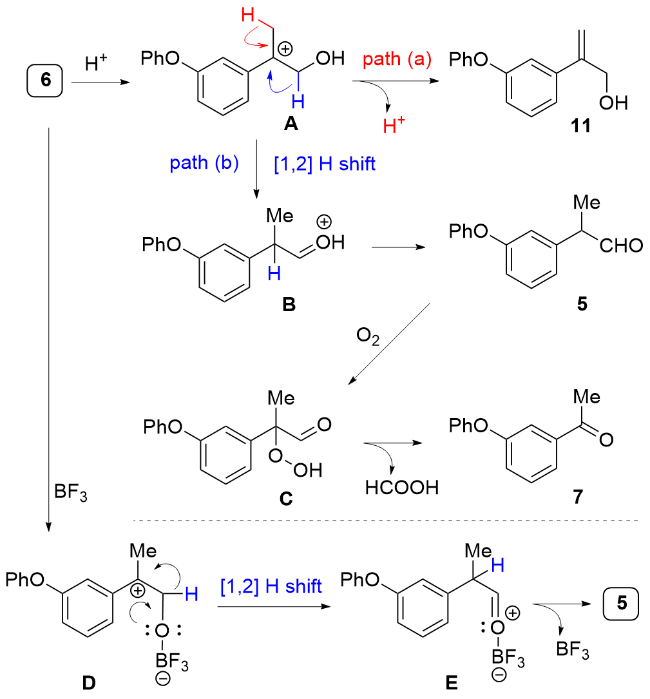
In light of the preceding experimental results, we envisaged a plausible mechanism for the rearrangement reaction. As depicted in Scheme 6, when a Brønsted acid was employed, the protonation of the epoxide 6 would generate the benzylic carbocation A. Now, two distinct pathways exist, where path (a) leads to the allylic alcohol 11 via β-elimination and path (b) leads to B via a [1,2] hydride shift process. The protonated aldehyde B should easily furnish 5 by deprotonation. In the presence of oxygen, 5 might react with one molecule of oxygen to engender the hydroperoxide C, which might proceed to 7 through a Hock cleavage.[8] On the other hand, when 6 was activated by BF3, the zwitterion D might first be formed before undergoing the subsequent [1,2] hydride shift to deliver E.[9] Liberation of BF3 from E would result in the formation of the aldehyde 5.
This newly developed protocol could be conveniently applied to the synthesis of related molecules (Scheme 7). Thus, ketone 12a was subjected to the reaction with (CH3)3S+Br-/t-BuOK in DMSO to provide the epoxide 13a in a yield of 98%. The BF3-mediated rearrangement converted epoxide 13a to aldehyde 14a in a yield of 75%.
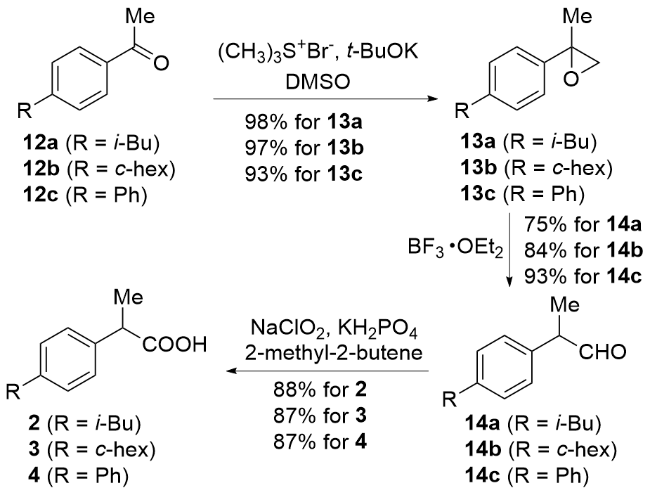


Finally, oxidation of 14a under Pinnick conditions produced ibuprofen (2) in 88% yield. By employing the same protocol, the syntheses of hexaprofen (3) and biprofen (4) were successfully accomplished with satisfactory overall yields (Scheme 7).
3 Conclusions
In conclusion, an efficient synthesis of fenoprofen was successfully realized, featuring a Corey-Chaykovsky ep- oxidation reaction and a BF3-catalyzed semi-pinacol rearrangement reaction. This protocol is amenable to the syntheses of ibuprofen, hexaprofen and biprofen. These syntheses generally involve cost-effect materials, concise steps, mild conditions, and high overall yields, constituting good bases for further development of novel processes to prepare these pharmaceutically important molecules. The fact that the optically active 6 rearranged to racemic 5 suggested this semi-pinacol reaction to be a stepwise process. The isotope-labeling experiments indicated that this rearrangement took place intramolecularly rather than intermolecularly, matching the [1,2]-hydride shift mechanism.
4 Experimental section
4.1 Instruments and reagents
All isolated compounds were characterized on JEOL 400 MHz or Bruker 400 MHz spectrometers in CDCl3. Chemical shifts were reported as δ values relative to internal chloroform (δ 7.26 for 1H NMR and δ 77.16 for 13C NMR). High-resolution mass spectra (HRMS) were recorded on a Waters UPLC H-Class/Xevo G2-XS QTOF mass spectrometer with electrospray ionization (ESI). Infrared (IR) spectra were measured on a Thermo Nicolet iS8 FT-IR spectrophotometer. The samples were placed on a diamond window as thin films (solids by evaporation from a CH2Cl2 solution and liquids by direct deposition) and recorded in the attenuated total reflectance (ATR) mode. The absorption peak maxima are given in cm-1. Column chromatography was performed on silica gel. All solvents and reagents were used as obtained from commercial sources without further purification.
4.2 Experimental method
4.2.1 Synthesis of 1-(3-phenoxyphenyl)ethan-1-one (7)
To a stirred solution of 8 (273 mg, 2.0 mmol) in DMF (3 mL) were added bromobenzene (0.64 mL, 6.0 mmol), copper (66.3 mg, 1.0 mmol), and K2CO3 (1.42 g, 10.0 mmol). The resulting mixture was stirred at 150 ℃ for 24 h. The reaction mixture was cooled to room temperature, diluted with ethyl acetate (10 mL) and filtered. The filtrate was washed with H2O (20 mL×3) and brine (20 mL×3). The organic layer was dried over sodium sulfate, filtered and concentrated under vacuum. The purification via flash column chromatography using V(PE)∶V(EtOAc)=20∶1 provided 1-(3-phenoxyphenyl)- ethan-1-one (7, 353 mg, 83% yield) as a colourless oil. 1H NMR (CDCl3, 400 MHz) δ: 7.68 (dt, J=7.7, 1.3 Hz, 1H), 7.58 (dd, J=2.5, 1.7 Hz, 1H), 7.43 (t, J=7.9 Hz, 1H), 7.39~7.33 (m, 2H), 7.21 (ddd, J=8.1, 2.5, 1.0 Hz, 1H), 7.18~7.12 (m, 1H), 7.05~6.99 (m, 2H), 2.58 (s, 3H); 13C NMR (CDCl3, 101 MHz) δ: 197.6, 157.9, 156.7, 139.0, 130.1 (3C), 123.9, 123.4, 123.2, 119.2 (2C), 118.2, 26.8; IR (film) ν: 3066, 2974, 2876, 1688, 1581, 1489, 1267, 897, 691 cm-1; HRMS (ESI-TOF) calcd for C14H13O2 [M+H]+ 213.0910, found 213.0921.
4.2.2 Synthesis of 2-methyl-2-(3-phenoxyphenyl)- oxirane (6)
To a stirred solution of 7 (5.38 g, 25.3 mmol) in CH3CN (50 mL) were added trimethylsulfonium bromide (6.05 g, 38.5 mmol), KOH (4.30 g, 76.6 mmol), and H2O (100 μL, 5.6 mmol). The resulting mixture was stirred at 60 ℃ for 12 h. The reaction mixture was cooled to 25~35 ℃ (r.t.) and was quenched by the addition of H2O (100 mL). The layers were separated and the aqueous layer was extracted with CH2Cl2 (100 mL×3). The organic layer was dried over sodium sulfate, filtered and concentrated under vacuum. The purification via flash column chromatography using V(PE)∶V(EtOAc)=20∶1 gave 2-methyl-2-(3- phenoxyphenyl)oxirane (6, 5.17 g, 93% yield) as a light yellow oil. 1H NMR (CDCl3, 400 MHz) δ: 7.34 (dd, J=8.6, 7.4 Hz, 2H), 7.30 (t, J=7.9 Hz, 1H), 7.14~7.08 (m, 2H), 7.05 (t, J=2.1 Hz, 1H), 7.01 (dd, J=8.7, 1.1 Hz, 2H), 6.91 (ddd, J=8.1, 2.4, 1.0 Hz, 1H), 2.98~2.76 (m, 2H), 1.70 (d, J=0.7 Hz, 3H); 13C NMR (CDCl3, 101 MHz) δ: 157.5, 157.2, 143.5, 129.9 (2C), 129.8, 123.5, 120.3, 119.0 (2C), 117.9, 116.1, 57.1, 56.6, 21.8; IR (film) ν: 3443, 1634, 1582, 1488, 1227, 930, 753, 694 cm-1; HRMS (ESI-TOF) calcd for C15H15O2 [M+H]+ 227.1067, found 227.1075.
4.2.3 Synthesis of 2-(3-phenoxyphenyl)propanal (5) and 14a~14c
To a stirred solution of 6 (5.17 g, 22.8 mmol) in CH2Cl2 (50 mL) were added boron trifluoride diethyl etherate (60 μL, 0.22 mmol, 3.68 mol/L). The resulting mixture was stirred at room temperature for 30 min under N2 atmosphere. The reaction mixture was quenched by the addition of H2O (100 mL). The layers were separated and the aqueous layer was extracted with CH2Cl2 (100 mL×3). The organic layer was dried over sodium sulfate, filtered and concentrated under vacuum. The purification via flash column chromatography using V(PE)∶V(EtOAc)=30∶1~20∶1 gave 2-(3-phenoxyphenyl)propanal (5, 4.71 g, 90% yield) as a colourless oil. 1H NMR (CDCl3, 400 MHz) δ: 9.68 (d, J=1.4 Hz, 1H), 7.40~7.30 (m, 3H), 7.13 (t, J=7.4 Hz, 1H), 7.02 (d, J=7.6 Hz, 2H), 6.93 (t, J=7.9 Hz, 2H), 6.90 (d, J=2.0 Hz, 1H), 3.61 (dd, J=7.1, 1.4 Hz, 1H), 1.43 (d, J=7.1 Hz, 3H); 13C NMR (CDCl3, 101 MHz) δ: 200.8, 158.1, 156.9, 139.9, 130.4, 130.0 (2C), 123.7, 123.1, 119.2 (2C), 118.7, 117.7, 52.9, 14.6; IR (film) ν: 3443, 1727, 1583, 1488, 1239, 757, 693, 458 cm-1; HRMS (ESI-TOF) calcd for C15H15O2 [M+H]+ 227.1067, found 227.1078.
Compounds 14a~14c were synthesized using the same method as 5.
2-(4-Isobutylphenyl)propanal (14a): 1H NMR (CDCl3, 400 MHz) δ: 9.67 (d, J=1.5 Hz, 1H), 7.16 (d, J=8.2 Hz, 2H), 7.11 (d, J=8.2 Hz, 2H), 3.61 (qd, J=7.1, 1.5 Hz, 1H), 2.47 (d, J=7.2 Hz, 2H), 1.86 (dt, J=13.5, 6.8 Hz, 1H), 1.43 (d, J=7.1 Hz, 3H), 0.90 (d, J=6.6 Hz, 6H); 13C NMR (CDCl3, 101 MHz) δ: 201.5, 141.2, 135.0, 130.0 (2C), 128.2 (2C), 52.8, 45.1, 30.3, 22.5 (2C), 14.7; IR (film) ν: 3432, 2956, 2869, 1722, 1513, 1019, 797 cm-1; HRMS (ESI-TOF) calcd for C13H19O [M+H]+ 191.1430, found 191.1433.
2-(4-Cyclohexylphenyl)propanal (14b): 1H NMR (CD- Cl3, 400 MHz) δ: 9.67 (d, J=1.5 Hz, 1H), 7.25~7.20 (m, 2H), 7.17~7.10 (m, 2H), 3.61 (qd, J=7.1, 1.5 Hz, 1H), 2.54~2.45 (m, 1H), 1.95~1.79 (m, 4H), 1.79~1.70 (m, 1H), 1.45~1.35 (m, 7H), 1.31~1.20 (m, 1H); 13C NMR (CDCl3, 101 MHz) δ: 201.5, 147.6, 135.1, 128.4 (2C), 127.7 (2C), 52.8, 44.3, 34.6 (2C), 27.0 (2C), 26.3, 14.7; IR (film) ν: 3430, 2924, 2851, 1724, 1448, 823, 558 cm-1; HRMS (ESI-TOF) calcd for C15H21O [M+H]+ 217.1587, found 217.1588.
2-([1,1'-Biphenyl]-4-yl)propanal (14c): 1H NMR (CD- Cl3, 400 MHz) δ: 9.73 (d, J=1.4 Hz, 1H), 7.65~7.56 (m, 4H), 7.50~7.41 (m, 2H), 7.40~7.33 (m, 1H), 7.33~7.27 (m, 2H), 3.69 (qd, J=7.1, 1.4 Hz, 1H), 1.49 (d, J=7.1 Hz, 3H); 13C NMR (CDCl3, 101 MHz) δ: 201.1, 140.7 (2C), 136.8, 129.0 (2C), 128.9 (2C), 127.9 (2C), 127.6, 127.2 (2C), 52.8, 14.8; IR (film) ν: 3444, 1719, 1644, 836, 765, 729, 693 cm-1; HRMS (ESI-TOF) calcd for C15H15O [M+H]+ 211.1117, found 211.1122.
4.2.4 Synthesis of 2-(3-phenoxyphenyl)propanoic acid (1) and 2~4
To a stirred solution of 5 (4.71 g, 20.8 mmol) in t- BuOH/H2O (30 mL∶10 mL) were added 2-methyl-2-bu- tene (5.2 mL, 42 mmol), KH2PO4 (4.25 g, 31.2 mmol), and NaClO2 (3.50 g, 31.0 mmol) at 0 ℃. The resulting mixture was stirred for 30 min. The reaction mixture was quenched by the addition of H2O (100 mL). The layers were separated and the aqueous layer was extracted with EtOAc (100 mL×3). The organic layer was dried over sodium sulfate, filtered and concentrated under vacuum. The purification via flash column chromatography using V(PE)∶V(EtO- Ac)=10∶1~5∶1~1∶1 gave 2-(3-phenoxyphenyl)- propanoic acid (1, 4.41 g, 87% yield) as a light yellow oil. 1H NMR (CDCl3, 400 MHz) δ: 7.37~7.31 (m, 2H), 7.31~7.26 (m, 1H), 7.14~7.08 (m, 1H), 7.06 (dt, J=7.7, 1.2 Hz, 1H), 7.03~7.01 (m, 2H), 7.01 (t, J=1.0 Hz, 1H), 6.91~6.86 (m, 1H), 3.72 (q, J=7.2 Hz, 1H), 1.50 (d, J=7.1 Hz, 3H); 13C NMR (CDCl3, 101 MHz) δ: 180.7, 157.6, 157.0, 141.8, 130.00, 129.9 (2C), 123.5, 122.5, 119.1 (2C), 118.4, 117.6, 45.3, 18.2; IR (film) ν: 3039, 2982, 2633, 1709, 1488, 1246, 932, 693 cm-1; HRMS (ESI-TOF) calcd for C15H15O3 [M+H]+ 243.1016, found 1020.
Compounds 2~4 were synthesized using the same method as 1.
2-(4-Isobutylphenyl)propanoic acid (2): 1H NMR (CD- Cl3, 400 MHz) δ: 7.26~7.22 (m, 2H), 7.15~7.09 (m, 2H), 3.73 (q, J=7.1 Hz, 1H), 2.47 (d, J=7.2 Hz, 2H), 1.87 (dq, J=13.5, 6.8 Hz, 1H), 1.51 (d, J=7.1 Hz, 3H), 0.92 (d, J=6.6 Hz, 6H); 13C NMR (CDCl3, 101 MHz) δ: 181.0, 141.0, 137.1, 129.5 (2C), 127.4 (2C), 45.2, 45.1, 30.3, 22.5 (2C), 18.2; IR (film) ν: 3448, 2089, 1638, 527 cm-1; HRMS (ESI-TOF) calcd for C13H19O2 [M+H]+ 207.1380, found 207.1383.
2-(4-Cyclohexylphenyl)propanoic acid (3): 1H NMR (CDCl3, 400 MHz) δ: 7.26~7.21 (m, 2H), 7.19~7.14 (m, 2H), 3.71 (q, J=7.2 Hz, 1H), 2.52~2.43 (m, 1H), 1.90~1.79 (m, 4H), 1.78~1.70 (m, 1H), 1.50 (d, J=7.2 Hz, 3H), 1.43~1.34 (m, 4H), 1.30~1.21 (m, 1H); 13C NMR (CDCl3, 101 MHz) δ: 181.2, 147.4, 137.1, 127.6 (2C), 127.2 (2C), 45.1, 44.3, 34.5 (2C), 27.0 (2C), 26.3, 18.2; IR (film) ν: 2923, 2850, 1699, 1415, 1230, 945, 835, 545 cm-1; HRMS (ESI-TOF) calcd for C15H21O2 [M+H]+ 233.1536, found 233.1540.
2-([1,1'-Biphenyl]-4-yl)propanoic acid (4): 1H NMR (CDCl3, 400 MHz) δ: 7.62~7.53 (m, 4H), 7.48~7.38 (m, 4H), 7.38~7.31 (m, 1H), 3.80 (q, J=7.1 Hz, 1H), 1.56 (d, J=7.2 Hz, 3H); 13C NMR (CDCl3, 101 MHz) δ: 181.1, 140.8, 140.5, 138.8, 128.9 (2C), 128.2 (2C), 127.6 (2C), 127.4, 127.2 (2C), 45.2, 18.2; IR (film) ν: 3459, 2980, 1701, 1487, 1409, 1230, 957, 756 cm-1; HRMS (ESI-TOF) calcd for C15H15O2 [M+H]+ 227.1067, found 227.1070.
4.2.5 Synthesis of 2-(3-phenoxyphenyl)prop-2-en-1-ol (11)
To a stirred solution of 6 (94.5 mg, 0.42 mmol) in THF (2 mL) were added a solution of p-toluenesulfonic acid in THF (0.1 mL of a 0.042 mol/L solution prepared from 7.2 mg in 1 mL THF). The resulting mixture was stirred at room temperature for 2 h under N2 atmosphere. The reaction mixture was quenched by the addition of H2O (10 mL). The layers were separated and the aqueous layer was extracted with CH2Cl2 (10 mL×3). The organic layer was dried over sodium sulfate, filtered and concentrated under vacuum. The purification via flash column chromatography using V(PE)∶V(EtOAc)=20∶1~5∶1 gave a mixture of 2-(3-phenoxyphenyl)propanal (5) and 1-(3-phenoxyphenyl)-ethan-1-one (7) (33 mg) as a colourless oil, along with 2-(3-phenoxyphenyl)prop-2-en-1-ol (11) (25.1 mg, 27% yield) as a colourless oil. 1H NMR (CDCl3, 400 MHz) δ: 7.37~7.28 (m, 3H), 7.19 (ddd, J=7.8, 1.7, 1.0 Hz, 1H), 7.15~7.08 (m, 2H), 7.05~6.99 (m, 2H), 6.96~6.91 (m, 1H), 5.41 (dq, J=42.9, 1.2 Hz, 2H), 4.51 (s, 2H); 13C NMR (CDCl3, 101 MHz) δ: 157.5, 157.2, 146.8, 140.5, 129.9 (3C), 123.5, 121.1, 119.0 (2C), 118.4, 116.8, 113.4, 65.1; IR (film) ν: 3365, 3053, 2990, 1647, 1520, 1140, 900, 713 cm-1; HRMS (ESI-TOF) calcd for C15H15O2 [M+H]+ 227.1067, found 227.1075.
4.2.6 Synthesis of 2-(4-isobutylphenyl)-2-methyloxi- rane (13a), 13b and 13c
To a stirred solution of 12a (506 mg, 2.84 mmol) in DMSO (4 mL) under N2 atmosphere were added trimethylsulfonium bromide (678 mg, 4.3 mmol) and potassium tert-butoxide (503 mg, 4.4 mmol). The resulting mixture was stirred at room temperature for 5 h. The reaction mixture was quenched by the addition of H2O (10 mL). The layers were separated, and the aqueous layer was extracted with CH2Cl2 (10 mL×3). The organic layer was dried over sodium sulfate, filtered and concentrated under vacuum. The purification via flash column chromatography using V(PE)∶V(EtOAc)∶V(Et3N)=30∶1∶5 gave 2-(4-iso- butylphenyl)-2-methyloxirane (13a) (531.2 mg, 98% yield) as a light yellow oil. 1H NMR (CDCl3, 400 MHz) δ: 7.30~7.19 (m, 2H), 7.14~7.03 (m, 2H), 2.94 (d, J=5.4 Hz, 1H), 2.80 (dt, J=5.4, 0.8 Hz, 1H), 2.44 (d, J=7.2 Hz, 2H), 1.83 (dt, J=13.5, 6.7 Hz, 1H), 1.69 (s, 3H), 0.87 (d, J=6.6 Hz, 6H); 13C NMR (CDCl3, 101 MHz) δ: 141.1, 138.5, 129.2 (2C), 125.2 (2C), 57.2, 56.8, 45.1, 30.3, 22.5 (2C), 21.9; IR (film) ν: 3448, 2088, 1637, 1465, 1064, 564 cm-1; HRMS (ESI-TOF) calcd for C13H19O [M+H]+ 191.1430, found 191.1432.
Compounds 13b and 13c were synthesized using the same method as 13a.
2-(4-Cyclohexylphenyl)-2-methyloxirane (13b): 1H NMR (CDCl3, 400 MHz) δ: 7.31~7.27 (m, 2H), 7.22~7.16 (m, 2H), 2.96 (d, J=5.4 Hz, 1H), 2.82 (d, J=5.4 Hz, 1H), 2.52~2.44 (m, 1H), 1.94~1.79 (m, 4H), 1.79~1.72 (m, 1H), 1.71 (s, 3H), 1.48~1.32 (m, 4H), 1.32~1.19 (m, 1H); 13C NMR (CDCl3, 101 MHz) δ: 147.6, 138.6, 126.9 (2C), 125.4 (2C), 57.2, 56.8, 44.4, 34.6 (2C), 27.0, 26.3 (2C), 22.0; IR (film) ν: 3445, 2925, 2851, 1448, 824, 570 cm-1; HRMS (ESI-TOF) calcd for C15H21O [M+H]+217.1587, found 217.1590.
2-([1,1'-Biphenyl]-4-yl)-2-methyloxirane (13c): 1H NMR (CDCl3, 400 MHz) δ: 7.62~7.54 (m, 4H), 7.47~7.42 (m, 4H), 7.40~7.31 (m, 1H), 3.02 (d, J=5.4 Hz, 1H), 2.86 (d, J=5.4 Hz, 1H), 1.77 (s, 3H); 13C NMR (CDCl3, 101 MHz) δ: 140.8, 140.5, 140.4, 128.9 (2C), 127.5, 127.21 (2C), 127.19 (2C), 125.9 (2C), 57.3, 56.7, 21.9; IR (film) ν: 3443, 1637, 1408, 832, 782, 761, 692 cm-1; HRMS (ESI-TOF) calcd for C15H15O [M+H]+ 211.1117, found 211.1119.
4.2.7 Synthesis of perdeuteriotrimethylsulfonium iodide ((CD3)3S+I-)
Trimethylsulfonium iodide (122 mg, 0.60 mmol) was added to a solution of NaOD prepared in situ from NaH (21.0 mg, 0.524 mmol) and D2O (1 mL). The resulting mixture was stirred at room temperature for 16~24 h. The reaction mixture was concentrated under vacuum to give a white solid. 1H NMR (D2O) spectroscopy with dioxane as internal reference indicates 89% D at the CH3 groups.
4.2.8 Synthesis of 2-methyl-2-(3-phenoxyphenyl)- oxirane (6D)
To a stirred solution of perdeuteriotrimethylsulfonium iodide (127 mg, 0.60 mmol, 89% D) in DMSO-d6 (1 mL) was added NaH (26 mg, 0.65 mmol). The resulting mixture was stirred at room temperature for 1 h under N2 atmosphere. Compound 7 (89 mg, 0.42 mmol) dissolved in THF (1 mL) was added into the reaction flask. The reaction mixture was stirred at room temperature for 3 h and was quenched by the addition of H2O (10 mL). The layers were separated and the aqueous layer was extracted with CH2Cl2 (10 mL×3). The organic layer was dried over sodium sulfate, filtered and concentrated under vacuum. The purification via flash column chromatography using V(PE)∶V(EtOAc)=20∶1 gave 2-methyl-2-(3-phenoxyphen- yl)oxirane (6D, 79 mg, 82% yield, 80%~82% D) as a light yellow oil. 1H NMR (CDCl3, 400 MHz) δ: 7.38~7.27 (m, 3H), 7.16~7.08 (m, 2H), 7.04 (t, J=2.1 Hz, 1H), 7.00 (dt, J=7.8, 1.1 Hz, 2H), 6.90 (ddd, J=8.1, 2.5, 1.0 Hz, 1H), 2.96 (d, J=8.6 Hz, 0.18H), 2.78 (d, J=7.9 Hz, 0.18H), 1.68 (dt, J=5.8, 2.0 Hz, 0.53H).
4.2.9 Synthesis of 2-(3-phenoxyphenyl)propanal (5D)
To a stirred solution of 6D (97 mg, 0.42 mmol) in CH2Cl2 (1 mL) was added boron trifluoride diethyl ethe- rate (1.2 μL, 0.0044 mmol, 3.68 mol/L). The resulting mixture was stirred at room temperature for 15 min with N2 atmosphere. The reaction mixture was quenched by the addition of H2O (10 mL). The layers were separated and the aqueous layer was extracted with CH2Cl2 (10 mL×3). The organic layer was dried over sodium sulfate, filtered and concentrated under vacuum. The purification via flash column chromatography using V(PE)∶V(EtOAc)=20∶1 gave 2-(3-phenoxyphenyl)propanal (5D, 73 mg, 75% yield) as a colourless oil. 1H NMR (CDCl3, 400 MHz) δ: 9.67 (s, 0.12H), 7.41~7.29 (m, 3H), 7.21~7.07 (m, 1H), 7.01 (dt, J=7.8, 1.1 Hz, 2H), 6.97~6.86 (m, 3H), 3.59 (d, J=5.8 Hz, 0.25H), 1.39 (ddd, J=8.2, 4.1, 1.7 Hz, 0.52H).
4.2.10 Isotope-labeling experiment (Scheme 5C)
To a stirred solution of 6D (13.4 mg, 0.058 mmol) and 6 (13.4 mg, 0.059 mmol) in CH2Cl2 (0.5 mL) was added boron trifluoride diethyl etherate (0.32 μL, 0.0012 mmol, 3.68 mol/L). The resulting mixture was stirred at room temperature for 15 min under N2 atmosphere. The reaction mixture was quenched by the addition of H2O (10 mL). The layers were separated and the aqueous layer was extracted with CH2Cl2 (10 mL×3). The organic layer was dried over sodium sulfate, filtered and concentrated under vacuum. The purification via flash column chromatography using V(PE)∶V(EtOAc)=20∶1 gave 2-(3-phen- oxyphenyl)propanal 5D and 5 (20.8 mg, 78% yield) as a colourless oil.
4.2.11 Isotope-labeling experiment (Scheme 5D)
To a stirred solution of 6D (17.4 mg, 0.075 mmol) and 6 (8.7 mg, 0.038 mmol) in CH2Cl2 (0.5 mL) was added boron trifluoride diethyl etherate (0.30 μL, 0.0011 mmol, 3.68 mol/L). The resulting mixture was stirred at room temperature for 15 min under N2 atmosphere. The reaction mixture was quenched by the addition of H2O (10 mL). The layers were separated and the aqueous layer was extracted with CH2Cl2 (10 mL×3). The organic layer was dried over sodium sulfate, filtered and concentrated under vacuum. The purification via flash column chromatography using V(PE)∶V(EtOAc)=20∶1 gave 2-(3-phen- oxyphenyl)propanal 5D and 5 (18.9 mg, 72% yield) as a colourless oil.
4.2.12 Isotope-labeling experiment (Scheme 5E)
To a stirred solution of 6D (51.1 mg, 0.22 mmol) and 6 (23.9 mg, 0.11 mmol) in CH2Cl2 (1 mL) was added camphorsulfonic acid (0.80 mg, 0.0034 mmol). The resulting mixture was stirred at room temperature overnight under N2 atmosphere. The reaction mixture was quenched by the addition of H2O (10 mL). The layers were separated and the aqueous layer was extracted with CH2Cl2 (10 mL×3). The organic layer was dried over sodium sulfate, filtered and concentrated under vacuum. The purification via flash column chromatography using V(PE)∶V(EtOAc)=30∶1~20∶1~5∶1 gave 5D/5 and 7D/7 (19.3 mg) as a colourless oil, and 11D/11 (21.3 mg).
Supporting Information 1H NMR, 13C NMR, and HPLC spectra for relevant compounds. The Supporting Information is available free of charge via the Internet at http://sioc-journal.cn/.
(Cheng, F.)