


1 Introduction
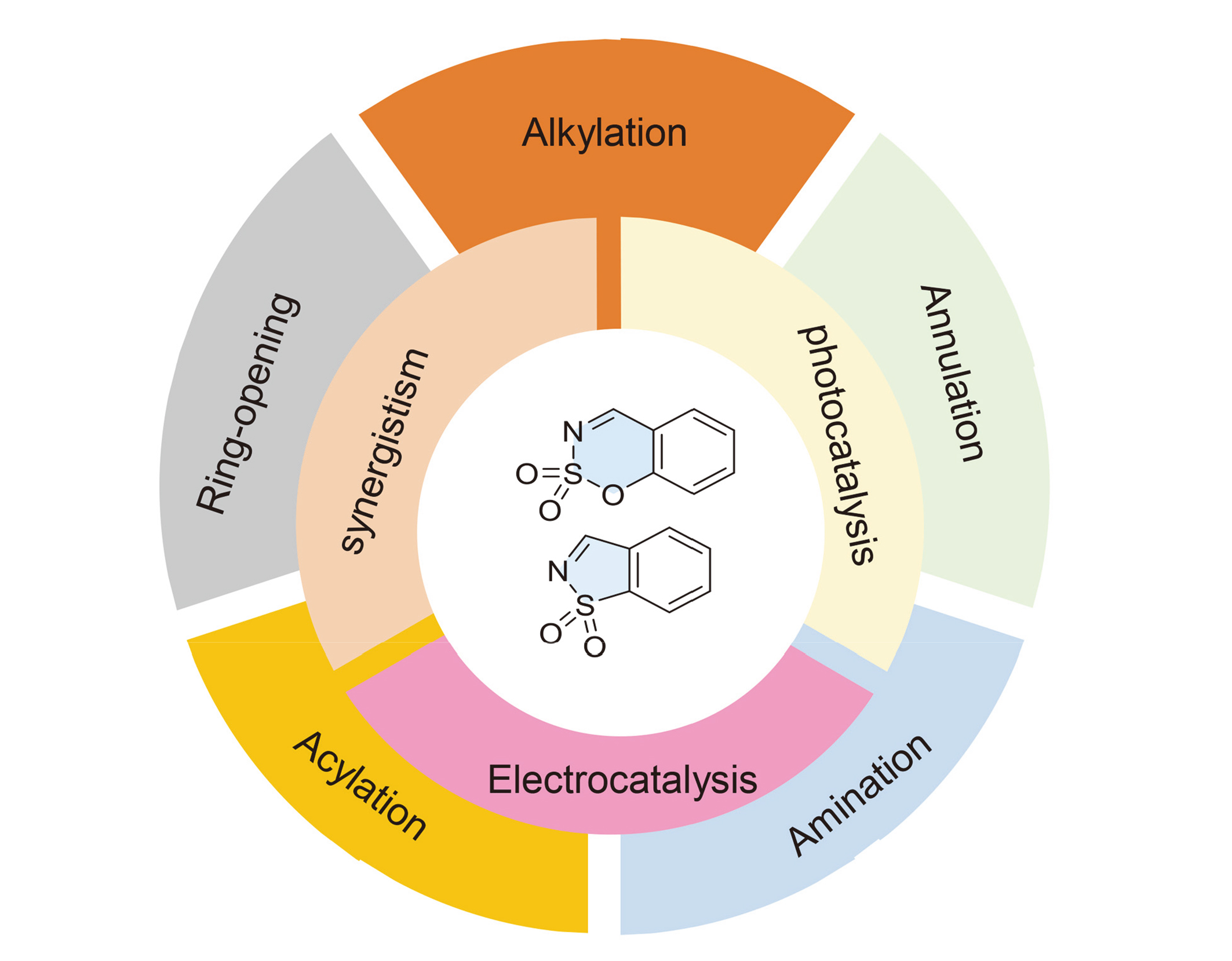
The precise and efficient construction and functiona- lization of heterocyclic molecules are one of the most pressing problems facing the synthetic community, and have always been the core force for promoting new drug development.[1] As a classic class of heterocycle with unique electronic properties and structural rigidity, N-sul- fonyl ketimines are significant and versatile synthetic building blocks for the preparation of sulfur-containing heterocycles with a broad bioactivity spectrum, and widely present in numerous biologically or pharmacologically active molecules and functional materials[2], beyond that, also serves as prevalent synthesis module in organic chemistry[3] (Figure 1). Therefore, the functionalization of N-sulfonyl ketimines scaffold has evoked considerable attention from synthetic chemists in recent years. Both electron-rich carbon nitrogen double bonds and strongly electron-withdrawing sulfonyl groups in N-sulfonyl ketimines make it dual platforms in organic synthesis: they can serve as the basic skeleton of active drug molecules and key precursors for constructing complex chiral amine compounds.
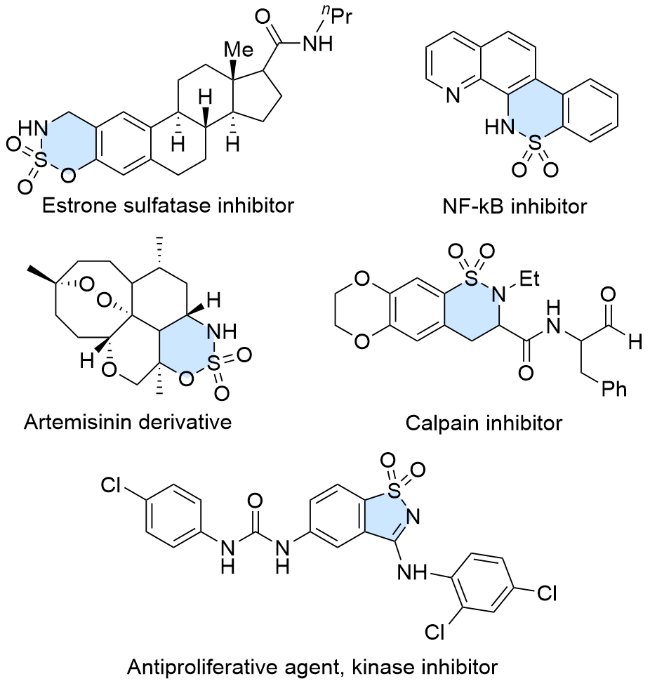
From the perspective of medicinal chemistry, N-sulfonyl ketimines exhibit important biological activity since the strong electron-withdrawing properties and planar confi- guration of sulfonyl give this skeleton itself a special role in drug design, effectively enhancing the membrane permeabi- lity, metabolic stability, and target affinity of molecules.[2a,4] Studies have confirmed that N-sulfonyl ketimines exhibits outstanding biological activity in the fields of antibacterial, antiviral, and enzyme inhibition.[5] More importantly, the unique electron distribution plus sulfonyl in N-sulfonyl ketimines makes its C=N bond an ideal reaction site for subsequent structural modifications, enabling synthetic chemists to precisely construct structurally diverse com- pound libraries through functionalization strategies, thereby accelerating the discovery and optimization process of lead compounds.
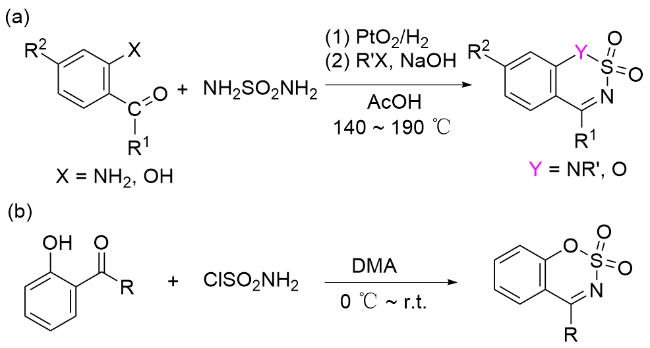
Chiral amine structures are not only widely present in natural products and drug molecules, but also serve as the core backbone of many chiral ligands and catalysts. As a key synthetic unit for constructing chiral amine compounds, N-sulfonyl ketimines play an irreplaceable role in synthetic chemistry[6], in particular asymmetric synthesis.[7] N-Sul- fonyl ketimines, through its activated C=N bond, can undergo stereoselective addition reactions with various nucleophiles, providing an atomically and step econo- mically efficient solution for the synthesis of chiral amines. The early synthesis of N-sulfonyl ketimines relies on PtO2/H2 catalyzed-cyclization/condensation reaction of adjacent hydroxyketones with sulfonamides (Scheme 1, a),[8] while current synthesis pathway is the “intramolecular nucleophilic substitution cyclization reaction” of ortho hydroxybenzaldehyde and chlorosulfonyl, which involves two steps: condensation and cyclization (Scheme 1, b).[9]
Early research on functionalization of N-sulfonyl keti- mines usually involved transition metal catalyzed nucleophilic addition reactions, yet limited by harsh condition, low functional group compatibility and atomic economy, step efficiency, and especially difficult stereo- selective control.[10] These challenges have prompted researchers to seek new solutions, driving a paradigm shift in the functionalization of N-sulfonyl ketimines. In recent decades, the C—H functionalization of N-sulfonyl ketimines has entered a new and innovative stage, mainly reflected in the following breakthroughs. Firstly, the emergence of new catalytic strategies, especially the establishment of photo- catalytic, electrochemical, and synergistic dual catalytic systems offers chemists a powerful toolbox through a single electron transfer process, like C—H bond functiona- lization.[11] Electrochemical catalysis utilizes current as a clean redox reagent, avoiding the use of stoichiometric oxidants or reducing agents, which is in line with the development concept of green chemistry. Beyond classical nucleophilic addition reactions, new catalytic paradigms such as radical processes and cyclization/ cycloaddition reactions provide an efficient pathway for the rapid construction of heterocyclic systems in drug molecules.[12] Despite significant progress, the functionalization of N-sul- fonyl ketimines still faces many challenges, for example, the efficiency of existing catalytic systems is often not ideal for large steric hindrance substituents, some reactions still require the use of stoichiometric additives, and atomic economy needs to be improved. The late functionalization application of complex natural products and drug molecules is still insufficient.
In the past decades, sereval reviews have summarized the progress in this field from different perspectives. Pyne et al.[13] systematically studied the synthesis methods and key reactions of five-membered cyclic sulfonamide imines. Their work focused on nucleophilic addition methods to achieve efficient and highly selective C—N bond construction, and explored the functionalization of the acidic proton at the C(5) position, which also demonstrated the application of these compounds in the synthesis of active molecules, such as norephedrine and β-site amyloid precursor protein cleaving enzyme 1 (BACE1) inhibitor Verubecestat, highlighting their synthetic value. By comparison, Samanta et al.[6] systematically reviewed the application of cyclic N-sulfonyl ketimine as a nucleophilic precursor in organic synthesis, focusing on N-sulfonyl ketimines with acidic α-C(sp³)—H protons. Under neutral, basic, and photocatalytic conditions, these substrates can generate three types of nucleophilic species: enamine, nitrogen-heteroenolate, and α-imino carbon center radical, which undergo multiple bond formation events with common electrophilic reagents (such as aldehydes, α,β-unsaturated aldehydes, etc.) to obtain a wide variety of fused heterocycles, carbocycles, pyridine skeletons, pyrroles, aromatic hydrocarbons, etc. Rencently, Kim and colleagues[7a] summarized the progress in catalytic asymmetric cycloaddition of N-sulfonyl ketimines since 2012, focusing on both organic catalysis and palladium catalysis paradigms, providing comprehensive guidance for the stereoselective synthesis of bioactive chiral heterocycles containing sulfonamide esters. The review content is divided into two parts. The first part systematically elabo- rates on organic catalysis strategies, covering the appli- cation of various catalysts, such as chiral phosphines and chiral amines in this reaction. The second part focuses on palladium catalysis systems, efficiently constructing hetero- cyclic structures with different ring sizes through [3+2], [4+2], and [5+2] cycloaddition modes.
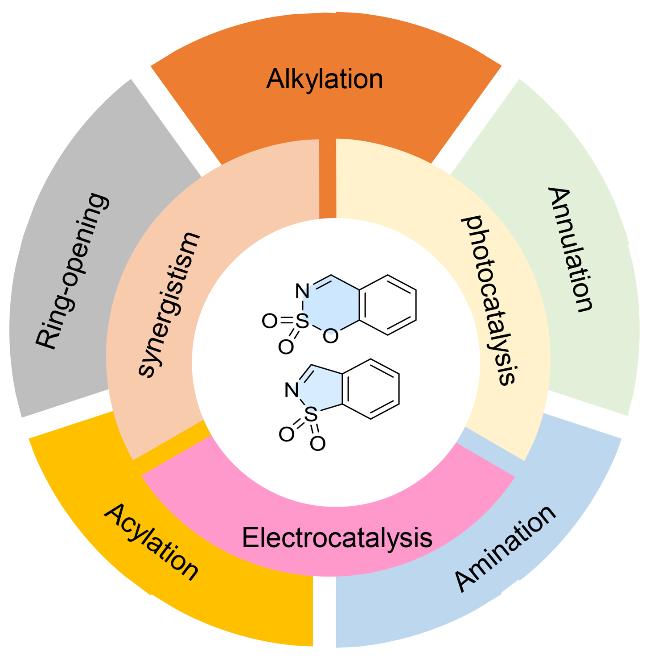
These works fully demonstrate the immense potential of N-sulfonyl ketimines as a synthons beyond traditional electrophilic reactions. In recent years, the research on C—H functionalization of N-sulfonyl ketimines has entered a new stage of development, with key breakthroughs mainly reflected in the establishment of novel catalytic systems and the expansion of new reaction mechanisms. In particular, the introduction of strategies such as photocatalysis, electrocatalysis, and synergistic dual catalysis has provided powerful tools for achieving efficient and highly selective C—H functionalization through single-electron transfer (SET) processes. However, a comprehensive literature review in this area is still lacking. In light of the above, this review systematically summarizes the latest developments in the C—H functionalization of N-sulfonyl ketimines over the past five years (from 2021 to 2025). We discuss new reaction types, catalytic strategies, and reaction mechanisms with particular emphasis on photocatalytic, electrocatalytic, and dual catalytic systems. Their applications in alkylation, cyclization, and amination, acylation and ring-opening reactions are analyzed in detail (Figure 2). We hope this review will not only furnish researchers with a comprehensive overview of this field, but also inspire new research ideas, promote the development of efficient and green synthesis methods, and further advance the application of N-sulfonyl ketimines in drug discovery and synthetic science. Finally, we will provide an outlook on the future development direction of this field, exploring possible research focuses and trends.
2 Alkylation
In recent years, the direct functionalization of inert C—H bonds of heterocyclic compounds has developed rapidly and attracted great attention from synthetic chemists and pharmacists, which avoids the step of pre functionalization, simplifies the synthesis route, and conforms to the principles of atomic economy and step economy in modern synthesis. Additionally, transforming bulk chemicals or simple reagents into high-value fine chemicals is also the dream of synthetic chemists. As widely used compounds, carboxylic acids are inexpensive and abundant, which are present in biologically active natural products and drug molecules and exist as basic building blocks in synthetic chemistry. In decades, a number of alkylation approaches have been established by using carboxylic acids as a free radical precursor via decarboxylation due to their obvious advantages. The alkylation of N-sulfonyl ketimines and their derivatives can introduce key derivative groups, laying the foundation for subsequent molecular modification and functionalization. Secondly, alkylation reactions can be used for the “late-functionalization” of drugs and bioactive molecules, enabling direct structural modification of complex drug molecules or natural products. This approach rapidly assembles drug-like molecular libraries for structure-activity relationship investigations or lead compound optimization. Such transformations generate a structurally and chemically diverse library, providing abundant candidate molecules for drug discovery and key synthetic intermediates. Therefore, a series of alkylation schemes have been reported.
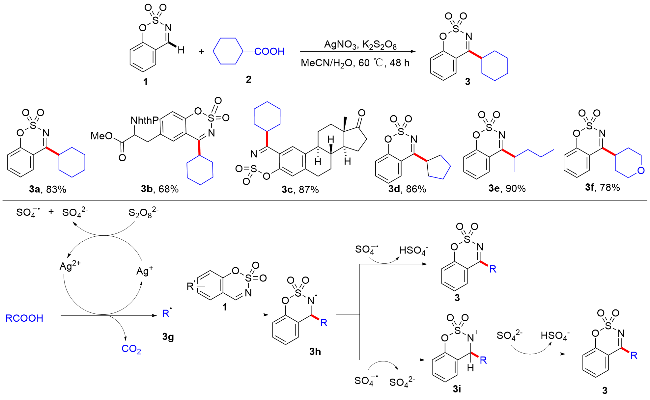
In 2021, Liu and colleagues[14] disclosed silver-catalyzed decarboxylative radical reaction of five- and seven-mem- bered N-sulfonyl ketimines with abundant aliphatic carboxylic acids using potassium persulfate K2S2O8 as oxidants in CH3CN/H2O (V∶V=1∶1) at 60 ℃ for 48 h, and a variety of alkylated N-sulfonyl ketimines were obtained in moderate to good yields (32%~91%) (Scheme 2). The remarkable advantages of this thermal protocol are straight forward scale-up process up to the gram scale, broad substrate scope in accessing a wide variety of easy accessibility of aliphatic carboxylic acids, and late-stage modification of bioactive drug-like molecules (fenbufen-anonsteroidal antiinflammatory drug and dehydrocholic acid-acholeretic drug). However, the requirement of high temperature, the use of stoichiometric strong oxidants, relatively long reaction time (48 h) and the lower reactivity of tertiary carboxylic acids have reduced the competitiveness of the synthetic method. Mechanistic studies (free radical capturing experiment) showed that the reaction might undergo a radical pathway. Accordingly, the authors propose a plausible reaction mechanism on the basis of these mechanistic investigations and previous literature precedents. Firstly, the Ag2⁺ is generated by oxidation of Ag⁺ with K2S2O8, and further undergoes a single-electron transfer (SET) process with an aliphatic carboxylic acid to form the radical intermediate 3g via decarboxylation. Subsequently, radical 3g attacks the N-sulfonyl ketimines to yield the N-radical intermediate 3h, forming a new C—C bond. Finally, the N-radical 3h delivers a hydrogen atom to the target product. Additionally, the sulfate anion oxidizes the nitrogencen-tered radical-intermediate 3h via SET to generate the nitrogen cation intermediate 3i, which subsequently undergoes deprotonation to afford the desired product. This study on decarboxylative C—H functionalization of aliphatic carboxylic acids and N-sulfonyl ketimines provides a new strategy for constructing biologically active cyclic ketimine derivatives.
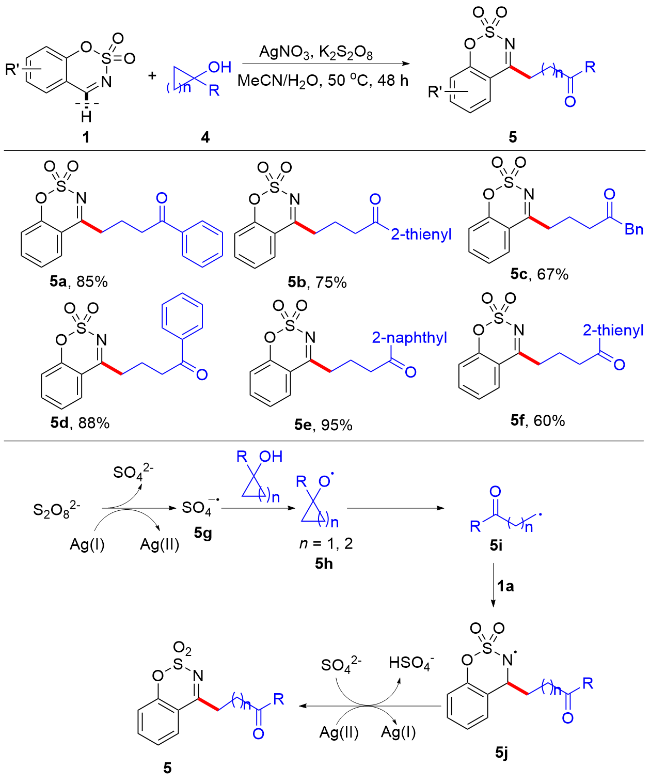
Alcohol is an important, inexpensive and readily available basic chemical. Therefore, the development of methodology using alcohols as alkylating agents has always been a topic of interest for scientists. At the same time, nucleophilic substitution of alcohols is one of the most fundamental reactions in organic synthesis, but the hydroxyl group itself has poor leaving ability. Traditional methods require first converting it into better leaving groups such as halides and sulfonic acid esters. This process not only requires the use of stoichiometric reagents and bases, but also generates intermediates with strong alkylating ability and carcinogenicity, while generating a large amount of waste, making the purification steps cumbersome. To overcome these inherent deficiencies, the development of direct substitution strategies for alcohols has become a research focus. The research on direct substitution of nonactivated alcohols is still in its infancy and urgently needs further exploration.
Soon after, Liu group[15] reported a clever combination of “ring opening of tension ring alcohols” and “C—H functionalization of N-sulfonyl ketimines”, providing a new tool for constructing complex molecules: a silver-catalyzed cycloalkanol ring-opening reaction for the C—H alkylation of cyclic aldimines via C—C bond cleavage cyclopropanol and cyclobutanol (Scheme 3). Extensive exploration has been extended to electron donating (Me, Et, tBu, OMe) or electron withdrawing (F, Cl, Br) N-sulfonyl ketimines and various cyclic alcohols, accommodating the universality of this catalytic reaction and wide applicability of substrates. The reaction was successfully scaled up to gram scale and another merit of this method resulted from various synthetic transformations, further enhancing its practical synthetic value. Primary mechanistic studies showed that a radical- type reaction regime was involved in this Ag-catalyzed ring-opening reaction. Accordingly, a radical pathway is proposed. The sulfate anion radical 5g is produced after the interaction of Ag(I) with the persulfate, and then abstracts a hydrogen atom from the cyclically strained alcohol, yielding an oxygen-centered radical 5h. This radical undergoes C—C bond cleavage to generate an alkyl radical 5i. The radical intermediate 5i attacks the N-sulfonyl ketimines 1, yielding a nitrogen-centered radical 5j. Subsequently, the Ag(II) species is converted to Ag(I) via single-electron transfer (SET) from the nitrogen-centered radical 5j, while 5j goes through deprotonation with the sulfate anion to afford the desired products 5. The practicality of the method is somewhat limited by certain drawbacks, as reflected in the high loadings of both silver catalyst and K2S2O8 oxidant, along with the long duration required for completion. Future direction for both methods should explore more efficient and green oxidants to reduce dependence on equivalent oxidants and potentially shorten reaction time. Theoretical calculations may help clarify the reaction mechanism especially the selective control factors of key steps.
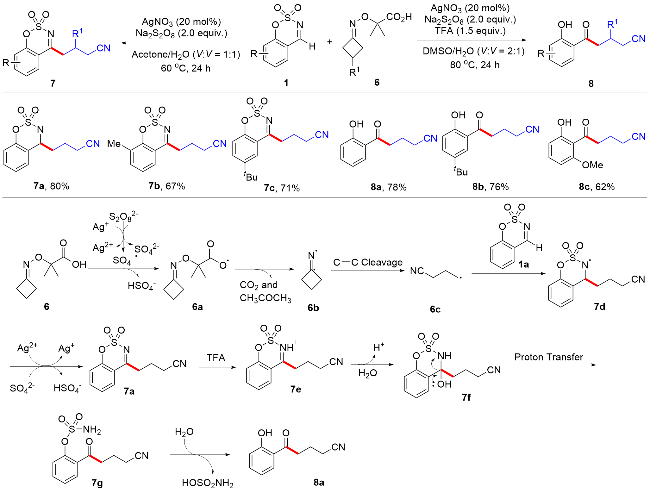
Oxime derivatives (such as α-iminooxy acid) are excellent precursors for generating imine radicals, which can be achieved through a decarboxylation single electron transfer (SET) process. Cyanide-containing compounds are crucial building blocks in medicinal chemistry and organic synthesis. Combining the two radical reactions is expected to construct structurally complex cyanide-containing products in a single step under mild conditions. In 2024, Li and coworkers[16] reported a silver-catalyzed radical cross-cou- pling reaction that achieves divergent transformation between N-sulfonyl ketimines and α-imino-oxy acid with the help of oxidants sodium persulfate (Na2S2O8) (Scheme 4). By simply selecting the reaction solvent, two structurally different cyanide-containing products can be obtained with high selectivity. Using acetone/water (V∶V=1∶1) as solvent (condition A), the reaction tends to yield a remotely functionalized alkylation skeleton (7), while in dimethyl sulfoxide (DMSO)/water (V∶V=2∶1) with trifluoroacetic acid (TFA) as an additive and at 80 ℃ (condition B), the reaction leads to the ketonitrile compound (8), which arises from ring-opening hydrolysis of the N-sulfonyl ketimines. Both of two reaction conditions are well-suited for a range of substrates, demonstrating good substrate adaptability. N-Sulfonyl ketimines with substituents such as allyl, alkoxy, phenyl, and halogen groups can all react smoothly, yielding target products in moderate to good yields. Ester- substituted cyclobutanone oxime derivatives and tyrosine-derived substrates are also compatible, demonstrating the potential of this method in the late-stage modification of bioactive molecules. Under optimized condition B, various N-sulfonyl ketimines with different substituents can be successfully converted to the corresponding open-ring ketonitriles with yields ranging from 45% to 78%. Halogen (F, Cl, Br) substituents, allyl ether and methoxy-substituted substrates are also applicable. The control experiment verified the key intermediates. Mass spectrometry detected possible intermediates and radical adducts captured by 2,2,6,6-tetramethylpiperidinooxy (TEMPO). Furthermore, under standard condition B, cyclic nitrile can be efficiently hydrolyzed to ketonitrile (yield 96%), confirming that 8a is the hydrolysis product of 7a. Based on experimental evidence, the authors proposed a reasonable reaction mechanism. Ag⁺ reacts with $\mathrm{S}_{2} \mathrm{O}_{8}^{2-}$ to generate $\mathrm{SO}_{4}^{-\mathrm{g}}$, which abstracts protons and electrons from α-imino-oxy acid, triggering decarboxylation and C—C/C—O bond cleavage, releasing CO2 and acetone, and generating imine radical 6b. 6b undergoes β-carbon cleavage to open the ring, yielding cyanate radical 6c, which attacks the C=N bond of the N-sulfonyl ketimines, generating nitrogen-centered radical 7d, which is finally oxidized by Ag2⁺ to form cyclic nitrile 7a. In the presence of dimethyl sulfoxide (DMSO)/H2O and trifluoroacetic acid (TFA), 7a decomposes via the unstable hemi-aldimine intermediate 7f and arylsulfonamide acid ester 7g, hydrolyzing to the final ring-opened ketonitrile 8. This strategy provides a concise and controllable new method for the modular synthesis of novel nitriles and ketone nitriles. The biggest highlight of this strategy lies in the selectivity of solvent control by simply changing the solvent (acetone/H2O vs. DMSO/H2O/TFA), and two structurally different products can be efficiently and selectively directed, which has significant advantages in synthesis efficiency and avoids the different reaction conditions and separation steps required for synthesizing two different skeletons separately, reflecting the economic efficiency of the steps. In terms of substrate range, the reaction is compatible with various functional groups on cyclic imines, demonstrating tolerance to electronic effects and moderate steric hindrance. Its tolerance is superior to many traditional cyanation methods, but compared to cutting-edge C—H functionalization or radical cyanation methods, the yield is moderate, and its compatibility with large steric hindrance or sensitive groups is still insufficient. Future research should focus on (1) developing more efficient and sustainable catalytic oxidation systems, and seeking greener oxidants; (2) expanding the range of substrates and exploring the application of complex molecular synthesis, such as conducting research on the application of post modification in natural products or drug molecules, truly reflecting its “post modification” value; (3) attempt to use chiral ligands or chiral solvents to control the selectivity of free radical addition steps and challenge asymmetric synthesis; (4) conducting key process scale-up research.
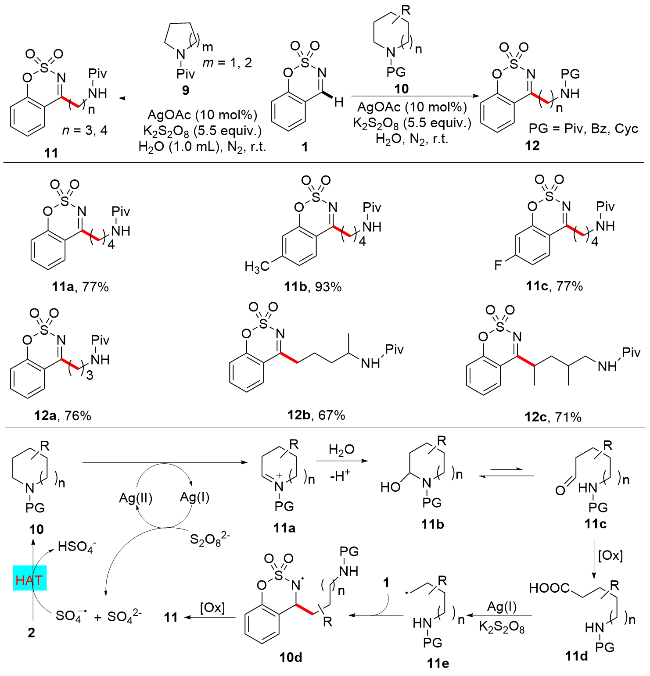
In 2025, Luo et al.[17] documented a novel Ag-catalyzed strategy that achieved distal aminoalkylation modification of N-sulfonyl ketimines through site-selective oxidative ring-opening of N-acylated cyclic amines. The reaction was conducted in water as a green solvent at room temperature, using AgOAc (10 mol%) as the catalyst, K2S2O8 (5.5 equiv.) as the oxidant (Scheme 5). The investigation of substrate scope revealed that the reaction system exhibits good functional group compatibility and is insensitive to electronic property and steric hindrance. Various electron-donating groups (methyl, methoxy, tert-butyl, allyl) or electron-withdrawing groups (halogens F, Cl, Br, I) can all react smoothly with yields ranging from 29% to 93%. Substrates substituted at 8- or 7-position are also compatible. A variety of N-acylated cyclic amines with different ring sizes (such as six-membered and seven-membered rings) are all applicable, resulting in aminoalkyl products with varying chain lengths in a yield ranging from 76% to 19%. However, amines protected with N-Boc or N-Cbz do not react. The gram-scale experiment yielded target product with a yield of 73%, demonstrating the practicality of the reaction, which could also be suitable for later derivatization reactions. To explore a possible mechanism, the authors conducted a radical trapping experiment, and when free radical inhibitor TEMPO was added, the reaction was completely inhibited, and further N-acylated amino acid intermediate was detected by HRMS, confirming the radical pathway. Under standard conditions, N-acylated amino acid can react with 1a to generate 11a (29% yield), supporting its role as a reaction intermediate. Based on this, the authors proposed a possible mechanism. Ag(I) reacts with $\mathrm{S}_{2} \mathrm{O}_{4}^{2-}$ to generate Ag(II) and $\mathrm{SO}_{4}^{-\mathrm{g}}$. The latter abstracts hydrogen from cyclic amine 9 via hydrogen atom transfer (HAT) to form carbon-centered radical 10, which is oxidized by Ag(II) to iminium ion 11a, which is then captured by water to undergo ring-opening, and oxidized to N-acylated amino acid 11d through linear aldehyde intermediate 11c. 11d undergoes silver-catalyzed decarboxylation to generate alkyl radical 11e. 11e attacks the C=N bond of N-sulfonyl ketimines to form nitrogen-centered radical 11d, which is finally oxidized to obtain the target product 11. This study developed an efficient and green silver-catalyzed method, achieving the first remote C—H aminoalkylation of N- sulfonyl ketimines through the oxidative ring-opening of cyclic aliphatic amines. Using water as the solvent under mild conditions, this reaction exhibits high atom economy and excellent substrate generality, providing a new pathway for the synthesis of aminoalkylated N-sulfonyl ketimines with potential biological activity. However, its high oxidant dosage (5.5 equiv.), silver catalyst cost, sensitivity to air, and lack of stereoselective control are the main limitations. Future research should focus on (1) developing more economical and sustainable oxidation catalytic systems, avoi- ding excessive use of oxidants and the production of large amounts of sulfate by-products, which are not environmentally friendly; (2) significantly expanding the substrate range and functional group compatibility, exploring more challenging amines (such as nitrogen-containing heterocycles commonly found in drug molecules) and different types of imine receptors; (3) exploring the application of post modification in complex molecules. Addressing these cha- llenges will propel the strategy from an interesting synthesis method to a truly practical synthesis tool.
Compared to the traditional paradigm of synthetic catalysis, the concept of green chemistry has become a guiding principle for chemists and chemical engineers since its inception. The efficient utilization of solar energy can alleviate the pressure brought by energy shortages and environmental pollution since solar energy is regarded as a clean, easily accessible, and renewable source of energy. Therefore, photocatalytic technology has become one of the most popular research areas, with wide applications in various fields such as photocatalytic water splitting, degradation of organic pollutants, CO2 reduction, and organic synthesis.[18] Although modern photocatalytic organic synthesis features mild reaction conditions, excellent functional group tolerance, and consistency with the trend of green synthesis, thus enabling new strategies to access structurally diverse heterocycles, this field still faces some challenges: (1) The development of visible light-driven organic chemical reactions is relatively slow; (2) Most early photochemical reactions require ultraviolet (UV) light, which can easily lead to the breakage of chemical bonds and low reaction selectivity due to its high energy, and require the use of special light sources and equipment; (3) Most organic compounds cannot absorb light directly and are difficult to excite, especially visible light, making it challenging to activate and produce active molecules without external force. Therefore, photocatalytic reactions often require the addition of photocatalysts to absorb photons and achieve the purpose of activating or exciting organic compounds; (4) This reaction exhibits relatively low tolerance toward sterically hindered substrates; (5) Some reactions still require the use of stoichiometric additives; (6) The application in the post-modification of complex molecules is not yet widespread. In common reports, upon excitation by light, photocatalysts can trigger the excited state of reaction substrates through various mechanisms such as hydrogen atom transfer (HAT), single electron transfer (SET), and energy transfer (ET), generating highly reactive radical intermediates.[19] Therefore, investigating the action mechanism of photocatalysts in visible-light-driven organic reactions to realize the rational design and precise fabrication of catalysts plays a vital role in the construction of C—C or C—X (N, O, S, Se, etc.) bonds, bearing profound theoretical and practical significance.
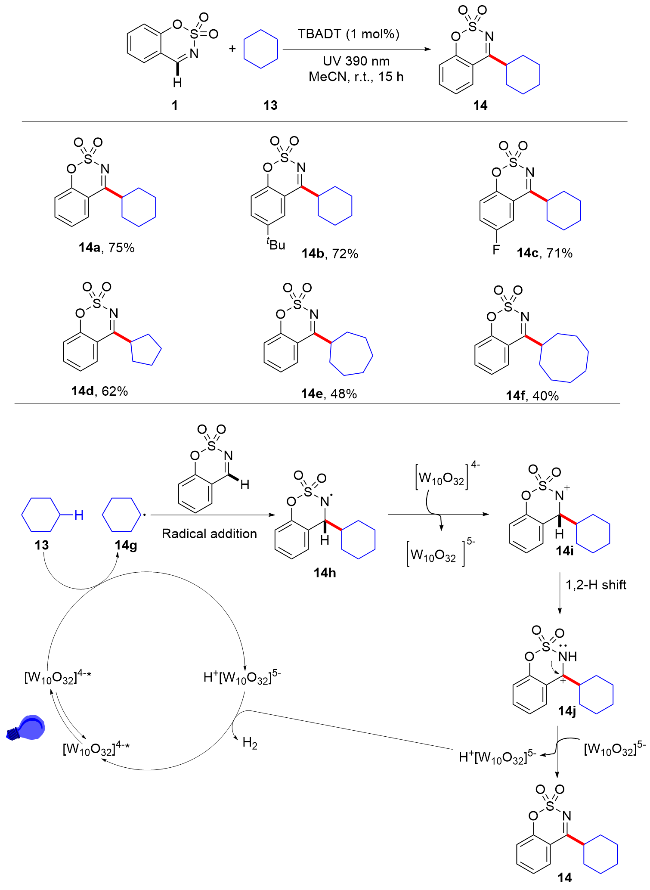
Alkanes are cost-effective, commercially available, and prevalent chemical feedstocks, and direct C(sp3)—H bond transformation into value-added chemicals via C(sp3)—H bonds cleavage flourished in the past decades. The strong bond dissociation energies (BDEs) of C(sp3)—H, poor regiocontrol, and low solubility in organic solvents make C(sp3)—H oxidation both meaningful and arduous for contemporary synthetic methodologies. In 2024, Zhou’s group[20] reported a photo-induced decatungstate-catalyzed direct coupling reaction between cycloalkanes and N-sul- fonyl ketimines under mild conditions with tetrabutyl- ammonium decatungstate (TBADT, 1 mol%) as the heterogeneous photocatalyst, demonstrating excellence in green- ness, practicality, broad substrate scope, and synthetic application value (Scheme 6). A series of alkylated products were obtained with moderate to good yields (31%~75%). This catalytic system is compatible with both electron- donating alkyl and alkoxy groups and electron-withdrawing groups such as Cl, Br, and CO₂Me, showing excellent functional group tolerance. This catalytic system can be applied to gram scale synthesis and the post-modification and late-stage amplification of drug-derived cyclic aldehyde imides such as the tyrosine derivative and the estrone derivative, providing a new tool for the structural modification of bioactive molecules and highlighting its scalability and potential application. The reaction mechanism involves the catalyst TBADT ([W10O32]4–) absorbing light energy upon LED irradiation, transitioning to a higher excited electronic state. The active TBADT species, denoted as TBADT* ([W10O32]4–∗), abstracts a hydrogen atom from cyclohexane, reducing itself to H+[W10O32]5– while forming the cyclohexyl radical 14g. Subsequently, the N-sulfonyl ketimines 1 is captured by radical 14g through addition, yielding the N-centered radical species 14h, further oxidized by ground-state TBADT to furnish the cation 14i, simultaneously generating [W10O32]5–. Then, N-centered cation 14i undergoes 1,2-hydrogen migration to form carbocation 14j, which subsequently restores the C=N bond by hydrogen abstraction. The protonated species H+[W10O32]5– regenerates ground-state TBADT via an electron transfer step while releasing hydrogen gas. This study represents a valuable methodological exploration, but moderate reaction efficiency, significant and critical limitations in substrate scope (particularly ineffective for straight-chain alkanes) impeded its wide application. Compared with the mentioned-above Ag-catalyzed decarboxylation or ring opening methods, this photocatalysis methodology utilizes light energy and polyacid anion catalysts instead of stoichiometric oxidants (K2S2O8) and metal silver catalysts to directly activate the more inert C—H bonds of cycloalkanes, representing a trend towards greener and more atomic economy, surpassing silver catalysis in concept and further expanding the potential of cyclic aldimines as a synthetic platform for late stage modification of complex molecules. But this method is ineffective for linear alkanes and aryl-substituted alkanes, severely limiting the diversity of substrates. In addition, although the article mentions post-modification of “drug molecules”, the examples provided are only tyrosine and estrone derivatives, and it remains unclear whether it is applicable to more challenging complex drug skeletons (such as nitrogen-containing heterocycles and multifunctional molecules). However, the stability and recyclability of the catalyst in this catalytic system have not been verified. Although TBADT is a classic photocatalyst, it may decompose or deactivate under long-term exposure to light, the presence of oxygen, and high temperatures. Especially in gram-scale amplification experiments, the recovery and reuse of the catalyst have not been reported, posing challenges to its industrial application prospects.
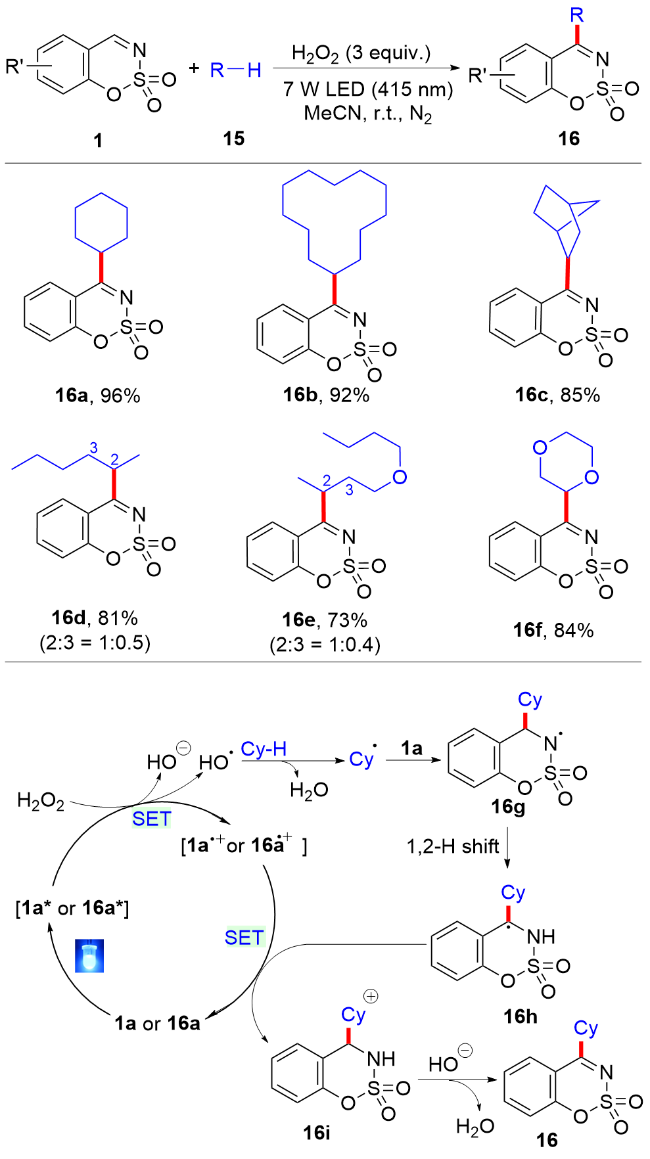
Due to the inertness and peroxidation issues of C—H bonds, selective oxidation with eco-friendly oxidants serves as an effective route to generate alkyl radicals among various catalytic systems. Hydrogen peroxide (H2O2) is an inexpensive, easy-to-handle green oxidant that outperforms conventional oxidants. H2O is an environmentally benign byproducts in the oxidative reactions with H2O2. Therefore, in 2023, He and coworkers[21] developed a simple, practical and eco-friendly visible light-induced C—H alkylation of N-sulfonylketimide. This protocol employs low-cost, abun- dant alkanes as atom-economic alkyl precursors and H2O2 as a green oxidant under metal-free, additive-free, and external-photocatalyst-free conditions. It enables the efficient synthesis of diverse valuable 4-alkylated N-sulfonyl keti- mines, with pure water generated as the sole environmentally benign byproduct (Scheme 7). Under optimized condition, N-sulfonyl ketimines and cyclohexane as model substrates could give the desired product at 92% yield by employing H2O2 (3 equiv.) as the environmentally beneficial oxidant under 415 nm LED (7 W) irradiation in a nitrogen atmosphere. This catalytic system featured N-sul- fonyl ketamine dual roles of reactants and photocatalysts which was proved with UV-vis absorption analysis, thus simplifying the reaction system. Also, the photocatalytic alkylation showed high substrate adaptability with both electron donating and electron withdrawing substituents on the cyclic ketimine benzene ring, and is adaptable for a series of cycloalkanes with bulky sterically hindrance and linear alkanes. This protocol is also amenable to gram-scale synthesis, obtaining 1.15 g of products with a yield of 87%, demonstrating its practical application potential. A series of control experiments including the radical-trapping experiments, kinetic isotope effect (KIE) experiments, and visible-light on/off experiments supported the author’ proposed reaction mechanism. Photoexcitation by 415 nm light endows ground-state N-sulfonyl ketamine (1a) with high potential in its excited state [1a]*, allowing for single-electron reduction of H2O2 to form a hydroxyl radical (OH•), a hydroxyl anion (OH–), along with generation of 1a radical cation [1a]•+. Subsequently, a hydrogen atom transfer from cyclohexane (15) to OH• leads to the formation of cyclohexyl radical (Cy•), which attacks 1a to form the N-center radical 16g, followed by 1,2-H shift to deliver the C-center radical 16h. The [1a]•+ oxidizes the intermediate 16h to give the carbocation intermediate 16i, along with the re- generation of ground-state 1a. Ultimately, the desired product 16 is obtained by the deprotonation of 16i with the assistance of OH–. In addition, the product 16 can also serve as the photocatalyst to participate the photo-catalytic cycle. Given the natural abundance of inexpensive alkanes, good to excellent yields, strong scalability, simple operational steps, and clean, mild conditions, this work represents an important breakthrough in the field of C—H functionalization of N-sulfonyl ketimines. Compared with previous strategies that relied on silver catalysts or TBADT photocatalysts, this work only uses H2O2 and water as green redox media instead of metal and external molecular photocatalysts, and establishes an extremely simple, efficient, and environmentally friendly synthesis method with broad application prospects in the pharmaceutical industry and fine chemicals. In the gram level, although the TBADT system can also be scaled up to the gram level, it requires 40 equiv. of alkane, whereas this methodology only requires 3 equiv., significantly improving atomic economy. Moreover, the adoption of continuous-flow photoreactors is recommended to improve mass transfer efficiency, reduce solvent usage, and attempt to extend this system to more heterocyclic systems.
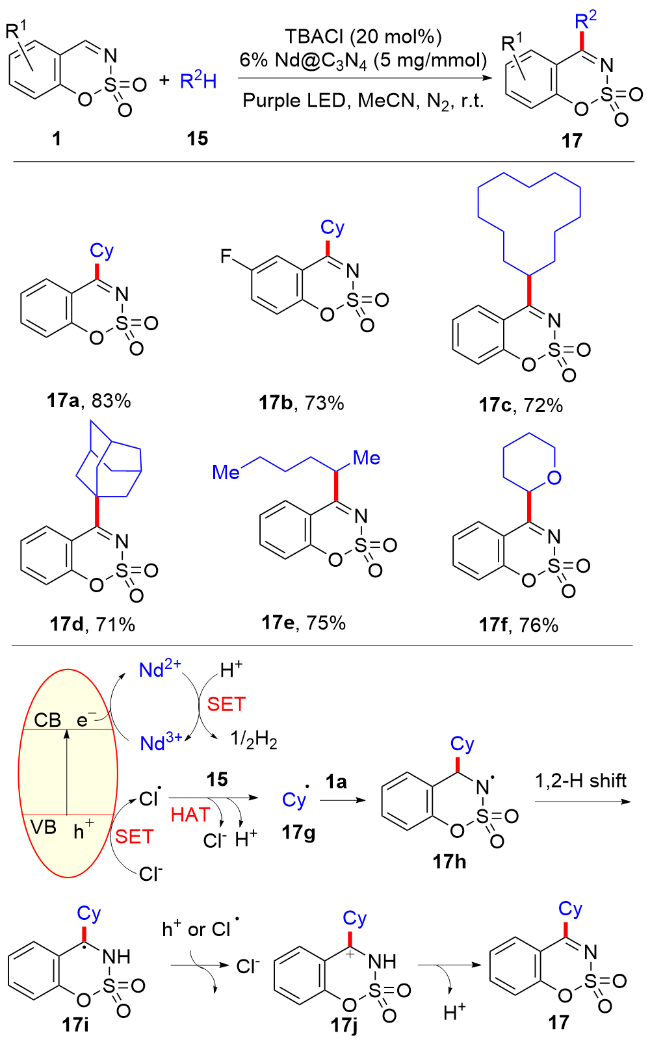
Among various heterogeneous catalysts, graphitic carbon nitride (g-C3N4) composed of nitrogen and carbon elements has received widespread attention in recent years due to its suitable band composition (2.7 eV) and redox potential (–1.2 V/+1.5 V), and has been applied in various fields of photochemistry,[22] such as photocatalytic degradation of organic pollutants, photocatalytic reduction and hydrogen evolution of CO2, photocatalytic organic synthesis, etc. However, the practical application of g-C3N4 cations is still hindered by several obstacles, such as few active sites, poor light capture, and photo induced hole/electron pair recombination.
Encouraged by these positive results, shortly after, He’s group[23] reported the first example of chlorine-mediated Nd@g-C3N4 (Neodymium@graphitic carbon nitride)-pho- tocatalyzed semi-heterogeneous synthesis of 4-alkylated N- sulfonyl ketimines and its antitumor activities research. Using green, clean photons as the energy source, Nd@g- C3N4 serves as a heterogeneous photocatalyst, while tetrabutylammonium chloride (TBACl) functions as both a redox catalyst and a hydrogen atom transfer (HAT) catalyst (Scheme 8). Under mild conditions, a series of high-value alkylated N-sulfonyl ketimine compounds were successfully synthesized using inert alkanes as atom-economic alkyl precursors. This protocol tolerates sterically hindered cycloalkanes, such as cyclopentane, cycloheptane, cyclooctane, cyclooctanes and adamantane, as well as linear alkanes and ethers, delivering the corresponding products in moderate to excellent yields. Its high catalytic activity and robustness were validated in gram-scale reactions and consecutive reaction-separation cycles, indicating promising industrial applicability. Then different control experiments including free radical capture experiments, electron/hole suppression experiments and kinetic isotope effects (KIE), revealed this mechanistic route was a radical pathway. Based on the results above and literature, a probable mechanism was proposed. Under the light irradiation, the composite photocatalyst Nd@g-C3N4 absorbs photons and generates photogenerated charge carriers. The introduction of Neodymium (Nd) in intrinsic g-C3N4 renders an impurity level, which can facilitate the separation of photogenerated electron-hole pairs. The photogenerated electron (e–) reduces Nd3+ to Nd2+, which in turn promotes the reduction of protons (H+) to produce H2 in a SET process. In parallel, chloride ions (Cl–) interacts with holes to form chlorine radicals via a SET event, which then engages in a hydrogen atom transfer (HAT) process with cyclohexane 15, generating cyclohexyl radicals and releasing protons (H+). Afterwards, the cyclohexyl radical regio-selectively attacks the C=N bond of N-sulfonyl ketimine to give intermediate 17g, followed by 1,2-H shift to yield a C-cen- tered radical intermediate 17h. The intermediate 17h is subsequently oxidized by holes to form the cationic intermediate 17i. Finally, 17i experiences dehydrogenation and aromatization to produce the terminal product 17. This semi-heterogeneous catalytic strategy is characterized by the synergistic interaction between the reversible Nd³⁺/Nd²⁺ and Cl–/Cl˙ redox couples, among which TBACl not only consumes photogenerated holes as a redox catalyst but also acts as an HAT catalyst to cleave C—H bonds in alkanes. This semi-heterogeneous catalytic scheme provides a good reference for the synthesis of lead compounds of antitumor drugs. In future research directions, the authors can try to extend this method to five- and seven-membered ring N-sulfonyl ketimines as well as the post-modification of complex drug molecules and natural products. Exploring greener oxidants such as oxygen or electrochemical drive as the ultimate green oxidation strategy is also one of the research objectives. However, it still exhibits significant limitations in terms of catalyst complexity, reaction time, scalability, chlorine source residuals, and system greenness. Breakthroughs can be made in catalyst simplification, process intensification, and systematic biological evaluation in the future, and this strategy is expected to become an important platform for green synthesis and early discovery of drugs.
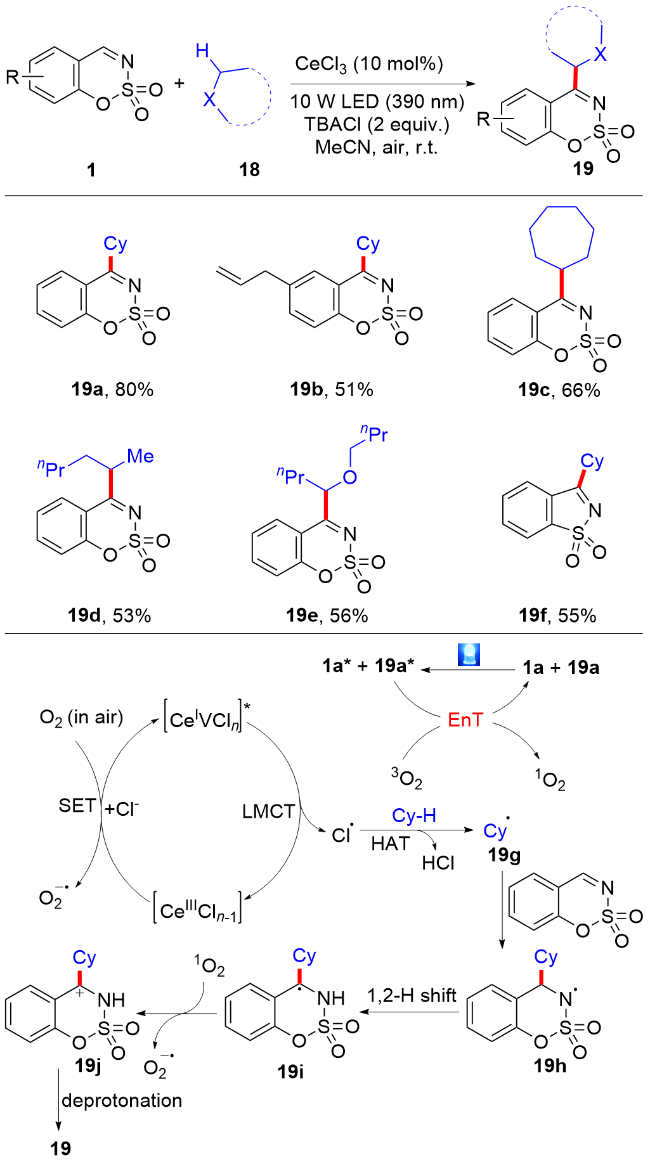
In 2024, Wei et al.[24] reported cerium-catalyzed strategy that achieved the C—H alkylation of cyclic N-sulfonyl ketimines with inexpensive alkanes/ethers through a photoinduced ligand-to-metal charge transfer (LMCT) process (Scheme 9). The model reaction was conducted under a condition of CeCl3 as homogeneous photocatalysts (10 mol%), TBACl as Cl sources (2 equiv.), acetonitrile (MeCN) as a solvent (2 mL), air as the sole green oxidant, 390 nm (10 W), for 24 h, providing a sequence of target product with moderate to excellent yields (51%~83%). A wide range of substrate applicability was demonstrated with a succession of N-sulfonyl ketimines electronically or spatially modified with functionals, including electron donating (Me, tBu), electron withdrawing (F, Cl, Br, and I), even easily oxidizable olefin as well as cycloalkanes (cyclopentane, cycloheptane, cyclooctane, and cyclododecane), linear alkanes and ethers, N,N-dimethylaniline. Notably, this Ce-catalyzed coupling was also suitable for the benzo[d]- isothiazole 1,1-dioxide. This method also successfully achieved gram scale synthesis, further exhibiting the practicality. The author performed control experiments to gain deep insight into the reaction mechanism, for example, the complete suppression of the photocatalytic transformation with the addition of radical scavengers 2,2,6,6-tetramethyl- piperidine-1-oxyl (TEMPO) or butylated hydroxytoluene (BHT), supporting a radical pathway. Besides, a clear kinetic isotope effect (kH/kD=3.6) supported that the production of hydroxyl radicals via the HAT and the cleavage of the C(sp3)—H bond were the rate-limiting step. To further identify the active species, when the superoxide anion ($\mathrm{O}_{2}^{\mathrm{g}^{-}}$) scavenger 1,4-benzoquinone was added to the system, the reaction efficiency significantly decreased, indicating the involvement of the oxygen. And the SET pathway was proved with the SET scavenger CuCl2. Based on experimental observations and relevant literature, a photoinduced LMCT mechanism is established. The core is that Ce(III)-chloride complexes undergo LMCT under photoexcitation, generating highly active chloride radicals (Cl•). At the same time, an energy transfer (EnT) process with ground-state triplet oxygen (3O2) generates the active excited-state singlet oxygen (1O2) in the presence of excited-species 1a* or 11a*. This radical extracts hydrogen atoms directly from inert alkane C(sp³)—H bonds through the hydrogen atom transfer (HAT) process, yielding the corresponding alkyl free radical 19g, which attacks C=N bonds of N-sulfonyl ketamine to furnish an intermediate 19h. The 1,2-H shift process furnishes a radical 19i. The target alkylated product is obtained after oxidization by 1O2 and the deprotonation of radical cation 19j. The outstanding value of this work lies in the utilization of abundant cerium as a catalyst, using the simplest and cheapest alkane as the alkyl source, and achieving direct functionalization of inert C—H bonds under mild conditions using O2 as green oxidant instead of stoichiometric chemical oxidants, providing a new path for the synthesis of valuable 4-alkylsulfonyl ketone imines. The LMCT catalytic paradigm also faces some challenges, such as the difficulty in recycling the homogeneous catalyst CeCl3, and the use of 2 equiv. of TBACl, which not only results in poor atom economy but also potentially introduces chlorine residue issues. In scaled-up experiments, it is advisable to boldly explore new technologies like microchannel reaction technology to enhance atom economy and align with green chemistry principles.
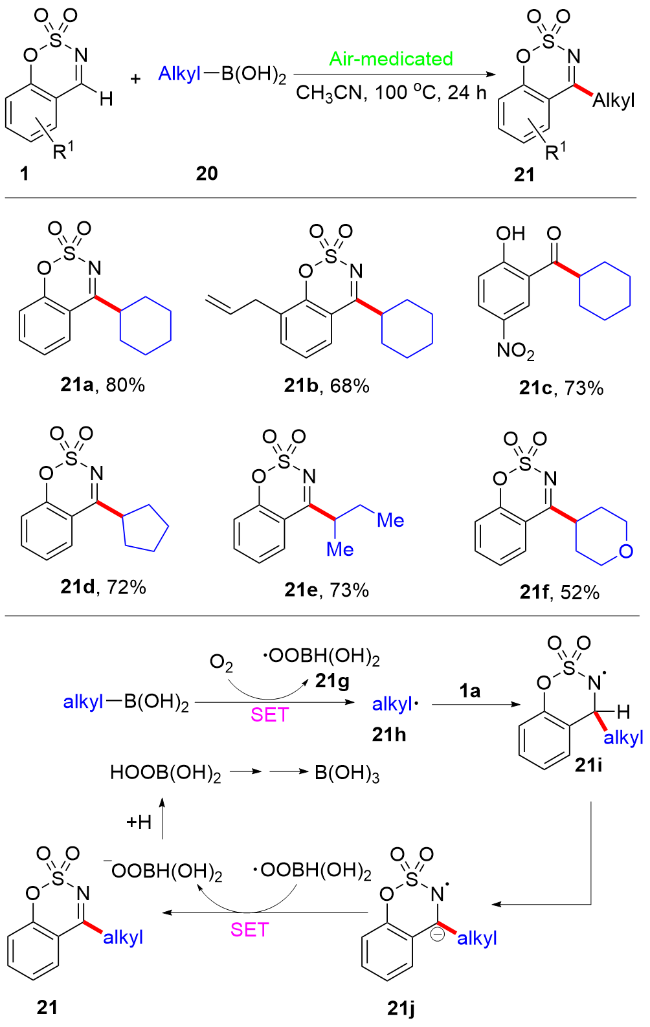
Given their versatility, organoboron compounds as indispensable synthons and key intermediates play a pivotal role in the interdisciplinary field, finding wide applications in organic synthesis, drug research, and functional materials. Soon afterwards, Luo’s group[25] disclosed a catalyst-free and air-mediated radical alkylation of cyclic aldimines. In this system, alkylboronic acids were oxidized using air as the only green oxidant to furnish alkyl radicals under catalyst-free conditions (Scheme 10). In this model reaction, benz[e][1,2,3]oxathiazine 2,2-dioxide was employed as the substrate to react with cyclohexylboronic acid at 100 ℃ under air atmosphere, affording the alkylated product in 21%~91% yields. Its biggest highlight is that it eliminates the need for any metal catalysts, photocatalysts, or additional stoichiometric oxidants, using only air as the oxidant, achieving the ultimate simplification of the reaction system. This method was successfully performed in gram-scale synthesis with a 77% yield. This system exhibits excellent functional group tolerance, accommodating electron-donating groups (methoxy, allyl) and electron-with- drawing groups (Cl, Br, I, CO₂R), which is beneficial for the late-stage functionalization of complex bioactive molecules. Free radical trapping experiments indicates that this reaction may involve a free radical mechanism, where the oxidation of alkylboronic acid by O2 produces an alkyl radical 21h and a boronic acid-substituted peroxy radical 21g. Afterwards, the alkyl radical 21h attacks the C=N bond to form the N-centered radical 21i. Intermediate 21i subsequently undergoes deprotonation of the benzylic C—H bond, yielding the radical anion intermediate 21j. Radical anion intermediate 21j then goes through a one-electron transfer with the boron-substituted peroxy radical, forming the final product and peroxyboronic acid. Finally, the peroxyboronic acid is converted to boronic acid. Compared with prior reports, this work presents a facile and green strategy for the C—H functionalization of N-sulfonyl ketimines. It completely eliminates the dependence on expensive and toxic reagents and various catalysts (silver catalysis, TBADT, g-C3N4), as well as sophisticated equipment, establishing a low-cost, easy-to-operate, and environmentally friendly synthetic protocol. As an outstanding representative of pursuing the “basic principles of green chemistry”, future research will focus more on specific application scenarios, such as drug molecule and complex heterocycles compound. Achieving a 77% yield at the gram scale (5.5 mmol) with only a slight decrease compared to the small scale (80%) demonstrates excellent scalability. However, the high temperature (100 ℃) and long time (24 h) required for the reaction lead to issues such as low energy efficiency, operational safety, and process greenness. Future development directions should focus on exploring strategies such as low temperature or photothermal synergies, continuous flow reactions, etc., to reduce energy consumption, attempting green solvents (such as ethanol, water) or solvent-free reactions, expanding to complex drug molecular skeletons, and developing tandem reactions (such as alkylation/cyclization, alkylation/ functionalization).
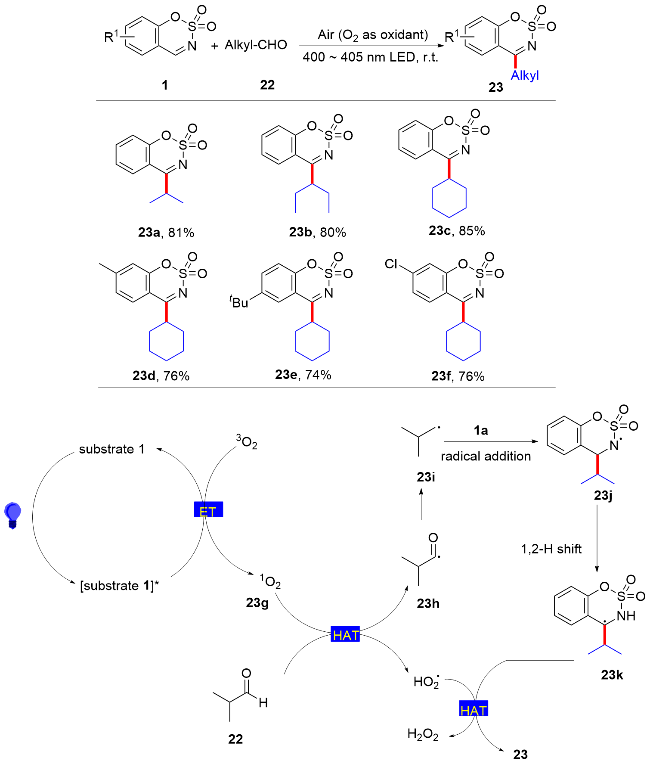
As a basic structural unit, the carbonyl group is widely existing in various compounds. However, the deoxygenation of carbonyl as alkyl radical sources will undoubtedly enrich the toolbox of chemists. In 2023, Ren et al.[26] described a photoinduced decarboxylative C—C bond- forming reaction using readily available aldehydes as alkyl sources (Scheme 11). In this reaction, air serves as a green oxidant, while N-sulfonyl ketimines function simultaneously as both substrates and photocatalysts, thereby avoiding the dependence on precious metal catalysts or organic photosensitizers in traditional photocatalytic reactions and providing a concise reaction system for the C—H alkylation of N-sulfonyl ketimines (53%~85%). The model reaction of N-sulfonyl ketimines and isobutyraldehyde proceeded smoothly in isopropanol as solvent at room temperature under irradiation of 400~405 nm LED for 24 h, yielding the desired alkylated product in 81% yield. Under this decarboxylative conditions, the photocatalytic alkylation reaction exhibited good functional groups tolerance (electron-rich Me, OMe, tBu, and Et; electron-deficient Cl and F) and excellent substrate adaptability, such as primary, secondary, and tertiary fatty aldehydes. Specifically, both linear and branched aldehydes such as propionaldehyde, butanaldehyde, and 3-methyl- butanaldehyde were well tolerated. Afterwards, the free radical capture experiments, observation of TEMPO-isopropyl adduct, and complete quenching with a singlet oxygen scavenger 1,4-diazabi- cyclo[2.2.2]octane (DABCO) supported the free radical hypothesis proposed by the author. Under light irradiation, substrate 1 undergoes photoexcitation to achieve the excited species 1*, which reacts with triplet molecular oxygen to form singlet molecular oxygen via energy transfer. Then, a hydrogen atom transfer (HAT) occurs between 1O2 and alkyl aldehyde 22, giving a hydroperoxy radical (HO2•) and an acyl radical intermediate 23h. This intermediate spontaneously decarboxylates to form alkyl radical 23i, which attacks the C(4) position of N-sulfonyl ketimines 1, yielding an N-centered radical 23j. A 1,2-H migration delivers the radical intermediate 23k, further undergoing another HAT with HO2• to produce the desired product 23, along with the by-product H2O2. This work provides a green, economical, and easy-to-operate new strategy for C—H alkylation of N-sulfonyl ketimines, which allows the efficient construction of key skeletons in medicinal chemistry and possesses favorable application prospects. However, this method still has obvious shortcomings: the substrate scope is limited, and it is less suitable for substrates containing strong electron-withdrawing groups, heteroatom substitutions, or large steric hindrance. At the same time, the reaction conditions are relatively harsh, all of which are the main existing drawbacks. Future research will focus on breaking through substrate limitations while maintaining simplicity.
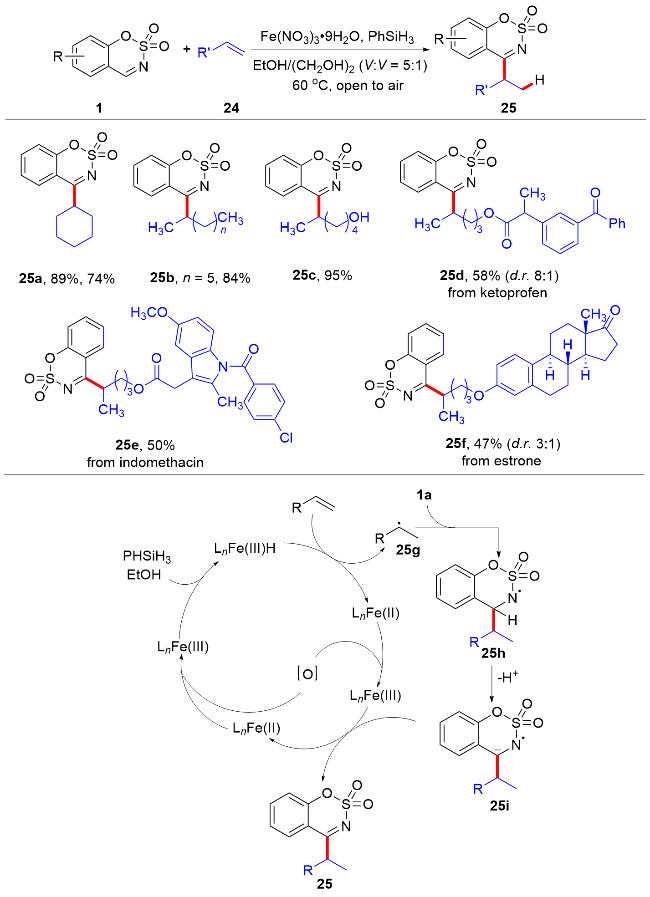
In 2025, Zhang and coworkers[27] innovatively proposed hydrogen atom transfer (HAT)-mediated Minisci-type alkylation of N-sulfonyl ketimines via the iron hydride (FeH) migration, enabling the synthesis of diverse valuable alkylated sulfonyl ketimides (Scheme 12). This system exhibits broad substrate scope, ease of operation, and efficient scalability. The reaction uses N-sulfonyl ketimines and cyclohexene as model substrates to optimize the conditions. It is determined that the optimal system uses Fe(NO3)3• 9H2O as the catalyst, phenylsilane as the hydrogen source, a mixed solvent of ethanol/ethylene glycol (V∶V=5∶1, 2.4 mL), and runs at 60 °C with air as the sole oxidant, affording the target product in yield up to 89%. The key to the success of this system lies in the efficient and regioselective (Markovian rule) generation of alkyl radicals through the MHAT process of olefins with Fe-H species, which then add to the C(4) position of imines. The following-up sub- strate scope investigation demonstrates that this method has excellent substrate generality: electron-donating groups (Me, OMe), electron-withdrawing (F, Cl, Br, I) groups on cyclic N-sulfonyl ketimines are all well tolerated, and steric effects have little impact on the yield. As for olefin, simple terminal alkenes, cyclic alkenes, and non-activated alkenes containing functional groups such as hydroxyl, silyl, amide, or ether can give the desired products in moderate to good yields. The reaction can be scaled up to the gram level without significant decrease in yield (1.32 g products with 74% isolated yield), indicating synthetic practicality. This catalytic system can be applied to the late-stage functionalization of seven complex bioactive molecules, including ketorolac, indomethacin, estrone, osaprazine, isocaproic acid, isofenprostenol, and febuxostat. To gain some insight into this transformation, the addition of radical scavenger TEMPO and 1,1-diphenyl ethylene in the catalytic system suppressed the formation of desired products. Therefore, the author proposes a reaction mechanism, in which FeH species from the iron catalyst and PhSiH3 is generated with EtOH assistance, followed by hydrogen atom transfer to form alkyl radical species 25g. The alkyl radical 25g adds to the C(4) position of 1a, yielding the nitrogen-centered radical 25h. Subsequently, deprotonation of the benzylic C—H bond generates the radical anion intermediate 25i. 25i is then oxidized by Fe(III) to afford the desired product 25, while Fe(II) is regenerated to Fe(III) by the oxidant. This work provides a new method with high atom economy, simple steps, and wide functional group compatibility for the construction of valuable 4-alkylsulfonyl ketimines, especially utilizing the bulk chemical olefin as a diversified alkyl source, which has important application potential in the discovery and modification of drug molecules. The main limitations lie in the difficulty in recycling homogeneous iron catalysts, the requirement for stoichiometric hydrosilylation reagents, and the limited room for optimization of reaction conditions (mixed solvents, heating).
3 Annulation
With the development of social industrialization, we are facing increasingly serious problems such as environmental pollution and energy shortages. To address these concerns, thereby, compared to the homogeneous counterpart (high cost and difficult recovery), heterogeneous catalysis is preferred in organic synthesis and industrial production since the inherent advantages such as recovery and recyclability, easier separation, etc. The past years have witnessed tremendous advancement in the functionalization of N-sulfonyl ketimines promoted by heterogeneous photocatalysts, accompanied by intensive research in new technologies of functionalization of N-sulfonyl ketimines. Given the excellent optoelectronic properties and stability, perovskite materials have a band gap (2.4 eV) suitable for visible light absorption and appropriate redox ability, and can be used as a heterogeneous catalyst, showing great potential in the field of photocatalysis. Cost-effective, commercially accessible, and chemically stable N-aryl glycine serves as an important organic synthesis synthon. In photocatalytic reaction systems, it can generate non-toxic carbon dioxide in situ and produce corresponding amino radicals or imine active intermediates, which are used to construct a wide range of nitrogen-containing organic compounds.[28]
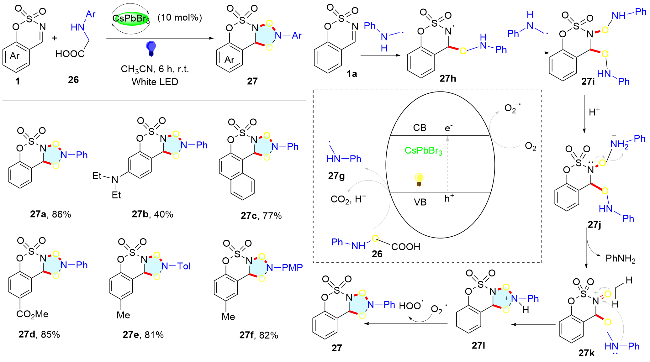
In 2022, Yu and colleagues[29] developed a sustainable and economically efficient method for synthesizing imidazolidine fused sulfonamide esters through the photocatalytic cyclization reaction of N-sulfonyl ketimines and N- arylglycine using cesium lead bromide CsPbBr3 as a heterogeneous photocatalyst (31 examples, 40%~87% yields), charactered by constructing two C—C bonds in one step, high atomic and step economy, simple operation and excellent functional group tolerance to electron deficient functional groups (Me, tBu) or electron-donating group (F, Cl, Br, I, CO2R) (Scheme 13). The survival of olefin and successful scale reaction at 5 mmol (yield up to 1.25 g, 79%) under the irradiation of outdoor sunlight further validated the robustness of this CsPbBr3-catalyzed method. Moreover, this photocatalytic protocol can be expanded to N-heterocycles including 6-methyl-[1,2,3]oxathiazino[6-c]quinolin-5(6H)-one 2,2-dioxide, benzo[d]isothiazole 1,1- dioxide, and 2H-benzo[b][1,4]oxazin-2-one. The catalyst CsPbBr3 can be easily recovered from the reaction mixture and reused at least five times without a significant decrease in its photocatalytic reactivity. In addition, powder X-ray diffraction (PXRD) analysis of the recovered material exhibited the structure stability of the photocatalyst, further demonstrating its versatility and the practical feasibility. A sequence of control experiments such as radical trapping experiment (TEMPO), quenching experiments [ammonium oxalate for photogenerated hole, potassium persulfate K2S2O8 for photogenerated electron, 1,4-benzoquinone for superoxide radical ($\mathrm{O}_{2}^{\mathrm{g}^{-}}$)], as well as the complete suppression of target product formation under a nitrogen atmosphere, strongly support the proposed reaction mechanism. Under visible light irradiation, CsPbBr3 is photoexcited to generate electrons (e⁻) and holes (h⁺). Photon- generated electrons reduce O2 to superoxide anion ($\mathrm{O}_{2}^{\mathrm{g}^{-}}$), while holes oxidize N-arylglycine 26 to yield the key aminomethyl radical 27g via decarboxylation. Thereafter, radical 27g undergoes radical addition to the C=N bond of N-sulfonyl ketimines 1, generating intermediate 27h. Intermediate 27h may undergo intramolecular cyclization or further transformation (possibly involving the capture of hydrogen atoms from another molecule or reaction with imine ion species), ultimately forming the observed product 27. $\mathrm{O}_{2}^{\mathrm{g}^{-}}$ may participate in the oxidation step to complete the catalytic cycle and regenerate the ground state catalyst. This study is of great significance for sustainable photosynthesis. Nevertheless, its inherent drawbacks, including lead leakage and biological toxicity, impede its widespread application. As a result, this approach remains largely conceptual and cannot be regarded as a fully green, industrially feasible protocol, requiring further research on lead-free perovskites and more environmentally benign semiconductor materials.
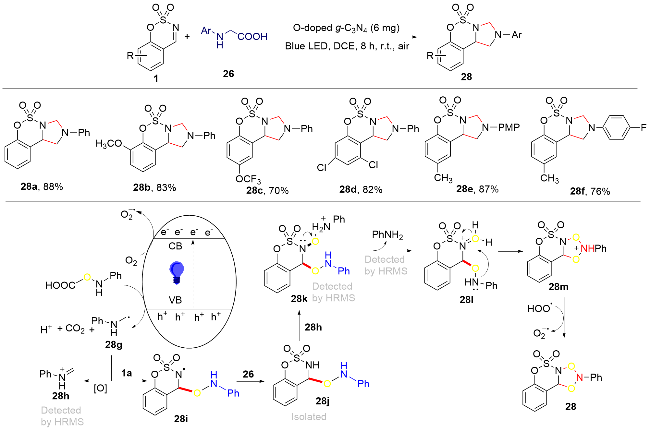
Afterwards, the Yu team[30] developed an oxygen-doped graphitic carbon nitride (g-C₃N₄) catalyzed cascade cyclization reaction between N-sulfonyl ketimines and N-aryl glycine, enabling the one-step construction of biologically active imidazolidine-fused sulfonamide esters (Scheme 14). Under visible light irradiation, oxygen-doped g-C3N4 (denoted as OCN) (with an oxygen content of 6.4%) exhibited superior catalytic performance compared to bulk g-C3N4. On the basis of a series of characterization techniques [X-ray photoelectron spectroscopy (XPS), powder X-ray diffraction (PXRD), scanning electron microscopy (SEM), ultraviolet-visible diffuse reflectance spectroscopy (UV-Vis DRS), photoluminescence spectroscopy (PL), etc.), the author confirmed that oxygen doping successfully introduced bonding structures such as C—O. The resulting porous layered morphology substantially enhances visiblelight absorption and effectively suppresses electron–hole pair recombination. Compared with the above-mentioned perovskite catalyzed protocol, this OCN promoted cyclization reaction has significant advantages: (1) adhering to the principles of green chemistry: “metal free” catalysis avoided the leakage of heavy metal residues; (2) environmentally friendly and additional additives-free conditions: no requirements of oxidants, reducing agents, or bases, etc.; (3) low cost: in contrast to CsPbBr3, the low cost of this rationally designed and optimized composite catalysts (6.4% O doping concentration) gave it great application potential in the pharmaceutical industry and green synthesis; (4) enhanced light absorption and improved charge separation efficiency: wider and stronger visible light absorption was proved by UV Vis DRS, and both photoluminescence (PL) spectroscopy and photocurrent testing have shown that oxygen doping effectively suppressed the recombination of photo generated electron hole pairs. Furthermore, this heterogeneous photocatalyst could be easily recovered and recycled at least five times without loss of activity. This strategy provides an extension for the development of novel heterogeneous photocatalysts and their application in organic synthesis such as the late-stage modification of the meaningful motif of ibuprofen. A wide range of N-sulfonyl ketimines 1 with different electron- donating groups (Me, tBu, OMe, NEt₂) or electron-with- drawing groups (OCF₃, F, Cl, Br, I, CO₂Me) at different positions successfully reacted with N-phenylglycine (26), exhibiting broad substrate scope (35 examples, 31%~88% yields). The author also did a few control experiments, and a radical route was confirmed with the formation of the aminomethyl radical trapping experiments (TEMPO and BHT), along with high-resolution mass spectroscopy (HR- MS) detection. Based on the results and previous literatures, the reaction mechanism is as follows. Initially, OCN absorbs visible light, generating electrons (e⁻) in the conduction band (CB) and holes (h⁺) in the valence band (VB). Subsequently, one-electron transfer occurs between N- phenylglycine (Eox=0.99 V vs SCE) and hole (h+), yielding the aminomethyl radical 28g, while O2 is reduced with the electron (e-) to form $\mathrm{O}_{2}^{\mathrm{g}^{-}}$. The aminomethyl radical 28g adds to the C=N bond of 1a, yielding the radical intermediate 28i. The radical intermediate 28i then takes a hydrogen atom from 26, resulting in intermediate 28j. Alternatively, the aminomethyl radical 28g may be oxidized to the imine species 28h, which then reacts with intermediate 28j to form intermediate 28k. Intermediate 28k releases PhNH2, followed by intramolecular cyclization to produce cation 28m. The cation 18 is further oxidized by $\mathrm{O}_{2}^{\mathrm{g}^{-}}$ to deliver the desired product 28, simultaneously forming HOO•. This decarboxylation cyclization reaction has the advantages of catalyst recyclability, mild reaction conditions, and no need for external redox agents, and provides an important reference for the development of new and sustainable heterogeneous photocatalytic synthesis. Compared to the previously mentioned perovskite system, OCN is lead-free and environmentally benign with no heavy metal-related hazards, rendering it more suitable for industrial scale-up. This catalytic system can be further extended to other C—H functionalization or asymmetric catalytic reactions, promoting its widespread application in green synthesis routes.
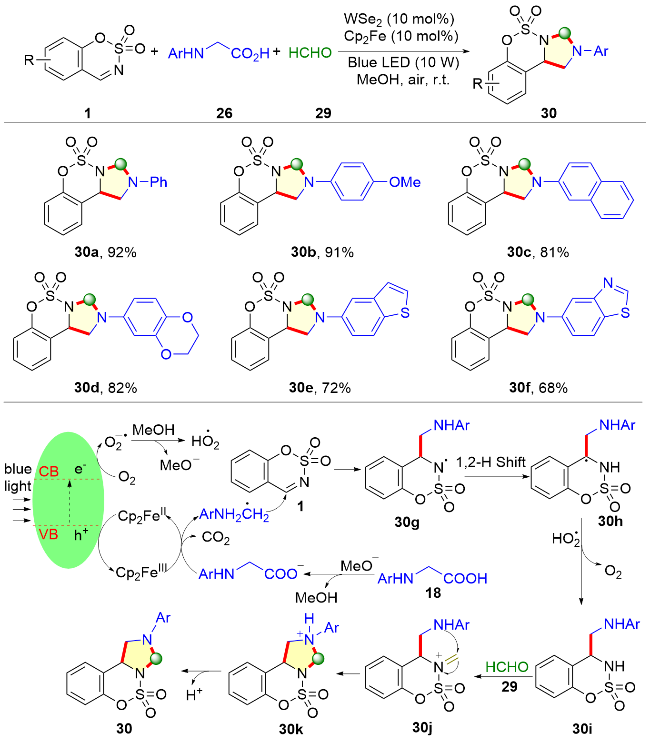
From the perspective of catalytic mechanisms, homogeneous photocatalysts typically exhibit higher activity and selectivity, while heterogeneous catalyst offers ease of separation and excellent recyclability.[31] However, from a practical standpoint, the ideal catalytic paradigm would be synergistic dual catalysis that combines the advantages of homogeneous catalysts with those of homogeneous photoreduction catalysis. To address this, a new paradigm, the semi-heterogeneous catalysis composed of heterogeneous such as titanium dioxide (TiO2), cadmium sulfide (CdS), covalent organic frameworks (COFs), g-C3N4 and homogeneous photocatalysts like metal or co-catalyst, has been regarded as a powerful and interesting tool in synthetic chemistry.[11a,32]
Inspired by these studies, in 2023, Heʼs team[33] adopted a new approach on this technology and established a synergistic dual catalysis combining polycrystalline tungsten diselenide (WSe2) semiconductor photocatalysis with homogeneous ferrocene Cp2Fe redox catalysis for cascade radical coupling/cyclization reactions of N-sulfonyl keti- mines (Scheme 15). In this redox mediated photocatalytic process, ferrocene cations were generated from ferrocene by consuming photo generated holes, thereby improving the separation of photo generated hole electron pairs in WSe2 and triggering molecular transformation. And the low-cost formaldehyde (HCHO) served as C1 synthon for the generation of iminium intermediate via Mannich reaction. This pathway was verified via deuterium labeling experiment when methanol-D4 was used as the sole solvent: no deuterated-30 was detected, ruling out the possibility of methanol as the methylene source. The target product was yielded in 93% in the model reaction of N-sulfonyl ketimines (1a), N-phenylglycine (26), and HCHO (29) using WSe2 (10 mol%) and Cp2Fe (10 mol%) in MeOH under air atmosphere and room temperature. Some control experiments were adopted to support the mechanistic hypothesis. Free radical trapping experiment and the formation of the aminomethyl radical-TEMPO adduct (detected by ESI-MS) suggested a radical pathway was involved. Furthermore, the exploration of its electron transfer pathways was verified by the quenching experiment of superoxide radicals with 1,4- benzoquinone and the photo-generated electron-hole pair with the hole scavenger sodium sulfide (Na2S) or electron scavenger (K2S2O8). The kinetic experiments further confirm this indirect catalysis mechanism, in which visible light induces charge separation in WSe2 semiconductor, producing photo generated electrons (e–) and photo generated holes (h⁺). Photo generated electrons (e–) reduces O2 (in the air) to superoxide radicals ($\mathrm{O}_{2}^{\mathrm{g}^{-}}$), which extracts hydrogen atoms from MeOH, delivering hydrogen peroxide radicals ($\mathrm{HO}_{2}^{\mathrm{g}-}$) and methanol anions (MeO–). In parallel, Cp2Fe(II) is oxidized by h⁺ to form Cp2Fe(III), which undergoes single electron oxidation of N-arylglycine anion (generated by deprotonation of 26 with MeO–), resulting in an amino- methyl radical. The aminomethyl radical selectively attacks the C=N bond of substrate 1, generating an N-center free radical 30g, which then undergoes 1,2-H migration to obtain the corresponding C-center free radical 30h. This free radical is then captured by the HO2• radical to form intermediate 30i. A Mannich reaction of intermediate 30i with HCHO occurs to obtain imine ion intermediate 30j, followed by intramolecular cyclization to form cationic intermediate 30k. Finally, the desired product 30 is obtained after dehydrogenation and aromatization of the intermediate 30k. At last, the practicality and robustness of this photocatalytic multicomponent reaction were verified in gram- scale synthesis (1.22 g, 81% yield) and WSe2 recycling experiments (5 runs). In this study, several advantages really help our protocol stood out: (1) first introduction of formaldehyde as a C1 synthon to reduce the amount of N-arylglycine from 3 equiv. to 1 equiv., resulting in better atomic and step economy; (2) in contrast to aforementioned strategy, WSe2 and ferrocene are both inexpensive and commercially available material, avoiding the lead toxicity problem of CsPbBr3 and eliminating the need for complex synthesis and optimization like OCN to achieve the combination of cost and environmental friendliness; (3) short reaction time (4 h) comparable to others; (4) a clear “semi homogeneous” catalytic cycle was established and ferrocene was used as an electron transfer medium for photocatalysis for the first time. This semi homogeneous model innovatively combines ferrocene redox mediation with low-cost and readily available polycrystalline WSe2 photocatalysis (with a lower cost than perovskite or noble metal photocatalysts, making it more suitable for industrialization), constructing an efficient, economical, and substrate- saving semi-heterogeneous photocatalytic cyclization system. It excels in catalyst stability, such as five cycles of use, scalability, and functional group tolerance, and particularly demonstrates significant advantages in reducing substrate consumption and enhancing reaction efficiency. However, issues such as the difficulty in recovering ferrocene, toxicity of formaldehyde, and dependence on light sources remain key factors limiting its green indicators. Promoting the application of this strategy in the synthesis of pharmaceutical intermediates is worth attempting.
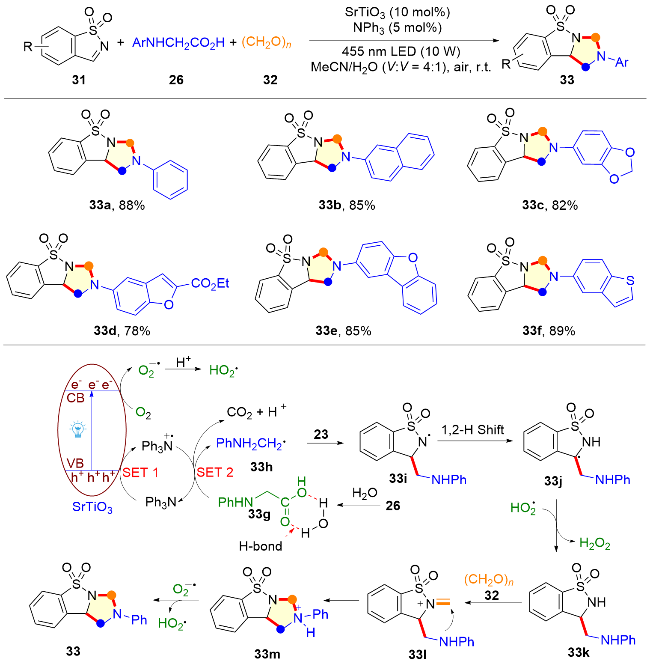
We hoped to keep going on this semi heterogeneous mode and applied strontium titanate (SrTiO3) semiconductor as a photocatalyst in organic synthesis for the first time and developed a cascade decarboxylation coupling/cycli- zation reaction of N-sulfonyl ketimines promoted by hydrogen bonding for the efficient synthesis of biologically active benzimidazole [1,5-b]isothiazole-5,5-dioxide (Scheme 16).[34] A “redox mediated” mechanism was put forward, in which SrTiO3 serves as a heterogeneous photocatalyst to absorb visible light and generates electron hole pairs. Triphenylamine NPh3 acts as a homogeneous redox catalyst, preferentially oxidized by photo generated holes to generate $\mathrm{NPh}_{3}^{+\mathrm{g}}$ radical cations, which in turn uniformly oxidize N-arylglycine to generate key α-aminomethyl radicals. This synergistic dual catalysis effectively suppresses the rapid recombination of photo generated charge carriers in SrTiO3, improving catalytic efficiency. In addition, it is found that trace amounts of water significantly reduced the oxidation potential of N-arylglycine by forming hydrogen bonds with the substrate, thereby greatly promoting the reaction. The model reaction of benzo[d]isothiazoles (31), N-phenylglycine (26), and paraformaldehyde (CH2O)ₙ (32) with open air in a mixture solvent of MeCN/H2O (V∶V=4∶1) under a 455 nm LED (10 W) gave the cyclization product in 92% yield. Various benzo[d]imidazolo[1,5-b]- isothiocyanate-5,5-dioxides can be efficiently synthesized through visible light induced cascade decarboxylation coupling/cyclization reactions, and polyformaldehyde acts as cheap and atomically economical methylene source, show- ing a wide substrate scope and excellent functional group tolerance, including alkyl groups (Me, Et, and tBu), alkoxy groups (OMe, OPh, and OCF3), sensitive thioalkyl groups (SMe and SCF3), halogens (F, Cl, Br, and I), trifluoromethyl groups (CF3), and ester groups (CO2Et). Based on the control experiments and previous literature, a plausible mechanism is put forwards. SrTiO3 absorbs blue light energy, producing h⁺ on the valence band (VB) and e– on the conduction band (CB). Then, a single electron transfer (SET) process occurs between the ground state NPh3 and h⁺, generating the $\mathrm{NPh}_{3}^{+\mathrm{g}}$ radical cations, which consequently has another SET process with complex 33g (generated in situ by intermolecular hydrogen bonding between 26 and H2O), delivering the aminomethyl radical 33h and regenerating the ground state Ph3N. At the same time, molecular oxygen (in air) is reduced by e– to form $\mathrm{O}_{2}^{\mathrm{g}^{-}}$, which combines with protons to provide hydrogen peroxide radicals (HO2•). Free radical 33h attacks the C=N bond of 31, generating nitrogen centered free radical 33i. Subsequently, 1,2-hydrogen migration leads to carbon-centered radical 33j, having hydrogen transfer with HO2• to form intermediate 33k, while releasing H2O2 (detected by H2O2 test paper). Subsequently, intermediate 33k undergoes Mannich reaction with polyformaldehyde 32 to obtain imine ion intermediate 33l, followed by intramolecular cyclization to form cationic intermediate 33m, which is then dehydro- aromatized to obtain cyclization product 33. This study systematically elucidated for the first time the hydrogen bonding promoting effect, which enhances reaction efficiency by reducing substrate oxidation potential, and continues the strategy of using inexpensive formaldehyde as a C1 synthon for substrate economy, achieving an excellent balance among catalytic efficiency, cost, safety, and sustainability. Based on the combination of non-toxic/inex- pensive SrTiO3 semiconductor photocatalysis, NPh3 redox catalysis, and hydrogen bonding promotion, an efficient, green, and widely applicable cyclization reaction system was established. It excels in catalyst stability (recyclable for at least 5 times, with the use of cheaper NPh3), scalability, functional group tolerance, and low cost. Especially, it expands the substrate scope, covering a variety of heterocycles and functional groups. However, issues such as low quantum efficiency still pose as key constraints for its practical application. Future research could aim to advance this system towards a more efficient, sustainable, and sca- lable photocatalytic synthesis platform.
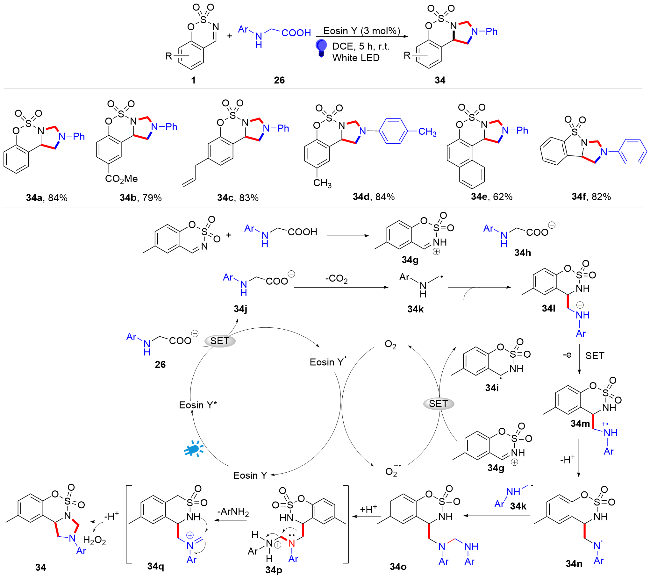
Apart from the heterogeneous and synergistic dual catalysis, Yu et al.[35] also reported a visible-light-induced, metal-free homogeneous cyclization reaction between cyclic N-sulfonyl ketimines and N-aryl glycine by employing 3 mol% eosin Y as a photocatalyst at room temperature, delivering a selection of N-sulfonamide-fused imidazolines in moderate to high yields (32 examples, 27%~86% yields) (Scheme 17). This catalytic system can be compatible with a wide range of substrates modified with various functional groups (Me, OMe, F, Cl, Br, and CF3) attached at the para- position of the benzene ring and naphtho[1,2-e][1,2,3]-oxa- thiazine 3,3-dioxide. The homogeneous photocatalytic system features metal-free and mild reaction conditions, broad substrate scope (32 cases), and easy scale-up (4 mmol, 1.03 g, 72% yield). Moreover, this reaction mechanism was proved with radical trapping experiments, and this vital role of O2 was confirmed with N2 atmosphere and 1,4-benzoquinone (BQ) as a superoxide radical ($\mathrm{O}_{2}^{\mathrm{g}^{-}}$) inhibitor. Based on the above results and observation, a proposed mechanism is established. Benzoyl oxathiazine-2,2- dioxide 1 reacts with N-aryl glycine to form an amino cation 34g and a carboxylate anion 34h. Subsequently, eosin Y absorbs visible light energy to form an excited state (eosin Y*), which further oxidizes the carboxylate anion 34h via a one-electron transfer process, yielding a carboxylate radical 34j and eosin Y•-. Simultaneously, a one-electron transfer occurs between O2 and eosin Y•-, yielding a superoxide anion radical ($\mathrm{O}_{2}^{\mathrm{g}^{-}}$) and regenerating eosin Y. Subsequent- ly, a one-electron transfer process between $\mathrm{O}_{2}^{\mathrm{g}^{-}}$ and cation 34g results in an alkyl radical 34i. An aminomethyl radical 34k is formed via the decarboxylation of intermediate 34j, subsequently coupling with radical 34i to yield another intermediate 34l. This intermediate 34l is further oxidized to obtain cationic radical 34m which undergoes proton transfer to generate radical 34n. The intermediate 34o is formed after coupling with radical 34k. The protonation of intermediate 34o (detected by ESI-MS) produces intermediate 34p, which subsequently loses one molecule of aniline to form cation 34q. Finally, intermediate 34q undergoes de- protonation and an electrophilic addition reaction to yield the final target product 34, simultaneously producing byproduct H2O2. Regarding future research prospects for this methodology, from a green chemistry perspective, transforming batch reactions into continuous-flow processes in microreactors could enable safer, more efficient, and easily scalable synthetic production, maybe further advance its industrial application. Alternatively, exploring the use of water or more environmentally benign solvents as reaction media could further enhance the sustainability and practicality of the process. Furthermore, the author may apply this reaction to the late-stage modification or the total synthesis of complex natural products or drug molecules to validate its practical application potential. At last, developing recyclable Eosin Y photocatalysts by integrating Eosin Y into polymer or inorganic carriers may be another future direction. Compared to the above-mentioned heterogeneous semiconductor and semi-heterogeneous synergistic catalysis, homogeneous organic dyes exhibit high catalytic activity in a homogeneous environment. However, they also face numerous challenges, such as general photostability, susceptibility to bleaching, difficulty in recovery, catalyst residue, and complex post-treatment processes.
Compared with traditional organic synthesis, organic electrochemical synthesis[36] has emerged as an indispensable and powerful platform in organic synthesis due to the advantages of mild condition, low pollution, and high atom economy which aligns well with green chemistry principles, and thereby avoiding excessive dependence or the use of dangerous or toxic oxidants and reducing agents by using clean electrons as green redox agents. In addition, thanks to its neutral conditions and precisely controlled current and potential, organic conversion under electrochemical conditions has received widespread attention from researchers in academia and industry. Based on the continuing study of electrochemical chemistry, in 2023, He and colleagues[37] disclosed an ethanol-catalyzed electrochemical multi-com- ponent synthesis method. Using formaldehyde as an atom- economic carbonyl synthon, they prepared a variety of imidazolidine-fused sulfamidates with good to excellent yields (27 examples, 71%~88% yields). This approach is characterized by green merits, mild conditions, and an oxidant-free system (Scheme 18). The model reaction involving N-sulfonyl ketimines, N-arylglycines and formaldehyde (HCHO) was carried out in an electrolytic cell Pt(+)/Pt(–) electrode pairs. With Et4NI (30 mol%) as the electrolyte, ethanol as the solvent, and a constant current of 5 mA, this reaction yielded the target product in 88% yield. An array of useful functional groups was compatible with this ethanol facilitated three-component reaction, such as electron rich groups (Me, OMe, OCF3), electron deficient groups (halogens, CO2Me), steric hindrance group (Me, OMe,), and even alkenyl and SMe could survive in this condition. Mechanistic studies have shown that ethanol salts generated in situ played a crucial role in generating aminomethyl radicals at lower voltages. Besides, the radical trapping experiment supported the participation of free radicals, therefore a radical mechanism was established. Initially, ethanol is reduced to ethanolic anion (EtO–) and molecular hydrogen on the Pt cathode. N-Phenylglycine (26) is deprotonated by EtO– to form carboxylate ions (35g), which undergoes anodic oxidation to generate oxygen-centered carboxyl radicals (35h), followed by decarboxylation to form aminomethyl radicals (35i) and carbon dioxide (CO2). Free radical 35i attacks the C(4) site of N- sulfonyl ketimines (1a), giving a nitrogen-centered free radical (35j). 1,2-H migration generates a carbon centered free radical 35k, which then grabs a hydrogen from 26 to generate compound 35l. Subsequently, the Mannich reaction of 35l with HCHO leads to iminium ion intermediate 35m, whose intramolecular cyclization gives rise to intermediate 35n. With the assistance of EtO–, 35 is provided, followed by protonation to regenerate EtOH for the next catalytic cycle. This novel and green electrochemical multi-component synthesis strategy utilizes ethanol as both a solvent and a catalyst, eliminating the need for toxic or volatile organic solvents. Abundant and low-cost formaldehyde, as a highly atom-economic C1 synthons, is preferred. Under mild conditions without external oxidants or metal catalysts, it achieves the efficient construction of imidazolidine-fused sulfamidates. This work clearly de- monstrates the potential of electrochemical synthesis in organic synthesis, with a clear green chemistry orientation. The wide applicability of the reaction is reflected in its insensitivity to the electronic and steric effects of N-sul- fonyl ketimines and N-aryl glycine, showing compatibility with a wide range of functional groups, but not involving strong electron-withdrawing groups (such as nitro, cyano) or sensitive groups (such as silyl ethers). Furthermore, although the yield remains at 81% in gram-scale experiments, indicating potential for scaling up, the challenge of this catalytic paradigm lies in the actual industrial amplification, specifically the excessive oxidation of ethanol (during long- term reactions or amplification processes). Future development should focus on promoting the reaction towards continuous flow and large-scale development, as well as expanding to more challenging syntheses of bioactive mole- cules.
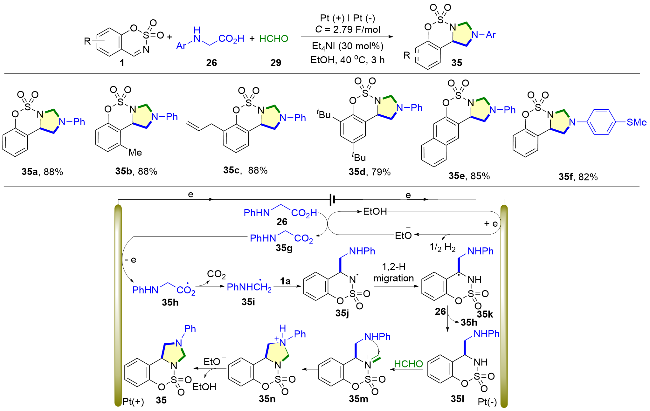
Greatly encouraged by these satisfying results, He et al.[38] further expanded the electrocatalytic strategy to ben- zo[d]isothiazole 1,1-dioxides via an electrochemical [2+ 2+1] cyclization reaction of benzo[d] isothiocyanate 1,1- dioxide, N-arylglycine, and polyformaldehyde promoted by hydrogen bonding under redox mediator, catalyst and electrolyte-free conditions (Scheme 19). Various derivatives of benzo[d]imidazolo[1,5-b]isothiazole 5,5-dioxide were synthesized in moderate to high yields (22 examples, 71%~92% yields). Moreover, a set of valuable functional- groups, such as alkyl (Me, iPr and tBu), alkoxy (OMe and OCF3), methylthio (SMe), trifluomethylthio (SCF3) and halogen (F, Cl, Br and I) were suitable with this electrocatalytic three-component reaction, demonstrating the excellent functional group tolerance. The practicality and robustness of electrolyte-free electrochemical annulation reaction were validated in the gram-scale synthesis (1.03 g, 71% yield). Observation results based on control experiments support the involvement of radicals in the reaction, and a mechanism of the free radical hypothesis is established. At the beginning, the hydrogen bonding between 26 and water leads to the formation of complex 36h, which is reduced to carboxylate anion (36i), water, and hydrogen on the platinum cathode surface. On the surface of graphite anode, intermediate 36i is oxidized to offer oxygen-cen- tered carboxyl radical 36j, followed by decarboxylation to form carbon-centered aminomethyl radical 36k. Afterwards, the radical 36k selectively attacks the benzo[d]- isothiocyanate 1,1-dioxide 31, generating the nitrogen- centered radical 36l, which takes a H atom from 26 to obtain the intermediate 36m (detected by ESI-MS). A Mannich reaction of the intermediate 36m with polyoxymethylene (CH₂O)ₙ provides the intermediate 36n. The final product is obtained after the intramolecular cyclization and dehydrogenation with the assistance of 36i. The significant advantages of this strategy are reflected in simplifying the reaction system, reducing costs, and improving atomic economy, for example, without requirements of supporting electrolyte, external catalyst, or redox mediator, which is in line with the essence of green chemistry. Especially, it exhibits remarkable innovation in the hydrogen bond-pro- moted electron transfer mechanism and the use of paraformaldehyde as a green methylene source. The hydrogen bond complex composed of H2O and N-aryl glycine, significantly reducing its oxidation potential, and thus achie- ving efficient conversion at lower voltages. It exhibits good tolerance towards various substituents of N-aryl glycine and substrates (including halogens, trifluoromethyl, alkoxy, sulfides), which helps expand the applicability of this system to other heterocyclic molecules, bioactive compounds, and natural product derivatives. The challenge of this system lies in moving from the laboratory to industrialization, such as the true stability of the electrolyte-free system, scaling up, and expansion of the functional group applicability.
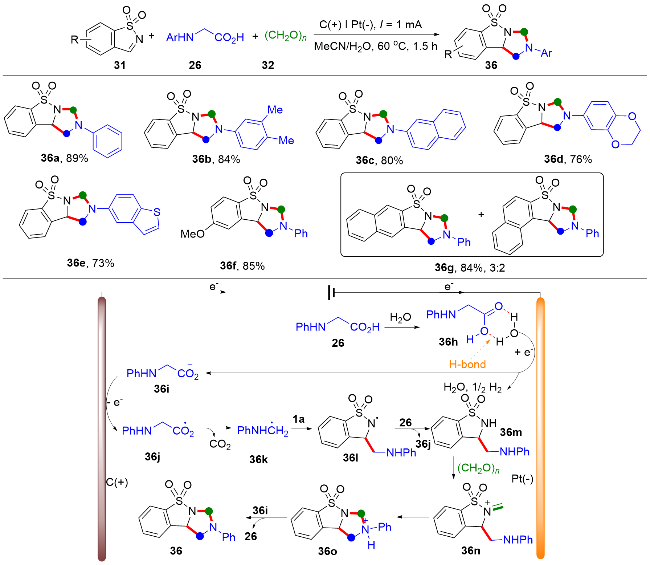
Recently, Luo and colleagues[39] reported a green and efficient electrochemical synthesis strategy that achieves two selective transformations of N-sulfonyl ketimines and N-aryl glycinates by simply switching the reaction solvent. In the MeCN/H2O (V∶V=4∶1) mixed solvent system, the reaction tends to undergo decarboxylation cyclization, efficiently constructing imidazolidine sulfonamide acid ester heterocyclic skeletons. When pure water is used as the solvent, the reaction pathway shifts to hydrogen amino- methylation, generating aminomethylated N-sulfonyl keti- mines products (Scheme 20). This method is mild in conditions, using only electrons as redox reagents, without the need for external chemical oxidants or metal catalysts. Systematic condition optimization indicates that tetrabutylammonium perchlorate (Bu4NclO4) is the optimal electrolyte, and the combination of a graphite plate anode and a platinum plate (or nickel plate) cathode performs well. Substrate scope investigation demonstrates that the reaction exhibits good functional group tolerance towards N-sul- fonyl ketimines and N-aryl glycinates bearing various electron-donating groups, halogens, and other substituents, achieving moderate to excellent yields (up to 87% for cyclization products). Gram-scale amplification experiment suggests that the reaction was scaled up proportionally. When the current was increased to 40 mA and the reaction time was extended to 24 h, the cyclization product was successfully obtained with a yield of 71%. Mechanism studies, confirmed by radical trapping experiments and cyclic voltammetry, reveal that the reaction involves a key aminomethylene radical intermediate generated through anodic oxidation and decarboxylation of N-aryl glycinates. Based on the above evidence, the author proposed a reasonable reaction mechanism: glycine undergoes anodic oxidation and decarboxylation to generate aminomethylene radical 37e, which attacks the C=N bond of N-sulfonyl ketimines to obtain nitrogen-centered radical 37f. In pure water, 37f undergoes cathodic reduction and protonation to yield hydrogen aminomethylation product 38. In MeCN/ H2O, excess radical 37e undergoes secondary oxidation to decompose formaldehyde, which condenses with 38 to form iminium ion 37g, and ultimately undergoes intramolecular nucleophilic addition and deprotonation to yield the cyclization product 37. This study achieved selective regulation of cyclization and hydrogen aminomethylation under electrochemical conditions through an ingenious “solvent switch” strategy (MeCN/H2O→cyclization product; pure H2O→hydrogen aminomethylation product), without the need to replace catalysts, electrodes, or redox mediators. It exhibits significant innovation in methodological design, characterized by simplicity of conditions, tunable selectivity, and environmental friendliness, in line with the concept of green synthesis. The presence of useful functional groups including halogen, alkyl, alkoxy, and alkenyl groups demonstrates the mild and neutral characteristics of this catalytic system. The gram-scale experiment shows certain potential for scaling up, but there is a significant loss of efficiency during the scaling process. It still has significant limitations in terms of stability, scaling process, and tolerance to strong electron-withdrawing groups. Future directions could include in-depth mechanistic studies of solvent effects, expanding the substrate range to more challenging bioactive molecules, and promoting the reaction towards continuous flow and large-scale preparation.
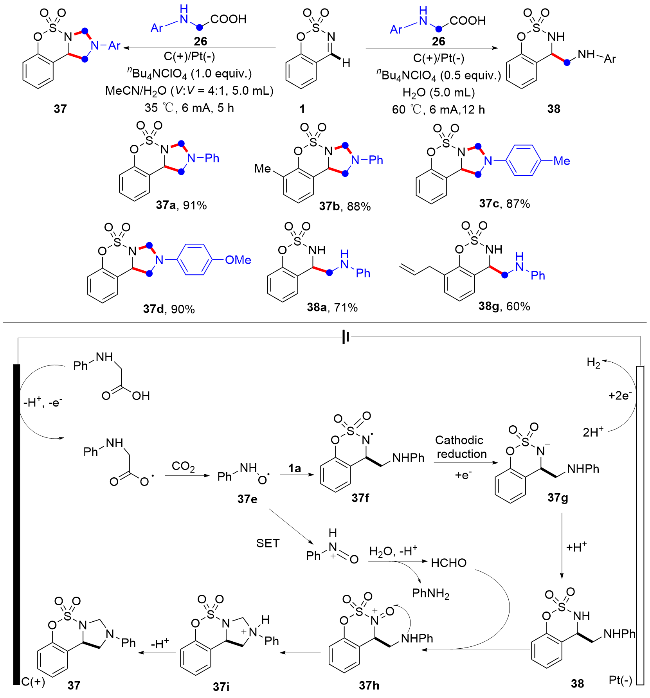
The catalytic asymmetric annulation of N-sulfonyl keti- mines is also of great significance to construct the nitrogen- containing heterocycles with bioactivity and anti-cancer activity, apart from being chiral adjuvants, ligands and catalysts. In 2023, Kim and coworkers[40] declared a organocatalytic asymmetric [3+2] cyclization reaction between γ-sulfonamide-α,β-unsaturated ketones and cyclic N-sulfonyl-imides, resulting in enantiomerically enriched functionalized polycyclic imidazolidines with good yield and excellent enantioselectivity (23 examples, up to>30∶1 dr and 95% ee) (Scheme 21). This method has also been extended to the asymmetric [3+2] cyclization reaction of γ-hydroxy-α,β-unsaturated ketones, resulting in enantiomerically enriched polyheterocyclic tricyclic oxazolidine (21 examples, up to 79% ee). First of all, the authors first reevaluated the base-catalyzed racemic [3+2] cyclization, achieving high diastereoselectivity (dr>30∶1) and good yields (77%~99%) for imidazolidine and oxazolidine synthesis using Cs2CO3 in tetrahydrofuran (THF). This condition is universal for various substrates to obtain the target product with good yield and excellent diastereoselectivity. For the reaction of γ-hydroxy-α,β-unsaturated ketones with cyclic N-sulfonyl ketimines, using triethylamine Et3N as the base and dichloromethane CH2Cl2 as the solvent, the yield of oxazolidine product reached 92%, with excellent diastereoselectivity. Afterwards, systematic screening of various chiral bifunctional thiourea and amide catalysts revealed that quinine-derived amide catalyst acted optimally in CH2Cl2, delivering up to 95% enantiomeric selectivity (ee) and >30∶1 dr. Moreover, the author conducted a very detailed examination of the compatibility of functional groups, suggesting this [3+2] cyclization reaction was insensitive to electronic effects on aromatic rings and has good compatibility with heteroaromatic rings, such as halogen, methyl, methoxy, furan, thienyl and different N-protecting groups (Ts, Bs, Ns), enabling the synthesis of complex molecules with diverse structures and providing a powerful tool for rapidly constructing chiral multi heterocyclic compound libraries with diverse structures. The universality and practicality of this base-cata- lyzed [3+2]-annulations of γ-hydroxy-α,β-unsaturated ketones and cyclic N-sulfonyl ketimines were determined in a 1 mmol scale reaction and later stage derivatization reaction. X-ray crystallography confirmed the absolute configurations of products 41 and 42 as (3R,10bR) and (3S,10bR), respectively, on the basis of which two possible mechanisms were put forward. The amide catalyst activates the enone via hydrogen bonding, promoting nucleophilic addition of the nitrogen anion to the N-sulfonyl ketimines, followed by an intramolecular aza-Michael addition, ultimately leading to ring closure and formation of the target product. This efficient and highly selective chiral square amide catalyzed asymmetric [3+2] cyclization reaction provides a powerful tool for the synthesis of chiral imidazolidine and oxazolidine heterocycles. It exhibits significant advantages in stereo-control, substrate scope, and reaction conditions. The reaction proceeds at room temperature without the need for metal catalysts or strong oxidants, making it easy to operate and in line with the concept of green synthesis. It covers a wide range of heteroaryl (furan, thiophene), showing good functional group tolerance (halogen, alkoxy, trifluoromethyl, etc.). Even at a 1 mmol scale, the reaction maintained high yield and high stereoselectivity (89% ee, 13∶1 dr), preliminarily demonstrating potential for scaling up. However, there is still room for improvement in terms of catalyst cost and stability, solvent greenness, applicability to aliphatic substrates, and practical application potential.
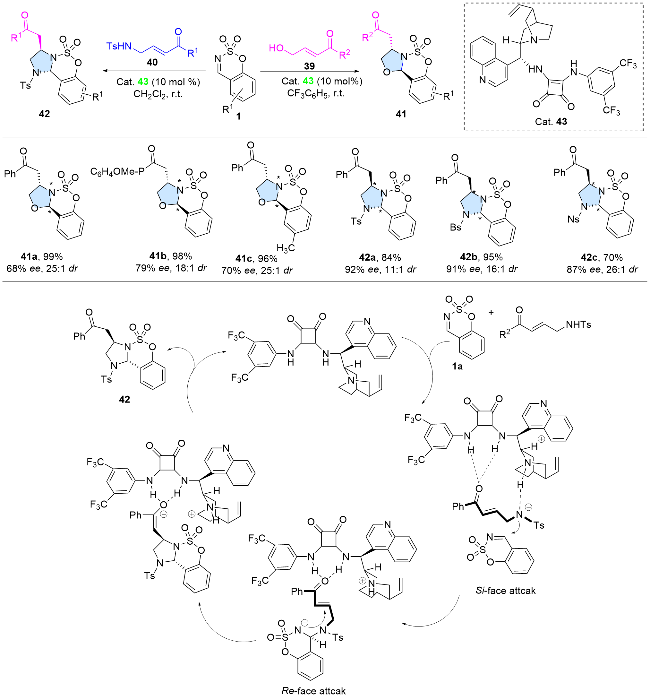
4 Amination
Amines are one of the most important structural motifs and synthetic intermediates in natural compounds, small molecule drugs, and organic synthetic chemistry. Besides, amines are widely present in in nature and biological systems, such as proteins, nucleic acids, many hormones, antibiotics, and alkaloids, exhibiting extremely important physiological and biological activities. Therefore, incorporating amino into biologically active molecules is beneficial for the diversity of drug-like molecule and the later modification of drug molecules. From a clinical perspective, it can improve the absorption and metabolism of drugs in organisms.
In 2021, Liu and coworker[41] presented the first example of the visible light driven C—H amination of benzoxathiazine-2,2-dioxides with aliphatic amines by exploiting com- mercially available and low-cost organic dye Eosin Y as photosensitizer through photocatalytic C—N formation under transition-metal-free and mild conditions (Scheme 22). The model reaction was stimulated by white light illumination and proceeded smoothly under air atmosphere in DMSO in the presence of 1,4-diazabicyclo[2.2.2]octane (DABCO, 2 equiv.) as an alkaline additive. This protocol afforded a plethora of aminated-sulfonylated imines (28 examples, 38%~95% yields), displaying a broad substrate scope applicability and good functional group compatibility, including methyl, methoxy, ethyl, tert-butyl, phenyl, chlorine. This method does not require precious metal catalysts or stoichiometric oxidants, showing excellent atomic and step economy. Various fatty amines such as morpholine, thiomorpholine and its dioxide, piperidine and piperazine derivatives can smoothly participate in the reaction to furnish the target amination product with moderate to excellent yields. The practical value and generality of this Eosin Y catalyzed amination strategy were validated successfully with gram scale synthesis and later functionalization of the antihistamine drug desloratadine. When the reaction was completely inhibited by the radical scavenger TEMPO, a radical route was put forwards and the yield sharply decreased under a nitrogen atmosphere, confirming that the reaction involved free radical pathways and oxygen in the air was crucial. Based on experimental observations, a reasonable mechanism cycle was established. Under light illumination, Eosin Y is stimulated to excited state Eosin Y*, and then it oxidizes amines through single electron transfer, generating amine radical cations 45g, whose hydrogen is scavenged by superoxide anions to form a key nitrogen-centered radical 45h. The nucleophilic addition of this free radical 45h to N-sulfonyl ketimines gives the resulting intermediate 45i, which is then oxidized to generate a cation intermediate 45j. Subsequent deprotonation of 45j yields the final aminated product 45, thereby closing the photocatalytic cycle. For the first time, this work addressed the challenge of direct C—H amination of N-sulfonyl ketimines, offering efficient new pathway for the synthesis of such amine compounds, enriching the methodological toolbox for metal free photocatalytic C—N bond construction and demonstrating potential application in drug development and fine chemical synthesis. The attractiveness of this seemingly “green” solution is overshadowed by the inherent drawbacks of organic dyes, that is, in homogeneous catalysis, organic dyes have poor photostability and are prone to photobleaching and decomposition during the photocatalytic process and it is usually used in high quantities. Besides, the photocatalytic system efficacy and diversity were retarded by the narrow scope of amines, making them only suitable for cyclic aliphatic amines (such as morpholine, piperidine, and piperazine derivatives), and not applicable to acyclic amines and aromatic amines, limiting their use in the synthesis of complex amine molecules. Future development prospects seem to utilize microfluidic or continuous flow reactors, which could enhance light efficiency, mass transfer, and reaction controllability, propelling it towards industrialization. Maybe, asymmetric catalytic version-enantioselective C—H amination could be achieved by combining chiral photocatalysts or chiral additives.
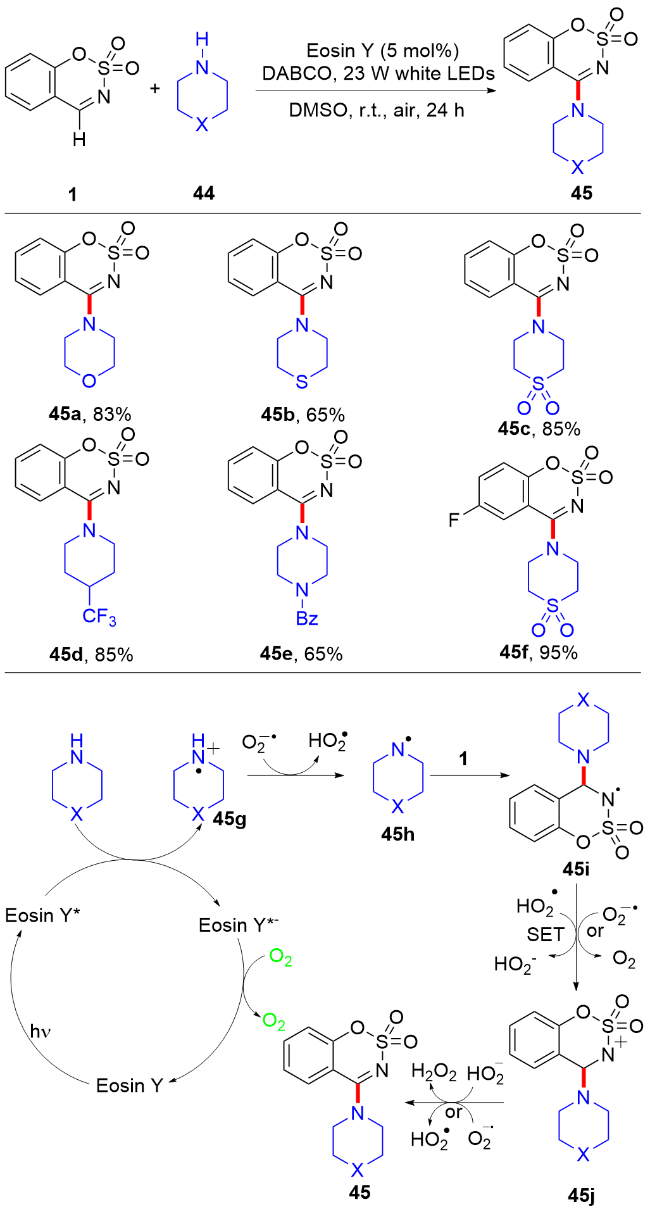
To overcome these issues, in 2022, Guo and collea- gues[42] developed a green-oriented and efficient electrochemical synthesis strategy via a coupling of cyclic N- sulfonyl ketimines with a range of amines in a diaphragm free electrolytic cell, providing a new approach for constructing N-sulfonamide compounds with important biological activities (Scheme 23). This coupling reaction employed current as a green oxidant instead of stoichiometric metal or oxidants, thereby reducing chemical waste from the source. The model reaction afforded a 78% yield in an undivided cell equipped with two platinum electrodes (15 mm×10 mm×0.2 mm for each electrode) at 27 °C and a constant current of 3 mA. The reaction was performed in CH3CN (3 mL) with potassium iodide (KI, 20 mol%) serving as the redox mediator, without the addition of extra supporting electrolytes. In addition to the advantages of reaction conditions, the most prominent feature of this electrochemical amination strategy is its extremely wide substrate applicability, compared to the mentioned-above photocatalytic reaction, and this amination system successfully expands the amine scope from fatty amine to various amines like various ortho-, meta-, and para- substituted anilines with electron donating or electron withdrawing substituents (such as methyl, ester, halogen, trifluoromethyl, nitro), delivering the target product in moderate to good yields (13 examples, 45%~78% yields). Additionally, the excellent compatibility was further demonstrated with cyclic and chain fatty secondary amines, for example, morpholine, piperidine, piperazine, thiomorpholine and their dioxide compounds, as well as cyclic amines with four to seven membered rings, and even spirocyclic amines with complex structures could participate in the reaction smoothly (38 examples, 24% to 99% yields), demonstrating their excellent functional group tolerance. At last, the versatility and practicability were evidenced by the scale-up experiment (1.81 g, 66% yield). Moreover, successful post-functionalization was achieved on a wide range of structurally complex drug molecules or natural products, including antidepressant amoxapine, typical antipsychotics risperidone, perospirone, anxiolytic agent, antidiabetic drug sitagliptin, buspirone, natural alkaloid nortropine and the breast and prostate drug aminoglutethimide, along with the utilization of amino acid derivatives. In view of results of control experiments (radical trapping, kinetic isotope effect (KIE) experiment, cyclic voltammetry analysis), a reasonable mechanism is proposed. Iodine molecules generated by anodic oxidation of iodine ions react with amines to form N-I intermediates 47h, whose cleavage yields nitrogen- centered free radicals 47i. Then, the intermediate 47i adds to the N-sulfonyl ketimines to produce N-centered radical 47j. A 1,2-H-shift process leads to the formation of C- centered radical 47k, which is further oxidized at the anode to cation intermediate 47l. Finally, the aminated product 47 is present after deprotonation while hydrogen gas is released at the cathode. To conclude, this work develops an environmentally friendly, low-cost, and sustainable electrochemical synthesis method. A mild condition, simple operation, unparalleled substrate broad-spectrum, excellent functional group compatibility, and successful application in complex molecular post modification mark important progress in green construction of C—N bonds and synthesis of high-value sulfonamide compounds. Compared to the previous photocatalytic systems, electrochemical methods eliminate the need for photocatalysts and illumination, thus avoiding the photodegradation issues associated with photocatalysts. Additionally, they do not require the addition of external chemical oxidants, making the reaction conditions simpler and more controllable. KI, as a cheap and stable inorganic salt, outperforms organic photocatalysts (such as eosin Y) in terms of cost, recyclability and stability, offering significant advantages in substrate investigation. In particular, it has successfully achieved the coupling of primary aniline and non-cyclic secondary amines, as well as the later amination of drug molecules (such as loratadine, tosilpate, sitagliptin, etc.), while photocatalytic methods are only suitable for cyclic secondary amines. In scaled-up reactions, the use of continuous-flow electrochemical reactors appears to be a reasonable and promising solution. Furthermore, based on these two methods, developing a photoelectrochemical synergistic strategy also seems to be a good choice for constructing C—N bonds.
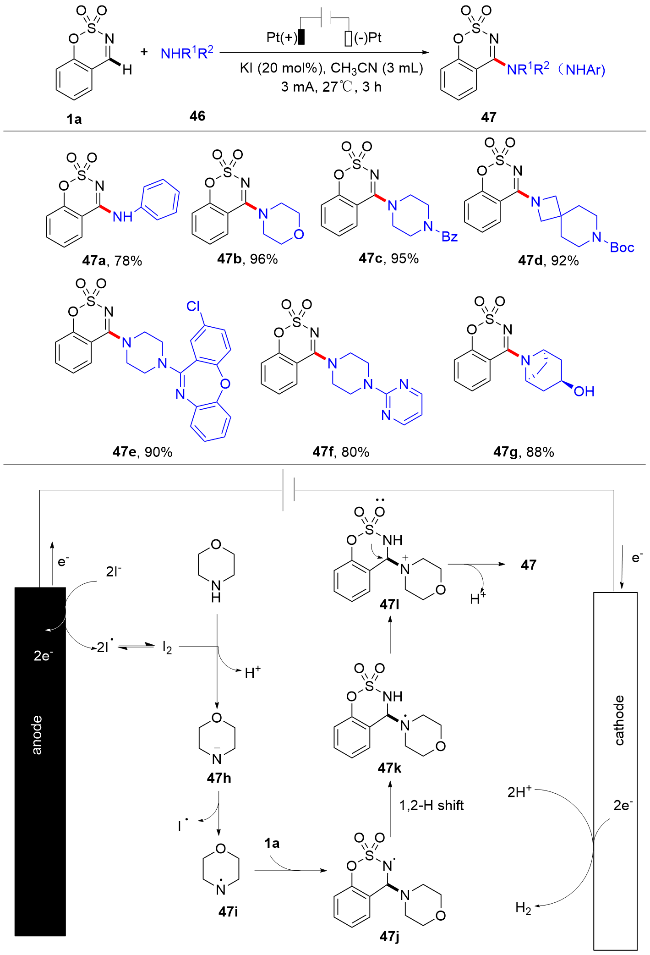
5 Acylation
The amide bond is one of the most fundamental and important chemical bonds in nature and pharmaceutical molecules, for example, amide bonds can bridge amino acids to form proteins. Moreover, the amide bond often participates in critical hydrogen bonding interactions with biological targets, such as enzymes and receptors, and is the key factor determining drug activity and selectivity to some extent. Thereby, the efficient formation or construction of amide structure has been a hot research spot in organic synthesis and drug design.
In 2025, Yu et al.[43] described a photocatalytic aminoacylation reaction of N-sulfonyl ketimines via heterogeneous potassium doped graphitic carbon nitride (K-CN) by using stable and non-toxic grass amino acid as the source of amide fragments, which is more advantageous than traditional methods such as using active toxic, and unstable acyl chlorides or anhydrides (Scheme 24). This study avoids stoichiometric coupling agents and generation of a large amount of waste in traditional amide bond synthesis, providing a novel and sustainable strategy, in line with the principles of green chemistry. First, potassium modified g-C3N₄ materials (K-CN) was prepared by the author via calcination, and systematical characterization revealed an enhanced visible light absorption ability (absorption edge red shifted to 480 nm), and a significantly suppressed photo generated electron hole pair recombination behavior promoted the photoelectric properties and catalytic activity of the composite photocatalyst in contrast to the single component, and the composite catalyst has smaller particle size and more uniform morphology. This improved photocatalytic performance stemmed from the changed crystal structure and electronic band structure of the K-CN material, which was altered by successful introduction of K and replacement of hydrogen atoms in the amino group, which was confirmed by XPS and XRD analysis. Thus, under optimized reaction conditions (K-CN-6 as a catalyst, Bi-OAc as oxidants, DCM as a solvent, blue light irradiation), the model reaction of N-sulfonyl ketimines with oxamine derivatives ran smoothly to give the target compound in 83% yield. A wide range of aminoacylation compounds were furnished in moderate to excellent yields (17 examples, 40%~86% yields), showing good functional group compatibility including electron-neutral (olefin), electron withdrawing (F, Cl, Br, CO2Me) or electron donating substituents (OMe), bifunctional substituents, and different N-substituted oxanthine. Mechanistic studies such as radical trapping experiment, electron transfer test, N2 atmosphere and superoxide radical anion inhibition confirmed the crucial roles of photo generated electrons, holes, oxygen, and superoxide radicals in the reaction and supported the free radical theory proposed by the author. Firstly, upon the light illumination, electron-hole pairs are generated and migrate to the surface. Parallelly, intermediate 49g is generated by the reaction between oxamic acids 48 and Bi-OAc, which further reduces with electron to deliver the radical anion 49h, followed by decarboxylation to yield the carbamoyl radical 49i while O2 is reduced to superoxide radical ($\mathrm{O}_{2}^{\mathrm{g}^{-}}$). The addition of the carbamoyl radical 49i to substrate 1 leads to the formation of the N-centered radical 49j, whose 1,2-H-shift procedure results in radical 49k. The oxidation of radical 49k with hole in a single electron transfer event furnish intermediate 49l. At last, the final compound 49 is yielded after a hydrogen atom transfer (HAT) with the superoxide radical anion. The successful heterogeneous aminoacylation reaction of heterocycles with g-C3N4 provides new ideas for the development of efficient and environmentally friendly synthesis methods. However, from the perspective of synthetic chemistry, it has major drawbacks such as poor catalyst stability, limited substrate range (highly sensitive to the steric hindrance of amines (such as adamantane) and electronic effects), and stoichiometric oxidants (1.5 equiv. of Bi-OAc). These drawbacks limit the direct application potential of this method in industrial synthesis.
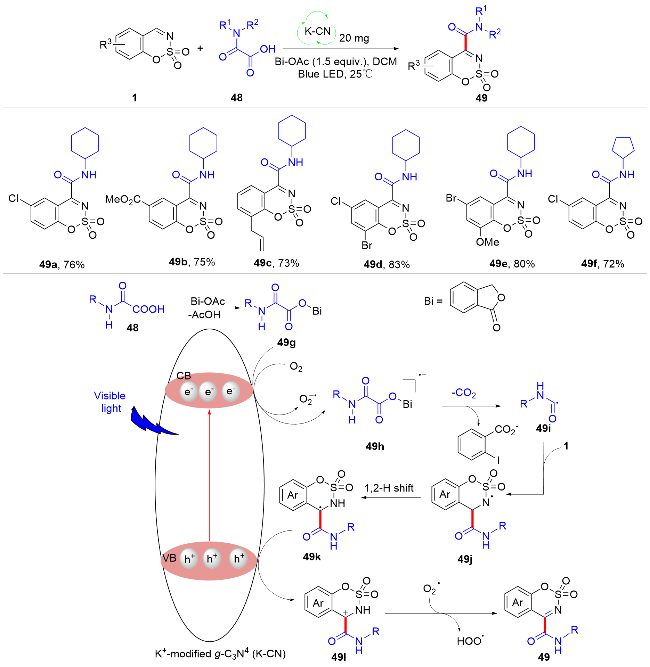
6 Ring-opening
Hydroxy Schiff bases have attracted much attention due to their extensive biological activity, important applications in coordination chemistry, catalysis, drug design, and optical materials. Traditional synthesis methods typically rely on the condensation reaction of salicylaldehyde with primary amines, often involving reflux conditions. Except from being drug skeleton, N-sulfonyl ketimines as a class of multifunctional synthons have shown potential in various transformations in recent years. In 2022, Cao and co- workers[44] documented a green, efficient, and catalyst-free ring opening reaction of N-sulfonyl ketimines for the synthesis of ortho hydroxy Schiff bases under mild reaction conditions (Scheme 25). This method does not require any metal or organic catalysts, avoiding the contamination of products by catalyst residues (especially in pharmaceutical chemistry and materials science), simplifying the post- treatment process, and reducing costs and environmental burdens. In addition, this condition is widely applicable to a range of substrates, including N-sulfonyl ketimines altered with electron rich group (Me, Et, MeO), electron deficient group (F, Cl, Br, CO2Me) and steric hindrance group (tBu, naphthalene) and various aliphatic primary amines, such as heterocyclic (furan, thiophene) amines, and cyclic amines (cyclohexylamine), efficiently constructing hydroxy Schiff bases in 80%~99% yields, displaying good substrate universality. The high synthetic value and potential application prospect were proved with the gram scale reaction (90% yield) and successfully expansion to methylhydrazine (99% yield), suggesting good synthetic practicality and potential for the later modification of drug molecules. A reasonable hypothesis is proposed. The nucleophilic addition of primary amine to N-sulfonyl ketimines gives intermediate 51g, followed by intramolecular C—N bond cleavage to form 51h, and ultimately the sulfonyl imine group is removed to obtain the target Schiff base 51. Overall, this protocol features mild conditions (40 ℃), excellent yields (80%~99%), good functional group tolerance, and potential for gram-scale preparation and subsequent derivatization applications. It represents a concise and efficient catalyst-free ring-opening strategy. However, the primary amines tested were mainly simple alkylamines or heterocycle-containing alkylamines, with aromatic amines not included in the study. For this protocol, it’s better to explore the applicability of this reaction to aromatic amines, and secondary amines to enrich the product library. Substrates with strongly hindered or strongly coordinating functional groups, such as ortho-substituted aromatic amines and polyamino compounds, were also not involved, limiting the versatility of this method. The impact of the reaction on hydroxyl, carboxyl, halogen, borate, olefin, and other groups, which are commonly found in complex molecular modifications, has not been systematically studied. Obviously, future development efforts should focus on expanding the diversity of substrate structures, such as post-modi- fication of aromatic amines and bioactive molecular fragments, to demonstrate the synthetic value.
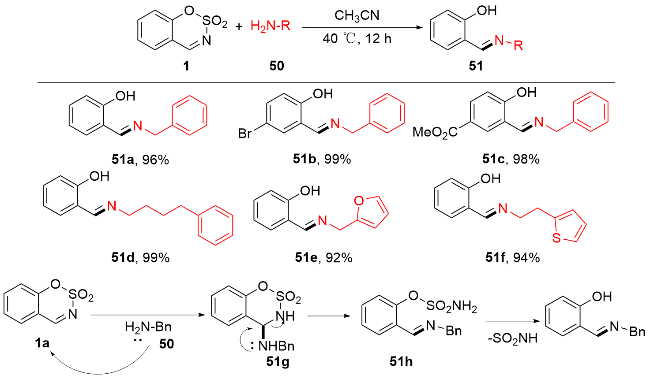
As a significant class of nitrogen-containing heterocycles widely found in natural products, pharmaceutical molecules, and functional materials, conventional synthetic approaches of 2-amino-3-cyanopyridines are governed by harsh conditions, low substrate and functional group compatibility. In the same year, Samanta team[45] innovatively narrated a Cu(OAc)2/DABCO co-catalyzed domino reaction with N-sulfonyl ketimines as 1C1N synthons and vinyl malononitrile as the 4C synthon and constructed a diversity of bioactive 6-hydroxyaryl-2-aminonicotinic acid derivatives in an efficient, atom- and step-economic manner (Scheme 26). After systematic screening of reaction parameters such as catalysts, bases, and solvents, this vinyl Mannich/cycloaromatization ran smoothly under optimal conditions [Cu(OAc)2 (10 mol%) as catalyst, DABCO (1.5 equiv.) as base, acetonitrile as solvent, and at room temperature]. It’s found that a sequence of N-sulfonyl ketimines and vinyl malononitriles participated well in the cascade reaction. N-Sulfonyl ketimines bearing electron-donating (Me, MeO) or electron-withdrawing groups (Cl) on the aromatic ring are compatible. Furthermore, vinylmalononitriles also exhibit excellent substrate generality, including aryl, heteroaryl, aliphatic, or highly sterically hindered cyclic/fused ring derivatives, enabling successful synthesis of complex 6-hydroxyaryl-2-aminonicotinic acid derivatives in good to excellent yields (61%~86%). In gram- scale synthesis and subsequent derivatization studies, this method demonstrated good generality and versatility, a favorable yield (1.19 g, 69% yield) was detected. Meanwhile, the key intermediate synthesis route was successfully constructed through the efficient conversion of nitrogen functional groups to amino groups, providing a potential method for the preparation of highly active drug molecules such as IKK-β kinase inhibitors. A proposed mechanism is also drawn. In presence of DABCO, the deprotonation of vinyl malononitriles generates a carbocation 52', which un- dergoes vinyl Mannich addition to the N-sulfonyl ketimines to deliver anionic intermediate 53g. Subsequently, Cu(II) coordinates with two cyano groups to activate the intermediate, promoting Pinner-type cyclization to form the C—N bond. The final target pyridine product is obtained via tautomerization and elimination of SO2. This work provides an excellent strategy for efficient construction of pharmacologically important nitrogen-containing heterocycle skeletons by forming two new C—N bonds in one pot, offering broad prospects for application in medicinal chemistry and organic synthesis. This strategy is characterized by room temperature, excellent functional group tolerance and good potential for gram-scale amplification. Its limitation lies in the fact that the system may be sensitive to oxygen and moisture, necessitating strict anhydrous and oxygen-free conditions during practical operations, which increases operational complexity. Potential challenges to scalability may include issues related to mass transfer, heat transfer efficiency, or increased side reactions. Future development directions and improvement suggestions focus on sustainable catalysis, continuous flow process development, green amplification processes, and breakthroughs in multi-com- ponent strategies. This strategy is expected to become an important tool in the synthesis of pyridine-based biologically active molecules and has wider applications in medicinal chemistry and materials science.
Isoxazoles as a crucial class of five-membered nitrogen heterocycles, widely occur in bioactive natural products, pharmaceuticals, and functional materials. Conventional synthetic approaches primarily involve 1,3-dipolar cyclo- addition of alkynes with nitrile oxides, Claisen condensation, and cycloisomerization, mainly relying on precious metal catalysts and suffering from poor regioselectivity and limited substrate scope. Especially, most methods of synthesizing 4-nitroisoxazoles are associated with direct nitration of the isoxazole core, resulting in cumbersome procedures and poor functional group compatibility. In 2025, Hao and Jiʼs group[46] documented a novel multicomponent cascade reaction (MCR) of benzoxathiazine-2,2-dioxides, styrenes, and sodium nitrite under transition-metal-free conditions, delivering diverse nitrated isoxazole derivatives in 47%~78% yields and featuring using benzoxathiazine- 2,2-dioxides as C1 synthons for the first time, excellent regioselectivity, simple and practical one-pot, environmentally friendly conditions (Scheme 27). Moreover, the existence of phenolic hydroxyl groups in the benzene ring may be conducive to the synthesis of structurally diversified derivatives for the potential drug development. This three-component one-pot reaction exhibits excellent functional group compatibility. Styrenes bearing both electron- donating (Me, OMe) and electron-withdrawing groups (halogen, nitro, ester) are well tolerated. Moreover, ortho- and meta-substituted styrenes, heterocyclic vinyl substrates, and structurally/electronically modified benzoxathiazine skeletons bearing methyl or halogen substituents are all applicable to this catalytic system. The practicality of this method was further validated through gram-scale synthesis (1.166 g, 69% yield) and subsequent functionalization of the phenolic hydroxyl group (acetylation), demonstrating potential for further structural modification in medicinal chemistry. Afterwards, the author conducted various experiments such as radical trapping experiment, in which the BHT adduct was detected by liquid chromatography-mass spectrometry (LC-MS), revealing a radical pathway. According to the results above, a plausible reaction mechanism is established. In the presence of K2S2O8, NO2 and NO radical generation occurs, and then the reaction of radical NO2 with styrene produces an intermediate 56i, which soon couples with NO radical to generate an oxime intermediate 56j. The rapid tautomerization of oxime intermediate 56j affords intermediate 2-nitro-1-phenylethan-1-one oxime 56k, whose nucleophilic addition to 1a offers intermediate 56l. Another intermediate 56m is provided with the help of potassium fluoride KF and further undergo internal cyclization to produce 56n, accompanied by the elimination of N-sulfonyl amine (SO2NH). The desired product is formed after the aromatic oxidation. Notably, the phenolic hydroxyl and nitro groups introduced in the product are both high- value functional groups, which are easy to carry out subsequent derivatization. Therefore, this study developed an efficient, green, and operationally straightforward synthetic route for nitroisoxazole. This approach not only expands the application of multicomponent reactions in nitrogen-con- taining heterocyclic construction, but also provides a novel strategy for the rapid derivatization of drug lead compounds. Despite some substrate limitations and optimization space (stoichiometric K2S2O8, high temperature), clear improvement directions for its future development and applications are developing greener and eco-friendly conditions such as catalytic amount of oxidant, and green oxidants such as oxygen or hydrogen peroxide as terminal oxidants, optimizing reaction conditions to improve yield, and expanding substrate range to aliphatic olefin.
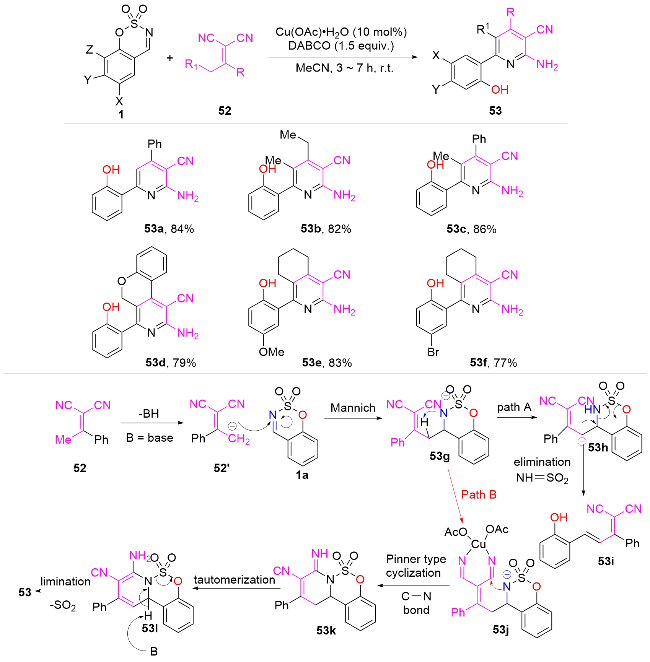
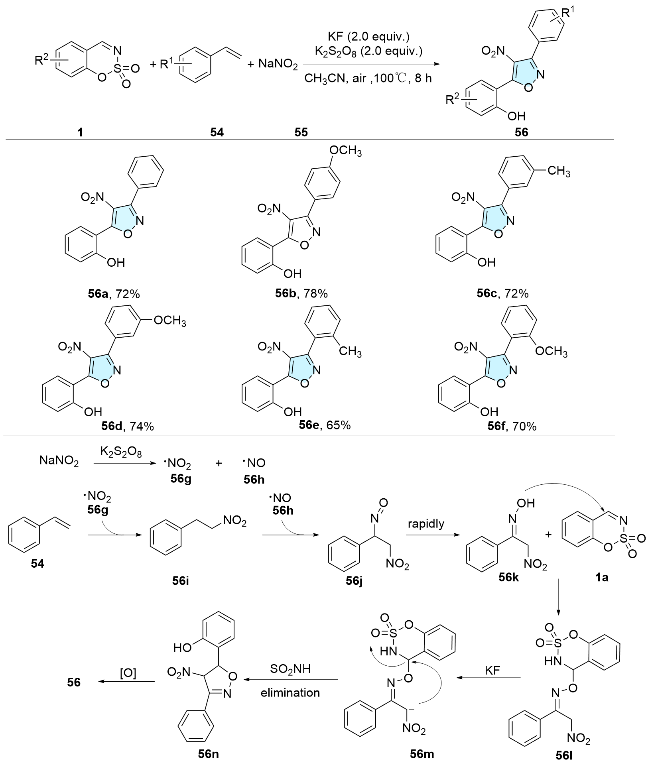


7 Conclusions
Advancements in new technologies have accelerated progress in synthetic methodologies, and the functionalization of N-sulfonyl ketimines has entered an innovative stage dominated by new catalytic paradigms such as photocatalysis, electrocatalysis, and the synergistic systems. These strategies have successfully overcome the dependence of traditional transition metal catalysis on harsh oxidants and additives, providing a powerful toolbox for efficiently and selectively constructing structurally complex heterocyclic molecules, significantly expanding their synthetic functionality and diversity. However, the field is at a critical juncture of transitioning from methodological innovation to practical applications. To achieve this leap, future research should fully focus on asymmetric carbon-H functionalization, industrial scalability, biological applications, and other fields to achieve systematic breakthroughs and fully unleash its synthetic potential and application value. The primary challenge and opportunity lie in the asymmetric C—H functionalization with high stereoselectivity. The current reactions are mostly limited to non-chiral or racemic processes, and precise enantioselective conversion via C—H bond activation is the key to obtaining high-value chiral amines and heterocyclic compounds. This requires us to go beyond existing catalytic designs, develop new chiral catalysts or ligands, and deeply integrate them with novel modes such as photoredox, electrochemical, or dual catalysis, in order to achieve the currently challenging stereo- control under mild conditions. Secondly, moving from the laboratory to the factory is a necessary path to realizing its actual value. The current synthesis strategies are mostly restricted to laboratory scale and often rely on precious metals or stoichiometric additives, which restricts their production applications. From the perspective of green chemistry, future research should focus on developing inexpensive and stable earth rich metal catalytic systems. The integration of continuous-flow chemistry, electrosynthesis, and other process technologies is essential to improve the atomic economy, step efficiency, and operational stability of the overall transformation process, thereby enabling the large-scale and green manufacturing of drug intermediates and functional materials. This strategy improves atomic economy and step simplicity, reduces byproduct formation and purification difficulty, and thus satisfies the requirements for the large-scale synthesis of pharmaceutical intermediates and functional materials. Furthermore, the functionalization products of N-sulfonyl ketimines (especially molecules containing heterocycles, chiral centers, and biocompatible functional groups) have broad potential in medicinal chemistry. However, current research is mostly focused on methodological establishment, lacking systematic work on the later modification and structure-activity relationship exploration of bioactive molecules. In the future, we should strengthen the research on the later C—H functionalization of complex drug molecules and natural products, and promote cross cooperation with biology and pharmacology research to evaluate the biological activity, metabolic stability, and toxicity of synthesized molecules, thereby promoting the practical application of such reactions in drug discovery and chemical biology, and opening up the path from new reaction discovery to the creation of new drug lead compounds. In summary, the C—H functionalization of N-sulfonyl ketimines is moving from reaction discovery to multidimensional development driven by multi-functionality/applications. This not only achieves higher levels of precision and greenness in methodology, but also has a profound impact on practical fields such as drug development and materials science. We look forward to this synthetic toolbox moving towards a more mature and creative new stage through interdisciplinary collaborative innovation. Therefore, this review aims to inspire synthetic chemists to develop new concepts and strategies for further functionalization and applications.
(Zhao, C.)