


1 Introduction
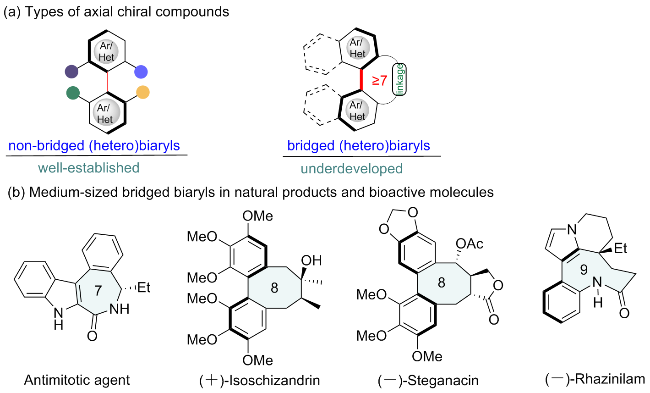
Axially chiral biaryl architectures are abundant in a wide assortment of natural products,[1] and biologically active molecules[2], some of which constitute the core structures of privileged chiral ligands or organocatalysts for asymmetric transformations.[3] In line with these contributions, the catalytic enantioselective construction of chiral biaryl scaffolds has evolved into a stimulating topic in synthetic science. In terms of structural characteristics, conformationally stable biaryl atropisomers can generally be divided into the following two categories: noncyclic and bridged biaryls (Figure 1a). The former comprises conformers with a rotationally hindered stereogenic axis whose configurational stability is normally governed by the number and size of the flanking substituents close to the stereogenic axis because sufficient steric congestion could cause a high rotational energy barrier, making the axis chirality stable (ΔG>123.6 kJ/mol). The last decade has witnessed many significant achievements in this field, most of which focus on the enantioselective assembly of six-six- and five-six-membered biaryl atropisomers.[3-4] In the latter, bridged biaryl atropisomers, characterized by the covalent linkage of two ortho-substituents on adjacent aryl rings via a bridging unit (ΔG usually less than 123.6 kJ/mol), exhibit configurational stability that is critically governed by the ring size of the bridging ring.[5] Notably, five- and six-membered bridges generally afford insufficient steric congestion and conformational restrictions to hinder rotation around the biaryl axis due to the low rotational energy barrier.[6] In contrast, medium-sized bridges uniquely demonstrate flexibility and rigidity through the expansion of their geometric structures to decrease transannular strain while enhancing a well- defined stable conformation through favorable torsional and noncovalent interactions.[5-7] In particular, medium-sized bridged biaryl scaffolds are widely distributed in numerous natural products, such as (+)-isoschizandrin,[8b] (+)-stega- nacin[8b] and (-)-rhazinilam,[8c] and other bioactive molecules, with demonstrated therapeutic relevance (Figure 1b).[9] Notably, when the bridging linkage contains central chirality, its configuration can stereoselectively govern the axial stereochemistry through a well-established central-to- axial chirality relay event.[7] This phenomenon has been documented in recent studies on the asymmetric construction of eight-membered bridged biaryl scaffolds. An illustrative example is the N-heterocyclic carbene (NHC)-cata- lyzed propargylic substitution-enabling bicyclization of propargylic alcohols with enals, producing enantioenriched eight-membered lactones featuring an axially chiral aryl- indole bridge and a chiral carbon center, as reported by Wong and Zhao (Scheme 1a).[10] The subsequent NHC- catalyzed (5+3) annulation of ortho-indolizinyl N-sulfon- ylanilines with α-bromoenals afforded eight-membered lactams connecting an aryl-indolizine bridge and a chiral carbon center (Scheme 1b).[11] Despite these limited advances, synthesizing chiral medium-sized bridged biaryl atropisomers poses a great challenge and remains underdeveloped, because of unfavorable transannular interactions and entropic and/or enthalpic factors.[12] Thus, novel synthetic strategies are needed to access atropisomerically enriched 8-membered bridged biaryl systems while addressing the above issues.[13]
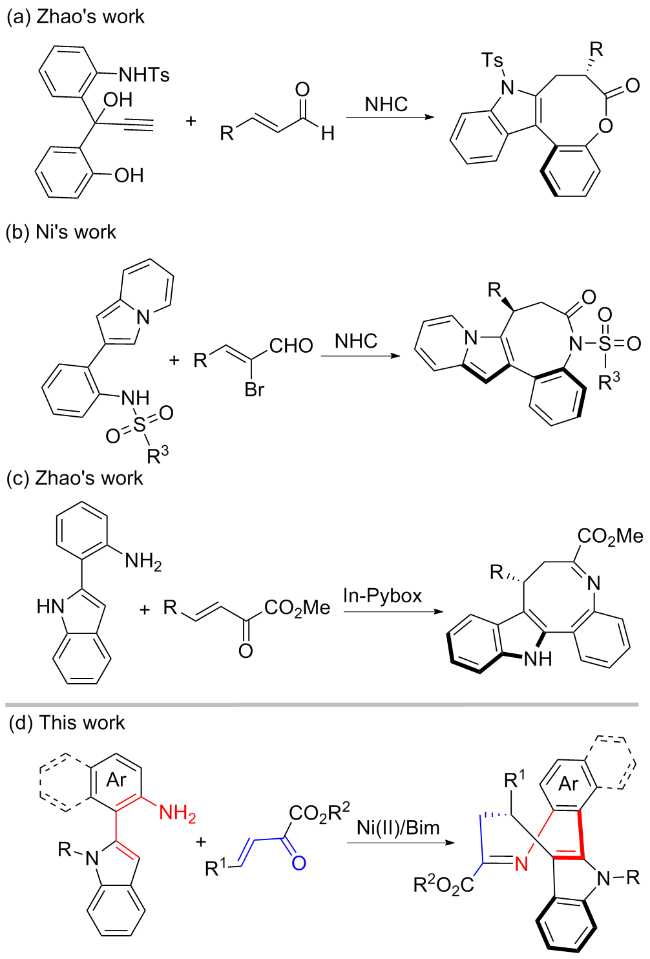
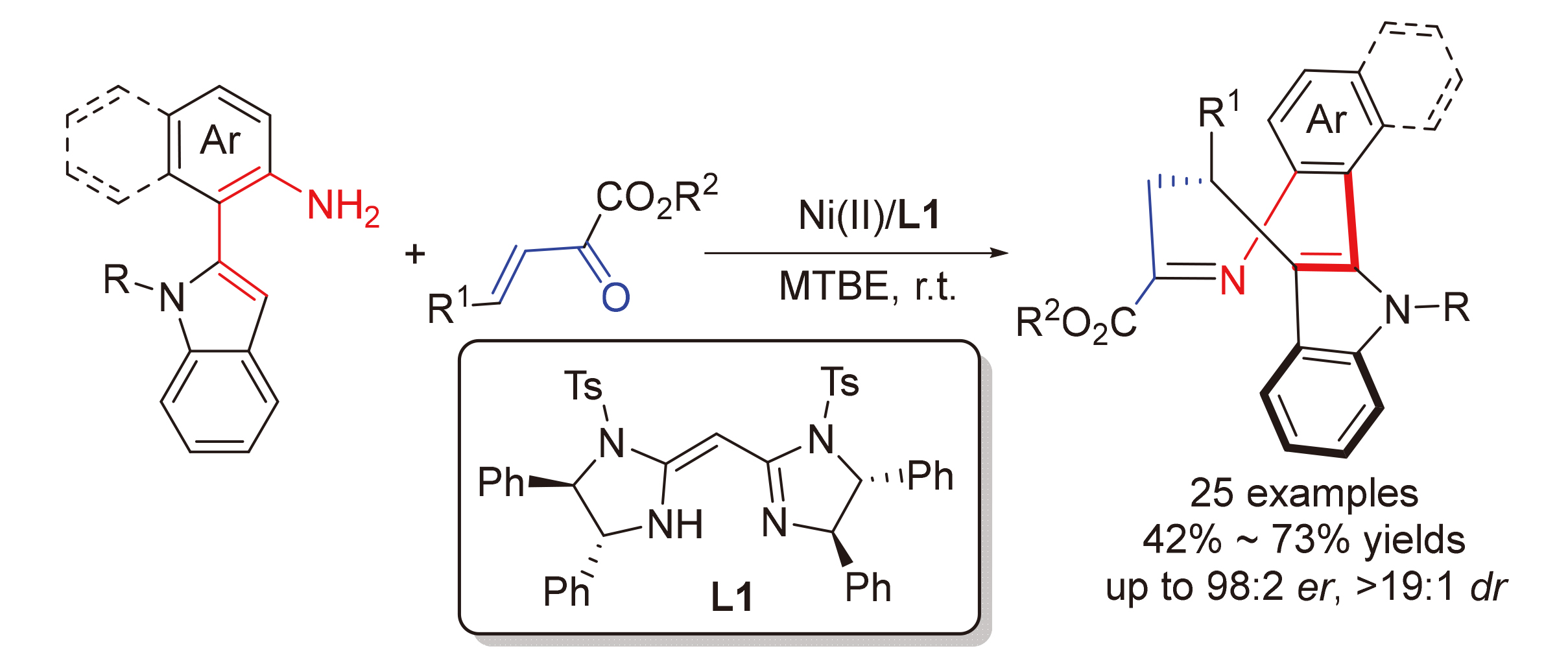
We recently developed a class of chiral C2-symmetric anionic N,N′-bidentate ligands, N,N′-disulfonyl bisimidazolines (Bims). Upon coordination to Pd(II), these ligands deliver highly enantioselective catalysis in both 1,2- and 1,4-conjugate addition reactions. This asymmetric ligand- enabled Pd(II) catalytic system provides reliable and efficient access to a broad range of optically pure cyclic α- tertiary amines and ketones.[14] To further broaden the asymmetric synthetic application of the preformed Bim ligand by extending its coordination to additional transition metals, we found that the Ni(II)/Bim catalytic system could drive higher-order (5+3) annulation of 2-(2-aminoaryl)- indoles and β,γ-unsaturated α-ketoesters,[15] affording saddle-shaped eight-membered aza-heterocycles featuring an axially chiral aryl-indole fragment with high enantioselectivity and excellent diastereoselectivity. When we were preparing this paper, Zhao and co-workers[16] reported an In(OTf)3/pybox-catalyzed (5+3) annulation for the enantioselective formation of similar eight-membered ring- bridged 2-aryl-indoles (Scheme 1c). A comparative analysis of the aforementioned literature reveals that the catalytic systems, reaction parameters, and substitution patterns of the products are all markedly distinct. Therefore, herein, we report the application of this Ni(II)/chiral Bim catalytic system to achieve higher-order (5+3) annulation for the diastereo- and enantioselective synthesis of saddle-shaped eight-membered aza-heterocycles.
2 Results and discussion
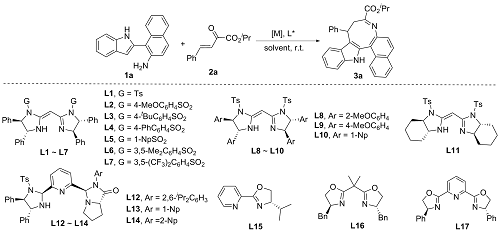
Our studies were started with the reaction of 1-(2-in- dolyl)naphthalen-2-amine (1a) and β,γ-unsaturated α-keto- ester (2a) as model substrates to optimize the reaction parameters (Table 1). The reaction of 1a with 2a was conducted in 1,2-dichloroethane (DCE) at room temperature under air conditions by using the Ni(NTf2)2/chiral Bim ligand L1, and the expected product 3a was obtained in 55% yield and 57% ee (Entry 1). These findings prompted a focused investigation into the influence of reaction parameters on both product yield and enantioselectivity. Subsequently, the influence of the solvents was carefully evaluated. The yields of product 3a obtained using the Ni(II)/L1 catalytic system in several solvents commonly employed in asymmetric transformations are summarized as follows (Entries 2~6): toluene (70%, 65% ee), acetonitrile (CH3CN, 21%, 32% ee), N,N-dimethylformamide (DMF, trace), tetrahydrofuran (THF, trace), and methyl tert-butyl ether (MTBE, 70%, 80% ee), in which the use of MTBE gave better results than MTBE did (Entry 1 vs Entry 6). Next, a series of chiral ligands, including N,N′-disulfonyl Bim L2~L10, benzo[d]imidazole L4, PyIPI L12~L14,[17] Pyrox L15, Box L16, and Pybox-L17 (Entries 7~22), were investigated, and the results indicated that all the ligands led to a significant decrease in the yield and/or enantioselectivity of the product. Exchanging Ni(NTf2) with Ni(OTf)2, or NiBr2 led to markedly diminished catalytic performance, as evidenced by the significantly decreased ee values of product 3a (Entries 23, 24). The use of Cu(OTf)2 or Zn(OTf)2 as a Lewis acid catalyst led to the poor enantioselectivity (Entries 25, 26).
Table 1 Condition optimization for product 3aa |
| Entry | [M] | L | Solvent | Yield/% | er | Entry | [M] | L | Solvent | Yield/% | er |
|---|---|---|---|---|---|---|---|---|---|---|---|
| 1 | Ni(NTf2)2 | L1 | DCE | 55 | 78∶22 | 14 | Ni(NTf2)2 | L9 | MTBE | 40 | 15∶85 |
| 2 | Ni(NTf2)2 | L1 | Toluene | 60 | 82∶18 | 15 | Ni(NTf2)2 | L10 | MTBE | 32 | 71∶29 |
| 3 | Ni(NTf2)2 | L1 | MeCN | 21 | 66∶34 | 16 | Ni(NTf2)2 | L11 | MTBE | 53 | 73∶27 |
| 4 | Ni(NTf2)2 | L1 | DMF | Trace | — | 17 | Ni(NTf2)2 | L12 | MTBE | 42 | 85∶15 |
| 5 | Ni(NTf2)2 | L1 | THF | Trace | — | 18 | Ni(NTf2)2 | L13 | MTBE | 51 | 40∶60 |
| 6 | Ni(NTf2)2 | L1 | MTBE | 70 | 90∶10 | 19 | Ni(NTf2)2 | L14 | MTBE | 75 | 60∶40 |
| 7 | Ni(NTf2)2 | L2 | MTBE | 46 | 85∶15 | 20 | Ni(NTf2)2 | L15 | MTBE | 72 | 49∶51 |
| 8 | Ni(NTf2)2 | L3 | MTBE | N.R. | — | 21 | Ni(NTf2)2 | L16 | MTBE | 65 | 50∶50 |
| 9 | Ni(NTf2)2 | L4 | MTBE | 36 | 88∶12 | 22 | Ni(NTf2)2 | L17 | MTBE | 55 | 60∶40 |
| 10 | Ni(NTf2)2 | L5 | MTBE | 29 | 75∶25 | 23 | Ni(OTf)2 | L1 | MTBE | 72 | 84∶16 |
| 11 | Ni(NTf2)2 | L6 | MTBE | 30 | 88∶12 | 24 | NiBr2 | L1 | MTBE | 45 | 72∶28 |
| 12 | Ni(NTf2)2 | L7 | MTBE | 17 | 75∶25 | 25 | Cu(OTf)2 | L1 | MTBE | 53 | 53∶47 |
| 13 | Ni(NTf2)2 | L8 | MTBE | 52 | 25∶75 | 26 | Zn(OTf)2 | L1 | MTBE | 58 | 50∶50 |
a Reaction conditions: 1a (0.05 mmol), 2a (0.075 mmol), Ni catalyst (10 mol%), and ligand (15 mol%) in solvent (1.5 mL) at room temperature for 2d. b Yield of isolated product. c The ee value was determined by HPLC on a chiral stationary phase. |
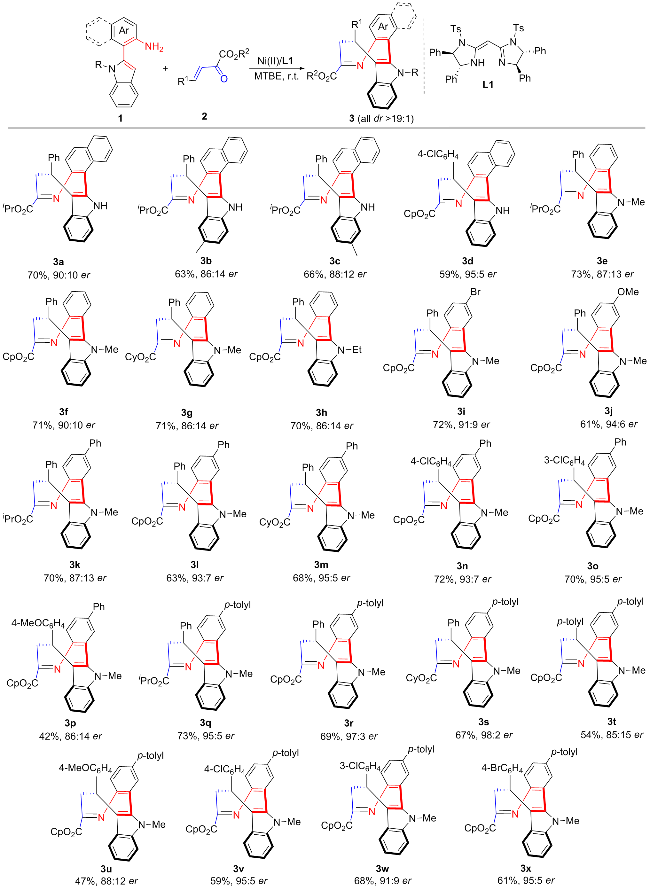
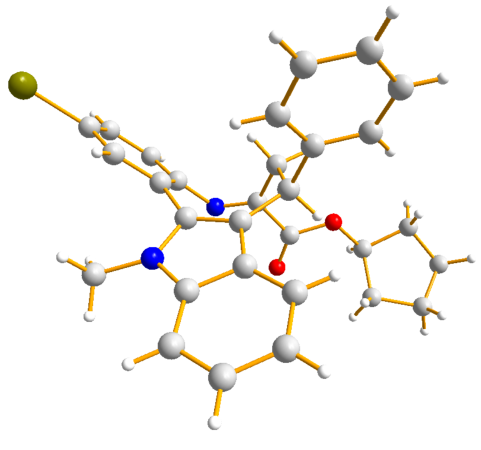
With these acceptable reaction conditions in hand (Table 1, Entry 6), the applicability of the asymmetric higher-order (5+3) annulation of various 2-(2-aminoaryl)indoles was then examined with a wide range of β,γ-unsaturated α-keto- esters (Scheme 2). Initially, 1-(2-indolyl)naphthalen-2- amines bearing a methyl substituent at the C(5) (1b) or C(6) (1c) position of the indole ring were subjected to reaction with 2a, affording corresponding products 3b and 3c in good yields and with enantiomeric ratios of 86∶14 and 88∶12, respectively. Swapping the isopropyl group with a cyclopentyl (Cp) functionality linked by the ester of substrate 2 led to a slight improvement in enantioselectivity, affording product 3d with an enantiomeric ratio of 95∶5. To expand the application of this Ni(II)/Bim catalysis, N-protected 2-(2-aminophenyl)indoles were employed as 1,5-dinucleophilic components to prove their compatibility. Subsequently, the reactions of N-methyl 2-(2-amino- phenyl)indole (1d) and various β,γ-unsaturated α-ketoesters were conducted under standard conditions, among which substituents, such as isopropyl, cyclopentyl (Cp) and cyclohexyl (Cy), tethered by the ester group of substrate 2 were compatible, providing chiral products 3e~3g in good yields and with high enantioselectivity (86∶14 to 90∶10 er). N-Ethyl counterpart 1e was suitable for this transformation, affording product 3h in 70% yield with 86∶14 er. Alternatively, a series of substrates 1 bearing bromo (1f), methoxy (1g), or aryl (1h and 1i) groups at the C(4)-position of the phenyl ring were investigated for their ability to react with β,γ-unsaturated α-ketoesters. All these substrates were well accommodated, confirming the reaction efficiency, as products 3i~3x were obtained in synthetically useful yields and with high enantioselectivity. Among these substrates, cyclopentyl-derived α-ketoesters consistently delivered higher enantioselectivities than isopropyl analogues did (3l vs 3k; 3r vs 3q), indicating the beneficial influence of the bulky cyclopentyl group on asymmetric induction. Moreover, substrate 1, bearing a bulky substituent at the C(4)- position of the phenyl ring, favored the control of the enantioselectivity, as exemplified by its C(4)-aryl counterparts, which resulted in higher er values than those of the C(4)-free substrate (3f vs 3l). Motivated by these distinctive observations, the substrate scope with respect to β,γ-unsatu- rated α-ketoesters was carefully expanded using C(4)-aryl variants. The results indicated that substrates with electronically poor (e.g., chloro and bromo), neutral (H) and rich (e.g., methyl and methoxy) groups at different positions (para and meta) on the phenyl ring were compatible with this catalytic system, furnishing tricyclic indoles 3k~3x with structural diversity in acceptable yields and high enantioselectivities. Notably, excellent diastereoselectivity (dr>19∶1 in all cases) was observed in these saddle-shaped eight-membered aza-heterocycles incorporating both central and axial chirality, and the saddle-shaped configuration was confirmed by X-ray single crystal diffraction analysis of racemic product 3i (Figure 2, CCDC 2531147).
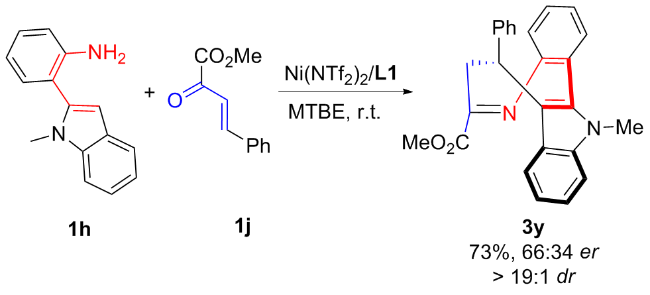
To confirm the absolute configuration of these resulting products, the same chiral product 3y reported in the literature was synthesized,[16] and its absolute configuration was unambiguously assigned as R by comparison of its HPLC spectrum (Scheme 3). The results indicate that our developed catalytic system is competent for asymmetric induction with sterically demanding ester substrates, whereas its stereocontrol is significantly diminished with less hindered analogues.
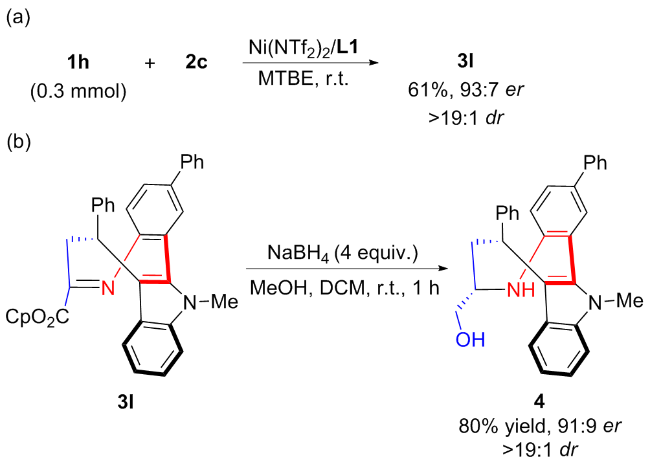
To demonstrate the synthetic scalability of this strategy, the reaction between 1h and 2c was scaled up to 0.3 mmol under standard conditions, affording 3l in comparable yield and enantioselectivity (Scheme 4a). Moreover, the cyclization products feature versatile functional handles including imine and ester groups that enable diverse downstream transformations. For example, the reduction of both imine and ester moieties in 3l with NaBH4 in MeOH at room temperature furnished the corresponding alcohol derivative 4 in 80% yield with slightly decreased enantioselectivity and >19∶1 dr (Scheme 4b).
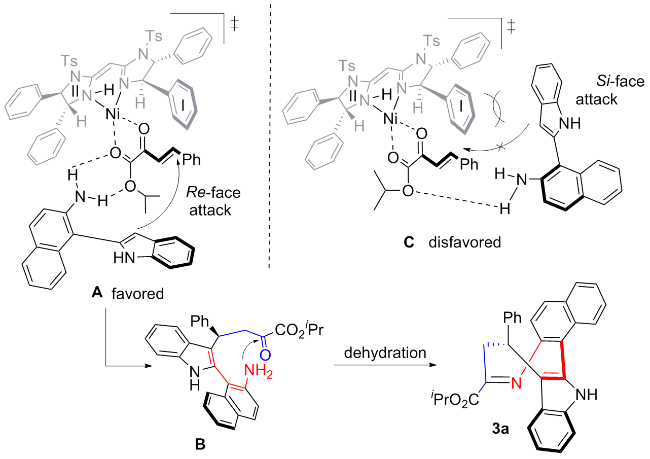
The stereochemical outcome for higher-order (5+3) cyclization can be explained using a model as shown in Scheme 5. The Bim ligand coordinates to Ni in a bidentate fashion through its two nitrogen atoms, forming a six- membered chelate ring. Simultaneously, the two carbonyl oxygen atoms of β,γ-unsaturated α-ketoester coordinates to the same Ni center, giving rise to an additional five-mem- bered chelate ring. The resulting four-coordinate Ni center, ligated by two N and two O atoms, adopts a distorted tetrahedral geometry, which orients the enone moiety of substrate 2 toward phenyl ring I of the Bim ligand. Re-face nucleophilic attack of the indole C(3)-carbon in substrate 1 on the electrophilic β-carbon of the enone moiety in substrate 2 is favorable, yielding intermediate B with central and axial chirality, followed by the dehydration to deliver saddle-shaped eight-membered aza-heterocycle 3a as the dominant conformationally stable product. In contrast, Si-face nucleophilic attack of the indole C(3) carbon on the enone moiety is disfavored due to severe steric repulsion imposed by phenyl ring I.


3 Conclusions
In summary, a Ni(II)/Bim-catalyzed enantioselective higher-order (5+3) cyclization of 2-(2-aminoaryl)indoles with β,γ-unsaturated α-ketoesters was developed, enabling a concerted Friedel-Crafts alkylation/dehydration cascade to access a range of saddle-shaped eight-membered-ring bri- dged aryl-indoles bearing both central and axial chirality. Notably, the protocol is capable of good functional group compatibility and a wide substrate scope and is distinguished by its mild conditions (under ambient conditions) and high stereoselectivities, thus offering a new asymmetric strategy for constructing chiral medium-sized bridged biaryl scaffolds. Ongoing efforts in our laboratory are directed toward expanding the synthetic utility of the Ni/Bim platform to other chiral molecules.
4 Experimental section
4.1 Materials and methods
1H NMR and 13C NMR spectra were measured on a Bruker DPX 400 MHz spectrometer in CDCl3 with chemical shift (δ) given relative to TMS as internal standard. HRMS (APCI and ESI) was determined by using a microTOF-QII HRMS/MS instrument (BRUKER). Starting materials 1[18a] and 2[18b-18d] were synthesized following literature procedures, respectively.
4.2 General procedure for the synthesis of products 3
With the synthesis of 3a, to a 10 mL Schlenk tube under air conditions, Ni(NTf2)2 (10 mol%, 3.1 mg), L1 (15 mol%) and MTBE (1.5 mL) were added, and the mixture was stirred for 1 h at room temperature. Then, 1a (0.05 mmol, 1.0 equiv.) and 2a (0.075 mmol, 1.5 equiv.) were successively added. The mixture was stirred at room temperature about 2 d. After the reaction was completed [indicated by thin-layer chromatography (TLC), petroleum ether/EtOAc, V∶V=5∶1], the reaction mixture was concentrated by vacuum distillation and purified by flash column chromatography (petroleum ether/acetone, V∶V=20∶1) to afford the desired pure product 3a as a yellow solid. Compunds 3b~3y were synthesized with the same method.
Isopropyl (R,E)-10-phenyl-10,15-dihydro-9H-naphtho-[2',1':2,3]azocino[4,5-b]indole-8-carboxylate (3a): Yellow solid, 15.6 mg, 70% yield. ${[\alpha ]}_{\text{D}}^{\text{20}}$-23.0 (c 0.3, acetone). m.p. 185~186 ℃; 1H NMR (400 MHz, CDCl3) δ: 8.08 (s, 1H), 7.98~7.84 (m, 3H), 7.58~7.49 (m, 2H), 7.47 (d, J=8.0 Hz, 1H), 7.39 (d, J=8.0 Hz, 1H), 7.31 (d, J=8.0 Hz, 1H), 7.24~7.17 (m, 3H), 7.14 (t, J=8.0 Hz, 2H), 7.11~7.02 (m, 2H), 5.32~5.15 (m, 1H), 5.07~4.90 (m, 1H), 3.35~3.20 (m, 1H), 2.92 (t, J=12.0 Hz, 1H), 1.42 (d, J=8.0 Hz, 3H), 1.35 (d, J=8.0 Hz, 3H); 13C NMR (100 MHz, CDCl3) δ: 163.9, 163.2, 146.6, 144.3, 135.9, 133.5, 129.8, 129.0, 128.7, 128.6, 127.8, 127.5, 127.4, 126.6, 126.5, 125.6, 122.9, 121.6, 119.8, 119.2, 117.7, 117.6, 110.6, 70.3, 40.8, 38.1, 21.9, 21.9; HRMS (ESI) calcd for C31H27N2O2 (M+H)+ 495.2067, found 495.2066. HPLC analysis: 90∶10 er [Daicel Chiralpak IA, hexane/i-PrOH, V∶V=60∶40, 0.8 mL/min, λ=254 nm, tR(minor)=7.7 min, tR(major)=24.7 min].
Isopropyl (R,E)-12-methyl-10-phenyl-10,15-dihydro-9H-naphtho[2',1':2,3]azocino[4,5-b]indole-8-carboxylate (3b): Yellow solid, 14.8 mg, 63% yield. ${[\alpha ]}_{\text{D}}^{\text{20}}$ +161.5 (c 0.5, acetone). m.p. 207~208 ℃; 1H NMR (400 MHz, CDCl3) δ: 8.00~7.85 (m, 4H), 7.56~7.47 (m, 2H), 7.38 (d, J=8.0 Hz, 1H), 7.25~7.18 (m, 4H), 7.15 (t, J=8.0 Hz, 2H), 7.11~7.05 (m, 1H), 7.02 (d, J=8.0 Hz, 1H), 5.28~5.16 (m, 1H), 5.07~4.92 (m, 1H), 3.29~3.20 (m, 1H), 2.89 (t, J=12.0 Hz, 1H), 2.39 (s, 3H), 1.43 (d, J=4.0 Hz, 3H), 1.36 (d, J=4.0 Hz, 3H); 13C NMR (100 MHz, CDCl3) δ: 163.7, 163.2, 146.4, 144.4, 134.1, 133.4, 132.0, 129.6, 129.1, 129.0, 128.6, 128.5, 127.9, 127.4, 127.3, 126.5, 125.5, 124.5, 121.5, 118.7, 117.7, 117.1, 110.2, 70.3, 40.6, 38.2, 21.9, 21.8, 21.6; HRMS (ESI) calcd for C32H29N2O2 (M+H)+ 473.2224, found 473.2220. HPLC analysis: 86∶14 er [Daicel Chiralpak IA, hexane/i-PrOH, V∶V=60∶40, 0.8 mL/min, λ=254 nm, tR(minor)=4.5 min, tR(major)=4.2 min].
Isopropyl (R,E)-13-methyl-10-phenyl-10,15-dihydro-9H-naphtho[2',1':2,3]azocino[4,5-b]indole-8-carboxylate (3c): Yellow solid, 16.5 mg, 66% yield. ${[\alpha ]}_{\text{D}}^{\text{20}}$ -67.0 (c 0.1, acetone). m.p. 205~207 ℃; 1H NMR (400 MHz, CDCl3) δ: 7.96~7.89 (m, 3H), 7.56~7.48 (m, 2H), 7.39 (d, J=8.0 Hz, 1H), 7.33 (d, J=8.0 Hz, 1H), 7.28~7.26 (m, 1H), 7.23~7.18 (m, 2H), 7.17~7.10 (m, 3H), 7.10~7.03 (m, 1H), 6.89 (d, J=8.0 Hz, 1H), 5.27~5.17 (m, 1H), 5.02~4.93 (m, 1H), 3.32~3.20 (m, 1H), 2.89 (t, J=12.0 Hz, 1H), 2.44 (s, 3H), 1.42 (d, J=6.0 Hz, 3H), 1.36 (d, J=6.1 Hz, 3H); 13C NMR (100 MHz, CDCl3) δ: 163.7, 163.2, 146.4, 144.3, 136.2, 133.4, 132.9, 132.0, 129.6, 128.8, 128.6, 128.5, 128.3, 127.4, 127.3, 127.1, 126.5, 125.5, 121.6, 121.4, 118.8, 117.7, 117.5, 110.4, 70.3, 40.7, 38.0, 21.9, 21.8, 21.8; HRMS (ESI) calcd for C32H29N2O2 (M+H)+ 473.2224, found 473.2221. HPLC analysis: 88∶12 er [Daicel Chiralpak OD-H, hexane/i-PrOH, V∶V=70∶30, 1 mL/min, λ=254 nm, tR(minor)=5.1 min, tR(major)=4.1 min].
Cyclopentyl (R,E)-10-(4-chlorophenyl)-10,15-dihydro-9H-naphtho[2',1':2,3]azocino[4,5-b]indole-8-carboxylate (3d): Yellow solid, 15.3 mg, 59% yield. ${[\alpha ]}_{\text{D}}^{\text{20}}$ -41.4 (c 0.3, acetone). m.p. 211~212 ℃; 1H NMR (400 MHz, CDCl3) δ: 7.80~7.65 (m, 4H), 7.50 (t, J=8.0 Hz, 2H), 7.42 (t, J=8.0 Hz, 1H), 7.36~7.29 (m, 3H), 7.25~7.22 (m, 1H), 7.19~7.08 (m, 4H), 7.05 (t, J=8.0 Hz, 1H), 5.43~5.31 (m, 1H), 5.01~4.91 (m, 1H), 3.58 (s, 3H), 3.25~3.11 (m, 1H), 2.84 (t, J=12.0 Hz, 1H), 2.09~1.65 (m, 8H); 13C NMR (100 MHz, CDCl3) δ: 163.3, 163.3, 146.5, 142.7, 135.7, 133.3, 132.2, 132.0, 129.9, 129.0, 128.8, 128.7, 128.6, 127.5, 127.5, 126.2, 125.7, 123.1, 121.5, 119.9, 118.8, 117.2, 117.1, 110.6, 40.1, 37.9, 32.8, 32.6, 23.9, 23.9; HRMS (ESI) calcd for C33H28ClN2O2 (M+H)+ 519.1834, found 519.1833. HPLC analysis: 95∶5 er [Daicel Chiralpak IA, hexane/i-PrOH, V∶V=60∶40, 0.8 mL/min, λ=254 nm, tR(minor)=4.8 min, tR(major)=4.2 min].
Isopropyl (R,E)-13-methyl-8-phenyl-8,13-dihydro-7H-benzo[2,3]azocino[4,5-b]indole-6-carboxylate (3e): Yellow solid, 15.8 mg, 73% yield. ${[\alpha ]}_{\text{D}}^{\text{20}}$ -35.8 (c 1.2, acetone). m.p. 192~193 ℃; 1H NMR (400 MHz, CDCl3) δ: 7.53~7.45 (m, 2H), 7.44~7.35 (m, 2H), 7.31 (d, J=8.0 Hz, 1H), 7.27~7.17 (m, 6H), 7.16~7.09 (m, 1H), 7.05 (t, J=8.0 Hz, 1H), 5.28~5.18 (m, 1H), 5.05~4.95 (m, 1H), 3.52 (s, 3H), 3.30~3.21 (m, 1H), 2.84 (t, J=12.0 Hz, 1H), 1.43 (d, J=8.0 Hz, 3H), 1.39 (d, J=8.0 Hz, 3H); 13C NMR (100 MHz, CDCl3) δ: 164.0, 163.2, 149.0, 145.0, 137.8, 133.7, 132.1, 129.0, 128.7, 127.3, 127.1, 126.6, 125.2, 122.5, 122.1, 121.7, 119.6, 119.1, 115.8, 109.4, 70.3, 41.1, 38.6, 31.2, 21.9; HRMS (ESI) calcd for C28H27N2O2 (M+H)+ 423.2067, found 423.2062. HPLC analysis: 87∶13 er [Daicel Chiralpak IA, hexane/i-PrOH, V∶V=99∶1, 1 mL/ min, λ=254 nm, tR(minor)=32.2 min, tR(major)=44.9 min].
Cyclopentyl (R,E)-13-methyl-8-phenyl-8,13-dihydro-7H-benzo[2,3]azocino[4,5-b]indole-6-carboxylate (3f): Yellow solid, 20.3 mg, 71% yield. ${[\alpha ]}_{\text{D}}^{\text{20}}$ +29.3 (c 0.4, acetone). m.p. 220~222 ℃; 1H NMR (400 MHz, CDCl3) δ: 7.48 (t, J=8.0 Hz, 2H), 7.40~7.33 (m, 2H), 7.29 (t, J=8.0 Hz, 1H), 7.25~7.14 (m, 6H), 7.14~7.08 (m, 1H), 7.03 (t, J=8.0 Hz, 1H), 5.42~5.31 (m, 1H), 5.00~4.91 (m, 1H), 3.51 (s, 3H), 3.23~3.13 (m, 1H), 2.82 (t, J=12.0 Hz, 1H), 2.03~1.92 (m, 2H), 1.91~1.59 (m, 6H); 13C NMR (100 MHz, CDCl3) δ: 164.0, 163.4, 149.0, 144.9, 137.8, 133.6, 132.1, 129.0, 128.7, 127.3, 127.0, 126.6, 125.1, 122.5, 122.0, 121.7, 119.6, 119.0, 115.7, 109.4, 79.4, 41.1, 38.7, 32.9, 32.6, 31.2, 24.0, 23.9; HRMS (ESI) calcd for C30H29N2O2 (M+H)+ 449.2224, found 449.2220. HPLC analysis: 90∶10 er [Daicel Chiralpak IA, hexane/i-PrOH, V∶V=60∶40, 0.7 mL/min, λ=254 nm, tR(minor)=8.9 min, tR(major)=9.6 min].
Cyclohexyl (R,E)-13-methyl-8-phenyl-8,13-dihydro-7H-benzo[2,3]azocino[4,5-b]indole-6-carboxylate (3g): Yellow solid, 20.9 mg, 71% yield. ${[\alpha ]}_{\text{D}}^{\text{20}}$ -38.1 (c 0.2, acetone). m.p. 220~222 ℃; 1H NMR (400 MHz, CDCl3) δ: 7.49 (d, J=8.0 Hz, 2H), 7.41~7.34 (m, 2H), 7.30 (d, J=8.0 Hz, 1H), 7.27~7.16 (m, 6H), 7.16~7.09 (m, 1H), 7.04 (t, J=8.0 Hz, 1H), 5.07~4.93 (m, 2H), 3.51 (s, 3H), 3.29~3.16 (m, 1H), 2.85 (t, J=12.0 Hz, 1H), 2.04~1.93 (m, 2H), 1.89~1.76 (m, 2H), 1.73~1.32 (m, 6H); 13C NMR (100 MHz, CDCl3) δ: 164.0, 162.9, 148.9, 144.9, 137.7, 133.6, 132.0, 129.0, 128.6, 127.3, 127.0, 126.5, 125.1, 122.4, 122.0, 121.6, 119.5, 119.0, 115.7, 109.4, 75.1, 41.1, 38.7, 31.5, 31.5, 31.1, 25.4, 23.9; HRMS (ESI) calcd for C31H31N2O2 (M+H)+ 463.2380, found 463.2378. HPLC analysis: 86∶14 er [Daicel Chiralpak IA, hexane/i-PrOH, V∶V=60∶40, 0.7 mL/min, λ=254 nm, tR(minor)=9.0 min, tR(major)=10.9 min].
Cyclopentyl (R,E)-13-ethyl-8-phenyl-8,13-dihydro-7H-benzo[2,3]azocino[4,5-b]indole-6-carboxylate (3h): Yellow solid, 16.1 mg, 70% yield. ${[\alpha ]}_{\text{D}}^{\text{20}}$ -116.8 (c 0.9, acetone). m.p. 149~150 ℃; 1H NMR (400 MHz, CDCl3) δ: 7.54 (d, J=8.0 Hz, 1H), 7.48 (t, J=8.0 Hz, 1H), 7.43~7.31 (m, 3H), 7.25~7.15 (m, 6H), 7.15~7.09 (m, 1H), 7.04 (t, J=8.0 Hz, 1H), 5.41~5.31 (m, 1H), 5.02~4.90 (m, 1H), 4.07~3.94 (m, 2H), 3.23~3.11 (m, 1H), 2.82 (t, J=12.0 Hz, 1H), 2.03~1.93 (m, 2H), 1.93~1.66 (m, 6H), 1.16 (t, J=4.0 Hz, 3H); 13C NMR (100 MHz, CDCl3) δ: 164.1, 163.2, 149.0, 144.8, 136.8, 133.2, 131.6, 129.0, 128.6, 127.4, 127.3, 126.5, 125.1, 122.3, 121.9, 119.5, 119.0, 116.0, 109.8, 79.3, 41.1, 38.8, 38.7, 32.9, 32.6, 23.9, 23.9, 15.2; HRMS (ESI) calcd for C31H31N2O2 (M+H)+ 463.2380, found 463.2377. HPLC analysis: 86∶14 er [Daicel Chiralpak OD-H, hexane/i-PrOH, V∶V=50∶50, 0.8 mL/min, λ=254 nm, tR(minor)=5.8 min, tR(major)=5.2 min].
Cyclopentyl (R,E)-2-bromo-13-methyl-8-phenyl-8,13-dihydro-7H-benzo[2,3]azocino[4,5-b]indole-6-carboxylate (3i): Yellow solid, 18.9 mg, 72% yield. ${[\alpha ]}_{\text{D}}^{\text{20}}$ -116.0 (c 1.7, acetone). m.p. 195~196 ℃; 1H NMR (400 MHz, CDCl3) δ: 7.66 (s, 1H), 7.59 (d, J=8.0 Hz, 1H), 7.37 (d, J=8.0 Hz, 1H), 7.33~7.28 (m, 1H), 7.27~7.20 (m, 3H), 7.17~7.11 (m, 3H), 7.05 (t, J=8.0 Hz, 1H), 5.44~5.30 (m, 1H), 5.03~4.93 (m, 1H), 3.54 (s, 3H), 3.27~3.17 (m, 1H), 2.81 (t, J=12.0 Hz, 1H), 2.07~1.65 (m, 8H); 13C NMR (100 MHz, CDCl3) δ: 164.4, 163.1, 147.9, 144.5, 137.9, 134.4, 132.1, 132.0, 128.7, 127.2, 126.9, 126.7, 123.8, 123.7, 122.9, 119.8, 119.2, 118.2, 116.4, 109.5, 79.5, 41.0, 38.6, 32.9, 32.6, 31.3, 23.9, 23.9; HRMS (ESI) calcd for C30H28BrN2O2 (M+H)+ 527.1329, found 527.1328. HPLC analysis: 91∶9 er [Daicel Chiralpak IA, hexane/i-PrOH, V∶V=60∶40, 0.9 mL/min, λ=254 nm, tR(minor)=6.1 min, tR(major)=8.0 min].
Cyclopentyl (R,E)-2-methoxy-13-methyl-8-phenyl-8,13-dihydro-7H-benzo[2,3]azocino[4,5-b]indole-6-carboxylate (3j): Yellow solid, 14.5 mg, 61% yield. ${[\alpha ]}_{\text{D}}^{\text{20}}$ +40.4 (c 1.3, acetone). m.p. 170~171 ℃; 1H NMR (400 MHz, CDCl3) δ: 7.36 (d, J=8.0 Hz, 1H), 7.30~7.26 (m, 1H), 7.24~7.15 (m, 6H), 7.14~7.08 (m, 1H), 7.07~6.98 (m, 3H), 5.35 (s, 1H), 4.98~4.89 (m, 1H), 3.90 (s, 3H), 3.51 (s, 3H), 3.19~3.11 (m, 1H), 2.85 (t, J=12.0 Hz, 1H), 2.04~1.92 (m, 2H), 1.90~1.62 (m, 6H); 13C NMR (100 MHz, CDCl3) δ: 163.8, 163.5, 157.0, 144.9, 142.5, 137.9, 133.6, 128.7, 127.3, 127.0, 126.6, 123.6, 122.8, 122.6, 119.6, 119.1, 117.1, 115.9, 114.7, 109.4, 79.3, 55.7, 41.0, 38.6, 32.9, 32.6, 31.3, 24.0, 23.9; HRMS (ESI) calcd for C31H31N2O3 (M+H)+ 479.2329, found 479.2328. HPLC analysis: 84∶16 er [Daicel Chiralpak IA, hexane/i-PrOH, V∶V=60∶40, 0.7 mL/min, λ=254 nm, tR(minor)=7.5 min, tR(major)=8.7 min].
Isopropyl (R,E)-13-methyl-3,8-diphenyl-8,13-dihydro-7H-benzo[2,3]azocino[4,5-b]indole-6-carboxylate (3k): Yellow solid, 17.4 mg, 70% yield. ${[\alpha ]}_{\text{D}}^{\text{20}}$ -210.5 (c 0.6, acetone). m.p. 197~198 ℃; 1H NMR (400 MHz, CDCl3) δ: 7.80~7.70 (m, 4H), 7.54 (t, J=8.0 Hz, 2H), 7.44 (d, J=8.0 Hz, 2H), 7.38~7.32 (m, 2H), 7.29~7.21 (m, 5H), 7.19~7.11 (m, 1H), 7.08 (t, J=8.0 Hz, 1H), 5.36~5.21 (m, 1H), 5.13~4.98 (m, 1H), 3.61 (s, 3H), 3.38~3.24 (m, 1H), 2.94 (t, J=12.0 Hz, 1H), 1.46 (d, J=4.0 Hz, 3H), 1.42 (d, J=4.0 Hz, 3H); 13C NMR (100 MHz, CDCl3) δ: 164.1, 163.2, 148.1, 144.9, 140.0, 138.0, 137.9, 133.6, 130.4, 129.1, 128.7, 127.8, 127.7, 127.3, 127.0, 126.6, 122.7, 122.6, 122.2, 119.6, 119.2, 116.0, 109.5, 70.4, 41.1, 38.6, 31.3, 21.9, 21.9; HRMS (ESI) calcd for C34H31N2O2 (M+H)+: 499.2380, found 499.2378. HPLC analysis: 87∶13 er [Daicel Chiralpak OD-H, hexane/i-PrOH, V∶V=50/50, 0.8 mL/min, λ=254 nm, tR(minor)=6.9 min, tR(major)=5.6 min].
Cyclopentyl (R,E)-13-methyl-3,8-diphenyl-8,13-dihydro-7H-benzo[2,3]azocino[4,5-b]indole-6-carboxylate (3l): Yellow solid, 16.5 mg, 63% yield. ${[\alpha ]}_{\text{D}}^{\text{20}}$ -201.1 (c 1.1, acetone). m.p. 207~208 ℃; 1H NMR (400 MHz, CDCl3) δ: 7.77~7.68 (m, 4H), 7.52 (t, J=8.0 Hz, 2H), 7.45~7.38 (m, 2H), 7.36~7.29 (m, 2H), 7.26~7.17 (m, 5H), 7.16~7.09 (m, 1H), 7.05 (t, J=8.0 Hz, 1H), 5.39 (s, 1H), 5.04~4.96 (m, 1H), 3.59 (s, 3H), 3.27~3.18 (m, 1H), 2.92 (t, J=12.0 Hz, 1H), 2.08~1.96 (m, 2H), 1.95~1.67 (m, 6H); 13C NMR (100 MHz, CDCl3) δ: 164.1, 163.3, 148.2, 144.9, 140.1, 138.0, 137.9, 133.6, 130.4, 129.1, 128.7, 127.8, 127.3, 127.1, 126.6, 122.7, 122.6, 122.2, 119.7, 119.1, 115.9, 109.5, 79.4, 41.1, 38.8, 32.9, 32.6, 31.3, 24.0, 23.9; HRMS (ESI) calcd for C36H33N2O2 (M+H)+ 525.2537, found 525.2535. HPLC analysis: 93∶7 er [Daicel Chiralpak IA, hexane/i-PrOH, V∶V=60/40, 0.8 mL/min, λ=254 nm, tR(minor)=6.6 min, tR(major)=7.6 min]/
Cyclohexyl (R,E)-13-methyl-3,8-diphenyl-8,13-dihydro-7H-benzo[2,3]azocino[4,5-b]indole-6-carboxylate (3m): Yellow solid, 17.6 mg, 68% yield. ${[\alpha ]}_{\text{D}}^{\text{20}}$ -226.1 (c 0.6, acetone). m.p. 235~236 ℃; 1H NMR (400 MHz, CDCl3) δ: 7.77~7.66 (m, 4H), 7.51 (t, J=8.0 Hz, 2H), 7.44~7.36 (m, 2H), 7.32 (t, J=8.0 Hz, 2H), 7.26~7.16 (m, 5H), 7.15~7.08 (m, 1H), 7.04 (t, J=8.0 Hz, 1H), 5.07~4.94 (m, 2H), 3.58 (s, 3H), 3.30~3.21 (m, 1H), 2.92 (t, J=12.0 Hz, 1H), 1.98 (s, 2H), 1.82 (s, 2H), 1.70~1.34 (m, 6H); 13C NMR (100 MHz, CDCl3) δ: 164.0, 162.9, 148.9, 144.9, 137.7, 133.6, 132.0, 129.0, 128.6, 127.3, 127.0, 126.5, 125.1, 122.4, 122.0, 121.6, 119.5, 119.0, 115.7, 109.4, 75.1, 41.1, 38.7, 31.5, 31.5, 31.1, 25.4, 23.9; HRMS (ESI) calcd for C37H35N2O2 (M+H)+ 539.2693, found 539.2690. HPLC analysis: 95∶5 er [Daicel Chiralpak OD-H, hexane/i-PrOH, V∶V=70/30, 0.8 mL/min, λ=254 nm, tR(minor)=9.8 min, tR(major)=4.8 min].
Cyclopentyl (R,E)-8-(4-chlorophenyl)-13-methyl-3-phenyl-8,13-dihydro-7H-benzo[2,3]azocino[4,5-b]indole-6-carboxylate (3n): Yellow solid, 20.4 mg, 72% yield. ${[\alpha ]}_{\text{D}}^{\text{20}}$ -248.4 (c 0.6, acetone). m.p. 143~145 ℃; 1H NMR (400 MHz, CDCl3) δ: 7.80~7.65 (m, 4H), 7.50 (t, J=8.0 Hz, 2H), 7.42 (t, J=8.0 Hz, 1H), 7.36~7.29 (m, 3H), 7.25~7.22 (m, 1H), 7.19~7.08 (m, 4H), 7.05 (t, J=8.0 Hz, 1H), 5.43~5.31 (m, 1H), 5.01~4.91 (m, 1H), 3.58 (s, 3H), 3.25~3.11 (m, 1H), 2.84 (t, J=12.0 Hz, 1H), 2.09~1.65 (m, 8H); 13C NMR (100 MHz, CDCl3) δ: 163.6, 163.3, 148.0, 143.3, 139.9, 138.1, 137.8, 133.6, 132.2, 130.3, 129.1, 128.8, 128.6, 127.8, 127.0, 126.8, 126.4, 122.7, 121.9, 119.7, 118.8, 115.4, 109.5, 79.5, 40.5, 38.5, 32.8, 32.5, 31.3, 23.9, 23.9; HRMS (ESI) calcd for C36H32ClN2O2 (M+H)+ 559.2147, found 559.2143. HPLC analysis: 93∶7 er [Daicel Chiralpak OD-H, hexane/i-PrOH, V∶V=50∶50, 0.8 mL/min, λ=254 nm, tR(minor)=8.8 min, tR(major)=6.0 min].
Cyclopentyl (R,E)-8-(3-chlorophenyl)-13-methyl-3-phenyl-8,13-dihydro-7H-benzo[2,3]azocino[4,5-b]indole-6-carboxylate (3o): Yellow solid, 19.4 mg, 70% yield. ${[\alpha ]}_{\text{D}}^{\text{20}}$ -210.9 (c 0.9, acetone). m.p. 197~198 ℃; 1H NMR (400 MHz, CDCl3) δ: 7.78~7.68 (m, 4H), 7.51 (t, J=8.0 Hz, 2H), 7.44~7.36 (m, 2H), 7.33 (d, J=8.0 Hz, 2H), 7.27 (t, J=8.0 Hz, 1H), 7.20 (s, 1H), 7.17~7.04 (m, 4H), 5.45~5.34 (m, 1H), 5.05~4.92 (m, 1H), 3.58 (s, 3H), 3.28~3.15 (m, 1H), 2.88 (t, J=12.0 Hz, 1H), 2.04~1.65 (m, 8H); 13C NMR (100 MHz, CDCl3) δ: 163.6, 163.3, 148.0, 147.0, 139.9, 138.3, 137.8, 134.4, 133.7, 130.4, 130.0, 129.1, 127.9, 127.8, 127.5, 127.1, 126.8, 126.8, 125.5, 122.7, 122.7, 121.9, 119.8, 118.8, 115.2, 109.6, 79.5, 40.8, 38.6, 32.9, 32.6, 31.3, 24.0, 23.9; HRMS (ESI) calcd for C36H32- ClN2O2 (M+H)+ 559.2147, found 559.2145. HPLC analysis: 95∶5 er [Daicel Chiralpak OD-H, hexane/i-PrOH, V∶V=50∶50, 0.8 mL/min, λ=254 nm, tR(minor)=8.7 min, tR(major)=6.3 min].
Cyclopentyl (R,E)-8-(4-methoxyphenyl)-13-methyl-3-phenyl-8,13-dihydro-7H-benzo[2,3]azocino[4,5-b]indole-6-carboxylate (3p): Yellow solid, 11.6 mg, 42% yield. ${[\alpha ]}_{\text{D}}^{\text{20}}$ -72.4 (c 0.4, acetone). m.p. 113~115 ℃; 1H NMR (400 MHz, CDCl3) δ: 7.74~7.66 (m, 4H), 7.50 (t, J=8.0 Hz, 2H), 7.44~7.35 (m, 2H), 7.30 (d, J=8.0 Hz, 2H), 7.22 (t, J=8.0 Hz, 1H), 7.09 (d, J=8.0 Hz, 2H), 7.04 (t, J=8.0 Hz, 1H), 6.73 (d, J=8.0 Hz, 2H), 5.37 (s, 1H), 4.99~4.90 (m, 1H), 3.69 (s, 3H), 3.57 (s, 3H), 3.23~3.15 (m, 1H), 2.86 (t, J=12.0 Hz, 1H), 2.03~1.93 (m, 2H), 1.90~1.66 (m, 6H); 13C NMR (100 MHz, CDCl3) δ: 164.1, 163.4, 158.2, 148.1, 140.1, 138.0, 137.1, 130.4, 129.1, 128.2, 127.7, 127.0, 122.7, 122.6, 122.2, 119.6, 119.1, 116.3, 114.1, 109.5, 79.4, 55.3, 40.3, 38.9, 32.9, 32.6, 31.3, 24.0, 23.9; HRMS (ESI) calcd for C37H35N2O3 (M+H)+ 555.2642, found 555.2640. HPLC analysis: 86∶14 er [Daicel Chiralpak IA, hexane/i-PrOH, V∶V=60∶40, 0.7 mL/min, λ=254 nm, tR(minor)=7.3 min, tR(major)=8.5 min].
Isopropyl (R,E)-13-methyl-8-phenyl-3-(p-tolyl)-8,13-dihydro-7H-benzo[2,3]azocino[4,5-b]indole-6-carboxylate (3q): Yellow solid, 18.9 mg, 73% yield. ${[\alpha ]}_{\text{D}}^{\text{20}}$ -88.3 (c 0.7, acetone). m.p. 246~247 ℃; 1H NMR (400 MHz, CDCl3) δ: 7.75~7.70 (m, 2H), 7.60 (d, J=8.0 Hz, 2H), 7.40 (d, J=8.0 Hz, 1H), 7.32 (d, J=8.0 Hz, 4H), 7.26~7.18 (m, 5H), 7.12 (s, 1H), 7.05 (t, J=8.0 Hz, 1H), 5.32~5.19 (m, 1H), 5.07~4.94 (m, 1H), 3.59 (s, 3H), 3.32~3.23 (m, 1H), 2.92 (t, J=12.0 Hz, 1H), 2.45 (s, 3H), 1.44 (d, J=8.0 Hz, 3H), 1.40 (d, J=8.0 Hz, 3H); 13C NMR (100 MHz, CDCl3) δ: 164.1, 163.2, 147.9, 144.9, 138.0, 137.9, 137.6, 133.7, 130.2, 129.9, 128.7, 127.5, 127.4, 127.1, 126.9, 126.6, 122.7, 122.6, 122.2, 119.6, 119.2, 115.9, 109.5, 70.3, 41.1, 38.7, 31.3, 21.9, 21.3; HRMS (ESI) calcd for C35H33N2O2 (M+H)+ 513.2537, found 513.2535. HPLC analysis: 95∶5 er [Daicel Chiralpak OD-H, hexane/i-PrOH, V∶V=50∶50, 0.8 mL/ min, λ=254 nm, tR(minor)=6.5 min, tR(major)=5.2 min].
Cyclopentyl (R,E)-13-methyl-8-phenyl-3-(p-tolyl)-8,13-dihydro-7H-benzo[2,3]azocino[4,5-b]indole-6-carboxylate (3r): Yellow solid, 17.9 mg, 69% yield. ${[\alpha ]}_{\text{D}}^{\text{20}}$ +130.0 (c 0.9, acetone). m.p. 264~265 ℃; 1H NMR (400 MHz, CDCl3) δ: 7.75~7.67 (m, 2H), 7.58 (d, J=8.0 Hz, 2H), 7.37 (d, J=8.0 Hz, 1H), 7.34~7.27 (m, 4H), 7.25~7.16 (m, 5H), 7.13~7.08 (m, 1H), 7.03 (t, J=8.0 Hz, 1H), 5.37 (s, 1H), 5.03~4.93 (m, 1H), 3.57 (s, 3H), 3.24~3.15 (m, 1H), 2.90 (t, J=12.0 Hz, 1H), 2.43 (s, 3H), 2.04~1.93 (m, 2H), 1.92~1.63 (m, 6H); 13C NMR (100 MHz, CDCl3) δ: 164.1, 163.4, 158.2, 148.1, 140.1, 138.0, 137.1, 130.4, 129.1, 128.2, 127.7, 127.0, 122.7, 122.6, 122.2, 119.6, 119.1, 116.3, 114.1, 109.5, 79.4, 55.3, 40.3, 38.9, 32.9, 32.6, 31.3, 24.0, 23.9; HRMS (ESI) calcd for C37H35N2O2 (M+H)+ 539.2693, found 539.2691. HPLC analysis: 97∶3 er [Daicel Chiralpak IA, hexane/i-PrOH, V∶V=60∶40, 0.7 mL/min, λ=254 nm, tR(minor)=9.1 min, tR(major)=11.6 min].
Cyclohexyl (R,E)-13-methyl-8-phenyl-3-(p-tolyl)-8,13-dihydro-7H-benzo[2,3]azocino[4,5-b]indole-6-carboxylate (3s): Yellow solid, 18.5 mg, 67% yield. ${[\alpha ]}_{\text{D}}^{\text{20}}$ -164.2 (c 0.7, acetone). m.p. 176~177 ℃; 1H NMR (400 MHz, CDCl3) δ: 7.76~7.69 (m, 2H), 7.60 (d, J=8.0 Hz, 2H), 7.39 (d, J=8.0 Hz, 1H), 7.32 (d, J=8.0 Hz, 4H), 7.26~7.17 (m, 5H), 7.15~7.08 (m, 1H), 7.05 (t, J=8.0 Hz, 1H), 5.09~4.95 (m, 2H), 3.58 (s, 3H), 3.31~3.20 (m, 1H), 2.93 (t, J=12.0 Hz, 1H), 2.45 (s, 3H), 2.04~1.91 (m, 2H), 1.89~1.78 (m, 2H), 1.71~1.35 (m, 6H); 13C NMR (100 MHz, CDCl3) δ: 164.1, 162.9, 147.9, 145.0, 138.0, 137.9, 137.6, 137.2, 133.7, 130.2, 129.8, 128.7, 127.5, 127.3, 127.1, 126.9, 126.6, 122.7, 122.6, 122.2, 119.6, 119.1, 115.9, 109.5, 75.1, 41.1, 38.8, 31.6, 31.6, 31.3, 25.4, 23.9, 21.3; HRMS (ESI) calcd for C38H37N2O2 (M+H)+ 553.2850, found 553.2857. HPLC analysis: 98∶2 er [Daicel Chiralpak IA, hexane/i-PrOH, V∶V=60∶40, 0.7 mL/min, λ=254 nm, tR(minor)=11.9 min, tR(major)=17.0 min].
Cyclopentyl (R,E)-13-methyl-3,8-di-p-tolyl-8,13-dihydro-7H-benzo[2,3]azocino[4,5-b]indole-6-carboxylate (3t): Yellow solid, 14.9 mg, 54% yield. ${[\alpha ]}_{\text{D}}^{\text{20}}$ -88.9 (c 1.1, acetone). m.p. 251~252 ℃; 1H NMR (400 MHz, CDCl3) δ: 7.70 (d, J=7.2 Hz, 2H), 7.59 (d, J=8.0 Hz, 2H), 7.39 (d, J=8.0 Hz, 1H), 7.34~7.28 (m, 4H), 7.24 (t, J=8.0 Hz, 1H), 7.10~6.99 (m, 5H), 5.38 (s, 1H), 5.01~4.93 (m, 1H), 3.57 (s, 3H), 3.24~3.16 (m, 1H), 2.89 (t, J=12.0 Hz, 1H), 2.44 (s, 3H), 2.23 (s, 3H), 2.05~1.95 (m, 2H), 1.93~1.68 (m, 6H); 13C NMR (100 MHz, CDCl3) δ: 164.1, 163.4, 147.9, 141.9, 138.0, 137.9, 137.6, 137.2, 136.1, 133.6, 130.2, 129.8, 129.4, 127.5, 127.2, 127.1, 126.9, 122.6, 122.5, 122.2, 119.6, 119.1, 116.1, 109.5, 79.4, 40.7, 38.8, 32.9, 32.6, 31.3, 24.0, 23.9, 21.3, 21.1; HRMS (ESI) calcd for C38H37N2O2 (M+H)+ 553.2850, found 553.2848. HPLC analysis: 85∶15 er [Daicel Chiralpak IA, hexane/ i-PrOH, V∶V=60∶40, 1 mL/min, λ=254 nm, tR(minor)=6.3 min, tR(major)=7.9 min].
Cyclopentyl (R,E)-8-(4-methoxyphenyl)-13-methyl-3-(p-tolyl)-8,13-dihydro-7H-benzo[2,3]azocino[4,5-b]indole-6-carboxylate (3u): Yellow solid, 11.6 mg, 47% yield. ${[\alpha ]}_{\text{D}}^{\text{20}}$ -116.5 (c 0.9, acetone). m.p. 155~156 ℃; 1H NMR (400 MHz, CDCl3) δ: 7.74~7.69 (m, 2H), 7.60 (d, J=8.0 Hz, 2H), 7.39 (d, J=8.0 Hz, 1H), 7.32 (d, J=8.0 Hz, 4H), 7.24 (t, J=8.0 Hz, 1H), 7.11 (d, J=8.0 Hz, 2H), 7.05 (t, J=8.0 Hz, 1H), 6.74 (d, J=8.0 Hz, 2H), 5.43~5.35 (m, 1H), 5.01~4.90 (m, 1H), 3.71 (s, 3H), 3.58 (s, 3H), 3.20 (t, J=12.0, 8.0 Hz, 1H), 2.88 (t, J=12.0 Hz, 1H), 2.44 (s, 3H), 2.05~1.95 (m, 2H), 1.94~1.66 (m, 6H); 13C NMR (100 MHz, CDCl3) δ: 164.1, 163.4, 158.2, 147.9, 137.9, 137.9, 137.6, 137.2, 137.1, 133.5, 130.2, 129.8, 128.2, 127.5, 127.1, 126.9, 122.7, 122.6, 122.2, 119.6, 119.1, 116.2, 114.1, 109.5, 79.4, 55.3, 40.3, 38.9, 32.9, 32.6, 31.3, 24.0, 23.9, 21.3, 14.2; HRMS (ESI) calcd for C38H37N2O3 (M+H)+ 569.2799, found 569.2798. HPLC analysis: 88∶12 er [Daicel Chiralpak IA, hexane/i-PrOH, V∶V=60∶40, 0.8 mL/min, λ=254 nm, tR(minor)=10.0 min, tR(major)=12.1 min].
Cyclopentyl (R,E)-8-(4-chlorophenyl)-13-methyl-3-(p-tolyl)-8,13-dihydro-7H-benzo[2,3]azocino[4,5-b]indole-6- carboxylate (3v): Yellow solid, 16.6 mg, 59% yield. ${[\alpha ]}_{\text{D}}^{\text{20}}$ -119.2 (c 0.8, acetone). m.p. 176~177 ℃; 1H NMR (400 MHz, CDCl3) δ: 7.73~7.68 (m, 2H), 7.58 (d, J=8.0 Hz, 2H), 7.36~7.29 (m, 5H), 7.26~7.22 (m, 1H), 7.19~7.10 (m, 4H), 7.05 (t, J=8.0 Hz, 1H), 5.41~5.33 (m, 1H), 5.00~4.92 (m, 1H), 3.57 (s, 3H), 3.22~3.15 (m, 1H), 2.85 (t, J=12.0 Hz, 1H), 2.44 (s, 3H), 2.04~1.94 (m, 2H), 1.90~1.66 (m, 6H).;13C NMR (100 MHz, CDCl3) δ: 163.6, 163.4, 147.8, 143.4, 138.1, 137.9, 137.7, 137.1, 133.7, 132.3, 130.1, 129.9, 128.9, 128.7, 127.6, 126.9, 122.7, 121.9, 119.8, 118.9, 115.4, 109.6, 79.5, 40.5, 38.6, 32.9, 32.6, 31.3, 24.0, 23.9, 21.3; HRMS (ESI) calcd for C37H34ClN2O2 (M+H)+ 573.2303, found 573.2300. HPLC analysis: 95∶5 er [Daicel Chiralpak OD-H, hexane/i-PrOH, V∶V=50/50, 0.8 mL/min, λ=254 nm, tR(minor)=8.0 min, tR(major)=5.9 min].
Cyclopentyl (R,E)-8-(3-chlorophenyl)-13-methyl-3-(p-tolyl)-8,13-dihydro-7H-benzo[2,3]azocino[4,5-b]indole-6- carboxylate (3w): Yellow solid, 19.8 mg, 68% yield. ${[\alpha ]}_{\text{D}}^{\text{20}}$ -276.6 (c 1.0, acetone). m.p. 259~260 ℃; 1H NMR (400 MHz, CDCl3) δ: 7.73~7.69 (m, 2H), 7.59 (d, J=8.0 Hz, 2H), 7.37 (d, J=8.0 Hz, 1H), 7.34~7.28 (m, 4H), 7.26~7.21 (m, 1H), 7.18 (s, 1H), 7.14~7.04 (m, 4H), 5.40~5.32 (m, 1H), 5.00~4.91 (m, 1H), 3.56 (s, 3H), 3.26~3.14 (m, 1H), 2.86 (t, J=12.0 Hz, 1H), 2.43 (s, 3H), 2.05~1.95 (m, 2H), 1.90~1.66 (m, 6H); 13C NMR (100 MHz, CDCl3) δ: 163.6, 163.3, 147.8, 147.0, 138.3, 137.7, 137.1, 134.4, 133.8, 130.2, 130.0, 129.8, 127.7, 127.6, 126.9, 126.8, 125.5, 122.7, 122.7, 121.9, 119.8, 118.8, 115.2, 109.6, 79.5, 40.9, 38.6, 32.9, 32.6, 31.3, 24.0, 23.9, 21.3; HRMS (ESI) calcd for C37H34ClN2O2 (M+H)+ 573.2303, found 573.2301. HPLC analysis: 91∶9 er [Daicel Chiralpak IA, hexane/i-PrOH, V∶V=60∶40, 0.8 mL/min, λ=254 nm, tR(minor)=6.5 min, tR(major)=8.2 min].
Cyclopentyl (R,E)-8-(4-bromophenyl)-13-methyl-3-(p-tolyl)-8,13-dihydro-7H-benzo[2,3]azocino[4,5-b]indole-6-carboxylate (3x): Yellow solid, 18.8 mg, 61% yield. ${[\alpha ]}_{\text{D}}^{\text{20}}$ -105.5 (c 0.2, acetone). m.p. 157~158 ℃; 1H NMR (400 MHz, CDCl3) δ: 7.74~7.68 (m, 2H), 7.57 (d, J=8.0 Hz, 2H), 7.36~7.28 (m, 7H), 7.26~7.21 (m, 1H), 7.06 (d, J=8.0 Hz, 3H), 5.40~5.33 (m, 1H), 4.99~4.91 (m, 1H), 3.57 (s, 3H), 3.52~3.47 (m, 1H), 3.23~3.14 (m, 1H), 2.85 (t, J=12.0 Hz, 1H), 2.44 (s, 3H), 2.05~1.94 (m, 2H), 1.92~1.64 (m, 6H); 13C NMR (100 MHz, CDCl3) δ: 163.6, 163.4, 147.8, 143.9, 138.1, 137.9, 137.7, 137.0, 133.7, 131.8, 130.1, 129.9, 129.1, 127.7, 126.9, 122.7, 121.9, 120.3, 119.8, 118.9, 115.3, 109.6, 79.5, 66.0, 40.6, 38.5, 32.9, 32.6, 31.3, 24.0, 23.9, 21.3, 15.4; HRMS (ESI) calcd for C37H34BrN2O2 (M+H)+ 617.1798, found 617.1796. HPLC analysis: 90∶10 er [Daicel Chiralpak IA, hexane/i-PrOH, V∶V=60∶40, 1 mL/min, λ=254 nm, tR(minor)=8.3 min, tR(major)=10.7 min].
Methyl (R,E)-13-methyl-8-phenyl-8,13-dihydro-7H-benzo[2,3]azocino[4,5-b]indole-6-carboxylate (3y): Yellow solid, 14.4 mg, 73% yield. ${[\alpha ]}_{\text{D}}^{\text{20}}$ -88.2 (c 2.2, CHCl3). m.p. 137~138 ℃; 1H NMR (400 MHz, CDCl3) δ: 7.49 (t, J=8.0 Hz, 2H), 7.39 (d, J=8.0 Hz, 2H), 7.29 (d, J=8.0 Hz, 1H), 7.25~7.17 (m, 6H), 7.14~7.08 (m, 1H), 7.04 (t, J=8.0 Hz, 1H), 5.01~4.90 (m, 1H), 3.89 (s, 3H), 3.50 (s, 3H), 3.33~3.25 (m, 1H), 2.81 (t, J=12.0 Hz, 1H); 13C NMR (100 MHz, CDCl3) δ: 164.2, 163.5, 148.6, 144.8, 137.8, 133.5, 132.1, 129.1, 128.7, 127.3, 127.0, 126.6, 125.4, 122.6, 121.9, 121.7, 119.6, 119.2, 115.9, 109.4, 53.3, 40.8, 38.3, 31.1, 27.0; HRMS (ESI) calcd for C26H23N2O2 (M+H)+ 395.1754, found 395.1752. HPLC analysis: 80∶20 er [Daicel Chiralpak OD-H, hexane/i-PrOH, V∶V=70∶30, 1 mL/min, λ=254 nm, tR(minor)=7.0 min, tR(major)=6.5 min].
4.3 Scale-up transformation of product 3l
To a 10 mL Schlenk tube under air conditions, Ni(NTf2)2 (10 mol %, 18.6 mg), L1 (15 mol%) and MTBE (1.5 mL) were added, and the mixture was stirred for 1 h at room temperature. Then, 1h (0.3 mmol, 1.0 equiv) and 2c (0.45 mmol, 1.5 equiv) were successively added. The mixture was stirred at room temperature about 3 d. After the reaction was completed (indicated by TLC, PE/EtOAc, V∶V=5∶1), the reaction mixture was concentrated by vacuum distillation and purified by flash column chromatography (petroleum ether/acetone, V∶V=20∶1) to afford the desired pure product 3l.
4.4 Transformation of product 4
To a solution of 3l (52.4 mg, 0.1 mmol) in MeOH (1.0 mL) and DCM (1.0 mL) was added NaBH4 (5.0 equiv.). The mixture was stirred at room temperature for 1 h. After completion, the reaction was quenched with saturated NH4Cl solution and extracted with DCM (5 mL×3). The combined organic layers were dried with Na2SO4, and the solvent was evaporated under a vacuum. The crude product was purified by column chromatography on silica gel (eluent: petroleum ether/EtOAc, V∶V=5∶1) to afford pure product ((8R)-13-methyl-2,8-diphenyl-6,7,8,13-tetrahydro- 5H-benzo[2,3]azocino[4,5-b]indol-6-yl)methanol (4), Wh- ite solid, 35.6 mg, 80% yield. ${[\alpha ]}_{\text{D}}^{\text{20}}$ -40.1 (c 0.7, acetone). m.p. 260~261 ℃; 1H NMR (400 MHz, DMSO-d6) δ: 7.7 (d, J=8.0 Hz, 2H), 7.5~7.5 (m, 2H), 7.4~7.3 (m, 7H), 7.3~7.2 (m, 2H), 7.0 (t, J=8.0 Hz, 1H), 7.0 (d, J=8.0 Hz, 1H), 6.7 (t, J=8.0 Hz, 1H), 6.4 (d, J=8.0 Hz, 1H), 5.8 (d, J=7.2 Hz, 1H), 4.7 (t, J=8.0 Hz, 1H), 4.6~4.4 (m, 1H), 3.8 (s, 3H), 3.5~3.4 (m, 2H), 3.2~3.0 (m, 1H), 2.0~1.8 (m, 2H); 13C NMR (100 MHz, DMSO-d6) δ: 148.8, 143.8, 140.3, 138.4, 131.6, 129.3, 128.6, 128.0, 127.5, 126.8, 126.5, 126.4, 125.9, 125.3, 121.0, 119.3, 119.0, 118.7, 113.2, 111.3, 110.4, 65.0, 60.2, 54.1, 38.3, 32.7, 32.1; HRMS (ESI) calcd for C31H29N2O (M+H)+ 445.2274, found 445.2271. HPLC analysis: 91∶9 er [Daicel Chiralpak OD-H, hexane/i-PrOH, V∶V=50∶50, 0.7 mL/min, λ=254 nm, tR(minor)=8.4 min, tR(major)=6.8 min].
Supporting Information 1H NMR, 13C NMR spectra and chiral HPLC spectra of products 3a~3y and 4. The Supporting Information is available free of charge via the Internet at http://sioc-journal.cn.
(Zhao, C.)