


1 Introduction
Phosphoramides, a class of organophosphorus compounds bearing P(O)—N bonds, represent structurally versatile and highly privileged scaffolds that have become indispensable in modern chemistry.[1] These highly versatile motifs serve as pivotal catalyst ligands and key synthetic intermediates across multiple disciplines, including advanced organic synthesis, highly selective asymmetric catalysis, innovative medicinal chemistry and cutting-edge material science.[2] Given their tremendous utility, the development of efficient and sustainable synthetic approaches to access these important compounds has progressively attracted research attention. Conventional methods rely on highly toxic and air-sensitive phosphoryl halides for amine phosphorylation.[3] Although the Atherton-Todd reaction offers an alternative method by avoiding phosphoryl halides, its dependence on environmentally detrimental CCl4 or other harmful haloalkanes remains a substantial limitation, particularly in the context of green chemistry principles and industrial-scale applications.[4] Against this research background, more green, efficient and convenient protocols are still in need for the construction of P(O)—N bonds to synthesize phosphamide compounds.
In recent years, considerable advances have been achieved in the non-metal or transition metal oxidant-cata- lyzed direct oxidative phosphorylation for producing desired phosphamide compounds, and some impressive achievements have been discovered (Scheme 1a). For example, in 2018, the Kaboudin group[5] developed a method for the synthesis of phosphoramides via a coupling reaction of amines with dialkyl H-phosphite using trichloroisocyanuric acid (TCCA) as a reagent. In 2020, Chen and coworkers[6] demonstrated an Atherton-Todd type reaction for the construction of phosphoramides, with the reaction being initiated by phosphoryl radicals, and toxic chloroform serving as the halogenating agent. In 2020, Tan and colleagues[7] reported an oxidative cross-coupling reaction of P(O)H compounds and amines catalyzed by ZnI2, thus enabling the synthesis of phosphoramides. In 2025, Cheng’s group[8] explored the synthesis of phosphoramides enabled by copper catalysts, selenium, and ligands, streamlining the “one-pot” synthesis of phosphoramide compounds. Generally, the conventional oxidative phosphorylation methodologies typically necessitate stoichiometric oxidants and transition metal catalysts, inevitably generating metallic contaminants, substantial quantities of undesirable side- products, and compromising the integrity of sensitive P(O)—N starting materials.
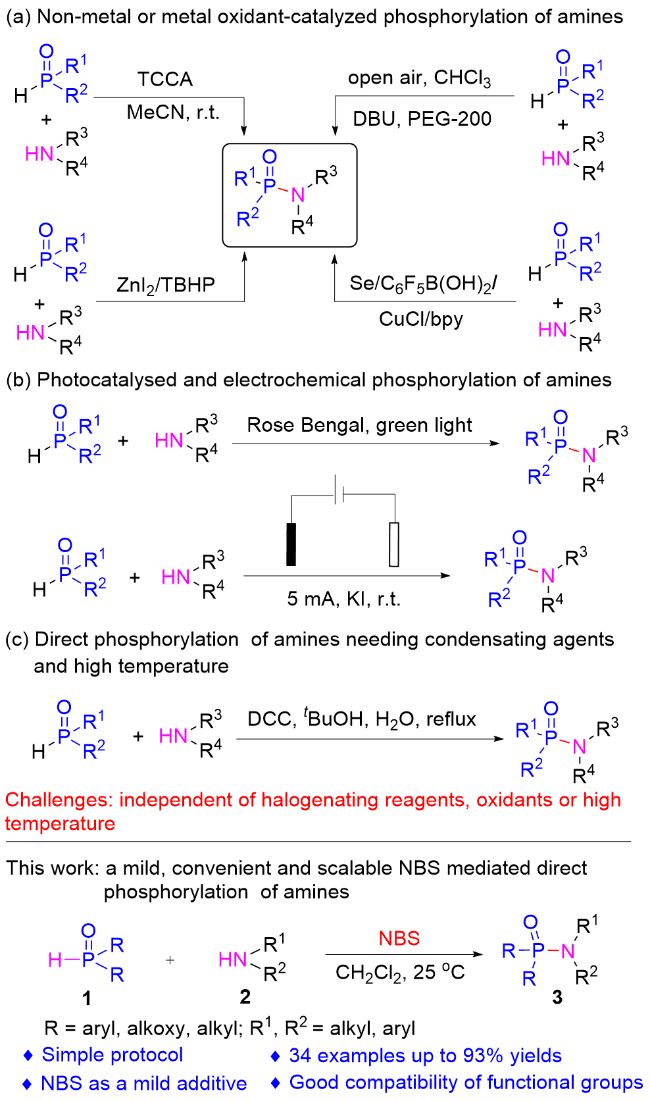
Recently, the photocatalyzed and electrochemical dehydrogenative phosphorylations were also investigated (Scheme 1b). For instance, in 2016, the Rios group[9] employed photocatalytic reactions for preparing phosphoramide compounds (Scheme 1b) and in 2021 the Gao group[10] utilized electrocatalytic reactions for the same purpose (Scheme 1b), yet accompanying by energy consumption and operational complexity. Furthermore, the direct amidation of R1R2P(O)OH with amines in the presence of condensation agents as activation reagents has also been developed, but depending on condensation agents or high temperature. (Scheme 1c).[11]
In recent years, phosphoryl radical-involved reactions have been extensively studied owing to their high reactivity.[6,12] For example, Chen and co-workers[6] reported a phosphoryl radical-initiated Atherton-Todd reaction using molecular oxygen as the radical source and chloroform (CHCl3) as the halogenating reagent for the phosphorylation of amines. However, these advanced phosphorus-contain- ing compounds are mainly synthesized via the phosphoryl radical-initiated Atherton-Todd protocols using carcinogenic chloroform or CCl4 as the halogenating reagent for the phosphorylation of amines. Free-radical chemistry might afford more efficient and convenient strategies for the synthesis of phosphamide. In our previous work,[13] the transition metal or non-metal oxidants could motivate the P(O)—H compounds to generate phosphorus free-radicals. Therefore, we envisaged whether the introducing of an additional free-radical species could promote the direct phosphorylation of amines with P(O)—H compounds.
To the best of our current knowledge, versatile synthetic utilizations of halogen-based intermediates have been extensively studied and successfully applied in numerous transformations, including highly efficient radical halonium catalysis.[14] The most commonly employed halogen sources encompass readily available hydrogen halides, highly reactive N-halosuccinimides (e.g., NBS, NIS), cost-effective halide salts, and related derivatives. For example, the Liang group[15] demonstrated that NBS could serve as a halogenating agent to initiate a facile P—N cross-coupling of P(O)—H compounds, ultimately affording the desired structurally diverse organic phosphamide in good to excellent yields.
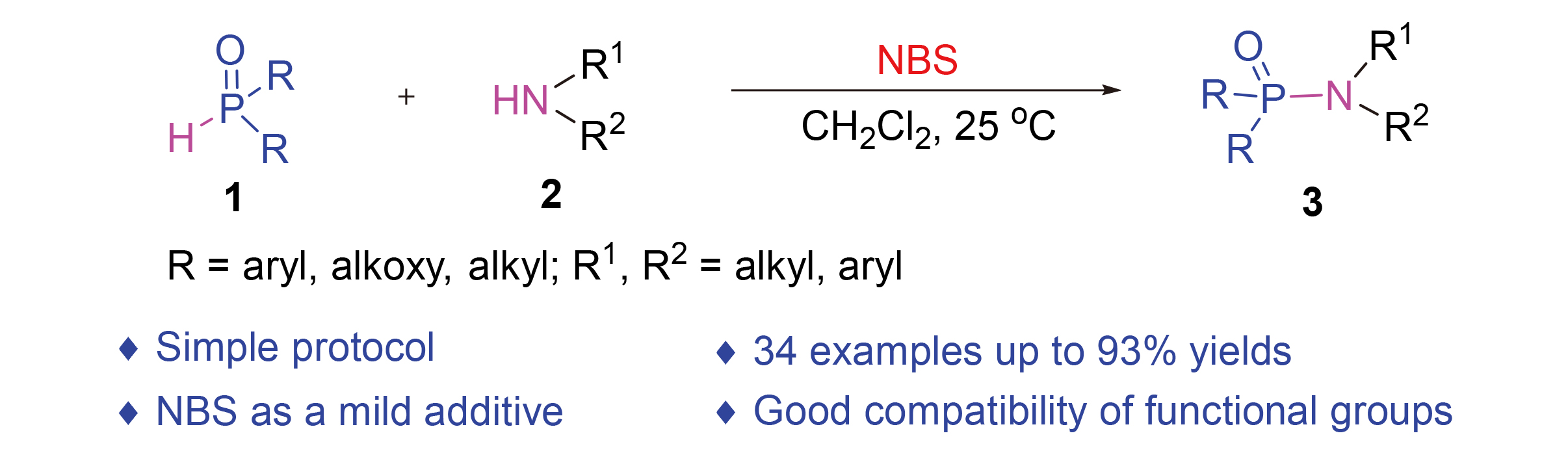
Encouraged by the recent development of P(O)—N bond forming reactions,[5-10] we envisioned that highly effective radical or halonium catalysis could potentially offer a promising strategy for the direct and efficient phosphorylation of amines. Accordingly, we herein present a mild, operationally simple, and environmentally benign method for the synthesis of structurally diverse phosphamide compounds via an NBS-mediated one-step phosphorylation reaction between amines and P(O)—H compounds. Notably, this protocol features broad substrate compatibility and exceptional functional group tolerance, thereby establishing a practical and sustainable alternative for the construction of valuable organic phosphamide compounds.
2 Results and discussion
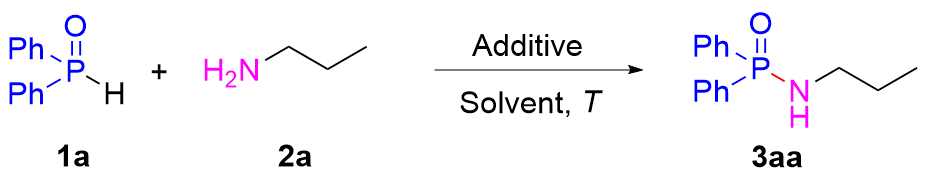
To optimize the reaction conditions, the model reaction between diphenylphosphine oxide (1a) and n-propylamine (2a) was initially investigated. The results are summarized in Table 1. Initially, NBS was employed as an additive to facilitate the phosphorylation of the amine. Notably, in toluene (Entry 1), the reaction afforded P,P-diphenyl-N-propylphosphinic amide (3aa) in 65% yield. To further explore the reaction conditions, N-chlorosuccinimide (NCS) and N-iodosuccinimide (NIS) were evaluated as alternative additives. However, both resulted in a moderate reduction in reaction efficiency (Entries 2, 3). Subsequently, a solvent screening was conducted, testing acetonitrile (MeCN), dimethylformamide (DMF), dimethyl sulfoxide (DMSO), dichloromethane (DCM), ethyl acetate (EA), 1,4-dioxane, carbon disulfide (CS2), chloroform (CHCl3), carbon tetrachloride (CCl4), tetrahydrofuran (THF) and acetone (Entries 4~14). The screening results revealed that DCM proved to be the optimal solvent for this transformation, delivering the desired product 3aa in 93% yield (Entry 7). In contrast, highly polar aprotic solvents, such as DMSO and DMF led to complete consumption of the starting materials without formation of the target product, instead yielding complex mixtures of unidentified by- products. Subsequently, the effect of the reaction temperature on the reaction was further investigated and the results showed that 25 ℃ was suitable for the reaction (Entries 15~18). Conclusively, the amount of NBS used was explored (Entry 19). Employing 1.5 equiv. of NBS sustained a 72% yield of 3aa. However, reducing the amount of NBS led to a significant decrease in the yield of 3aa, which indicated the excess use of NBS might be inevitable.
Table 1 Optimization of reaction conditionsa |
| Entry | Additive | Solvent | T/℃ | Yieldb/% |
|---|---|---|---|---|
| 1 | NBS | Toluene | 25 | 65 |
| 2 | NCS | Toluene | 25 | 62 |
| 3 | NIS | Toluene | 25 | 59 |
| 4 | NBS | CH3CN | 25 | 76 |
| 5 | NBS | DMF | 25 | None |
| 6 | NBS | DMSO | 25 | None |
| 7 | NBS | DCM | 25 | 93 |
| 8 | NBS | EA | 25 | 65 |
| 9 | NBS | Dioxane | 25 | 57 |
| 10 | NBS | CS2 | 25 | 75 |
| 11 | NBS | Chloroform | 25 | 87 |
| 12 | NBS | CCl4 | 25 | 85 |
| 13 | NBS | TH4 | 25 | 67 |
| 14 | NBS | Acetone | 25 | 65 |
| 15 | NBS | DCM | 0 | 78 |
| 16 | NBS | DCM | 45 | 87 |
| 17 | NBS | DCM | 60 | 76 |
| 18 | NBS | DCM | 80 | 65 |
| 19 | NBS | DCM | 25 | 45c, 64d, 72e |
a Reaction conditions: 1a (0.5 mmol), 2a (0.5 mL), additive (1.0 mmol), solvent (2.0 mL), air, 25 ℃, 6 h. b Isolated yields. c 0.2 mmol of NBS. d 0.5 mmol of NBS. e 0.75 mmol of NBS. |
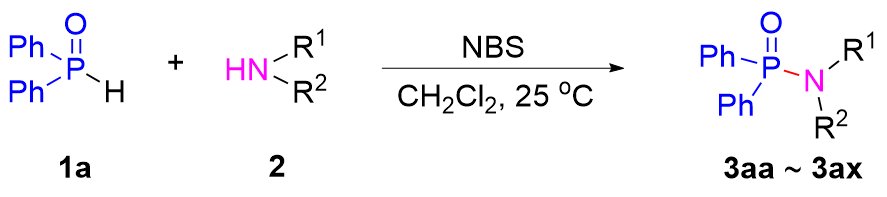
After obtaining the reaction conditions, the scope of the reaction was investigated (Table 2). Satisfactorily, a range of amines reacted efficiently with diphenylphosphine oxide to obtain the corresponding diphenylphosphinamides in moderate to excellent yields. Firstly, the chain length of fatty amines was examined. Both short-chain and long-chain primary amines can be smoothly converted into the corresponding products 3aa to 3ak in excellent yields of 61%~93%. Subsequently, other varieties of amines were explored, including different secondary amines, cycloalkylamines, branched amines, substituted amines, unsaturated amines and aromatic amines. However, these investigations only provided moderate yields (3al~3as, 3au~ 3aw). For instance, secondary amines such as diethylamine and dipropylamine afforded the desired products 3al~3am with yields of 78%~83%. Unsaturated amine compounds, such as propargyl amine, afforded the required 3an in 86% yield. In contrast, cyclic amines had lower yields (59%~78%). The products derived from cyclopropylamine and cyclobutylamine were 3ao~3ap. In addition, heterocyclic amines provided 3aq in a 78% yield. Immediately thereafter, isobutylamine and tert-butylamine were also found to undergo the reaction. However, for sterically hindered amines, the reaction slowed down, and by-products were produced, resulting in a relatively low yield of 3ar~3as. It is of significant note that when readily accessible and available aqueous ammonia was employed as a versatile amine source, the primary amide 3at was obtained in good yield. In addition, both aniline and p-fluoroaniline can react and form the corresponding products 3au~3av. Finally, 2-naphthyl-amine successfully underwent the reaction and generated the corresponding product 3aw. Amlodipine, a drug with therapeutic activity for hypertension and angina pectoris also worked well in this reaction, giving the phos- phinylated product 3ax in 66% yield. These results indicate that the direct phosphorylation promoted by NBS has a wide substrate range.
Table 2 Screening of substrate scopea,b |
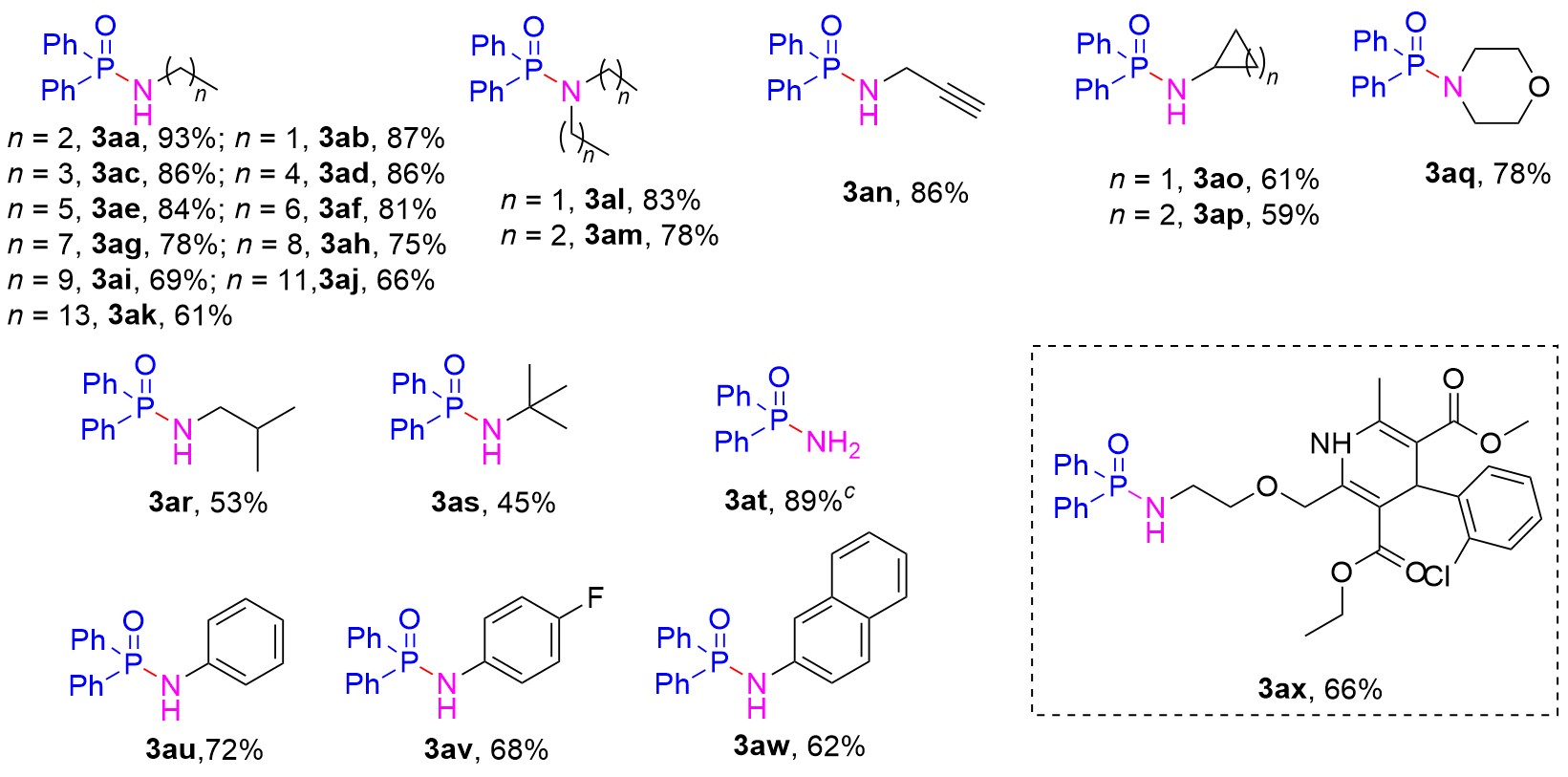 |
a Reaction conditions: 1a (0.5 mmol), 2 (1.0 mmol), NBS (1.0 mmol), CH2Cl2 (2.0 mL), air, 25 ℃, 6 h. b Isolated yields based on 1a. c Aqueous ammonia as amine source. |
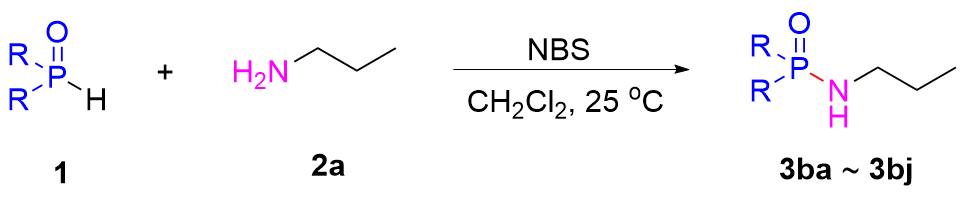
Subsequently, under the optimal conditions, the applicable scope of phosphamides was studied. As shown in Table 3, regardless of the electron donor groups (such as methyl groups) or electron-withdrawing groups (such as chlorine and bromine) on the benzene ring, various H-diaryl- phosphine oxides can effectively react with n-propylamine, and compounds 3ba~3bd have been successfully synthesized in yields of 79%~85%. It is worth noting that dimethyl- substituted and trisubstituted diphenylphosphine oxides can also react efficiently in this system, generating the product 3be and 3bf in 68% and 62% yields, respectively. Meanwhile, due to the greater steric hindrance of 1,1'-dinaphthyl- phosphine oxide, the target product 3bg was also successfully obtained in 58% yield. In addition, diphenyl phosphonate, diethyl phosphonate and diisopropyl phosphonate could all undergo the reaction to afford the corresponding products 3bh~3bj. In addition, to verify the synthetic applicability of this method, a gram-scale reaction was carried out under standard conditions, and the product 3aa was obtained in 91% yield, indicating that this scheme has good practical value in organic synthesis.
Table 3 Screening of substrate scopea,b |
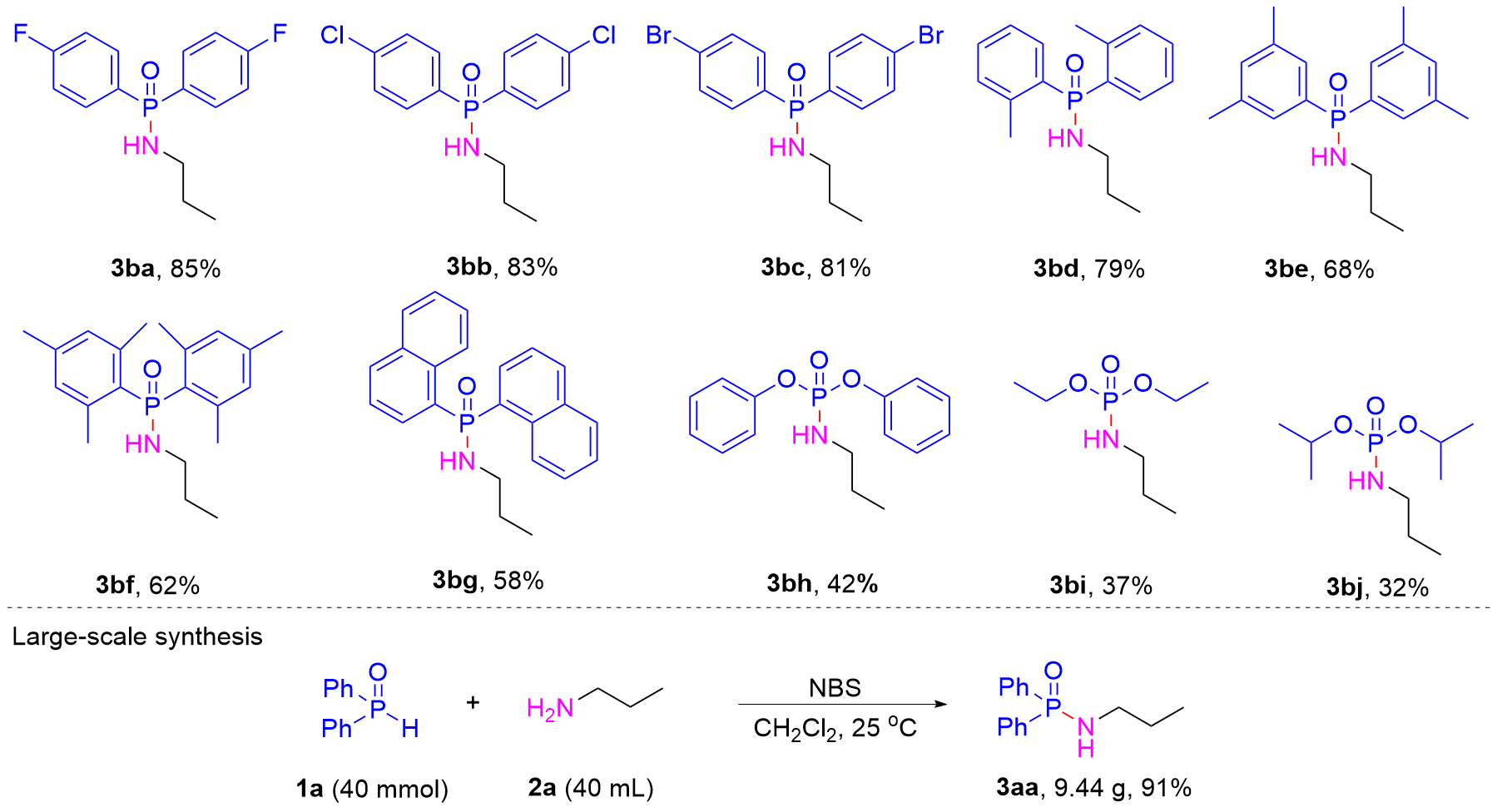 |
a Reaction conditions: 1a (40 mmol), 2a (40 mL), NBS (80 mmol), CH2Cl2 (160 mL), air, 25 ℃, 6 h. b Isolated yields based on 1a. |
To elucidate information on reaction mechanism, a series of control experiments were performed in Scheme 2. First- ly, when the radical scavenger 2,2,6,6-tetramethylpiperi- dinooxy (TEMPO) and 2,6-di-tert-butyl-4-methylphenol (BHT) were employed under the standard conditions, no product of 3aa was obtained, indicating that the free radical might be involved in the reaction. To capture the adducts, the liquid chromatography-high resolution mass spectrometry (LC-HRMS) analysis was conducted. Confirmed the presence of radical adduct A (calcd for C21H29NO2P [M+H]+ 358.1930; found 358.1929) and radical adduct B (calcd for C27H33O2P [M+H]+ 421.2292; found 421.2297) (Scheme 2a). Furthermore, an intermediate diphenylphosphinyl bromine E was also captured in the LC-HRMS analysis. Confirmed the presence of E (calcd for C13H15OP [M+H]+ 280.9731; found 280.9739). It reveals that diphenylphos- phinyl bromine was formed in this system (Scheme 2b). Additionally, when the reaction of 1a with 2a was carried out under argon atmosphere, no notable impact on the yield of product 3aa was observed (Scheme 2c). The process of aerobic oxidative cross-coupling could be excluded. Based on the above results of control experiments and previous studies,[5-10,13,16-18] a plausible mechanism for the direct phosphorylation of amines was described in Scheme 3.
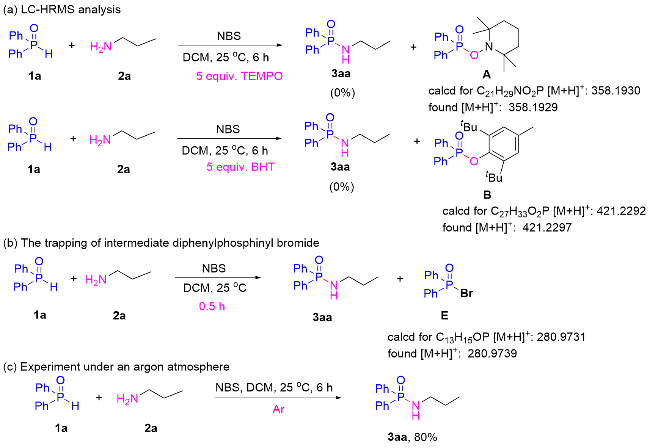
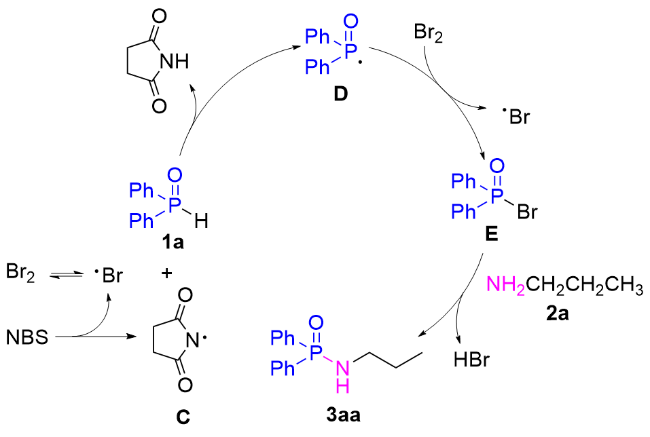


Firstly, NBS generated bromine radical and pyrrolidine-2,5- dione radical C through homolytic cleavage of bond. Bromine radicals combine to form bromine. Then, the radical C reacted with diphenylphosphine oxide 1a to afford active diphenylphosphoryl radical D, which then reacted with bromine to form phosphoryl bromide E. D and E were both captured in the LC-HRMS analysis. The resulting intermediate E then reacted with n-propylamine 2a to provide the final product 3aa.
3 Conclusions
In conclusion, the first NBS-initiated oxidative phosphorylation of amines with P(O)H compounds is described. Attractively, this protocol provides a mild, efficient, high atom-economical and gram-scaled access to various valuable phosphoramides without addition of metal, base or high temperature. Additionally, the cost-effec- tive and efficient synthesis of phosphamide compounds with broad functional-group tolerance demonstrates the potential of this method in organic synthesis.
4 Experimental section
4.1 Instruments and agents
Unless otherwise stated, commercially available reagents including dry solvents were used without additional purification. Petroleum ether refers to the petroleum fraction b.p. 60~90 ℃; All reactions were carried out in oven-dried thick-walled glassware. Flash chromatography was performed using the indicated solvent system on silica gel standard grade (200~300 mesh). 1H NMR and 13C NMR spectra were recorded on a Bruker advance III 600 spectrometer (600 MHz for 1H and 150 MHz for 13C) in CDCl3 with tetramethylsilane (TMS) as internal standard. Chemical shifts (δ) were measured relative to TMS δ=0 for 1H, or chloroform δ=77.0 for 13C as internal tandard. 31P NMR and 19F NMR were recorded on the same instrument. High-resolution mass spectra (HRMS) were recorded on a Q-Exactive Orbitrap mass spectrometer (Thermo, CA).
4.2 Synthesis of compound 3aa
NBS (178.0 mg, 1 mmol) was added to DCM (2 mL) solutions of diphenylphosphine oxide 1a (101.1mg, 0.5 mmol) and n-propylamine 2a (0.5 mL). The mixture was stirred at 25 ℃ under air for 6 h. The reaction mixture was then concentrated under reduced pressure. The crude product was purified by flash column chromatography on silica gel with petroleum ether/ethyl acetate (V∶V=5∶1) to afford propyl diphenylphosphamide 3aa (120.6 mg, 93%) as a white solid.
P,P-diphenyl-N-propylphosphinic amide (3aa): White solid, m.p. 90~92 ℃; 1H NMR (600 MHz, CDCl3) δ: 7.93~7.86 (m, 4H), 7.51~7.40 (m,6H), 2.95~2.88 (m, 2H), 2.84 (s, 1H), 1.62~1.53 (m, 2H), 0.90 (t, J=7.4 Hz, 3H); 13C NMR (151 MHz, CDCl3) δ: 132.05 (d, J=129.1 Hz), 132.23 (d, J=9.6 Hz), 131.93 (d, J=2.7 Hz), 128.65 (d, J=12.5 Hz), 42.73 (d, J=2.0 Hz), 25.46 (d, J=7.2 Hz), 11.40; 31P NMR (243 MHz, CDCl3) δ: 23.75. HRMS (ESI) calcd for C15H19NOP [M+H]+ 260.1199, found 260.1200.
N-Ethyl-P,P-diphenylphosphinic amide (3ab): White solid, m.p. 103~104 ℃; 1H NMR (600 MHz, CDCl3) δ: 7.92~7.85 (m, 4H), 7.50~7.36 (m, 6H), 3.05~2.96 (m, 2H), 2.82 (s, 1H), 1.19 (t, J=7.2 Hz, 3H); 13C NMR (151 MHz, CDCl3) δ: 132.70 (d, J=129.4 Hz), 132.20 (d, J=9.4 Hz), 131.87 (d, J=2.7 Hz), 128.62 (d, J=12.5 Hz), 35.80 (d, J=1.8 Hz), 17.84 (d, J=7.6 Hz); 31P NMR (243 MHz, CDCl3) δ: 23.47. HRMS (ESI) calcd for C14H17NOP [M+H]+ 246.1042, found 246.1044.
N-Butyl-P,P-diphenylphosphinic amide (3ac): White solid, m.p. 93~95 ℃; 1H NMR (600 MHz, CDCl3) δ: 7.93~7.85 (m, 4H), 7.56~7.40 (m, 6H), 3.02~2.89 (m, 2H), 2.78 (s, 1H), 1.62~1.45 (m, 2H), 1.39~1.25 (m, 2H), 0.88 (t, J=7.4 Hz, 3H); 13C NMR (151 MHz, CDCl3) δ: 133.15 (d, J=129.9 Hz), 132.25 (d, J=9.5 Hz), 131.93 (d, J=2.7 Hz), 128.32 (d, J=12.5 Hz), 40.67 (d, J=2.0 Hz), 34.41 (d, J=7.1 Hz), 20.05, 13.87; 31P NMR (243 MHz, CDCl3) δ: 23.55. HRMS (ESI) calcd for C16H21NOP [M+H]+ 274.1355, found 274.1358.
N-Pentyl-P,P-diphenylphosphinic amide (3ad): White solid, m.p. 97~98 ℃; 1H NMR (600 MHz, CDCl3) δ: 7.96~7.83 (m, 4H), 7.54~7.39 (m, 6H), 3.00~2.89 (m, 2H), 2.78 (s, 1H), 1.66~1.52 (m, 2H), 1.31~1.26 (m, 4H), 0.87 (t, J=7.3 Hz, 3H); 13C NMR (151 MHz, CDCl3) δ: 132.74 (d, J=129.1 Hz), 132.25 (d, J=9.4 Hz), 131.92 (d, J=2.7 Hz), 128.65 (d, J=12.5 Hz), 40.94 (d, J=1.9 Hz), 32.02 (d, J=7.1 Hz), 29.03, 22.45, 14.10; 31P NMR (243 MHz, CDCl3) δ: 23.50. HRMS (ESI) calcd for C17H23NOP [M+H]+ 288.1512, found 288.1514.
N-Hexyl-P,P-diphenylphosphinic amide (3ae): White solid, m.p. 89~90 ℃; 1H NMR (600 MHz, CDCl3) δ: 7.92~7.80 (m, 4H), 7.55~7.31 (m, 6H), 2.95~2.89 (m, 2H), 2.86 (s, 1H), 1.56~1.50 (m, 2H), 1.27~1.22 (m, 6H), 0.82 (t, J=7.2 Hz, 3H); 13C NMR (151 MHz, CDCl3) δ: 132.66 (d, J=129.2 Hz), 132.16 (d, J=9.3 Hz), 131.84 (d, J=2.7 Hz), 128.58 (d, J=12.4 Hz), 40.89 (d, J=2.0 Hz), 32.21 (d, J=7.2 Hz), 31.49, 26.49, 22.60, 14.06; 31P NMR (243 MHz, CDCl3) δ: 23.54. HRMS (ESI) calcd for C18H25NOP [M+H]+ 302.1668, found 302.1669.
N-Heptyl-P,P-diphenylphosphinic amide (3af): White solid, m.p. 83~84 ℃; 1H NMR (600 MHz, CDCl3) δ: 7.95~7.78 (m, 4H), 7.55~7.36 (m, 6H), 2.96~2.83 (m, 3H), 1.58~1.49 (m, 2H), 1.26~1.19 (m, 8H), 0.83 (t, J=6.9 Hz, 3H); 13C NMR (151 MHz, CDCl3) δ: 132.69 (d, J=129.3 Hz), 132.14 (d, J=9.3 Hz), 131.78 (d, J=2.9 Hz), 128.53 (d, J=12.5 Hz), 40.86 (d, J=1.9 Hz), 32.22 (d, J=7.3 Hz), 31.76, 28.95, 26.75, 22.61, 14.10; 31P NMR (243 MHz, CDCl3) δ: 23.48. HRMS (ESI) calcd for C19H27NOP [M+H]+ 316.1825, found 316.1826.
N-Noctyl-P,P-diphenylphosphinic amide (3ag): White solid, m.p. 70~71 ℃; 1H NMR (600 MHz, CDCl3) δ: 7.93~7.86 (m, 4H), 7.52~7.40 (m, 6H), 2.99~2.91 (m, 2H), 2.78 (s, 1H), 1.56 (m, 2H), 1.28~1.22 (m, 10H), 0.86 (t, J=7.1 Hz, 3H); 13C NMR (151 MHz, CDCl3) δ: 132.75 (d, J=129.2 Hz), 132.25 (d, J=9.3 Hz), 131.91 (d, J=2.9 Hz), 128.65 (d, J=12.5 Hz), 40.96 (d, J=2.0 Hz), 32.32 (d, J=7.4 Hz), 31.92, 29.34, 29.31, 26.89, 22.76, 14.22; 31P NMR (243 MHz, CDCl3) δ: 23.49. HRMS (ESI) calcd for C20H29NOP [M+H]+ 330.1981, found 330.1983.
N-Nonyl-P,P-diphenylphosphinic amide (3ah): White solid, m.p. 76~77 ℃; 1H NMR (600 MHz, CDCl3) δ: 7.90~7.84 (m, 4H), 7.48~7.37 (m, 6H), 2.95~2.89 (m, 2H), 2.86 (s, 1H), 1.55~1.51 (m, 2H), 1.26 (dt, J=14.1, 7.2 Hz, 12H), 0.85 (t, J=7.0 Hz, 3H); 13C NMR (151 MHz, CDCl3) δ: 132.68 (d, J=129.8 Hz), 132.18 (d, J=9.3 Hz), 131.82 (d, J=2.7 Hz), 128.56 (d, J=12.5 Hz), 40.89 (d, J=1.9 Hz), 32.24 (d, J=7.1 Hz), 31.90, 29.54, 29.35, 29.30 (d, J=2.7 Hz), 26.81, 22.71, 14.15; 31P NMR (243 MHz, CDCl3) δ: 23.54. HRMS (ESI) calcd for C21H31NOP [M+H]+ 344.2138, found 344.2139.
N-Decyl-P,P-diphenylphosphinic amide (3ai): White solid, m.p. 79~81 ℃; 1H NMR (600 MHz, CDCl3) δ: 7.90~7.83 (m, 4H), 7.47~7.37 (m, 6H), 2.95~2.89 (m, 2H), 2.86 (s, 1H), 1.53 (q, J=7.4 Hz, 2H), 1.22 (d, J=13.5 Hz, 14H), 0.85 (t, J=7.5 Hz, 3H); 13C NMR (151 MHz, CDCl3) δ: 132.69 (d, J=129.6 Hz), 132.17 (d, J=9.4 Hz), 131.80 (d, J=2.7 Hz), 128.55 (d, J=12.5 Hz), 40.88 (d, J=1.9 Hz), 32.24 (d, J=7.1 Hz), 31.94 (d, J=3.9 Hz), 29.64, 29.58, 29.38, 29.32 (d, J=5.9 Hz), 26.81, 22.72, 14.16; 31P NMR (243 MHz, CDCl3) δ: 23.51. HRMS (ESI) calcd for C22H33NOP [M+H]+ 358.2294, found 358.2295.
N-Dodecyl-P,P-diphenylphosphinic amide (3aj): White solid, m.p. 82~83 ℃; 1H NMR (600 MHz, CDCl3) δ: 7.92~7.86 (m, 4H), 7.51~7.40 (m, 6H), 2.97~2.90 (m, 2H), 2.79 (s, 1H), 1.55 (q, J=7.4 Hz, 2H), 1.30~1.20 (m, 18H), 0.87 (t, J=7.0 Hz, 3H); 13C NMR (151 MHz, CDCl3) δ: 132.18 (d, J=129.7 Hz), 132.25 (d, J=9.4 Hz), 131.91 (d, J=2.7 Hz), 128.65 (d, J=12.5 Hz), 40.96 (d, J=1.9 Hz), 32.32 (d, J=7.1 Hz), 32.04, 29.77, 29.75, 29.71, 29.66, 29.47, 29.38, 26.88, 22.82, 14.25; 31P NMR (243 MHz, CDCl3) δ: 23.52. HRMS (ESI) calcd for C24H37NOP [M+H]+ 386.2607, found 386.2608.
P,P-Diphenyl-N-tetradecylphosphinic amide (3ak): White solid, m.p. 85~86 ℃; 1H NMR (600 MHz, CDCl3) δ: 7.94~7.83 (m, 4H), 7.56~7.36 (m, 6H), 2.98~2.91 (m, 2H), 2.78 (s, 1H), 1.56 (t, J=7.3 Hz, 2H), 1.32~1.19 (m, 22H), 0.87 (t, J=6.9 Hz, 3H); 13C NMR (151 MHz, CDCl3) δ: 132.30 (d, J=129.8 Hz), 132.27 (d, J=9.3 Hz), 131.94 (d, J=2.6 Hz), 128.67 (d, J=12.4 Hz), 40.97 (d, J=1.8Hz), 32.33 (d, J=7.2 Hz), 32.06, 29.83, 29.80, 29.79, 29.78,29.72, 29.67, 29.50, 29.39, 26.89, 22.83, 14.27; 31P NMR (243 MHz, CDCl3) δ: 23.61. HRMS (ESI) calcd for C26H41NOP [M+H]+ 414.2920, found 414.2922.
N,N-Diethyl-P,P-diphenylphosphinic amide (3al): White solid, m.p. 135~138 ℃; 1H NMR (600 MHz, CDCl3) δ: 7.88~7.81 (m, 4H), 7.50~7.39 (m, 6H), 3.06 (dq, J=10.8, 7.1 Hz, 4H), 1.09 (t, J=7.1 Hz, 6H); 13C NMR (151 MHz, CDCl3) δ: 132.40 (d, J=127.6 Hz), 132.47 (d, J=9.2 Hz), 131.66 (d, J=2.7 Hz), 128.55 (d, J=12.5 Hz), 39.45 (d, J=3.3 Hz), 14.22 (d, J=4.2 Hz); 31P NMR (243 MHz, CDCl3) δ: 30.52. HRMS (ESI) calcd for C16H21NOP [M+H]+ 274.1355, found 274.1356.
P,P-Diphenyl-N,N-dipropylphosphinic amide (3am): White solid, m.p. 141~142 ℃; 1H NMR (600 MHz, CDCl3) δ: 7.87~7.79 (m, 4H), 7.50~7.38 (m, 6H), 2.95~2.86 (m, 4H), 1.59~1.49 (m, 4H), 0.74 (t, J=7.4 Hz, 6H); 13C NMR (151 MHz, CDCl3) δ: 132.67 (d, J=128.5 Hz), 132.51 (d, J=9.2 Hz), 131.67 (d, J=2.7 Hz), 128.50 (d, J=12.4 Hz), 47.66 (d, J=3.1 Hz), 21.98 (d, J=3.7 Hz), 11.49; 31P NMR (243 MHz, CDCl3) δ: 30.55. HRMS (ESI) calcd for C18H25NOP [M+H]+ 302.1668, found 302.1669.
P,P-Diphenyl-N-(prop-2-yn-1-yl)phosphinic amide (3an): White solid, m.p. 115~117 ℃; 1H NMR (600 MHz, CDCl3) δ: 7.90~7.75 (m, 4H), 7.56~7.36 (m, 6H), 4.30 (s, 1H), 4.17~4.03 (m, 2H), 3.90 (s, 1H); 13C NMR (151 MHz, CDCl3) δ: 132.33 (d, J=129.9 Hz),132.24 (d, J=3.0 Hz), 131.79 (d, J=9.9 Hz), 128.66 (d, J=13.1 Hz), 61.26 (d, J=10.5 Hz), 16.67, 16.63; 31P NMR (243 MHz, CDCl3) δ: 31.31. HRMS (ESI) calcd for C15H15NOP [M+H]+ 256.0886, found 256.0887.
N-Cyclopropyl-P,P-diphenylphosphinic amide (3ao): White solid, m.p. 132~133 ℃; 1H NMR (600 MHz, CDCl3) δ: 7.92~7.84 (m, 4H), 7.53~7.40 (m, 6H), 3.29 (s, 1H), 2.53~2.46 (m, 1H), 0.62~0.42 (m, 4H); 13C NMR (151 MHz, CDCl3) δ: 132.92 (d, J=127.9 Hz), 132.14 (d, J=9.6 Hz), 131.93 (d, J=2.8 Hz), 128.59 (d, J=12.5 Hz), 23.21, 7.55 (d, J=5.0 Hz); 31P NMR (243 MHz, CDCl3) δ: 23.38. HRMS (ESI) calcd for C15H17NOP [M+H]+ 258.1042, found 258.1044.
N-Cyclobutyl-P,P-diphenylphosphinic amide (3ap): White solid, m.p. 140~141 ℃; 1H NMR (600 MHz, CDCl3) δ: 7.92~7.81 (m, 4H), 7.53~7.39 (m, 6H), 3.66 (s, 1H), 3.11 (s, 1H), 2.00~1.63 (m, 4H), 1.60~1.39 (m, 2H); 13C NMR (151 MHz, CDCl3 ) δ: 132.92 (d, J=127.7 Hz), 132.27 (d, J=9.7 Hz), 131.96 (d, J=2.7 Hz), 128.64 (d, J=12.2 Hz), 47.12, 34.57 (d, J=5.3 Hz), 14.74; 31P NMR (243 MHz, CDCl3) δ: 21.77. HRMS (ESI) calcd for C16H19NOP [M+H]+ 272.1199, found 272.1200.
Morpholinodiphenylphosphine oxide (3aq): White solid, m.p. 98~100 ℃; 1H NMR (600 MHz, CDCl3) δ: 7.93~7.82 (m, 4H), 7.59~7.38 (m, 6H), 3.70 (t, J=4.6 Hz, 4H), 3.11~2.99 (m, 4H); 13C NMR (151 MHz, CDCl3) δ: 132.54 (d, J=8.9 Hz), 132.10 (d, J=2.7 Hz), 131.04 (d, J=128.9 Hz), 128.85 (d, J=12.5 Hz), 67.37 (d, J=6.8 Hz), 45.12; 31P NMR (243 MHz, CDCl3) δ: 29.00. HRMS (ESI) calcd for C16H19NO2P [M+H]+ 288.1148, found 288.1150.
N-Isobutyl-P,P-diphenylphosphinic amide (3ar): White solid, m.p. 189~191 ℃; 1H NMR (600 MHz, CDCl3) δ: 7.94~7.84 (m,4H), 7.54~7.35 (m, 6H), 2.83 (s, 1H), 2.80~2.72 (m, 2H), 1.83~1.73 (m, 1H), 0.92 (d, J=6.7 Hz, 6H); 13C NMR (151 MHz, CDCl3) δ: 132.33 (d, J=129.6 Hz), 132.28 (d, J=9.4 Hz), 131.95 (d, J=2.8 Hz), 128.67 (d, J=12.5 Hz), 48.38 (d, J=2.2 Hz), 30.29 (d, J=7.1 Hz), 20.18, 19.33; 31P NMR (243 MHz, CDCl3) δ: 23.61. HRMS (ESI) calcd for C16H21NOP [M+H]+ 274.1355, found 274.1357.
N-(tert-Butyl)-P,P-diphenylphosphinic amide (3as): White solid, m.p. 133~135 ℃; 1H NMR (600 MHz, CDCl3) δ: 8.00~7.77 (m, 4H), 7.56~7.32 (m, 6H), 2.78 (s, 1H), 1.32~1.19 (m, 9H); 13C NMR (151 MHz, CDCl3) δ: 137.15 ( d, J=128.1Hz),131.29( d, J=9.6Hz),131.22( d, J=2.7Hz), 128.32( d, J=12.5 Hz), 32.05 (d, J=4.4 Hz), 28.87 (d, J=5.0 Hz), 28.74, 28.62; 31P NMR (243 MHz, CDCl3) δ: 17.00. HRMS (ESI) calcd for C16H21NOP [M+H]+ 274.1355, found 274.1356.
P,P-Diphenylphosphinic amide (3at): White solid, m.p. 160~162 ℃; 1H NMR (600 MHz, CDCl3) δ: 7.86~7.77 (m, 4H), 7.53~7.49 (m, 2H), 7.44 (m, 4H), 4.11 (t, J=7.1 Hz, 2H); 13C NMR (151 MHz, CDCl3) δ: 132.23 (d, J=2.8 Hz), 131.76 (d, J=10.0 Hz), 131.34 (d, J=128.2Hz), 128.65 (d, J=13.1 Hz); 31P NMR (243 MHz, CDCl3) δ: 31.36. HRMS (ESI) calcd for C12H13NOP [M+H]+ 218.0729, found 218.0731.
N,P,P-Triphenylphosphinic amide (3au): White solid, m.p. 230~232 ℃; 1H NMR (600 MHz, CDCl3) δ: 7.92~7.85 (m, 4H), 7.56~7.42 (m, 6H), 7.16~7.10 (m, 2H), 7.02~6.83 (m, 3H), 5.28 (s, 1H); 13C NMR (151 MHz, CDCl3) δ: 140.44, 132.41 (d, J=2.7 Hz), 132.12 (d, J=9.9 Hz), 131.62 (d, J=130.8 Hz), 129.43, 128.97 (d, J=13.0 Hz), 122.00, 118.59 (d, J=6.5 Hz); 31P NMR (243 MHz, CDCl3) δ: 18.41. HRMS (ESI) calcd for C18H17NOP [M+H]+ 294.1042, found 294.1043.
N-(4-Fluorophenyl)-P,P-diphenylphosphinic amide (3av): White solid, m.p. 170~172 ℃; 1H NMR (600 MHz, CDCl3) δ: 7.22~7.13 (m, 5H), 6.92~6.80 (m, 5H), 6.74~6.66 (m, 4H), 3.93 (s, 1H); 13C NMR (151 MHz, CDCl3) δ: 155.49 (d, J=239.8 Hz), 144.89,140.70 (d, J=2.6 Hz), 119.42, 119.25, 116.04 (d, J=8.0 Hz), 115.37 (d, J=22.3 Hz), 108.76 (d, J=9.9 Hz); 31P NMR (243 MHz, CDCl3) δ: -19.95; 19F NMR (565 MHz, CDCl3) δ: -125.25. HRMS (ESI) calcd for C18H16FNOP [M+H]+ 312.0948, found 312.0949.
N-(Naphthalen-2-yl)-P,P-diphenylphosphinic amide (3aw): White solid, m.p. 166~167 ℃; 1H NMR (600 MHz, CDCl3) δ: 8.08~7.76 (m, 6H), 7.61~7.27 (m, 10H), 7.00 (m, 1H), 4.32 (s, 1H); 13C NMR (151 MHz, CDCl3) δ: 142.55, 142.16, 133.21(d, J=1.9 Hz), 131.88 (d, J=9.7 Hz), 130.48 (d, J=134.1 Hz), 128.23, 127.81 (d, J=11.0 Hz), 126.97 (d, J=7.9 Hz), 125.04, 123.05, 118.76, 117.83 (d, J=3.8 Hz). HRMS (ESI) calcd for C22H19NOP [M+H]+ 344.3732, found 344.3734.
3-Ethyl 5-methyl 4-(2-chlorophenyl)-2-((2-((diphenyl-phosphoryl)amino)ethoxy)methyl)-6-methyl-1,4-dihydropyridine-3,5-dicarboxylate (3ax): White solid, m.p. 282~283 ℃; 1H NMR (600 MHz, CDCl3) δ: 7.92 (m, 4H), 7.55~7.50 (m, 2H), 7.48~7.41 (m, 5H), 7.21 (m, 1H), 7.12 (m, 1H), 7.04~6.99 (m, 1H), 5.41 (s, 1H), 4.76 (d, J=15.3 Hz, 1H), 4.67 (d, J=15.4 Hz, 1H), 4.04 (dddd, J=13.5, 10.8, 9.0, 5.4 Hz, 3H), 3.68~3.54 (m, 5H), 3.12 (q, J=6.8 Hz, 1H), 2.95 (s, 1H), 2.88 (s, 1H), 2.53 (s, 3H), 1.18 (t, J=7.1 Hz, 3H); 13C NMR (151 MHz, CDCl3) δ: 168.01 (d, J=135.5 Hz), 146.49, 146.00 (d, J=5.8 Hz), 132.77, 132.64, 132.38 (d, J=9.3 Hz), 132.29, 132.23, 132.20, 132.19, 131.71, 131.06, 129.17, 128.88 (d, J=2.3 Hz), 128.80 (d, J=2.3 Hz), 127.19 (d, J=41.3 Hz), 102.62 (d, J=276.0 Hz), 71.68 (d, J=2.8 Hz), 68.33, 65.71, 59.86, 50.82, 41.61, 37.04, 30.71, 19.32, 19.05, 14.42, 13.86; 31P NMR (243 MHz, CDCl3) δ: 24.24. HRMS (ESI) calcd for C32H35ClN2O6P [M+H]+ 609.1916, found 609.1917.
P,P-Bis(4-fluorophenyl)-N-propylphosphinic amide (3ba): White solid, m.p. 98~99 ℃; 1H NMR (600 MHz, CDCl3) δ: 7.91~7.83 (m, 4H), 7.15~7.07 (m, 4H), 2.88 (dt, J=8.7, 5.6 Hz, 3H), 1.57 (ddt, J=14.4, 10.6, 5.3 Hz, 2H), 0.90 (t, J=7.4 Hz, 3H); 13C NMR (151 MHz, CDCl3) δ: 165.25 (dd, J=253.0, 3.3 Hz), 134.70 (dd, J=10.8, 8.8 Hz), 128.44 (dd, J=133.5, 3.2 Hz), 116.02 (ddd, J=21.8, 14.0, 2.2 Hz), 42.74 (d, J=2.0 Hz), 25.43 (d, J=7.2 Hz), 11.37; 31P NMR (243 MHz, CDCl3) δ: 21.91; 19F NMR (565 MHz, CDCl3) δ: -107.02. HRMS (ESI) calcd for C15H17- F2NOP [M+H]+ 296.1010, found 296.1011.
P,P-Bis(4-chlorophenyl)-N-propylphosphinic amide (3bb): White solid, m.p. 96~97 ℃; 1H NMR (600 MHz, CDCl3) δ: 7.83~7.74 (m, 4H), 7.46~7.36 (m, 4H), 2.91~2.87 (m, 2H), 1.97 (s, 1H), 1.58 (h, J=7.2 Hz, 2H), 0.90 (t, J=7.4 Hz, 3H); 13C NMR (151 MHz, CDCl3) δ: 138.81 (d, J=3.6 Hz), 133.63 (d, J=10.3 Hz), 130.83 (d, J=131.8 Hz), 129.13 (d, J=13.1 Hz), 42.80 (d, J=2.1 Hz), 25.46 (d, J=7.2 Hz), 11.39; 31P NMR (243 MHz, CDCl3) δ: 21.84. HRMS (ESI) calcd for C15H17Cl2NOP [M+H]+ 328.0419, found 328.0420.
P,P-Bis(4-bromophenyl)-N-propylphosphinic amide (3bc): White solid, m.p. 99~100 ℃; 1H NMR (600 MHz, CDCl3) δ: 7.75~7.66 (m, 4H), 7.59~7.53 (m, 4H), 3.01 (s, 1H), 2.91~2.83 (m, 2H), 1.56 (h, J=7.4 Hz, 2H), 0.89 (t, J=7.4 Hz, 3H); 13C NMR (151 MHz, CDCl3) δ: 133.71 (d, J=10.2 Hz), 132.02 (d, J=12.9 Hz), 131.28 (d, J=131.3 Hz), 127.35 (d, J=3.7 Hz), 42.75 (d, J=2.1 Hz), 25.41 (d, J=7.1 Hz), 11.36; 31P NMR (243 MHz, CDCl3) δ: 22.13. HRMS (ESI) calcd for C15H17Br2NOP [M+H]+ 415.9409, found 415.9411.
N-Propyl-P,P-di-o-tolylphosphinic amide (3bd): White solid, m.p. 95~96 ℃; 1H NMR (600 MHz, CDCl3) δ: 7.71~7.64 (m, 2H), 7.41~7.35 (m, 2H), 7.25~7.18 (m, 4H), 3.07~2.95 (m, 2H), 2.69 (s, 1H), 2.52~2.44 (m, 6H), 1.62 (q, J=7.3 Hz, 2H), 0.93 (t, J=7.4 Hz, 3H); 13C NMR (151 MHz, CDCl3) δ: 142.43 (d, J=9.8 Hz), 133.06 (d, J=10.8 Hz), 131.87, 131.85, 131.83, 131.79, 131.33 (d, J=123.5 Hz), 125.48 (d, J=12.5 Hz), 42.91, 25.57 (d, J=6.1 Hz), 21.67 (d, J=4.0 Hz), 11.48; 31P NMR (243 MHz, CDCl3) δ: 28.02. HRMS (ESI) calcd for C17H23NOP [M+H]+ 288.1512, found 288.1513.
P,P-Bis(3,5-dimethylphenyl)-N-propylphosphinic amide (3be): White solid, m.p. 102~103 ℃; 1H NMR (600 MHz, CDCl3) δ: 7.55~7.41 (m, 6H), 2.92~2.88 (m, 2H), 2.74 (s, 1H), 2.33 (s, 12H), 1.60~1.56 (m, 2H), 0.91 (t, J=7.4 Hz, 3H); 13C NMR (151 MHz, CDCl3) δ: 138.28 (d, J=13.1 Hz), 133.58 (d, J=2.8 Hz), 132.56 (d, J=128.1 Hz), 129.80 (d, J=9.3 Hz), 42.73 (d, J=2.1 Hz), 25.54 (d, J=7.1 Hz), 21.40, 11.46; 31P NMR (243 MHz, CDCl3) δ: 24.35. HRMS (ESI) calcd for C19H27NOP [M+H]+ 316.1825, found 316.1826.
P,P-Dimesityl-N-propylphosphinic amide (3bf): White solid, m.p. 108~109 ℃; 1H NMR (600 MHz, CDCl3) δ: 6.85~6.77 (m, 4H), 2.99~2.85 (m, 2H), 2.58 (s, 1H), 2.38 (s, 12H), 2.25 (s, 6H), 1.72 (m, 2H), 1.44 (dt, J=14.4, 7.3 Hz, 3H); 13C NMR (151 MHz, CDCl3) δ: 132.47 (d, J=129.8 Hz), 131.07 (d, J=2.9 Hz), 130.92 (d, J=12.0 Hz), 129.00 (d, J=9.9 Hz), 65.73, 42.93, 30.73, 29.85, 22.90 (d, J=4.3 Hz), 21.09, 19.34, 13.88, 11.60; 31P NMR (243 MHz, CDCl3) δ: 29.34. HRMS (ESI) calcd for C21H31NOP [M+H]+ 344.2138, found 344.2139.
P,P-Di(naphthalen-1-yl)-N-propylphosphinic amide (3bg): White solid, m.p. 105~106 ℃; 1H NMR (600 MHz, CDCl3) δ: 8.96~8.83 (m, 2H), 8.06~7.95 (m, 2H), 7.93~7.84 (m, 4H), 7.58~7.49 (m, 4H), 7.46~7.41 (m, 2H), 3.19~3.09 (m, 2H), 3.04 (s, 1H), 1.67~1.65 (m, 2H), 0.93 (t, J=7.4 Hz, 3H); 13C NMR (151 MHz, CDCl3) δ: 134.09 (d, J=10.1 Hz), 133.80 (d, J=9.8 Hz), 133.38 (d, J=10.7 Hz), 133.17 (d, J=2.9 Hz), 129.45 (d, J=124.4 Hz), 128.94, 127.47, 127.44, 127.40, 126.46, 124.67 (d, J=14.3 Hz), 43.25, 25.61 (d, J=6.1 Hz), 11.52; 31P NMR (243 MHz, CDCl3) δ: 29.11. HRMS (ESI) calcd for C23H23NOP [M+H]+ 360.1512, found 360.1514.
Diphenyl propylphosphate (3bh): White solid, m.p. 94~95 ℃; 1H NMR (600 MHz, CDCl3) δ: 7.34~7.30 (m, 4H), 7.28~7.11 (m, 6H), 3.37 (s, 1H), 3.09~2.96 (m, 2H), 1.47 (h, J=7.3 Hz, 2H), 0.85 (t, J=7.0 Hz, 3H); 13C NMR (151 MHz, CDCl3) δ: 150.99 (d, J=6.6 Hz), 129.74, 124.93, 120.32 (d, J=5.0 Hz), 43.65, 24.72 (d, J=6.4 Hz), 11.14; 31P NMR (243 MHz, CDCl3) δ: -0.45. HRMS (ESI) calcd for C15H19NOP [M+H]+ 292.1097, found 292.1098.
Diethyl propylphosphoramidate (3bi): Colorless oil. 1H NMR (600 MHz, CDCl3) δ: 4.06~3.87 (m, 4H), 2.84 (s, 1H), 2.81~2.76 (m, 2H), 1.45 (q, J=7.2 Hz, 2H), 1.26 (td, J=7.1, 0.9 Hz, 6H), 0.85 (t, J=7.4 Hz, 3H); 13C NMR (151 MHz, CDCl3) δ: 62.10 (d, J=5.4 Hz), 43.20, 24.92 (d, J=6.1 Hz), 16.22 (d, J=7.1 Hz), 11.14; 31P NMR (243 MHz, CDCl3) δ: 9.32. HRMS (ESI) calcd for C7H19NO3P [M+H]+ 196.1097, found 196.1098.
Diisopropyl propylphosphoramidate (3bj): Colorless oil. 1H NMR (600 MHz, CDCl3) δ: 4.64~4.54 (m, 2H), 2.89~2.81 (m, 2H), 2.42 (s, 1H), 1.50 (h, J=7.3 Hz, 2H), 1.32 (dd, J=8.1, 6.2 Hz, 12H), 0.91 (t, J=7.4 Hz, 3H); 13C NMR (151 MHz, CDCl3) δ: 70.70 (d, J=5.5 Hz), 43.43, 25.00 (d, J=6.8 Hz), 24.00, 23.97 (d, J=2.6 Hz), 11.31; 31P NMR (243 MHz, CDCl3) δ: 7.29. HRMS (ESI) calcd for C9H23NO3P [M+H]+ 224.1410, found 224.1411.
Supporting Information Reaction condition optimization; overview of substrates numbering; typical experimental procedures; 1H NMR, 13C NMR, 31P NMR, 19F NMR spectra for products 3aa~3ax, 3ba~3bj. The Supporting Information is available free of charge via the Internet at http://sioc-journal.cn.
(Lu, Y.)