


1 Introduction
Hydrazones and oxime ethers, two important classes of Schiff bases, have found extensive applications in pharmaceuticals,[1] pesticides,[2] chemical synthesis,[3] and materials chemistry,[4] owing to their remarkable chemical, physical, and biological properties. Accordingly, the development of efficient synthetic methodologies toward these compounds has long been a prominent research focus in synthetic organic chemistry. The conventional synthesis of hydrazones generally relies on the nucleophilic addition-elimination reaction between carbonyl compounds and substituted hydrazines (Scheme 1, I, a). In recent years, advances in synthetic organic chemistry have led to the development of several alternative routes to hydrazones and oxime ethers, including the dehydrogenative coupling of arylhydrazines with alcohols (Scheme 1, I, b),[5] the reaction of alkenes with substituted hydrazines (Scheme 1, I, c),[6] the reaction of haloalkanes with substituted hydrazines (Scheme 1, I, d),[7] the direct coupling of hydrazine derivatives to access hydrazones (Scheme 1, I, e),[8] and the nucleophilic substitution of azides with hydrazines (Scheme 1, I, f).[9] Commonly employed synthetic strategies for oxime ethers can be divided into two main categories: the dehydration condensation of carbonyl compounds with hydroxylamine derivatives (Scheme 1, I, g), and the O-coupling reaction of oximes with aryl halides, arylboronic acids, or alcohols (Scheme 1, I, h).[10] Very recently, a cobalt-catalyzed protocol for the synthesis of oxime ethers through C=C bond cleavage of alkenes with hydroxylamine derivatives has been reported (Scheme 1, I, i).[11]
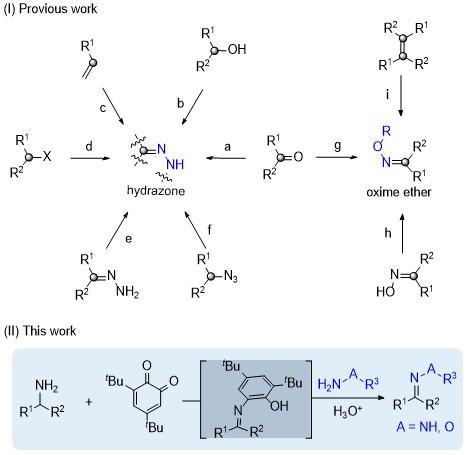
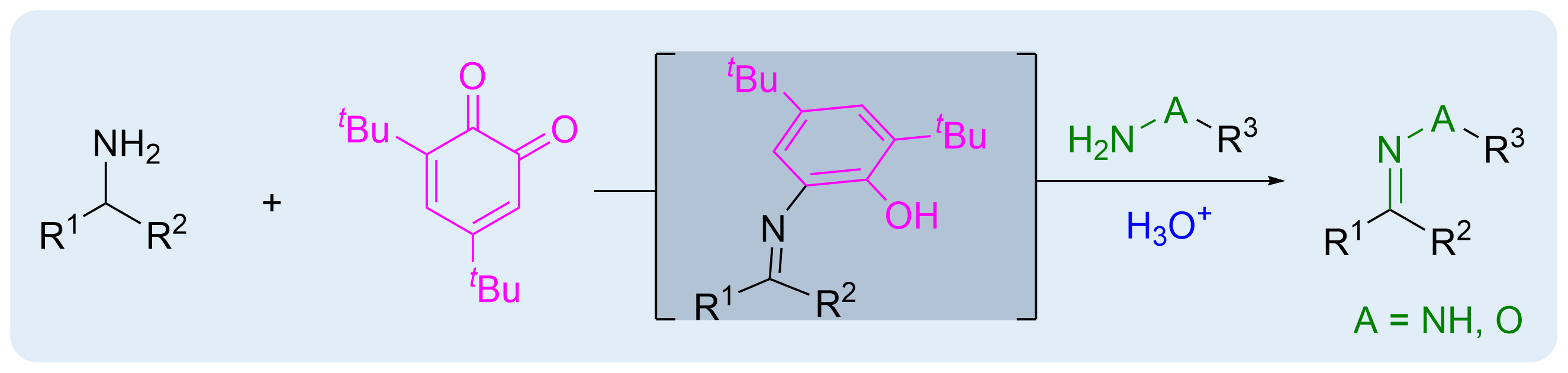
However, to date, no one-pot synthetic protocol has been reported for the direct construction of hydrazones and oxime ethers from readily available amino compounds. Currently, hydrazones and oxime ethers can only be accessed indirectly from amino compounds via a two-step sequence: the amino group is first converted into a reactive intermediate (e.g., carbonyl compound,[12] alcohol,[13] alkyl halide,[14] or azide[15]), which is then subjected to subsequent transformations. These multi-step strategies generally require precious metal catalysts (e.g., Ru or Co), peroxide-based oxidants, or harsh reaction conditions including elevated temperatures and high pressures, thus suffering from low economic efficiency and potential safety risks. Given these limitations, the development of a facile and efficient one-pot strategy for the direct synthesis of hydrazones and oxime ethers from amino compounds is highly desirable and of great synthetic value. As early as the mid-20th century, Corey and coworkers[12a] reported a mild and highly efficient protocol for the oxidation of primary amines to ketones. Under acidic conditions, 3,5-di-tert- butyl-o-benzoquinone activates the amino group to form an imine intermediate, which is subsequently converted in situ to the corresponding carbonyl compound under acidic conditions. This seminal work thus provides a theoretical foundation for the efficient construction of hydrazones and oxime ethers directly from amino compounds (Scheme 1, II). This newly developed strategy eliminates the requirement for precious metal catalysts and inert atmosphere protection, enabling the efficient one-pot synthesis of a diverse array of hydrazones and oxime ethers at ambient temperature.
In this study, we systematically optimized the reaction conditions using α-methylbenzylamine and methyl hydrazinecarboxylate as model substrates, and demonstrated that this protocol features a broad substrate scope, encompassing aromatic, heterocyclic, and aliphatic amines. This one- pot approach delivers a wide range of hydrazone products and the corresponding oxime ether derivatives in high to excellent yields, and can be successfully scaled up to the gram scale without significant loss of reactivity. Mechanistic investigations revealed a plausible reaction pathway, which involves two sequential nucleophilic addition-dehy- dration steps between the amino substrate and the in situ generated ketone intermediate. Overall, this work provides a cost-effective, operationally simple, and environmentally benign strategy for the one-pot synthesis of hydrazones and oxime ethers directly from amino compounds, which holds great potential for applications in organic synthesis and related fields.
2 Results and discussion
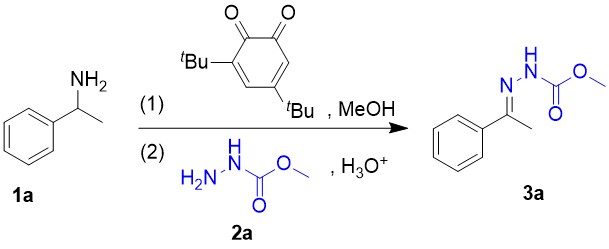
The reaction was initially performed with 1 mmol of α-methylbenzylamine (1a) as the model substrate, to which 1 mmol of 3,5-di-tert-butyl-o-benzoquinone dissolved in 4 mL of methanol was added. After the resulting mixture was stirred at ambient temperature for 1 h, 2 mmol of methyl hydrazinecarboxylate and 2 mmol of 6 mol/L aqueous HCl were introduced to the reaction system, and the mixture was stirred for a further 3 h, furnishing the corresponding product in 65% yield (Table 1, Entry 1). To improve the reaction efficiency, we systematically investig-ated the effects of both reactant stoichiometry and the type of acid additive. Acid screening results showed that 50% TFA/H2O did not lead to a notable improvement in yield (Table 1, Entry 2), whereas 50% AcOH/H2O (V/V) afforded an increased yield of 82% (Table 1, Entry 3), suggesting that a weakly acidic environment is more favorable for this transformation. In contrast, anhydrous AcOH delivered an inferior yield of only 31% (Table 1, Entry 4), indicating that the presence of water is critical for promoting the reaction. This observation was further supported by subsequent mechanistic investigations, which revealed that water participates in the hydrolysis of the key imine intermediate. With 50% AcOH/H2O (V/V) identified as the optimal acid additive, the influence of adjusting the reactant stoichiometry was next evaluated. Slightly increasing the loading of α-methylbenzylamine (1a) to 1.1 equiv. further improved the reaction yield (Table 1, Entry 5), while further increasing it to 1.2 equiv. (Table 1, Entry 6) provided no additional improvement in yield, which is presumably attributed to side reactions involving excess amine. From the perspective of economic efficiency, the dosage of methyl hydrazinecarboxylate (2a) was further investigated for reduction. Reducing the loading of 2a to 1.5 equiv. still furnished the product in 86% yield (Table 1, Entry 7), while further decreasing it to 1.2 equiv. resulted in a slight drop in yield to 83% (Table 1, Entry 8). Based on these optimizations, the optimal reaction conditions were thus established as follows: 1a (1.1 equiv.) and 3,5-di-tert-but- yl-o-benzoquinone (1.0 equiv) were stirred in methanol at ambient temperature for 1 h. Subsequently, 2a (1.5 equiv.) and 50% AcOH/H2O (V/V, 2.0 equiv.) were added, and the reaction mixture was stirred for another 3 h.
Table 1 Selected reaction condition optimizationsa |
| Entry | 1a/equiv. | 2a/equiv. | H3O+ | Yieldb/% |
|---|---|---|---|---|
| 1 | 1.0 | 2.0 | 6 mol/L HCl/H2O | 65 |
| 2 | 1.0 | 2.0 | 50% TFA/H2Oc | 68 |
| 3 | 1.0 | 2.0 | 50% AcOH/H2Oc | 82 |
| 4 | 1.0 | 2.0 | AcOH | 31 |
| 5 | 1.1 | 2.0 | 50% AcOH/H2Oc | 85 |
| 6 | 1.2 | 2.0 | 50% AcOH/H2Oc | 81 |
| 7 | 1.1 | 1.5 | 50% AcOH/H2Oc | 86 |
| 8 | 1.1 | 1.2 | 50% AcOH/H2Oc | 83 |
a Reaction condition: 1a, 3,5-di-tert-butyl-o-benzoquinone (1.0 mmol), MeOH (4.0 mL), room temperature, reaction for 1 h, then add 2a, H3O+ (2 mmol), room temperature, reaction for 3 h; b Isolated yield; c Volume fraction. |
With the optimized conditions in hand, the substrate scope of this methodology was explored, and the results are summarized in Table 2. The influence of substituents on the phenyl ring of substrate 1 was first examined, and 1-aminoindane furnished the corresponding product 3b in 59% yield. para-Substituted α-methylbenzylamines bearing electron-donating or electron-withdrawing groups— including methyl (3c), halogens (3d~3g), methoxy (3h), tert-butyl (3i), and trifluoromethyl (3j)—all afforded moderate to good yields, indicating minimal directing-group effects. meta-Substituted substrates behaved similarly, giving yields of 76%~82% (3k~3p), further confirming that the electronic nature and position of the substituent exert limited influence on reactivity. In contrast, ortho-substituted substrates (3q~3t) afforded only moderate yields of 51%~62%, and incomplete conversion was observed for ortho-methyl (3q) and ortho-chloro (3s) derivatives, suggesting substantial steric hindrance. This steric effect likely arises from the bulky structure of 3,5-di-tert- butyl-o-benzoquinone, whose approach to the amine is more restricted in the presence of ortho-substituents. This is likely due to the large molecular size of 3,5-di-tert-but- yl-o-benzoquinone, which is more affected by ortho-sub- stituents during the reaction with amino groups. The heterocyclic amine 1-(3-pyridyl)ethanamine also underwent the reaction smoothly to give 3u in 77% yield. Although the pyridine nitrogen is capable of coordination and hydrogen bonding, it becomes protonated under acidic conditions, yet still allows efficient reaction at room temperature—contrasting with literature cases where corresponding hydrazone synthesis from 3-acetylpyridine required reflux conditions.[16] These findings highlight the broad functional-group tolerance of the reaction, including toward strongly basic heterocyclic amines. Remarkably, even cyclohexylamine, lacking aromatic conjugation, produced the desired 3v in 72% yield. This result demonstrates that the reaction is not limited to aromatic amines; mechanistic studies suggest that 3,5-di-tert-butyl-o-benzo- quinone forms a conjugated imine intermediate with the amine, thereby stabilizing the otherwise less favorable aliphatic imine pathway.
Table 2 Substrate scopea |
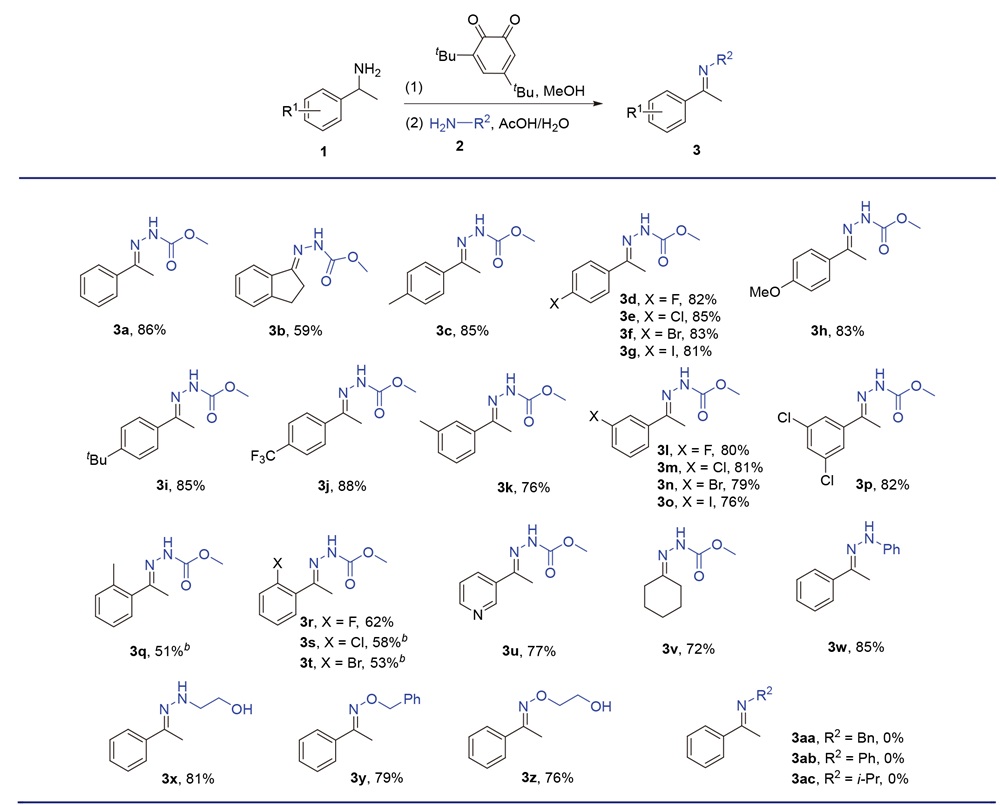 |
a Unless otherwise specified, all reactions were carried out with 1 (1.1 mmol), 3,5-di-tert-butyl-o-benzoquinone (1.0 mmol), MeOH (4.0 mL), room temperature, reaction for 1 h, then add 2 (1.5 mmol), 50% AcOH/H2O (240 μL), room temperature, reaction for 3 h; b Reaction for 16 h. |
Based on the above results, this study further evaluated additional amino-containing compounds as coupling partners. Phenylhydrazine and 2-(hydrazinyloxy)ethanol were smoothly converted to products 3w and 3x in good yields, demonstrating the method’s versatility in synthesizing diverse hydrazone derivatives. Replacing 2a with O-sub- stituted hydroxylamines—O-benzylhydroxylamine and 2- (aminooxy)ethanol—successfully afforded the correspond- ing oxime ethers 3y and 3z in 79% and 76% yields, respectively, further expanding the utility of the method. However, under the standard conditions, benzylamine, aniline, and isopropylamine all failed to afford the target products 3aa~3ac. The synthesized hydrazone and oxime ether compounds can be used to prepare functionalized molecules such as diazo compounds and fused-ring compounds through a series of reactions, and thus possess high application value.[17]
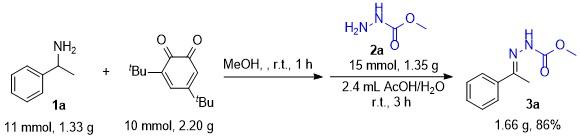
A gram-scale experiment was performed using 1a under the optimized conditions (Scheme 2). Reaction of 1a (1.33 g, 11 mmol) with 3,5-di-tert-butyl-o-benzoquinone (2.20 g, 10 mmol) was carried out in 40 mL of methanol at room temperature for 1 h. Subsequently, 2a (1.35 g, 15 mmol) and 50% AcOH/H2O (V/V, 2.40 mL, 20 mmol) were added, and the mixture was stirred for 3 h to afford product 3a in 86% isolated yield. This result underscores the practical scalability of the method for one-step conversion of amino compounds into hydrazones and oxime ethers.
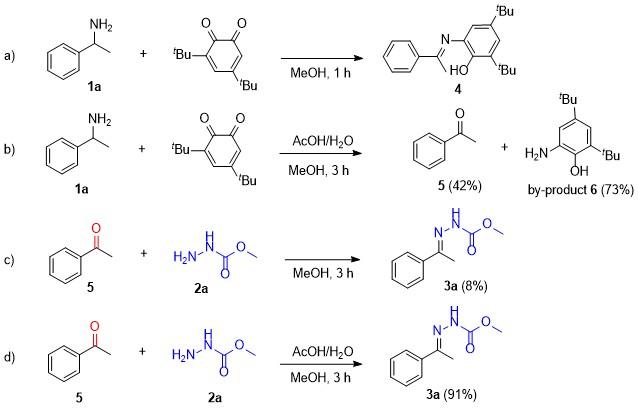
To clarify the reaction mechanism, this study further conducted several control experiments (Scheme 3). Stirring 1a with 3,5-di-tert-butyl-o-benzoquinone in methanol for 1 h produced a species with m/z 324.21 ([M+H]+) by LC-MS. Attempts to isolate this species resulted in rapid decomposition, and the compound was identified as intermediate 4 based on literature precedence.[18] Adding 50% AcOH/H2O (V/V) to this mixture and stirring for 3 h afforded acetophenone 5 in 42% yield along with byproduct 6 (Scheme 3, b). Notably, byproduct 6 shows promising applications in chemical synthesis and pharmaceutical chemistry.[19] Stirring acetophenone 5 with 2a in methanol for 3 h gave 3a in 8% yield (Scheme 3, c). However, adding 50% AcOH/H2O (V/V) to the mixture of 5 and 2a increased the yield dramatically to 3a in 91% yield (Scheme 3, d). These control experiments show that the reaction proceeds through three distinct stages, with AcOH/H2O (V/V) playing two key roles: promoting the hydrolysis of intermediate 4 to ketone 5, and accelerating the conversion of 5 into the final hydrazone 3a.
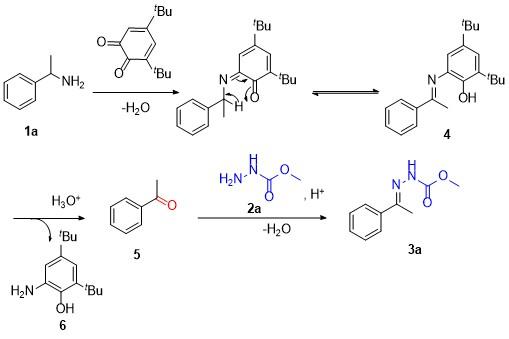
Based on these results, the following reaction pathway was proposed (Scheme 4). The amine 1a adds to one carbonyl group of 3,5-di-tert-butyl-o-benzoquinone, followed by dehydration and rearrangement to form Schiff base intermediate 4. Intermediate 4 is unstable in acidic aqueous media and undergoes hydrolysis to yield acetophenone 5 and byproduct 6. Under acid catalysis, acetophenone 5 reacts with 2a through nucleophilic addition and dehydration to form the final Schiff base compound 3a, which is stable under the reaction conditions.


3 Conclusions
In summary, this study has developed a facile and efficient one-pot method for synthesizing hydrazones and oxime ethers directly from amino compounds, offering a streamlined strategy for transforming amines into imine- based derivatives. This protocol operates at ambient tem- perature without the need for an inert atmosphere or expensive metal catalysts, thereby providing practical advantages for laboratory and potential industrial application. Notably, the reaction simultaneously generates byproduct 6 in synthetically useful quantities, highlighting its potential value as a secondary chemical feedstock. Mechanistic investigations indicate that the transformation proceeds through two consecutive nucleophilic addition-dehydration steps between amino groups and carbonyl intermediates, ultimately constructing the hydrazone or oxime-ether frameworks. These insights not only clarify the reaction pathway but also rationalize the broad substrate across aromatic, heterocyclic, and aliphatic amines. Overall, this work establishes a cost-effective, operationally simple, and mechanistically well-supported approach that significantly expands the synthetic utility of amino compounds for direct access to hydrazones and oxime ethers.
4 Experimental section
4.1 General Information
1H and 13C NMR spectra were recorded on a Bruker Avance III HD 500 spectrometer in DMSO-d6 using TMS as the internal standard. 19F NMR spectra were recorded on the same instrument. Mass spectra were obtained using a Waters UPLC H-Class/SQD2 system. All starting materials were purchased from Aldrich, Acros Organics, or TCI and used without further purification. Solvents were dried and purified according to standard procedures described in Purification of Laboratory Chemicals. Column chromatography was performed on silica gel (200~300 mesh, ASTM).
4.2 Typical procedure for the synthesis of compound 3
α-Methylbenzylamine (1a) (1.1 mmol, 133 mg) and 3,5- di-tert-butyl-o-benzoquinone (1.0 mmol, 220 mg) were added to a single-neck flask and dissolved in methanol (4 mL). The mixture was stirred at room temperature for 1 h, after which methyl hydrazinecarboxylate (2a) (1.5 mmol, 135 mg) and 50% AcOH/H2O (V/V) (240 μL) were added. The reaction was allowed to proceed for an additional 3 h. Upon completion, the solvent was removed under reduced pressure using rotary evaporation. The residue was dissolved in ethyl acetate (EA) and washed with water three times. The organic phase was concentrated under reduced pressure, and the crude product was purified by column chromatography on silica-gel (Heptane/EA, V∶V=2∶1) to afford product 3a.
Methyl (E)-2-(1-phenylethylidene)hydrazine-1-carboxy- late (3a): White solid, m.p. 121~123 ℃ (lit.[20] m.p. 120 ℃); 1H NMR (500 MHz, DMSO-d6) δ: 10.13 (s, 1H), 7.77~7.70 (m, 2H), 7.42~7.32 (m, 3H), 3.72 (s, 3H), 2.22 (s, 3H); 13C NMR (126 MHz, DMSO-d6) δ: 154.63, 148.89, 138.28, 128.67, 128.09, 125.91, 51.76, 13.65; MS (ESI+) m/z: 193.13 ([M+H]+, 100), 161.17 (58), 118.10 (35).
Methyl (E)-2-(2,3-dihydro-1H-inden-1-ylidene)hydrazi- ne-1-carboxylate (3b): Pale yellow solid, m.p. 145~ 147 ℃; 1H NMR (500 MHz, DMSO-d6) δ: 9.96 (s, 1H), 7.60 (d, J=7.6 Hz, 1H), 7.35 (d, J=4.2 Hz, 2H), 7.28 (dq, J=8.1, 4.2 Hz, 1H), 3.70 (s, 3H), 3.06~3.00 (m, 2H), 2.77 (dd, J=7.9, 5.2 Hz, 2H).13C NMR (126 MHz, DMSO-d6) δ: 158.23, 154.47, 147.93, 137.81, 129.94, 126.75, 125.47, 120.92, 51.64, 27.91, 26.86; MS (ESI+) m/z: 205.18 [M+H]+. HRMS (ESI+) calcd for C11H13N2O2 [M+H]+ 205.0972, found 205.0975.
Methyl (E)-2-(1-(p-tolyl)ethylidene)hydrazine-1-carbo- xylate (3c):[20] White solid, m.p. 113~115 ℃ (lit. m.p. 108 ℃); 1H NMR (500 MHz, DMSO-d6) δ: 10.06 (s, 1H), 7.66~7.60 (m, 2H), 7.19 (d, J=8.0 Hz, 2H), 3.71 (s, 3H), 2.31 (s, 3H), 2.19 (s, 3H); 13C NMR (126 MHz, DMSO-d6) δ: 154.63, 148.96, 138.21, 135.50, 128.69, 125.84, 51.72, 20.62, 13.57; MS (ESI+) m/z: 207.11 ([M+H]+, 100), 175.08 (55), 132.05 (37).
Methyl (E)-2-(1-(4-fluorophenyl)ethylidene)hydrazine- 1-carboxylate (3d): White solid, m.p. 115~117 ℃; 1H NMR (500 MHz, DMSO-d6) δ: 10.13 (s, 1H), 7.81~7.73 (m, 2H), 7.20 (t, J=8.8 Hz, 2H), 3.71 (s, 3H), 2.20 (s, 3H); 13C NMR (126 MHz, DMSO-d6) δ: 163.47, 161.51, 154.62, 147.93, 134.77(d, JC-F=3.1 Hz), 128.05(d, JC-F=8.3 Hz), 114.94 (d, JC-F=21.7 Hz), 51.76, 13.65; 19F NMR (282 MHz, DMSO-d6) δ: -108.40; MS (ESI+) m/z: 211.18 [M+H]+. HRMS (ESI+) calcd for C10H12FN2O2 [M+H]+211.0877, found 211.0875.
Methyl (E)-2-(1-(4-chlorophenyl)ethylidene)hydrazine- 1-carboxylate(3e): Off-white solid, m.p. 136~138 ℃ (lit.[21] m.p. 158~161 ℃); 1H NMR (500 MHz, DMSO-d6) δ: 10.17 (s, 1H), 7.77~7.71 (m, 2H), 7.47~7.41 (m, 2H), 3.71 (s, 3H), 2.20 (s, 3H); 13C NMR (126 MHz, DMSO-d6) δ: 154.55, 147.58, 137.06, 133.42, 128.12, 127.61, 51.82, 13.49; MS (ESI+) m/z: 227.14 ([M+H]+, 100), 229.16 (M+, 86) 249.19 (44), 195.14 (28).
Methyl (E)-2-(1-(4-bromophenyl)ethylidene)hydrazine- 1-carboxylate(3f): White solid, m.p. 158~161 ℃ (lit. m.p.[22] 152~155 ℃); 1H NMR (500 MHz, DMSO-d6) δ: 10.18 (s, 1H), 7.71~7.64 (m, 2H), 7.60~7.54 (m, 2H), 3.72 (s, 3H), 2.19 (s, 3H); 13C NMR (126 MHz, DMSO-d6) δ: 154.53, 147.63, 137.41, 131.04, 127.88, 122.10, 51.82, 13.42; MS (ESI+) m/z: 271.15 ([M+H]+, 100), 273.13 (100), 565.08 (28) 336.14 (25).
Methyl (E)-2-(1-(4-iodophenyl)ethylidene)hydrazine-1- carboxylate (3g): Yellow solid, m.p. 168~170 ℃; 1H NMR (500 MHz, DMSO-d6) δ: 10.17 (s, 1H), 7.78~7.72 (m, 2H), 7.55~7.49 (m, 2H), 3.71 (s, 3H), 2.18 (s, 3H); 13C NMR (126 MHz, DMSO-d6) δ: 154.52, 147.84, 137.77, 136.94, 127.92, 95.19, 51.83, 13.36; MS (ESI+) m/z: 319.15 [M+H]+. HRMS (ESI+) calcd for C10H12I- N2O2 [M+H]+ 318.9940, found 318.9938.
Methyl (E)-2-(1-(4-methoxyphenyl)ethylidene)hydrazi- ne-1-carboxylate(3h): White solid, m.p. 125~127 ℃ (lit.[20] m.p. 131 ℃); 1H NMR (500 MHz, DMSO-d6) δ: 10.00 (s, 1H), 7.72~7.65 (m, 2H), 6.97~6.90 (m, 2H), 3.77 (s, 3H), 3.70 (s, 3H), 2.18 (s, 3H); 13C NMR (126 MHz, DMSO-d6) δ: 159.87, 154.65, 148.88, 130.75, 127.34, 113.52, 55.07, 51.68, 13.54; MS (ESI+) m/z: 223.15 ([M+H]+, 100), 191.08 (51), 148.10 (35).
Methyl (E)-2-(1-(4-(tert-butyl)phenyl)ethylidene)hydra- zine-1-carboxylate (3i): White solid, m.p. 127~129 ℃; 1H NMR (500 MHz, DMSO-d6) δ: 10.06 (s, 1H), 7.68~7.62 (m, 2H), 7.43~7.37 (m, 2H), 3.70 (s, 3H), 2.19 (s, 3H), 1.28 (s, 9H); 13C NMR (126 MHz, DMSO-d6) δ: 154.60, 151.35, 148.98, 135.51, 125.69, 124.82, 51.70, 34.19, 30.88, 13.63; MS (ESI+) m/z: 249.22 [M+H]+. HRMS (ESI+) calcd for C14H21N2O2 [M+H]+ 249.1601, found 249.1597.
Methyl (E)-2-(1-(4-(trifluoroMethyl)phenyl)ethylidene)- hydrazine-1-carboxylate (3j): White solid, m.p. 123~125 ℃; 1H NMR (500 MHz, DMSO-d6) δ: 10.34 (s, 1H), 7.93 (d, J=8.2 Hz, 2H), 7.74 (d, J=8.3 Hz, 2H), 3.73 (s, 3H), 2.25 (s, 3H); 13C NMR (126 MHz, DMSO-d6) δ: 154.52, 147.17, 142.09, 128.76 (q, JC-F=31.9 Hz), 126.56, 125.01 (q, JC-F=3.8 Hz), 124.13 (q, JC-F=272.54 Hz), 51.90, 13.56; 19F NMR (376 MHz, DMSO-d6) δ: -61.12; MS (ESI+) m/z: 261.16 [M+H]+. HRMS (ESI+) calcd for C11H12F3N2O2 [M+H]+ 261.0843, found 261.0845.
Methyl (E)-2-(1-(m-tolyl)ethylidene)hydrazine-1-carbo- xylate (3k): White solid, m.p. 83~85 ℃ (lit.[20] m.p. 81 ℃); 1H NMR (500 MHz, DMSO-d6) δ: 10.09 (s, 1H), 7.57~7.49 (m, 2H), 7.30~7.23 (m, 1H), 7.17 (d, J=7.7 Hz, 1H), 3.71 (s, 3H), 2.33 (s, 3H), 2.20 (s, 3H); 13C NMR (126 MHz, DMSO-d6) δ: 154.62, 149.09, 138.27, 137.18, 129.35, 127.99, 126.42, 123.19, 51.74, 20.91, 13.74; MS (ESI+) m/z: 207.15 ([M+H]+, 100), 175.15 (25), 435.29 (25), 229.16 (24).
Methyl (E)-2-(1-(3-fluorophenyl)ethylidene)hydrazine- 1-carboxylate (3l): White solid, m.p. 121~123 ℃; 1H NMR (500 MHz, DMSO-d6) δ: 10.23 (s, 1H), 7.57 (dt, J=7.8, 1.2 Hz, 1H), 7.54~7.48 (m, 1H), 7.43 (td, J=8.0, 6.1 Hz, 1H), 7.19 (td, J=8.6, 3.1 Hz, 1H), 3.72 (s, 3H), 2.21 (s, 3H); 13C NMR (126 MHz, DMSO-d6) δ: 163.10, 161.17, 154.54, 147.43, 140.80 (d, JC-F=7.6 Hz), 130.07 (d, JC-F=8.3 Hz), 122.00 (d, JC-F=2.8 Hz), 115.38 (d, JC-F=21.4 Hz), 112.38 (d, JC-F=22.9 Hz), 51.85, 13.60. 19F NMR (376 MHz, DMSO-d6) δ: -113.41; MS (ESI+) m/z: 211.07 [M+H]+. HRMS (ESI+) calcd for C10H12F- N2O2 [M+H]+ 211.0878, found 211.0875.
Methyl (E)-2-(1-(3-chlorophenyl)ethylidene)hydrazine- 1-carboxylate (3m): White solid, m.p. 98~100 ℃; 1H NMR (500 MHz, DMSO-d6) δ: 10.24 (s, 1H), 7.76 (q, J=1.5 Hz, 1H), 7.67 (pd, J=4.5, 1.7 Hz, 1H), 7.45~7.38 (m, 2H), 3.72 (s, 3H), 2.21 (s, 3H); 13C NMR (126 MHz, DMSO-d6) δ: 154.53, 147.25, 140.37, 133.11, 129.98, 128.39, 125.45, 124.56, 51.86, 13.54; MS (ESI+) m/z: 227.10, 229.08 [M+H]+. HRMS (ESI+) calcd for C10H12- ClN2O2 [M+H]+227.0585, found 227.0582.
Methyl (E)-2-(1-(3-bromophenyl)ethylidene)hydrazine- 1-carboxylate (3n): White solid, m.p. 110~113 ℃; 1H NMR (500 MHz, DMSO-d6) δ: 10.24 (s, 1H), 7.92~7.88 (m, 1H), 7.71 (d, J=7.9 Hz, 1H), 7.55 (dd, J=7.8, 2.1 Hz, 1H), 7.35 (t, J=7.9 Hz, 1H), 3.72 (s, 3H), 2.20 (s, 3H); 13C NMR (126 MHz, DMSO-d6) δ: 154.51, 147.18, 140.59, 131.28, 130.25, 128.30, 124.95, 121.65, 51.85, 13.53; MS (ESI+) m/z: 271.11, 273.13 [M+H]+. HRMS (ESI+) calcd for C10H12BrN2O2 [M+H]+ 271.0081, found 271.0078.
Methyl (E)-2-(1-(3-iodophenyl)ethylidene)hydrazine-1- carboxylate (3o): White solid, m.p. 133~135 ℃; 1H NMR (500 MHz, DMSO-d6) δ: 10.22 (s, 1H), 8.08 (t, J=1.7 Hz, 1H), 7.71 (dt, J=8.1, 1.9 Hz, 2H), 7.19 (t, J=7.8 Hz, 1H), 3.72 (s, 3H), 2.18 (s, 3H); 13C NMR (126 MHz, DMSO-d6) δ: 154.52, 147.24, 140.46, 137.19, 134.17, 130.27, 125.39, 94.57, 51.87, 13.54; MS (ESI+) m/z: 319.08 [M+H]+. HRMS (ESI+) calcd for C10H12IN2O2 [M+H]+ 318.9935, found 318.9940.
Methyl (E)-2-(1-(3,5-dichlorophenyl)ethylidene)hydra- zine-1-carboxylate (3p): White solid, m.p. 108~110 ℃; 1H NMR (500 MHz, DMSO-d6) δ: 10.35 (s, 1H), 7.70 (d, J=2.0 Hz, 2H), 7.57 (t, J=1.9 Hz, 1H), 3.73 (s, 3H), 2.20 (s, 3H); 13C NMR (126 MHz, DMSO-d6) δ: 154.44, 145.87, 141.72, 134.05, 127.82, 124.43, 51.96, 13.44; MS (ESI+) m/z: 261.21, 263.18 [M+H]+. HRMS (ESI+) calcd for C10H11Cl2N2O2 [M+H]+261.0195, found 261.0197.
Methyl (E)-2-(1-(o-tolyl)ethylidene)hydrazine-1-carbo- xylate (3q): White solid, m.p. 115~117 ℃ (lit.[20] m.p. 115 ℃); 1H NMR (500 MHz, DMSO-d6) δ: 10.04 (s, 1H), 7.28~7.16 (m, 4H), 3.68 (s, 3H), 2.28 (s, 3H), 2.15 (s, 3H); 13C NMR (126 MHz, DMSO-d6) δ: 154.63, 151.67, 139.82, 134.91, 130.31, 127.81, 127.72, 125.42, 51.67, 19.79, 17.67; MS (ESI+) m/z: 207.19 ([M+H]+, 100), 229.20 (45), 435.33 (40).
Methyl (E)-2-(1-(2-fluorophenyl)ethylidene)hydrazine- 1-carboxylate (3r): White solid, m.p. 110~113 ℃; 1H NMR (500 MHz, DMSO-d6) δ: 10.21 (s, 1H), 7.50 (td, J=7.8, 1.8 Hz, 1H), 7.46~7.38 (m, 1H), 7.26~7.19 (m, 2H), 3.70 (s, 3H), 2.20 (d, J=2.6 Hz, 3H); 13C NMR (126 MHz, DMSO-d6) δ: 160.72, 158.75, 154.53, 146.88, 130.48 (d, JC-F=8.6 Hz), 129.61 (d, JC-F=3.4 Hz), 127.36 (d, JC-F=12.3 Hz), 124.20 (d, JC-F=3.3 Hz), 115.84 (d, JC-F=22.1 Hz), 51.80, 17.06 (d, JC-F=5.0 Hz); 19F NMR (376 MHz, DMSO-d6) δ: -115.42; MS (ESI+) m/z: 211.10 [M+H]+. HRMS (ESI+) calcd for C10H12FN2O2 [M+H]+ 211.0876, found 211.0879.
Methyl (E)-2-(1-(2-chlorophenyl)ethylidene)hydrazine- 1-carboxylate (3s): White solid, m.p. 133~135 ℃; 1H NMR (500 MHz, DMSO-d6) δ: 10.21 (s, 1H), 7.48 (dd, J=7.5, 1.4 Hz, 1H), 7.44~7.31 (m, 3H), 3.69 (s, 3H), 2.18 (s, 3H); 13C NMR (126 MHz, DMSO-d6) δ: 154.53, 149.69, 139.11, 131.01, 130.06, 129.80, 129.40, 127.01, 51.77, 17.86; MS (ESI+) m/z: 227.14, 229.16 [M+H]+. HRMS (ESI+) calcd for C10H12ClN2O2 [M+H]+ 227.0582, found 227.0585.
Methyl (E)-2-(1-(2-bromophenyl)ethylidene)hydrazine- 1-carboxylate (3t): White solid, m.p. 155~156 ℃; 1H NMR (500 MHz, DMSO-d6) δ: 10.20 (s, 1H), 7.65 (dd, J=8.3, 1.3 Hz, 1H), 7.41 (td, J=7.3, 1.2 Hz, 1H), 7.31 (td, J=7.2, 1.7 Hz, 2H), 3.69 (s, 3H), 2.17 (s, 3H); 13C NMR (126 MHz, DMSO-d6) δ: 154.51, 150.75, 141.12, 132.48, 130.09, 129.91, 127.50, 120.58, 51.76, 18.02; MS (ESI+) m/z: 271.04, 273.02 [M+H]+. HRMS (ESI+) calcd for C10H12BrN2O2 [M+H]+271.0079, found 271.0077.
Methyl (E)-2-(1-(pyridin-3-yl)ethylidene)hydrazine-1- carboxylate (3u): Off-white solid, m.p. 145~148 ℃ (lit.[22] m.p. 148~150 ℃); 1H NMR (500 MHz, DMSO-d6) δ: 10.28 (s, 1H), 8.90 (d, J=2.3 Hz, 1H), 8.55 (d, J=5.0 Hz, 1H), 8.08 (d, J=8.0 Hz, 1H), 7.41 (dd, J=8.1, 4.8 Hz, 1H), 3.72 (s, 3H), 2.24 (s, 3H); 13C NMR (126 MHz, DMSO-d6) δ: 154.28, 149.17, 146.86, 146.48, 133.50, 132.89, 122.90, 51.61, 13.26; MS (ESI+) m/z: 194.15 ([M+H]+, 100), 162.07 (45), 119.08 (35).
Methyl 2-cyclohexylidenehydrazine-1-carboxylate (3v):[18] Yellow oil. 1H NMR (500 MHz, DMSO-d6) δ: 9.79 (s, 1H), 3.62 (s, 3H), 2.30 (t, J=5.9 Hz, 2H), 2.17 (t, J=6.2 Hz, 2H), 1.63~1.56 (m, 2H), 1.52 (dq, J=7.6, 3.7 Hz, 4H); 13C NMR (126 MHz, DMSO-d6) δ: 157.39, 154.81, 51.36, 51.27, 34.68, 26.70, 26.61, 25.42, 25.01; MS (ESI+) m/z: 171.13 ([M+H]+, 100), 41.96 (80), 96.03 (65), 139.09 (59).
(E)-1-Phenyl-2-(1-phenylethylidene)hydrazine (3w): Yellow solid, m.p. 95~97 ℃ (lit.[23] m.p. 102~103 ℃); 1H NMR (500 MHz, DMSO-d6) δ: 9.26 (s, 1H), 7.84~7.77 (m, 2H), 7.43~7.33 (m, 2H), 7.33~7.19 (m, 5H), 6.76 (tt, J=6.9, 1.6 Hz, 1H), 2.26 (s, 3H); 13C NMR (126 MHz, DMSO-d6) δ: 146.03, 140.46, 139.20, 128.71, 128.08, 127.30, 125.03, 118.73, 112.77, 12.62; MS (ESI+) m/z: 211.52 ([M+H]+, 100), 133.04 (40), 194.08 (22).
(E)-2-(2-(1-Phenylethylidene)hydrazineyl)ethan-1-ol (3x): Colorless oil; MS (ESI+) m/z: 179.22 ([M+H]+, 100), 161.11 (43), 118.07 (37). The product is unstable.
(E)-1-Phenylethan-1-one O-benzyl oxime (3y):[24] Colorless oil. 1H NMR (500 MHz, DMSO-d6) δ: 7.67 (dt, J=6.2, 1.9 Hz, 2H), 7.45~7.35 (m, 7H), 7.35~7.29 (m, 1H), 5.23 (s, 2H), 2.23 (s, 3H); 13C NMR (126 MHz, DMSO-d6) δ: 154.28, 137.91, 135.84, 128.96, 128.19, 128.10, 127.75, 127.45, 125.71, 75.28, 12.28; MS (ESI+) m/z: 226.15 ([M+H]+, 100), 118.11 (55), 107.08 (45).
(E)-1-Phenylethan-1-one O-(2-hydroxyethyl) oxime (3z)[25]: Colorless oil. 1H NMR (500 MHz, DMSO-d6) δ: 7.69~7.62 (m, 2H), 7.44~7.34 (m, 3H), 4.70 (t, J=5.5 Hz, 1H), 4.16 (dd, J=5.9, 4.7 Hz, 2H), 3.68 (q, J=5.4 Hz, 2H), 2.20 (s, 3H); 13C NMR (126 MHz, DMSO-d6) δ: 153.88, 136.07, 128.91, 128.25, 125.71, 75.31, 59.52, 12.29; MS (ESI+) m/z: 180.17 ([M+H]+, 100), 162.15 (63), 118.11 (39).
4.3 Typical procedure for the synthesis of compound 4
Compound 1a (1.1 mmol, 133 mg) and 3,5-di-tert-butyl- o-benzoquinone (1.0 mmol, 220 mg) were added to a single-neck flask, and dissolved in methanol (4 mL). The mixture was stirred at room temperature for 1 h. The reaction progress was monitored by LC-MS, which showed a molecular ion peak at m/z 324.21 [M+H]+ in the ESI mass spectrum. Attempts to purify the crude product by column chromatography failed, as the target product was prone to decomposition.
4.4 Typical procedure for the synthesis of compounds 5 and 6
α-Methylbenzylamine (1a) (1.1 mmol, 133 mg) and 3,5-di-tert-butyl-o-benzoquinone (1.0 mmol, 220 mg) were added to a single-neck flask and dissolved in methanol (4 mL). The mixture was stirred at room temperature for 1 h, after which 50% AcOH/H2O (V/V) (240 μL) was added. The reaction was continued for 3 h. After the reaction was completed, the solvent was removed under reduced pressure using a rotary evaporator, and the residue was purified by column chromatography on silica gel (Heptane/EA, V∶V=30∶1) to afford acetophenone 5 in 42% yield and byproduct 6 in 73% yield.
Acetophenone (5):[26] Colorless oil. 1H NMR (500 MHz, DMSO-d6) δ: 7.95 (dt, J=7.3, 1.4 Hz, 2H), 7.64~7.57 (m, 1H), 7.50 (dd, J=8.5, 7.1 Hz, 2H), 2.56 (s, 3H); 13C NMR (126 MHz, DMSO-d6) δ: 197.53, 197.49, 136.78, 132.82, 128.40, 127.92, 26.30; MS (ESI+) m/z: 121.15 ([M+H]+, 100), 105.08 (31), 77.15 (20).
2-Amino-4,6-di-tert-butylphenol (6): Off-white solid, m.p. 164~165 ℃ (lit.[27] m.p. 168~170 ℃); 1H NMR (501 MHz, DMSO-d6) δ: 7.22 (s, 1H), 6.58 (d, J=2.4 Hz, 1H), 6.49 (d, J=2.4 Hz, 1H), 4.43 (s, 2H), 1.33 (s, 9H), 1.19 (s, 9H); 13C NMR (126 MHz, DMSO-d6) δ: 141.33, 139.95, 137.13, 136.21, 111.33, 111.09, 34.51, 33.80, 31.58, 29.92; MS (ESI+) m/z: 222.31 ([M+H]+, 100), 263.25 (45).
4.5 Procedure for the synthesis of 3a from compound 5
Compound 5 (1.0 mmol, 120 mg), 2a (1.5 mmol, 135 mg) and 50% AcOH/H2O (V/V) (240 μL) were added to a single-neck flask, and dissolved in methanol (4 mL). The mixture was stirred at room temperature for 3 h. Upon completion, the solvent was removed by rotary evaporation. The resulting residue was dissolved in ethyl acetate (EA) and washed with water three times. The organic phase was concentrated under reduced pressure, and the crude product was purified by column chromatography on silica gel (Heptane/EA, V∶V=2∶1) to afford the desired product 3a in 91% yield.
Supporting Information 1H NMR, 13C NMR, and 19F NMR spectra of compounds. The Supporting Information is available free of charge via the Internet at http://sioc-journal.cn/.
(Li, L.)