


1 Introduction
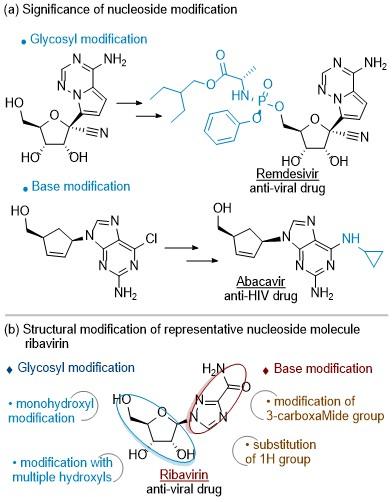
Nucleosides and nucleotides are significant components of biomolecules that are vital for genetic processes and energy supply in living organisms.[1-9] Recently, targeted structural modification of nucleoside molecules has become an important strategy in the development of novel therapeutic drugs.[10-11] For instance, the antiviral drug rem- desivir is obtained by structural modification of the nucleoside glycosyl moiety,[12] whereas the anti-HIV drug abacavir is derived from the modification of the base moiety (Figure 1a).[13] These successful examples illustrate the broad potential and application value of nucleoside structural modifications in the field of pharmaceutical research.[14]
As a representative nucleoside analogue, ribavirin exhibits broad-spectrum antiviral activity and is widely used in the clinical treatment of chronic hepatitis C, influenza, and infections caused by respiratory syncytial virus and herpes simplex virus.[15-16] However, studies have shown that prolonged use or high doses of ribavirin may lead to certain side effects, such as a reduction in white blood cell count and inhibition of red blood cell production, potentially resulting in hemolytic anemia.[17-24] Therefore, the development of efficient and low-toxic broad-spectrum antiviral drugs derived from ribavirin has attracted considerable research interest.
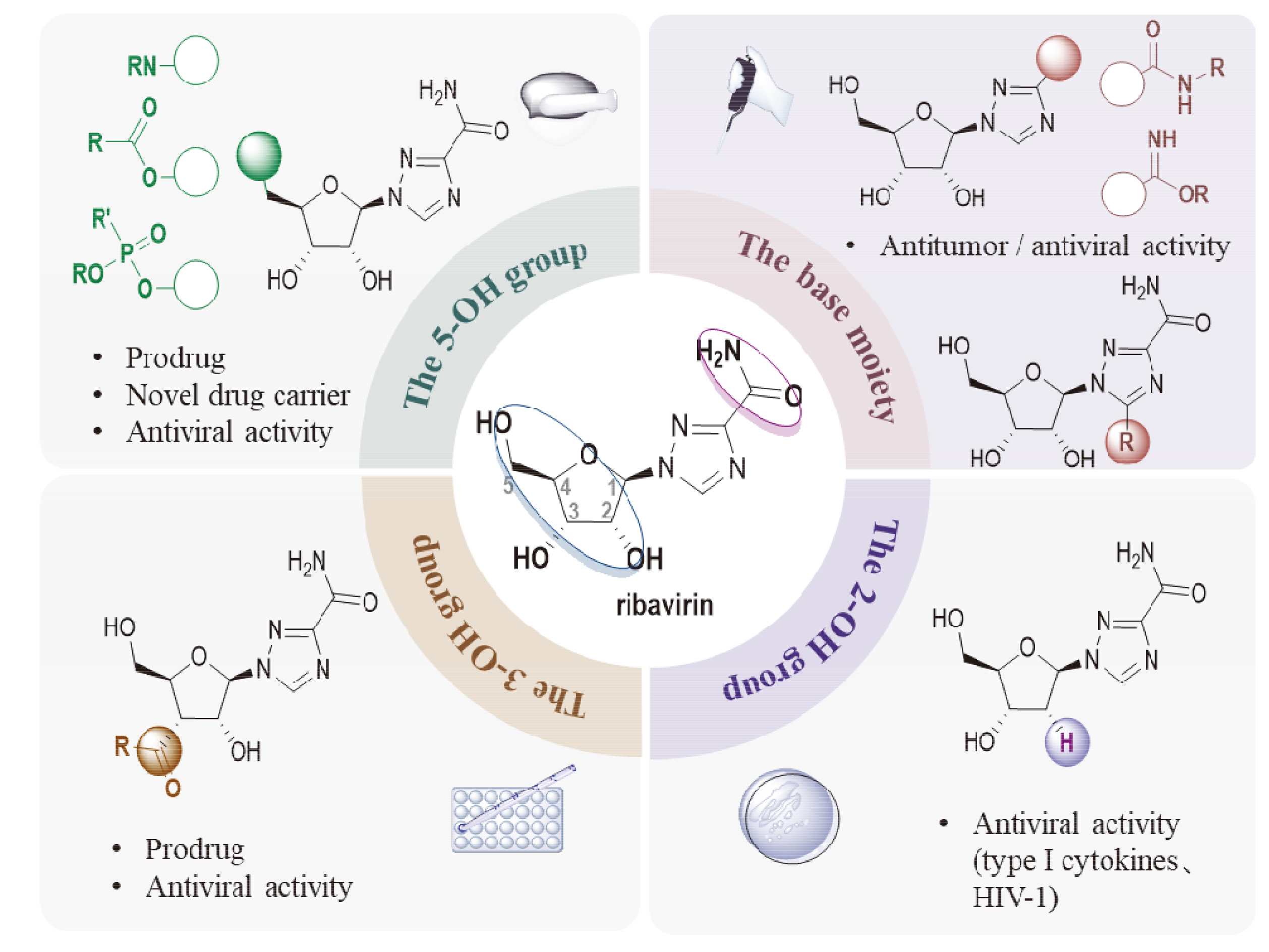
The structural features of ribavirin include a sugar moiety and a base moiety. Structurally, it exhibits varying degrees of similarity to natural nucleosides, enabling it to interfere with or directly affect the biosynthesis of proteins and nucleic acids.[25-27] Consequently, structural modification of ribavirin may lead to the development of novel antiviral drugs. Although numerous researchers have studied the synthesis and applications of ribavirin derivatives, there is currently no corresponding review on the structural modification of ribavirin. In recent years, we have focused on the selective modification of polyhydroxy compounds. Based on a comprehensive literature review and our own research experience, we herein systematically summarize the structural modifications and applications of ribavirin, focusing on two key aspects: (1) glycosyl modifications and (2) base modifications (Figure 1b). At the end of this review, we also provide our own understanding and perspectives on this rapidly evolving research area. We hope that this review will serve as a valuable reference for experts focusing on ribavirin structural modifications and as a guiding resource for newcomers to enter the field.
2 Glycosyl modification of ribavirin
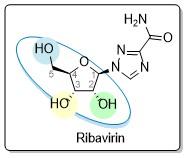
Glycosylation modifications have a significant impact on the antiviral activity of ribavirin and its derivatives. This approach can enhance the antiviral activity of drugs and reduce their toxic side effects.[28,29] Therefore, glycosylation modification represents a promising strategy for developing antiviral drugs. Here, we primarily focus on research related to the hydroxyl modification of ribavirin (Figure 2).
2.1 Modification of the 5-OH group in the glycosyl of ribavirin
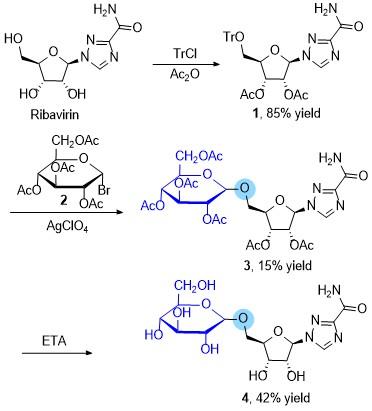
In 1987, Revankar and colleagues[30] synthesized 5-O-β-D-glucopyranosyl derivatives of the antiviral drug ribavirin (Figure 3). The synthesis involved sequential reaction of ribavirin with triphenylmethyl chloride (TrCl) and acetic anhydride (Ac2O) to generate a hydroxyl-protected intermediate 1. Subsequently, intermediate 1 was reacted with glycosyl bromide 2 under Bredereck-modified Koenigs-Knorr reaction conditions (silver perchlorate and Drierite in nitromethane) to form the 5-O-glycosylated derivative 3, which was then deacetylated to yield the target compound 4. The Bredereck-modified Koenigs-Knorr reaction is proposed to proceed via an SN2 mechanism. The silver perchlorate (AgClO4) present in the reaction system not only activates the glycosyl bromide, but also facilitates cleavage of the trityl ether through coordination of the silver ion with the oxygen atom of the trityl ether. This in-situ deprotection mechanism releases the 5-OH group of intermediate 1 for SN2 nucleophilic attack on glycosyl bromide 2. Concurrently, the C2-acetyl group of glycosyl bromide 2 provides a neighboring group participation effect, leading to the formation of a tautomeric intermediate that interconverts between a dioxolenium ion and an oxocarbenium ion, ultimately affording derivative 3. The structures of the synthesized derivatives were confirmed by spectroscopic analysis.
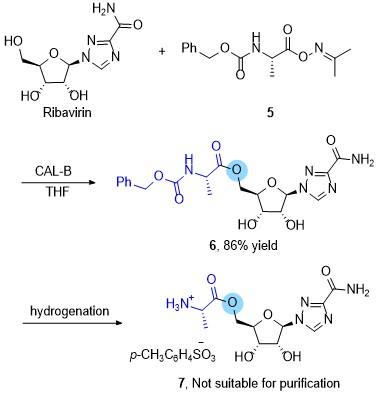
In 2003, Zaks and co-workers[31] reported the selective acylation reaction of the 5-OH group of ribavirin catalyzed by Candida antarctica lipase B (CAL-B) (Figure 4). They employed CAL-B to catalyze the selective acylation reaction between ribavirin and O-(N-benzyloxycarbonyl-L-alanyl)acetoxime 5 (L-Cbz-Ala), yielding the 5-O-acylation intermediate 6. This reaction exhibited high regioselectivity, leading to selective acylation of the 5-OH group without the generation of other acylation products. In a scaled-up industrial process, this reaction produced 80 kg of intermediate 6, with an isolated yield of about 80%. Subsequently, the intermediate 6 was converted into the 5-O-acylated ribavirin derivative 7 through hydrogenation reaction, which proceeded without racemization. A series of preclinical evaluations have demonstrated that the bioavailability and pharmacokinetic variability of the derivative 7 were improved compared to ribavirin.
In 2004, Chen and colleagues[32] synthesized a series of novel 5-O-substituted derivatives of ribavirin through a three-step reaction involving protection, nucleophilic substitution, and hydrolysis (Figure 5). Ribavirin was reacted with acetaldehyde to form the 2,3-O-protected intermediate 8. Intermediate 8 then underwent nucleophilic substitution and hydrolysis to generate 5-O-substituted ribavirin derivatives 10. The substitution reaction exhibited good tolerance towards a variety of functional groups, with the 5-O-substituted ribavirin derivatives 10 afforded in excellent yields. The antiviral activity of 5-O-substituted ribavirin derivatives was subsequently evaluated. The results showed that compound 10d exhibited good antiviral activity against influenza virus, although its inhibitory effect was slightly lower than that of the control drug ribavirin.
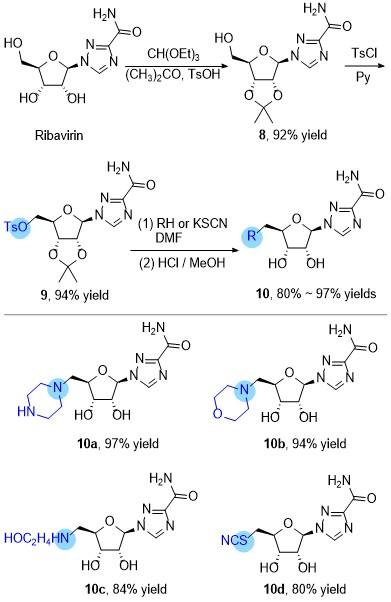
Almost simultaneously, Cui and colleagues[33] also synthesized a similar 5-O-modified ribavirin derivative. The synthesis route for this derivative was identical to that reported by Chen, differing only in the 5-O substituent group, which was an azido (N3) moiety.
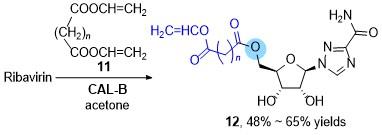
In 2005, Lin and co-workers[34] synthesized a series of multifunctional ribavirin derivatives 12 catalyzed by CAL-B, using divinyl dicarboxylate esters 11 with different chain lengths (C4, C6, C9, C10) as acyl donors (Figure 6). The CAL-B-mediated regioselective acylation at the 5-OH group of ribavirin afforded the corresponding vinyl esters 12 (C4, C6, C9, C10) with yields of 48%, 65%, 54%, and 55%, respectively. These derivatives can be polymerized with other bioactive compounds to form attractive prodrugs.
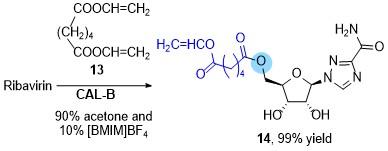
Subsequently, based on CAL-B catalyzing the regio-selective synthesis of nucleoside drugs, they[35] further investigated the effect of solvent composition on reaction yield (Figure 7). The results indicated that using a mixed solvent system comprising 90% acetone and 10% 1-butyl-3- methylimidazolium tetrafluoroborate ([BMIM]BF4), the yield of 5-O-acylated vinyl ester 14 reached 99% by HPLC analysis. This reaction has the advantages of excellent regioselectivity, fast reaction rate, and high yield.
Soon after, the investigation was extended to optimize the solvent system for enzymatic catalysis.[36] Studies demon- strated that N-methylimidazole is a constituent of cationic 1-alkyl-3-methylimidazolium ([CnMIM]+) ionic liquids. The addition of 10% N-methylimidazole significantly accelerated the reaction rate, making it an effective additive for enhancing transesterification reactions catalyzed by immobilized CAL-B. This methodology provided a novel strategy for exploring the role of ionic liquids in modulating enzymatic activity.
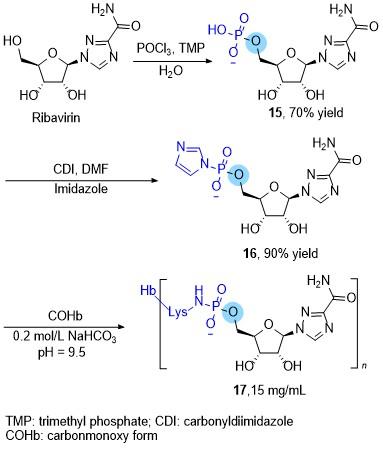
In 2006, Bell and colleagues[37] synthesized a novel conjugate of human hemoglobin (Hb) and ribavirin as a potential biocompatible drug carrier for targeted drug delivery in the treatment of hepatic disorders (Figure 8). The conjugate releases the bioactive drug during cellular endocytosis, particularly in macrophages and hepatic cells responsible for extracellular Hb catabolism. Ribavirin 5-O-monophosphate 15 was synthesized from ribavirin, and then reacted with imidazole to obtain 5-O-monophosphori-midazolide derivative 16. Subsequently, compound 16 was reacted with carboxyhemoglobin to yield the Hb-ribavirin conjugate 17 at a concentration of 15 mg/mL.
In 2008, Lin and co-workers[38] prepared hepatocellular carcinoma-targeted polymeric micelles as a novel drug delivery system through the self-assembly of amphiphilic random copolymers functionalized with ribavirin-conju-gated lactose. These lactose copolymers were synthesized via a combination of enzyme-catalyzed ring-opening poly- merization and free radical polymerization methods. Cell toxicity experiments and 3-(4,5-dimethylthiazol-2-yl)-2,5- diphenyltetrazolium bromide (MTT) lactose inhibition assays demonstrated that the copolymers exhibited signi- ficant targeting specificity for HepG2 cells, with binding affinity significantly reduced in the presence of excess lactose.
Subsequently, they[39] detailed an efficient lipase- catalyzed method for introducing heterocyclic motifs into vinyl esters in organic solvents. A novel enzymatic strategy for synthesizing drug derivatives was developed through a diester-linked tandem reaction combining nitrogen-hetero- Michael addition and regioselective acylation (Figure 9). Ribavirin was subjected to regioselective acylation at the 5-OH group to prepare corresponding vinyl esters 19 (C4, C8) with yields of 41%~93%. This newly discovered enzymatic capability broadens potential applications of biocatalysts, presenting a promising route for the synthesis of diverse drug derivatives.
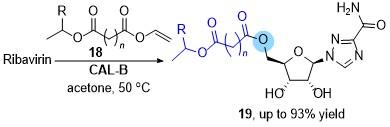
Soon after, they[40] used compound 19 to construct liver- targeting nanogels for the delivery of ribavirin through self-assembly of lactose-functionalized amphiphilic random copolymers. MTT assays demonstrated that the nano- gelsexhibited significant growth inhibition against human hepatocellular carcinoma (HepG2) cells.
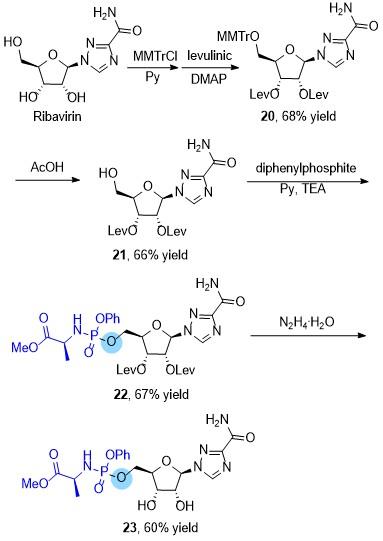
In 2010, Virta and co-workers[41] reported the synthesis of 5-O-phosphoramidate derivatives of ribavirin (Figure 10). Ribavirin was reacted sequentially with 4-methoxy-trityl chloride (MMTrCl), levulinic anhydride, and acetic acid (AcOH) to generate the 2,3-OH-protected ribavirin intermediate 21. Intermediate 21 was then reacted with diphenylphosphite to form the 5-O-monophosphate inter- mediate 22, which was subsequently deacetylated to produce the target 5-O-phosphoramidate derivative 23. Subsequently, they employed HPLC-ESI-MS/MS to inve- stigate the enzymatic deprotection kinetics of the precursor drugs using porcine liver esterase and human prostate cancer cell lysates.
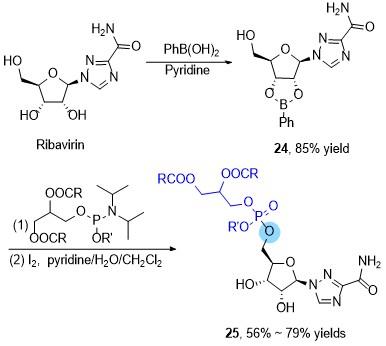
In 2013, Kalinichenko and colleagues[42] synthesized 5-O-phosphoramidate ribavirin derivatives via a phospho- ramidite coupling strategy (Figure 11). To achieve regio- selective protection, they used boric acid as a protecting group to synthesize the 2,3-OH-protected intermediate 24. Intermediate 24 underwent a condensation reaction with lipid phosphoramidites in MeCN, followed by oxidation with I2/H2O to afford the phosphoramidate ribavirin derivatives 25 with yields of 56%~79%. The study also investigated the effectiveness of these derivatives in liver- targeted drug delivery, which could potentially improve therapeutic outcomes while minimizing systemic toxicity.
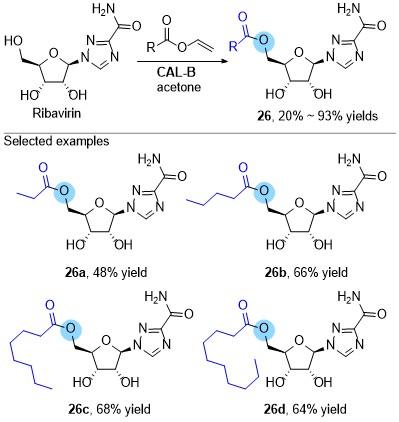
In 2013, Lin and colleagues[43] reported a CAL-B-cata- lyzed transesterification process to synthesize 5-O-acylated ribavirin esters 26 (Figure 12). This enzymatic method enabled the synthesis of 5-O-acylated esters 26 of various chain lengths with moderate to excellent yields. They con-ducted experimental analysis and theoretical modeling to examine the impact of substituent effects on CAL-B- catalyzed transesterification efficiency. Using 22 vinyl ester analogs and ribavirin as substrates, they established quantitative structure-activity relationship (QSAR) models, and identified five key physicochemical parameters governing reaction yield. The study revealed that substrate size, geometry, and charge distributions significantly influenced reaction yield, with size exerting the most pronounced influence, followed by charge distribution and substrate topology. This mechanistic insight provides a rational framework for designing enzyme-compatible sub-strates in biocatalytic systems.
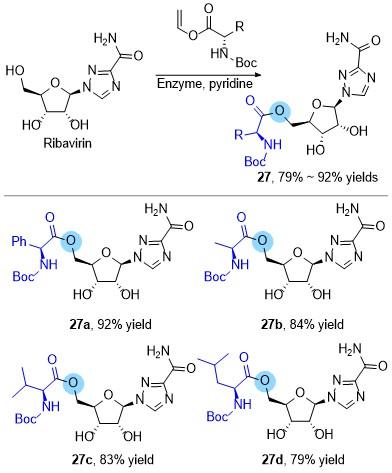
Subsequently, they[44] developed a straightforward enzy- matic approach for the synthesis of L-amino acid ester prodrugs of ribavirin (Figure 13). Bacillus subtilis protease catalyzed the transesterification between ribavirin and Boc-protected amino acid esters to yield Boc-protected amino acid conjugates 27 with excellent regioselectivity and yield. In vitro release studies demonstrated sustained hydrolysis of the prodrugs, with tunable release kinetics depending on the amino acid side chain properties. These findings highlight the potential of protease-catalyzed syn- thesis for developing ribavirin prodrugs with enhanced pharmacokinetic profiles and clinical applicability.
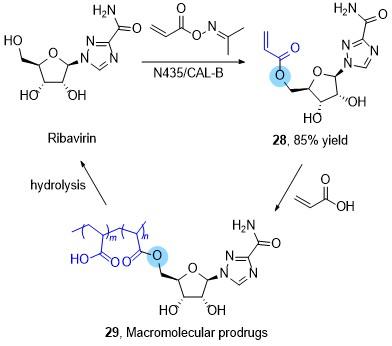
In 2013, Zelikin and colleagues[45] developed a macro- molecular prodrug of ribavirin 29 (Figure 14). The 5-O-acylated ribavirin derivative 28 was synthesized via Novozym 435 (N435)/CAL-B chemical-enzymatic me- thods. Subsequently, the intermediate was subjected to reversible addition-fragmentation chain transfer (RAFT) polymerization with acrylic acid to form the macro- molecular prodrug 29. Upon hydrolysis, prodrug 29 released the original ribavirin. Biological evaluations revealed that the polymeric carrier significantly reduced ribavirin accumulation in red blood cells (RBCs), thereby mitigating hemolytic toxicity while maintaining potent antiviral activity.
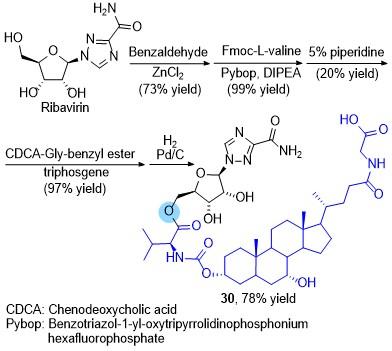
In 2015, Polli and co-workers[46] synthesized six bile acid-ribavirin conjugates in 5 steps (including protection, functionalization, and deprotection) to achieve hepatocyte- specific drug delivery and reduce off-target effects in red blood cells (RBCs) (Figure 15). In vitro metabolism studies showed that compound 30, ribavirin-L-Val-glycochenodeo-xycholic acid (GCDCA), released ribavirin in mouse liver S9 fractions. In vivo pharmacokinetic studies in mice demonstrated that compound 30 provided equivalent riba- virin exposure in the liver compared to ribavirin admini- stration, but resulted in approximately 1.8-fold higher exposure in RBCs, plasma, and kidneys compared to riba- virin. These findings suggest that the conjugate successfully delivered ribavirin to the liver. However, further optimi- zation is needed to reduce off-target distribution and en- hance hepatocyte specificity.
In 2017, based on Virtaʼs research, Zelikin and co- workers[47] developed macromolecular prodrugs from poly-(methacrylic acid) and ribavirin. Utilizing 2,3-OH protection, 5-OH functionalization, and 2,3-OH deprotection tech- niques, they synthesized 10 polymer conjugates and ana- lyzed their structure-activity relationships (SAR). Antiviral activity assays demonstrated that the lead compound effectively inhibited influenza virus infection in chicken embryos.
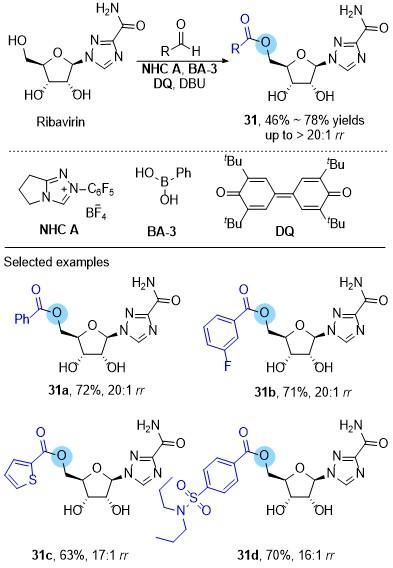
In 2023, Chi and colleagues[48] developed a novel N- heterocyclic carbene (NHC) catalyzed strategy for the straightforward and protection-free synthesis of nucleoside esters (Figure 16). By leveraging the synergistic effects of NHC catalysts and boric acid (which acts as a transient directing group), they achieved selective acylation of the 5-OH group of ribavirin without the need for protection or deprotection steps. A variety of aldehyde substituents were well tolerated, affording the corresponding 5-O-acylated ribavirin products 31 in moderate to good yields and regioselectivities. Moreover, this method enables the efficient synthesis of numerous nucleoside ester prodrugs, such as molnupiravir and ATV006. Biological evaluations demonstrated that the 5-O-acylated ribavirin derivatives exhibit good antiviral activity against tobacco mosaic virus (TMV) and potato virus Y (PVY).
2.2 Modification of the 3-OH group in the glycosyl of ribavirin
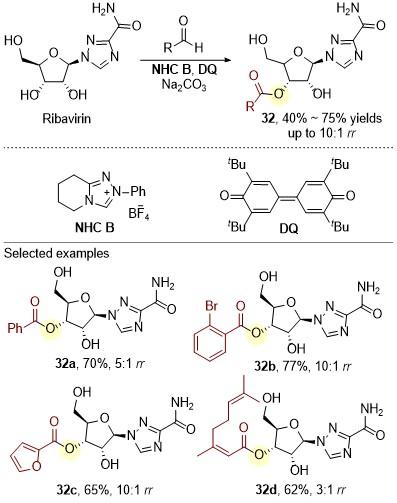
Currently, only one study has documented the 3-OH modification of ribavirin. In 2023, Chi and colleagues[48] reported an efficient NHC-catalyzed synthesis of 3-O-acy- lated ribavirin derivatives 32 (Figure 17). This one-step reaction does not necessitate protection or deprotection steps. Various aldehyde substrates with diverse substituents demonstrated excellent compatibility, affording the corresponding 3-O-acylated ribavirin products 32 in good yields and moderate regioselectivities. Furthermore, preliminary biological evaluations revealed that 3-O-acylated ribavirin derivatives exhibit promising antiviral activity against TMV and PVY.
2.3 Modification of the 2-OH group in the glycosyl of ribavirin
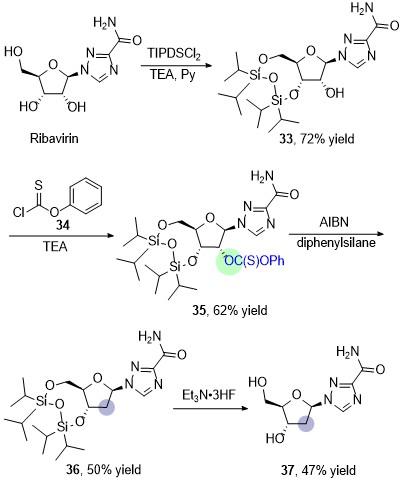
In 2000, Ramasamy and co-workers[49] reported a multi- step synthesis of 2-O-modified ribavirin derivatives (Figure 18). Ribavirin was reacted with 1,3-dichloro-1,1,3,3- tetraisopropyldisiloxane (TIPDSCl2) in anhydrous pyridine to yield the 3,5-O-TIPDS-protected intermediate 33. The intermediate 33 was then acylated with phenyl chloro- thionoformate 34 to afford the 2-O-thiophenoxycarbonyl derivative 35. Subsequently, compound 36 was synthesized using tri-N-butyltin hydride and 2,2'-azobis(2-methylpro- pionitrile) (AIBN). Finally, deprotection with Et3N•HF yielded the 2-OH modified ribavirin derivative 37. The immunostimulatory potential of ribavirin derivative 37 was evaluated by measuring its ability to activate human T cells and induce the production of type I cytokines. The results demonstrated that ribavirin derivative 37 exhibited an activation potential comparable to ribavirin, effectively stimulating T cells to secrete cytokines such as interferon- alpha (IFN-α) and interleukin-2 (IL-2). These findings suggest that the 2-O-modification in derivative 37 preserves the immunomodulatory properties of ribavirin while offer- ing potential advantages in stability and bioavailability.
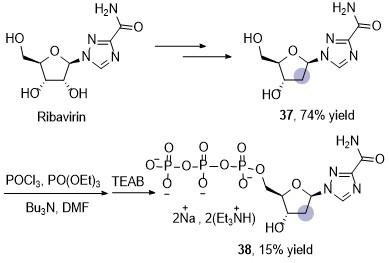
In 2007, Paillart and colleagues[50] synthesized the 2-OH modified ribavirin derivative 37 following the method developed by Kanda S. Ramasamy. Subsequently, the derivative 37 was reacted with bis-tributylammonium pyrophosphate in the presence of tributylamine to obtain the 5-triphosphate nucleoside derivative 38 (Figure 19). The antiviral activity of compound 38 against HIV-1 NL4-3 was evaluated in CEMx174 cell cultures. After 2.5 months, no significant reduction in HIV-1 viability was observed. In contrast, in vitro experiments using purified HIV-1 reverse transcriptase (RT) demonstrated that the triphosphate analogs could reversibly compete with natural nucleoside triphosphates. This finding suggests that competitive inhibition of RT may represent a potential mechanism of action.
2.4 Modification of the 2,3-OH group in the glycosyl of ribavirin
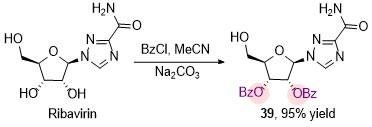
In 2013, Liu and co-workers[51] synthesized a series of 2,3-O-acylated nucleoside derivatives using ribavirin and benzoyl chloride as starting materials in an aqueous MeCN solution (Figure 20). Under mild basic conditions (Na2CO3), the electron-withdrawing triazole nucleobase enhances the acidity of the 2-OH, which is selectively deprotonated and acylated. The introduced 2-O-benzoyl group further activates the adjacent 3-OH for subsequent acylation through an electronic effect. Meanwhile, the 5-OH exhibits reduced nucleophilicity in this aqueous system, and the carboxamide group remains inert. Notably, the yield of 2,3-O-acylated ribavirin derivative 39 reached 95%. This method provides a straightforward and high- yielding approach to access acylated nucleoside derivatives, which are valuable intermediates for further chemical modifications and prodrug development.
2.5 Modification of the 2,3,5-OH group in the gly- cosyl of ribavirin
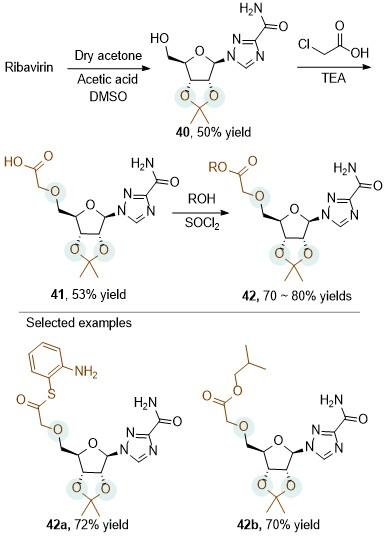
In 2024, Samina and colleagues[52] synthesized a series of novel 2,3,5-O-modified ribavirin derivatives (Figure 21). Ribavirin was reacted with acetone to give the 2,3-O-pro- tected derivative 40. Mechanistically, under acetic acid catalysis, the carbonyl group of acetone is protonated and activated, facilitating nucleophilic attack by one of the hydroxyl groups on the 2,3-diol moiety. Subsequent cyclization with the adjacent hydroxyl group generates a stable five-membered acetonide ring, affording 2,3-O-protected derivative 40. Subsequently, the 5-OH group of derivative 40 was reacted with chloroacetic acid to afford derivative 41, followed by esterification to obtain derivatives 42. A variety of substrates with diverse substituents were well tolerated, and 33 novel ribavirin derivatives were successfully prepared. In addition, the anti-inflammatory and anti-viral activities of these compounds against SARS-CoV-2 were evaluated. Compound 42a showed promising anti- inflammatory activity with a half-maximal inhibitory concentration (IC50) of 0.40 µmol/L, and SARS-CoV-2 infection inhibition up to 80% (IC50=1.42 µmol/L).
Glycosyl modifications primarily target the 5-OH, 3-OH, 2-OH, 2,3-OH, and 2,3,5-OH positions of ribavirin. Modifications at the 5-OH are the most extensively studied. Enzyme-catalyzed acylation and prodrug design improve bioavailability and reduce toxicity. For example, CAL-B- catalyzed 5-O-acylated derivatives improve bioavailability and reduce pharmacokinetic variability. 5-O-phosphorami- dates and macromolecular prodrugs achieved hepatocyte- specific delivery and mitigated hemolytic toxicity. Modifications at the 3-OH and 2-OH are rare but have yielded derivatives with immunomodulatory properties (2-OH) or activity against plant viruses (3-OH). Simultaneous modification of the 2,3-OH provided a convenient route to prodrug intermediates. Full modification of all three hydroxyl groups produced derivatives with potent anti-inflammatory and anti-SARS-CoV-2 activity. Overall, glycosyl modification offers diverse strategies to enhance metabolic stability, enable targeted delivery, and reduce toxicity.
3 Base modification of ribavirin
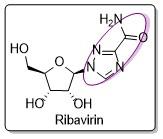
Base modifications are pivotal in modulating the antiviral spectrum and pharmacological properties of ribavirin and its derivatives.[53] Consequently, structural modifications of the base moiety of ribavirin represent a key strategy in the development of novel nucleoside analogs with enhanced therapeutic potential. Here, we focus on recent advances in base modification strategies for ribavirin (Figure 22).
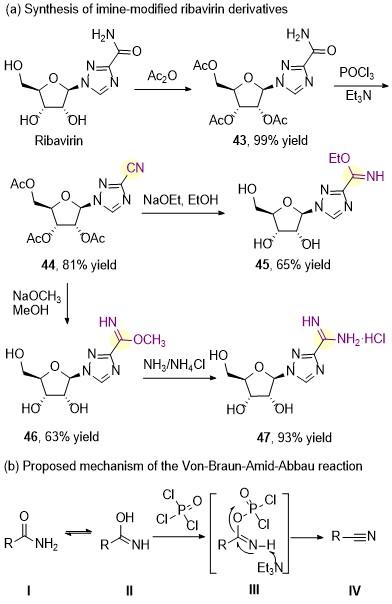
In 1989, Kini and colleagues[54] designed and synthesized base-modified ribavirin compounds 45 and 46 through a multi-step synthetic route involving protection, functional group transformation, and deprotection. Subsequently, derivative 46 served as a key intermediate for the efficient synthesis of 1-β-D-ribofuranosyl-1,2,4-triazole-3-carbox-amide hydrochloride (47) (Figure 23a). Mechanistically, amide intermediate I undergoes tautomerization to form the enol intermediate II under basic conditions (Figure 23b). The oxygen atom of intermediate II then acts as a nucleo- phile, attacking the electrophilic phosphorus atom of POCl3 to generate intermediate III. In the presence of Et3N, intermediate III undergoes deprotonation and elimination of dichlorophosphate, leading to the formation of the cyano group in compound 46. Compounds 45 and 46 were inactive in vitro, but demonstrated significant antitumor activity in vivo.
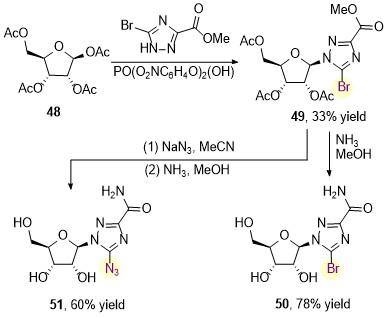
In 2004, Peng and co-workers[55] synthesized fluorescent probe compounds 50 and 51 by directly coupling azidotri-azole with a protected ribose moiety (Figure 24). This strategy aimed to investigate the antiviral mechanism of ribavirin using a photo-labeling method. Compound 50 exhibited rapid and characteristic photochemical reactions in various solvents, indicating its potential as a photo- labeling probe for studying the mechanism of antiviral activity of ribavirin.
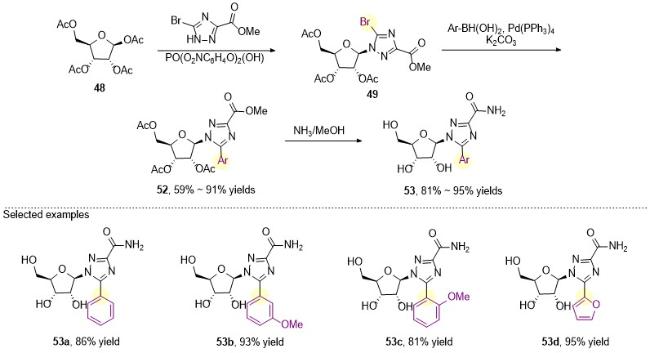
In 2006, Peng and colleagues[56] reported an efficient strategy for the synthesis of 5-aryltriazole nucleosides 53 (Figure 25). This method utilized Suzuki coupling and ammonolysis reactions to synthesize various aryl-substi-tuted triazole nucleoside derivatives 53, using brominated triazole nucleoside scaffold 49 as the starting material. Under conventional thermal conditions, only moderate yields were obtained. However, the yields were significant- ly improved under microwave irradiation. The study de- monstrated that microwave-assisted Suzuki coupling great- ly enhanced reaction efficiency, enabling the rapid syn- thesis of ribavirin derivatives with aromatic substitutions in good to excellent yields. Additionally, aldehyde substrates with different substituents were well tolerated, resulting in corresponding 5-aryl triazole nucleosides 53 with good to excellent yields.
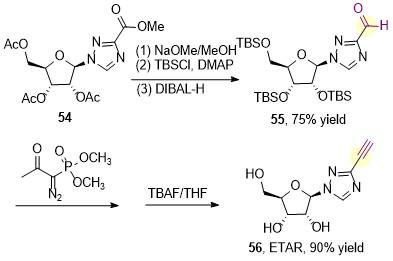
In 2008, Jonsson and co-workers[57] reported the multi-step synthesis of a novel 1-β-D-ribofuranosyl-3-ethynyl[1,2,4]triazole (ETAR). Starting from methyl ester 54, sequential deacetylation, followed by tert-butyldimethyl-silyl (TBS) protection, and regioselective reduction affor- ded triazole aldehyde 55. Subsequently, the aldehyde was converted into an alkyne using the Bestmann-Ohira reagent, and deprotection of the TBS group yielded a novel alkyne- modified ribavirin derivative ETAR (Figure 26). The conversion of the aldehyde to the alkyne proceeds via the Seyferth-Gilbert homologation. The Bestmann-Ohira reagent is deprotonated by base to generate a carbanion, which attacks the aldehyde carbonyl to form an alkoxide intermediate. This intermediate undergoes intramolecular cycli-zation with the phosphorus atom to form an oxaphosphetane ring. Ring opening eliminates dimethyl phosphate, yielding a vinyldiazomethane compound. Subsequent nitrogen release generates a vinyl carbene. The vinyl carbene then undergoes a 1,2-migration to afford the terminal alkyne. ETAR exhibited promising antiviral activity against Hantaan virus (HTNV) and Andes virus, with half-maximal effective concentration (EC50) values of 10 and 4.4 μmol/L, respectively. Mechanistic and metabolic studies indicated that its activity primarily stemmed from inosine monophos- phate dehydrogenase (IMPDH) inhibition and consequent GTP pool reduction, potentially affecting the viral L protein due to residual complementary activity.
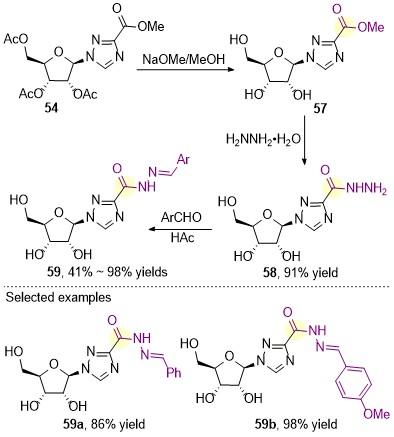
In 2010, Zhang and colleagues[58] used methyl formate 54 as the starting material to synthesize intermediate 58 through hydrolysis and amination reactions. Compound 58 was then reacted with aromatic aldehydes, modifying the 3-position of the triazole base, to afford the synthesis of 6 Schiff base derivatives of ribavirin 59 (Figure 27). Furthermore, the reaction exhibited excellent compatibility with various aldehyde substrates, affording the corres- ponding hydrazide-modified ribavirin derivatives 59 in moderate to high yields. This strategy facilitated the systematic exploration of aromatic pharmacophores on the triazole core, providing a platform for optimizing nucleoside analog antiviral activity through targeted base modifications.


Since 2010, progress in base modification research has slowed, primarily due to two factors. Synthetically, the multiple reactive sites on bases make site-selective modification challenging, and protecting group strategies are often cumbersome, which may compromise the stability of glycosidic bonds. Biologically, the shift in drug development from broad-spectrum antiviral therapies toward precision treatments has placed greater demands on the metabolic stability and selectivity of modified com- pounds, thereby narrowing the scope for structure-activity relationship (SAR) optimization.
Base modifications focus on functionalizing the triazole core at the C3 and C5 positions. This strategy expands the antiviral spectrum and explores new mechanisms of action. Alkyne-modified ETAR demonstrated potent activity against Hantaan and Andes viruses through inosine mono- phosphate dehydrogenase (IMPDH) inhibition and GTP depletion, without inducing viral genome mutations. Aryl- modified derivatives were efficiently synthesized via microwave-assisted Suzuki coupling. Azide-modified probes served as photoaffinity labels for studying antiviral mechanisms. Hydrazide derivatives enabled systematic exploration of aromatic pharmacophores on the triazole core. In conclusion, base modification introduces diverse functional groups onto the triazole ring. This approach broadens the antiviral spectrum and reveals multi-target mechanisms, offering valuable lead compounds for next- generation nucleoside analogs.
4 Summary and outlook
Ribavirin, a broad-spectrum antiviral nucleoside drug, has been widely used in the treatment of various viral diseases. However, its clinical application is limited by dose-dependent hemolytic toxicity and variable bioavai- lability, which has driven efforts to develop derivatives with optimized therapeutic indices. This review provides a com- prehensive overview of the structural modifications and applications of ribavirin, focusing on glycosyl and base modifications. Glycosyl modifications, particularly at the 5-OH, 3-OH, and 2-OH positions, have yielded derivatives with improved bioavailability and antiviral efficacy, often involving advanced synthetic techniques such as enzyme- catalyzed reactions and regioselective acylations. Base modifications, including the synthesis of various triazole, azide, and alkyne derivatives, have expanded the antiviral spectrum of ribavirin and its analogues.
Despite promising results, the synthesis of ribavirin derivatives presents several challenges. Achieving high regioselectivity and yield in glycosyl and base modifi- cations often requires harsh reaction conditions and expen- sive catalysts. Developing derivatives with significantly improved bioavailability and reduced toxicity while maintaining antiviral efficacy remains a formidable task. Additionally, comprehensive preclinical and clinical evaluations are necessary to ensure the safety and efficacy of these new derivatives, a process that is time-consuming and resource-intensive.
The future of ribavirin modification research is promising with several avenues for exploration. Advances in enzy- matic catalysis and chemical synthesis techniques are expected to simplify the production of ribavirin derivatives and enhance their yields and selectivity. Furthermore, integrating computational modeling and high-throughput screening could accelerate the identification of promising candidates with optimal pharmacological properties. Conti- nued interdisciplinary collaboration among chemists, biologists, and pharmacologists will be essential for overcoming the remaining challenges. Ultimately, the development of efficient and low-toxicity ribavirin deri- vatives will significantly enhance antiviral therapy, pro- viding improved treatment options for a range of viral infections.
(Lu, Y.)