



Photoredox catalysis has emerged as a powerful strategy in modern organic synthesis, enabling the generation of reactive radical intermediates under mild conditions using visible light as a clean and sustainable energy source.[1] This catalytic mode grants access to unique reaction pathways via single-electron transfer (SET) processes, with inherent excellent functional group tolerance and high chemoselectivity.
Nickel stands out as an earth-abundant and inexpensive transition metal, offering compelling economic and sustainability advantages over precious metals like palladium, rhodium, and ruthenium.[2] Benefiting from abundant supply in recent years, nickel has become a cost-effective choice for specific large-scale industrial application. More- over, its ability to access multiple oxidation states enables versatile reaction pathways distinct from noble metals. These features collectively position nickel catalysis as a powerful platform for diverse transformations, one that is uniquely aligned with the growing global emphasis on sustainable chemical processes.
The synergistic combination of photoredox and nickel catalysis—metallaphotoredox catalysis—integrates the strengths of both platforms.[3] In this dual catalytic system, the photocatalyst mediates SET events to generate radical intermediates, while the nickel catalyst leverages its accessible oxidation states to govern bond formation. This cooperative interplay enables efficient and selective transformations under mild conditions.
Carboxylic acids are attractive feedstocks for sustainable synthesis, offering advantages including ready availability, structural diversity, bench stability, and low cost. In recent years, decarboxylative coupling of carboxylic acids has advanced rapidly, establishing them as a class of versatile and convenient coupling precursors.[4] In contrast, the direct deoxygenative functionalization of carboxylic acids represents a more challenging yet atom-economical transformation mode.[5] Recent progress in photoredox/nickel dual catalysis has now unlocked this potential, providing direct access to ketones—ubiquitous structural motifs in natural products and pharmaceuticals (Scheme 1a). This strategy employs in situ activation of carboxylic acids using reagents such as dimethyl dicarbonate (DMDC), di- tert-butyl dicarbonate (Boc2O), or triphenylphosphine (PPh3) to generate highly reactive intermediates, which subsequently engage with various coupling partners, enabling direct deoxygenative conversion of carboxylic acids under mild conditions. The method circumvents the cumbersome pre-activation and the associated waste inherent to conventional methods, offering an efficient route to ketones and related compounds.
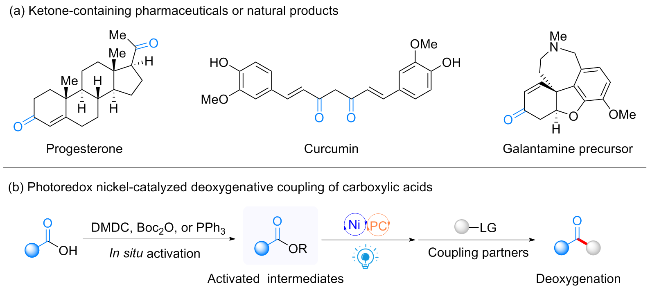
This review summarizes recent progress in photoredox nickel-catalyzed deoxygenative coupling of carboxylic acids, organized according to the activating reagents employed. The reaction mechanisms, substrate scope, and synthetic applications of each strategy are discussed, along with remaining challenges and future directions in this rapidly evolving field (Scheme 1b).
1 DMDC as the activator
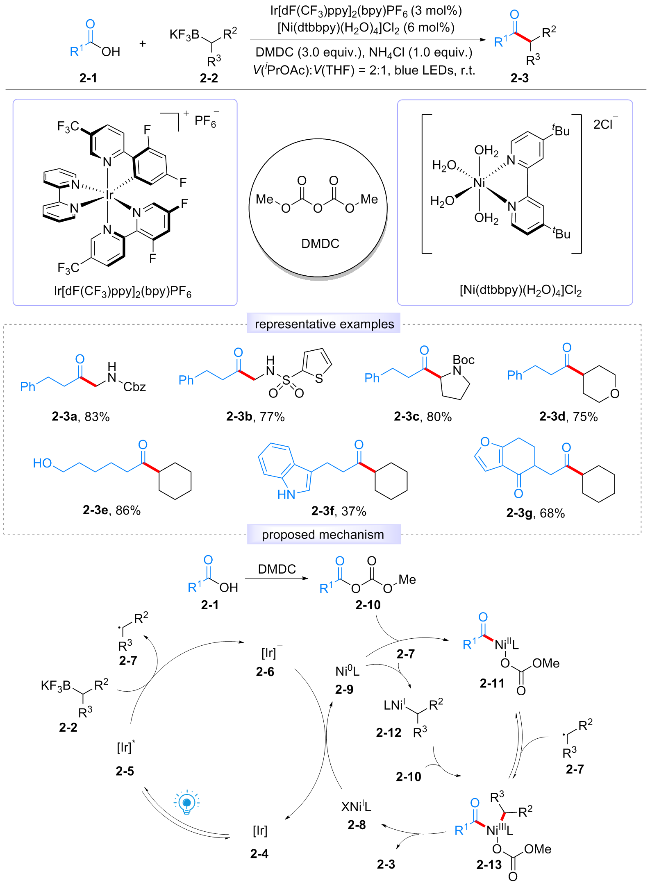
In 2017, Molander and co-workers[6] reported the first example of directly converting simple, stable carboxylic acids into alkyl ketones via visible-light-induced cooperative photoredox/nickel catalysis. This protocol operates under ambient temperature, utilizes carboxylic acids directly as starting materials without the need for pre-syn- thesis of activated derivatives such as acyl halides or esters. It demonstrates excellent functional group tolerance and broad substrate scope, thereby efficiently enabling the construction of C(O)—C(sp3) bonds under mild conditions. The reaction mechanism proceeds as follows: under visible light irradiation, the ground-state [Ir] photosensitizer 2-4 is excited to its excited state 2-5, which is subsequently reduced by alkyltrifluoroborate 2-2 via SET to generate the reduced iridium species [Ir]- 2-6 along with an alkyl radical 2-7. The [Ir]- species further reduces Ni(I) 2-8 to highly reactive Ni(0) 2-9 while regenerating the [Ir] catalyst 2-4. Meanwhile, the carboxylic acid reacts with DMDC in situ to form an activated carbonic anhydride intermediate 2-10. Ni(0) undergoes oxidative addition with this intermediate to produce a Ni(II)-acyl species 2-11. The generated alkyl radical 2-7 is then captured by this Ni(II)- acyl species, resulting in the formation of a Ni(III)-acyl- alkyl complex 2-13. Alternatively, alkyl radical 2-7 can first interact with Ni(0) 2-9 to form Ni(I) intermediate 2-12, which then undergoes oxidative addition with 2-10 to also afford 2-13. Finally, rapid reductive elimination from 2-13 delivers the target alkyl ketone product 2-3 and regenerates the Ni(I) catalyst 2-8, thereby completing the catalytic cycle (Scheme 2).
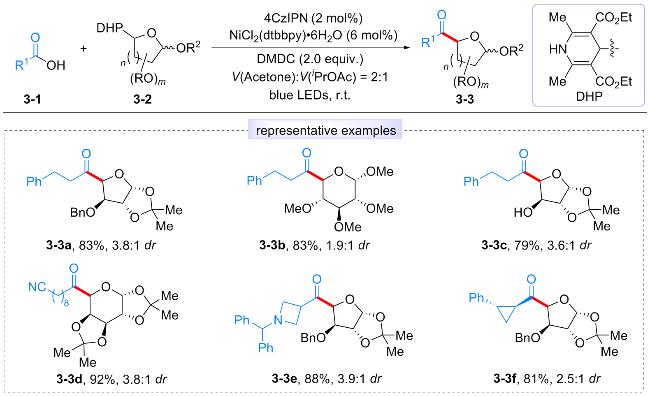
C-Glycosides, as important structural motifs in natural products, exhibit favorable metabolic stability (superior to O-glycosides) and diverse bioactivities, such as antitumor, antibiotic, and type-II antidiabetic effects.[7] Among them, C-acyl glycosides have demonstrated significant functions in inhibiting reactive oxygen species and regulating cell signaling.[8] Moreover, they serve as important synthetic intermediates for natural compounds, nucleoside analogues, and pharmaceutical molecules.[9] Their downstream derivatives also have broad applications in drug discovery, chemical biology, and biochemical research.[10] However, traditional synthetic methods often require harsh conditions and show poor functional-group tolerance.[11] Furthermore, these approaches typically fail to preserve the reactivity of the anomeric carbon, thereby limiting further structural modification and applications in drug development. Building on their previous studies, the same group[12] reported in 2018 an efficient method for synthesizing non-anomeric C-acyl glycosides (Scheme 3). This approach operates under visible-light irradiation at room temperature via photoredox/nickel dual-catalytic system, using glycosyl-1,4-dihydropyridines (1,4-DHPs) as radical precursors that cross-couple with in situ activated carboxylic acids. The retention of the anomeric carbon provides a key functional handle for late-stage modification of glycoside-based drug candidates. Beyond expanding the synthetic toolkit in carbohydrate chemistry, this strategy offers a novel pathway for constructing C(sp3)—C(O) bonds and holds significant promise for applications in medicinal chemistry, natural product synthesis, and bioconjugation.
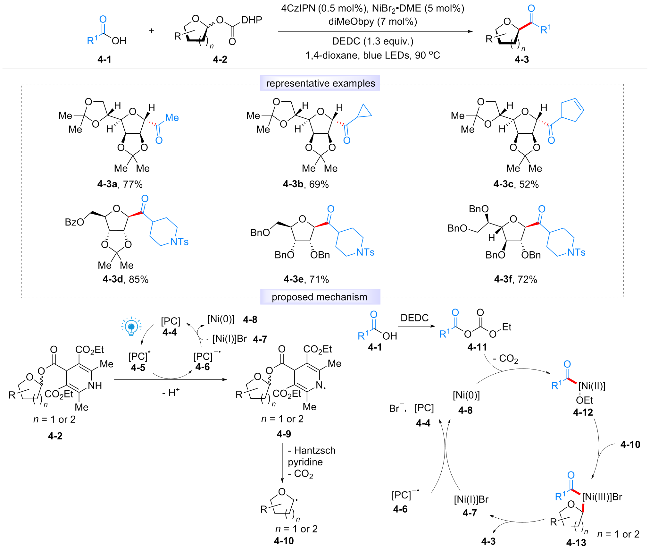
In 2021, the Diao group[13] developed an analogous photoredox/nickel dual catalytic system enabling the cross- coupling of glycosyl esters with carboxylic acids. This strategy relies on CO2 extrusion-driven homolysis of the anomeric C—O bond as the key step, allowing for the efficient and highly stereoselective synthesis of a range of C-acyl furanosides (Scheme 4). The method has been successfully applied to the synthesis of nucleoside analogues and the late-stage modification of natural products. Mecha-nistically, glycosyl DHP esters are excited under photoredox conditions and undergo decarboxylation to generate glycosyl radicals 4-10. Concurrently, and in contrast to the activating reagents discussed above, carboxylic acids are activated by diethyl dicarbonate (DEDC) to form mixed anhydrides 4-11. The glycosyl radical then undergoes cross-coupling with an acyl radical captured by the nickel center, furnishing the desired product.
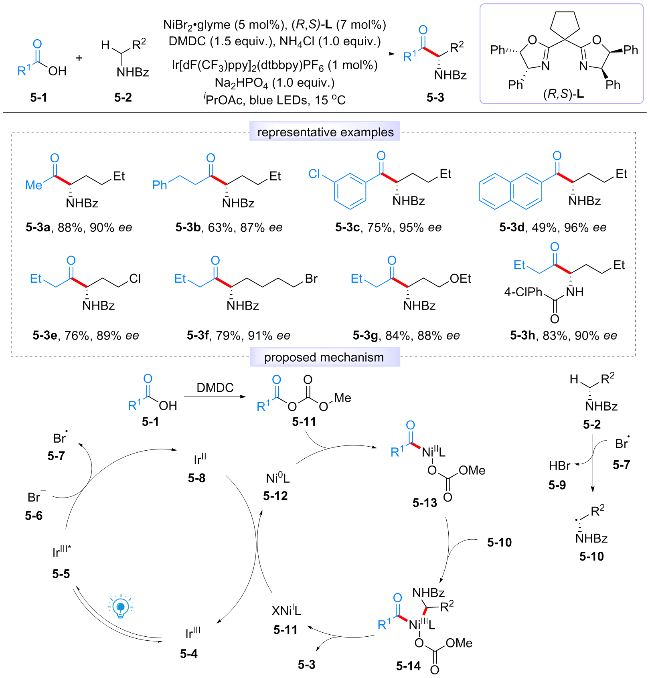
Chiral α-amino ketones are key structural motifs found in a wide range of pharmaceuticals.[14] Classical approaches to their synthesis typically rely on asymmetric electrophilic or nucleophilic amination of carbonyl compounds, methods often constrained by limited substrate scope and multistep manipulations. Asymmetric C(sp3)—H acylation represents a more direct and modular alternative, though achieving effective enantiocontrol in this context has remained a formidable challenge. In 2020, the Huo group[15] described a direct, enantioselective C(sp3)—H acylation reaction that enables the efficient construction of chiral α-amino ketones (Scheme 5). This transformation leverages a synergistic combination of nickel and photoredox catalysis, allowing for cross-coupling between carboxylic acids and N-alkyl benzamides under mild conditions with excellent enantioselectivity and broad functional group tolerance. Mechanistically, the photocatalyst facilitates the generation of bromine radicals 5-7, which mediate hydrogen atom transfer (HAT) from the α-C(sp3)—H bond of N-alkyl benzamides 5-2 to deliver α-amino alkyl radicals 5-10. Simultaneously, a chiral Ni/bisoxazoline catalyst undergoes oxidative addition with activated carbonic anhydride 5-11 generated in situ from a carboxylic acid and DMDC, captures the resulting radical species 5-10, and undergoes reductive elimination to furnish the enantioenriched α-amino ketone products 5-3. This work represents the first asymmetric transformation in photoredox/nickel- catalyzed deoxygenative coupling of carboxylic acids, providing an enantioselective C(sp3)—H acylation and an efficient, modular, and eco-friendly protocol for the synthesis of chiral α-amino ketones. More broadly, it opens up new avenues for asymmetric radical C—H functionalization.
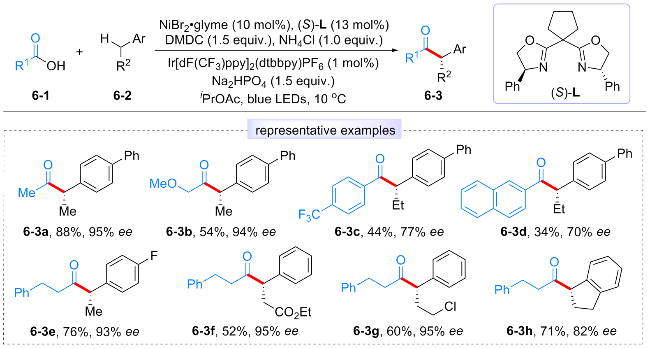
In 2021, building on their previous work, the Huo group[16] extended the asymmetric C(sp3)—H acylation strategy from polar substrates (N-alkyl benzamides) to non-polar alkylarenes, achieving direct enantioselective acylation of benzylic C(sp3)—H bonds (Scheme 6). This method provides a concise route to chiral α-aryl ketones that circumvents the need for pre-functionalization, sensitive organometallic reagents, and stoichiometric reducing agents. This work successfully expanded the asymmetric C—H acylation strategy to alkylarenes, thereby further broadening the application boundaries of photoredox/ nickel catalysis in asymmetric radical transformations.
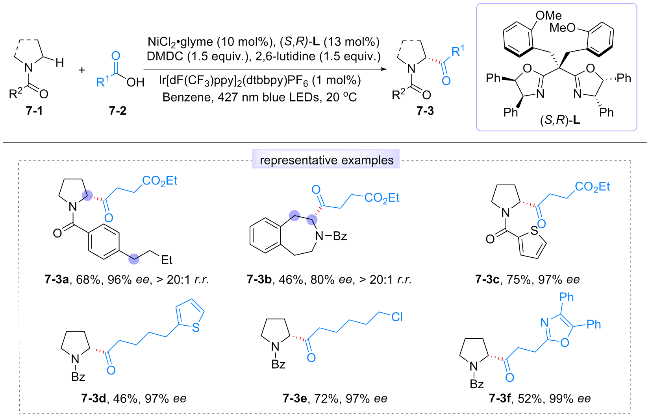
In 2023, the same group[17] advanced the application of the asymmetric C(sp3)—H acylation strategy to the more challenging domain of saturated N-heterocycles, successfully addressing the longstanding dual challenges of regioselectivity and enantioselectivity (Scheme 7). This work reports an unprecedented direct α-acylation of saturated azacycles with high regio- and enantiocontrol, enabled by a synergistic platform that integrates chlorine-radical-me- diated HAT with chiral nickel catalysis. Upon photooxidation, NiCl2•glyme serves as both the nickel catalyst and chlorine radical precursor, releasing highly electrophilic chlorine radicals. These radicals exploit the polarity ma- tching effect to selectively abstract the cyclic α-amino C—H bond—outcompeting benzylic, allylic, α-oxy, and acyclic α-amino C—H bonds. The resulting prochiral α-amino radicals are efficiently intercepted by a chiral Ni(I) species, followed by single-electron reduction, then oxidative addition, furnishes the C—C coupled product with excellent stereoselectivity.
To address the critical barriers to the scalable implementation of asymmetric photocatalysis, particularly the scarcity, high cost, and difficult recovery of iridium, Wang and Huo[18] have developed an innovative strategy centered on the immobilization of iridium photosensitizers onto metal-organic layers (MOLs). This strategy significantly enhances enantioselectivity and expands substrate applicability in the Ni/Ir dual-catalytic system, while simultaneously enabling efficient catalyst recovery and reuse. In doing so, it establishes a new paradigm for the design of asymmetric photocatalytic platforms that seamlessly unite sustainability with high catalytic performance.
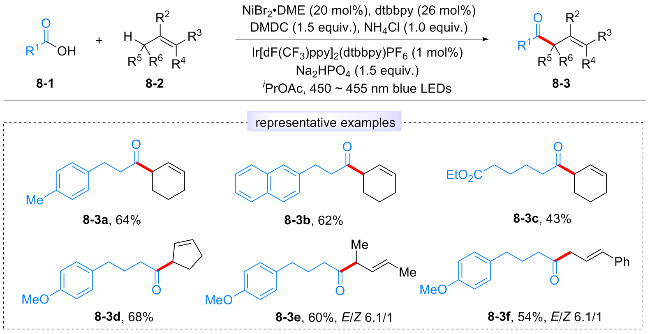
In 2026, Yang and Tang[19] established a photoredox/ nickel dual catalytic system for the direct allylic C(sp3)—H acylation of unactivated alkenes with carboxylic acids (Scheme 8). Central to this strategy is a bromine-radical- mediated HAT process, which enables the efficient and step-economical synthesis of β,γ-unsaturated ketones. The method features an exceptionally broad substrate scope, accommodating aryl, heteroaryl, cyclic and acyclic alkyl acids, N-Boc amino acids, while also tolerating sensitive functional groups including esters, amides, ketones, and alkyl chlorides. A broad range of alkenes, such as five- to eight-membered cyclic, acyclic, tri- and tetrasubstituted, and aryl-substituted variants, participate efficiently in the reaction. It also demonstrates multiple advantages, including late-stage modification of pharmaceuticals, assembly of bis(β,γ-unsaturated ketone) scaffolds, and the use of green solvents, offering a new paradigm for the direct fun- ctionalized coupling of carboxylic acids with alkenes.
2 Boc2O as the activator
Ketones are widely found in pharmaceuticals and natural products and serve as important synthetic intermediates.[20] Traditional synthetic methods rely on the reaction of pre-functionalized carboxylic acid derivatives with organometallic reagents, which involves cumbersome steps. Carboxylic acid themselves are abundant, structurally diverse, and ideal building blocks. However, although the direct cross-ketonization of two unmodified carboxylic acids has a history of 150 years, it has long been limited to simple carboxylic acids (such as acetic acid) due to harsh reaction conditions (typically>300 ℃), poor cross-selec- tivity, and difficulty in distinguishing between two different carboxylic acids. As a result, the synthesis of complex unsymmetrical ketones remains challenging. In 2022, the Yoon group[21] reported a selective cross-ketonization reaction enabled by photoredox/nickel catalysis, achieving the direct coupling of two unmodified carboxylic acids to form unsymmetrical ketones (Scheme 9). This strategy requires no pre-functionalization, operates under mild conditions, and exhibits a broad substrate scope. The reaction design achieves selectivity based on structural differences between the carboxylic acids: less sterically hindered acids undergo in situ formation of a mixed anhydride with Boc2O, followed by nickel-catalyzed oxidative addition; whereas more sterically hindered acids undergo photoinduced decarboxylation to generate stable radical intermediates. These radicals then couple with the nickel complex, followed by reductive elimination to yield the unsymmetrical ketone products.
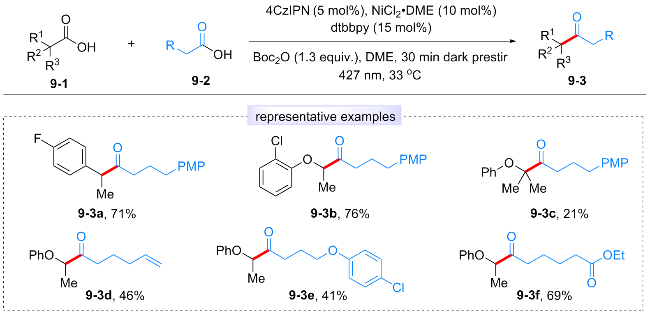
In 2024, Tang and Yang[22] reported the direct deoxygenative cross-coupling of carboxylic acids and alcohols. This method utilizes Boc2O for carboxylic acid activation and an NHC reagent for alcohol activation, efficiently converting two classes of ideal synthetic building blocks—abundant, structurally diverse, and bench-stable—into dialkyl ketones (Scheme 10). Mechanistic studies indicate that the reaction operates through a dual photoredox/nickel catalytic cycle. In the photocatalytic cycle, the alcohol 10-2 is first activated by an NHC reagent and then oxidized by the excited-state photocatalyst to form an aminium radical cation 10-5. This intermediate subsequently undergoes deprotonation and β-scission to generate an alkyl radical 10-7. In the nickel catalytic cycle, the carboxylic acid is activated in situ by Boc2O to form a mixed anhydride 10-13, which undergoes oxidative addition with Ni(0) 10-12 to afford an acyl-Ni(II) complex 10-14. This complex captures the alkyl radical 10-7 to produce a Ni(III) intermediate 10-15, which then undergoes reductive elimination to deliver the desired ketone 10-3. Concurrently, the resulting Ni(I) species 10-11 participates in a SET with the reduced photocatalyst, regenerating Ni(0) and the ground-state photocatalyst 10-8 and thereby closing both catalytic cycles.
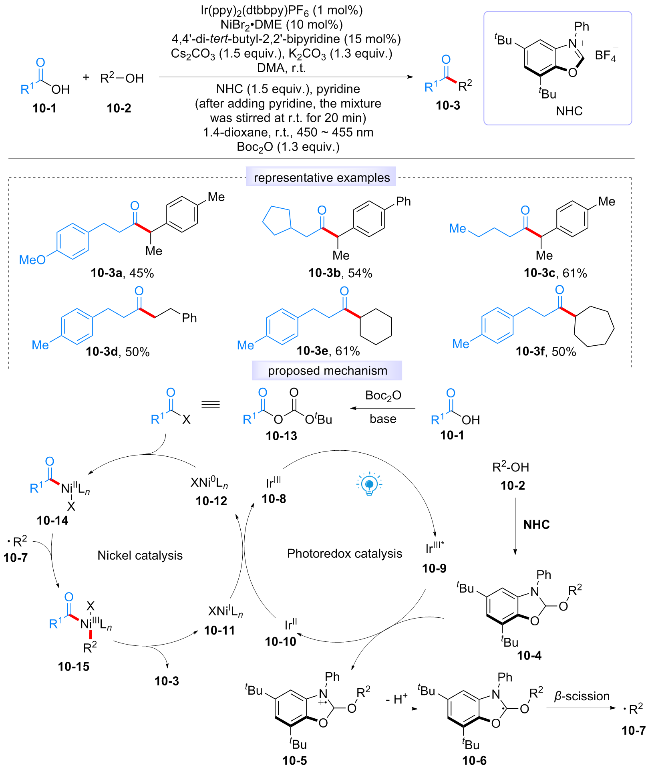
In 2025, Li et al.[23] reported a dual photoredox/nickel catalytic strategy for the direct acylation of spiro-dihydro- quinazolones with carboxylic acids (Scheme 11). This method leverages aromatization as a thermodynamic driving force to promote the ring-opening of unstrained spirocycles (e.g., five- and six-membered rings), generating carbon-centered radicals. These radicals then couple with acyl-Ni complexes formed in situ from carboxylic acids, providing efficient access to diverse ketone scaffolds. The proposed reaction mechanism proceeds as follows: Initially, the excited-state photocatalyst oxidizes the spiro-dihy- droquinazolone to generate a nitrogen-centered radical cation 11-5, which then undergoes aromatization-driven β-scission, leading to ring-opening and the formation of a carbon-centered radical 11-6. Concurrently, the carboxylic acid is activated in situ by Boc2O to form a mixed anhydride 11-12, which undergoes oxidative addition with Ni(0) 11-11 to produce an acyl-Ni(II) complex 11-13. This complex subsequently captures the carbon-centered radical 11-6 to form a Ni(III) intermediate 11-14, followed by reductive elimination to deliver the desired ketone product 11-3.
3 PPh3 as the activator
As early as 2018, the Xie group[24] pioneered a visible-light photocatalytic system for carboxylic acid deoxygenation using inexpensive PPh3 as an O-transfer reagent, marking the first PPh3-activated deoxygenative approach. This strategy enables the direct generation of acyl radicals from aromatic carboxylic acids under mild conditions, which then undergo coupling with alkenes to afford aromatic ketones. Building on this groundwork, the recently emerged visible-light-induced phosphinyl radical fragmentation strategy has further evolved into a novel and efficient general platform for the direct activation of C—O bonds in carboxylic acids.
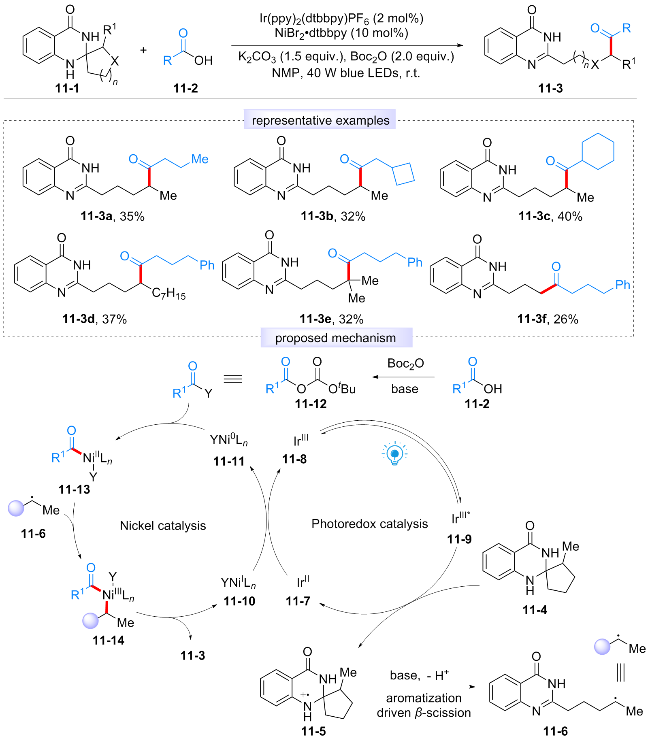
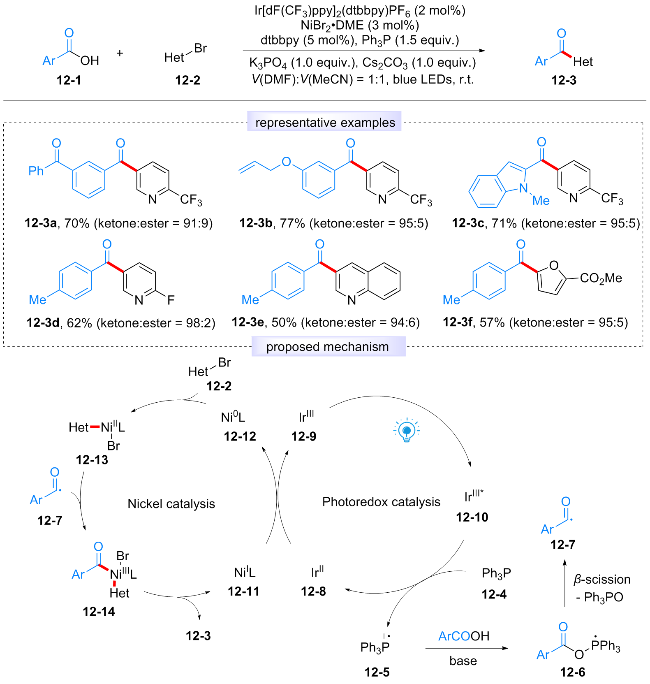
In 2020, Xie and colleagues[25] integrates photoredox/ nickel catalysis to enable the direct cross-electrophile coupling of carboxylic acids with organohalides for ketone synthesis (Scheme 12). Utilizing two bulk chemical feedstocks as starting materials, this method achieves C—O bond cleavage through phosphoranyl radical intermediates, thereby overcoming the constraints of conventional activation strategies. Merging photoredox, metal, and radical catalysis, this approach provides a mild and atom-econo- mical route for ketone synthesis, demonstrating its versatility and efficiency in accessing high-value compounds. The reaction mechanism is as follows: the excited-state iridium catalyst oxidizes triphenylphosphine 12-4 to generate a phosphine radical cation 12-5, which combines with a carboxylate anion to form a phosphoranyl radical intermediate 12-6, subsequent β-scission of 12-6 releases an acyl radical 12-7. In parallel, Ni(0) 12-12 undergoes oxidative addition with an organohalide 12-2 to form an aryl-Ni(II) complex 12-13. This complex captures the acyl radical 12- 7 to generate a Ni(III) intermediate 12-14, which then undergoes reductive elimination to deliver the product 12-3.
With an annual global output of 180 million tons, ethylene is the most widely used alkene in the chemical industry, primarily for the production of plastics and polymer materials. However, its direct application in the synthesis of fine chemicals remains limited. In 2021, the Xie group[26] reported a photoredox/nickel-catalyzed hydroacylation of ethylene using aromatic carboxylic acids (Scheme 13).
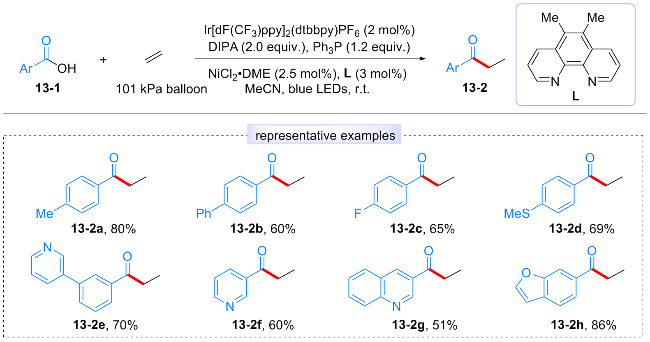
The key challenge lies in the inherent polarity mismatch: acyl radicals are nucleophilic, while ethylene, as an unactivated alkene, is weakly electrophilic, rendering conventional radical addition difficult. By enabling the capture of acyl radicals within the nickel catalytic cycle, this approach strategically diverts the reaction pathway from radical addition to an organometallic route, thereby realizing efficient hydroacylation of ethylene under ambient conditions. This work offers a new avenue for the direct conversion of bulk ethylene into functional aromatic ketones.
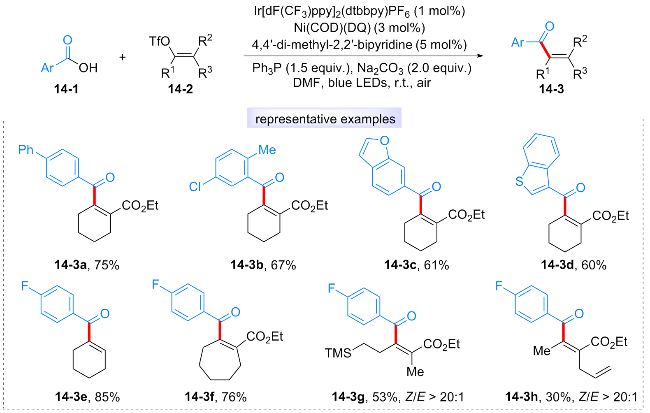
The synthesis of all-carbon tetrasubstituted alkenes under mild conditions remains a formidable challenge, largely due to their inherent steric congestion and the difficulty in controlling Z/E stereoselectivity.[27] To address this limitation, the same group[28] leveraged the air-stable Ni(COD)(DQ) catalyst to develop a deoxygenative cross-coupling reaction between carboxylic acids and alkenyl triflates, enabling the efficient and selective construction of all-carbon tetrasubstituted alkenes (Scheme 14). This protocol operates under an air atmosphere with straightforward manipulation and accommodates a broad substrate scope, including aromatic and heteroaromatic carboxylic acids, as well as cyclic and acyclic alkenyl triflates, highlighting its practicality and synthetic potential.
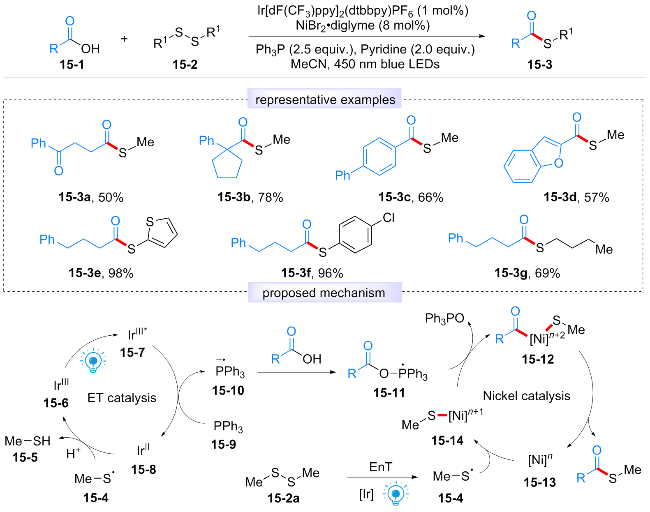
Methyl thioesters are widely present in natural products, pharmaceuticals, and materials science, serving as important biosynthetic precursors—for example, in native chemical ligation for peptide and protein synthesis.[29] However, existing synthetic methods suffer from several limitations: in the reaction of electrophilic acyl compounds with sodium methylthiolate or methyl mercaptan, methyl mercaptan is a gas and operationally inconvenient, while sodium methylthiolate is prone to hydrolysis; multistep synthetic routes are often inefficient and lack atom economy; and palladium-catalyzed carbonylative thiomethylation suffers from a narrow substrate scope. To address these challenges, in 2023, Glorius and co-workers[30] developed a novel strategy based on nickel-catalyzed sensitized electron transfer, enabling the radical thioesterification of carboxylic acids with disulfides (Scheme 15). This method leverages the synergistic cooperation of nickel catalysis, photoinduced electron transfer, and energy transfer (EnT) to achieve the direct radical thioesterification of carboxylic acids with dimethyl disulfide (DMDS), offering a new and efficient pathway for the synthesis of methyl thioesters. Based on mechanistic investigations, a plausible reaction pathway is delineated as follows. In the photocatalytic cycle, the excited-state iridium catalyst mediates single-electron oxidation of triphenylphosphine 15-9, furnishing a phosphine radical cation 15-10. This species readily associates with a carboxylate anion to form a key intermediate, which subsequently undergoes β-scis- sion to release an acyl radical concomitant with the formation of triphenylphosphine oxide. At the same time, in the nickel catalytic cycle, homolytic cleavage of DMDS generates a thiomethyl radical 15-4, which is efficiently captured by a low-valent nickel species 15-13. The resulting nickel intermediate 15-14 engages in radical coupling with the acyl radical to produce a high-valent nickel comp-lex 15-12. Facile reductive elimination then delivers the desired methyl thioester product and regenerates the low- valent nickel catalyst 15-13.
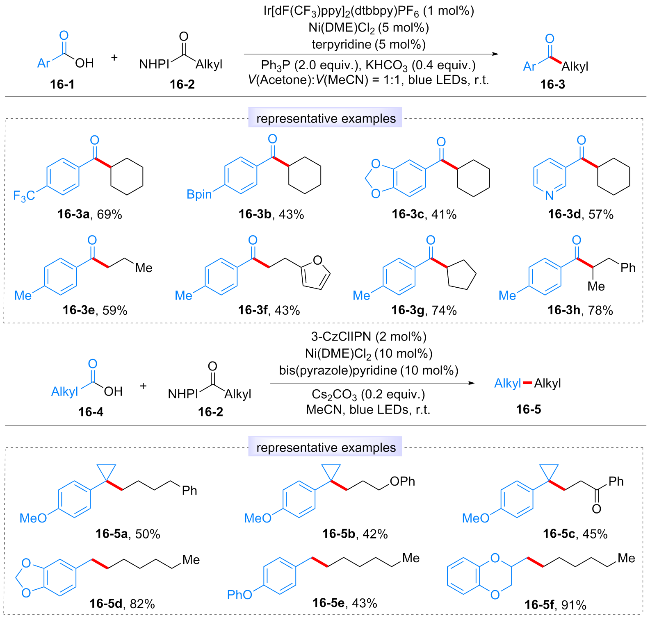
Building on their foundational work in carboxylate activation, the Xie group[31] further advanced the field in 2024 by establishing a novel radical cross-coupling platform through photoredox/nickel dual catalysis. Through judicious modulation of reaction conditions, two complementary bond-forming manifolds were established using readily accessible carboxylic acids and NHPI esters: deoxygenative coupling of aryl carboxylic acids with alkyl radicals delivers diverse ketones, and decarboxylative coupling of alkyl acids to construct sterically congested frameworks bearing all-carbon quaternary centers (Scheme 16). This strategy not only offers a new avenue for the divergent synthesis of ketones but also provides an efficient approach to access complex skeletons bearing all-carbon quaternary centers, thereby broadening the utility of carboxylic acid feedstocks in radical cross-coupling reactions.


4 Conclusions
In summary, photoredox nickel-catalyzed deoxygenative coupling of carboxylic acids has emerged as a powerful and versatile strategy that proceeds under mild conditions, with this review highlighting recent advances categorized by activating reagents—namely DMDC, Boc2O, and PPh3—each enabling distinct transformations. These methodologies leverage the abundance and structural diversity of carboxylic acids, offering efficient access to high-value ketones and related scaffolds with excellent selectivity and functional group tolerance. Despite significant progress, several challenges persist. The reliance on noble metal photocatalysts raises sustainability concerns, highlighting the need for earth-abundant alternatives. Enantioselective transformations remain limited in substrate scope, necessitating improved chiral ligand design. Alkyl carboxylic acids are prone to undesired decarboxylation, posing reactivity challenges. Continued developments in catalyst design and reaction engineering promise to further expand the scope and sustainability of this transformative platform. In line with green chemistry principles, future research should also focus on reducing solvent consumption and minimizing waste generation. Promising directions include the development of aqueous-phase reactions, the design of recyclable catalytic systems, and the exploration of one-pot multi-step tandem processes. We hope the strategies summarized herein will serve as a useful reference for researchers seeking to develop new deoxygenative couplings or apply existing ones to complex molecule synthesis.
(Cheng, F.)