


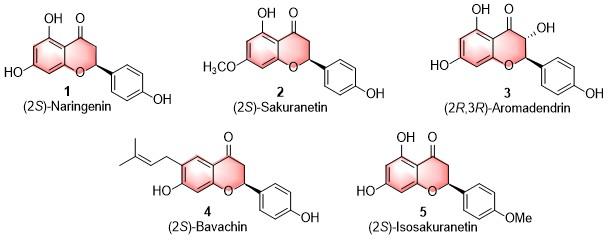
C(2)手性-4-色满酮衍生物因其多样的生物活性, 已成为有机化学和药物化学领域的一个重要研究对象. 截至目前, 已有文献报道的具有生物活性的C(2)手性-4-色满酮衍生物已达上万个[1]. 典型的C(2)手性-4-色满酮衍生物见图1. 其中柚皮素(Naringenin, 1)具有抗肿瘤活性[2-5], 樱花素(Sakuranetin, 2)具有抗炎活性[6-9], 香橙素(Aromadendrin, 3)具有抗氧化活性[10-14], 补骨脂甲素(Bavachin, 4)具有促进成骨功效[15-16], 异樱花素(Isosa- kuranetin, 5)具有神经保护活性[17].
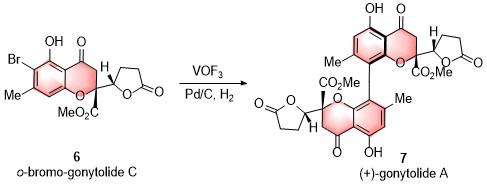
另外, C(2)手性-4-色满酮衍生物作为重要中间体, 也是合成多种具有生物活性衍生物的前体[18-20]. 例如, 前体色满酮衍生物6是合成苔类植物中具有抗炎与抗肿瘤等多重活性的(+)-gonytolide A (7)的重要前体(Scheme 1).
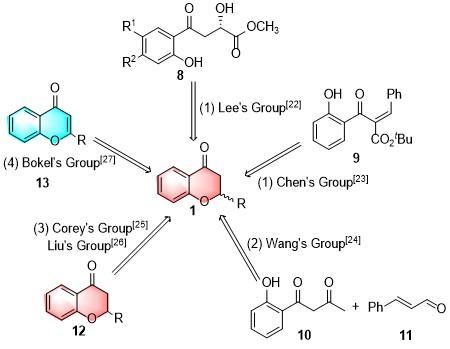
综上所述, C(2)手性-4-色满酮衍生物是一类非常重要的化合物[21]. 目前有关其不对称合成方法的报道主要有以下4种方法, 如Scheme 2所示: (1)分子内不对称环化合成: 通过分子内形成C—O键构建色满酮骨架, 实现对映选择性控制. 此方法具有较好的立体选择性和环化效率, 适用于构建特定稠环或螺环结构的C(2)手 性-4-色满酮衍生物. 2015年, Lee课题组[22]以(S)-2-羟基-4-(2-甲氧基苯基)-4-氧代丁酸甲酯(8)为底物, 通过分子内不对称环化加成反应, 得到了C(2)手性-4-色满酮衍生物, 但该方法需使用高负载量的偶氮试剂和膦试剂, 仍需进一步优化反应条件; 2022年, 陈傅雪课题组[23]报道了一种有机催化不对称串联策略, 底物叔丁基-2-(2-羟基苯甲酰基)-3-苯基丙烯酸酯(9)通过分子内不对称环化加成与亲电硫氰化连续反应, 得到C(2)手性-4-色满酮衍生物. (2)分子间不对称环化合成: 通过两个或多个不同分子之间的反应构建色满酮骨架, 并引入C(2)手性中心, 能够构建结构多样的色满酮衍生物. 2020年, 王震课题组[24]报道了一种手性胺催化底物1-(2-羟基苯基)-1,3-丁二酮(10)与底物肉桂醛11发生分子间的不对称加成与分子内环缩酮化的不对称串联策略, 构建含三个连续立体中心的稠环色满酮, 具有优异的对映选择性(96% ee). (3)消旋色满酮衍生物的拆分: 包括手性拆分与动力学拆分. 手性拆分是最早用于获得光学活性色满酮的方法之一, 操作简便且理论产率最高可达50%, 但存在拆分试剂用量大及回收步骤繁琐等问题. 1962年, Corey课题组[25]首次利用(+)-丁烷-2,3-二硫醇与外消旋色满酮12生成非对映体缩酮的混合物, 经重结晶分离后水解, 得到(R/S)-产物. 动力学拆分通过手性催化剂与一对对映体反应速率的差异实现分离, 条件更温和, 但理论产率不超过50%. 2024年, Shi课题组[26]采用基于(S,S)-Ru/二胺配合物的光催化体系, 在蓝光照射下实现了C(2)手性-4-色满酮衍生物12的高效动力学拆分, 获得(R)-产物(产率46%, 98% ee), 为C(2)手性-4-色满酮衍生物的绿色合成提供了新途径. (4)色烯酮衍生物双键的不对称加成: 该策略以色烯酮类化合物为底物, 通过对其C(2)=C(3)双键进行不对称加成反应, 构建C(2)手性中心. 最早在2003年, Bokel课题组[27]报道了(R)-(+)- 2,2'-双(二苯膦基)-1,1'-联萘[(R)-BINAP]/Rh配合物催化的色烯酮13双键的不对称加成, 得到C(2)手性-4-色满酮衍生物(91% ee). 由于色烯酮骨架13本身已具备色满酮的前体结构, 因此该方法能够高效地将平面分子转化为手性产物, 是获得C(2)手性-4-色满酮的重要途径之一.
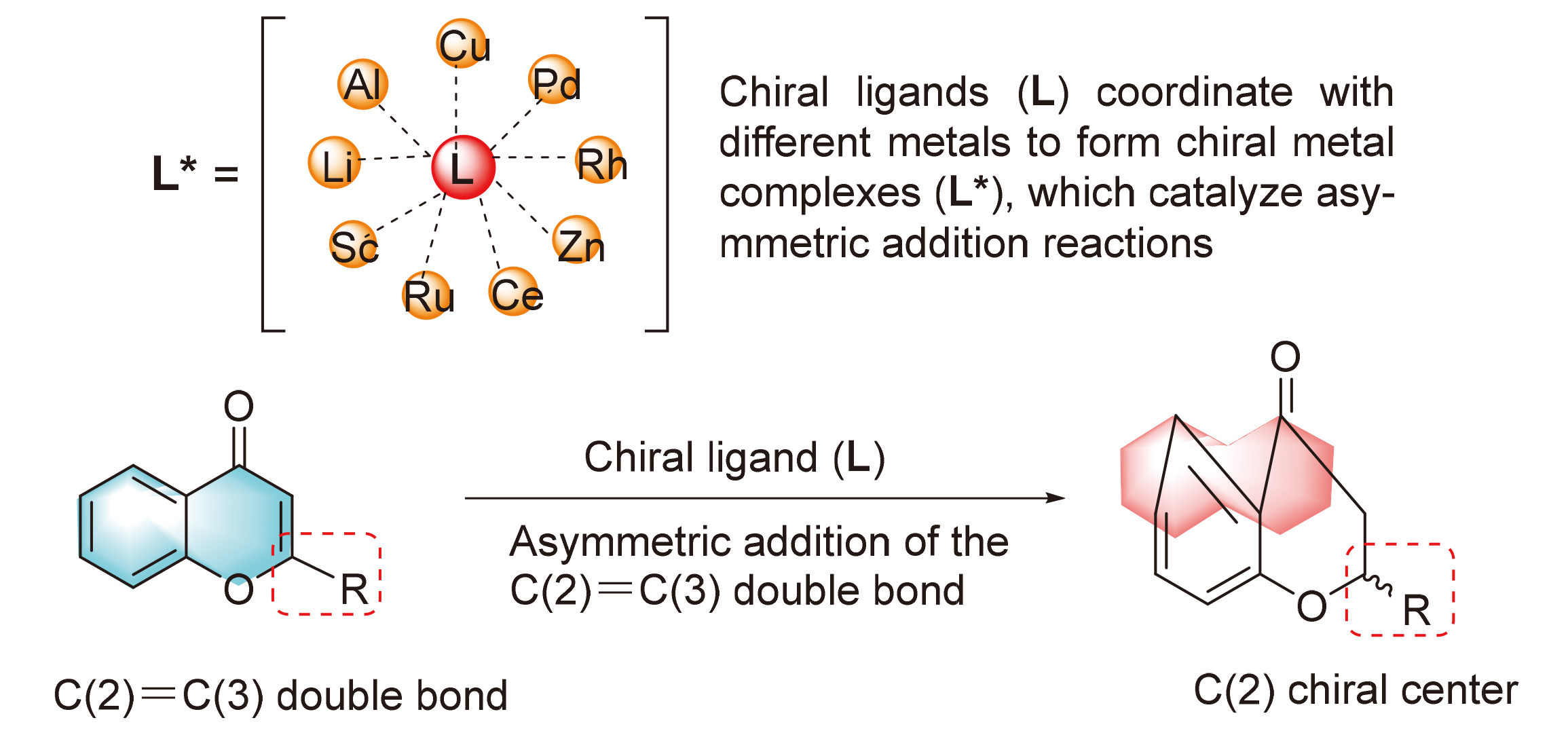
在4种合成方法中, 色烯酮衍生物双键的不对称加成, 由于其前体化合物易得、立体选择性强及原子经济性高等优点, 已逐渐成为合成C(2)手性-4-色满酮衍生物的主要途径[28]. 与传统双键的不对称加成反应相比, 色烯酮衍生物的C(2)=C(3)双键因反应活性低、立体控制困难, 因而具有一定的局限性. 根据文献报道, 此类双键不对称加成的催化体系主要包括金属手性配合物催化体系及非金属手性配合物催化体系, 其中金属手性配合物催化体系, 因其配体类型丰富、可调节性强和立体选择性较好等特点, 长期以来被广泛应用于不对称合成领域. 本文将主要围绕金属手性配合物催化体系, 对近十年来以色烯酮衍生物为底物, 通过双键的不对称加成构建C(2)手性-4-色满酮衍生物的研究报道进行归纳总结.
1 金属手性配合物催化色烯酮衍生物双键不对称加成
1.1 铜(Cu)手性配合物催化双键不对称加成
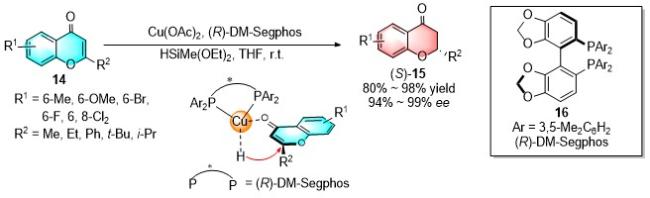
2019年, Aponick课题组[39]报道了通过碘化亚铜(CuI)与配体(S)-StackPhos (20)形成Cu手性配合物, 催化底物色烯酮衍生物17双键的不对称加成, 得到了C(2)-苯乙炔基-4-色满酮(R)-19 (Scheme 4). 在二异丙基乙胺(i-Pr2NEt)提供的碱性条件下, 苯乙炔18与Cu手性配合物形成Cu-炔中间体A; 底物17经三甲基硅基三氟甲磺酸酯(TMSOTf)硅醚化后, 生成硅氧基苯并吡喃鎓离子, 并与A配位得到络合物B. 随后, 由于手性配体的骨架的联萘基和五氟苯基较大的空间位阻, 致使18进攻活化后的底物硅氧基苯并吡喃鎓离子的C(2)位中空间位阻较小的一侧(C), 经解离释放硅基烯醇醚D, 最终酸化得到(R)-19(产率52%~89%, 87%~94% ee).
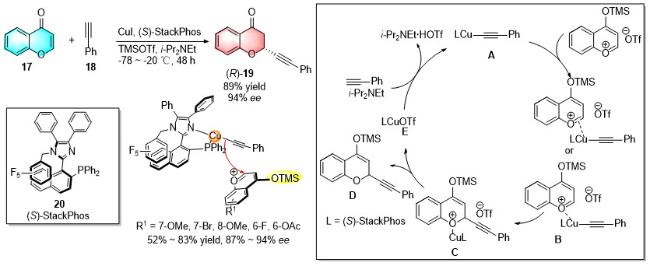
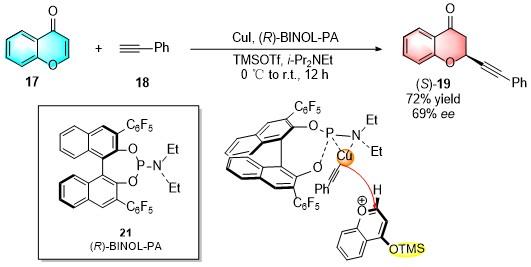
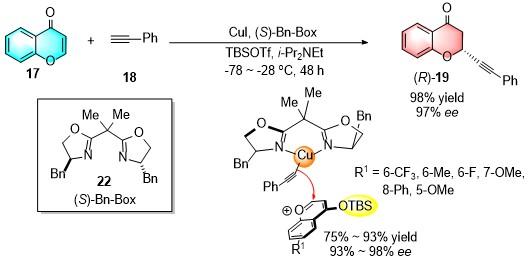
上述三个课题组均采用“碱性条件下形成Cu-炔中间体、硅基三氟甲磺酸酯活化色烯酮”的核心反应模式. 由于配体骨架及空间位阻存在差异, 致使生成构型相对单一的目标化合物. Aponick课题组[39]首次利用Cu手性配合物合成(R)-19, 立体选择性比较高, 但配体20由其实验室自制, 成本高; 在王俊课题组[40]报道的催化体系中, (S)-19的立体选择性不高, 但此体系对硫代色烯酮表现出优异的立体选择性(ee值最高可达95%), 这一差异可能源于硫原子较大的空间位阻; Mattson课题组[41] 进一步使用商品化的配体22, 在相同反应底物条件下, 此反应体系的产率与对映选择性均获得提升, 进一步增强了此反应体系的实用性.
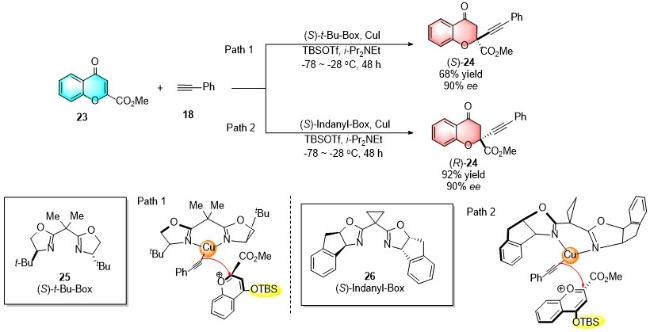
2021年, Mattson课题组[42]在前期工作的基础上, 沿用“碱性条件下形成Cu-炔中间体、硅基三氟甲磺酸酯活化色烯酮”的核心反应模式. 利用CuI与不同取代基的双噁唑啉配体形成Cu手性配合物, 催化色烯酮衍生物23双键的不对称加成. 通过合理的配体设计, 实现了对反应立体选择性的控制, 得到不同构型的C(2)手 性-4-色满酮衍生物(Scheme 7). 路线一: 因配体叔丁基-双噁唑啉[(S)-t-Bu-Box] (25)的t-Bu与底物的叔丁基二甲基硅基(TBS)存在空间排斥作用, 致使18进攻活化后的底物硅氧基苯并吡喃鎓离子的C(2)位中空间位阻较小的一侧, 得到(S)-24(产率68%, 90% ee). 路线二: 因配体茚满基-双噁唑啉[(S)-Indanyl-Box] (26)中的茚基可与底物形成π堆积, 稳定过渡态, 致使18从特定面进攻活化后的底物硅氧基苯并吡喃鎓离子的C(2)位, 得到(R)-24(产率92%, 90% ee, >2.6∶1 dr).
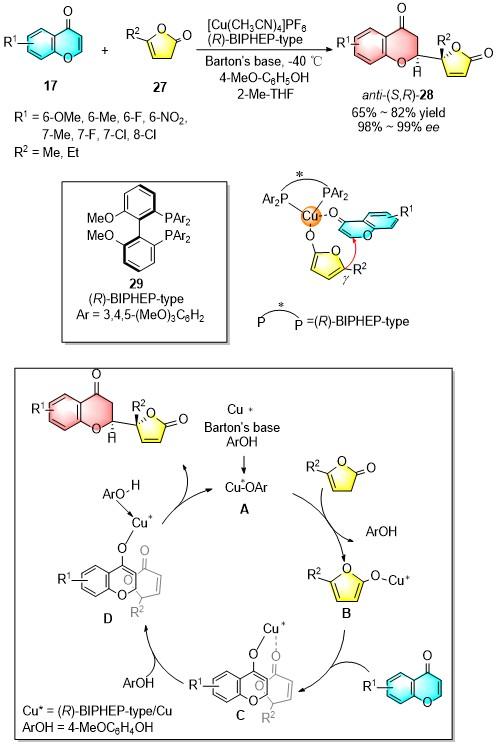
2020年, Shibasaki课题组[43]利用六氟磷酸四乙腈合铜([Cu(CH3CN)4]PF6)与配体(R)-BIPHEP-type (29)形成Cu手性配合物, 催化色烯酮衍生物17双键的不对称加成, 得到了anti-(S,R)-28 (Scheme 8). 在二叔丁基四甲基胍(Bartonʼs base)提供的碱性条件下, 酚盐与铜配位生成Cu*-OAr (A), 随后与去质子化的丁烯内酯27形成Cu-二烯醇盐中间体B; 配合物Cu中心与底物17的羰基氧配位, 活化并固定色烯酮的空间结构(C), 由于配体29中三甲氧基苯基较大的空间位阻, 致使二烯醇盐的γ位碳进攻底物17的C(2)位中空间位阻较小的一侧, 最后经质子化得到anti-(S,R)-28(产率65%~82%, 98%~99% ee). 上述工作成功逆转产物固有的syn选择性, 优先生成anti产物, 实现了丁烯内酯对色烯酮的反式不对称加成.
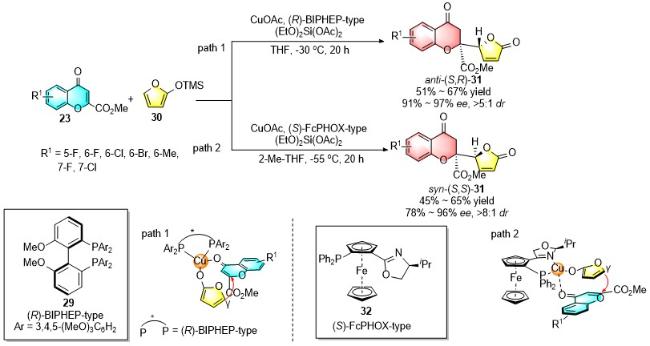
在此基础, 2022年, Shibasaki课题组[44]进一步拓展底物范围至C(2)-甲酸甲酯基-色烯酮(23), 将丁烯内酯改为亲核性更强的三甲基硅氧基呋喃(TMSOF, 30), 同时通过更换手性配体类型, 改变产物的构型(Scheme 9). 路线一: 沿用2020年工作中确立的Cu/双膦配体催化体系, 在催化底物23中仍可获得较高立体选择性的anti-(S,R)-31(产率51%~67%, 91%~97% ee, >5∶1 dr). 路线二: 由于手性配体(S)-FcPHOX-type (32)相对较小的空间位阻, 允许底物采取syn优势的接近方式,致使二烯醇盐的γ位碳进攻底物23的C(2)位中空间位阻较小的一侧, 得到syn-(S,S)-31(产率45%~65%, 78%~96% ee, >8∶1 dr).
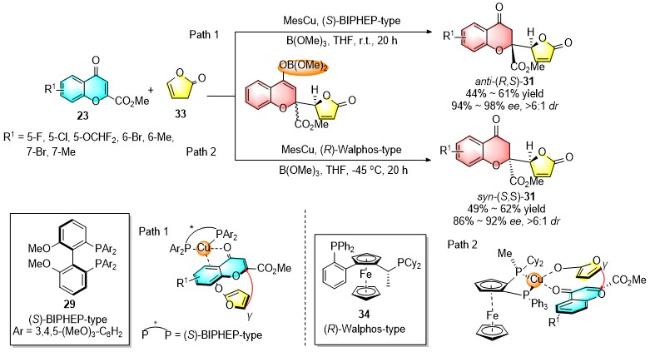
2023年, Shibasaki课题组[45]在前期的工作基础上, 构建了一种新的催化体系: 采用原有的金属手性配合物, 通过加入新的三甲基硼酸酯[B(OMe)3]捕获Cu-二烯醇盐加成中间体, 加速了立体选择性的速控步骤, 提高了立体选择性(Scheme 10). 路线一: 使用与配体(R)- BIPHEP-type (29)构型相反的配体(S)-BIPHEP-type, 同样能够得到anti-31(产率44%~61%, 94%~98% ee, >6∶1 dr), 但产物构型完全反转, 分别为anti-(S,R)-31与anti-(R,S)-31, 二者为对映异构关系, 表明了催化剂对产物构型的精准控制. 路线二: 由于配体(R)-Walphos-type (34)的空间位阻较小, 允许底物采取syn优势的接近方式, 致使二烯醇盐中间体的γ位碳进攻底物23的C(2)位中空间位阻较小的一侧, 同时B(OMe)3置换铜离子, 与羰基形成烯醇, 最后通过水解得到syn-(S,S)-31(产率49%~62%, 86%~92% ee, 19∶1 dr).
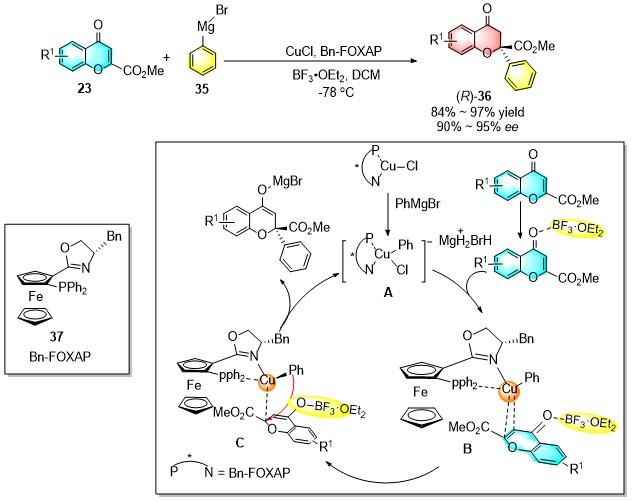
综上所述, 已报道的Cu手性配合物催化色烯酮双键的不对称加成反应, 大部分遵循“亲核中间体生成-底物活化-立体选择性加成”的反应模式, 可高效构建多种取代类型与构型的C(2)手性-4-色满酮衍生物, ee值最高可达99%. 在此类催化体系中, 通过不同类型的配体(双膦、双噁唑啉、二茂铁等)与Cu基金属[Cu(OAc)2、CuOAc、CuI、CuCl等]配位形成Cu手性配合物; 随后亲核试剂(炔基、丁烯内酯、H2等)与配体Cu中心形成“亲核中间体”. 在此基础上, 底物色烯酮进一步通过硅基化(TMSOTf)或路易斯酸活化(BF3•OEt2)等方式被有效活化, 以增强反应活性; 由于空间位阻的影响, 致使“亲核中间体”从单一面进攻活化底物色烯酮的C(2)位, 生成立体构型单一的C(2)手性-4-色满酮衍生物. 此类金属手性配合物实现高立体选择性的根本原因在于: 不同配体骨架在Cu中心周围构建的空间结构, 通过其空间位阻, 控制亲核试剂的进攻取向, 从而实现对反应立体选择性的有效控制.
1.2 钯(Pd)手性配合物催化双键不对称加成
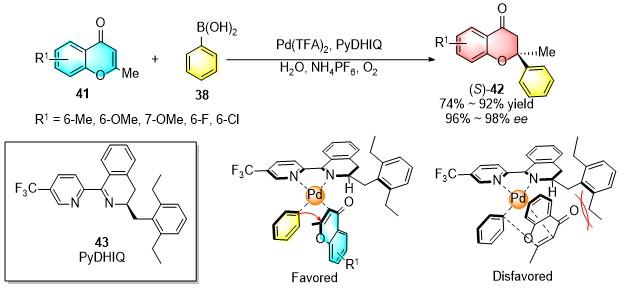
2020年, Hong课题组[51]也设计了一种新型吡啶并二氢异喹啉配体PyDHIQ (43), 其与三氟乙酸钯[Pd(TFA)2]形成Pd手性配合物, 催化色烯酮衍生物41双键的不对称加成, 得到C(2)-(甲基苯基)-4-色满酮(S)-42 (Scheme 13). 配合物的Pd中心与化合物苯硼酸38的苯基形成Pd-Ph亲核中间体, 体系中添加的六氟膦酸铵(NH4PF6)能够促进Pd-Ph亲核中间体的形成. 由于配体43中乙基取代基及芳香环较大的空间位阻, 与底物色烯酮的羰基存在空间排斥作用, 致使苯基进攻底物41的C(2)位中空间位阻较小的一侧, 得到(S)-42(产率74%~92%, 96%~98% ee).
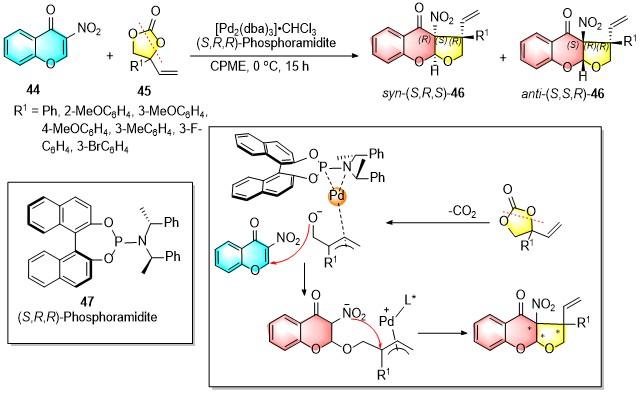
2021年, 张勇健课题组[52]报道了亚磷酰胺配体(S,R,R)-Phosphoramidite (47)与三(二亚苄基丙酮)二钯-氯仿加合物([Pd2(dba)3]•CHCl3)形成的Pd手性配合物, 催化色烯酮衍生物44双键的不对称环加成, 得到呋喃环与色满酮稠化的C(2)手性-4-色满酮衍生物46 (Scheme 14). 在Pd手性配合物的催化条件下, 碳酸乙烯亚乙酯(VEC, 45)的O—CO2键发生断裂, 脱除CO2后并与Pd中心结合, 生成Pd-烯丙基氧中间体. 由于配体47中苯乙基的空间位阻, 致使烯丙基氧负离子优先进攻底物44的C(2)位中空间位阻较小的一侧, 随后发生稠化反应, 最终生成一对非对映体三环稠化的四手性中心的色满酮衍生物46 (syn/anti up to 3.8∶1). 两种产物均具有高对映体纯度, 其中主产物syn-(S,R,S)-46的ee值最高可达99%, 副产物anti-(S,S,R)-46的ee值可达94%.
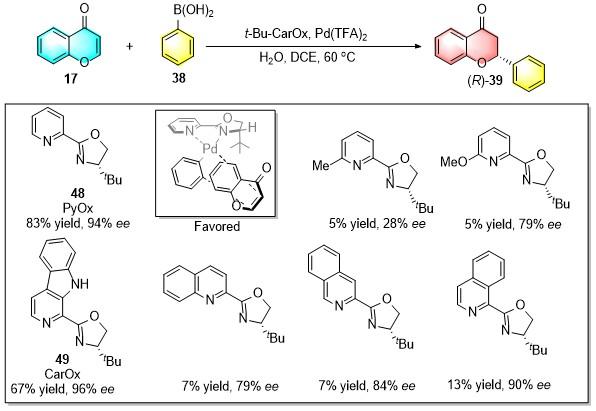
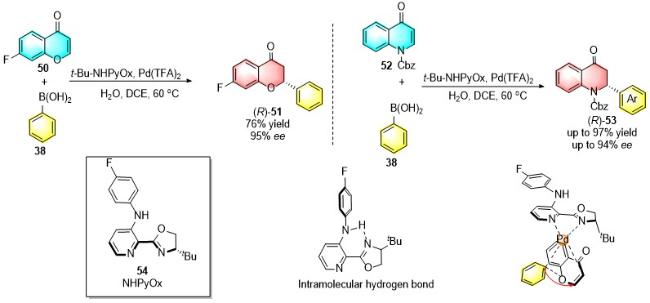
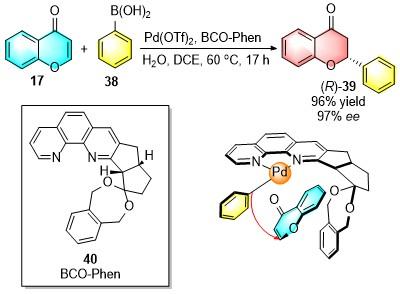
综上所述, 相关课题组报道的Pd手性配合物中, Pd金属常与双N配体配位(吡啶/二氢异喹啉类、CarOx类、PyOx类、Phosphoramidite类等), 形成稳定的Pd手性配合物; 随后配合物Pd中心进一步与苯硼酸等芳基源作用, 生成Pd-Ar亲核中间体; 在配体空间位阻的影响下, 亲核中间体从单一面进攻色烯酮, 得到单一手性的C(2)手性-4-色满酮衍生物或多手性中心的4-色满酮衍生物. Pd催化体系不仅丰富了C(2)手性-4-色满酮的合成路径, 且通过配体结构的优化[55][如从CarOx (49)到NHPyOx (54)], 进一步提高了反应的立体选择性与底物适配性, 为后续开发更高效、底物适用范围更广的C(2)手性-4-色满酮合成方法奠定了基础. 值得注意的是, 目前报道的Pd催化色烯酮双键的不对称加成反应中, 亲核试剂大部分来自于苯硼酸等芳基源. 这主要是由于苯硼酸在Pd催化条件下可形成稳定且反应性适中的Pd-Ar中间体, 有利于手性配合物对反应立体选择性的精准控制.
1.3 铑(Rh)手性配合物催化双键不对称加成
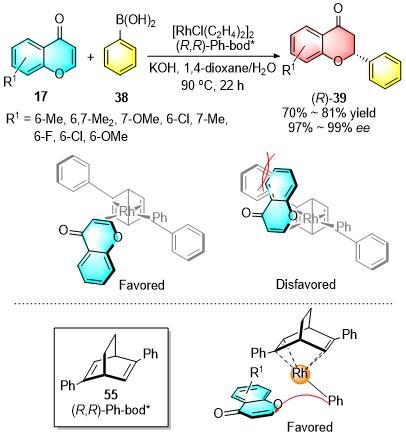
根据相关文献报道, 相较于Cu、Pd催化体系, 在Rh催化体系中, 与Rh配位的手性配体通常结构更复杂. 正是由于配体的复杂结构, 致使其空间立体效应明显, 从而表现出优异的立体选择性[56].
2022年, 姚琳课题组[59]报道了双(降冰片二烯)合铑四氟硼酸盐([Rh(NBD)2]BF4)与配体SL-J216-1 (58)形成Rh手性配合物, 催化色烯酮衍生物56双键的不对称加成, 得到C(2)-羧基-4-色满酮[(S)-57] (Scheme 18). 配体Rh中心与H2作用形成Rh-H中间体A; 色烯酮-2-羧酸56在甲醇溶剂中电离生成羧酸根阴离子, 与Rh中心配位形成羧基-Rh中间体B; 随后底物色烯酮56的羰基在甲醇溶剂中被活化成芳香氧鎓离子C; 由于甲醇与配体萘环形成的氢键稳定了Re面进攻过渡态, 使得H进攻芳香氧鎓离子的C(2)位中空间位阻较小的一侧(D); 最后经O—H键还原消除生成烯醇中间体, 并迅速异构化为更稳定的(S)-57(产率90%~95%, 98%~99% ee).
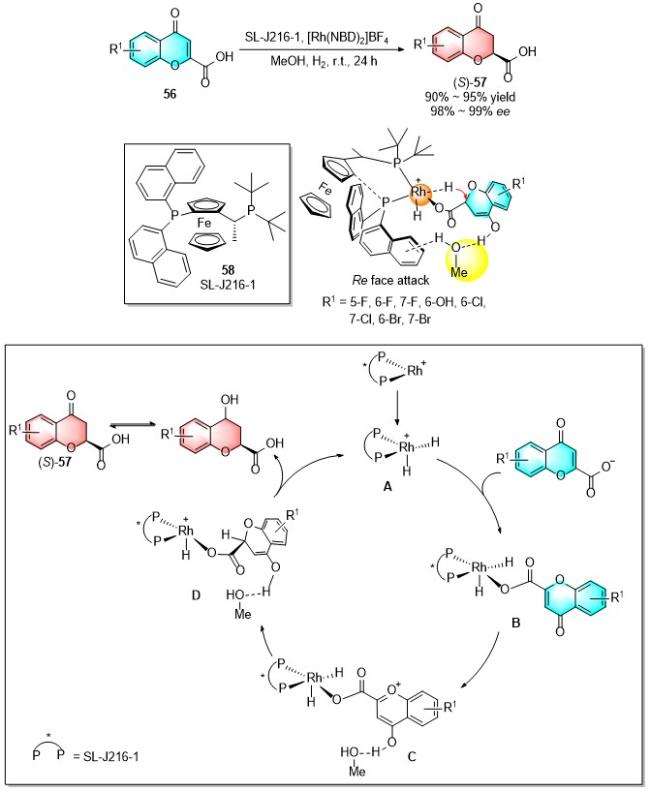
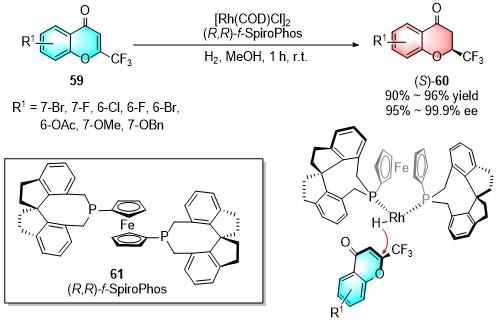
综上所述, Rh手性配合物催化色烯酮双键的不对称加成反应, 遵循“Rh手性配合物形成-底物配位或非共价作用-立体选择性加成”的反应模式, 均表现出较高的立体选择性(ee值可达99%~99.9%). Rh催化体系中, 手性双膦或螺环膦配体与Rh形成稳定的Rh手性配合物, 通过生成Rh-Ph或Rh-H中间体, 实现对色烯酮双键的不对称加成. 在反应过程中, 配体的空间位阻控制了亲核试剂或氢从单一面进攻底物的C(2)位, 从而获得立体构型单一的C(2)手性-4-色满酮衍生物.
1.4 其它金属手性配合物催化双键不对称加成
在此领域, 除Cu、Pd和Rh等常用金属手性配合物外, 同样有少量文献报道Zn、Ce、Ru或Sc等其它非常用金属手性配合物有效催化色烯酮双键的不对称加成, 得到C(2)手性-4-色满酮衍生物. 此类金属手性配合物在金属种类、配体设计及催化模式等方面提供了新的选择, 进一步丰富了金属手性配合物催化色烯酮双键不对称加成的反应体系.
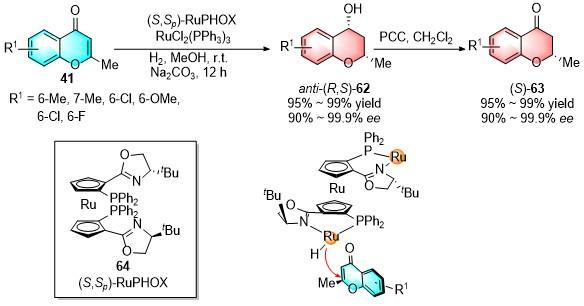
张万斌课题组[61-62]报道了使用三(三苯基膦)二氯化钌[RuCl2(PPh3)3]与配体(S,Sp)-RuPHOX (64), 形成Ru手性配合物, 催化色烯酮衍生物41双键的不对称加成, 得到直接产物C(2)-甲基-4-色满醇[anti-(R,S)-62] (Scheme 20). 配合物的Ru中心与H2形成Ru-H中间体; 由于配体64中叔丁基、苯基较大的空间位阻, 致使Ru-H进攻底物41的C(2)位中空间位阻较小的一侧, 得到anti- (R,S)-62(产率95%~99%, 90%~99.9% ee). 由于此催化剂会进一步还原酮羰基, 所以直接产物为色满醇而非色满酮, 需通过吡啶氯铬酸盐(PCC)氧化后处理得到手性色满酮(S)-63, 且氧化过程产率和ee值基本保持不变.
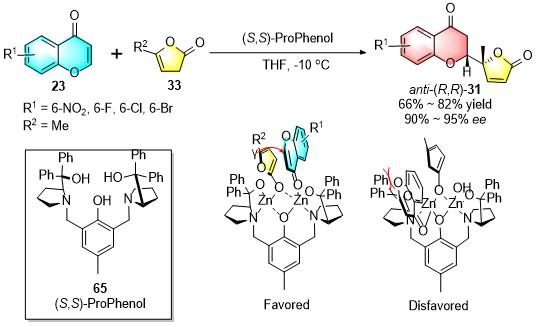
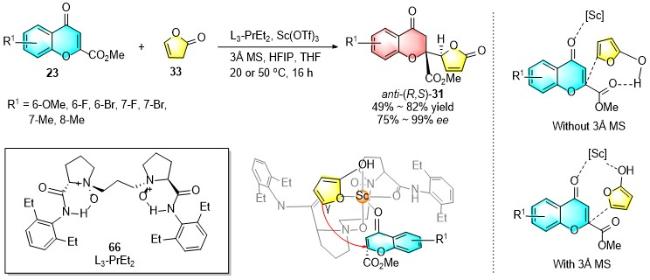
2022年, 冯小明课题组[64]报道了三氟甲磺酸钪Sc(OTf)3与配体L3-PrEt2 (66)形成Sc手性配合物, 催化色烯酮衍生物23双键的不对称加成, 得到色满酮衍生物anti-(R,S)-31 (Scheme 22). 水分子的存在会与Sc中心配位, 阻止丁烯内酯33与Sc中心配位, 生成syn副产物. 只有在无水条件下, 配合物的Sc中心同时与丁烯内酯33的烯醇氧和色烯酮23的羰基氧配位形成Sc-烯醇盐中间体, 由于配体66中酰胺亚基的空间位阻(与色烯酮的酯基(CO2Me)及丁烯内酯的烯醇存在空间排斥), 致使烯醇盐的γ位碳进攻底物23的C(2)位中空间位阻较小的一侧, 得到anti-(R,S)-31(产率49%~82%, 75%~99% ee).
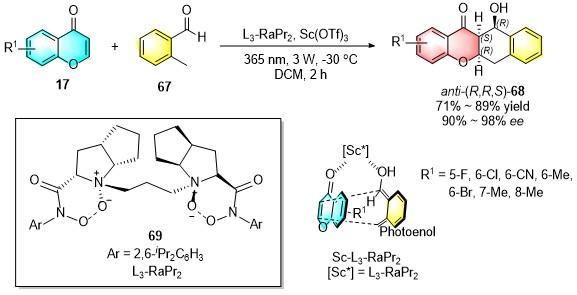
2024年, 冯小明课题组[65]报道了光与金属Sc手性配合物Sc-L3-RaPr2 (69)协同作用的双催化体系, 催化色烯酮衍生物17双键的不对称加成, 得到具有稠环结构的色满酮衍生物anti-(R,R,S)-68 (Scheme 23). Sc(OTf)3与配体69形成Sc手性配合物(Sc-L3-RaPr2). 底物2-甲基苯甲醛67在光的激发下, 生成高活性的光烯醇中间体(Photoenol); 随后配合物Sc中心同时与色烯酮17的羰基氧原子和光烯醇中间体的羟基配位形成中间体. 由于配体69中2,6-二异丙基苯胺的空间位阻, 致使光烯醇中间体的两个烯末端碳同时进攻底物17的C(2)=C(3)中空间位阻较小的一侧, 得到稠环结构的anti-(R,R,S)-68 (产率71%~89%, 90%~98% ee).
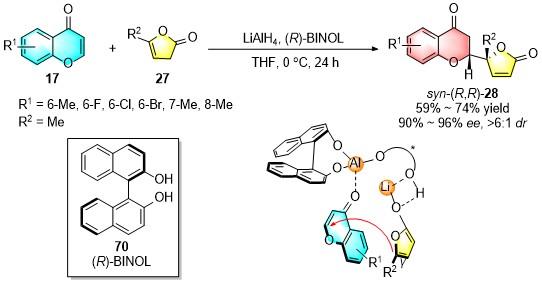
2023年, Shibasaki课题组[66]报道了氢化锂铝(LiAlH4)与配体(R)-BINOL (70)形成Al-Li-BINOL (ALB)双金属手性配合物, 催化色烯酮衍生物17双键的不对称加成, 得到色满酮衍生物syn-(R,R)-28 (Scheme 24). Al中心作为Lewis酸与色烯酮17的羰基氧配位, 增强其亲电性, Li-芳氧基作为Brønsted碱活化丁烯内酯, 生成亲核性锂烯醇盐. 配体70的萘环骨架空间位阻, 致使锂烯醇盐进攻底物17的C(2)位中空间位阻较小的一侧, 得到syn-(R,R)-28(产率59%~74%, 90%~96% ee, >6∶1 dr).
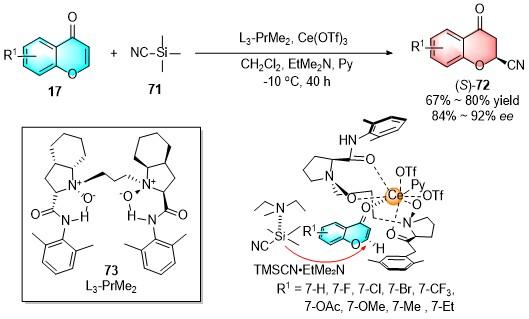
2022年, 冯小明课题组[67]利用三氟甲磺酸铈[Ce(OTf)3]与配体L3-PrMe2 (73)形成Ce手性配合物, 催化色烯酮衍生物17双键的不对称加成, 得到C(2)-氰基- 4-色满酮衍生物(S)-72 (Scheme 25). 手性配合物的Ce中心与底物色烯酮的羰基氧配位, 固定底物构型; 在二甲基乙基胺(EtMe2N)提供的碱性环境中, 底物三甲基硅氰(TMSCN, 71)被活化成亲核性增强的氰源(TMSCN•EtMe2N), 由于配体73的2,6-二甲基苯基侧链的空间位阻, 致使氰基进攻底物17的C(2)位中空间位阻较小的一侧, 得到(S)-72(产率67%~80%, 84%~92% ee).
2 非金属手性配合物催化双键不对称加成
在不对称催化研究中, 金属手性配合物因其丰富的配体类型和较好的立体选择性而被广泛应用, 但仍存在一定局限性. 例如, 部分金属催化剂价格较高、来源有限、回收困难, 在一定程度上限制了金属手性配合物催化色烯酮双键的不对称加成进一步发展[68]. 在此局限和发展需求下, 有文献报道了非金属手性配合物催化色烯酮双键的不对称加成[69-70], 其催化机制主要通过分子间氢键相互作用与空间位阻的协同作用, 实现部分金属催化难以高效进行的反应, 与金属手性配合物催化形成互补. 非金属手性催化剂通常为手性磷酸、金鸡纳碱及其衍生物或其它有机小分子, 具有结构易调控、对敏感官能团兼容性优异以及反应条件温和等优势.
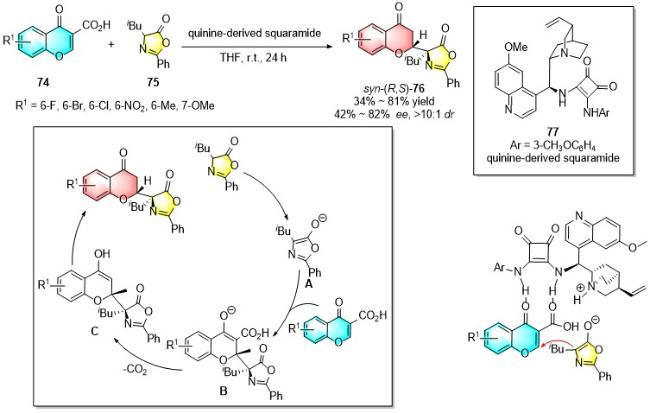
2019年, Albrecht课题组[71]报道双功能有机催化剂奎宁衍生方酰胺(quinine-derived squaramide, 77)催化色烯酮衍生物74双键的不对称加成, 得到色满酮衍生物syn-(R,S)-76 (Scheme 26). 在奎宁叔胺(quinine)提供的碱性条件下, 底物氮杂内酯75形成烯醇负离子A; 同时方酰胺(squaramide)通过氢键与底物色烯酮74的羧酸和羰基形成双氢键, 固定底物, 在手性催化剂的奎宁刚性骨架及芳酰胺基团的空间位阻影响下, 致使带有大空间位阻(t-Bu)的烯醇负离子进攻底物74的C(2)位中空间位阻较小的一侧形成中间体B, 随后经脱CO2并经质子化, 得到syn-(R,S)-76(产率34%~81%, 42%~82% ee, >10∶1 dr).
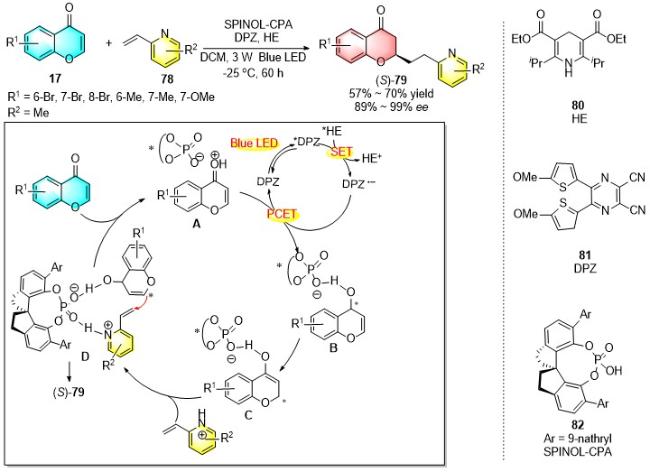
2022年, 蒋志勇课题组[72]报道了一种“光催化的手性磷酸(CPA)介导质子-电子协同转移(PCET)”路径, 催化色烯酮双键的不对称加成得到了C(2)-(3-甲基吡啶甲基)-4-色满酮(S)-79 (Scheme 27). 手性磷酸SPINOL- CPA (82)通过氢键与底物色烯酮17形成离子对A; 在蓝光照射下, 二氰基吡嗪类有机光敏剂DPZ (81)被激发并经过单电子转移(SET)生成强还原态DPZ•-, 与CPA协同作用, 通过PCET过程将A转化为结构更稳定的烯醇自由基中间体B, 随后经互变异构化转化为具有亲核性的α-酮基自由基C. 手性磷酸的刚性螺旋骨架与9-蒽基的大位阻共同构建了手性空间, 在手性磷酸双氢键的作用下, C与被活化的底物78形成过渡态D, 最终得到(S)-79(产率57%~70%, 89%~99% ee). 此过程能够在自由基生成与C—C键形成过程中引入手性控制, 从而实现高立体选择性.
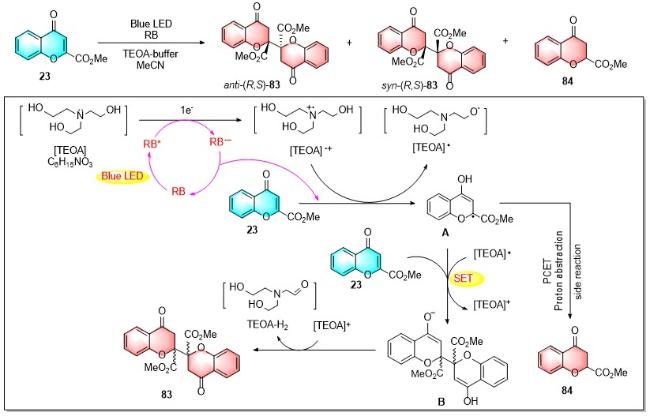
2024年, Husain课题组[73]报道了光催化色烯酮的二聚反应, 合成2,2'-双色满酮二聚体83 (Scheme 28). 蓝光照射下, 光敏剂玫瑰红(RB)被激发并经还原剂三乙醇胺(TEOA)还原生成RB•-, 具有强还原性, 还原色烯酮23生成色烯酮自由基中间体A; 自由基中间体A与另一色烯酮分子23发生自由基加成, 形成二聚体中间体, 经[TEOA]•单电子转移(SET)还原生成烯醇盐中间体B; 随后经互变异构化、质子化, 得到2,2'-双色满酮二聚体83, 同时A经过PCET路径还原生成副产物84. 在无手性催化剂的体系中, 生成的自由基中间体更易通过二聚、还原等副反应终止反应, 难以实现反应的立体选择性控制, 最终产物为外消旋体.


3 结束语与展望
综上所述, 科研工作者已在此领域开展了大量研究工作, Cu、Pd和Rh等常用金属手性配合物在反应类型、立体选择性控制及底物适用等方面不断完善, 实现了C(2)手性-4-色满酮衍生物的高效、高选择性合成. 研究表明, Cu手性配合物因其反应多样性, 在此类化合物合成中应用最广泛; Pd手性配合物在芳基化及环化反应中展现出独特优势, 能高效构建目标产物的骨架结构; Rh手性配合物凭借金属与配体之间的强相互作用, 在立体选择性控制方面表现突出, 可有效提升产物的对映选择性. 此外, Zn、Sc、Al、Ru及Ce等非常用金属手性配合物, 通过双底物同时配位或多点协同活化等新型催化模式, 为C(2)手性-4-色满酮的构建提供了新的选择.
非金属催化体系的发展, 为金属敏感的分子提供了无金属替代方案. 其中, 奎宁-方酰胺、金鸡纳碱及其衍生物以及有机小分子等催化剂, 对酸/碱敏感的分子表现出良好兼容性, 能实现部分金属催化难以进行的反应. 然而, 此类非金属催化体系仍存在明显局限, 其底物适配范围相对狭窄, 目前仅适用于少数几类色烯酮衍生物, 且催化效率相较于金属催化体系仍有较大提升空间, 有待进一步优化.
尽管通过催化色烯酮双键的不对称加成反应, 得到C(2)手性-4-色满酮衍生物的研究已取得一定的进展, 但此领域仍面临着诸多挑战与待解决的问题, 未来的研究展望可重点聚焦于以下几点: (1)金属手性配合物催化体系仍有优化空间, 降低催化成本、提高立体选择性、拓宽底物适用范围, 将成为此领域下一阶段的研究目标. (2)非金属手性催化体系在立体选择性控制、底物适配范围及催化效率方面, 与金属手性配合物催化体系相比仍存在明显差距, 进一步优化非金属催化体系是后续研究的重要方向之一. (3)目前已报道的催化体系, 大多局限于单手性中心色满酮衍生物的合成, 对于含多个手性中心的复杂色满酮, 仍缺乏适用的合成方案, 因此, 多手性中心色满酮衍生物的高效合成方法是后续研究的重点方向之一. (4)构建“金属-非金属双功能催化”体系, 结合金属催化的高效活化优势与非金属催化的调控优势, 协同提高复杂底物的立体选择性. (5)目前多数C(2)手性-4-色满酮衍生物的制备仍局限于克级实验室规模, 距离实现规模化生产仍有差距. 后续需开发高效、可放大的合成工艺, 将其制备规模推进至公斤级, 为此类化合物实现产业化应用提供基础.
(Zhao, C.)