


1 Introduction
Methyl group is an important chemical motif, which can significantly impact a molecule’s biological and physical properties.[1-3] Typically, α-branched methylated ketones are important structural fragment and often encountered in biologically active molecules (Figure 1a).[4-6] Thus, the α- methylation of ketones is a pivotal and ubiquitous transformation in organic synthesis, particularly in the pharmaceutical industry, where methyl groups profoundly influence bioactivity and pharmacokinetics through the methyl effect.[7-8] Conventional approaches to achieve this transformation are chiefly based on alkyl substitution reactions (Figure 1b). These methods usually necessitate the initial generation of enolate or enol silane intermediates, which are subsequently exposed to standard methylation reagents like dimethyl sulfate ((CH3)2SO4), methyl iodide (CH3I), or methyl triflate (CH3OTf).[9] Nevertheless, these well-estab- lished procedures are hampered by limitations that affect their broader application and environmental compatibility. Employing such reagents, which are often toxic, volatile, and strongly electrophilic, presents substantial safety risks, demands meticulous operational practices, and produces stoichiometric amounts of hazardous waste.
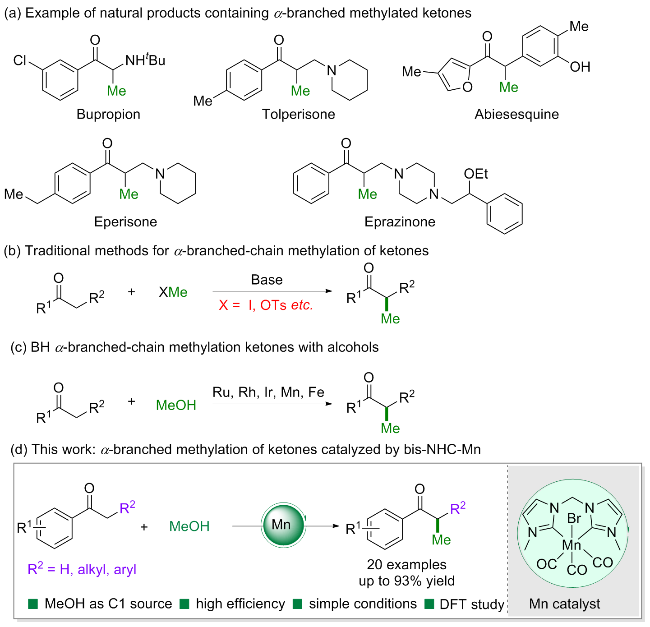
In response to the growing demand for greener and more step-economical synthetic protocols. Borrowing hydrogen/ hydrogen autotransfer (BH/HA) reaction has emerged as a powerful strategy for selective branched alkylation using alcohols as benign alkylating agents.[10-12] Using green and sustainable alcohol as alkylation agent, plenty of N-alk- ylation and C-alkylation reaction have been reported in recent years.[13-17] However, mainstream reports demonstrating N-alkylation and C-alkylation generally use benzylic alcohols as alkylating agents.[18-22] Surely, a few aliphatic alcohols were also tolerant in some reports.[23-27] In contrast, utilizing methanol as a C1 building block for BH-mediated methylation remains a far more challenging target.[28-32] It is well known that methanol was more higher activation barrier for the dehydrogenation step into aldehydes compared to heavier alcohols. Using BH/HA reaction approach with methanol as a C1 source can offer a convenient protocol for the α-branched methylation of ketones (Figure 1c).[33-38]
Compared to traditional methods relying on methyl halides or diazomethane, methanol offers distinct advantages over conventional methylation reagents, which is inexpensive, abundantly available, and produces water as the sole byproduct. However, the utilization of methanol in BH/HA catalysis is intrinsically more challenging than that of higher alcohols due to its higher activation barrier for dehydrogenation to formaldehyde. Notwithstanding these difficulties, homogeneous catalysts based on noble metals such as Ru,[4,37] Rh,[3] and Ir[35,38,39] have been achieved notable progress. Very recently, the implementation of efficient systems based on inexpensive and earth-abundant transition metals for alkylation of ketones with methanol is also established.[40-43] For example, the groups of Morrill,[44] Sundararaju,[41] and Renaud[43] have developed highly efficient iron catalysts for the methylation of ketones using methanol as the C1 source. Liu and co-work- ers[36] presented the first report on the α-methylation of ketones by cobalt metal using methanol. The groups of Sortais,[42] Rueping[45] and Ruiter[40] have developed phosphine-based manganese catalytic system for the α-meth- ylation of ketones with methanol. However, in contrast to the well-developed phosphine-Mn systems, phosphine-free manganese catalysts, especially those supported by N-hete- rocyclic carbene (NHC) ligands remain underdeveloped, arising from the strong σ-donating ability of NHCs and the high reducing power of Mn(I), which can lead to over- reduction of the unsaturated ketone substrates and impede selective methylation. Accordingly, the development of efficient, phosphine-free, bis-NHC manganese catalytic systems for the α-methylation of ketones using methanol continues to represent an urgent and highly attractive endeavor.
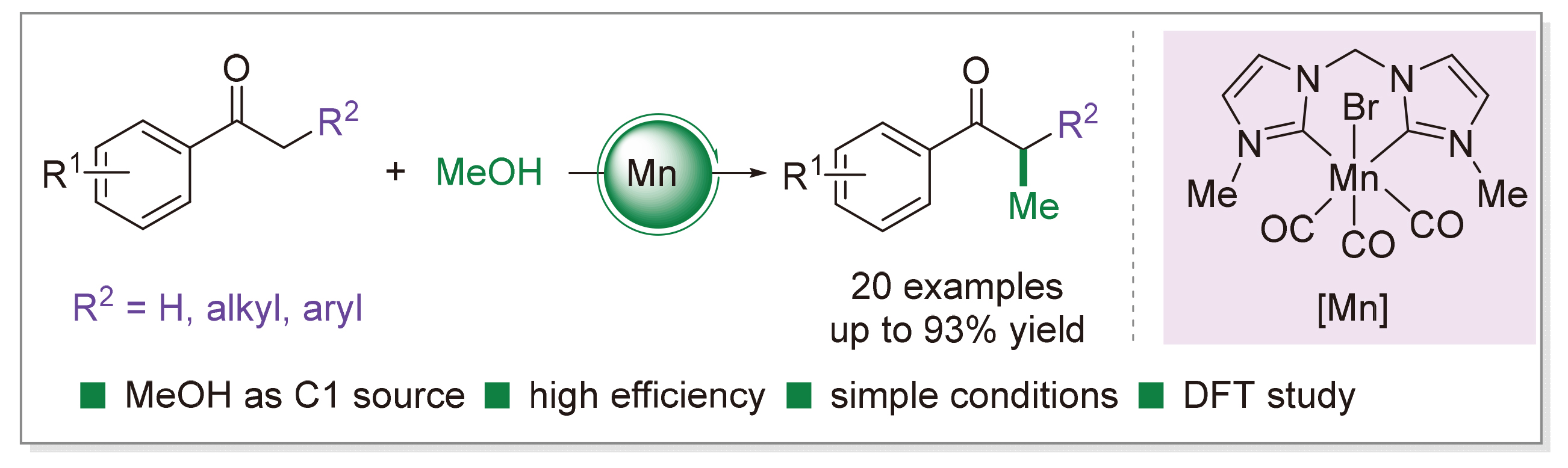
In line with our sustained interest in bis-NHC manganese catalyzed BH/HA reaction, a variety of alkylations including anilines, ketones and indenes was achieved in our laboratory.[46-48] Especially, the room temperature bis-NHC manganese homogeneous system for the N-alkylation of anilines with alcohols at a low catalyst loading was reported in our laboratory.[48] This system exhibits remarkable efficacy even for the challenging transformation of methanol into mono-N-alkylated amines at 100 ℃. Inspired by these promising results, we sought to investigate whether the bis-NHC manganese complex could also mediate the α-branched methylation of ketones using methanol as a C1 source, while suppressing the over- reduction of ketone substrates. On this basis, herein we report an efficient bis-NHC manganese-catalyzed α-bran- ched methylation of ketones, employing methanol as a sustainable C1 methylating agent (Figure 1d). This system operates at 120 ℃ within 12 h, achieving excellent yields across diverse aryl ketones. Control experiment indicated that the branched methylation of ketone went through a BH/HA process with an enone as an intermediate. This work expands the toolbox for sustainable C1 branched methylation of ketones catalyzed by earth-abundant 3d metals.
2 Results and discussion
To commence our studies, the α-branched methylation of 4-methylpropiophenone (1a) with methanol was selected as a model reaction to optimize the reaction conditions (Table 1). As expected, only trace amounts of the α- branched methylated 4-methylpropiophenone (2a) were obtained when our previous system was used (Entries 1, 2, Table 1). However, when we increased the amount of methanol to toluene/MeOH (V∶V=9∶1), the methylated product (2a) was isolated in 38% yield or 27% yield (Entries 3, 4, Table 1). Particularly, when MeOH was employed as a solvent, the desired product (2a) was isolated in 89% yield (Entry 5, Table 1). These results demonstrated that using methanol as solvent was crucial. To our delight, reducing the catalyst loading to 2 and 1 mol% did not result in a significant decrease in the yield (Entries 6, 7, Table 1). Subsequently, several bases including KOH, NaOH and K2CO3 were screened. Employing KOH or NaOH as base, the expected product (2a) was isolated in 90% yield or 86% yield, respectively (Entries 8, 9, Table 1). In contrast, replacing KOtBu with K2CO3 decreased the yield to only 11% (Entry 10, Table 1). After further reduction of the base to 0.5 equiv., it was found that KOtBu was the optimal choice (Entries 11~13, Table 1). This may be attributed to the fact that KOtBu is a relatively stronger base with moderate steric hindrance, allowing it to efficiently initiate the catalytic cycle even at low base loadings. However, further decreasing the reaction temperature or reducing the base loading led to a remarkable drop in the isolated yield of the target product (Entries 14~17, Table 1). There was no product formation in the absence of the catalyst or base (Entries 18, 19, Table 1). Additionally, commercially available Mn salts including MnBr(CO)5, MnCl2, and Mn(acac)3 were examined as catalysts, and no target product was detected under the standard conditions (Entries 20~22, Table 1). We attempted to employ green solvent water in this reaction, but no target product was formed (Entries 23, 24, Table 1).
Table 1 Optimization of Mn-catalyzed BH methylationa |

| Entry | Base | Catalysis | Catalysis/mol/% | Solvent | Time/h | Yieldb/% |
|---|---|---|---|---|---|---|
| 1d | NaOH | [Mn] | 5 | Toluene | 12 | Trace |
| 2d | KOtBu | [Mn] | 5 | Toluene | 12 | 9 |
| 3 | KOtBu | [Mn] | 5 | Toluene/MeOH (V∶V=9∶1) | 12 | 38 |
| 4 | NaOH | [Mn] | 5 | Toluene/MeOH (V∶V=9∶1) | 12 | 27 |
| 5 | KOtBu | [Mn] | 5 | MeOH | 12 | 89 |
| 6 | KOtBu | [Mn] | 2 | MeOH | 12 | 86 |
| 7 | KOtBu | [Mn] | 1 | MeOH | 12 | 85 |
| 8 | KOH | [Mn] | 1 | MeOH | 12 | 90 |
| 9 | NaOH | [Mn] | 1 | MeOH | 12 | 86 |
| 10 | K2CO3 | [Mn] | 1 | MeOH | 12 | 11 |
| 11c | KOtBu | [Mn] | 1 | MeOH | 12 | 88 |
| 12c | KOH | [Mn] | 1 | MeOH | 12 | 43 |
| 13c | NaOH | [Mn] | 1 | MeOH | 12 | 40 |
| 14e | KOtBu | [Mn] | 1 | MeOH | 12 | 38 |
| 15f | KOtBu | [Mn] | 1 | MeOH | 12 | Trace |
| 16g | KOtBu | [Mn] | 1 | MeOH | 12 | Trace |
| 17h | KOtBu | [Mn] | 1 | MeOH | 12 | Trace |
| 18 | KOtBu | [Mn] | — | MeOH | 12 | 0 |
| 19 | — | [Mn] | 1 | MeOH | 12 | 0 |
| 20 | KOtBu | MnBr(CO)5 | 1 | MeOH | 12 | 0 |
| 21 | KOtBu | MnCl2 | 1 | MeOH | 12 | 0 |
| 22 | KOtBu | Mn(acac)3 | 1 | MeOH | 12 | 0 |
| 23 | KOtBu | [Mn] | 1 | MeOH/H2O (V∶V=9∶1) | 12 | Trace |
| 24 | KOtBu | [Mn] | 1 | MeOH/H2O (V∶V=8∶2) | 12 | 0 |
a Reaction conditions: 1a (0.3 mmol), base (0.3 mmol), solvent (1.0 mL), at 120 ℃ for 12 h under an atmosphere of N2. b Isolated yield. c Base (0.15 mmol). d 1a (0.3 mmol), MeOH (0.36 mmol), base (0.15 mmol), toluene (1.0 mL), at 120 ℃ for 12 h under an atmosphere of N2. e Base (0.15 mmol), 100 ℃. f Base (0.15 mmol), 80 ℃. g Base (0.06 mmol), 120 ℃. h Base (0.03 mmol), 120 ℃. |
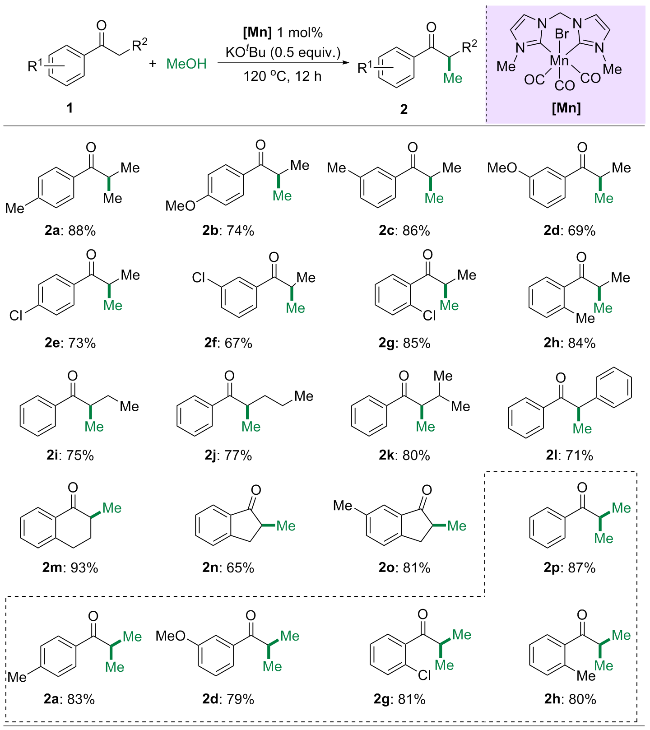
With the optimized reaction conditions in hand, our attention was next turned to the scope of various ketones and the results are outlined in Scheme 1. Differently substituted propiophenone derivatives were converted into the corresponding α-branched methylated products 2a~2o in good yields. Electron-donating methyl or methoxy-substituted aryl propiophenones were well-tolerated, affording the desired products 2a~2d in 69%~88% yields. Weak electron-withdrawing chloro-substituted aryl propiophenones could also be tolerated, leading to the desired products 2e and 2f in 73% yield and 67% yield, respectively. Sterically hindered substrates bearing ortho-methyl or ortho-chloro groups also underwent the reaction efficiently, affording the corresponding products 2g and 2h in good yields of 85% and 84%, respectively. A variety of α-alkyl substituted ketones were converted to α-branched methylated products in good isolated yields (2i, 2j and 2k, 75%, 77%, 80%, respectively). α-Phenylacetophenone (2l) underwent efficient methylation to afford the corresponding product in 71% yield. The α-cyclic ketones including α-tetralone 2m, 1-indanone 2n and 6-methyl-1-indanone 2o were meth- ylated in moderate to excellent yields (93%, 65% and 81%, respectively). Furthermore, using acetophenone derivatives, double methylation was also achieved, and the corresponding products were obtained in good yields (2p, 2a, 2d, 2g, and 2h, 82% average yield). It should be noted that methylation attempts on alkyl ketones, fluorine-substituted and heterocyclic substrates were unsuccessful, affording only trace amounts of the desired products.
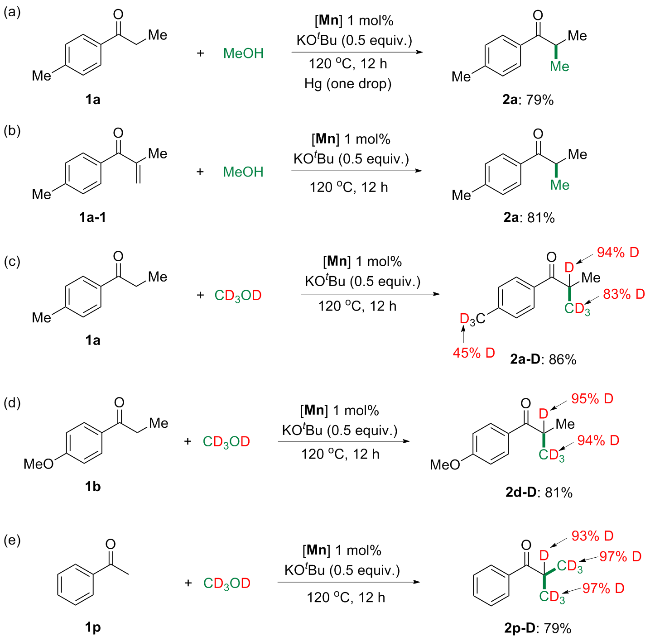
To obtain mechanistic insight, control experiments were carried out and the results are shown in Scheme 2. There was no retardation observed in this catalysis system when a mercury poisoning experiment was conducted, which implies that the catalysis probably proceeds homogeneously (Scheme 2a). The intermediate enone (1a-1) was reacted with methanol under standard conditions and gave the corresponding product (2a) with 81% yield, suggesting that the enone (1a-1) could be a possible intermediate in the reaction (Scheme 2b). To validate that methanol is the source of the methyl group, several deuterium-labeling experiments were conducted (Scheme 2c~2e). Firstly, 4-methylpropiophenone (1a) was treated with deuterated methanol (CD3OD) as the solvent under standard conditions to afford product 2a-D in 86% yield with 83%~94% deuterium incorporation (Scheme 2c). Interestingly, H/D exchange for substrates at 4-methyl positions was observed (Scheme 2c). This observed H/D exchange could be attributed to keto-enol tautomerism of the para-methyl of the aromatic substrates. This result is consistent with previous work.[45] Subsequently, 4-methoxypropiophenone (1b) and acetophenone thereof were further used in the methylation reaction, and the deuteromethylated products 2d-D and 2p-D were obtained in good yields (Schemes 2c~2d). All these results demonstrated clearly that methanol is the source of the methyl group.
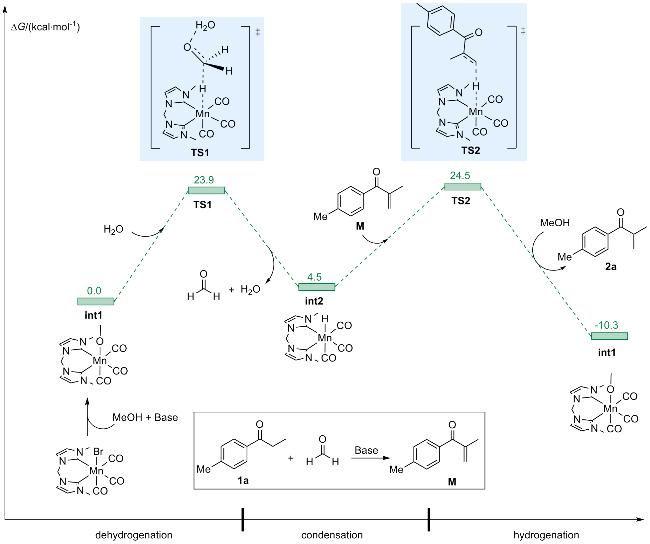
Density functional theory (DFT) study was performed to further verify the reaction mechanism. The results are shown in Figure 2. The reaction starts from int1 and promotes the hydride elimination through transition state TS1 (23.9 kcal/mol, 1 cal=4.183 J) via an outer-sphere manner, in which the by-product water molecule (or methanol itself alternatively) assisted the hydride elimination and the formation of formaldehyde and the [Mn-H] species int2. Subsequently, 4-methylpropiophenone (1a) reacts with aldehyde to form the intermediate M via aldol condensation. The intermediate M is then reduced by the [Mn-H] species through transition state TS2 (24.5 kcal/ mol). The Gibbs free energy of TS1 and TS2 are nearly identical, which implies that the dehydrogenation or the hydrogenation may both act as the rate-determining step in the present system. Thus, micro-reversible interconversion can take place during catalysis, leading to H/D exchange, which is consistent with our deuterium-labeling experiments (Sche- me 2c).


3 Conclusions
In summary, we have reported a phosphine-free, bis- N-heterocyclic carbene manganese(I) catalyst that enables α-branched methylation of ketones using methanol as a green and sustainable C1 source via a BH/HA strategy. This catalytic system efficiently promotes methanol dehydrogenation and enables selective α-branched methylation of a broad range of aromatic ketones, with water being generated as the only byproduct. Isotope-labeled methanol variants were also subjected to this manganese-catalyzed process to selectively generate CD3-labeled products. Me- chanistic investigations support a borrowing hydrogen pathway involving outer-sphere dehydrogenation/hydro- genation steps. The developed α-branched methylation reaction should be of interest for straightforward selective α-methylation of ketones.
4 Experimental section
4.1 General information
Unless otherwise noted, all reagents were from commercial sources and used as received without further purification. Toluene was dried according to standard procedures and techniques before use. All reactions were carried out under a N2 atmosphere. Column chromatography was performed on silica gel (300~400 meshes) using petroleum ether/ethyl acetate (V∶V=40∶1) as eluent. NMR spectra were recorded on a Bruker Avance operating for 1H NMR at 400 MHz and 13C NMR at 100 MHz, and spectral data were recorded with tetramethylsilane (TMS) as internal standard and CDCl3 (1H NMR δ 7.26, 13C NMR δ 77.16) as solvent.
4.2 Synthesis of bis-N-heterocyclic carbene manganese(I) catalyst
The bis-N-heterocyclic carbene manganese(I) catalyst was prepared according to the procedure reported in our previous work.[46-48] First, dibromomethane (10 mmol) was added to a solution of 1-methylimidazole (20 mmol) in 5 mL of tetrahydrofuran (THF) in a 75 mL sealed tube. The mixture was stirred at 110 ℃ for 20 h. The resulting precipitated solid was repeatedly washed with excess THF and CH2Cl2 to afford the desired ligand as a white solid (2.6 g, 76%). 1H NMR (400 MHz, DMSO-d6) δ: 9.55 (s, 2H), 8.10 (s, 2H), 7.83 (s, 2H), 6.77 (s, 2H), 3.91 (s, 6H).
Subsequently, KOtBu (10 mmol) and the ligand (5 mmol) were added to a suspension of Mn(CO)5Br (5 mmol) in 25 mL of THF inside a 150 mL sealed tube. The reaction mixture was stirred at 60 ℃ for 16 h and cooled to room temperature. All volatile components were removed under vacuum. The crude residue was washed with Et2O and redissolved in dichloromethane. The organic solution was washed with water, dried over anhydrous Na2SO4, and filtered. The solvent was then removed in vacuo to afford the target manganese complex ([Mn]) as a yellow solid (1.34 g, 67%). 1H NMR (400 MHz, DMSO- d6) δ: 7.57 (s, 2H), 7.42 (s, 2H), 6.61 (s, 1H), 6.01 (s, 1H), 3.97 (s, 6H). The spectral data were in agreement with literature data.[48]
4.3 General procedure for the α-methylation of ketones using methanol as the C1 source
In a glovebox, ketone (0.3 mmol) and KOtBu (0.15 mmol), [Mn] (1 mol%) and MeOH (1.0 mL) were mixed in a 10 mL reaction tube equipped with a magnetic stirring bar and a Teflon cap. Afterwards, the sealed reaction tube was removed from the glovebox. The mixture was then stirred at 120 ℃ for 12 h. After completion of the reaction, the reaction mixture was cooled to ambient temperature. 5 mL of water was added and the aqueous layer was extracted with ethyl acetate (5 mL×3). The combined extracts were dried over anhydrous Na2SO4. The solvent removed and the crude product was purified by a flash chromatography column on silica gel using petroleum ether/ethyl acetate (V∶V=40∶1) as eluent.
4.4 Characterization data of products
2-Methyl-1-(p-tolyl)propan-1-one (2a): Colorless oil (43 mg, yield 88%). 1H NMR (400 MHz, CDCl3) δ: 7.86 (d, J=8.0 Hz, 2H), 7.25 (d, J=8.0 Hz, 2H), 3.53 (hept, J=6.8 Hz, 1H), 2.40 (s, 3H), 1.20 (d, J=6.9 Hz, 6H); 13C NMR (100 MHz, CDCl3) δ: 204.2, 143.6, 133.7, 129.3, 128.5, 35.2, 21.6, 19.3. The spectral data were in agreement with literature data.[40]
1-(4-Methoxyphenyl)-2-methylpropan-1-one (2b): Co- lorless oil (39 mg, yield 74%). 1H NMR (400 MHz, CDCl3) δ: 7.94 (d, J=8.9 Hz, 2H), 6.93 (d, J=8.9 Hz, 2H), 3.86 (s, 3H), 3.51 (hept, J=6.9 Hz, 1H), 1.20 (d, J=6.9 Hz, 6H); 13C NMR (100 MHz, CDCl3) δ: 203.2, 163.4, 130.7, 129.3, 113.9, 55.6, 35.1, 19.4. The spectral data were in agreement with literature data.[40]
2-Methyl-1-(m-tolyl)propan-1-one (2c): Colorless oil (41 mg, yield 86%). 1H NMR (400 MHz, CDCl3) δ: 7.75 (d, J=11.9 Hz, 2H), 7.34 (d, J=6.2 Hz, 2H), 3.55 (hept, J=6.8 Hz, 1H), 2.41 (s, 3H), 1.21 (d, J=6.9 Hz, 6H); 13C NMR (100 MHz, CDCl3) δ: 204.9, 138.5, 136.4, 133.6, 128.9, 128.6, 125.6, 35.5, 21.5, 19.3. The spectral data were in agreement with literature data.[45]
1-(3-Methoxyphenyl)-2-methylpropan-1-one (2d): Colorless oil (37 mg, yield 69%). 1H NMR (400 MHz, CDCl3) δ: 7.60~7.47 (m, 2H), 7.36 (t, J=7.9 Hz, 1H), 7.08 (s, 1H), 3.85 (s, 3H), 3.53 (hept, J=6.9 Hz, 1H), 1.21 (d, J=6.9 Hz, 6H); 13C NMR (100 MHz, CDCl3) δ: 204.5, 160.0, 137.8, 129.7, 120.9, 119.3, 112.9, 55.5, 35.6, 19.3. The spectral data were in agreement with literature data.[41]
1-(4-Chlorophenyl)-2-methylpropan-1-one (2e): Colorless oil (40 mg, yield 73%). 1H NMR (400 MHz, CDCl3) δ: 7.88 (d, J=8.5 Hz, 2H), 7.42 (d, J=8.6 Hz, 2H), 3.48 (hept, J=6.8 Hz, 1H), 1.19 (d, J=6.8 Hz, 6H); 13C NMR (100 MHz, CDCl3) δ: 203.3, 139.3, 134.6, 129.8, 129.0, 35.5, 19.2. The spectral data were in agreement with literature data.[40]
1-(3-Chlorophenyl)-2-methylpropan-1-one (2f): Colorless oil (37 mg, yield 67%). 1H NMR (400 MHz, CDCl3) δ: 7.91 (s, 1H), 7.81 (d, J=7.7 Hz, 1H), 7.51 (d, J=7.9 Hz, 1H), 7.40 (t, J=7.8 Hz, 1H), 3.48 (hept, J=6.9 Hz, 1H), 1.21 (d, J=6.8 Hz, 6H); 13C NMR (100 MHz, CDCl3) δ: 203.3, 138.0, 135.1, 132.8, 130.1, 128.6, 126.5, 35.7, 19.1. The spectral data were in agreement with literature data.[41]
1-(2-Chlorophenyl)-2-methylpropan-1-one (2g): Colorless oil (46 mg, yield 85%). 1H NMR (400 MHz, CDCl3) δ: 7.40~7.27 (m, 4H), 3.33 (hept, J=6.9 Hz, 1H), 1.17 (d, J=6.9 Hz, 6H); 13C NMR (100 MHz, CDCl3) δ: 208.2, 138.0, 131.2, 130.6, 130.3, 128.4, 126.9, 40.3, 18.2. The spectral data were in agreement with literature data.[36]
2-Methyl-1-(o-tolyl)propan-1-one (2h): Colorless oil (41 mg, yield 84%). 1H NMR (400 MHz, CDCl3) δ: 7.50 (d, J=7.1 Hz, 1H), 7.34 (t, J=6.8 Hz, 1H), 7.24 (t, J=6.8 Hz, 2H), 3.34 (hept, J=6.9 Hz, 1H), 2.42 (s, 3H), 1.16 (d, J=6.9 Hz, 6H); 13C NMR (100 MHz, CDCl3) δ: 209.3, 138.8, 137.5, 131.7, 130.7, 127.5, 125.6, 38.9, 20.8, 18.6. The spectral data were in agreement with literature data.[42]
2-Methyl-1-phenylbutan-1-one (2i): Colorless oil (36 mg, yield 75%). 1H NMR (400 MHz, CDCl3) δ: 7.95 (d, J=7.0 Hz, 2H), 7.54 (t, J=7.3 Hz, 1H), 7.45 (t, J=7.6 Hz, 2H), 3.40 (hept, J=6.8 Hz, 1H), 1.88~1.73 (m, 1H), 1.49 (dp, J=14.4, 7.3 Hz, 1H), 1.18 (d, J=6.9 Hz, 3H), 0.91 (t, J=7.4 Hz, 3H); 13C NMR (100 MHz, CDCl3) δ: 204.5, 136.9, 132.9, 128.7, 128.3, 42.2, 26.8, 16.8, 11.8. The spectral data were in agreement with literature data.[36]
2-Methyl-1-phenylpentan-1-one (2j): Colorless oil (41 mg, yield 77%). 1H NMR (400 MHz, CDCl3) δ: 7.95 (d, J=7.7 Hz, 2H), 7.55 (t, J=7.3 Hz, 1H), 7.46 (t, J=7.5 Hz, 2H), 3.48 (hept, J=6.7 Hz, 1H), 1.87~1.66 (m, 2H), 1.51~1.28 (m, 3H), 1.19 (d, J=6.9 Hz, 2H), 0.96~0.85 (m, 3H); 13C NMR (100 MHz, CDCl3) δ: 204.7, 137.0, 132.9, 128.7, 128.3, 40.5, 36.0, 20.7, 17.3, 14.3. The spectral data were in agreement with literature data.[40]
2,3-Dimethyl-1-phenylbutan-1-one (2k): Colorless oil (42 mg, yield 80%). 1H NMR (400 MHz, CDCl3) δ: 7.95 (d, J=7.4 Hz, 2H), 7.55 (t, J=7.3 Hz, 1H), 7.45 (t, J=7.6 Hz, 2H), 2.83 (d, J=6.9 Hz, 2H), 2.30 (dp, J=13.5, 6.7 Hz, 1H), 1.14 (d, J=6.8 Hz, 1H), 1.03~0.86 (m, 7H); 13C NMR (100 MHz, CDCl3) δ: 200.4, 137.6, 133.0, 128.7, 128.2, 47.7, 30.8, 25.3, 22.9. The spectral data were in agreement with literature data.[36]
1,2-Diphenylpropan-1-one (2l): Colorless oil (45 mg, yield 71%). 1H NMR (400 MHz, CDCl3) δ: 7.96 (d, J=7.0 Hz, 2H), 7.48 (t, J=6.8 Hz, 1H), 7.38 (t, J=7.7 Hz, 2H), 7.30 (d, J=4.4 Hz, 4H), 7.21 (q, J=4.3 Hz, 1H), 4.70 (q, J=6.9 Hz, 1H), 1.55 (d, J=6.9 Hz, 3H); 13C NMR (100 MHz, CDCl3) δ: 200.5, 141.6, 136.6, 132.9, 129.1, 128.9, 128.6, 127.9, 127.0, 48.0, 19.6. The spectral data were in agreement with literature data.[41]
2-Methyl-3,4-dihydronaphthalen-1(2H)-one (2m): Colorless oil (44 mg, yield 93%). 1H NMR (400 MHz, CDCl3) δ: 8.03 (d, J=7.8 Hz, 1H), 7.45 (t, J=7.4 Hz, 1H), 7.29 (t, J=7.5 Hz, 1H), 7.23 (d, J=7.6 Hz, 1H), 3.14~2.89 (m, 2H), 2.64~2.53 (m, 1H), 2.19 (dq, J=13.3, 4.5 Hz, 1H), 1.97~1.82 (m, 1H), 1.27 (d, J=6.8 Hz, 3H); 13C NMR (100 MHz, CDCl3) δ: 200.9, 144.3, 133.2, 132.5, 128.8, 127.5, 126.6, 42.8, 31.5, 28.9, 15.6. The spectral data were in agreement with literature data.[40]
2-Methyl-2,3-dihydro-1H-inden-1-one (2n): Yellow solid (28 mg, yield 65%). 1H NMR (400 MHz, CDCl3) δ: 7.76 (d, J=7.6 Hz, 1H), 7.58 (t, J=8.0 Hz, 1H), 7.47~7.35 (m, 2H), 3.40 (m, J=17.8, 8.6 Hz, 1H), 2.81~2.59 (m, 2H), 1.32 (d, J=7.2 Hz, 3H); 13C NMR (100 MHz, CDCl3) δ: 209.6, 153.6, 143.4, 134.8, 127.5, 126.7, 124.2, 42.2, 35.1, 16.4. The spectral data were in agreement with literature data.[42]
2,6-Dimethyl-2,3-dihydro-1H-inden-1-one (2o): Colorless oil (39 mg, yield 81%). 1H NMR (400 MHz, CDCl3) δ: 7.54 (s, 1H), 7.39 (d, J=7.8 Hz, 1H), 7.32 (d, J=7.9 Hz, 1H), 3.58~3.20 (m, 1H), 2.81~2.60 (m, 2H), 2.39 (s, 3H), 1.29 (d, J=7.3 Hz, 3H); 13C NMR (100 MHz, CDCl3) δ: 209.6, 150.9, 137.4, 136.6, 136.0, 126.3, 124.0, 42.4, 34.7, 21.2, 16.4. The spectral data were in agreement with literature data.[44]
2-Methyl-1-phenylpropan-1-one (2p): Colorless oil (39 mg, yield 87%). 1H NMR (400 MHz, CDCl3) δ: 7.95 (d, J=7.3 Hz, 2H), 7.54 (t, J=7.3 Hz, 1H), 7.46 (t, J=7.5 Hz, 2H), 3.56 (hept, J=6.8 Hz, 1H), 1.22 (d, J=6.9 Hz, 6H); 13C NMR (100 MHz, CDCl3) δ: 204.6, 136.4, 132.9, 128.7, 128.4, 35.5, 19.3. The spectral data were in agreement with literature data.[40]
4.5 Computational details
All calculations were performed using Gaussian 16 Program.[49] Geometry optimizations were carried out at the M06L[50] method and def2-SVP[51] basis set in the gas phase. Frequency analysis calculations were performed to characterize the structures to be the minima (no imaginary frequency) or transition states (one imaginary frequency). Transition states were verified by intrinsic reaction coordinate (IRC) calculations. The single point energy was computed using the def2-TZVP[51] basis set. The solvation effect of methanol was introduced in geometry optimizations through the SMD[52] polarizable continuum model. The 3D optimized structure figures in this paper were displayed by the CYLview[53] visualization program.
Supporting Information Detailed deuterium labeling experiments, unreactive substrates, the cartesian coordinates (xyz) for all optimized structures, and NMR spectra of products 2a~2p. The Supporting Information is available free of charge via the Internet at http://sioc-journal.cn/.
(Lu, Y.)