研究论文

镍催化三氟甲基取代烯烃与烷基甲磺酸酯的烯丙位脱氟交叉亲电偶联

  • 房毅 ,
  • 王川 , *
展开
  • 中国科学技术大学化学系 合肥 230026

收稿日期: 2026-03-30

  修回日期: 2026-04-23

  网络出版日期: 2026-06-11

基金资助

国家自然科学基金(22271267)

国家自然科学基金(22471256)

Nickel-Catalyzed Allylic Defluorinative Cross-Electrophile Coupling of Trifluoromethyl-Substituted Alkenes with Alkyl Mesylates

  • Yi Fang ,
  • Chuan Wang , *
Expand
  • Department of Chemistry, University of Science and Technology of China, Hefei 230026

Received date: 2026-03-30

  Revised date: 2026-04-23

  Online published: 2026-06-11

Supported by

National Natural Science Foundation of China(22271267)

National Natural Science Foundation of China(22471256)

Copyright

© 2026 Shanghai Institute of Organic Chemistry, Chinese Academy of Sciences

摘要

基于镍催化的还原体系, 成功发展了三氟甲基取代烯烃与二级烷基甲磺酸酯的分子间烯丙位脱氟亲电交叉偶联反应, 发展了一种以醇类衍生物为亲电烷基来源、直接且高效构建偕二氟烯烃的新方法. 该反应采用原位(拟)卤素交换策略, 在碘化钠作用下将烷基甲磺酸酯原位转化为高活性的烷基碘物种, 从而顺利进入后续的催化循环.

本文引用格式

房毅 , 王川 . 镍催化三氟甲基取代烯烃与烷基甲磺酸酯的烯丙位脱氟交叉亲电偶联[J]. 有机化学, 2026 , 46(7) : 2743 -2750 . DOI: 10.6023/cjoc202603041

Abstract

A nickel-catalyzed reductive system that enables an intermolecular allylic defluorinative cross-electrophile coupling between trifluoromethyl-substituted alkenes and secondary alkyl mesylates is developed. It provides a direct and efficient method for constructing gem-difluoroalkenes, using alcohol-derived substrates as electrophilic alkyl sources. The reaction proceeds via an in situ (pseudo)halide-exchange strategy, in which sodium iodide converts alkyl mesylates into highly reactive alkyl iodide species, thereby enabling their smooth participation in the subsequent catalytic cycle.

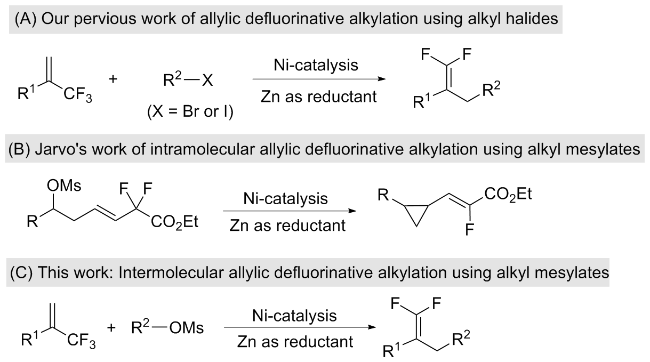
Gem-difluoroalkenes are highly valuable motifs in both medicinal and synthetic chemistry. In drug design, gem- difluoroalkenes are often used as bioisosteres of carbonyl groups, enabling improved metabolic stability and resistance to enzymatic degradation, which can enhance the pharmacokinetic profiles of therapeutic candidates.[1] Furthermore, the presence of two fluorine atoms on the same carbon strongly influences reactivity by increasing electrophilicity of the olefinic unit, making these compounds versatile precursors in a wide range of transformations to access other valuable fluorine-containing compounds.[2] Synthetic strategies towards gem-difluoroalkenes have been extensively developed to enable efficient incorporation of the difluoromethylene (CF2) unit into organic molecules.[3] One of the most common approaches involves the olefination of carbonyl,[4] diazo,[5] or hydrazone compounds.[6] Another widely used method is allylic defluorinative functionalization of trifluoromethyl-substituted alkenes, where selective removal of fluoride generates the gem-difluoro- alkene motif under basic,[7] photoredox,[8] electrochemical,[9] Lewis acid catalyzed,[10] or transition-metal catalyzed conditions.[11] In recent years, our group has developed a series of transition metal-catalyzed allylic defluorinative cross-electrophile coupling reactions of trifluoromethyl- substituted alkenes, providing a reliable platform for constructing gem-difluoroalkenes with broad functional group tolerance and structural diversity.[12] By leveraging nickel catalysis under reductive conditions, we achieved allylic defluorinative alkylation of trifluoromethyl-substituted alkenes employing alkyl halides as the electrophilic alkylating agents (Scheme 1A).[12a] Considering the commercial availability of alcohols and their prevalence in medicinal agents and natural products, cross-electrophile coupling reactions utilizing alcohol derivatives like alkyl sulfonates as coupling partners are more desirable.[13] In 2023, Jarvo and coworkers[14] developed a nickel catalyzed intramolecular allylic defluorinative alkylation of allylic gem-difluo- rides with alkyl mesylates (Scheme 1B). However, no example involving intermolecular C—C bond formation was described in this seminal work. Herein, we report the development of nickel-catalyzed allylic defluorinative alkylation of trifluoromethyl-substituted alkenes with aliphatic mesylates (Scheme 1C).
Scheme 1 Research background and our work in this context

1 Results and discussion

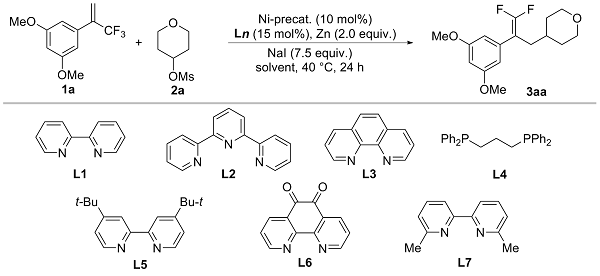
The reaction conditions were optimized by first evaluating a series of ligands (L1~L7) using Ni(dme)Br2 (10 mol%) as a precatalyst, zinc (2 equiv.) as a reductant, and NaI (7.5 equiv.) as an additive in tetrahydrofuran/N,N-dimethylacetamide (THF/DMA, VV=4∶1) at 40 ℃. The solvent combination was selected because it proved to be optimal in our previous related reaction using alkyl halides.[12a] Among the ligands examined, 2,2'-bipyridine (L1), terpyridine (L2), and 1,10-phenanthroline (L3) were found to promote the target reaction, delivering product 3aa in 24%~41% yields (Table 1, Entries 1~3). In contrast, the use of the phosphine ligand L4 resulted in only trace product formation (Table 1, Entry 4). Introduction of electron-donating tert-butyl groups to 4- and 4'-positions of the bipyridine scaffold (L5) did not show a significant effect on the reaction outcome (Table 1, Entry 5). In the case of the electron-deficient bipyridine ligand L6, the desired reaction was nearly completely suppressed (Table 1, Entry 6). The sterically more demanding 6,6'-dimethyl-2,2'-bipyridine (L7) proved to be the most effective, providing product 3aa in 58% yield (Table 1, Entry 7). When single solvent was employed, such as THF, DMA, and MeCN, diminished yields were observed (Table 1, Entries 8~10), whereas mixed THF/DMA systems improved the reaction outcome (Table 1, Entries 11 and 12) with THF/DMA (VV=1∶4) giving the best result among the solvent combinations tested (Table 1, Entry 12). Next, different nickel precatalysts were screened under these improved solvent conditions (Table 1, Entries 13~16). Ni(dme)Br2 remained superior, outperforming NiBr2, NiCl2, Ni(OTf)2, and Ni(acac)2. Further refinement of the conditions showed that increasing the reaction temperature to 60 ℃ significantly enhanced the yield to 90% (Table 1, Entry 17), whereas replacing Zn with Mn as the reductant completely suppressed the reaction (Table 1, Entry 18). When the catalyst loading was reduced to 5 mol%, the yield decreased to 81% (Table 1, Entry 19). Overall, the optimal conditions were established as Ni(dme)Br2/L7 (10 mol%) in THF/DMA (VV=1∶4) with Zn as the reductant and NaI as an additive at 60 ℃.
Table 1 Optimization of reaction conditionsa

Entry Ln Precatalyst Solvent (VV) Yieldb/% Entry Ln Precatalyst Solvent (VV) Yieldb/%
1 L1 Ni(dme)Br2 THF/DMA (4∶1) 38 11 L7 Ni(dme)Br2 THF/DMA (1∶1) 49
2 L2 Ni(dme)Br2 THF/DMA (4∶1) 41 12 L7 Ni(dme)Br2 THF/DMA (1∶4) 69
3 L3 Ni(dme)Br2 THF/DMA (4∶1) 24 13 L7 NiBr2 THF/DMA (1∶4) 58
4 L4 Ni(dme)Br2 THF/DMA (4∶1) Trace 14 L7 NiCl2 THF/DMA (1∶4) 52
5 L5 Ni(dme)Br2 THF/DMA (4∶1) 40 15 L7 Ni(OTf)2 THF/DMA (1∶4) 24
6 L6 Ni(dme)Br2 THF/DMA (4∶1) Trace 16 L7 Ni(acac)2 THF/DMA (1∶4) 40
7 L7 Ni(dme)Br2 THF/DMA (4∶1) 58 17c L7 Ni(dme)Br2 THF/DMA (1∶4) 90
8 L7 Ni(dme)Br2 THF 47 18c,d L7 Ni(dme)Br2 THF/DMA (1∶4) 0
9 L7 Ni(dme)Br2 DMA 34 19c,e L7 Ni(dme)Br2 THF/DMA (1∶4) 81
10 L7 Ni(dme)Br2 MeCN 23

a Unless otherwise specified, the reactions were performed on a 0.1 mmol scale of the trifluoromethyl-substituted alkene 1a using 2.0 equiv. of the alkyl methanesulfonate 2a, 10 mol% Ni precatalyst, 15 mol% ligand, 2 equiv. of reductant, and 7.5 equiv. of NaI in 1 mL of a solvent at 40 ℃ under N2 atmosphere for 24 h. b Yield of the isolated product. c The reaction was performed at 60 ℃. d Mn was used as the reductant instead of Zn. e The reaction was performed with 5 mol% catalyst loading.

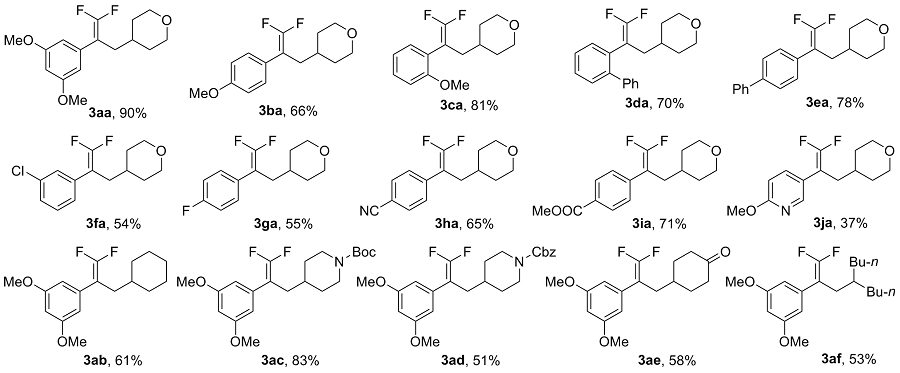
With the optimized conditions in hand, the substrate scope of trifluoromethyl-substituted alkenes was investigated using a range of aryl or heterocycle-containing coupling partners. As shown in Table 2, electron-rich aryl-substituted trifluoromethyl alkenes were well tolerated, as demonstrated by the formation of 3ba (66%) and 3ca (81%). Substrates bearing a phenyl substituent also participated effectively, affording 3da in 70% yield and 3ea in 78% yield. Halo-substituted substrates remained compatible under the standard conditions, with 3fa and 3ga obtained in 54% and 55% yield, respectively. Electron-deficient alkenes containing a cyano or ester substituent also underwent the transformation to provide 3ha (65%) and 3ia (71%), although the pyridyl-containing substrate gave a comparatively lower yield of 3ja (37%). Beyond tetrahydropyran-derived methanesulfonates, other cyclic and acyclic alkyl mesylates were also competent partners, delivering products 3ab~3af in 53%~83% yields. In particular, piperidine- and protected piperazine-derived substrates gave 3ac (83%) and 3ad (51%), while cyclohexanone- and dibutyl-containing products 3ae and 3af were formed in 58% and 53% yields, respectively.
Table 2 Evaluation of substrate scopea,b

a Unless otherwise specified, the reactions were performed on a 0.1 mmol scale of the trifluoromethyl-substituted alkenes 1 using 2.0 equiv. of the alkyl methanesulfonates 2, 10 mol% Ni(dme)Br2, 15 mol% L7, and 2 equiv. of zinc in THF (0.2 mL) and DMA (0.8 mL) at 60 ℃ under N2 atmosphere for 24 h. b Yield of the isolated product.

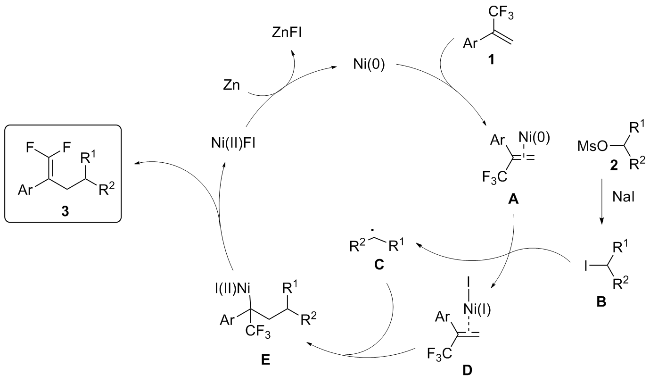
Based on our previous studies,[12a] a plausible mechanism is proposed for the nickel-catalyzed defluorinative cross-electrophile coupling between trifluoromethyl-substituted alkenes and alkyl mesylates (Scheme 2). Initially, a Ni(0) complex is generated under reductive conditions and subsequently coordinates with the trifluoromethyl-substituted alkene 1 to form complex A. Meanwhile, alkyl mesylates 2 are converted in situ into the corresponding alkyl iodide species B in the presence of sodium iodide. Next, the alkyl iodides B undergo a halogen atom transfer (XAT) with complex A, to generate an alkyl radical intermediate C and a Ni(I) intermediate D, which combine via a radical addition process to afford intermediate E. Subsequently, the Ni(II) species E undergoes β-fluoride elimination to deliver the desired gem-difluoroalkene product 3. The resulting Ni(II)FI is subsequently reduced by zinc to regenerate the Ni(0) spe- cies, thereby completing the catalytic cycle.
Scheme 2 Proposed reaction mechanism

2 Conclusion

In Summary, we developed a nickel-catalyzed intermolecular allylic defluorinative cross-electrophile coupling reaction of trifluoromethyl-substituted alkenes with secondary alkyl mesylates, which provides a new method to prepare gem-difluoroalkenes using alcohol derivatives as electrophilic alkylating agents.

3 Experimental section

3.1 Instruments and reagents

1H NMR and 13C NMR spectra were recorded on Bruker Avance 400M NMR or 500M NMR spectrometers at ambient temperature in CDCl3 at 400 and 101 or 500 and 126 MHz. 19F NMR spectra were recorded with composite pulse decoupling (CPD). The chemical shifts are relative to tetra- methylsilane [1H: δ (SiMe4)=0.00] as an internal standard or relative to the resonance of the solvent [1H: δ(CDCl3)=7.26, 13C: δ(CDCl3)=77.16]. High resolution mass spectral analysis (HRMS) was performed on a Waters XEVO G2 Q-TOF. Flash chromatography was performed using 200~300 mesh silica gel with the indicated solvent system. All Ni-salts were purchased from Adamas-beta, Sigma-Aldrich, Alfa Aesar, TCI, and used as received. All solvents were purchased from Adamas-beta China and used as received. Other commercial reagents were purchased from Sigma-Aldrich, Alfa Aesar, TCI, Strem, Acros and Energy Chemical, and used as received. Reactions were monitored through thin layer chromatography [Merck 60 F254 precoated silica gel plate (0.2 mm thickness)]. After elution, spots were visualized using UV radiation (254 nm) on Spectroline Model ZF-7 254 nm. Other visualization methods include staining with a basic solution of potassium permanganate or acidic solution of ceric ammonium molybdate, followed by heating. Unless otherwise noted, all reagents and starting materials were purchased from commercial vendors and used without further purification.

3.2 General procedure for Nickel-catalyzed defluorinative cross-electrophile coupling of trifluoromethyl- substituted alkenes with alkyl mesylates

Ni(dme)Br2 (3.1 mg, 0.01 mmol, 10 mol%), 6,6'-dimethyl-2,2'-bipyridine (L7) (2.8 mg, 0.015 mmol, 15 mol%), alkyl methanesulfonates 2 (if solid, 0.2 mmol, 2.0 equiv.), trifluoromethyl-substituted alkenes 1 (if solid, 0.1 mmol, 1.0 equiv.), NaI (112.5 mg, 0.75 mmol, 7.5 equiv.), and Zn (13.0 mg, 0.2 mmol, 2.0 equiv.) were added to a Schlenk tube equipped with a stir bar. The Schlenk tube was evacuated and filled with nitrogen (three cycles). To these solids, THF (0.20 mL) and DMA (0.80 mL) were added under nitrogen atmosphere. The reaction mixture was stirred at room temperature for 60 s. Next, alkyl methane- sulfonates 2 (if liquid, 0.2 mmol, 2.0 equiv.) were added under a positive flow of nitrogen and stirred at room temperature for another 60 s. Subsequently, trifluoromethyl- substituted alkenes 1 (if liquid, 0.1 mmol, 1.0 equiv.) were added. After stirring at 60 ℃ for 24 h, the reaction was quenched by addition of water (3 mL). The organic layer was separated, and the aqueous phase was extracted with ethyl acetate (4 mL×3). The combined organic phases were dried over Na2SO4, filtered, and concentrated in vacuo. The crude material was purified through column chromatography on silica gel (petroleum ether/ethyl acetate) to afford the corresponding products 3.
4-(2-(3,5-Dimethoxyphenyl)-3,3-difluoroallyl)tetrahy-dro-2H-pyran (3aa): Isolated as a white solid (27 mg, 90%) through column chromatography on silica gel eluting with petroleum ether/ethyl acetate (VV=20∶1). 1H NMR (500 MHz, Chloroform-d) δ: 6.38 (t, J=2.3 Hz, 2H), 6.33 (t, J=2.3 Hz, 1H), 3.90~3.79 (m, 2H), 3.73 (s, 6H), 3.20 (td, J=11.7, 1.9 Hz, 2H), 2.23 (dt, J=7.3, 2.4 Hz, 2H), 1.53~1.36 (m, 3H), 1.24~1.21 (m, 2H); 13C NMR (101 MHz, Chloroform-d) δ: 160.7 (2C), 155.0 (dd, J=292.5, 285.2 Hz), 135.7 (dd, J=4.6, 3.2 Hz, 2C), 106.7 (t, J=3.3 Hz, 2C), 99.0, 90.5 (dd, J=22.3, 12.8 Hz), 67.8 (2C), 55.4 (2C), 34.8 (d, J=0.8 Hz), 33.2 (t, J=2.5 Hz), 32.6 (2C); 19F NMR (471 MHz, Chloroform-d) δ: -89.82 (d, J=41.7 Hz, 1F), -90.42 (d, J=41.7 Hz, 1F). HRMS (ESI) calcd for C16H21F2O3 [M+H]+ 299.1453, found 299.1458.
4-(3,3-Difluoro-2-(4-methoxyphenyl)allyl)tetrahydro-2H-pyran (3ba): Isolated as a white solid (18 mg, 66%) through column chromatography on silica gel eluting with petroleum ether/ethyl acetate (VV=20∶1). 1H NMR (500 MHz, Chloroform-d) δ: 7.22 (d, J=8.3 Hz, 2H), 6.90 (d, J=8.7 Hz, 2H), 3.93~3.87 (m, 2H), 3.82 (s, 3H), 3.26 (td, J=11.8, 2.0 Hz, 2H), 2.31 (dt, J=7.1, 2.4 Hz, 2H), 1.59~1.45 (m, 3H), 1.35~1.23 (m, 2H); 13C NMR (126 MHz, Chloroform-d) δ: 158.7, 154.0 (dd, J=289.6, 285.7 Hz), 129.3 (t, J=3.1 Hz, 2C), 125.8 (t, J=3.4 Hz), 114.0 (2C), 89.8 (dd, J=21.7, 13.5 Hz), 67.8 (2C), 55.3, 34.8, 33.2 (t, J=2.6 Hz), 32.6 (2C); 19F NMR (376 MHz, Chloroform-d) δ: -91.81 (d, J=45.5 Hz, 1F), -92.10 (d, J=45.4 Hz, 1F). HRMS (ESI) calcd for C15H19F2O2 [M+H]+ 269.1348, found 269.1345.
4-(3,3-Difluoro-2-(2-methoxyphenyl)allyl)tetrahydro-2H-pyran (3ca): Isolated as a white solid (22 mg, 81%) through flash chromatography on silica gel eluting with petroleum ether/ethyl acetate (VV=20∶1). 1H NMR (500 MHz, Chloroform-d) δ: 7.30 (t, J=7.2 Hz, 1H), 7.12 (d, J=7.2 Hz, 1H), 6.96~6.90 (m, 2H), 3.96~3.87 (m, 2H), 3.82 (s, 3H), 3.26 (td, J=11.6, 1.9 Hz, 2H), 2.28 (dt, J=7.2, 2.3 Hz, 2H), 1.61~1.58 (m, 2H), 1.41~1.38 (m, 1H), 1.32~1.26 (m, 2H); 13C NMR (126 MHz, Chloroform-d) δ: 157.3 (d, J=2.0 Hz), 153.5 (t, J=286.8 Hz), 130.9 (t, J=2.4 Hz), 129.1, 122.7 (dd, J=5.1, 1.8 Hz), 120.5, 111.1, 87.1 (dd, J=23.9, 16.5 Hz), 67.9 (2C), 55.4, 35.2, 33.24 (t, J=2.5 Hz), 32.8 (2C); 19F NMR (471 MHz, Chloroform-d) δ: -89.40 (d, J=43.3 Hz, 1F), -93.41 (d, J=43.2 Hz, 1F). HRMS (ESI) calcd for C15H18F2O2 [M+H]+ 269.1348, found 269.1356.
4-(2-([1,1'-Biphenyl]-2-yl)-3,3-difluoroallyl)tetrahydro-2H-pyran (3da): Isolated as a white solid (22 mg, 70%) through column chromatography on silica gel eluting with petroleum ether/ethyl acetate (VV=20∶1). 1H NMR (500 MHz, Chloroform-d) δ: 7.35~7.23 (m, 8H), 7.17 (d, J=7.0 Hz, 1H), 3.77~3.67 (m, 2H), 3.08 (td, J=11.6, 2.2 Hz, 2H), 1.65~1.56 (m, 2H), 1.28~1.15 (m, 2H), 1.17~1.09 (m, 1H), 1.09~0.97 (m, 2H); 13C NMR (101 MHz, Chloroform-d) δ: 154.1 (dd, J=287.5, 285.9 Hz), 141.6 (d, J=3.0 Hz), 141.2, 132.2 (dd, J=5.0, 1.4 Hz), 130.9 (t, J=2.3 Hz), 130.5, 128.7 (2C), 128.2 (2C), 128.1, 127.4, 127.3, 90.6 (dd, J=22.3, 16.2 Hz), 67.8 (2C), 35.2, 32.8 (t, J=2.6 Hz), 32.6 (2C); 19F NMR (376 MHz, Chloroform-d) δ: -89.41 (d, J=44.3 Hz, 1F), -93.15 (d, J=44.3 Hz, 1F). HRMS (ESI) calcd for C20H21F2O [M+H]+ 315.1555, found 315.1552.
4-(2-([1,1'-Biphenyl]-4-yl)-3,3-difluoroallyl)tetrahydro-2H-pyran (3ea): Isolated as a white solid (24 mg, 78%) through column chromatography on silica gel eluting with petroleum ether/ethyl acetate (VV=20∶1). 1H NMR (500 MHz, Chloroform-d) δ: 7.60 (m, 4H), 7.45 (t, J=7.7 Hz, 2H), 7.40~7.33 (m, 3H), 3.96~3.85 (m, 2H), 3.28 (td, J=11.8, 1.9 Hz, 2H), 2.42~2.31 (m, 2H), 1.62~1.52 (m, 3H), 1.36~1.30 (m, 2H); 13C NMR (126 MHz, Chloroform-d) δ: 155.9 (dd, J=284.7, 279.2 Hz), 140.5, 140.1, 132.6 (dd, J=3.7, 0.9 Hz), 128.8 (2C), 128.5 (t, J=3.3 Hz, 2C), 127.5, 127.2 (2C), 127.0 (2C), 90.1 (dd, J=22.1, 13.0 Hz), 67.8 (2C), 34.6, 33.3 (t, J=2.5 Hz), 32.7 (2C); 19F NMR (471 MHz, Chloroform-d) δ: -90.15 (d, J=42.2 Hz, 1F), -90.57 (d, J=42.0 Hz, 1F). HRMS (ESI) calcd for C20H21F2O [M+H]+ 315.1555, found 315.1563.
4-(2-(3-Chlorophenyl)-3,3-difluoroallyl)tetrahydro-2H-pyran (3fa): Isolated as a white solid (13 mg, 54%) through column chromatography on silica gel eluting with petroleum ether/ethyl acetate (VV=20∶1). 1H NMR (400 MHz, Chloroform-d) δ: 7.24~7.17 (m, 3H), 7.14~7.09 (m, 1H), 3.87~3.82 (m, 2H), 3.20 (td, J=11.7, 2.1 Hz, 2H), 2.26 (ddd, J=7.1, 2.8, 2.0 Hz, 2H), 1.53~1.41 (m, 2H), 1.44~1.36 (m, 1H), 1.29~1.17 (m, 2H); 13C NMR (101 MHz, Chloroform-d) δ: 154.2 (dd, J=291.9, 287.6 Hz), 135.6 (dd, J=4.4, 3.3 Hz), 134.4, 129.8, 128.3 (t, J=3.4 Hz), 127.6, 126.4 (t, J=3.2 Hz), 89.7 (dd, J=22.7, 13.0 Hz), 67.7 (2C), 34.6, 33.2 (t, J=2.6 Hz), 32.6 (2C); 19F NMR (376 MHz, Chloroform-d) δ: -89.39 (d, J=40.1 Hz, 1F), -89.73 (d, J=39.8 Hz, 1F). HRMS (ESI) calcd for C14H15ClF2ONa [M+Na]+ 295.0672, found 295.0676.
4-(3,3-Difluoro-2-(4-fluorophenyl)allyl)tetrahydro-2H-pyran (3ga): Isolated as a white solid (14 mg, 55%) through column chromatography on silica gel eluting with petroleum ether/ethyl acetate (VV=20∶1). 1H NMR (400 MHz, Chloroform-d) δ: 7.21~7.18 (m, 2H), 7.01~6.96 (m, 2H), 3.86~3.82 (m, 2H), 3.19 (td, J=11.7, 2.1 Hz, 2H), 2.25 (ddd, J=7.0, 2.8, 2.0 Hz, 2H), 1.49~1.45 (m, 2H), 1.43~1.34 (m, 1H), 1.26~1.19 (m, 2H); 13C NMR (101 MHz, Chloroform-d) δ: 160.8 (d, J=247.0 Hz), 153.0 (ddd, J=290.3, 286.8, 1.1 Hz), 128.8 (dt, J=8.2, 3.2 Hz, 2C), 128.5 (dd, J=4.7, 3.4 Hz), 114.5 (d, J=21.6 Hz, 2C), 88.5 (dd, J=22.4, 13.6 Hz), 66.7 (2C), 33.8, 32.1 (t, J=2.6 Hz), 31.5 (2C); 19F NMR (471 MHz, Chloroform-d) δ: -90.89 (dd, J=43.2, 1.6 Hz, 1F), -91.25 (d, J=43.4 Hz, 1F), -114.48 (d, J=1.7 Hz, 1F). HRMS (ESI) calcd for C14H15F3ONa [M+Na]+ 279.0967, found 279.0961.
4-(1,1-Difluoro-3-(tetrahydro-2H-pyran-4-yl)prop-1-en-2-yl)benzonitrile (3ha): Isolated as a white solid (17 mg, 65%) through column chromatography on silica gel eluting with petroleum ether/ethyl acetate (VV=10∶1). 1H NMR (500 MHz, Chloroform-d) δ: 7.66 (d, J=8.4 Hz, 2H), 7.43 (d, J=7.1 Hz, 2H), 3.93~3.90 (m, 2H), 3.26 (td, J=11.8, 2.0 Hz, 2H), 2.38 (dt, J=7.1, 2.4 Hz, 2H), 1.55~1.52 (m, 2H), 1.50~1.43 (m, 1H), 1.34~1.27 (m, 2H); 13C NMR (126 MHz, Chloroform-d) δ: 154.5 (dd, J=294.1, 289.3 Hz), 138.7 (dd, J=4.8, 3.8 Hz), 132.4 (2C), 128.8 (t, J=3.6 Hz, 2C), 118.6, 111.1, 89.9 (dd, J=23.3, 11.9 Hz), 67.7 (2C), 34.2, 33.4 (t, J=2.5 Hz), 32.5 (2C); 19F NMR (471 MHz, Chloroform-d) δ: -86.96 (d, J=35.3 Hz, 1F), -87.90 (d, J=34.8 Hz, 1F). HRMS (ESI) calcd for C15H15F2NONa [M+Na]+ 286.1014, found 286.0996.
Methyl 4-(1,1-difluoro-3-(tetrahydro-2H-pyran-4-yl)- prop-1-en-2-yl)benzoate (3ia): Isolated as a white solid (21 mg, 71%) through column chromatography on silica gel eluting with petroleum ether/ethyl acetate (VV=10∶1). 1H NMR (500 MHz, Chloroform-d) δ: 7.96 (d, J=8.4 Hz, 2H), 7.32 (d, J=7.0 Hz, 2H), 3.85 (s, 3H), 3.84~3.80 (m, 2H), 3.17 (td, J=11.8, 2.1 Hz, 2H), 2.31 (dt, J=7.2, 2.4 Hz, 2H), 1.48~1.45 (m, 2H), 1.43~1.37 (m, 1H), 1.26~1.18 (m, 2H); 13C NMR (126 MHz, Chloroform-d) δ: 166.7, 154.3 (dd, J=292.9, 288.1 Hz), 138.54 (t, J=4.6, 3.7 Hz), 129.8 (2C), 129.0, 128.1 (t, J=3.4 Hz, 2C), 90.2 (dd, J=22.7, 12.5 Hz), 67.7 (2C), 52.2, 34.4, 33.4 (t, J=2.6 Hz), 32.6 (2C); 19F NMR (471 MHz, Chloroform-d) δ: -88.44 (d, J=38.1 Hz, 1F), -88.99 (d, J=38.1 Hz, 1F). HRMS (ESI) calcd for C16H19F2O3 [M+H]+ 297.1297, found 297.1301.
5-(1,1-Difluoro-3-(tetrahydro-2H-pyran-4-yl)prop-1-en-2-yl)-2-methoxypyridine (3ja): Isolated as a white solid (10 mg, 37%) through column chromatography on silica gel eluting with petroleum ether/ethyl acetate (VV=5∶1). 1H NMR (400 MHz, Chloroform-d) δ: 8.04 (dt, J=2.2, 1.0 Hz, 1H), 7.45 (ddd, J=8.6, 2.5, 1.1 Hz, 1H), 6.69 (dd, J=8.7, 0.7 Hz, 1H), 3.88 (s, 3H), 3.86~3.83 (m, 2H), 3.19 (td, J=11.8, 2.0 Hz, 2H), 2.24 (dt, J=7.0, 2.6 Hz, 2H), 1.49~1.46 (m, 2H), 1.43~1.39 (m, 1H), 1.28~1.18 (m, 2H); 13C NMR (101 MHz, Chloroform-d) δ: 162.2, 153.1 (dd, J=290.7, 287.4 Hz), 145.1 (t, J=3.6 Hz), 137.3 (t, J=3.2 Hz), 121.4 (dd, J=4.4, 3.5 Hz), 109.8, 86.3 (dd, J=23.6, 13.6 Hz), 66.7 (2C), 52.5, 33.4, 32.1 (t, J=2.4 Hz), 31.5 (2C); 19F NMR (376 MHz, Chloroform-d) δ: -90.09 (d, J=42.5 Hz, 1F), -90.76 (d, J=42.5 Hz, 1F). HRMS (ESI) calcd for C14H18F2NO2 [M+H]+ 270.1300, found 270.1303.
1-(3-Cyclohexyl-1,1-difluoroprop-1-en-2-yl)-3,5-dime-thoxybenzene (3ab): Isolated as a colorless oil (18 mg, 61%) through column chromatography on silica gel eluting with petroleum ether/ethyl acetate (VV=20∶1). 1H NMR (400 MHz, Chloroform-d) δ: 6.45 (dd, J=2.3, 1.1 Hz, 2H), 6.39 (t, J=2.3 Hz, 1H), 3.80 (s, 6H), 2.23 (ddd, J=7.2, 2.9, 2.0 Hz, 2H), 1.69~1.64 (m, 4H), 1.62~1.59 (m, 1H), 1.32~1.25 (m, 2H), 1.15~1.10 (m, 2H), 0.95~0.88 (m, 2H); 13C NMR (101 MHz, Chloroform-d) δ: 160.6 (2C), 154.0 (dd, J=289.9, 285.4 Hz), 136.1 (dd, J=4.8, 3.0 Hz), 106.7 (t, J=3.3 Hz, 2C), 98.9, 91.2 (dd, J=22.4, 12.4 Hz), 55.3 (2C), 35.7 (t, J=2.4 Hz), 35.3, 32.9 (2C), 26.4, 26.1 (2C); 19F NMR (376 MHz, Chloroform-d) δ: -90.53 (d, J=43.0 Hz, 1F), -91.02 (d, J=43.0 Hz, 1F). HRMS (ESI) calcd for C17H23F2O2 [M+H]+ 297.1661, found 297.1657.
tert-Butyl 4-(2-(3,5-dimethoxyphenyl)-3,3-difluoroall- yl)piperidine-1-carboxylate (3ac): Isolated as a colorless oil (33 mg, 83%) through column chromatography on silica gel eluting with petroleum ether/ethyl acetate (VV=10∶1). 1H NMR (400 MHz, Chloroform-d) δ: 6.44 (dd, J=2.2, 1.1 Hz, 2H), 6.40 (t, J=2.2 Hz, 1H), 4.10~3.96 (m, 2H), 3.80 (s, 6H), 2.58 (t, J=13.7 Hz, 2H), 2.29 (dt, J=7.3, 2.1 Hz, 2H), 1.62 (d, J=14.1 Hz, 2H), 1.44 (s, 9H), 1.41~1.39 (m, 1H), 1.16~1.07 (m, 2H); 13C NMR (101 MHz, Chloroform-d) δ: 160.7 (2C), 154.8, 154.0 (dd, J=291.3, 286.6 Hz), 135.6 (dd, J=4.6, 3.1 Hz), 106.7 (t, J=3.3 Hz, 2C), 99.0, 90.6 (dd, J=22.3, 12.9 Hz), 79.3, 55.4 (2C), 34.5 (3C), 34.2 (t, J=2.5 Hz), 31.7 (2C), 28.5 (3C); 19F NMR (376 MHz, Chloroform-d) δ: -89.80 (d, J=41.6 Hz, 1F), -90.36 (d, J=41.6 Hz, 1F). HRMS (ESI) calcd for C21H29F2NO4Na [M+Na]+ 420.1957, found 420.1957.
Benzyl 4-(2-(3,5-dimethoxyphenyl)-3,3-difluoroallyl)pi-peridine-1-carboxylate (3ad): Isolated as a colorless oil (22 mg, 51%) through column chromatography on silica gel eluting with petroleum ether/ethyl acetate (VV=8∶1). 1H NMR (500 MHz, Chloroform-d) δ: 7.37~7.29 (m, 5H), 6.44 (d, J=2.3 Hz, 2H), 6.39 (t, J=2.3 Hz, 1H), 5.11 (s, 2H), 4.13 (d, J=27.4 Hz, 2H), 3.80 (s, 6H), 2.69~2.64 (m, 2H), 2.30 (d, J=7.2 Hz, 2H), 1.65~1.64 (m, 2H), 1.49~1.42 (m, 1H), 1.19~1.09 (m, 2H); 13C NMR (101 MHz, Chloroform-d) δ: 160.7 (2C), 155.2, 154.0 (dd, J=293.3, 288.3 Hz), 136.9, 135.5 (dd, J=4.7, 2.8 Hz), 128.5 (2C), 127.9, 127.8 (2C), 106.7 (t, J=3.2 Hz, 2C), 99.0, 90.5 (dd, J=24.5, 12.0 Hz), 67.0, 55.4 (2C), 44.0 (2C), 34.4, 34.1 (t, J=2.3 Hz), 31.6 (2C); 19F NMR (471 MHz, Chloroform-d) δ: -89.67 (d, J=41.4 Hz, 1F), -90.25 (d, J=41.5 Hz, 1F). HRMS (ESI) calcd for C24H27F2NO4Na [M+Na]+ 454.1800, found 454.1796.
4-(2-(3,5-Dimethoxyphenyl)-3,3-difluoroallyl)cyclohe-xan-1-one (3ae): Isolated as a colorless oil (18 mg, 58%) through column chromatography on silica gel eluting with petroleum ether/ethyl acetate (VV=8∶1). 1H NMR (400 MHz, Chloroform-d) δ: 6.47 (dd, J=2.3, 1.2 Hz, 2H), 6.42 (t, J=2.3 Hz, 1H), 3.81 (s, 6H), 2.40~2.37 (m, 3H), 2.34~2.33 (m, 1H), 2.29~2.20 (m, 2H), 2.06~1.96 (m, 2H), 1.81~1.73 (m, 1H), 1.49~1.38 (m, 2H); 13C NMR (101 MHz, Chloroform-d) δ: 211.7, 160.8 (2C), 154.1 (dd, J=291.4, 286.5 Hz), 135.4 (dd, J=4.6, 3.1 Hz), 106.7 (t, J=3.3 Hz, 2C), 99.0, 90.9 (dd, J=22.0, 13.3 Hz), 55.4 (2C), 40.5 (2C), 34.2 (t, J=2.5 Hz), 33.6, 32.2 (2C); 19F NMR (376 MHz, Chloroform-d) δ: -89.64 (d, J=41.6 Hz, 1F), -90.24 (d, J=41.5 Hz, 1F). HRMS (ESI) calcd for C17H21F2O3 [M+H]+ 311.1453, found 311.1459.
1-(4-Butyl-1,1-difluorooct-1-en-2-yl)-3,5-dimethoxy-benzene (3af): Isolated as a colorless oil (18 mg, 53%) through column chromatography on silica gel eluting with petroleum ether/ethyl acetate (VV=20∶1). 1H NMR (400 MHz, Chloroform-d) δ: 6.44 (dd, J=2.3, 1.1 Hz, 2H), 6.38 (t, J=2.3 Hz, 1H), 3.79 (s, 6H), 2.28 (dt, J=7.0, 2.3 Hz, 2H), 1.35~1.28 (m, 1H), 1.27~1.14 (m, 12H), 0.86 (t, J=6.5 Hz, 6H); 13C NMR (101 MHz, Chloroform-d) δ: 160.6 (2C), 153.9 (dd, J=290.2, 285.7 Hz), 135.96 (dd, J=4.9, 2.8 Hz), 106.6 (t, J=3.1 Hz, 2C), 99.2, 91.8 (dd, J=22.2, 12.4 Hz), 55.3 (2C), 35.4 (t, J=2.3 Hz), 32.7 (2C), 32.2, 28.5 (2C), 23.0 (2C), 14.1 (2C); 19F NMR (376 MHz, Chloroform-d) δ: -90.49 (d, J=43.7 Hz, 1F), -91.49 (d, J=43.7 Hz, 1F). HRMS (ESI) calcd for C20H30F2O2Na [M+Na]+ 363.2106, found 363.2110.
Supporting Information The 1H NMR, 13C NMR, and 19F NMR spectra of compounds 3. The Supporting Information is available free of charge via the Internet at http://sioc-journal.cn.
(Lu, Y.)
[1]
(a) Meanwell, N. A. J. Med. Chem. 2011, 54, 2529.

DOI

(b) Bobek, M.; Kavai, I.; De Clercq, E. J. Med. Chem. 1987, 30, 1494.

PMID

(c) Pan, Y.; Qiu, J.; Silverman, R. B. J. Med. Chem. 2003, 46, 5292.

DOI

(d) Altenburger, J.-M.; Lassalle, G. Y.; Matrougui, M.; Galtier, D.; Jetha, J.-C.; Bocskei, Z.; Berry, C. N.; Lunven, C.; Lorrain, J.; Herault, J.-P.; Schaeffer, P.; O'Connor, S. E.; Herbert, J.-M. Bioorg. Med. Chem. 2004, 12, 1713.

DOI

(e) Magueur, G.; Crousse, B.; Ourévitch, M.; Bonnet-Delpon, D.; Bégué, J.-P. J. Fluorine Chem. 2006, 127, 637.

DOI

(f) Messaoudi, S.; Treguier, B.; Hamze, A.; Provot, O.; Peyrat, J.-F.; De Losada, J. R.; Liu, J.-M.; Bignon, J.; Wdzieczak-Bakala, J.; Thoret, S.; Dubois, J.; Brion, J.-D.; Alami, M. J. Med. Chem. 2009, 52, 4538.

DOI PMID

[2]
(a) Chelucci, G. Chem. Rev. 2012, 112, 1344.

DOI PMID

(b) Zhang, X.; Cao, S. Tetrahedron Lett. 2017, 58, 375.

DOI

[3]
(a) Tian, F.; Yan, G.; Yu, J. Chem. Commun. 2019, 55, 13486.

DOI

(b) Fujita, T.; Fuchibe, K.; Ichikawa, J. Angew. Chem., Int. Ed. 2019, 58, 390.

DOI

(c) Zhao, F.; Zhou, W.; Zuo, Z. Adv. Synth. Catal. 2022, 364, 234.

DOI

(d) Li, S.; Shu, W. Chem. Commun. 2022, 58, 1066.

DOI

(e) Song, S.-Y.; Xu, S.-M. Chin. J. Org. Chem. 2023, 43, 411 (in Chinese).

(宋树勇, 徐森苗, 有机化学, 2023, 43, 411.)

(f) Jin, Y.; Ren, B.; Liang, F. Chin. J. Org. Chem. 2023, 44, 85 (in Chinese).

DOI

(金玉坤, 任保轶, 梁福顺, 有机化学, 2024, 44, 85.)

DOI

(g) Liu, F.; Wu, Q.; Wang, X.; Dong, Q.; Sun, K. Org. Chem. Front. 2025, 12, 3725.

DOI

[4]
(a) Faqua, S. A.; Duncan, W. G.; Silverstein, R. M. Tetrahedron Lett. 1964, 5, 1461.

DOI

(b) Nowak, R.; Robins, M. J. Org. Lett. 2005, 7, 721.

DOI

(c) Zhao, Y.; Huang, W.; Zhu, L.; Hu, J. Org. Lett. 2010, 12, 1444.

DOI

(d) Zheng, J.; Lin, J.-H.; Cai, J.; Xiao, J.-C. Chem. Eur. J. 2013, 19, 15261.

DOI

(e) Aikawa, K.; Toya, W.; Nakamura, Y.; Mikami, K. Org. Lett. 2015, 17, 4996.

DOI

(f) Krishnamoorthy, S.; Kothandaraman, J.; Saldana, J.; Prakash, G. K. S. Eur. J. Org. Chem. 2016, 2016, 4965.

DOI

[5]
(a) Hu, M.; He, Z.; Gao, B.; Li, L.; Ni, C.; Hu, J. J. Am. Chem. Soc. 2013, 135, 17302.

DOI

(b) Zheng, J.; Lin, J.-H.; Yu, L.-Y.; Wei, Y.; Zheng, X.; Xiao, J.-C. Org. Lett. 2015, 17, 6150.

DOI PMID

(c) Zhang, Z.; Yu, W.; Wu, C.; Wang, C.; Zhang, Y.; Wang, J. Angew. Chem., Int. Ed. 2016, 55, 273.

DOI

[6]
(a) Nenajdenko, V. G.; Varseev, G. N.; Korotchenko, V. N.; Shastin, A. V.; Balenkova, E. S. J. Fluorine Chem. 2003, 124, 115.

DOI

(b) Wang, S.; Cheng, B.-Y.; Sršen, M.; König, B. J. Am. Chem. Soc. 2020, 142, 7524.

DOI

[7]
(a) Kendrick, D. A.; Kolb, M. J. Fluorine Chem. 1989, 45, 265.

DOI

(b) Bégué, J.-P.; Bonnet-Delpon, D.; Rock, M. H. Tetrahedron Lett. 1995, 36, 5003.

(c) Fuchikami, T.; Shibata, Y.; Suzuki, Y. Tetrahedron Lett. 1986, 27, 3173.

DOI

(d) Fujita, M.; Obayashi, M.; Hiyama, T. Tetrahedron 1988, 44, 4135.

DOI

(e) Fuchibe, K.; Takahashi, M.; Ichikawa, J. Angew. Chem., Int. Ed. 2012, 51, 12059.

DOI

(f) Coates, G.; Tan, H. Y.; Kalff, C.; White, A. J. P.; Crimmin, M. R. Angew. Chem. Int. Ed. 2019, 58, 12514.

DOI PMID

(g) Chen, X.-L.; Wu, C.-Y.; Yang, D.-S.; Tang, B.-C.; Wang, H.-Y.; Yu, Z.-C.; Li, A.; Wu, Y.-D.; Wu, A.-X. Chin. J. Chem. 2024, 42, 1360.

DOI

[8]
(a) Xiao, T.; Li, L.; Zhou, L. J. Org. Chem. 2016, 81, 7908.

DOI

(b) Lang, S.; Wiles, R. J.; Kelly, C. B.; Molander, G. A. Angew. Chem. Int. Ed. 2017, 56, 15073.

DOI

(c) Guo, Y.-Q.; Wang, R.; Song, H.; Liu, Y.; Wang, Q. Org. Lett. 2020, 22, 709.

DOI

(d) Yue, F.; Liu, J.; Ma, H.; Liu, Y.; Dong, J.; Wang, Q. Org. Lett. 2022, 24, 4019.

DOI

(e) Tang, M.; Feng, B.; Bao, Y.; Xu, Z.; Huang, C.; Zheng, H.; Zhu, G.; Wang, Y.; Yuan, Z. Chin. J. Chem. 2024, 42, 2203.

DOI

(f) Chen, M.-X.; Fan, X.-L.; Wang, Z.-Y.; Zhu, Y.-L.; Zhao, X.; Jia, Z.; Hu, X.-H. Org. Chem. Front. 2025, 12, 4476.

DOI

[9]
(a) Gao, X.-T.; Zhang, Z.; Wang, X.; Tian, J.-S.; Xie, S.-L.; Zhou, F.; Zhou, J. Chem. Sci. 2020, 11, 10414.

DOI

(b) Liu, Y.; Tao, X.; Mao, Y.; Yuan, X.; Qiu, J.; Kong, L.; Ni, S.; Guo, K.; Wang, Y.; Pan, Y. Nat. Commun. 2021, 12, 6745.

DOI

(c) Zhang, H.; Liang, M.; Zhang, X.; He, M.; Yang, C.; Guo, L.; Xia, W. Org. Chem. Front. 2022, 9, 95.

DOI

[10]
(a) Fuchibe, K.; Hatta, H.; Oh, K.; Oki, R.; Ichikawa, J. Angew. Chem., Int. Ed. 2017, 56, 5890.

DOI

(b) Liu, Z.; Tu, X.-H.; Guo, L.-T.; Wang, X.-C. Chem. Sci. 2020, 11, 11548.

DOI

[11]
(a) Ichitsuka, T.; Fujita, T.; Ichikawa, J. ACS Catal. 2015, 5, 5947.

DOI

(b) Hayashi, T.; Huang, Y. J. Am. Chem. Soc. 2016, 138, 12340.

DOI

(c) Liu, Y.; Zhou, Y.; Zhao, Y.; Qu, J. Org. Lett. 2017, 19, 946.

DOI

(d) Dai, W.; Lin, Y.; Wan, Y.; Cao, S. Org. Chem. Front. 2018, 5, 55.

DOI

(e) Wang, M.; Pu, X.; Zhao, Y.; Wang, P.; Li, Z.; Zhu, C.; Shi, Z. J. Am. Chem. Soc. 2018, 140, 9061.

DOI

(f) Kojima, R.; Akiyama, S.; Ito, H. Angew. Chem. In. Ed. 2018, 57, 7196.

DOI

(g) Paioti, P. H. S.; Pozo, J.; Mikus, M. S.; Lee, J.; Koh, M. J.; Romiti, F.; Hoveyda, A. H. J. Am. Chem. Soc. 2019, 141, 19917.

DOI PMID

(h) Chen, F.; Xu, X.; He, Y.; Huang, G.; Zhu, S. Angew. Chem., Int. Ed. 2020, 59, 5398.

DOI

(i) Yao, C.; Wang, S.; Norton, J.; Hammond, M. J. Am. Chem. Soc. 2020, 142, 4793.

DOI

(j) Zhu, C.; Liu, Z.-Y.; Tang, L.; Zhang, H.; Zhang, Y.-F.; Walsh, P. J.; Feng, C. Nat. Commun. 2020, 11, 4860.

DOI

(k) Chen, R.; Sang, Y.; Gao, X.; Zhang, S.; Xue, X.-S.; Zhang, X. Angew. Chem., Int. Ed. 2021, 60, 12386.

DOI

(l) Pan, Q.; Ping, Y.; Wang, Y.; Guo, Y.; Kong, W. J. Am. Chem. Soc. 2021, 143, 10282.

DOI PMID

(m) Yan, X.; Wang, S.; Liu, Z.; Luo, Y.; Wang, P.; Shi, W.; Qi, X.; Huang, Z.; Lei, A. Sci. China Chem. 2022, 65, 762.

DOI

(n) Wang, K.; Chen, J.; Liu, W.; Kong, W. Angew. Chem. Int. Ed. 2022, 61, e202212664.

DOI

(o) Shinde, P. S.; Shinde, V. S.; Zhu, C.; Rueping, M. ACS Catal. 2025, 15, 17198.

DOI

(p) Li, Z.; Luo, M.; Zeng, X. Org. Biomol. Chem. 2025, 23, 5293.

DOI

[12]
(a) Lan, Y.; Yang, F.; Wang, C. ACS Catal. 2018, 8, 9245.

DOI

(b) Lin, Z.; Lan, Y.; Wang, C. ACS Catal. 2019, 9, 775.

DOI

(c) Lin, Z.; Lan, Y.; Wang, C. Org. Lett. 2019, 21, 8316.

DOI

(d) Ding, D.; Lan, Y.; Lin, Z.; Wang, C. Org. Lett. 2019, 21, 2723.

DOI

(e) Lin, Z.; Lan, Y.; Wang, C. Org. Lett. 2020, 22, 3509.

DOI

(f) Jin, Y.; Wu, J.; Lin, Z.; Lan, Y.; Wang, C. Org. Lett. 2020, 22, 5347.

DOI

(g) Zhang, C.; Lin, Z.; Zhu, Y.; Wang, C. J. Am. Chem. Soc. 2021, 143, 11602.

DOI

(h) Zhang, C.; Wang, L.; Shi, H.; Lin, Z.; Wang, C. Org. Lett. 2022, 24, 3211.

DOI

(i) Dong, H.; Lin, Z.; Wang, C. J. Org. Chem. 2022, 87, 892.

DOI

(j) Yuan, B.; Zhang, C.; Dong, H.; Wang, C. Org. Lett. 2023, 25, 1883.

DOI

(k) Dong, H.; Lin, Z.; Wang, C. Adv. Synth. Catal. 2023, 365, 1165.

DOI

(l) Shi, H.; Dong, H.; Wang, C. Org. Chem. Front. 2023, 10, 5843.

DOI

[13]
(a) Liang, Z.; Xue, W.; Lin, K.; Gong, H. Org. Lett. 2014, 16, 5620.

DOI

(b) Liu, J.-H.; Yang, C.-T.; Lu, X.-Y.; Zhang, Z.-Q.; Xu, L.; Cui, M.; Lu, X.; Xiao, B.; Fu, Y.; Liu, L. Chem. Eur. J. 2014, 20, 15334.

DOI

(c) Molander, G. A.; Traister, K. M.; O’Neill, B. T. J. Org. Chem. 2015, 80, 29071.

(d) Ackerman, L. K. G.; Anka-Lufford, L. L.; Naodovic, M.; Weix, D. J. Chem. Sci. 2015, 6, 1115.

DOI PMID

(e) Wang, J.; Zhao, J.; Gong, H. Chem. Commun. 2017, 53, 10180.

DOI

(f) Komeyama, K.; Ohata, R.; Kiguchi, S.; Osaka, I. Chem. Commun. 2017, 53, 6401.

DOI

(g) Komeyama, K.; Michiyuki, T.; Osaka, I. ACS Catal. 2019, 9, 9285.

DOI

(h) Ibrahim, M. Y. S.; Cumming, G. R.; Vega, R. G.; Garcia-Losada, P.; Frutos, O.; Kappe, C. O.; Cantillo, D. J. Am. Chem. Soc. 2023, 145, 31, 17023.

(i) Wang, R.; Xu, J.; Li, J.-X.; Wu, B.-B.; Jin, R.-X.; Bi, Y.-X.; Wang, X.-S. Chin. Chem. Lett. 2023, 34, 108490.

DOI

(j) Li, Z.-H.; Peng, H.; Zhang, P.; Hu, Y.-A.; Pi, C.; Zhu, C.; Xu, H. Org. Chem. Front. 2024, 11, 5010.

DOI

[14]
Lin, P. C.; Joshi, C.; McGinnis, T. M.; Mallojjala, S. C.; Sanford, A. B.; Hirschi, J. S.; Jarvo, E. R. ACS Catal. 2023, 13, 4488.

DOI

文章导航

/