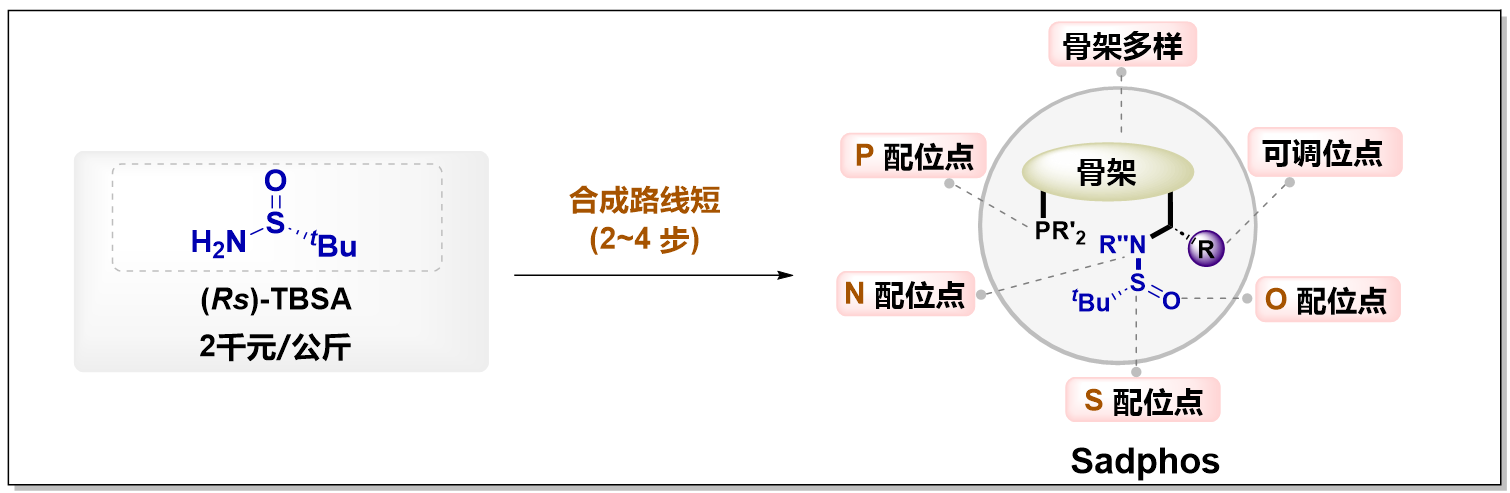
丰产金属(铁、钴、镍、铜、锌、锰等)因储量丰富、成本低廉、环境友好、反应条件温和及副产物少等优势,其不对称催化已成为替代钯、铑、铱等贵金属的核心研究方向。Sadphos配体是张俊良课题组于2014年基于非C₂对称、刚柔并济及含P、N、O、S等多配位原子的设计理念开发的新型手性膦配体,以手性叔丁基亚磺酰胺为核心骨架,已发展出Ming-Phos, Wei-Phos,Xiang-Phos, Xu-Phos, PC-Phos, TY-Phos, W-Phos, WJ-Phos等多个系列,具有结构多样、易于修饰、配位位点丰富及立体调控能力优异等特点。2016年,Sadphos配体首次应用于不对称丰产金属催化反应,开启了二者结合的研究新篇章。本文系统综述了2016—2026年近十年间,Sadphos配体在丰产金属(铜、镍、钴等)催化的不对称反应及聚合反应中的研究进展,按丰产金属种类分类,重点总结其在[3+2]环加成、不对称加成、不对称交叉偶联、1,1-双取代联烯不对称硼酰基化、还原环化、动态动力学还原共轭加成、轴手性构建、亚磺酰亚胺对映选择性加成/烯基化及联烯单体聚合等反应中的应用,探讨配体结构与金属中心的匹配性及催化立体调控机制,分析当前研究面临的挑战,并对未来发展方向进行展望,为该领域的进一步研究、结构创新及工业化应用提供参考。
张瑞楠
,
郑琪智
,
赖圣怡
,
罗文俊
,
许冰
,
张展鸣
,
张俊良
. Sadphos在丰产金属催化反应中的应用[J]. 有机化学, 0
: 202604047
.
DOI: 10.6023/cjoc202604047
Abundant metals (such as iron, cobalt, nickel, copper, zinc, and manganese) have prominent advantages including rich reserves, low cost, environmental friendliness, mild reaction conditions, and few by-products. Their asymmetric catalysis has become a core research direction to replace precious metals such as palladium, rhodium, and iridium. Developed by the Junliang Zhang research group in 2014 based on the design concepts of non-C₂ symmetry, rigidity combined with flexibility, and containing multiple coordinating atoms such as P, N, O, and S, Sadphos ligands are a new type of chiral phosphine ligands with chiral tert-butylsulfinamide as the core skeleton. They have been developed into multiple series including Ming-Phos, Wei-Phos,Xiang-Phos, Xu-Phos, PC-Phos, TY-Phos, W-Phos, WJ-Phos, etc, featuring diverse structures, easy modification, abundant coordination sites, and excellent stereoregulatory ability. In 2016, Sadphos ligands were first applied in asymmetric abundant metal catalytic reactions, opening a new chapter in the research on the combination of the two. This review systematically summarizes the research progress of Sadphos ligands in asymmetric reactions and polymerization reactions catalyzed by abundant metals (such as copper, nickel, and cobalt) over the past ten years from 2016 to 2026. Classified by the type of abundant metals, it focuses on summarizing their applications in various reactions including [3+2] cycloaddition, asymmetric addition, asymmetric cross-coupling, asymmetric borylation of 1,1-disubstituted allenes, reductive cyclization, dynamic kinetic reductive conjugate addition, axially chiral construction, enantioselective addition/vinylation of sulfinimines, and polymerization of allene monomers. It also discusses the matching between ligand structure and metal center as well as the stereoregulatory mechanism of catalysis, analyzes the challenges faced in current research, and looks forward to future development directions, providing references for further research, structural innovation, and industrial application in this field.
[1] 林国强,李月明,陈耀全,孙兴文,陈新滋. 手性合成——不对称反应及其应用. 科学出版社,北京,2010.
[2] 麻生明. 金属有机参与的现代有机合成化学. 广东科技出版社, 广州, 2003.
[3] Nozaki H.; Moriuti S.; Takaya H.; Noyiri R. Tetrahedron Lett.1966, 7, 5239.
[4] Knowles W. S.; Sabacky M. J.; Vineyard, B. D. J. Chem. Soc. Chem. Commun.1972, 10.
[5] Noyori, R. Science1990, 248, 1194.
[6] Klunder J. M.; Onami T.; Sharpless, K. B. J. Org. Chem.1989, 54, 1295.
[7] Liu X.-Y.; Qin, Y. Green Synth. Catal.2022, 3, 25.
[8] Liu H.; Deng Y.; Ling D.; Chen L.; Jin, Z. Chin. Chem. Lett.2026, 37, 111793.
[9] Fürstner, A. ACS Cent. Sci.2016, 2, 778.
[10] Liu Y.; You T.; Wang H.-X.; Tang Z.; Zhou C.-Y.; Che, C.-M. Chem. Soc. Rev.2020, 49, 5310.
[11] Yang, M.; Liu, Y.; Qi, X.; Zhao, Y.; Wu, X.-F.Green Synth. Catal. 2024, 5, 211.
[12] Das A. K.; Sarkar K.; Bhattacharjee S.; Gajurel S.; Dhibar S.; Panja S. K.; Deshmukhf S. A.; Sarkar S. RSC Adv.2026, 16, 19920.
[13] Zhou T.; Yang H.; Zhou G.; Chen F.; Gao, P. Chin. Chem. Lett.2026, 37, 112223.
[14] Liu Y.; Li W.; Zhang, J. Natl. Sci. Rev.2017, 4, 326.
[15] Li W.; Zhang, J. Acc. Chem. Res.2024, 57, 489.
[16] Zhang Z.-M.; Chen P.; Li W.; Niu Y.; Zhao X.; Zhang, J. Angew. Chem. Int. Ed.2014, 53, 4350.
[17] Zhang Z.-M.; Xu B.; Xu S.; Wu H.-H.; Zhang, J. Angew. Chem. Int. Ed.,2016, 128, 6432.
[18] Xu B.; Zhang Z.-M.; Xu S.; Liu B.; Xiao Y.; Zhang J. ACS Catal.,2016, 7, 210.
[19] Liu, B.; Zhang, Z.-M., Xu, B.; Xu, S.; Wu, H.-H.; Zhang, [J].Adv. Synth. Catal., 2018, 360, 2144.
[20] Zhang R.; Xu B.; Zhang Z.; Zhang, J. Acta Chim. Sinica,2020, 78, 245. 张荣华;许冰;张展鸣;张俊良. 化学学报, 2020, 78, 245.
[21] Luo W.; Zhang L.-M.; Zhang Z.-M.; Zhang, J. Angew. Chem. Int. Ed.,2022, 61, e202204443.
[22] Zhang L.-M.; Luo W.; Fu J.; Liu Y.; Zhang J. ACS Catal.,2023, 13, 8830.
[23] Shi Y.; Yuan Y.; Li J.; Yang J.; Zhang, J. J. Am. Chem. Soc.,2024, 146, 17580.
[24] Yuan Y.; Pan L.; Han Y.; Tian X.; Ye W.; Zhang J.; Yang J. CCS Chem.2026, 8, 2206.
[25] Han J.; Zhou W.; Zhang P.-C.; Wang H.; Zhang R.; Wu H.-H.; Zhang J. ACS Catal.,2019, 9, 6890.
[26] Kang S.-M.; Xu X.-H.; Xu L.; Zhou L.; Liu N.; Wu Z.-Q. Polym. Chem.,2021, 12, 4822.
[27] Pan Q.; Wang K.; Xu W.; Ai Y.; Ping Y.; Liu C.; Kong, W. J. Am. Chem. Soc.,2024, 146, 15453.
[28] Xu X.-Y.; Liu L.-G.; Xu L.-C.; Zhang S.-Q.; Hong, X. J. Am. Chem. Soc.,2025, 147, 15318.
[29] Xiong W.; Jiang X.; Wang W.-C.; Cheng Y.; Lu L.-Q.; Gao K.; Xiao, W.-J. J. Am. Chem. Soc.,2023, 145, 7983.