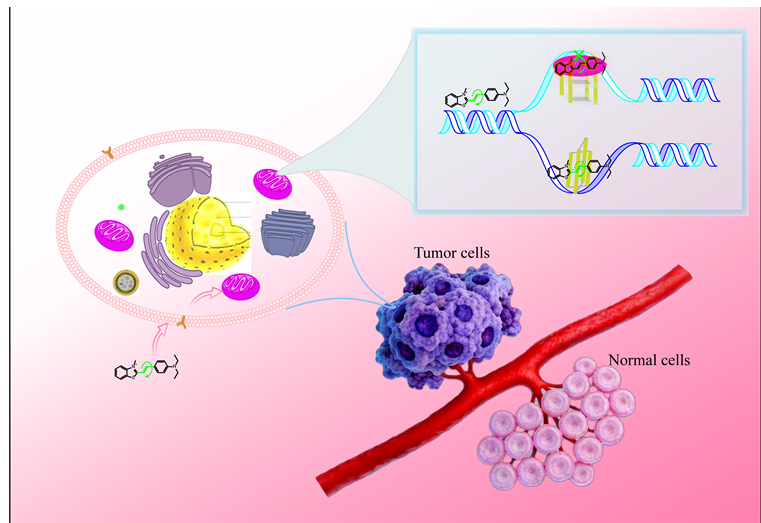
化学生物学研究表明G-四链体(G4)DNA是肿瘤诊疗的潜在靶点,针对靶向G4荧光配体的研究有望推动精准医学与分子诊断领域的发展。为了进一步提升G4 DNA荧光配体的选择性,本研究通过对已有苯并噻唑类配体的结构进行修饰,在温和条件下合成了一种具有大斯托克斯位移(80 nm)的新型红色荧光配体2-(4-(二乙氨基)苯乙烯基)-3-甲基苯并噻唑-3-碘鎓盐(DEAST)。光谱实验表明DEAST对G4 DNA表现出特异性的Turn-On型荧光响应,能够使其与其他DNA结构区分开来,对bcl-2 G4的检测限达到了2.8 nM。用乙基取代配体苯胺部分的甲基明显提升了配体对G4 DNA的荧光灵敏度。此外,细胞活性实验表明DEAST能够选择性抑制肿瘤细胞增殖;激光共聚焦成像表明其主要分布在肿瘤细胞A549的线粒体中;尿素变性实验进一步证明DEAST在细胞内的作用靶点为线粒体G4。该研究将为配体结构的进一步优化提供理论支持,有望推动以G4 DNA为靶点的肿瘤诊断与抗癌药物的研发。
Chemical biology studies have demonstrated that G-quadruplex (G4) DNA is a potential target for tumor diagnosis and therapy. The development of fluorescent ligands targeting G4 structures is expected to advance the fields of precision medicine and molecular diagnostics. With the aim of improving the selectivity of G4 ligands, a new red fluorescent ligand DEAST was synthesized under mild conditions through modification of an existing benzothiazole scaffold. The ligand DEAST exhibited a large Stokes shift of voer 80 nm. The absorption and fluorescence experiments indicated that the ligand displayed a fast and sensitive "turn-on" fluorescence response specifically triggered by G4 DNA, which allowed it to be clearly distinguished from other nucleic acid structures, achieving a detection limit of 2.8 nM for G-quadruplex DNA (bcl-2). Notably, substitution of the methyl groups on the aniline moiety with ethyl groups enhanced the fluorescence sensitivity of the ligand toward G4. In addition, cell viability assays revealed that DEAST exhibited selective inhibition of tumor cell proliferation, suggesting its potential for development as a targeted anticancer therapeutic. Confocal fluorescence imaging indicated that DEAST preferentially accumulated in the mitochondria of live A549 cells. Urea-denaturation experiments further confirmed that the target site of DEAST in A549 cells was mitochondria G4 DNA. Collectively, this study will provide valuable insights for the structural optimization of fluorescent ligands, thereby promoting drug discovery and tumor diagnosis targeting G4.
[1] Mergny J.L.; Sen D. Chem. Rev.2019, 119, 6290.
[2] Xu Y.; Komiyama M. Molecules2024, 29, 174.
[3] Papadimitropoulou A.; Makri M.; Zoidis, G. Eur. J. Med. Chem.2024, 267, 116194.
[4] Huppert J.L.; Balasubramanian, S. Nucleic Acids Res.2007, 35, 406.
[5] Figueiredo J.; Mergny J.-L.; Cruz C. Life Sci.2024, 340, 122481.
[6] Alessandrini I.; Recagni M.; Zaffaroni N.; Folini, M. Int. J. Mol. Sci.2021, 22, 5947.
[7] Laskowski T.; Kosno M.; Andralojc W.; Pakula J.; Stojalowski R.; Borzyszkowska-Bukowska J.; Paluszkiewicz E.; Mazerska, Z. Mol. Ther. Nucleic Acids2025, 36, 102513.
[8] Tosoni B.; Naghshineh E.; Zanin I.; Gallina I.; Di Pietro L.; Cleris L.; Nadai M.; Lecchi M.; Verderio P.; Pratesi P.; Pasquali S.; Zaffaroni N.; Neidle S.; Folini M.; Richter, S.N. Nucleic Acids Res.2025, 53, gkaf085.
[9] Marzano S.; Pinto G.; Di Porzio A.; Amato J.; Randazzo A.; Amoresano A.; Pagano B. Commun. Chem.2025, 8, 64.
[10] Li H.; Jin Z.; Gao S.; Kuang S.; Lei C.; Nie Z. Chem. Sci.2025, 16, 10083.Liu, W.T.; Liu, L.Y.; Zhu, B.C.; Mao, Z.W. Chem. J. Chin. Univ 2023, 44, 89 (in Chinese).
(刘文婷,刘柳宜,朱博琛,毛宗万, 高等学校化学学报, 2023, 44, 89)
[12] Xu J.; Jiang R.; He H.; Ma C.; Tang, Z. TrAC, Trends Anal. Chem.2021, 139, 116257.
[13] Zhao X.; Liu W.; Qu R.; Jiang X.; Chen J.; Chen, P. Sens. Actuators, B.2025, 430, 137372.
[14] Carvalho J.; Queiroz J.A.; Mergny J.L.; Salgado G.F.; Cruz, C. Trends Mol. Med.2020, 26, 848.
[15] Teng F.Y.; Jiang Z.Z.; Guo M.; Tan X.Z.; Chen F.; Xi X.G.; Xu, Y. Cell. Mol. Life Sci.2021, 78, 6557.
[16] He Y.C.; Li M.L.; Fu W.L.; Chen S.B.; Tan J.H.; Huang, Z.S. Prog. Pharm. Sci.2025, 49, 621 (in Chinese).
(何毅成,李茂林,傅雯丽,陈硕斌,谭嘉恒,黄志纾, 药学进展, 2023, 44, 89)
[17] Hashimoto Y.; Imagawa Y.; Nagano K.; Maeda R.; Nagahama N.; Torii T.; Kinoshita N.; Takamiya N.; Kawauchi K.; Tatesishi-Karimata H.; Sugimoto N.; Miyoshi D. Chem. Commun.2023, 59, 4891.
[18] Li Z.-C.; Wu T.-Y.; Zeng S.-T.; Fang L.; Mao J.-X.; Chen S.-B.; Huang Z.S.; Chen X.C.; Tan, J.H. Bioorg. Med. Chem. Lett.2022, 70, 128801.
[19] Luo X.; Xue B.; Feng G.; Zhang J.; Lin B.; Zeng P.; Li H.; Yi H.; Zhang X.-L.; Zhu H.; Nie, Z. J. Am. Chem. Soc.2019, 141, 5182.
[20] Zheng B.-X.; She M.-T.; Long W.; Xu Y.-Y.; Zhang Y.-H.; Huang X.-H.; Liu W.; Hou J.-Q.; Wong W.-L.; Lu Y.-J. Chem. Commun.2020, 56, 15016.
[21] Lu X.; Wu X.; Kuang S.; Lei C.; Nie Z. Anal. Chem.2022, 94, 10283.
[22] Gaur P.; Kumar A.; Dalal R.; Bhattacharyya S.; Ghosh S. Chem. Commun.2017, 53, 2571.
[23] Sun R.; Sun H.; Ye X.; Yang D.; Zhang B.; Liu Y.; Bai R.; Zhong F.; Yao L.; Tang, Y. Sens. Actuators, B.2024, 408, 135524.
[24] Wang X.D.; Yu B.Y.; Lin J.H.; Yan Y.Y.; Hu, M.H. Sens. Actuators, B.2021, 330, 129391.
[25] Yuan L.; Lin W.; Zheng K.; He L.; Huang, W. Chem. Soc. Rev.2013, 42, 622.
[26] Kang Y.; Wei, C. Spectrochim. Acta, Part A.2022, 278, 121316.
[27] Kang Y.; Wei, C. Spectrochim. Acta, Part A.2022, 267, 120518.
[28] Guan A.j.; Zhang X.F.; Sun X.; Li Q.; Xiang J.F.; Wang L.X.; Lan L.; Yang F.M.; Xu S.J.; Guo X.M.; Tang Y.L. Sci. Rep.2018, 8, 2666.
[29] Wang C.; Chi W.; Qiao Q.; Tan D.; Xu Z.; Liu, X. Chem. Soc. Rev.2021, 50, 12656.
[30] Li L.L.; Xu H.R.; Li K.; Yang Q.; Pan S.L.; Yu, X.Q. Sens. Actuators, B.2019, 286, 575.
[31] Yu Q.Q.; Gao J.J.; Lang X.X.; Li H.Y.; Wang M.Q. ChemBioChem2021, 22, 1042.
[32] O'Hagan M.P.; Penalver P.; Gibson R.S.L.; Morales J.C.; Galan, M.C. Chem. - Eur. J.2020, 26, 6224.
[33] Zhu L.N.; Zhao S.J.; Wu B.; Li X.Z.; Kong D.M. PLoS One2012, 7, e35586.
[34] Guo R.J.; Yan J.W.; Chen S.B.; Gu L.Q.; Huang Z.S.; Tan J.H. Dyes Pigm.2016, 126, 76.
[35] You D.; Liu L.; Yang Q.; Wu X.; Li S.; Li A. Dyes Pigm.2020, 176, 108222.
[36] Yu Q.Q.; Lang X.X.; Gao J.J.; Li H.Y.; Bai Y.T.; Wang H.J.; Wang M.Q. Dyes Pigm.2021, 195, 109707.
[37] Liu S.; Bu L.; Zhang Y.; Yan J.; Li L.; Li G.; Song Z.; Huang J. Anal. Chem.2021, 93, 5267.
[38] Zhang S.; Sun H.; Chen H.; Li Q.; Guan A.; Wang L.; Shi Y.; Xu S.; Liu M.; Tang, Y. Biochim. Biophys. Acta.2018, 1862, 1101.
[39] Kiprianov A.I.; Pazenko, Z.N. Zh. Obshch. Khim.1949, 19, 1515.


