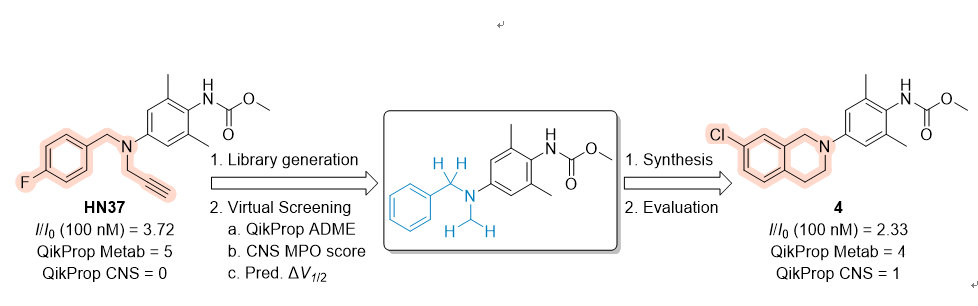
本文采用分子模块组装策略,以靶向电压门控钾通道Q亚家族 (Potassium voltage-gated channel subfamily Q, KCNQ) 的临床候选药物派恩加滨 (HN37) 为模版进行结构优化。研究首先基于多构象分子对接与多元线性回归建立了活性预测模型;同时,通过子结构检索获取多样化的分子砌块,利用Buchwald-Hartwig反应进行模块化组装,构建了兼具高合成可及性与结构新颖性的虚拟化合物库。随后,结合类药性评价和活性预测模型对库内分子进行分级筛选,识别出一批优选结构。在此基础上,合成了24个目标化合物并采用全细胞膜片钳技术评估其激动活性。实验结果显示,共有6个化合物在100 nM浓度下可显著激动KCNQ2通道,并初步明确了构效关系。其中化合物3和4表现出良好的KCNQ2激动活性、KCNQ通道亚型选择性及代谢稳定性。本研究将基于模块组装的分子设计、分级虚拟筛选与实验验证相结合,发现了一批具有潜力的KCNQ2激动剂,为后续的结构优化奠定了基础。
In this study, a molecular module assembly strategy was employed for the structural optimization of pynegabine (HN37), a clinical candidate targeting the potassium voltage-gated channel subfamily Q (KCNQ). First, an activity prediction model was established based on multi-conformation molecular docking and multiple linear regression. Simultaneously, a virtual compound library with high synthetic accessibility and structural novelty was constructed via modular assembly based on the Buchwald-Hartwig reaction, utilizing diverse building blocks acquired through substructure searches. Subsequently, a hierarchical virtual screening workflow—combining drug-likeness evaluation and established activity prediction model—was applied to identify a set of prioritized structures. On this basis, 24 target compounds were synthesized and evaluated using whole-cell patch-clamp electrophysiology. Experimental results demonstrated that 6 compounds exhibited significant agonistic activity against the KCNQ2 channel at 100 nM, with the structure-activity relationships (SAR) preliminary elucidated. Among them, compounds 3 and 4 showed favorable KCNQ2 agonistic activity, subtype selectivity for KCNQ channels, and metabolic stability. By integrating module-assembly-based molecular design, hierarchical virtual screening, and experimental validation, this work identifies a series of promising KCNQ2 agonists and paves the way for subsequent optimization.
[1] Fisher R. S.; Van Emde Boas W.; Blume W.; Elger C.; Genton P.; Lee P.; Engel, J. Jr. Epilepsia,2005, 46, 470.
[2] Auvin, S. Rev. Neurol., 2025, 181, 450.
[3] Springer K.; Varghese N.; Tzingounis, A. V. Dev. Neurosci.,2021, 43, 191.
[4] Wang, H. Science, 1998, 282, 1890.
[5] Wladyka C. L.; Kunze, D. L. J. Physiol.,2006, 575, 175.
[6] Peters H. C.; Hu H.; Pongs O.; Storm J. F.; Isbrandt D. Nat. Neurosci.,2005, 8, 51.
[7] Chen J.; Tao Q.; Fan L.; Shen Y.; Liu J.; Luo H.; Yang Z.; Liang M.; Gan, J. Mol. Genet. Genomic Med.,2022, 10, e2024.
[8] Blackburn-Munro G.; Dalby-Brown W.; Mirza N. R.; Mikkelsen J. D.; Blackburn-Munro, R. E. CNS Drug Rev.,2005, 11, 1.
[9] French J. A.; Porter R. J.; Perucca E.; Brodie M. J.; Rogawski M. A.; Pimstone S.; Aycardi E.; Harden C.; Qian J.; Rosenblut C. L.; Kenney C.; Beatch G. N.; Group, X. T. S. JAMA Neurol.,2023, 80, 1145.
[10] Perucca E.; Taglialatela M. CNS Drugs,2025, 39, 263.
[11] Bialer M.; Johannessen S. I.; Koepp M. J.; Perucca E.; Perucca P.; Tomson T.; White H. S. Epilepsia,2024, 65, 2831.
[12] Zhang Y. M.; Xu H. Y.; Hu H. N.; Tian F. Y.; Chen F.; Liu H. N.; Zhan L.; Pi X. P.; Liu J.; Gao Z. B.; Nan, F. J. J. Med. Chem.,2021, 64, 5816.
[13] Bialer M.; Johannessen S. I.; Koepp M. J.; Perucca E.; Perucca P.; Tomson T.; White H. S. Epilepsia,2024, 65, 2858.
[14] Wei S.; Shiwen W.; Cao-Wenjing C.; Huajun Y.; Qun, W. CNS Neurosci. Ther.,2024, 30, e70002.
[15] Liu Z.; Du L.; Li, M. Curr. Med. Chem.,2012, 19, 1405.
[16] Neyroud N.; Tesson F.; Denjoy I.; Leibovici M.; Donger C.; Barhanin J.; Faure S.; Gary F.; Coumel P.; Petit C.; Schwartz K.; Guicheney P. Nat. Genet.,1997, 15, 186.
[17] Whittaker D. G.; Colman M. A.; Ni H.; Hancox J. C.; Zhang H. Front. Physiol.,2018, 9, 1402.
[18] Chen Y. H.; Xu S. J.; Bendahhou S.; Wang X. L.; Wang Y.; Xu W. Y.; Jin H. W.; Sun H.; Su X. Y.; Zhuang Q. N.; Yang Y. Q.; Li Y. B.; Liu Y.; Xu H. J.; Li X. F.; Ma N.; Mou C. P.; Chen Z.; Barhanin J.; Huang W. Science,2003, 299, 251.
[19] Kharkovets T.; Hardelin J. P.; Safieddine S.; Schweizer M.; El-Amraoui A.; Petit C.; Jentsch, T. J. Proc. Natl. Acad. Sci. U. S. A.,2000, 97, 4333.
[20] Wang L.; Qiao G. H.; Hu H. N.; Gao Z. B.; Nan, F. J. ACS Med. Chem. Lett.,2019, 10, 27.
[21] Musella S.; Carotenuto L.; Iraci N.; Baroli G.; Ciaglia T.; Nappi P.; Basilicata M. G.; Salviati E.; Barrese V.; Vestuto V.; Pignataro G.; Pepe G.; Sommella E.; Di Sarno V.; Manfra M.; Campiglia P.; Gomez-Monterrey I.; Bertamino A.; Taglialatela M.; Ostacolo C.; Miceli, F. J. Med. Chem.,2022, 65, 11340.
[22] Ma D.; Zheng Y.; Li X.; Zhou X.; Yang Z.; Zhang Y.; Wang L.; Zhang W.; Fang J.; Zhao G.; Hou P.; Nan F.; Yang W.; Su N.; Gao Z.; Guo J. Nat. Commun.,2023, 14, 6632.
[23] Zhang S.; Ma D.; Wang K.; Li Y.; Yang Z.; Li X.; Li J.; He J.; Mei L.; Ye Y.; Chen Z.; Shen J.; Hou P.; Guo J.; Zhang Q.; Yang, H. Nat. Chem. Biol.,2024, 20, 847.
[24] Li X.; Zhang Q.; Guo P.; Fu J.; Mei L.; Lv D.; Wang J.; Lai D.; Ye S.; Yang H.; Guo J. Cell Res.,2021, 31, 52.
[25] Golbraikh A.; Tropsha, A. J. Mol. Graphics Modell.,2002, 20, 269.
[26] Roy K.; Mitra, I. Comb. Chem. High Throughput Screening,2011, 14, 450.
[27] Marbán-González A.; Ramírez-Cid V.; Cristóbal-Ramírez A.; Medina-Franco, J. L. Expert Opin. Drug Discovery,2025, 20, 1387.
[28] Gao W.; Coley, C. W. J. Chem. Inf. Model.,2020, 60, 5714.
[29] Lyu J.; Wang S.; Balius T. E.; Singh I.; Levit A.; Moroz Y. S.; O'meara M. J.; Che T.; Algaa E.; Tolmachova K.; Tolmachev A. A.; Shoichet B. K.; Roth B. L.; Irwin J. J. Nature,2019, 566, 224.
[30] Liu R.; Zuo Y.; Zhang Y.; Zhang, J. Chin. J. Org. Chem.,2025, 45, 3075 (in Chinese).
(刘荣, 左应林, 张英俊, 张霁, 有机化学, 2025, 45, 3075.)
[31] Wager T. T.; Hou X.; Verhoest P. R.; Villalobos, A. ACS Chem. Neurosci.,2010, 1, 435.
[32] Hartwig, J. F. Acc. Chem. Res., 2008, 41, 1534.
[33] Meng E. C.; Goddard T. D.; Pettersen E. F.; Couch G. S.; Pearson Z. J.; Morris J. H.; Ferrin, T. E. Protein Sci.,2023, 32, e4792.


