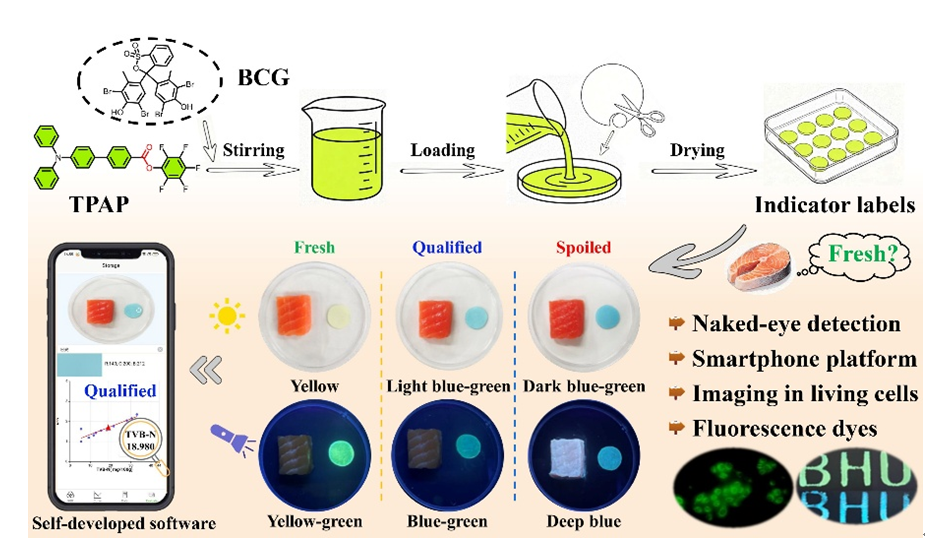
鱼肉新鲜度与饮食安全密切相关。传统新鲜度检测方法存在仪器昂贵、操作复杂等局限,而已开发的传感标签仅通过单一通道颜色变化,裸眼难以准确评价。为此,本文合成了一种生物胺荧光探针TPAP可以荧光增强识别多种胺,且具有大斯托克斯位移(150 nm)、较低的检测限(7.48 μM)和较宽的pH适用范围(4~11)。将TPAP与溴甲酚绿以摩尔比4:1混合后负载于滤纸片上,制备成兼具比色与荧光双响应的指示标签,可通过日光和荧光双通道颜色变化裸眼判断鱼肉新鲜度,增加了评价的准确性。此外,利用自主开发的手机app提取指示标签RGB值,通过B/R值与总挥发性盐基氮(TVB-N)含量构建线性关系,实现了智能手机评价鱼肉新鲜度等级。此外,探针TPAP还表现出多面性,制备的荧光墨水可用于防伪,并可在活细胞中对尸胺荧光成像。本研究不仅为鱼肉新鲜度快速、准确、无损检测提供了新方法,同时也拓展了荧光探针多领域应用的潜力。
温馨
,
李阳阳
,
钟克利
,
孙小飞
,
李学鹏
,
励建荣
,
汤立军
. 基于三苯胺荧光探针构建双通道指示标签用于鱼肉新鲜度可视化评价[J]. 有机化学, 0
: 202606028
-202606028
.
DOI: 10.6023/cjoc202606028
Fish freshness of is closely related to dietary safety. Conventional freshness detection techniques suffer from drawbacks including costly analytical instruments and cumbersome operational workflows. Meanwhile, existing indicator labels only rely on single-channel color variations, leading to inaccurate naked-eye evaluation. To address these limitations, this work synthesized a biogenic amine fluorescent probe TPAP, capable of recognition toward various amines with a fluorescent turn-on response. The probe possesses a large Stokes shift of 150 nm, a low limit of detection of 7.48 μM, and a broad pH range of 4-11. TPAP was blended with bromocresol green at a molar ratio of 4:1 and immobilized on filter paper to fabricate colorimetric and fluorescent dual-responding indicator labels. Visible color alterations under daylight and fluorescent light enable naked-eye evaluation of fish freshness, substantially improving detection reliability. Furthermore, a self-developed smartphone application was utilized to extract RGB from the indicator labels. A linear correlation was established between the B/R ratio and total volatile basic nitrogen (TVB-N) concentrations, enabling smartphone-based grading of fish freshness. In addition, probe TPAP exhibits versatile multifunctional properties: the formulated fluorescent ink can be applied for anti-counterfeiting, and TPAP achieves intracellular fluorescence imaging of cadaverine in living cells. This study not only establishes a novel strategy for rapid, accurate, and non-destructive detection of fish freshness, but also broadens the multi-scenario application potential of fluorescent probes.
[1] Chen L.;Wang,J.; Zhao, X.; Yan, X.Food Chem. 2025, 482, 144144.
[2] Chen C.; Wang X.; Wang X.; Waterhouse G.; Jiang M.; Qiao X.; Xu Z.Anal. Chem. 2024, 96, 12862.
[3] Ceylan B.; Çayci M.Glob. Nest. J. 2024, 26, 06420.
[4] Nguyen T.; Rupasinghe H.; Nguyen Q.; Pham T.; Hoang Q.; Pham B.; Mai T.; Le T.; Le T.; Mai T.J. Food Compos. Anal. 2025, 138, 106997.
[5] Sánchez-Parra, M.; Pierna, J.; Baeten, V.; Muñoz-Redondo, J.; Ordóñez-Díaz, J.; Moreno-Rojas, J.J. Food Eng. 2024, 379, 112129.
[6] He H.; Nie R.; Dong N.Microchem. J. 2024, 200, 110429.
[7] Jiang D.; Ling W.; Yi Z.; Jiang Y.; Wang Z.; An X.; Ji C.; Wang X.; Sun Q.; Kang B.Microchem. J. 2024, 203, 110821.
[8] Wei Y.; Huang L.; Shi Z.; Tang Y.; Huang X.; Wu Y.Microchem. J. 2024, 198, 110148.
[9] Wang Z.; Li X.; Xue X.; Wang Q.; Wang X.; Li J.J. Rare Earth., 2026, 44, 2028.
[10] Liu S.; Liang T.; Tian M.; Wu C.; Tang L.; Li Y.; Zhong K.; Sun X.; Li X.; Li J.J. Food Eng. 2025, 399, 112614.
[11] Sun X.; Jiang X.; Zhao X.; Wang Z.; Yuan J.; Li Y.; Li X.; Li J.; Tang L.; Zhong K.Food Chem. 2025, 473, 143013.
[12] Yang Y.; Yan X.; Liang T.; Tian M.; Wu C.; Tang L.; Sun X.; Zhang J.; Li Y.; Zhong K.J. Hazard. Mater. 2024, 469, 134003.
[13] Zhong K.; Liu S.; Li Y.; Tang L.; Sun X.; Li X.; Li, J. J. Sci. Food. Agr.2025, 105, 3951.
[14] Chen Q.; Wang C.; Wang Y.; Tian M.; Liang T.; Wu C.; Tang L.; Yan X.; Zhong K.Talanta 2026, 298, 129014.
[15] Wang A.; Tang F.; Zang T.; Liu X.; Cheng G.; Chen W.; Shu W.; Li D.; Tang Y.; Sun X.; Xiao H.Food Chem. 2024, 454, 139714.
[16] Noushija M.; Krishna A.; Ali R.; Shanmugaraju S. Sens. Diagn.2025, 4, 293.
[17] Miao X.; Jiang Y.; Liu W.; Lu C.; Tan W.; Li F.; Zhang M.ACS Sensors 2025, 10, 3669.
[18] Li J.; Wang C.; Tian M.; Liang T.; Yan X.; Li Y.; Wu C.; Zhong K.; Tang, L. Chem. Eng. J.2026, 540, 177268.
[19] Liu L.; Zhou L.; Liang T.; Zhong K.; Yan X.; Tang, L. Chin. J. Org. Chem.2026, 46, 866 (in Chinese).
(刘琳, 周璐璐, 梁天宇, 钟克利, 燕小梅, 汤立军, 有机化学, 2026, 46, 866.).
[20] Erdemir S.; Malkondu S.; Oguz M.Microchem. J. 2026, 220, 116598.
[21] Wang C.; Yu Z.; Zhao X.; Lu H.; Wang Q.Dyes.Pigm. 2021, 189, 109228.
[22] Sun X.; Ren N.; Gong H.; Wang Z.; Li X.; Tang L.; Zhong K.; Li, J. Anal. Chim. Acta2025, 1374, 344525.
[23] Zhang L.; Peng M.; Su Y.; Wang Y.; Peng Y.Microchem. J. 2025, 216, 114710.
[24] Zhao Y.; Liu L.; Ha Y.; Hou B.; Liang T.; Zhong K.; Sun X.; Li X.; Yan X.; Tang L.Spectrochim. Acta A 2026, 358, 127833.
[25] Zhong K.; Liu L.; Li Y.; Liang T.; Tang L.; Yan X.; Sun X.; Li X.; Li, J. J. Food Sci.2025, 90, e70659.
[26] Zhong K.; Hu L.; Tian L.; Tang L.; Sun X.; Liang T.; Li J.; Li X.J. Mater. Chem. C 2025, 13, 13315.