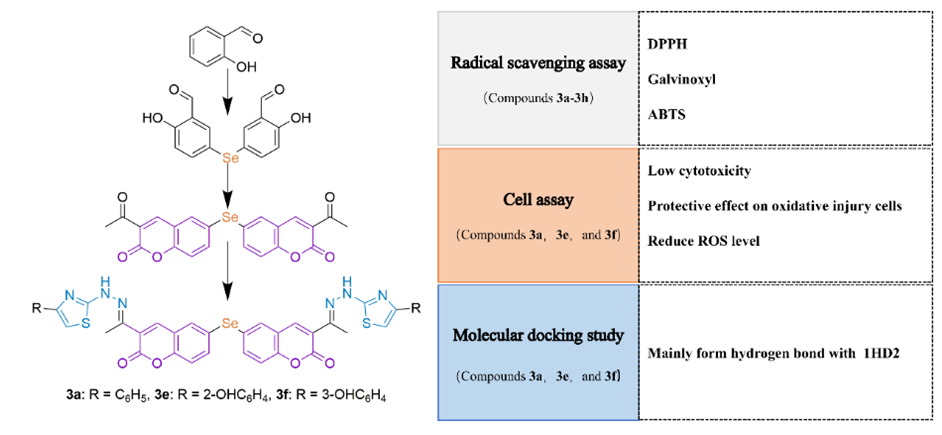
香豆素衍生物因其低毒性和广谱生物活性而备受关注,本研究合成了一系列香豆素硒醚噻唑腙类衍生物,并通过1H NMR、13C NMR和HRMS进行了表征。根据清除DPPH、加尔文氧和ABTS+自由基的能力对合成衍生物的体外抗氧化能力进行了评估,衍生物3a-3h表现出相当大的自由基清除活性,其中3a、3e和3f的性能优于标准药物抗坏血酸。使用CCK8测定法在RAW 264.7巨噬细胞上评估了细胞毒性,发现3a、3e和3f的细胞毒性较低。使用H2O2诱导的氧化损伤模型评估了它们在RAW 264.7细胞中的抗氧化保护作用,2',7'-二氯二氢荧光素二酸酯(DCFH-DA)测定结果显示,3a、3e和3f显著降低了氧化损伤细胞中的ROS水平。通过分子操作环境(MOE)进行了计算机分子对接研究,通过对人类过氧化氢酶5(PDB ID:1HD2)的活性位点进行了分子对接,结果表明3a、3e和3f与蛋白质受体主要是通过氢键结合。这些发现表明3a、3e和3f具有良好的抗氧化特性,值得进一步研究和开发。
Lin
,
Tingting
,
Fu
,
Leiqing
,
Zhang
,
Wei
,
Wang
,
Yong
,
Guo
,
Mengping
,
Zeng
,
Chunlai
. 新型香豆素硒醚噻唑腙类衍生物的合成、表征、抗氧化活性及分子对接研究[J]. 有机化学, 0
: 202604045
.
DOI: 10.6023/cjoc202604045
Coumarin derivatives have attracted significant interest due to their low toxicity and broad-spectrum biological activities. In this study, coumarin selenoether thiazolylhydrazone derivatives were synthesized, and characterized using 1H NMR, 13C NMR, and HRMS. Their in vitro antioxidant capacities were assessed based on their abilities to scavenge DPPH, galvinoxyl, and ABTS+ radicals. Derivatives 3a-3h demonstrated considerable radical-scavenging activity, with 3a, 3e, and 3f exhibiting superior performance compared to the standard drug ascorbic acid. while ortho‑hydroxy (3e) and meta‑hydroxy (3f) derivatives further improved activity to IC₅₀ values of 7.47/4.62/7.70 and 7.99/7.86/10.25 µmol/L, respectively, highlighting that ortho/meta hydroxyl positioning is the key structural determinant for enhanced antioxidant potency. Cytotoxicity was evaluated on RAW 264.7 macrophages using the CCK-8 assay, revealing low cytotoxicity for 3a, 3e, and 3f. Their antioxidant protective effects in RAW 264.7 cells were evaluated using an H2O2-induced oxidative injury model. 2',7'-Dichlorodihydrofluorescein diacetate (DCFH-DA) assays revealed that 3a, 3e, and 3f markedly reduced ROS levels in oxidative injury cells. The molecular docking study targeting the active site of human peroxiredoxin 5 (PDB ID: 1HD2) was performed to investigate the potential interactions of 3a, 3e, and 3f with the protein receptor. The results revealed that the mainly binding modes of them was hydrogen bond. In conclusion, these findings suggest that 3a, 3e, and 3f possess promising antioxidant properties and warrant further investigation and development.
[1] Ray P. D.; Huang B. W.; Tsuji Y.Cell. Signalling. 2012, 24, 981.
[2] Dong C. C.; Fang W. Z.; Yi Q. Y.; Zhang J. L. Chemosphere.2022, 308, 136205.
[3] Snezhkina A. V.; Kudryavtseva A.V.; Kardymon O. L.; Savvateeva M. V.; Melnikova N. V.; Krasnov G. S.; Dmitriev, A. A. Oxid. Med. Cell. Longevity.2019, 2019, 6175804.
[4] Alfadda A. A.; Sallam, R. M. Biomed Res. Int.2012, 2012, 936486.
[5] Mihailović N.; Marković V.; Matić I. Z.; Stanisavljević N. S.; Jovanović Z. S.; Trifunović S.; Joksović L. RSC Adv.2017, 7, 8550.
[6] Blokhina O.; Virolainen E.; Fagerstedt, K. V. Ann. Bot.2003, 91, 179.
[7] Deshmukh T. R.; Khedkar V. M.; Sangshetti J. N.; Shingate, B. B. Res. Chem. Intermed.2023, 49, 635.
[8] Hamid A. A.; Aiyelaagbe O. O.; Usman1 L. A.; Ameen O. M.; Lawal, A. Afr. J. Pure Appl. Chem.2010, 4, 142.
[9] Kecel-Gunduz S.; Budama-Kilinc Y.; Bicak B.; Gok B.; Belmen B.; Aydogan F.; Yolacan, C. Arabian J. Chem.2023, 16, 104440.
[10] Salehian F.; Nadri H.; Jalili-Baleh L.; Youseftabar-Miri L.; Bukhari S. N. A.; Foroumadi A.; Küçükkilinç T. T.; Sharifzadeh M.; Khoob, M. Eur. J. Med. Chem.2021, 212, 113034.
[11] Pérez-Cruz F.; Vazquez-Rodriguez S.; Matos M. J.; Herrera-Morales A.; Villamena F. A.; Das A.; Gopalakrishnan B.; Olea-Azar C.; Santana L.; Uriarte, E. J. Med. Chem.2013, 56, 6136.
[12] Mamgain R.; Kostic M.; Singh, F. V. Curr. Med. Chem.2023, 30, 2421.
[13] Behne D.; Kyriakopoulos A.; Meinhold H.; Köhrle, J. Biochem. Biophys. Res. Commun.1990, 173, 1143.
[14] Capperucci A.; Coronnello M.; Salvini F.; Tanini D.; Dei S.; Teodori E.; Giovannelli L. Bioorg. Chem.2021, 110, 104812.
[15] Muller A.; Cadenas E.; Graf P.; Sies H. Biochem. Pharmacol.1984, 33, 3235.
[16] Shaaban S.; Vervandier-Fasseur D.; Andreoletti P.; Zarrouka A.; Richard P.; Negm A.; Manolikakes G.; Jacobg C.; CherkaouiMalki M. Bioorg. Chem.2018, 80, 43.
[17] Zhang Y.; Fu X.; Yan Y. T.; Liu, J. B. J. Heterocyclic Chem.2020, 57, 991.
[18] Paudel Y. N.; Ali M. R.; Shah S.; Adil M.; Akhtar M. S.; Wadhwa R.; Bawa S.; Sharma M. Biomed. Pharmacother.2017, 89, 651.
[19] Bensalah D.; Mnasri A.; Chakchouk-Mtibaa A.; Mansour L.; Mellouli L.; Hamdi, N. Green Chem. Lett. Rev.2020, 13, 155.
[20] Djafarou S.; Mermer A.; Barut B.; Yılmaz G. T.; Khodj I. A.; Boulebd H. Food Chem.2023, 414, 135745.
[21] Belkheiri N.; Bouguerne B.; Bedos-Belval F.; Duran H.; Bernis C.; Salvayre R.; Nègre-Salvayre A.; Baltas, M. Eur. J. Med. Chem.2010, 45, 3019.
[22] Dincel E. D.; Gürsoy E.; Yilmaz-Ozden T.; Ulusoy-Güzeldemirci N. Bioorg. Chem.2020, 103, 104220
[23] Tvrdoňová M.; Borovská B.; Salayová A.; Rončák R.; Michalčin P.; Bednáriková Z.; Gažová Z. Bioorg. Chem.2023, 137, 106636.
[24] Tian J.; Xu Q.; Wang X.; Zhang X.; Chen X.; Rui X.; Zhang Q.; Dong M.; Li, W. Chem. Bio. Drug. Des.2023, 102, 471.
[25] Lin T. T.; Peng Q. L.; Lv M. Y.; Guo, M. P. Z Krist-New Cryst St.2023, 238, 673.
[26] Wu M. H.; Liu, W. J. Acta Crtstallogr E.2011, 67, o2983.


