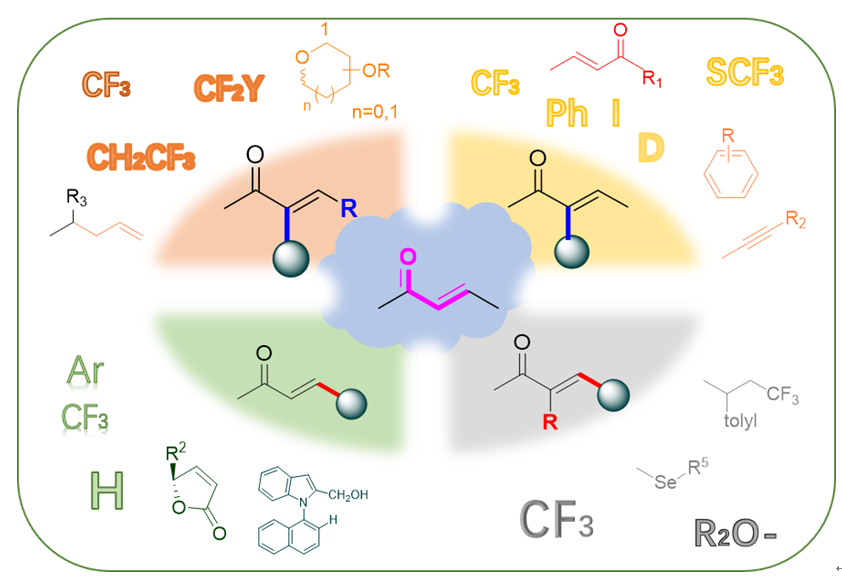
α,β-不饱和羰基结构是药物化学中一类非常重要的结构单元。围绕α位,借助烯醇中间体、有机小分子催化以及光/电介导的自由基路径,已发展出多种烷基化、氟烷基化和不对称修饰方法,底物适用范围整体较广。β位的官能化近年来相继形成了Heck芳基化、金属导向C-H活化、自由基氟烷基化以及可见光内源催化等多条路线,实现对芳基、含氟基团及杂原子片段的定点引入。整体来看,该领域正在逐步摆脱对金属和当量试剂的依赖,向无金属、光促、电催化等温和绿色体系转变。本文围绕α,β-不饱和烯烃α位与β位的位点选择性官能化,综述了相关合成策略,并对若干代表性反应的机理作了简要讨论。
The α,β-unsaturated carbonyl scaffold is a cornerstone of medicinal chemistry. At the α-carbon, well-established protocols—ranging from enolate chemistry and organocatalysis to photochemical and electrochemical radical pathways—have enabled a broad array of alkylations, fluoroalkylations, and asymmetric modifications, generally with wide substrate tolerance. Functionalization at the β-position has proven more difficult, owing to the inherently low electron density of the olefinic carbon. Nevertheless, a suite of approaches has emerged in recent years to tackle this challenge, including Heck arylation, metal-directed C-H activation, radical fluoroalkylation, and visible-light-driven photocatalysis, all of which allow for the selective installation of aryl, fluorinated, or heteroatom-containing groups.Overall, the field is shifting steadily away from reliance on metals and stoichiometric reagents, moving instead toward metal-free, photo-induced, and electrochemical platforms that operate under milder and more sustainable conditions. This Review surveys recent synthetic strategies for site-selective functionalization at both the α- and β-positions of α,β-unsaturated carbonyls, and briefly discusses the mechanistic underpinnings of representative transformations.
[1] Mehara P.; Sharma P.; Das P. Chem.Rec. 2025, 25, e202500071.
[2] Arshad L.; Jantan I.; Bukhari S. N.A.; Haque, M. A. Front. Pharmacol. 2017, 8, 22.
[3] Yang P.; Zhao Y. H.; Wu X. F. ACS Catal. 2025, 15, 14423.
[4] Baxter J. M.; Steinhübel D.; Palucki M.; Davies I. W. Org. Lett. 2005, 7, 215.
[5] Tanaka D.; Myers A. G. Org. Lett. 2004, 6, 433.
[6] O’Neill, J.; Yoo, K. S.; Jung, K. W. Tetrahedron Lett. 2008, 49, 7307.
[7] Pujol M.; Méndez M.; Fernández E. Org.Lett. 2024, 26, 2821.
[8] Sundström S.; Nguyen T. S.; May J. A. Org. Lett. 2020, 22, 1355.
[9] Zhang C.; Sun Y.; Gong J.; Li X. Angew.Chem., Int. Ed. 2025, 64, e202415496.
[10] Probasco K. C.; Jennings M. P.J. Org. Chem. 2021, 86, 8945.
[11] Kim K. M.; Park I. H. Synthesis 2004, 2641.
[12] Zhang X. L.; Chen Q.; Song R. J.; Xu J.; Tian W.; Li S.; Jin Z.; Chi Y. R. ACS Catal. 2020, 10, 5475.
[13] McDougal, N. T.; Schaus, S. E. J. Am. Chem. Soc. 2003, 125, 12094.
[14] Koech P. K.; Krische M. J.J. Am. Chem. Soc. 2004, 126, 5350.
[15] Sousa E Silva, F. C.; Van, N. T.; Wengryniuk, S. E. J. Am. Chem. Soc. 2020, 142, 64.
[16] Zheng K.; Chen C.; Xu H.; Wang Y. J. Org. Chem. 2025, 90, 15567.
[17] Yuen O. Y.; So, C. M. Angew. Chem., Int. Ed. 2020, 59, 23438.
[18] Dimakos V.; Canterbury D. P.; Monfette S.; Hill D. A. ACS Catal. 2022, 12, 11557.
[19] Deng Y.; Su M.; Kang D.; Wang J. J. Med. Chem. 2018, 61, 11341.
[20] Deng Y.; Li Y.; Wen Z.; Zhang L. Antibiotics 2022, 11, 425.
[21] Wang Z.; Liang M.; Zhang D.; Liu H. Org.Lett. 2025, 27, 4129.
[22] Liu T.; Wang Y.; Wu G.; Li H. J. Org. Chem. 2011, 76, 4119.
[23] Chen P. C.; You P. Y.; Wu L. Y.; Lin W. Org.Lett. 2024, 26, 553.
[24] Fang Z.; Ning Y.; Mi P.; Liao P.; Bi X. Org.Lett. 2014, 16, 1522.
[25] Ilchenko N. O.; Janson P. G.; Szabó, K. J. Chem. Commun. 2013, 49, 6614.
[26] Nagib D. A.;MacMillan, D. W. C. Nature 2011, 480, 224.
[27] Chen X.; Li L.; Pei C.; Liu J. J. Org. Chem. 2021, 86, 2772.
[28] Cui H.; Hu C.; Qiao X.; Zhao J. J. Org. Chem. 2025, 90, 13610.
[29] Yang K.; Yin D.; Sun Y.; Zhou H. J. Org. Chem. 2024, 89, 565.
[30] Peng Q. H.; Cai Y. L.; Dai H.; Wang X. J. Org. Chem. 2025, 90, 14786.
[31] Yoo J.; Ha H. J.; Kim B.; Lee S. J. Org. Chem. 2020, 85, 7077.
[32] Zhang S.; Yang Z.; Shi H.; Lu M. JACS Au 2025, 5, 5739.
[33] Landge V. G.; Shrestha K. K.; Grant A. J.; Young M. C. Org. Lett. 2020, 22, 9745.
[34] Zhang C. M.; He D. Q.; Ma Z. H.; Wang M.; Zhu Y. F.; Liu Y.; Chen J.; Guo L.; Lv G. H.; Wu Y. J. Org. Chem. 2024, 89, 10112.
[35] Das R.; Sakander N.; Kundu S.; Mukherjee D.; Kundu T. Org.Lett. 2025, 27, 5491.
[36] Pan Q.; Wang M.; Tu Y. H.; Li Z. Org.Lett. 2025, 27, 12904.
[37] Gottumukkala A. L.; de Vries, J. G.; Minnaard, A. J. Chem.-Eur. J. 2011, 17, 3091.
[38] Yang W. R.; Choi Y. S.; Jeong J. H. Org. Biomol. Chem. 2017, 15, 3074.
[39] Dhawa U.; Wdowik T.; Hou X.; Ackermann L. Chem.Sci. 2021, 12, 14182.
[40] Krause A.; Pollähne J.; Sperlich E.; Schmidt B. J. Org. Chem. 2025, 90, 4466.
[41] Li Y. L.; Zhang H.; Li J. W.; Shen D. L.; Liu Z. X. Org. Lett. 2022, 24, 9163.
[42] Logeswaran R.; Jeganmohan M. Org.Lett. 2023, 25, 6284.
[43] Iino Y.; Matsushima Y.; Nakashima K.; Hirashima S.; Miura T. J. Org. Chem. 2024, 89, 11789.
[44] Liu S. Y.; Zhang C. C.; Xiong Q. H.; Liu Y. X.; Li L.; Sun Y. Q.; Cheng B. C.; Chen F. J. Org. Chem. 2023, 88, 17489.
[45] Wang X.; Ye Y. X.; Ji G. J.; Xu Y.; Zhang S. N.; Feng J. J.; Zhang Y.; Wang J. B. Org. Lett. 2013, 15, 3730.
[46] Feng C.; Loh, T. P. Angew. Chem., Int. Ed. 2013, 52, 12448.
[47] Li L.; Guo J. Y.; Liu X. G.; Chen S.; Wang Y.; Tan B.; Liu X. Y. Org. Lett. 2014, 16, 6032.
[48] Tang L.; Yang F.; Zhang S.; Lv G.; Zhou Q. J.; Zheng L. Y.J. Org. Chem. 2022, 87, 7274.
[49] Tang L.; Jia F. J.; Yu R. J.; Zhang L. F.; Zhou Q. J. Org. Biomol. Chem. 2025, 23, 151.
[50] Logeswaran R.; Jeganmohan M. J. Org. Chem. 2023, 88, 4554.
[51] Monguchi Y.; Kunishima K.; Hattori T.; Takahashi T.; Shishido Y.; Sawama Y.; Sajiki H. ACS Catal. 2016, 6, 3994.
[52] Xiong L.; He S. Q.; Pan J.; Yu B.New J. Chem. 2022, 46, 4550.
[53] Tang L.; Jia F. J.; Yu R. J.; Wei X. M.; Zhang L. F.; Lv G.; Zhou Q. J.J. Org. Chem. 2024, 89, 13117.