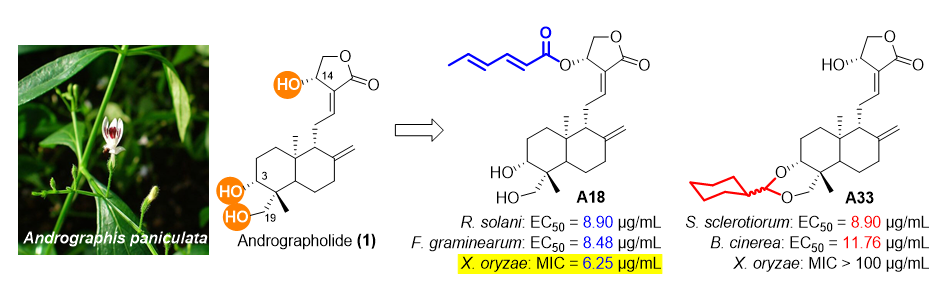
对穿心莲内酯的C-3、C-14和C-19位羟基进行结构修饰,合成了一系列酯化、磺酰化和缩醛化衍生物,并评价其对植物病原真菌和细菌的抗微生物活性。结果表明,大多数衍生物的体外抗真菌活性优于穿心莲内酯和恶霉灵。其中,酯化衍生物A16和A18对立枯丝核菌和禾谷镰刀菌具有较高活性,缩醛化衍生物A33和A39对核盘菌和灰葡萄孢具有较强抑制活性。此外,A18对水稻黄单胞菌表现出良好的抗细菌活性,MIC值为6.25 μg/mL,显著优于噻菌铜。进一步的活体药效评价表明,代表性高活性化合物对相应植物病害具有良好的防治效果。构效关系研究表明,酯化衍生物中烷基链延长及不饱和键数目的增加是影响抗菌活性的关键因素。上述结果表明,穿心莲内酯衍生物具有优异的广谱抗菌活性,可作为植物病害防治的候选先导化合物。
Wang
,
Huiwen
,
Zhang
,
Huimin
,
Ding
,
Junhui
,
Zhang
,
Shaoyong
,
Wang
,
Yuling
,
Liang
,
Zhuo
,
Liu
,
Yingqian
,
Zhang
,
Zhijun
. 穿心莲内酯衍生物的设计、合成及其抗植物病原菌活性研究[J]. 有机化学, 0
: 0
.
DOI: 10.6023/cjoc202608014
A series of esterified, sulfonylated, and acetalized andrographolide derivatives were synthesized by modifications of the hydroxyl groups at the C-3, C-14 and C-19 positions, and evaluated for their antimicrobial activities against pathogenic fungi and bacteria. Most of these compounds displayed excellent in vitro fungicidal activity compared to andrographolide and hymexazol. Among them, the esterified derivatives A16 and A18 exhibited the superior antifungal activity against Rhizoctonia solani and Fusarium graminearum, while the acetalized compounds A33 and A39 exhibited the highest inhibitory activities against Sclerotinia sclerotiorum and Botrytis cinerea. Moreover, compound A18 possessed remarkable in vitro antibacterial activity against Xanthomonas oryzae with a MIC value of 6.25 μg/mL, and was more potent than thiodiazole copper. The in vivo fungicidal and antibacterial evaluation further demonstrated that these highly active compounds could effectively control corresponding plant fungal or bacterial diseases. The structure-activity relationship revealed that alkyl chain extension and unsaturated bond increase were the crucial factors that governed antimicrobial activity for the esterified derivatives. These findings implied that andrographolide derivatives displayed superior antimicrobial activities, and could be potential candidates against plant fungal and bacterial diseases.
[1] Mansfield J.; Genin S.; Magori S.; Citovsky V.; Sriariyanum M.; Ronald P.; Dow M.; Verdier V.; Beer S. V.; Machado M. A.; Toth I.; Salmond G.; Foster G. D.Mol. Plant Pathol. 2012, 13, 614-629.
[2] Brauer V. S.; Rezende C. P.; Pessoni A. M.; De Paula, R. G.; Rangappa, K. S.; Nayaka, S. C.; Gupta, V. K.; Almeida, F.Biomolecules 2019, 9, 521.
[3] Oerke E. C.J. Agric. Sci. 2006, 144, 31-43.
[4] Shang X. F.; Dai L. X.; Zhang Z. J.; Yang C. J.; Du S. S.; Wu T. L.; He Y. H.; Zhu J. K.; Liu Y. Q.; Yan Y. F.; Miao X. L.; Zhang J. Y.J. Agric. Food Chem. 2021, 69, 6455-6464.
[5] Lin Y. L.; Zhong W. Q.; Dong C. Y.; Zhang C.; Feng X. X.; Zhang A. Q.ACS Appl. Bio. Mater. 2018, 1, 2062-2072.
[6] Huang N.; Angeles E. R.; Domingo J.; Magpantay G.; Singh S.; Zhang G.; Kumaravadivel N.; Bennett J.; Khush G. S.Theor. Appl. Genet. 1997, 95, 313-320.
[7] Lin D.; Qu L. J.; Gu H.; Chen Z.J. Appl. Microbiol. 2001, 91, 1044-1050.
[8] Watanabe H.; Horinouchi H.; Muramoto Y.; Ishii H.Plant Pathol. 2017, 66, 1472-1479.
[9] Jiang J. H.; Ding L. S.; Michailides T. J.; Li H. Y.; Ma Z. H.Pestic. Biochem. Phys. 2009, 93, 72-76.
[10] Forster H.;McGhee, G. C.; Sundin, G. W.; Adaskaveg, J. E.Phytopathology 2015, 105, 1302-1310.
[11] Han H. S.; Koh Y. J.; Hur J. S.; Jung J. S.J. Microbiol. 2004, 42, 365-368.
[12] Rodrigues T.; Reker D.; Schneider P.; Schneider G.Nat. Chem. 2016, 8, 531-541.
[13] Isman M. B.Annu. Rev. Entomol. 2006, 51, 45-66.
[14] Kumoro A. C.; Hasan M.; Singh H.Ind. Eng. Chem. Res. 2019, 58, 742-751.
[15] Manoharan S.; Singh A. K.; Suresh K.; Vasudevan K.; Subhasini R.; Baskaran N.Asian Pac. J. Cancer Prev. 2012, 13, 5701-5708.
[16] Hodroj M. H.; Jardaly A.; Raad S. A.; Zouein A.; Rizk S.Cancer Manage. Res. 2018, 10, 1079-1088.
[17] Wang W.; Wu Y. L.; Yang K. Y.; Wu C. R.; Tang R. T.; Li H.; Chen L. X.Eur. J. Med. Chem. 2019, 173, 282-293.
[18] Zhu Z. Y.; Duan H. B.; Jing M.; Xu L. P.; Yu P.Curr. Pharm. Des. 2018, 24, 3529-3533.
[19] Chen W.; Su H. M.; Feng L.; Zheng X. D.Life Sci. 2016, 156, 21-29.
[20] Guo X.; Zhang L. Y.; Wu S. C.; Xia F.; Fu Y. X.; Wu Y. L.; Leng C. Q.; Yi P. F.; Shen H. Q.; Wei X. B.; et al.Vet. Microbiol. 2014, 174, 496-503.
[21] Chen Z. G.; Zhu Q.; Zong M. H.; Gu Z. X.; Han Y. B.Process Biochem. 2011, 46, 1649-1653.
[22] Patil H. S.; Jadhav D. D.; Paul A.; Mulani F. A.; Karegaonkar S. J.; Thulasiram H. V.Bioorg. Med. Chem. Lett. 2018, 28, 1132-1137.
[23] Qiao Y.; Huang Y.; Feng F.; Chen Z. G.Process Biochem. 2016, 51, 675-680.
[24] Li F.; Li X.-M.; Sheng D.; Chen S.-R.; Nie X.; Liu Z.; Wang D.; Zhao Q.; Wang Y.; Wang Y.; et al.RSC Adv. 2018, 8, 9440-9456.
[25] Jiang X. J.; Yu P.; Jiang J.; Zhang Z. J.; Wang Z. L.; Yang Z. Q.; Tian Z. M.; Wright S. C.; Larrick J. W.; Wang, Y. Q. Eur. J. Med. Chem.2009, 44, 2936-2943.
[26] Wong C. C.; Sagineedu S. R.; Sumon S. H.; Sidik S. M.; Phillips R.; Lajis N. H.; Stanslas J.Environ. Toxicol. Pharmacol. 2014, 38, 489-501.
[27] Liu L.; Yan Y.; Zheng L. H.; Jia H. Y.; Han G.Nat. Prod. Res. 2020, 34, 782-789.
[28] Pandeti S.; Sonkar R.; Shukla A.; Bhatia G.; Tadigoppula N.Eur. J. Med. Chem. 2013, 69, 439-448.
[29] Zhang Z.-J.; Jiang Z.-Y.; Zhu Q.; Zhong G.-H.J. Agric. Food Chem. 2018, 66, 9598-9607.
[30] Chu Q.-R.; He Y.-H.; Tang C.; Zhang Z.-J.; Luo X.-F.; Zhang B.-Q.; Zhou Y.; Wu T.-L.; Du S.-S.; Yang C.-J.; Liu Y.-Q.J. Agric. Food Chem. 2022, 70, 2851-2863.