

Chinese Journal of Organic Chemistry ›› 2026, Vol. 46 ›› Issue (7): 2604-2621.DOI: 10.6023/cjoc202602020 Previous Articles Next Articles
REVIEW
程振东, 高亚飞*( )
)
收稿日期:2026-02-24
修回日期:2026-04-15
发布日期:2026-06-03
基金资助:
Zhendong Cheng, Yafei Gao*()
Received:2026-02-24
Revised:2026-04-15
Published:2026-06-03
Contact:
*E-mail: gaoyf@nju.edu.cn
Supported by:Share
Zhendong Cheng, Yafei Gao. Research Progress on Catalytic Dinitrogen Activation and Functionalization Mediated by Cobalt Complexes[J]. Chinese Journal of Organic Chemistry, 2026, 46(7): 2604-2621.
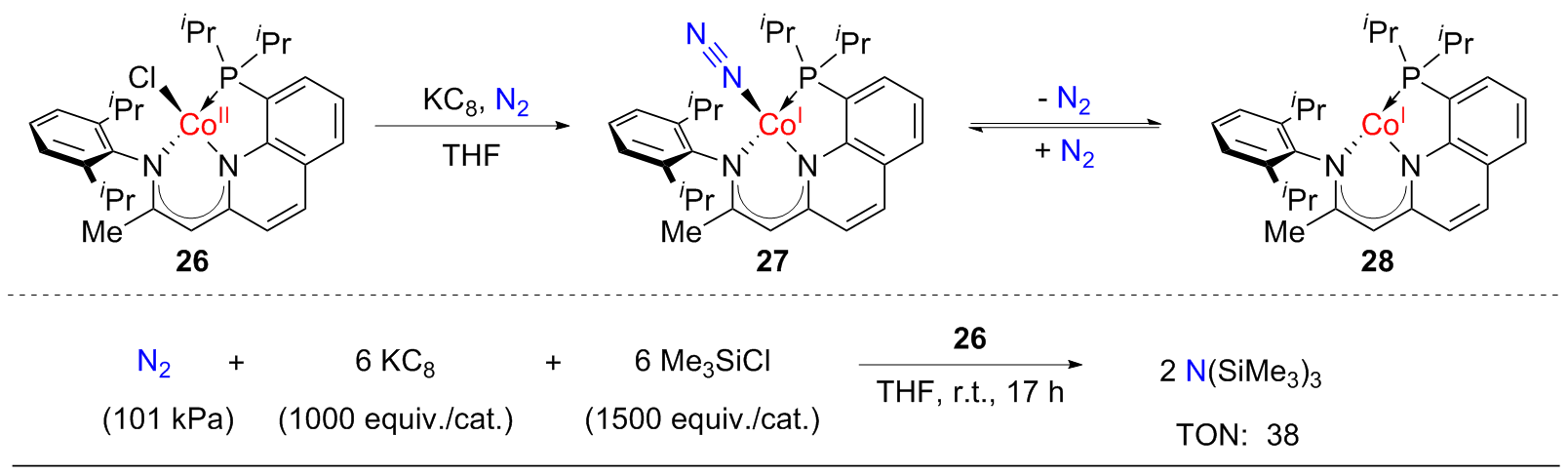
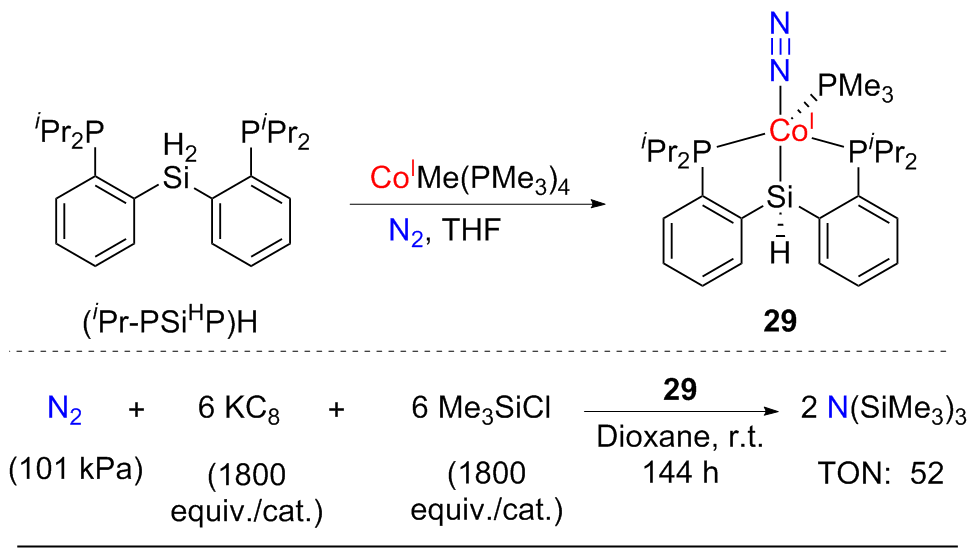
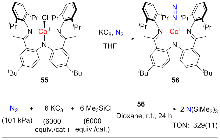
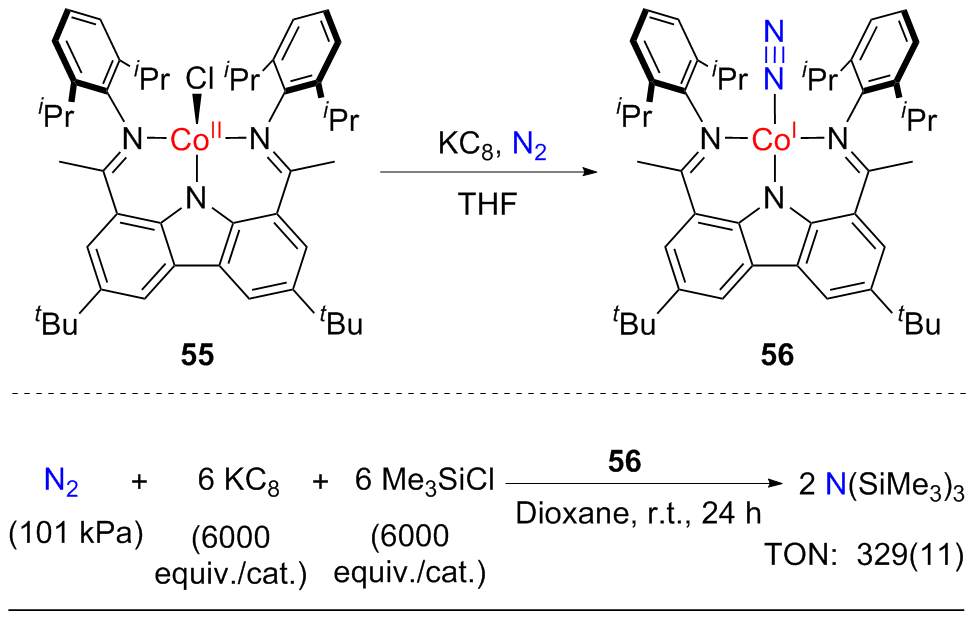
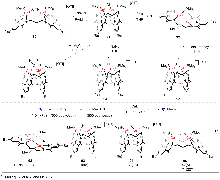
| Cobalt-N2 complex | Bond length d(N—N)/nm | IR ν(N—N)/cm-1 | TONa | Cobalt-N2 complex | Bond length d(N—N)/nm | IR ν(N—N)/cm-1 | TONa |
|---|---|---|---|---|---|---|---|
| | 0.1116(5) | 2062 | 41 | | 0.1128(3)~0.1150(3) | 1837 1931 | 89 |
| | 0.1154(2) 0.1159(3) | 1807 1881 | 107(16) | | 0.1115(9) | 2009 | 351(42) |
| | 0.1115(2) | 2061 | 52 | | 0.1121(3) | 2103 | 329(11) |
| Cobalt-N2 complex | Bond length d(N—N)/nm | IR ν(N—N)/cm-1 | TONa | Cobalt-N2 complex | Bond length d(N—N)/nm | IR ν(N—N)/cm-1 | TONa |
|---|---|---|---|---|---|---|---|
| | 0.1116(5) | 2062 | 41 | | 0.1128(3)~0.1150(3) | 1837 1931 | 89 |
| | 0.1154(2) 0.1159(3) | 1807 1881 | 107(16) | | 0.1115(9) | 2009 | 351(42) |
| | 0.1115(2) | 2061 | 52 | | 0.1121(3) | 2103 | 329(11) |
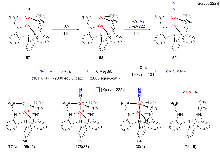
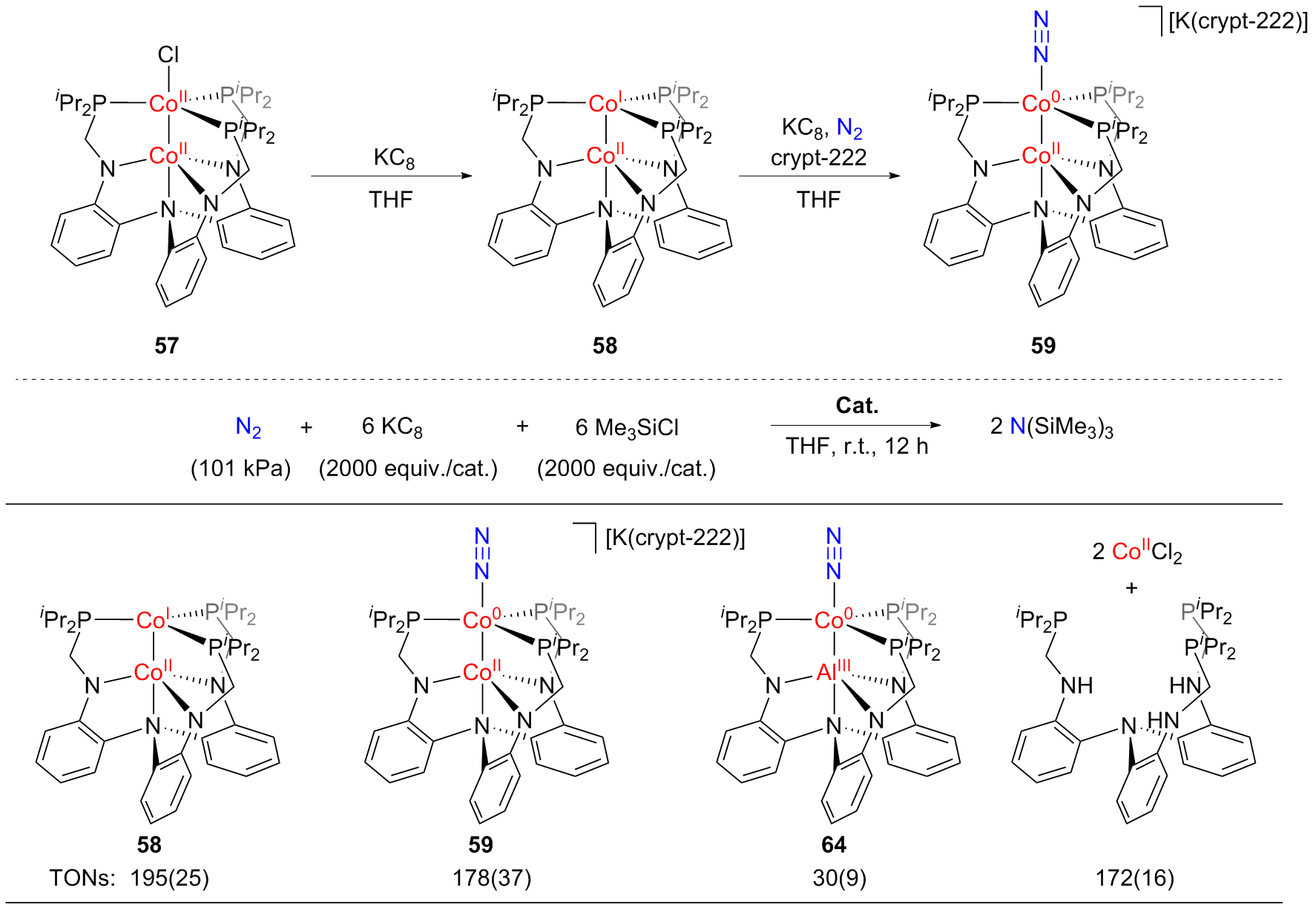
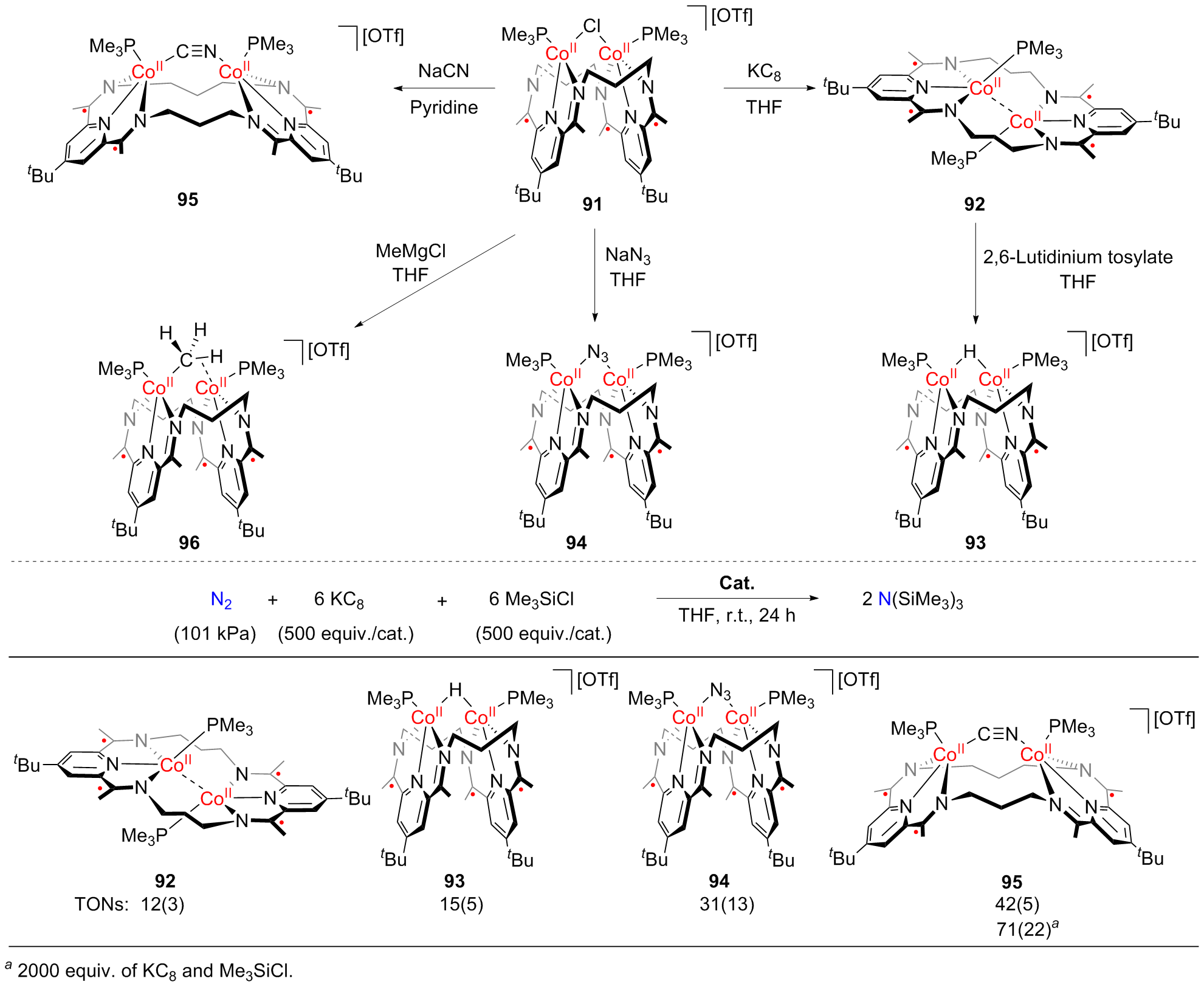
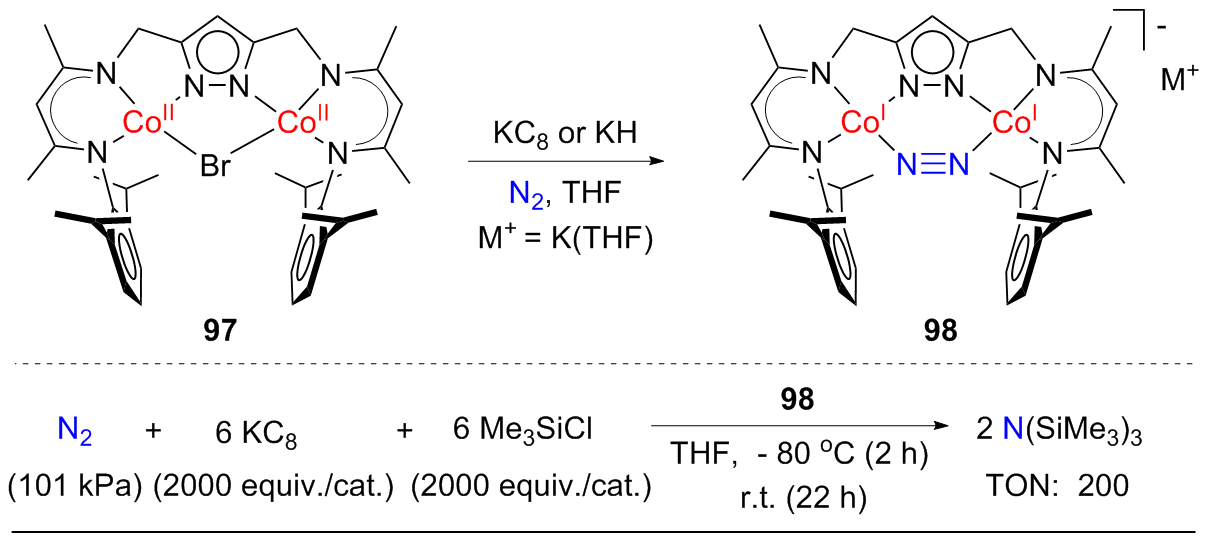
| Cobalt-N2 complex | Bond length d(N—N)/nm | IR ν(N—N)/cm-1 | TONa |
|---|---|---|---|
| | 0.1114(4) | 1994 | 178(37) |
| | 0.1124(3) 0.1125(3) | 2032 2009 | 240 |
| | 0.1138(3) | 2044 | 53 |
| | 0.1135(9) 0.1144(10) | 1901 | 200 |
| Cobalt-N2 complex | Bond length d(N—N)/nm | IR ν(N—N)/cm-1 | TONa |
|---|---|---|---|
| | 0.1114(4) | 1994 | 178(37) |
| | 0.1124(3) 0.1125(3) | 2032 2009 | 240 |
| | 0.1138(3) | 2044 | 53 |
| | 0.1135(9) 0.1144(10) | 1901 | 200 |
| [1] |
doi: 10.1038/nature06592 |
| [2] |
|
| [3] |
doi: 10.1007/BF01565394 |
| [4] |
|
| [5] |
|
| [6] |
doi: 10.1128/jb.27.4.325-340.1934 pmid: 16559703 |
| [7] |
doi: 10.1021/cr00106a002 |
| [8] |
doi: 10.1073/pnas.74.8.3249 |
| [9] |
pmid: 1529354 |
| [10] |
doi: 10.1021/ja805025w |
| [11] |
doi: 10.1038/nchem.1594 pmid: 23511421 |
| [12] |
|
| [13] |
doi: 10.1002/anie.v64.26 |
| [14] |
|
| [15] |
doi: 10.1021/acs.chemrev.9b00638 pmid: 32352271 |
| [16] |
doi: 10.1021/jacs.9b00822 |
| [17] |
doi: 10.1002/anie.v60.22 |
| [18] |
doi: 10.1021/jacs.1c11134 |
| [19] |
doi: 10.1021/jacs.2c01851 |
| [20] |
doi: 10.1021/jacs.2c01507 |
| [21] |
doi: 10.1021/jacs.2c08000 |
| [22] |
doi: 10.1021/jacs.2c13086 |
| [23] |
doi: 10.1021/jacs.3c00266 |
| [24] |
doi: 10.1021/jacs.3c08715 |
| [25] |
doi: 10.1021/jacs.4c02905 |
| [26] |
doi: 10.1021/acscatal.5c03731 |
| [27] |
doi: 10.1002/cjoc.v43.1 |
| [28] |
doi: 10.1021/jacs.5c15167 |
| [29] |
|
| [30] |
|
| [31] |
doi: 10.1002/chem.v21.24 |
| [32] |
|
| [33] |
doi: 10.1021/jacs.7b11660 |
| [34] |
doi: 10.1021/acscatal.7b04351 |
| [35] |
|
| [36] |
doi: 10.1021/acs.inorgchem.0c02332 |
| [37] |
doi: 10.31635/ccschem.021.202100945 |
| [38] |
doi: 10.1021/acs.inorgchem.2c00234 |
| [39] |
doi: 10.1016/j.cclet.2023.109292 |
| [40] |
doi: 10.1039/D4NJ00883A |
| [41] |
doi: 10.1039/D4DT02057J |
| [42] |
doi: 10.1021/acs.inorgchem.5c02069 |
| [43] |
doi: 10.1021/jacs.5b01445 pmid: 25799204 |
| [44] |
|
| [45] |
doi: 10.1021/jacs.1c01840 pmid: 33830763 |
| [46] |
doi: 10.1002/ange.v133.26 |
| [47] |
doi: 10.1002/chem.v28.67 |
| [48] |
doi: 10.1039/D2DT03320H |
| [49] |
doi: 10.1021/acs.inorgchem.2c04099 |
| [50] |
doi: 10.1021/acs.organomet.4c00156 pmid: 40726633 |
| [51] |
doi: 10.1021/jacsau.5c00129 |
| [52] |
doi: 10.1021/acs.inorgchem.5b00645 pmid: 26001022 |
| [53] |
doi: 10.1002/anie.v55.46 |
| [54] |
doi: 10.1002/anie.v64.25 |
| [55] |
doi: 10.1002/adsu.v9.9 |
| [56] |
doi: 10.1016/S1872-2067(21)63939-6 |
| [1] | Man Wu, Jie Yao, Yufu Fang, Weiyou Zhou, Junfeng Qian, Xuan Dai, Mingyang He. Efficient Synthesis of Quinazolines and Quinazolinones via Cascade Reactions over Heterogeneous CuMgMn Layered Double Hydroxide without Additives [J]. Chinese Journal of Organic Chemistry, 2026, 46(8): 3268-3275. |
| [2] | Lei Tang, Gang Zhao. Silver-Catalyzed Asymmetric Cycloaddition Reaction of Difluoro- methyl Containing Vinyl Indoles and Azodicarboxylates [J]. Chinese Journal of Organic Chemistry, 2026, 46(8): 3255-3267. |
| [3] | Fengsheng Huang, Pengfei Chen, Yufa Feng, Longqin Gu, Weiyou Zhou, Mingyang He, Xuan Dai. Cu(I)-Doped TiO2 for Oxidative Dehydrogenation of N-Heterocycles [J]. Chinese Journal of Organic Chemistry, 2026, 46(8): 3227-3236. |
| [4] | Xiaodong Liu, Yongle Chen, Yuwei Meng, Maorui Wang, Haitao Tang. Aryl Halides and Styrene Electrochemical Reduction Coupling Alkylation Reaction [J]. Chinese Journal of Organic Chemistry, 2026, 46(8): 3246-3254. |
| [5] | Rui Wu, Zhiquan Wu, Juan Zhang, Wenchao Gao, Yingxiong Wang, Honghong Chang. Research Progress in the Selective Catalytic Oxidation of Ethylene Glycol to Glycolic Acid [J]. Chinese Journal of Organic Chemistry, 2026, 46(8): 2969-2987. |
| [6] | Yinsong Han, Dongwei Wang, Jiayi Xiao, Ruokun Feng. Amide-Oxazoline-Directed Copper-Catalyzed C—H Acyloxylation of [2.2]Paracyclophanes [J]. Chinese Journal of Organic Chemistry, 2026, 46(8): 3147-3157. |
| [7] | Xiaoyu Zhu, Yiming Luo, Man Sun, Wenze Li. Recent Advances in Asymmetric Carbene Catalytic Reactions Mediated by Rhodium and Chiral Phosphoric Acid [J]. Chinese Journal of Organic Chemistry, 2026, 46(8): 2926-2948. |
| [8] | Qianxi Yi, Chenwei Liang, Yaohang Cheng, Guanghui An. Visible-Light-Mediated Ruthenium-Catalyzed para-Acylation and Difluoroalkylation of Aniline Derivatives [J]. Chinese Journal of Organic Chemistry, 2026, 46(8): 3276-3287. |
| [9] | Haoyu Zheng, Chuan-Ying Li, You-Yun Zhou. Progress on Transition-Metal-Catalyzed Asymmetric Synthesis of Chiral Tertiary Alkyl Ethers via C—O Bond Formation [J]. Chinese Journal of Organic Chemistry, 2026, 46(8): 2892-2925. |
| [10] | Lizhuo Wang, Xinyi Liu, Geyang Song, Xiaoli Shi, Dong Xue. Photoexcitation-Enabled C(sp2)—N Coupling of Aryl Halides with Sulfonamides Catalyzed by Earth-Abundant Nickel [J]. Chinese Journal of Organic Chemistry, 2026, 46(7): 2835-2852. |
| [11] | Fengkai Yu, Xianjin Zhu, Zihan Xu, Lingyu Shi, Yongjia Shi, Xufeng Li, Daoshan Yang. Copper-Catalyzed Three-Component Synthesis of Triazoles Containing Thioether Fragments [J]. Chinese Journal of Organic Chemistry, 2026, 46(7): 2825-2834. |
| [12] | Rutong Ren, Shichao Lu, Hongshuang Li. Earth-Abundant Cobalt-Catalyzed Alkene Hydroacylation [J]. Chinese Journal of Organic Chemistry, 2026, 46(7): 2701-2712. |
| [13] | Yingpeng Gao, Linjun Zhang, Jiyi Song, Pinyong Zhong, Jinbiao Liu. Catalytic Synthesis of 2-Aminobenz-1,3-oxazin-4-ketone by Copper-Catalyzed Desulfurization and Cyclization of 2-Aminobenzoic Acid and Isothiocyanate [J]. Chinese Journal of Organic Chemistry, 2026, 46(7): 2808-2815. |
| [14] | Song-Yao Chen, Xue Feng, Man-Su Tu, Wen-Juan Hao, Bo Jiang. Ni(II)/Bisimidazoline-Catalyzed Asymmetric Higher-Order (5+3) Annulation for the Construction of Saddle-Shaped Eight-Membered Bridged Biaryls with Concurrent Central and Axial Chirality [J]. Chinese Journal of Organic Chemistry, 2026, 46(7): 2796-2807. |
| [15] | Weiwen Ji, Ning Ye, Jian Jin. Ligand-Facilitated Ligand-to-Metal Charge Transfer-Driven Photoinduced Iron Catalysis [J]. Chinese Journal of Organic Chemistry, 2026, 46(7): 2683-2700. |
| Viewed | ||||||
|
Full text |
|
|||||
|
Abstract |
|
|||||
