

Chinese Journal of Organic Chemistry ›› 2026, Vol. 46 ›› Issue (2): 379-398.DOI: 10.6023/cjoc202507041 Previous Articles Next Articles
REVIEWS
郭峻烽, 李春迎*( ), 胡荣贵, 戎豪杰, 李江伟, 杜咏梅, 秦越, 吕剑*(), 孙道安*()
收稿日期:2025-10-03
修回日期:2025-10-16
发布日期:2025-11-12
通讯作者:
李春迎, 吕剑, 孙道安
基金资助:
Junfeng Guo, Chunying Li*(), Ronggui Hu, Haojie Rong, Jiangwei Li, Yongmei Du, Yue Qin, Jian* Lü*(), Dao'an Sun*()
Received:2025-10-03
Revised:2025-10-16
Published:2025-11-12
Contact:
Chunying Li, Jian* Lü, Dao'an Sun
Supported by:Share
Junfeng Guo, Chunying Li, Ronggui Hu, Haojie Rong, Jiangwei Li, Yongmei Du, Yue Qin, Jian* Lü, Dao'an Sun. Advances in the Construction Methods of Cyclopropane Skeleton and Their Applications[J]. Chinese Journal of Organic Chemistry, 2026, 46(2): 379-398.
| 年份 | 作者 | 内容 |
|---|---|---|
| 2018 | 唐功利 | 总结了天然产物中环丙烷官能团的化学合成与生物合成策略, 主要包括卡宾参与的环丙烷化、分子内SN2反应、环异构化以及生物合成等策略. |
| 2018 | Yury V. Tomilov | 主要聚焦于供体-受体环丙烷(Donor-acceptor cyclopropanes, DACs)的合成方法, 包括亲核烯烃与重氮化合物和碘叶立德的反应, 以及亲电烯烃与硫叶立德的反应(Corey-Chaykovsky反应). |
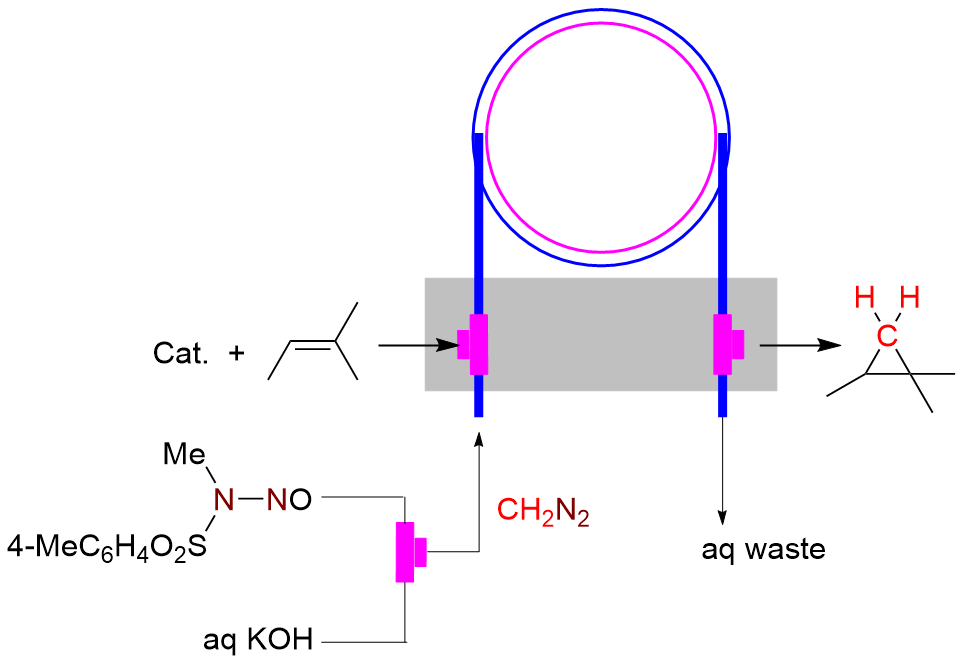
| 2021 | Yury V. Tomilov | 系统综述了重氮甲烷(CH₂N₂)催化环丙烷化的最新进展, 包括核心催化剂钯基催化剂(如Pd(OAc)2), 以及安全合成技术和原位生成法, 解决CH₂N₂爆炸性难题; 底物适用性: 单/双取代烯烃、多烯、杂环烯烃均可环丙烷化, 但三取代烯烃需过量CH₂N₂(产率≤50%); 局限性: 不对称环丙烷化效果差(ee<2%). |
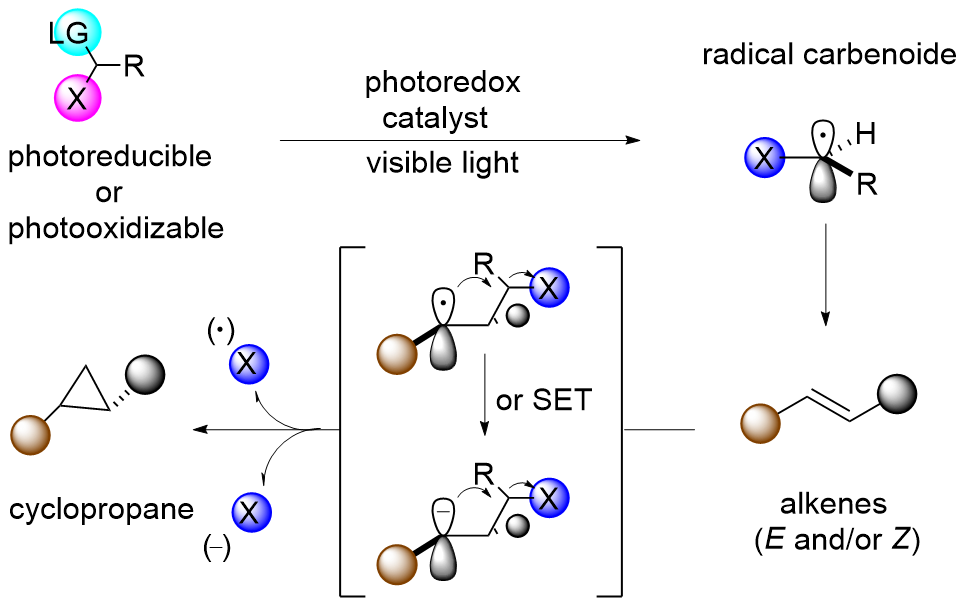
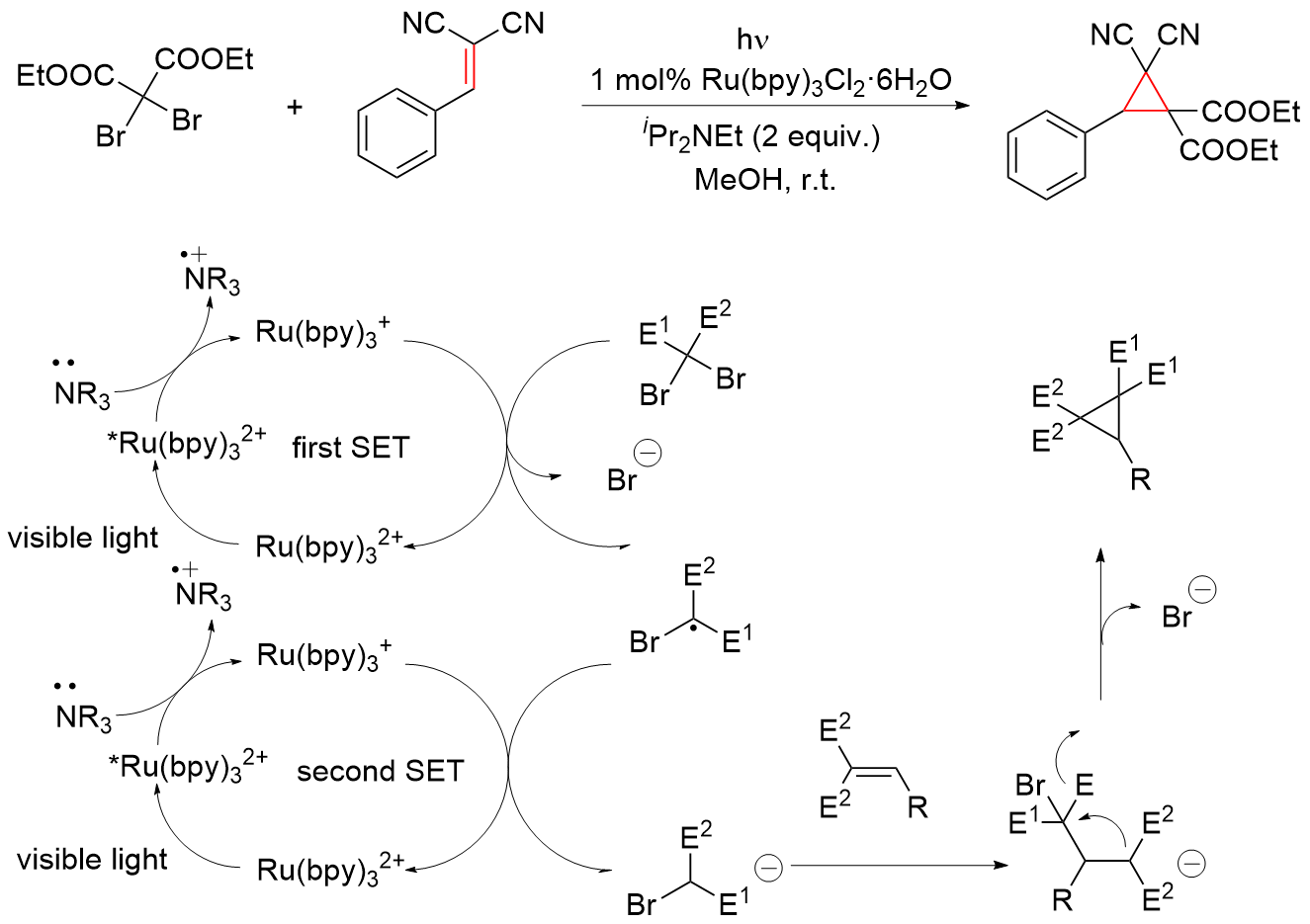
| 2019 | Marcos G. Suero | 总结了2017~2019年光氧化还原催化自由基类卡宾环丙烷化的突破性进展. |
| 2021 | 王也铭, 王自坤 | 总结了碘叶立德在有机合成中的研究进展, 其中涉及的环丙烷化反应主要包括金属催化、无金属催化(如PhI(OAc)₂/Bu₄NI体系)、光催化及无催化剂策略. |
| 年份 | 作者 | 内容 |
|---|---|---|
| 2018 | 唐功利 | 总结了天然产物中环丙烷官能团的化学合成与生物合成策略, 主要包括卡宾参与的环丙烷化、分子内SN2反应、环异构化以及生物合成等策略. |
| 2018 | Yury V. Tomilov | 主要聚焦于供体-受体环丙烷(Donor-acceptor cyclopropanes, DACs)的合成方法, 包括亲核烯烃与重氮化合物和碘叶立德的反应, 以及亲电烯烃与硫叶立德的反应(Corey-Chaykovsky反应). |
| 2021 | Yury V. Tomilov | 系统综述了重氮甲烷(CH₂N₂)催化环丙烷化的最新进展, 包括核心催化剂钯基催化剂(如Pd(OAc)2), 以及安全合成技术和原位生成法, 解决CH₂N₂爆炸性难题; 底物适用性: 单/双取代烯烃、多烯、杂环烯烃均可环丙烷化, 但三取代烯烃需过量CH₂N₂(产率≤50%); 局限性: 不对称环丙烷化效果差(ee<2%). |
| 2019 | Marcos G. Suero | 总结了2017~2019年光氧化还原催化自由基类卡宾环丙烷化的突破性进展. |
| 2021 | 王也铭, 王自坤 | 总结了碘叶立德在有机合成中的研究进展, 其中涉及的环丙烷化反应主要包括金属催化、无金属催化(如PhI(OAc)₂/Bu₄NI体系)、光催化及无催化剂策略. |
| 序号 | 底物 | 产物 | 相对反应速率 | ||
|---|---|---|---|---|---|
| Pd(OAc)2 | Pd(acac)2 | (Ph3P)2PdCl2 | |||
| 1 | | | 1 | 1 | 1 |
| 2 | | | 1.05 | 1.33 | 1.12 |
| 3 | | | 2.25 | 3.00 | 3.80 |
| 4 | | | 2.50 | 1.68 | 1.86 |
| 5 | | | 0.08a | 0.10 | — |
| 6 | | | 0.02 | 0.08 | 0.03 |
| 7 | | | ≈0.001 | ≈0.001 | <0.002 |
| 8 | | | 0.18 | 0.24 | 0.24 |
| 序号 | 底物 | 产物 | 相对反应速率 | ||
|---|---|---|---|---|---|
| Pd(OAc)2 | Pd(acac)2 | (Ph3P)2PdCl2 | |||
| 1 | | | 1 | 1 | 1 |
| 2 | | | 1.05 | 1.33 | 1.12 |
| 3 | | | 2.25 | 3.00 | 3.80 |
| 4 | | | 2.50 | 1.68 | 1.86 |
| 5 | | | 0.08a | 0.10 | — |
| 6 | | | 0.02 | 0.08 | 0.03 |
| 7 | | | ≈0.001 | ≈0.001 | <0.002 |
| 8 | | | 0.18 | 0.24 | 0.24 |







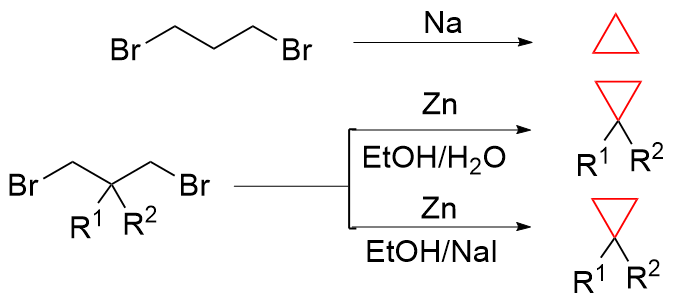




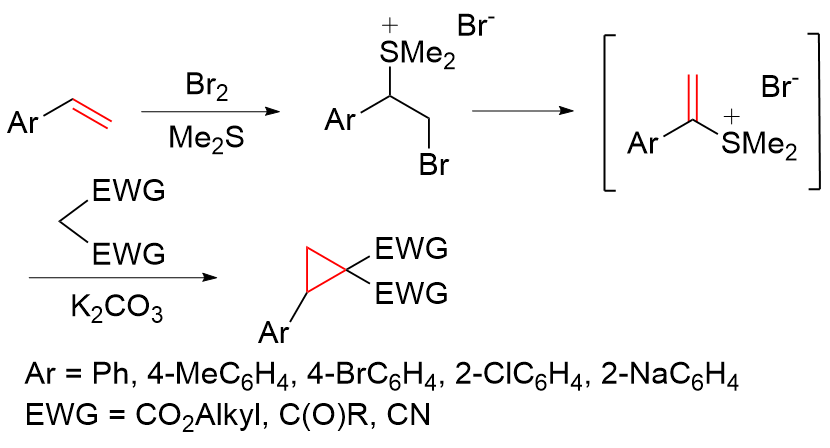
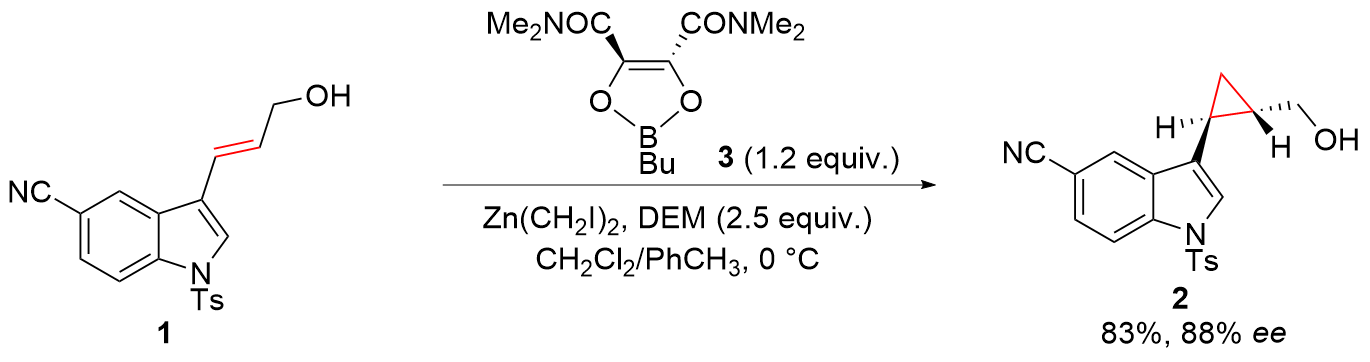
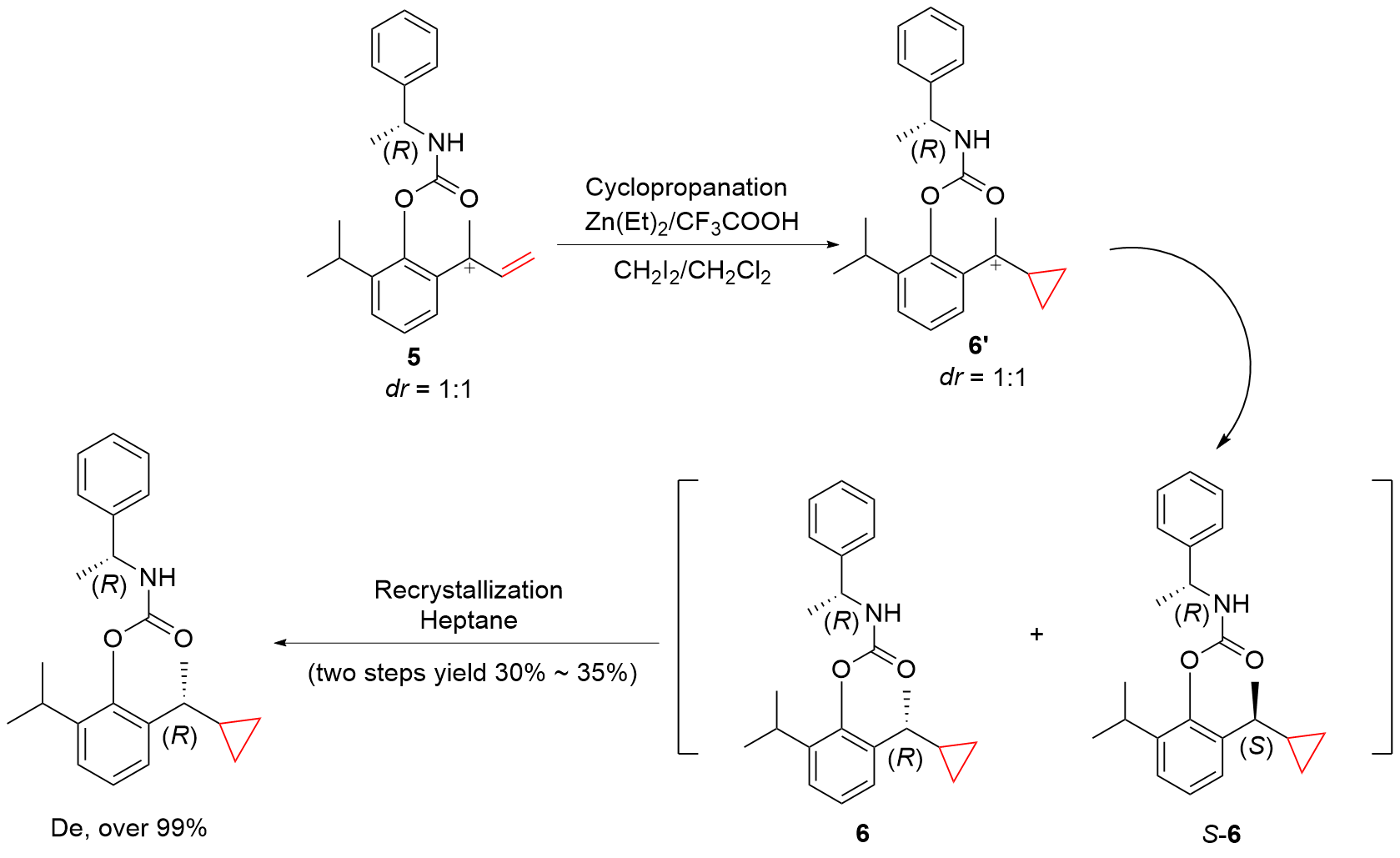





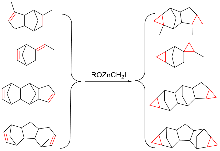
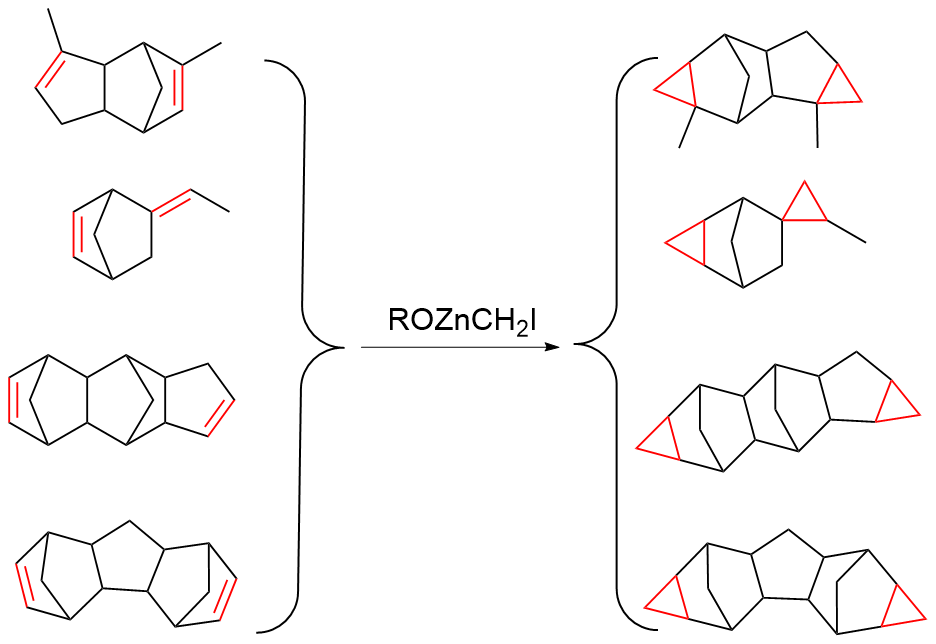
| [58] |
doi: 10.3390/molecules25132989 |
| [59] |
doi: 10.1038/nchembio.1278 pmid: 23792734 |
| [60] |
doi: 10.1002/anie.v54.6 |
| [61] |
doi: 10.1007/BF01516828 |
| [62] |
|
| [63] |
doi: 10.1021/ie50315a017 |
| [64] |
|
| [65] |
(a)
|
|
(b)
|
|
| [66] |
doi: 10.1016/j.tet.2008.11.060 |
| [67] |
doi: 10.1021/op700125z |
| [1] |
doi: 10.1070/RCR4982 |
| [2] |
doi: 10.3390/microorganisms12040706 |
| [3] |
doi: 10.1016/j.joule.2022.05.011 |
| [4] |
doi: 10.1021/acs.jmedchem.6b00472 |
| [5] |
|
| [6] |
doi: 10.1016/j.fuel.2024.132329 |
| [7] |
doi: 10.1016/j.fuel.2023.130342 |
| [68] |
doi: 10.1021/acs.oprd.1c00306 |
| [69] |
doi: 10.1021/op300059b |
| [70] |
doi: 10.1021/acs.oprd.3c00151 |
| [71] |
|
| [72] |
doi: 10.1021/acs.orglett.6b00814 pmid: 27105390 |
| [73] |
doi: 10.1021/ol3000124 pmid: 22304653 |
| [74] |
doi: 10.1002/anie.v54.38 |
| [75] |
doi: 10.1016/j.ces.2017.11.044 |
| [8] |
pmid: 12683792 |
| [9] |
doi: 10.6023/cjoc201805059 |
|
(金文兵, 袁华, 唐功利, 有机化学, 2018, 38, 2324.)
doi: 10.6023/cjoc201805059 |
|
| [10] |
doi: 10.1039/c2ob26082d |
| [11] |
doi: 10.1070/RCR4787 |
| [12] |
|
| [13] |
doi: 10.1055/s-0037-1611872 |
| [14] |
doi: 10.1021/acs.orglett.8b02968 pmid: 30350660 |
| [15] |
doi: 10.1126/science.adg3209 |
| [16] |
doi: 10.1016/j.fuel.2023.129380 |
| [76] |
doi: 10.3390/molecules28217361 |
| [77] |
doi: 10.1007/s12209-020-00273-5 |
| [78] |
doi: 10.1016/j.fuproc.2021.107056 |
| [79] |
(a)
|
|
(b)
doi: 10.1039/C0SC00500B |
|
| [80] |
doi: 10.1016/j.fuproc.2020.106339 |
| [81] |
|
| [17] |
|
| [18] |
doi: 10.1016/j.fuel.2021.121906 |
| [19] |
|
|
(严国兵, 匡春香, 彭程, 王剑波, 有机化学, 2009, 29, 813.)
|
|
| [20] |
|
|
(朱利民, 有机化学, 1991, 11, 437.)
|
|
| [21] |
doi: 10.1039/CT9068900172 |
| [22] |
|
| [23] |
doi: 10.1016/S0040-4039(01)99630-3 |
| [24] |
doi: 10.1021/acscentsci.5c00245 |
| [25] |
|
| [26] |
doi: 10.1070/MC1992v002n01ABEH000099 |
| [27] |
doi: 10.1007/BF00863821 |
| [28] |
doi: 10.1070/RC1993v062n09ABEH000048 |
| [29] |
(a)
doi: 10.1021/acs.chemrev.6b00798 |
|
(b)
doi: 10.1021/ja01652a087 |
|
| [30] |
(a)
doi: 10.1039/c5ob01088h pmid: 26173173 |
|
(b)
pmid: 26173173 |
|
| [31] |
(a)
doi: 10.1002/anie.v59.40 pmid: 14986957 |
|
(b)
doi: 10.1021/ja9900454 pmid: 14986957 |
|
|
(c)
pmid: 14986957 |
|
|
(d)
doi: 10.1021/jo990972t pmid: 14986957 |
|
|
(e)
pmid: 14986957 |
|
|
(f)
pmid: 14986957 |
|
|
(g)
doi: 10.1016/j.tet.2007.05.124 pmid: 14986957 |
|
|
(h)
doi: 10.1007/BF02494639 pmid: 14986957 |
|
|
(i)
doi: 10.1038/s41467-024-48085-8 pmid: 14986957 |
|
|
(j)
doi: 10.1038/s41929-022-00881-5 pmid: 14986957 |
|
|
(k)
doi: 10.1021/acscatal.6b01914 pmid: 14986957 |
|
|
(l)
doi: 10.1021/acs.joc.4c01748 pmid: 14986957 |
|
|
(m)
doi: 10.1002/chem.v21.40 pmid: 14986957 |
|
| [32] |
(a)
pmid: 12848581 |
|
(b)
doi: 10.1021/ja01552a080 pmid: 12848581 |
|
| [33] |
|
| [34] |
|
| [35] |
doi: 10.1016/S0040-4039(00)87443-2 |
| [36] |
doi: 10.1016/j.ces.2023.119366 |
| [37] |
(a)
doi: 10.1021/ja00864a040 |
|
(b)
|
|
|
(c)
doi: 10.1021/jo034710+ |
|
| [38] |
doi: 10.1021/op500263m |
| [39] |
|
| [40] |
|
| [41] |
|
| [42] |
doi: 10.6023/cjoc202006021 |
|
(仝明慧, 张欣宇, 王也铭, 王自坤, 有机化学, 2021, 41, 126.)
doi: 10.6023/cjoc202006021 |
|
| [43] |
doi: 10.1021/jo802208q |
| [44] |
doi: 10.1039/C7CC04859A |
| [45] |
doi: 10.1002/ajoc.v7.10 |
| [46] |
doi: 10.1002/anie.v58.47 |
| [47] |
doi: 10.1088/0305-4470/39/19/S09 |
| [48] |
doi: 10.1002/anie.v43:35 |
| [49] |
doi: 10.1021/ar800108z |
| [50] |
|
| [51] |
doi: 10.6023/cjoc202206058 |
|
(李森, 周磊, 有机化学, 2022, 42, 3944.)
doi: 10.6023/cjoc202206058 |
|
| [52] |
(a)
doi: 10.1021/acs.orglett.7b01095 |
|
(b)
doi: 10.1038/s41467-018-04331-4 |
|
| [53] |
doi: 10.1016/j.tetlet.2015.10.012 |
| [54] |
doi: 10.1002/anie.v57.41 |
| [55] |
doi: 10.1021/jacs.1c12762 |
| [56] |
|
| [57] |
doi: 10.1021/acscentsci.6b00391 |
| [82] |
doi: 10.1039/D4RA01816H |
| [1] | Jinyu Zhang, Zhigang Lu, Zhe Liu, Cong Wang. Transition Metal-Catalyzed Hydrosilylation and Boration of Methylenecyclopropanes [J]. Chinese Journal of Organic Chemistry, 2026, 46(3): 806-816. |
| [2] | Yuhan Zhao, Huimin Ma, Shulin Ge, Lingbin Kong. Iodine-Catalyzed Intermolecular Cyclopropanation of Olefins with Active Methylene Compounds [J]. Chinese Journal of Organic Chemistry, 2025, 45(9): 3469-3477. |
| [3] | Yin Zhang, Rui Zhang, Wenjuan Li. Ring Opening Reaction between Donor Acceptor (D-A) Cyclopropane and β-Aminketone [J]. Chinese Journal of Organic Chemistry, 2025, 45(7): 2469-2479. |
| [4] | Lin Che, Zhong-Tao Jiang, Hui Yang, Fangdong Hu, Ying Xia. Transition-Metal Free Synthesis of Cyclopropanone Ketals via Double Defluorinative Alkoxylation of gem-Difluorinated Cyclopropanes [J]. Chinese Journal of Organic Chemistry, 2025, 45(6): 2222-2230. |
| [5] | Ying Xie, Shaomin Fu, Bo Liu. Application of Acyl Radical in Total Synthesis of Natural Products [J]. Chinese Journal of Organic Chemistry, 2025, 45(3): 852-861. |
| [6] | Haikang Mao, Jing Xu. Recent Progress in the Total Synthesis of Daphniphyllum Alkaloids [J]. Chinese Journal of Organic Chemistry, 2025, 45(3): 866-880. |
| [7] | Xiaonan Mu, Minhui Guan, Yulong Niu, Hao Chen, Chuanying Li, Lei Wang. Synthesis of Difluorocyclopropanes via a Photoinduced [1+2] Cycloaddition of Diazo Esters with gem-Difluoroalkenes [J]. Chinese Journal of Organic Chemistry, 2025, 45(1): 256-266. |
| [8] | Yuxuan Yan, Wanqing Lu, Huijun Qian, Leiyang Lv, Zhiping Li. Pd-Catalyzed Ring-Opening of gem-Difluorocyclopropanes for the Mono- and Bis-fluoroallylation of 1,3-Dicarbonyls [J]. Chinese Journal of Organic Chemistry, 2024, 44(5): 1630-1640. |
| [9] | Tianfeng Peng, Yuxiang Zhao, Shaojian Pu, Juan Luo, Teng Liu, Yingchun Miao, Xianfu Shen. Recent Advances in Total Synthesis of Prenylated Indole Alkaloids by Transition Metal-Catalyzed Reactions as the Key Step [J]. Chinese Journal of Organic Chemistry, 2024, 44(4): 1160-1180. |
| [10] | Jinshao Liang, Lihong Ruan, Xurong Shi, Yinzhi Chen, Chuhuang Song, Jun'an Xiao, Zhiping Liu. Mechanochemistry Enabled Friedel-Crafts Alkylation Reactions of Donor-Acceptor Cyclopropanes with 2-Indolymethanols [J]. Chinese Journal of Organic Chemistry, 2024, 44(11): 3437-3445. |
| [11] | Xiurong Wu, Chaojiang Xiao, Yi Shen, Hongxia Tang, Junyi Zhu, Bei Jiang. Research Progress on Antimalarial Natural Sesquiterpenoids from Plants from 1972 to 2022 [J]. Chinese Journal of Organic Chemistry, 2023, 43(8): 2764-2789. |
| [12] | Zhipeng Liang, Hao Ye, Haibin Zhang, Guomin Jiang, Xinxing Wu. Ring Opening Amination of gem-Difluorocyclopropanes with Cyclobutanone Hydrazones [J]. Chinese Journal of Organic Chemistry, 2023, 43(4): 1483-1491. |
| [13] | Yueling Liu, Xinxin Zhong, Ganbing Zhang. Density Functional Theory Study for Exploring the Mechanisms of the [3+2] Cycloaddition Reactions between 1-R-3-Phenylpropylidenecyclopropane (R=Me/H) and Furfural Catalyzed by Pd(0) [J]. Chinese Journal of Organic Chemistry, 2023, 43(2): 660-667. |
| [14] | Ran Gao, Weisheng Tian. Synthesis of Azedarachol and 2α,3α,20R-Trihydroxypregnane-16β-methacrylate [J]. Chinese Journal of Organic Chemistry, 2022, 42(8): 2521-2526. |
| [15] | Fasheng Shi, Shengwen Wang, Huan Xu, Xingxing Lu, Xinling Yang, Tengda Sun, Changkai Wang, Xiaoming Zhang, Qing Yang, Yun Ling. Design, Synthesis and Fungicidal Actiνity of Noνel Thiosemicarbazide Compounds [J]. Chinese Journal of Organic Chemistry, 2022, 42(7): 2106-2116. |
| Viewed | ||||||
|
Full text |
|
|||||
|
Abstract |
|
|||||
