

Chinese Journal of Organic Chemistry ›› 2026, Vol. 46 ›› Issue (9): 3646-3658.DOI: 10.6023/cjoc202605029 Previous Articles Next Articles
ARTICLE
陈金权, 黄培强*( )
)
收稿日期:2026-05-29
修回日期:2026-07-07
发布日期:2026-07-23
通讯作者:
黄培强
基金资助:
Jinquan Chen, Peiqiang Huang*()
Received:2026-05-29
Revised:2026-07-07
Published:2026-07-23
Contact:
Peiqiang Huang
About author:Dedicated to the 100th anniversary of the birth of Professor Xikui Jiang.
Supported by:Share
Jinquan Chen, Peiqiang Huang. Application of Amide Reductive Alkynylation and Reductive Alkylation in the Rapid Synthesis of Schwarzinicines A~C and Ficusnotins B, F[J]. Chinese Journal of Organic Chemistry, 2026, 46(9): 3646-3658.
| Compound source | Schwarzinicine A | Schwarzinicine B | Schwarzinicine C |
|---|---|---|---|
| Natural product [ | ${[\alpha ]}_{\text{D}}^{\text{25}}$+2 (c 1.17, CHCl3) er=1∶4 tR(minor)=8.796 min tR(major)=9.779 min | ${[\alpha ]}_{\text{D}}^{\text{25}}$+20 (c 1.01, CHCl3) enantiomerically pure (R)-Schwarzinicine B tR(major)=6.908 min | ${[\alpha ]}_{\text{D}}^{\text{25}}$-7 (c 0.48, CHCl3) er (unreported) (R)-Schwarzinicine C (major enantiomer) tR(major)=7.468 min tR(minor)≈8.5 min (data read from its HPLC diagram) |
| Our synthetic productb | (R)-Schwarzinicine A (major enantiomer) ${[\alpha ]}_{\text{D}}^{\text{25}}$-6.6 (c 1, CHCl3) er=2.4∶ 1 tR(major)=9.946 min tR(minor)=10.859 min | (R)-Schwarzinicine B (major enantiomer) ${[\alpha ]}_{\text{D}}^{\text{25}}$+8.4 (c 1, CHCl3) er=2∶1 tR(major)=10.314 tR(minor)=11.599 | (R)-Schwarzinicine C (major enantiomer) ${[\alpha ]}_{\text{D}}^{\text{25}}$-6.1 (c 1, CHCl3) er=2.4∶1 tR(major)=20.005 min tR(minor)=23.527 min |
| Enantiopure enantiomer obtained via resolution of synthetic product[ | ${[\alpha ]}_{\text{D}}^{\text{25}}$-11 (c 0.17, CHCl3), tR=9.1 min ${[\alpha ]}_{\text{D}}^{\text{25}}$+11 (c 0.25, CHCl3), tR=10.1 min | ||
| Deng’s asymmetric synthetic productc | ${[\alpha ]}_{\text{D}}^{\text{25}}$+1.4 (c 1, CH2Cl2), 99% ee tR(minor)=10.85 min tR(major)=11.64 min | ${[\alpha ]}_{\text{D}}^{\text{25}}$=+1.8 (c 1, CH2Cl2), 98% ee tR(minor)=8.83 min tR(major)=9.75 min |
| Compound source | Schwarzinicine A | Schwarzinicine B | Schwarzinicine C |
|---|---|---|---|
| Natural product [ | ${[\alpha ]}_{\text{D}}^{\text{25}}$+2 (c 1.17, CHCl3) er=1∶4 tR(minor)=8.796 min tR(major)=9.779 min | ${[\alpha ]}_{\text{D}}^{\text{25}}$+20 (c 1.01, CHCl3) enantiomerically pure (R)-Schwarzinicine B tR(major)=6.908 min | ${[\alpha ]}_{\text{D}}^{\text{25}}$-7 (c 0.48, CHCl3) er (unreported) (R)-Schwarzinicine C (major enantiomer) tR(major)=7.468 min tR(minor)≈8.5 min (data read from its HPLC diagram) |
| Our synthetic productb | (R)-Schwarzinicine A (major enantiomer) ${[\alpha ]}_{\text{D}}^{\text{25}}$-6.6 (c 1, CHCl3) er=2.4∶ 1 tR(major)=9.946 min tR(minor)=10.859 min | (R)-Schwarzinicine B (major enantiomer) ${[\alpha ]}_{\text{D}}^{\text{25}}$+8.4 (c 1, CHCl3) er=2∶1 tR(major)=10.314 tR(minor)=11.599 | (R)-Schwarzinicine C (major enantiomer) ${[\alpha ]}_{\text{D}}^{\text{25}}$-6.1 (c 1, CHCl3) er=2.4∶1 tR(major)=20.005 min tR(minor)=23.527 min |
| Enantiopure enantiomer obtained via resolution of synthetic product[ | ${[\alpha ]}_{\text{D}}^{\text{25}}$-11 (c 0.17, CHCl3), tR=9.1 min ${[\alpha ]}_{\text{D}}^{\text{25}}$+11 (c 0.25, CHCl3), tR=10.1 min | ||
| Deng’s asymmetric synthetic productc | ${[\alpha ]}_{\text{D}}^{\text{25}}$+1.4 (c 1, CH2Cl2), 99% ee tR(minor)=10.85 min tR(major)=11.64 min | ${[\alpha ]}_{\text{D}}^{\text{25}}$=+1.8 (c 1, CH2Cl2), 98% ee tR(minor)=8.83 min tR(major)=9.75 min |
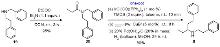
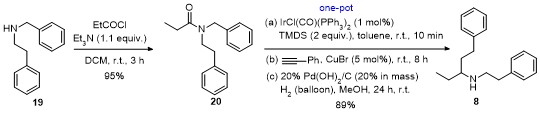
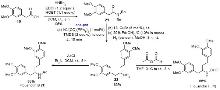
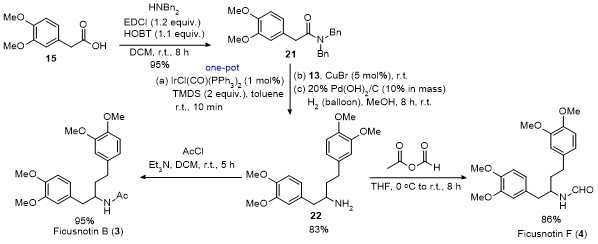
| [1] |
(a)
doi: 10.1021/np0580560 |
|
(b)
doi: 10.1021/acs.jmedchem.4c01122 |
|
| [2] |
(a)
doi: 10.6023/cjoc202509025 pmid: 32064858 |
|
(赵子鸣, 郑剑峰, 黄培强, 有机化学, 2026, 46, 1984.)
doi: 10.6023/cjoc202509025 pmid: 32064858 |
|
|
(b)
doi: 10.1039/D5QO01507C pmid: 32064858 |
|
|
(c)
doi: 10.1039/D5CC04974A pmid: 32064858 |
|
|
(d)
doi: 10.1039/D4QO02078B pmid: 32064858 |
|
|
(e)
doi: 10.6023/cjoc202406050 pmid: 32064858 |
|
|
(杨俊峰, 赵艳秋, 时磊, 有机化学, 2025, 45, 559.)
doi: 10.6023/cjoc202406050 pmid: 32064858 |
|
|
(f)
doi: 10.6023/cjoc202404040 pmid: 32064858 |
|
|
(张腾飞, 常喆, 陈春霞, 彭进松, 有机化学, 2025, 45, 168.)
doi: 10.6023/cjoc202404040 pmid: 32064858 |
|
|
(g)
doi: 10.1039/D4QO00324A pmid: 32064858 |
|
|
(h)
doi: 10.1021/acs.chemrev.2c00482 pmid: 32064858 |
|
|
(i)
pmid: 32064858 |
|
|
(j)
doi: 10.1021/acs.chemrev.9b00462 pmid: 32064858 |
|
|
For selected recent examples, see:(k)
doi: 10.1126/science.adu3996 pmid: 32064858 |
|
|
(l)
doi: 10.1002/anie.v64.12 pmid: 32064858 |
|
|
(m)
doi: 10.1007/s11426-023-1882-5 pmid: 32064858 |
|
| [3] |
(a)
doi: 10.1002/adsc.v356.18 |
|
(b)
doi: 10.1039/c4ob00389f |
|
|
(c)
doi: 10.1039/C8OB00733K |
|
|
(d)
doi: 10.1039/C8CS00335A |
|
|
(e)
doi: 10.1021/acscatal.0c02377 |
|
|
(f)
doi: 10.1016/j.trechm.2020.07.001 |
|
|
(g)
doi: 10.3389/fchem.2021.655849 |
|
|
(h)
doi: 10.1021/acs.accounts.5c00366 |
|
| [4] |
(a)
pmid: 37995236 |
|
(b)
doi: 10.1126/science.adk2312 pmid: 37995236 |
|
|
(c)
doi: 10.1126/science.adk1001 pmid: 37995236 |
|
|
(d)
doi: 10.1038/s41586-021-03447-w pmid: 37995236 |
|
|
(e)
doi: 10.1126/science.aaz3855 pmid: 37995236 |
|
|
(f)
doi: 10.1126/science.aap7503 pmid: 37995236 |
|
|
(g)
doi: 10.1038/nature19811 pmid: 37995236 |
|
|
(h)
doi: 10.1039/D5CC05328E pmid: 37995236 |
|
|
(i)
doi: 10.3762/bjoc.21.162 pmid: 37995236 |
|
| [5] |
(a)
doi: 10.6023/A18020054 |
|
(黄培强, 化学学报, 2018, 76, 357.)
doi: 10.6023/A18020054 |
|
|
(b)
doi: 10.1021/ja9939284 |
|
| [6] |
(a) Efficiency in Natural Product Total Synthesis, Eds.: Huang, P.-Q.; Yao, Z.-J.; Hsung, R. P., Wiley, Hoboken, NJ, 2018.
pmid: 19847337 |
|
(b)
doi: 10.6023/A25070247 pmid: 19847337 |
|
|
(赵雅宸, 俞飚, 化学学报, 2025, 83, 1397.)
doi: 10.6023/A25070247 pmid: 19847337 |
|
|
(c)
doi: 10.1021/acs.accounts.4c00654 pmid: 19847337 |
|
|
(d)
doi: 10.1021/acs.accounts.0c00727 pmid: 19847337 |
|
|
(e)
doi: 10.1039/b821200g pmid: 19847337 |
|
|
(f)
doi: 10.1021/ar700155p pmid: 19847337 |
|
|
(g)
doi: 10.1038/nature07543 pmid: 19847337 |
|
| [7] |
(a)
doi: 10.1002/anie.v49:17 |
|
(b)
doi: 10.1002/chem.v16.43 |
|
|
(c)
doi: 10.1039/C6CC05318A |
|
|
(d)
doi: 10.1002/anie.v57.35 |
|
|
(e)
doi: 10.1039/D2QO00335J |
|
|
(f)
doi: 10.1038/s41467-023-41846-x |
|
|
(g)
doi: 10.1002/chem.v32.22 |
|
|
(h)
doi: 10.6023/A25120419 |
|
|
(卢广生, 韩增, 叶剑良, 黄培强, 化学学报, 2026, 84, 476.)
doi: 10.6023/A25120419 |
|
|
(i)
doi: 10.31635/ccschem.025.202506810 |
|
| [8] |
(a)
doi: 10.6023/cjoc202408032 |
|
(徐业鹏, 阮义, 郑剑峰, 黄培强, 有机化学, 2025, 45, 988.)
doi: 10.6023/cjoc202408032 |
|
|
(b)
doi: 10.1038/s41467-020-19163-4 |
|
| [9] |
(a)
doi: 10.1002/anie.v63.14 |
|
(b)
doi: 10.1021/acs.joc.3c02366 |
|
|
(c)
doi: 10.1021/jacs.2c02795 |
|
|
(d)
doi: 10.1021/acs.joc.2c00131 |
|
|
(e)
doi: 10.1055/s-0041-1737276 |
|
|
(f)
doi: 10.3390/molecules27154698 |
|
|
(g)
doi: 10.1055/s-00000084 |
|
|
(h)
doi: 10.1021/ol103050c |
|
| [10] |
doi: 10.1016/j.phytochem.2017.05.016 |
| [11] |
doi: 10.1021/acs.jnatprod.9b01160 |
| [12] |
(a)
doi: 10.1248/cpb.7.648 |
|
(b)
|
|
| [13] |
(a)
doi: 10.1002/ptr.v36.7 |
|
(b)
|
|
| [14] |
(a)
doi: 10.1080/14786419.2021.1903005 |
|
(b)
doi: 10.1021/acs.jnatprod.3c00707 |
|
|
(c)
doi: 10.1016/j.phytol.2023.11.007 |
|
| [15] |
doi: 10.1021/acs.jmedchem.4c02736 pmid: 39629819 |
| [16] |
doi: 10.1016/j.tet.2024.133909 |
| [17] |
doi: 10.1021/acscatal.5c04633 |
| [18] |
doi: 10.1021/acscatal.3c04269 |
| [19] |
|
| [20] |
|
| [21] |
|
| [22] |
|
| [23] |
doi: 10.1248/cpb.7.589 |
| [1] | Zelin Liu, Siquan He, Abudurexiti Adila, Zhong Jin. Concise Total Synthesis of (–)-Galanthamine: An Efficient Base-Promoted Lactamization Strategy [J]. Chinese Journal of Organic Chemistry, 2026, 46(6): 2423-2430. |
| [2] | Xueqian Wang, Baozhong Duan, Hongchang Tian, Lei Zhang. Research Progress in Synthesis of Indole Alkaloid Catharanthine [J]. Chinese Journal of Organic Chemistry, 2026, 46(3): 725-742. |
| [3] | Wenfu Cheng, Minghao Zhao, Yuchen Yang, Lijia Wang. The First Total Synthesis of N-Methyl Pratensilin B [J]. Chinese Journal of Organic Chemistry, 2026, 46(2): 670-677. |
| [4] | Weigang He, Mingyue Duan, Shuai Yan, Weijie Ye, Xueyuan Xu, Xianyu Sun. Progress in the Total Synthesis of the Kopsia Alkaloids Arboridinine and Arborisidine [J]. Chinese Journal of Organic Chemistry, 2026, 46(2): 443-454. |
| [5] | Junfeng Guo, Chunying Li, Ronggui Hu, Haojie Rong, Jiangwei Li, Yongmei Du, Yue Qin, Jian* Lü, Dao'an Sun. Advances in the Construction Methods of Cyclopropane Skeleton and Their Applications [J]. Chinese Journal of Organic Chemistry, 2026, 46(2): 379-398. |
| [6] | Lilin Zhao, Zhaoqi Li, Liping Zhong, Long Min. Recent Progress in the Total Synthesis of abeo-Steroids [J]. Chinese Journal of Organic Chemistry, 2026, 46(1): 21-38. |
| [7] | Xinyi Cui, Lifan Guo, Congxuan Ma, Yun Li, Jianhua Liang. Structural Modifications, Structure-Activity Relationships, and Total Synthesis Advances in Erythromycin Analogs against Resistant Pathogens [J]. Chinese Journal of Organic Chemistry, 2026, 46(1): 39-73. |
| [8] | Qianqian Zhao, Peiyao Wei, Sundian Liu, Boxin Zhang, Chengyuan Liang. Applications of Palladium-Catalyzed Cascade Reactions in Total Synthesis of Complex Natural Products with Quaternary Carbon Centers [J]. Chinese Journal of Organic Chemistry, 2025, 45(9): 3289-3300. |
| [9] | Ying Xia, Chenlong Zhu, Bingfeng Sun. Progress in Total Synthesis of Entecavir, an Antiviral Drug for Hepatitis B★ [J]. Chinese Journal of Organic Chemistry, 2025, 45(9): 3186-3202. |
| [10] | Xiaoyu Liu, Tingrui Xu, Yong Qin. Recent Progress in the Total Synthesis of Morphine Alkaloids★ [J]. Chinese Journal of Organic Chemistry, 2025, 45(9): 3098-3112. |
| [11] | Baichuan Mo, Tingting Li, Fang Wang, Xiaojie Li, Darifu Ba. Recent Progress in the Synthesis of Carbazolequinone Natural Products [J]. Chinese Journal of Organic Chemistry, 2025, 45(8): 2746-2766. |
| [12] | Yiming Ding, Tingrong Zhang, Jingwei Zhang, Jun Deng. Progress in the Total Synthesis of Cephalotane Diterpenoid Natural Products [J]. Chinese Journal of Organic Chemistry, 2025, 45(6): 2048-2073. |
| [13] | Weigang He, Yadong Liu, Yingkai Deng, Xianyu Sun. Recent Progress in the Synthesis of the Malagasy Alkaloids [J]. Chinese Journal of Organic Chemistry, 2025, 45(4): 1153-1165. |
| [14] | Jiuzhou Yi, Liang Huo, Jinyan Chen, Meng Liu, Huilin Li, Xuegong She. Protecting Group Effects on the Total Syntheses of Several Classes of Natural Products [J]. Chinese Journal of Organic Chemistry, 2025, 45(3): 1030-1039. |
| [15] | Jie Chen, Jun Li, Xianwen Long, Haixiang Shen, Jun Deng. Recent Advances of Wagner-Meerwein Rearrangement in Natural Product Synthesis [J]. Chinese Journal of Organic Chemistry, 2025, 45(3): 896-912. |
| Viewed | ||||||
|
Full text |
|
|||||
|
Abstract |
|
|||||
