

化学学报 ›› 2025, Vol. 83 ›› Issue (9): 1072-1088.DOI: 10.6023/A25050163 上一篇 下一篇
综述
徐亦璞a,b, 徐舒涛b,*( ), 魏迎旭b, 阎子峰a,*(), 刘中民b
投稿日期:2025-05-12
发布日期:2025-07-04
作者简介: |
徐亦璞, 中国石油大学(华东)重质油全国重点实验室博士生, 中国科学院大连化学物理研究所联合培养博士生. 本科毕业于中国石油大学(华东)化学化工学院. 主要研究方向为多级孔沸石的合成及催化应用和沸石催化剂的扩散及动力学. |
 |
| 徐舒涛, 中国科学院大连化学物理研究所研究员, 优青. 2004年本科毕业于复旦大学化学系, 2010年博士毕业于中国科学院大连化学物理研究所. 现为大连化学物理研究所低碳催化技术国家工程研究中心科研骨干. 2016年获第16届国际催化大会青年科学家奖, 2020年获国家自然科学基金委优秀青年基金资助, 2023年获中国化学会分子筛青年奖. 主要研究方向为原位固体核磁谱学技术在分子筛催化中的应用. |
 |
| 魏迎旭, 中国科学院大连化学物理研究所研究员. 1993年于上海交通大学获得学士学位, 2001年于中国科学院大连化学物理研究获得博士学位, 毕业后在中国科学院大连化学物理研究所工作, 期间于2003~2004年赴比利时Namur大学进行博士后研究. 现为低碳催化技术国家工程研究中心研究员, 催化反应机理和新反应探索研究组组长. 从事分子筛催化、甲醇制烯烃、烷烃转化及二氧化碳耦合烷烃转化制高值化学品的基础和应用研究. 入选科技部创新人才推进计划中青年科技创新领军人才、大连化学物理研究所首席研究员及张大煜优秀学者等. |
 |
| 阎子峰, 中国石油大学(华东)重质油全国重点实验室教授. 于兰州大学化学系获得学士、硕士学位, 于中国科学院兰州化学物理研究所获得博士学位. 目前为中国石油大学(华东)二级教授, 同时兼任中国化学会催化委员会委员、中国化学会分子筛委员会委员、中国化工学会理事及山东省化学化工学会常务理事兼催化专业委员会主任委员. 二十多年来, 主持承担30余项国家/山东省重点研发项目、国家自然科学基金重点项目等国家、省部级重大研究课题和攻关项目, 承担5项与Shell、KACST等的国际合作项目, 先后实现多项技术的工业化. 主要研究方向为催化材料与催化剂的结构设计、定向合成及催化应用, 新型电极材料及新能源领域应用研究. |
 |
| 刘中民, 中国工程院院士, 中国科学院大连化学物理研究所所长、低碳催化技术国家工程研究中心主任、国家能源低碳催化与工程研发中心主任. 1983年于郑州大学获得学士学位, 1986年于中国科学院大连化学物理研究所获得硕士学位业, 1990年在中国科学院大连化学物理研究所获得博士学位, 1996年3月至1996年10月, 在法国科研中心CNRS418 (Montpellier)开展博士后工作. 刘中民院士长期从事应用催化研究, 作为技术总负责人合作完成了多项创新成果并实现产业化. 完成了世界首次甲醇制烯烃(DMTO)技术工业性试验及首次工业化, 完成了世界首套10万吨/年煤基乙醇(DMTE)工业示范项目, 引领了我国新兴煤制大宗化学品和清洁燃料产业的发展. |
★ “中国青年化学家”专辑.
基金资助:
Yipu Xua,b, Shutao Xub,*(), Yingxu Weib, Zifeng Yana,*(), Zhongmin Liub
Received:2025-05-12
Published:2025-07-04
Contact:
* E-mail: xushutao@dicp.ac.cn;zfyancat@upc.edu.cn
About author:★ For the VSI “Rising Stars in Chemistry”.
Supported by:文章分享
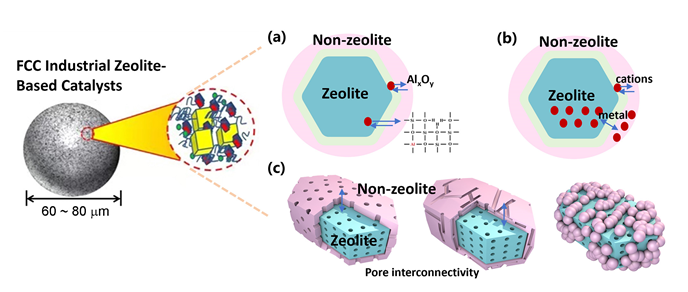
催化领域的最终目标是在工业技术层面提高催化效率. 工业催化剂通常是由沸石组元与基质和粘结剂等“非沸石组元”共同构成的多组元多活性敏感结构复合体, 其性能不仅取决于单一组元的性质, 更受组元间相互作用的显著影响. 然而, 实验室的大量研究多聚焦于沸石组元的调控, 而忽视了非沸石组元的影响及其与沸石组元的相互作用, 导致工业催化剂的设计与实际性能之间存在显著差异. 对于沸石-非沸石组元间的结构设计及各组元间结构-性质-功能关系的理解在很大程度上被忽视. 本综述着重强调了工业沸石-非沸石一体化催化剂组元间相互作用的复杂性. 以典型的催化裂解催化剂为例, 分析了催化裂化多组元催化剂的等级特征及其等级结构协同接力催化功能. 重点探讨了沸石-非沸石组元间的三类相互作用机制: (1)铝物种迁移及其对酸性质的调控; (2)阳离子交换及金属在组元间落位的距离效应对酸性位点的动态调节; (3)组元间孔道匹配联通性对扩散效率的影响. 最后, 展望了多组元催化剂设计的未来方向, 强调通过先进表征技术与计算模拟揭示组元相互作用的微观机制, 为开发高效、低能耗且环境友好的催化裂化催化剂提供理论指导.
徐亦璞, 徐舒涛, 魏迎旭, 阎子峰, 刘中民. 沸石基工业多组元催化剂的结构设计及组元间相互作用研究★[J]. 化学学报, 2025, 83(9): 1072-1088.
Yipu Xu, Shutao Xu, Yingxu Wei, Zifeng Yan, Zhongmin Liu. Studies on Structural Engineering and Intercomponent Interactions of Zeolite-Based Industrial Multicomponent Catalysts★[J]. Acta Chimica Sinica, 2025, 83(9): 1072-1088.





| [1] |
|
|
(许友好, 中国科学: 化学, 2014, 44, 13.)
|
|
| [2] |
|
|
(熊昊, 梁潇予, 张晨曦, 白浩隆, 范晓宇, 魏飞, 化工学报, 2023, 74, 86.)
doi: 10.11949/0438-1157.20221188 |
|
| [3] |
|
| [4] |
doi: 10.1021/acscatal.9b00151 |
| [5] |
|
| [6] |
|
|
(任夫健, 凌永社, 王庆志, 现代化工, 2011, 31, 13.)
|
|
| [7] |
doi: 10.1039/c3cs60076a pmid: 23648466 |
| [8] |
doi: 10.1039/c5cs00376h pmid: 26382875 |
| [9] |
|
| [10] |
|
| [11] |
|
| [12] |
doi: 10.6023/A24070216 |
|
(赵勤, 李芳, 张鹏鹤, 刘月明, 化学学报, 2024, 82, 1013.)
doi: 10.6023/A24070216 |
|
| [13] |
|
|
(张红丹, 兰欣雨, 程鹏, 化学学报, 2023, 81, 100.)
doi: 10.6023/A22100420 |
|
| [14] |
|
| [15] |
|
| [16] |
|
| [17] |
|
|
(徐奇, 任飞, 朱玉霞, 石油炼制与化工, 2017, 48, 57.)
|
|
| [18] |
|
|
(霍连波, 化工设计通讯, 2019, 45, 214.)
|
|
| [19] |
|
|
(张有文, 申志峰, 化工管理, 2018, 30, 94.)
|
|
| [20] |
doi: 10.1093/nsr/nwaa184 pmid: 34691504 |
| [21] |
|
| [22] |
|
| [23] |
|
| [24] |
doi: 10.1038/s41467-023-36502-3 pmid: 36878918 |
| [25] |
|
| [26] |
|
| [27] |
|
| [28] |
doi: 10.6023/A23040177 |
|
(洪梅, 高金强, 李彤, 杨世和, 化学学报, 2023, 81, 937.)
doi: 10.6023/A23040177 |
|
| [29] |
|
| [30] |
|
| [31] |
|
| [32] |
|
| [33] |
|
| [34] |
|
| [35] |
|
| [36] |
|
| [37] |
|
| [38] |
|
| [39] |
|
| [40] |
|
| [41] |
|
| [42] |
|
| [43] |
|
| [44] |
|
| [45] |
doi: 10.1039/c5fd00200a pmid: 27101314 |
| [46] |
|
| [47] |
|
| [48] |
doi: 10.1039/d1ra02677a pmid: 35479253 |
| [49] |
|
| [50] |
doi: 10.1021/acsomega.0c05855 pmid: 33681592 |
| [51] |
|
| [52] |
|
| [53] |
doi: 10.1039/c9cy00693a |
| [54] |
|
| [55] |
doi: 10.1002/cctc.201900777 |
| [56] |
|
| [57] |
|
| [58] |
|
| [59] |
|
| [60] |
|
| [61] |
doi: 10.1021/jacs.8b12861 pmid: 30649870 |
| [62] |
|
| [63] |
|
| [64] |
|
| [65] |
|
| [66] |
|
| [67] |
|
| [68] |
|
|
(徐续盼, 范凯, 赵胜泽, 李健, 高珊, 吴忠标, 孟祥举, 肖丰收, 化学学报, 2023, 81, 1108.)
doi: 10.6023/A23040175 |
|
| [69] |
|
| [70] |
|
| [71] |
|
| [72] |
|
| [73] |
|
| [74] |
|
| [75] |
|
| [76] |
|
| [77] |
|
| [78] |
|
| [79] |
|
| [80] |
|
| [81] |
|
| [82] |
|
| [83] |
|
| [84] |
|
| [85] |
|
| [86] |
|
| [87] |
|
| [88] |
|
| [89] |
|
| [90] |
|
| [91] |
|
| [92] |
|
| [93] |
|
| [94] |
|
| [95] |
|
| [96] |
|
| [1] | 魏文杰, 陈文龙, 戴晓彬, 燕立唐. 生物大分子介质中的反常扩散动力学理论★[J]. 化学学报, 2023, 81(8): 967-978. |
| [2] | 刘蓓, 廉源会, 李智, 陈光进. 生物金属-有机骨架材料中药物吸附及扩散的分子模拟研究[J]. 化学学报, 2014, 72(8): 942-948. |
| [3] | 杨思七, 张天然, 陶占良, 陈军. 锂离子电池正极材料LiNi0.5Mn1.5O4金属掺杂的第一性原理研究[J]. 化学学报, 2013, 71(07): 1029-1034. |
| [4] | 刘蓓, 唐李兴, 廉源会, 李智, 孙长宇, 陈光进. 互穿结构及混合配体对金属-有机骨架材料分离性能的影响[J]. 化学学报, 2013, 71(06): 920-928. |
| [5] | 吴选军, 杨旭, 宋杰, 蔡卫权. ZIF-8材料中CH4/H2吸附与扩散的分子模拟[J]. 化学学报, 2012, 70(24): 2518-2524. |
| [6] | 陈聪, 李维仲, 宋永臣, 翁林岽, 张宁. 甘油-水-氯化钠三元溶液中甘油浓度对甘油自扩散系数的影响[J]. 化学学报, 2012, 70(08): 1043-1046. |
| [7] | 陆晓挺, 李东林, 樊小勇, 赵鹏, 苟蕾, 李严, 李倩, 王静. Na 掺杂对LiFePO4/C 复合正极材料的结构和倍率性能的影响[J]. 化学学报, 2012, 70(03): 223-228. |
| [8] | 蒋俊, 张俊喜, 鲁进亮, 钱胜杰, 邬永成, 王昆, 屈文俊. 钢筋在再碱化过程中的电化学行为研究[J]. 化学学报, 2011, 69(20): 2347-2352. |
| [9] | 吕建燚, 翁清龙. 乙烯/空气反扩散火焰中气体温度及碳烟体积分数的分布特征[J]. 化学学报, 2011, 69(08): 1011-1016. |
| [10] | 杜海龙, 张勇, 盛敏奇, 刘卫东, 钟庆东, 王毅, 周琼宇. Co-W合金镀层表面氧化膜在碱性体系中的电化学研究[J]. 化学学报, 2011, 69(08): 881-888. |
| [11] | 方艳, 翟光群, 蒋必彪, 陈建海. 苯乙烯的低温原子转移自由基聚合: 扩散效应导致的加速现象[J]. 化学学报, 2011, 69(07): 853-862. |
| [12] | 杨嘉伟, 方正, 潘义, 刘仁红, 王佳黎, 但德忠. 甲醛电化学传感器多孔气体扩散电极不同催化层结构与响应性能研究[J]. 化学学报, 2011, 69(01): 65-70. |
| [13] | 刘金祥, 尤龙, 张军, 燕友果, 于立军, 任振甲. 温度对半胱氨酸缓蚀性能影响的实验评价与机理研究[J]. 化学学报, 2010, 68(18): 1807-1812. |
| [14] | 王进, 王军霞, 曾凡桂, 吴秀玲. 水化锂蒙脱石层间结构和动力特征的分子模拟[J]. 化学学报, 2010, 68(16): 1653-1660. |
| [15] | 尤龙, 刘金祥, 张军, 刘林法, 于立军, 乔贵民. 咪唑啉缓蚀剂膜抑制腐蚀介质扩散行为的MD研究[J]. 化学学报, 2010, 68(08): 747-752. |
| 阅读次数 | ||||||
|
全文 |
|
|||||
|
摘要 |
|
|||||
