

化学学报 ›› 2026, Vol. 84 ›› Issue (6): 849-858.DOI: 10.6023/A26010017 上一篇 下一篇
研究论文
谢颂恒a,b,c, 林怡然a,b,c, 袁亚龙b, 陈瑶b, 温珍海b,c, 黄钧衡a,b,c,*( )
)
投稿日期:2026-01-14
发布日期:2026-04-27
基金资助:
Songheng Xiea,b,c, Yiran Lina,b,c, Yalong Yuanb, Yao Chenb, Zhenhai Wenb,c, Junheng Huanga,b,c,*()
Received:2026-01-14
Published:2026-04-27
Contact:
E-mail: Supported by:文章分享
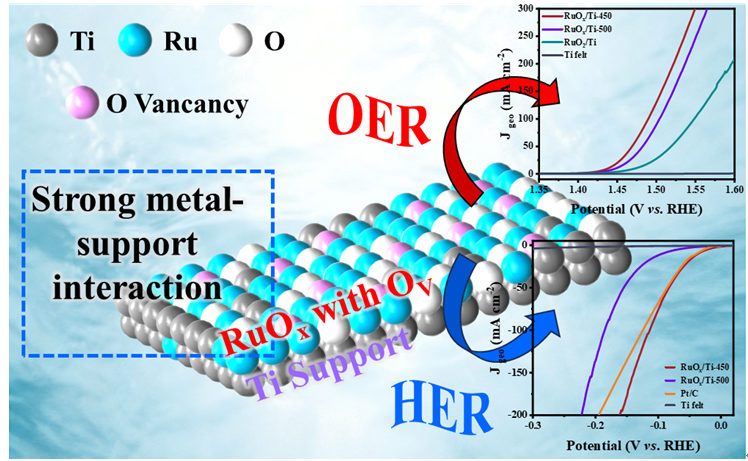
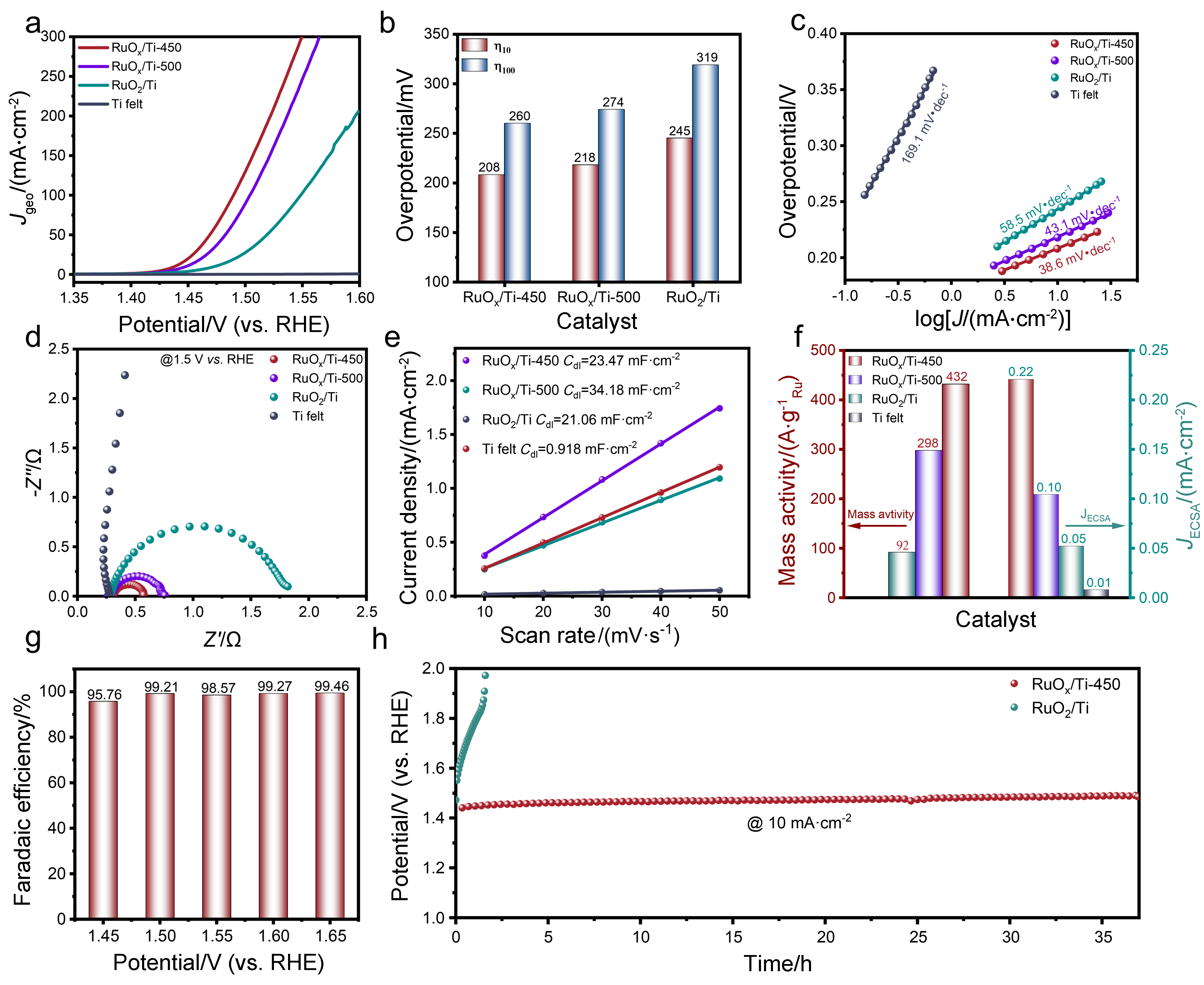
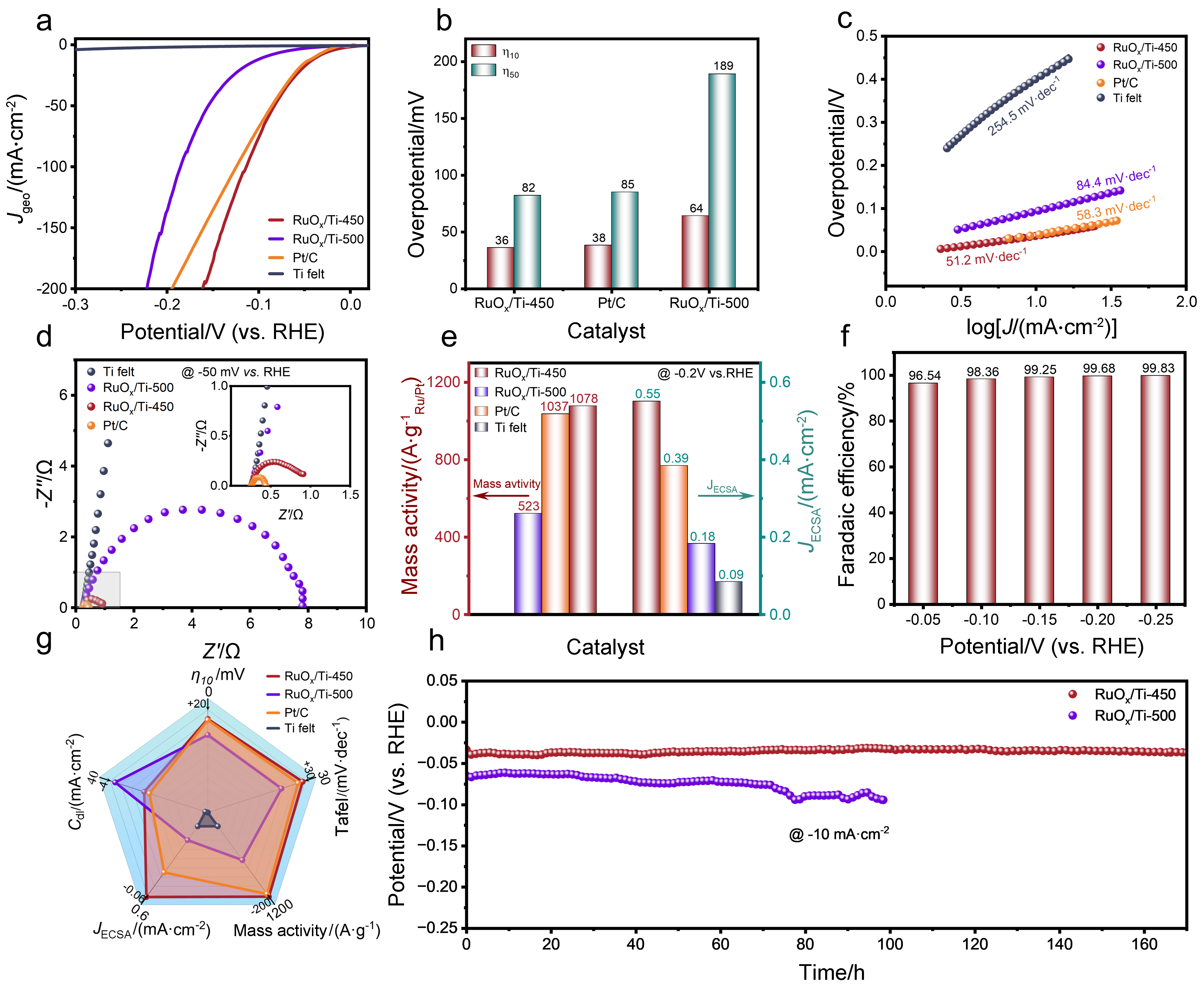
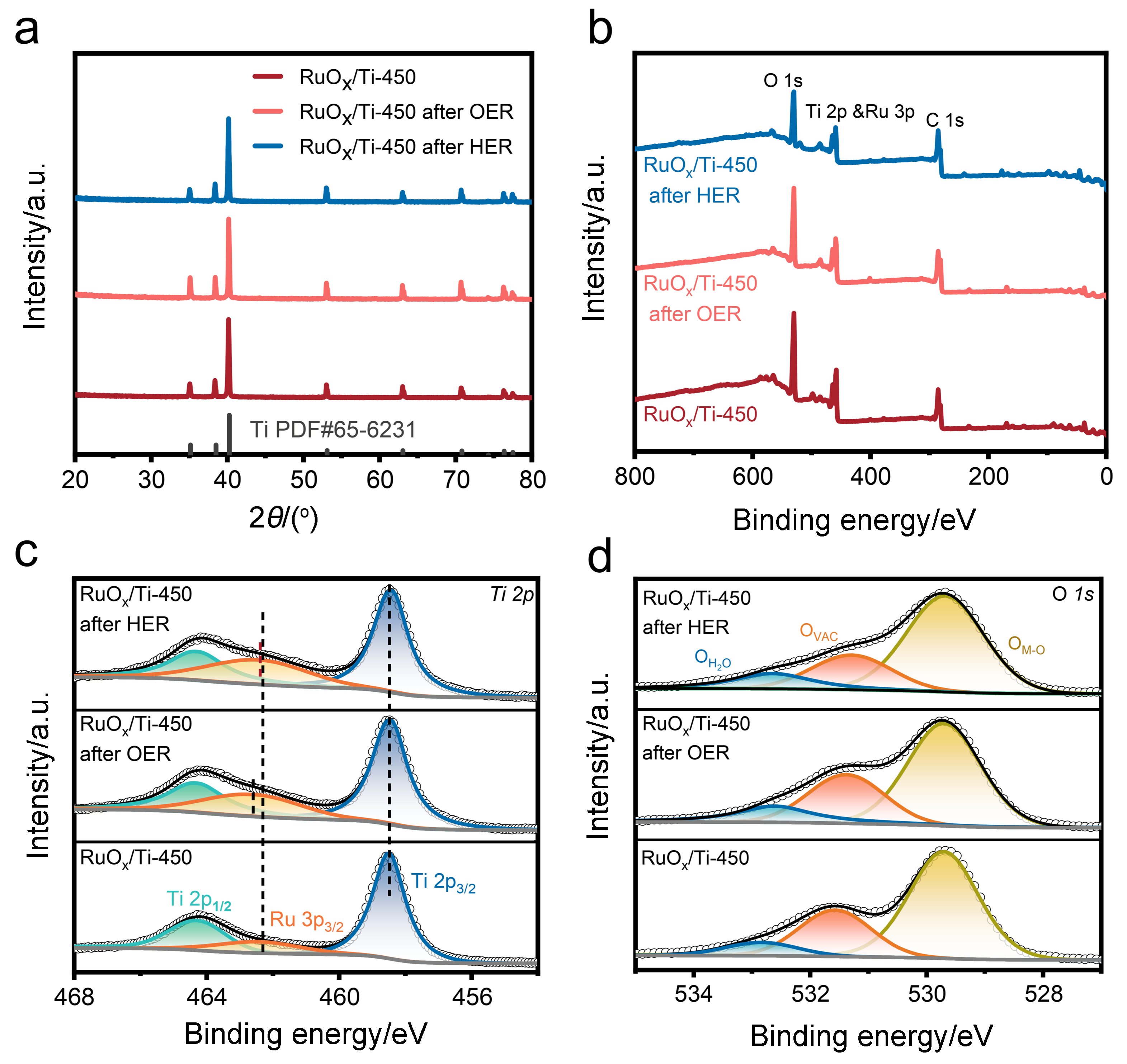
质子交换膜电解水技术的规模化应用受到贵金属催化剂成本高昂和稳定性不足的双重制约. 为此, 本研究采用简易的喷涂-氧化法, 在耐酸腐蚀的钛毡基底上原位制备了具有超低钌载量的双功能催化剂RuOx/Ti. 该催化剂中Ru基纳米颗粒均匀锚定于三维多孔钛骨架上, 且表面富含氧空位. 电化学测试表明, RuOx/Ti在酸性电解质中同时表现出优异的析氧反应和析氢反应活性. 在10 mA•cm-2电流密度下, 析氧反应过电位仅为208 mV, 析氢反应过电位低至36 mV. 此外, 该催化剂在持续的析氧反应和析氢反应测试中均展现出优异的长期稳定性, 且法拉第效率均超过95%. 进一步研究揭示, 其优异的催化活性和稳定性源自丰富的氧空位对催化剂电子结构的调控, 以及钌与钛基底之间的金属-载体强相互作用. 该研究为低成本、高性能的酸性电解水催化剂的开发提供了新路径.
谢颂恒, 林怡然, 袁亚龙, 陈瑶, 温珍海, 黄钧衡. 高效稳定的RuOx/Ti双功能电催化剂用于酸性析氢与析氧反应[J]. 化学学报, 2026, 84(6): 849-858.
Songheng Xie, Yiran Lin, Yalong Yuan, Yao Chen, Zhenhai Wen, Junheng Huang. Efficient and Stable RuOx/Ti Bifunctional Electrocatalyst for Acidic Oxygen Evolution and Hydrogen Evolution Reactions[J]. Acta Chimica Sinica, 2026, 84(6): 849-858.
| [1] |
(a)
doi: 10.1038/s41467-024-48372-4 pmid: 37684237 |
|
(b)
doi: 10.1038/s41467-023-41107-x pmid: 37684237 |
|
|
(c)
doi: 10.1021/jacs.4c05070 pmid: 37684237 |
|
|
(d)
doi: 10.6023/A22070309 pmid: 37684237 |
|
|
(蒋博龙, 崔艳艳, 史顺杰, 姜楠, 谭伟强, 化学学报, 2022, 80, 1394.)
doi: 10.6023/A22070309 pmid: 37684237 |
|
| [2] |
(a)
doi: 10.1002/adfm.v35.21 |
|
(b)
doi: 10.1126/science.adg5193 |
|
| [3] |
(a)
doi: 10.1038/s41467-023-37008-8 pmid: 36918568 |
|
(b)
doi: 10.1038/s41563-022-01380-5 pmid: 36918568 |
|
|
(c)
doi: 10.1002/advs.v9.23 pmid: 36918568 |
|
|
(d)
doi: 10.1021/jacs.3c13248 pmid: 36918568 |
|
|
(e)
doi: 10.1021/jacs.3c07777 pmid: 36918568 |
|
| [4] |
doi: 10.1016/j.jpowsour.2024.234856 |
| [5] |
doi: 10.1021/acscatal.9b02457 |
| [6] |
(a)
doi: 10.1039/D3TA05347D pmid: 39151091 |
|
(b)
doi: 10.1021/jacs.4c04607 pmid: 39151091 |
|
|
(c)
doi: 10.1039/D1EE03610F pmid: 39151091 |
|
|
(d)
pmid: 39151091 |
|
|
(崔成强, 姚士冰, 周绍民, 化学学报, 1990, 48, 436.)
pmid: 39151091 |
|
| [7] |
(a)
doi: 10.1002/anie.v64.9 |
|
(b)
doi: 10.1002/adfm.v35.22 |
|
| [8] |
(a)
doi: 10.1039/D4CS00527A |
|
(b)
doi: 10.1126/science.adp6034 |
|
| [9] |
|
| [10] |
doi: 10.1002/anie.v61.41 |
| [11] |
(a)
doi: 10.1021/acscatal.2c05783 |
|
(b)
doi: 10.1002/adfm.v34.51 |
|
|
(c)
doi: 10.1002/anie.v62.24 |
|
| [12] |
doi: 10.1088/1361-6528/ad501d |
| [13] |
(a)
doi: 10.1039/D0EE00859A |
|
(b)
doi: 10.1038/s41467-020-15873-x |
|
| [14] |
doi: 10.1002/anie.v60.34 |
| [15] |
doi: 10.1021/acsnano.5c21185 |
| [16] |
doi: 10.1002/cey2.70124 |
| [17] |
doi: 10.1002/adfm.v36.1 |
| [18] |
(a)
doi: 10.1021/acscatal.4c02779 |
|
(b)
doi: 10.1021/acscatal.4c03862 |
|
| [19] |
doi: 10.1002/anie.v63.28 |
| [20] |
(a)
doi: 10.1016/j.cej.2023.148007 |
|
(b)
doi: 10.1016/j.apcatb.2022.122294 |
|
| [21] |
doi: 10.1038/s41467-022-28947-9 |
| [22] |
(a)
doi: 10.1021/acsami.5c16663 |
|
(b)
doi: 10.1002/anie.v61.21 |
|
|
(c)
doi: 10.1007/s12274-024-6696-0 |
|
|
(d)
doi: 10.1016/j.cej.2023.147939 |
|
|
(e)
|
|
|
(f)
doi: 10.1002/adma.v35.24 |
|
|
(g)
|
|
|
(h)
doi: 10.1021/acsanm.4c01835 |
|
|
(i)
doi: 10.1039/D0TA00445F |
|
| [23] |
doi: 10.1021/acsami.3c11290 |
| [24] |
(a)
doi: 10.1002/adma.v35.42 |
|
(b)
doi: 10.1002/anie.v64.21 |
| [1] | 税子怡, 尹书睿, 邓锦涛, 许留云, 郭莉. 聚乙烯吡咯烷酮辅助金属有机框架衍生分级多孔碳材料的制备及其双功能催化性能研究[J]. 化学学报, 2026, 84(1): 53-63. |
| [2] | 刘浩, 徐旭莉, 郭勇, 刘晓晖, 王艳芹. Ru/NiPOx高效电催化醛还原胺化反应的研究[J]. 化学学报, 2024, 82(5): 477-485. |
| [3] | 税子怡, 于思乐, 陆伟, 许留云, 刘庆叶, 赵炜, 刘益伦. Mn掺杂Co3O4双功能电催化剂在碱性介质下氧还原和析氧反应中的应用[J]. 化学学报, 2024, 82(10): 1039-1049. |
| [4] | 杨镇鸿, 干晓娟, 王书哲, 段君元, 翟天佑, 刘友文. 金属性Ni3N纳米粒子的制备与乙二醇电氧化性能★[J]. 化学学报, 2023, 81(11): 1471-1477. |
| [5] | 于潇涵, 黄伟, 李彦光. 二维共价有机框架材料的可控合成及其光催化应用研究进展[J]. 化学学报, 2022, 80(11): 1494-1506. |
| [6] | 王金格, 周伟, 李佳轶, 丁雅妮, 高继慧. 脉冲电催化的研究进展及性能强化机制[J]. 化学学报, 2022, 80(11): 1555-1568. |
| [7] | 蒋博龙, 崔艳艳, 史顺杰, 姜楠, 谭伟强. 双金属氮化物NiMoN析氢催化剂制备及其电解海水析氢性能的研究[J]. 化学学报, 2022, 80(10): 1394-1400. |
| [8] | 麻旺坪, 贺彦彦, 刘洪来. 烯烃连接的三嗪共轭多孔聚合物的合成及其可见光催化产氢性能[J]. 化学学报, 2021, 79(7): 914-919. |
| [9] | 王思, 马嘉苓, 陈利芳, 张欣. 双金属氢氧化物催化析氧反应的协同机制研究[J]. 化学学报, 2021, 79(2): 216-222. |
| [10] | 张宇, 王世兴, 杨蕊, 戴腾远, 张楠, 席聘贤, 严纯华. Co9S8/MoS2异质结构的构筑及电催化析氢性能研究[J]. 化学学报, 2020, 78(12): 1455-1460. |
| [11] | 王艺霖, 王敏杰, 李静, 魏子栋. 铁镍合金纳米颗粒镶嵌的多级孔氮掺杂碳催化剂的制备及析氧性能研究[J]. 化学学报, 2019, 77(1): 84-89. |
| [12] | 史建平, 马冬林, 张艳锋, 刘忠范. 金箔上单层MoS2的控制生长及电催化析氢应用[J]. 化学学报, 2015, 73(9): 877-885. |
| [13] | 钮东方, 丁勇, 马智兴, 王明辉, 刘洲, 张博文, 张新胜. 纳米碳纤维的表面改性对水电解析氢反应催化活性的影响[J]. 化学学报, 2015, 73(7): 729-734. |
| [14] | 秦春段, 苏勇, 刘福东. 冷却速度对铅酸蓄电池用Pb-Ca合金性能的影响[J]. 化学学报, 2010, 68(22): 2363-2366. |
| [15] | 张一平,费金华, 于英民, 郑小明. 固载Ru基催化剂上二氧化碳加氢合成甲酸的研究(IV): 反应机理[J]. 化学学报, 2007, 65(4): 289-294. |
| 阅读次数 | ||||||
|
全文 |
|
|||||
|
摘要 |
|
|||||
