化学学报 ›› 2026, Vol. 84 ›› Issue (7): 1033-1039.DOI: 10.6023/A26030063 上一篇 下一篇
研究论文
管敏慧a, 孙超b, 耿娜a, 陈铃涵a, 周泉a,*( ), 王成烨a, 王磊a,*()
投稿日期:2026-03-02
发布日期:2026-03-24
基金资助:
Minhui Guana, Chao Sunb, Na Genga, Linghan Chena, Quan Zhoua,*(), Chengye Wanga, Lei Wanga,*()
Received:2026-03-02
Published:2026-03-24
Contact:
* E-mail: qzhou@tzc.edu.cn;
leiwang88@hotmail.com
Supported by:文章分享
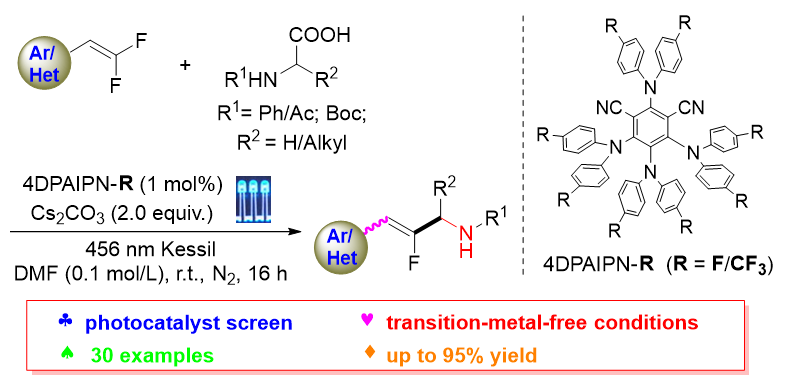
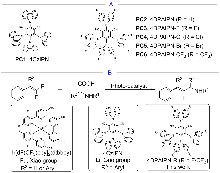
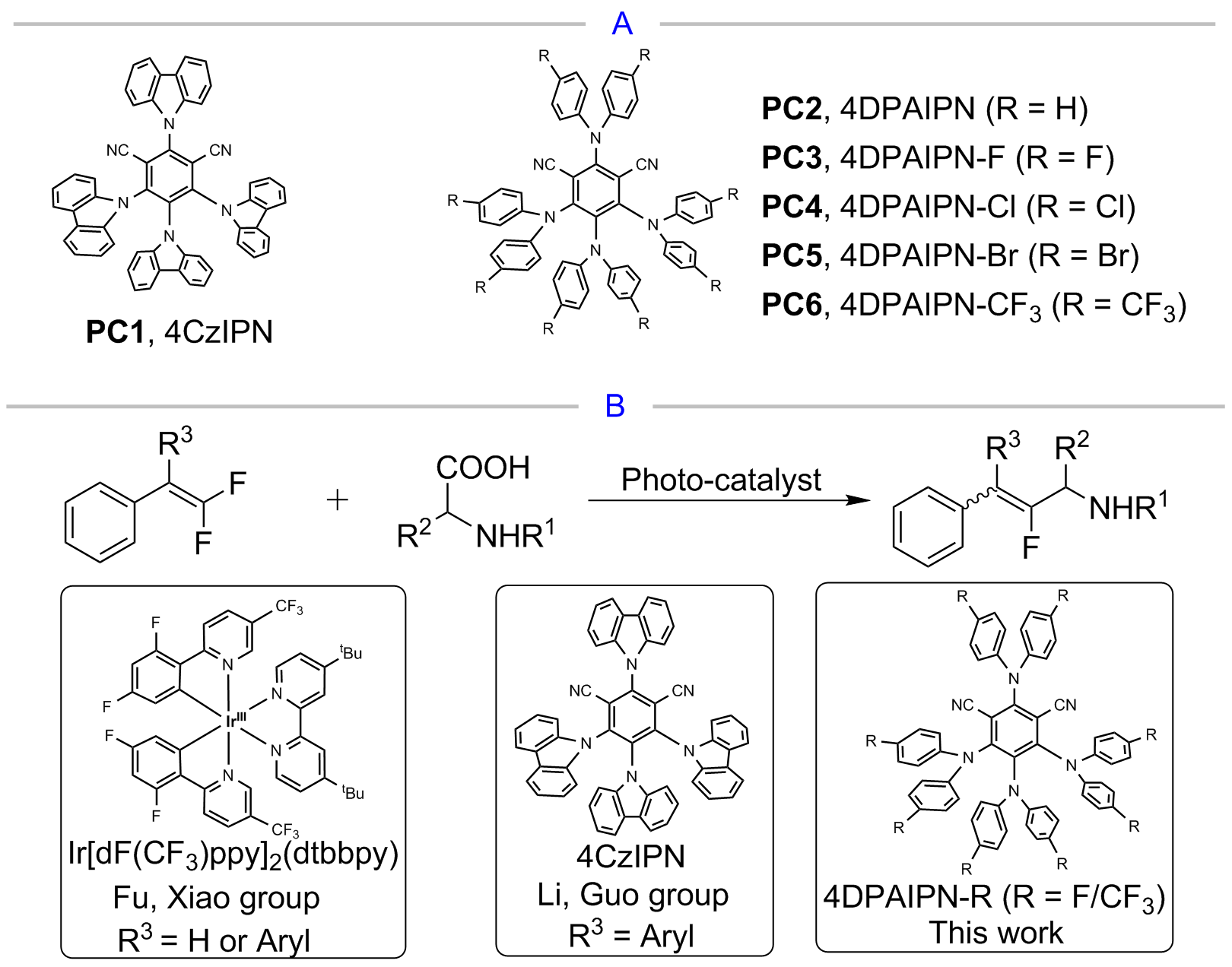
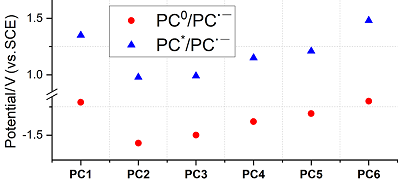
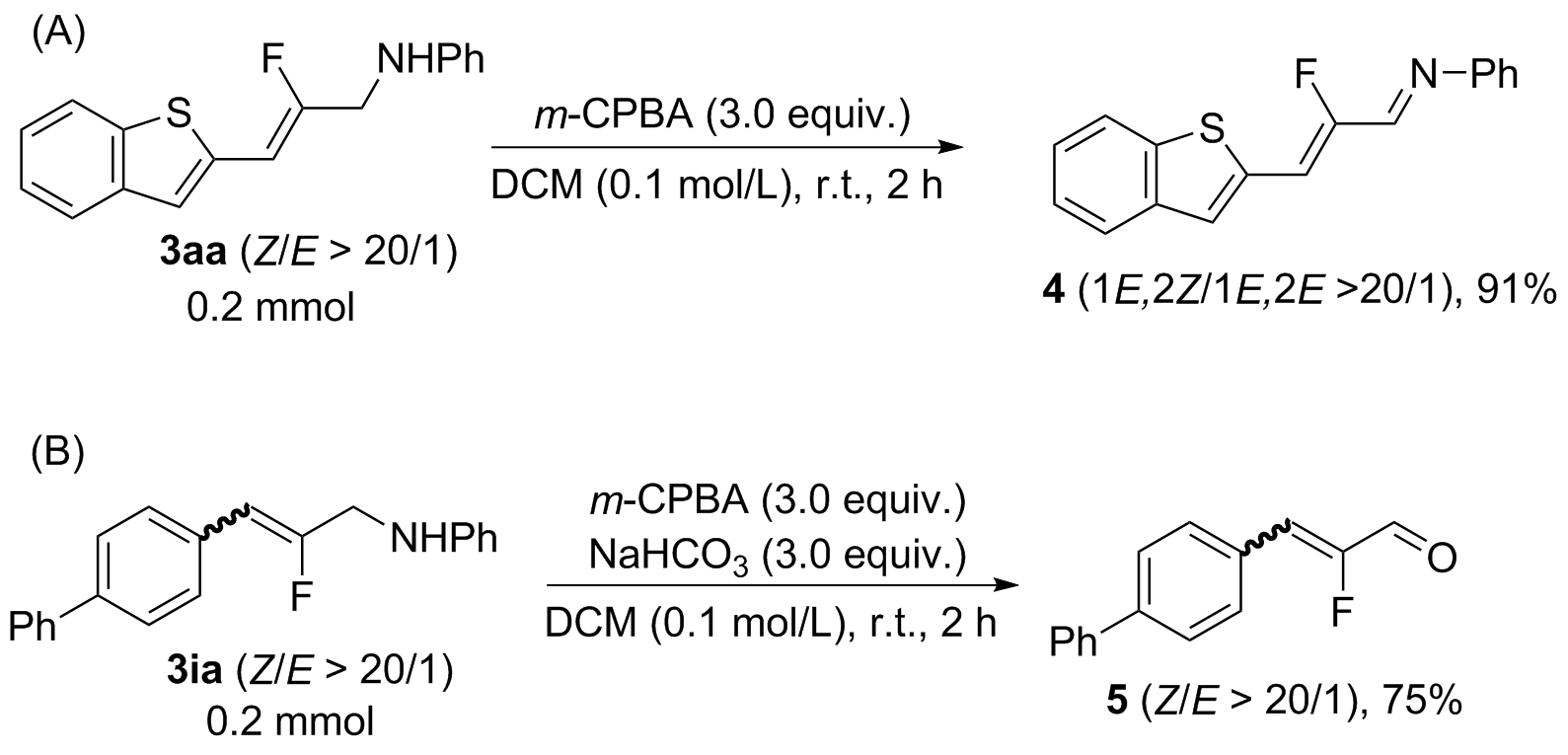
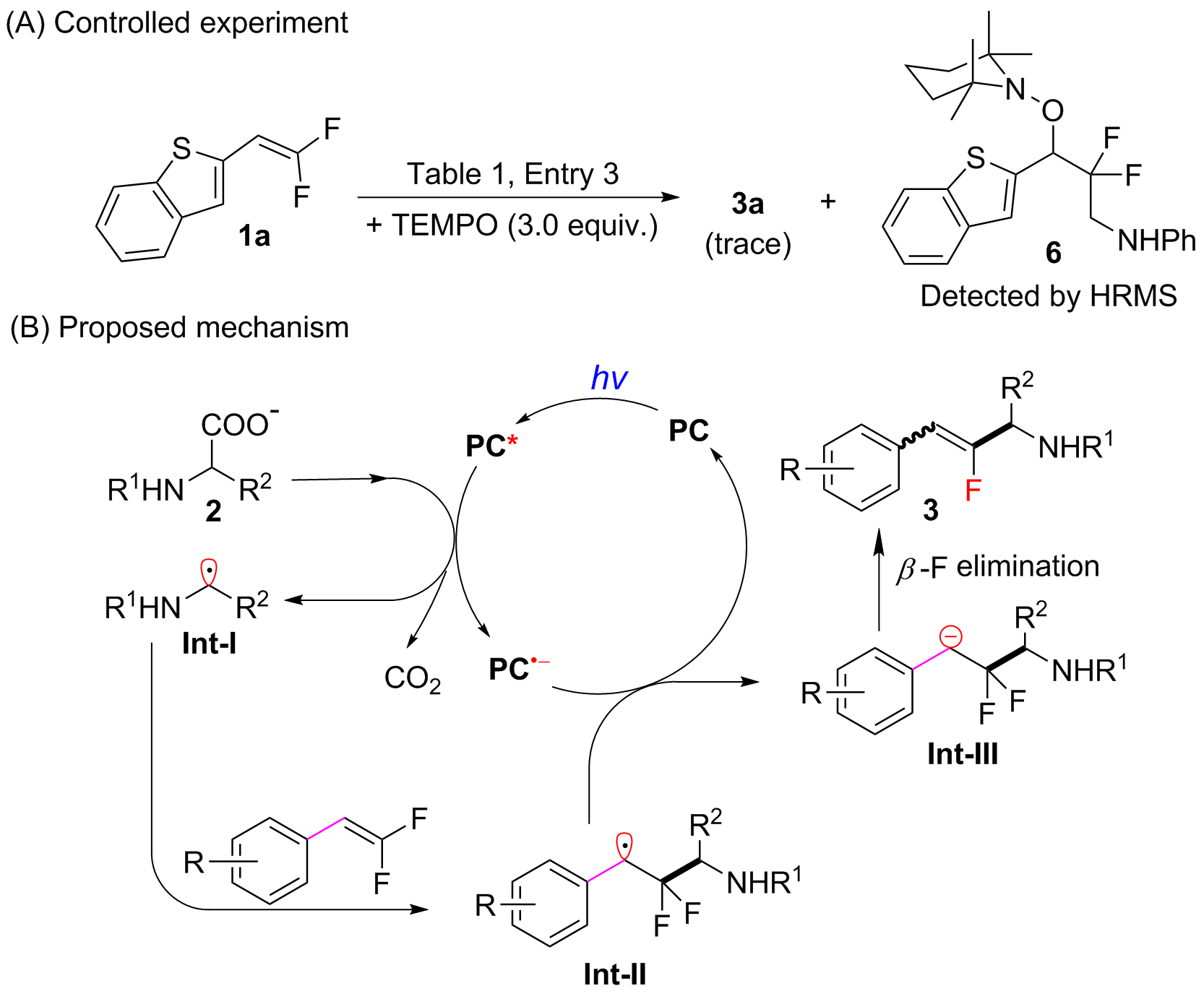
此研究致力于4DPAIPN-R衍生物作为N-保护氨基酸的光氧化催化剂, 实现其脱羧并和偕二氟烯烃偶联. 经过系统研究发现, 对于N-苯基甘氨酸和偕二氟烯烃, 氟取代的4DPAIPN (4DPAIPN-F)具有优异的偶联性能(25个例子). 对于N-乙酰基/叔丁基氧酰基氨基酸和偕二氟烯烃偶联, 三氟甲基取代的4DPAIPN (4DPAIPN-CF3)具有更好的催化性能(5个例子). 研究表明该分子平台可广泛应用于不同的偕二氟苯乙烯和不同的N-保护氨基酸的偶联, 超过30个例子, 最高产率到95%. 产物后期修饰可实现产物转化成氟代烯胺或者氟代肉桂醛.
管敏慧, 孙超, 耿娜, 陈铃涵, 周泉, 王成烨, 王磊. 光促进4DPAIPN-F/CF3催化偕二氟苯乙烯和N-保护氨基酸偶联反应[J]. 化学学报, 2026, 84(7): 1033-1039.
Minhui Guan, Chao Sun, Na Geng, Linghan Chen, Quan Zhou, Chengye Wang, Lei Wang. 4DPAIPN-F/CF3 Dyes for Photocatalytic Cross-Coupling of gem-Difluorostyrenes with N-Protected Amino Acids[J]. Acta Chimica Sinica, 2026, 84(7): 1033-1039.
| Entry | Variants | 3aa (%, Z/E)a |
|---|---|---|
| 1 | PC1 instead of PC3 | 40 (6/1) |
| 2 | PC2 instead of PC3 | 92 (4/1)a/88 (7/1)b |
| 3 | none | 97 (5/1)a/92 (8/1)b |
| 4 | PC4 instead of PC3 | 66 (4/1) |
| 5 | PC5 instead of PC3 | 80 (3/1) |
| 6 | PC6 instead of PC3 | 35 (2/1) |
| 7 | CH3CN instead of DMF | 85 (2/1) |
| 8 | THF instead of DMF | 37 (3/1)b,c |
| 9 | MeOH instead of DMF | 26 (3/1) |
| 10 | DCE instead of DMF | trace |
| 11 | without Cs2CO3 | 18 (5/1) |
| 12 | without PC/irradiation | 0 |
 | ||
| Entry | Variants | 3aa (%, Z/E)a |
|---|---|---|
| 1 | PC1 instead of PC3 | 40 (6/1) |
| 2 | PC2 instead of PC3 | 92 (4/1)a/88 (7/1)b |
| 3 | none | 97 (5/1)a/92 (8/1)b |
| 4 | PC4 instead of PC3 | 66 (4/1) |
| 5 | PC5 instead of PC3 | 80 (3/1) |
| 6 | PC6 instead of PC3 | 35 (2/1) |
| 7 | CH3CN instead of DMF | 85 (2/1) |
| 8 | THF instead of DMF | 37 (3/1)b,c |
| 9 | MeOH instead of DMF | 26 (3/1) |
| 10 | DCE instead of DMF | trace |
| 11 | without Cs2CO3 | 18 (5/1) |
| 12 | without PC/irradiation | 0 |
| | ||
| [1] |
doi: 10.1038/nature11687 |
| [2] |
doi: 10.1021/acscatal.5b02204 |
| [3] |
(a)
doi: 10.1021/jacs.8b08933 pmid: 30277767 |
|
(b)
doi: 10.1002/anie.v62.11 pmid: 30277767 |
|
| [4] |
doi: 10.1021/jacs.0c11138 |
| [5] |
doi: 10.1002/anie.v61.11 |
| [6] |
(a)
doi: 10.1002/anie.201901922 pmid: 30079201 |
|
(b)
doi: 10.1039/c8sc01818a pmid: 30079201 |
|
| [7] |
doi: 10.1021/jacs.3c04912 |
| [8] |
doi: 10.1021/acs.orglett.3c04071 |
| [9] |
(a)
doi: 10.1021/acs.orglett.5c00476 pmid: 37676728 |
|
(b)
doi: 10.1021/jacs.1c05988 pmid: 37676728 |
|
|
(c)
doi: 10.1021/jacs.3c06347 pmid: 37676728 |
|
| [10] |
(a)
doi: 10.1021/acscatal.5c03795 |
|
(b)
doi: 10.1021/jacs.5c00372 |
|
|
(c)
doi: 10.1021/acs.orglett.0c04101 |
|
|
(d)
doi: 10.1021/acs.orglett.1c02014 |
|
|
(e)
doi: 10.1021/acs.joc.2c02757 |
|
|
(f)
doi: 10.1002/tcr.v23.10 |
|
|
(g)
doi: 10.1021/acs.orglett.0c02518 |
|
| [11] |
(a)
doi: 10.1039/C7CC05758J |
|
(b)
doi: 10.1039/D1QO01024G |
|
| [12] |
(a)
doi: 10.1039/c9qo00495e |
|
(b)
|
|
|
(c)
|
|
|
(d)
doi: 10.1016/j.checat.2024.101200 |
|
|
(e)
doi: 10.1002/anie.v62.20 |
|
|
(f)
doi: 10.6023/A25060238 |
|
|
(苏秦, 雷平, 王栋, Shahid Ali Khan, 阿布拉江•克依木, 化学学报, 2025, 83, 1372.)
doi: 10.6023/A25060238 |
|
|
(g)
doi: 10.1002/cjoc.v43.10 |
|
|
(h)
doi: 10.1002/cjoc.v43.19 |
|
|
(i)
doi: 10.1021/acs.orglett.5c05271 |
|
|
(j)
doi: 10.1039/D5CC06757J |
|
|
(k)
doi: 10.1002/adsc.v368.4 |
|
| [13] |
doi: 10.1021/acs.orglett.4c02154 |
| [14] |
(a)
doi: 10.1021/acs.orglett.6b02026 |
|
(b)
doi: 10.1039/D1QO00549A |
|
| [15] |
(a)
doi: 10.1021/acscatal.2c02233 pmid: 26310905 |
|
(b)
doi: 10.1021/jacs.5b07136 pmid: 26310905 |
|
| [16] |
doi: 10.6023/A25010015 |
|
(周泉, 蒋佳怡, 罗年华, 黄家翩, 化学学报, 2025, 83, 274.)
doi: 10.6023/A25010015 |
|
| [17] |
(a)
doi: 10.1039/D5OB00557D pmid: 39565359 |
|
(b)
doi: 10.1039/d4ob01071j pmid: 39565359 |
|
|
(c)
doi: 10.6023/cjoc202311013 pmid: 39565359 |
|
|
(孙超, 周泉, 李传莹, 王磊, 有机化学, 2024, 44, 1957.)
doi: 10.6023/cjoc202311013 pmid: 39565359 |
|
|
(d)
doi: 10.1039/D2OB00639A pmid: 39565359 |
|
|
(e)
doi: 10.6023/cjoc202207031 pmid: 39565359 |
|
|
(沈梦涵, 李来强, 周泉, 王洁慧, 王磊, 有机化学, 2023, 43, 697.)
doi: 10.6023/cjoc202207031 pmid: 39565359 |
|
|
(f)
doi: 10.1021/acs.orglett.4c04432 pmid: 39565359 |
|
| [18] |
doi: 10.1002/anie.v63.7 |
| [1] | 孟凡荣, 李国锋, 赵杰, 肖文精, 石德清, 陈加荣. 光催化氮自由基参与的乙烯基环丙烷加成/环化反应合成四氢吡啶★[J]. 化学学报, 2025, 83(12): 1472-1479. |
| [2] | 卢小彪, 肖茜, 万常峰, 汪志勇, 刘晋彪. 无金属条件下的肉桂酸类和酰胺的脱羧氧化偶联反应构建碳-碳键[J]. 化学学报, 2021, 79(6): 751-754. |
| [3] | 贾红绍, 乔保坤, 江智勇. 光氧化还原催化自由基偶联合成β-氟代-α-氨基酸衍生物[J]. 化学学报, 2021, 79(12): 1477-1480. |
| [4] | 靳继康, 张凤莲, 汪义丰. 路易斯碱-硼自由基促进的邻苯二甲酰亚胺类羧酸酯的Giese反应和Barton脱羧反应研究[J]. 化学学报, 2019, 77(9): 889-894. |
| [5] | 张洪浩, 俞寿云. 过渡金属与光氧化还原协同催化的烯丙基取代反应的研究进展[J]. 化学学报, 2019, 77(9): 832-840. |
| [6] | 李忠原, 景昆, 李祁利, 王官武. 钯催化的2-苯氧基吡啶导向的脱羧酯基化反应研究[J]. 化学学报, 2019, 77(8): 729-734. |
| [7] | 尹欣驰, 江游, 楚士颖, 翁国锋, 方向, 潘远江. 气相中铜催化的脱羧碘化反应[J]. 化学学报, 2018, 76(6): 436-439. |
| [8] | 叶文波, 晏子聪, 万常峰, 侯豪情, 汪志勇. 一种新的肉桂酸类化合物的脱羧/甲基化反应[J]. 化学学报, 2018, 76(2): 99-102. |
| [9] | 宋治东, 蒋绿齐, 易文斌. 氢氟酸盐和三价碘实现的β,γ-不饱和羧酸脱羧氟化反应[J]. 化学学报, 2018, 76(12): 967-971. |
| [10] | 张晨杰, 张婧, 林洁茹, 金琦, 徐敏敏, 姚建林. 金纳米粒子单层膜表面SPR催化反应的原位SERS研究[J]. 化学学报, 2017, 75(9): 860-865. |
| [11] | 吴自俊, 汪舰. 可见光氧化还原催化下α-酮酸对对位亚甲基醌(p-QMs)脱羧/1,6-共轭加成反应[J]. 化学学报, 2017, 75(1): 74-79. |
| [12] | 周泉泉, 刘丹, 肖文精, 陆良秋. 可见光光氧化还原催化的三级胺α位C-H氰基化反应[J]. 化学学报, 2017, 75(1): 110-114. |
| [13] | 荣健, 倪传法, 王云泽, 匡翠文, 顾玉诚, 胡金波. 可见光促进下氟烷基砜对芳基烯烃的自由基氟烷基化反应[J]. 化学学报, 2017, 75(1): 105-109. |
| [14] | 谭芬, 肖文精. 可见光促进的氧化还原催化反应在天然产物全合成中的应用[J]. 化学学报, 2015, 73(2): 85-89. |
| [15] | 范雪峰, 赵会君, 朱晨. 羰基兼容的氟代反应及远端氟代脂肪酮合成的近期进展[J]. 化学学报, 2015, 73(10): 979-983. |
| 阅读次数 | ||||||
|
全文 |
|
|||||
|
摘要 |
|
|||||