

化学学报 ›› 2026, Vol. 84 ›› Issue (10): 1579-1590.DOI: 10.6023/A26050161 上一篇 下一篇
研究论文
徐世彪a, 潘美伊a, 韦正兵a, 尹飞龙a, 鲍梦凡a, 胡倩倩a, 孙君豪a, 林娜a, 冒爱琴a,b,*( )
投稿日期:2026-05-13
发布日期:2026-08-04
基金资助:
Shibiao Xua, Meiyi Pana, Zhengbing Weia, Feilong Yina, Mengfan Baoa, Qianqian Hua, Junhao Suna, Na Lina, Aiqin Maoa,b,*()
Received:2026-05-13
Published:2026-08-04
Contact:
*E-mail: maoaiqinmaq@163.com
Supported by:文章分享
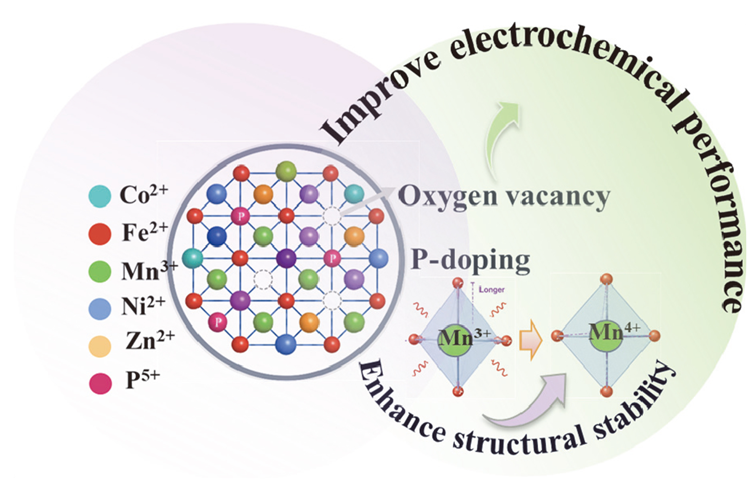
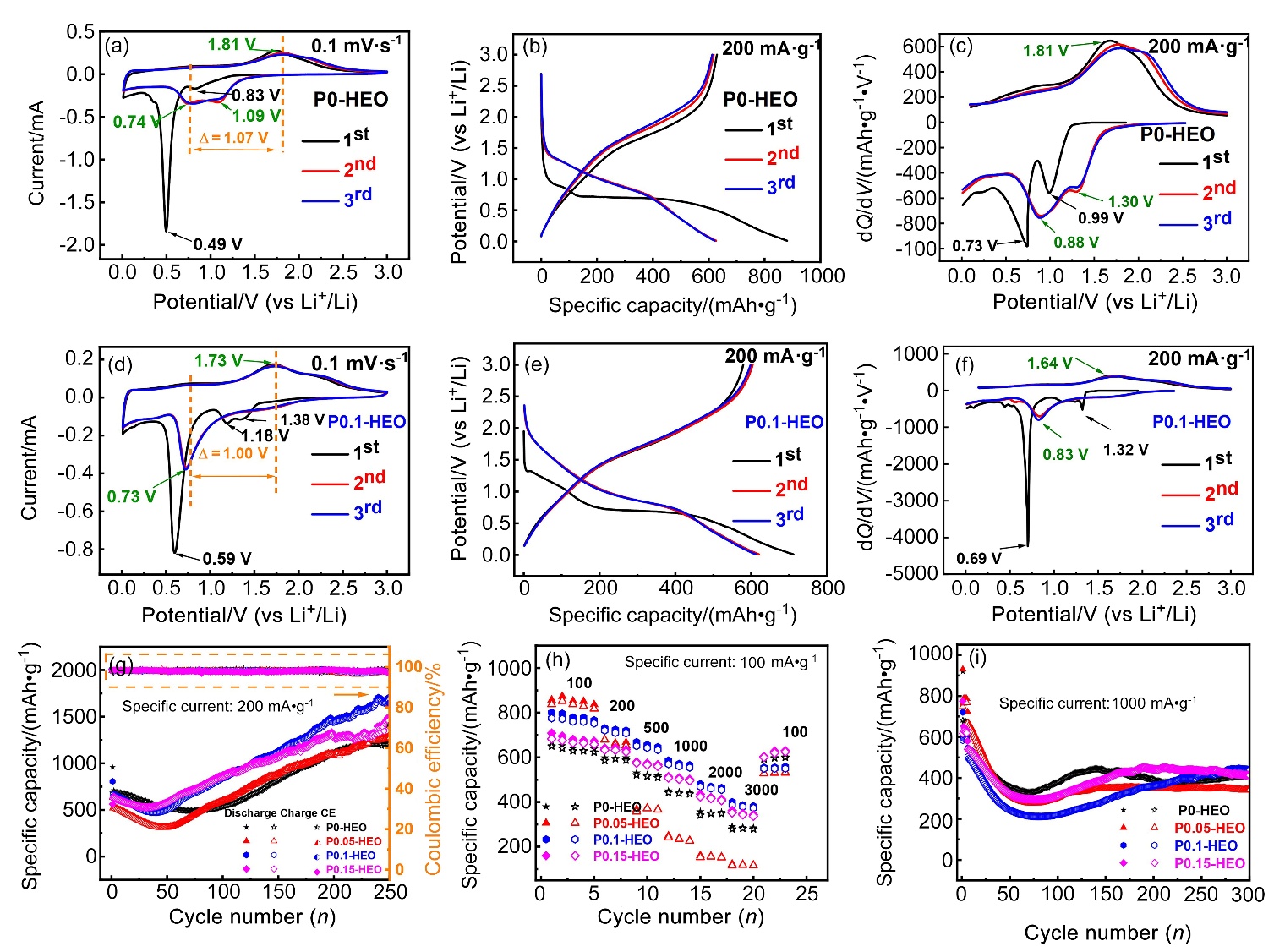
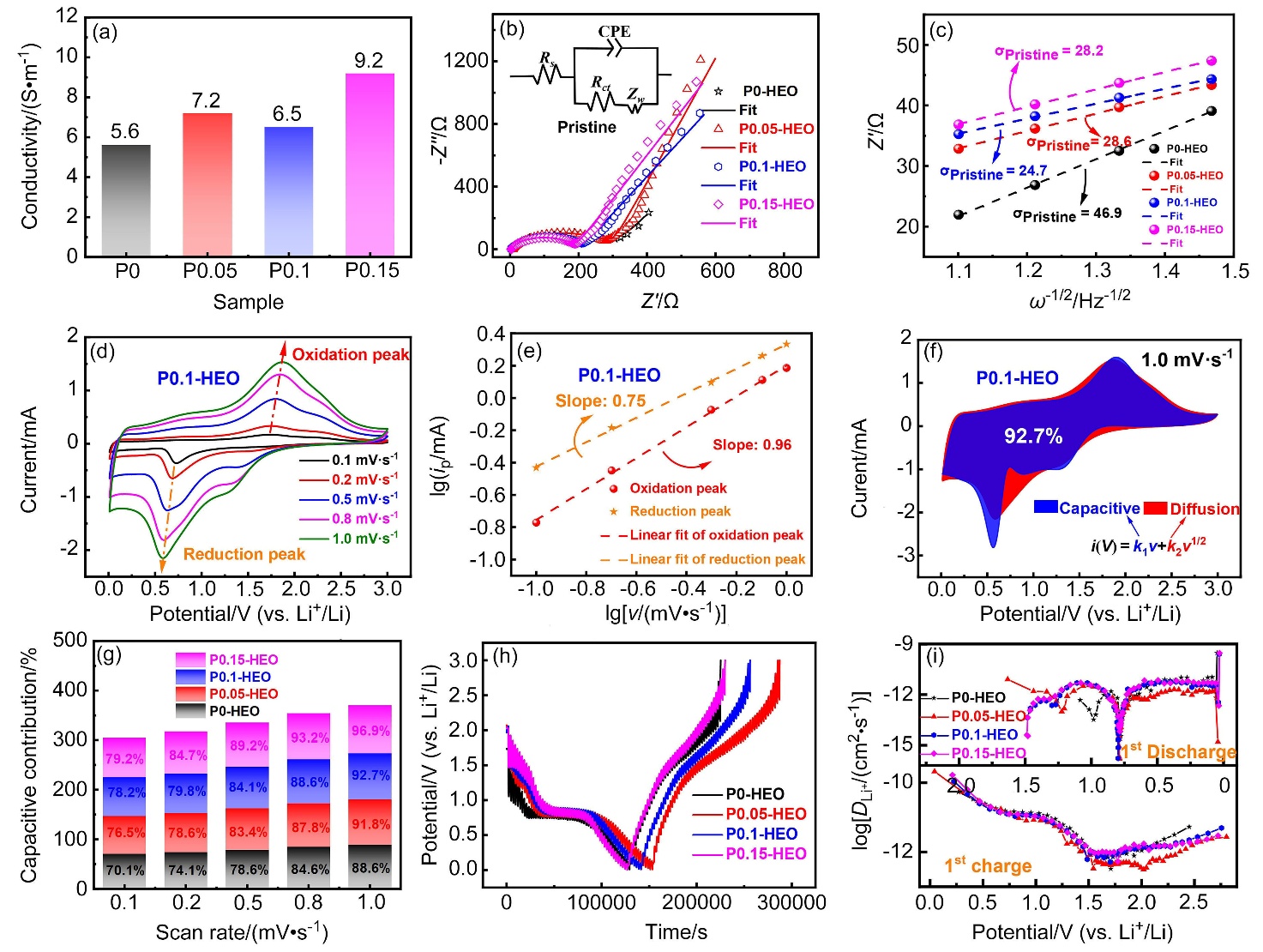
高熵氧化物(HEO)因具有高熵效应、多主元协同效应和可调组成, 在锂离子电池负极材料领域展现出良好的应用前景. 然而, 尖晶石型高熵氧化物在储锂过程中仍存在电子/离子传输动力学缓慢等问题, 限制了其电化学性能的进一步提升. 采用类金属P掺杂策略, 通过溶液燃烧法制备了尖晶石型HEO [Px(Co0.2Fe0.2Mn0.2Ni0.2Zn0.2)1-x]3O4 (x=0, 0.05, 0.10, 0.15, 0.2, 记为Px-HEO), 并研究了P掺杂对材料结构、缺陷特征及储锂性能的影响. 结果表明, P掺杂形成的P—O及P—O—M共价键促进了氧空位生成, 并通过电荷补偿使部分Mn3+转化为Mn4+, 有效减弱Jahn-Teller效应, 提升了结构稳定性. 其中, P0.1-HEO样品具有较高的比表面积(60.85 m2•g-1)和丰富的表面氧空位(50.1%), 显著改善了电子/离子传输动力学. P0.1-HEO电极在200 mA•g-1下循环250圈后仍保持1711 mAh•g-1的可逆容量, 在3000 mA•g-1下仍可提供385 mAh•g-1的可逆容量. 该研究为通过类金属P掺杂协同优化高熵氧化物的结构稳定性和储锂性能提供了实验基础.
徐世彪, 潘美伊, 韦正兵, 尹飞龙, 鲍梦凡, 胡倩倩, 孙君豪, 林娜, 冒爱琴. 类金属磷掺杂调控高熵氧化物本征缺陷: 协同提升结构稳定性与反应动力学[J]. 化学学报, 2026, 84(10): 1579-1590.
Shibiao Xu, Meiyi Pan, Zhengbing Wei, Feilong Yin, Mengfan Bao, Qianqian Hu, Junhao Sun, Na Lin, Aiqin Mao. Metalloid Phosphorus Doping-regulated Intrinsic Defect Engineering in High-entropy Oxides: Synergistically Enhanced Structural Stability and Reaction Kinetics[J]. Acta Chimica Sinica, 2026, 84(10): 1579-1590.
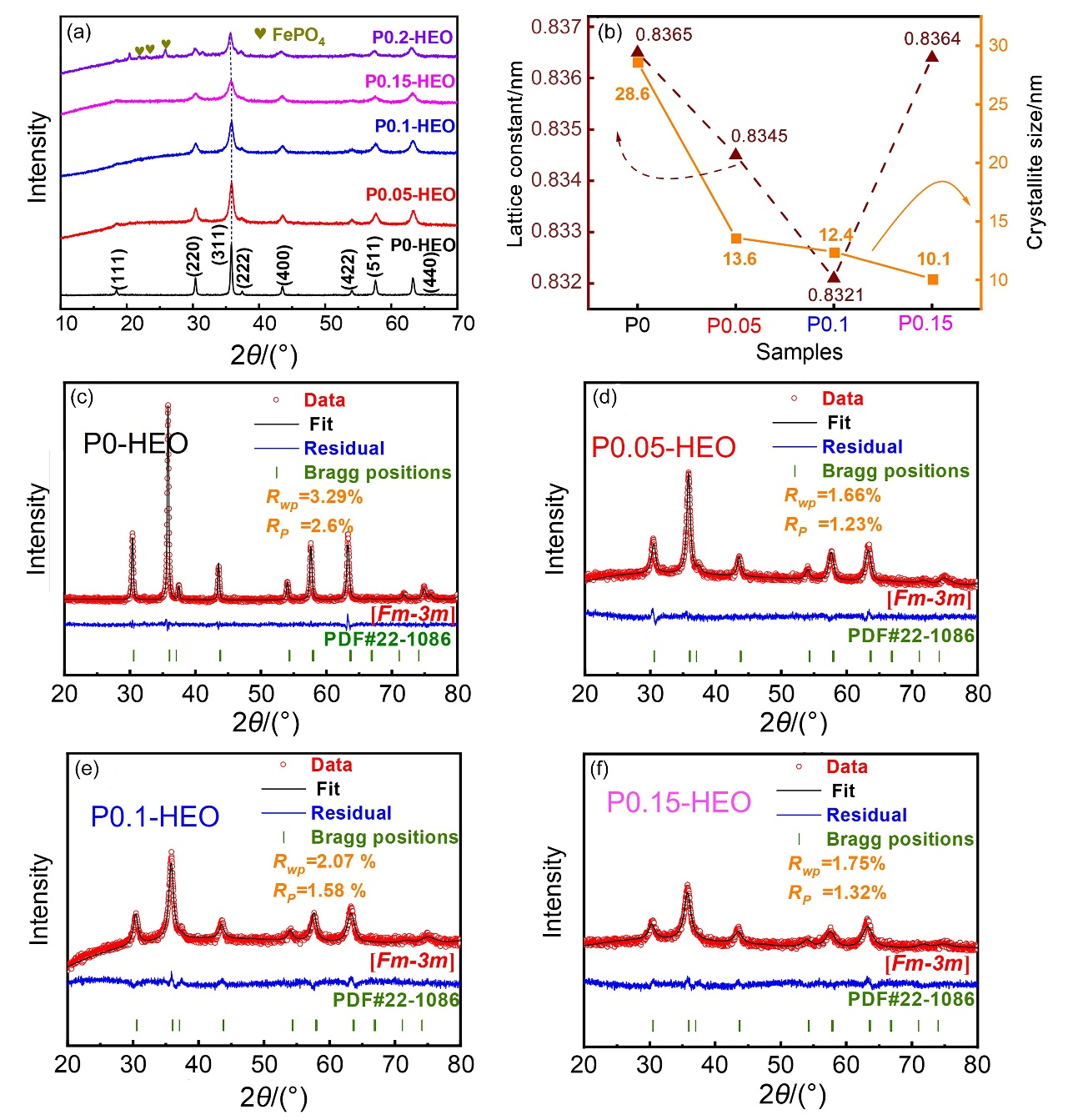
| Sample | Average crystallite size/nm | Crystal lattice parameter | Reliability factor | ||||||||
|---|---|---|---|---|---|---|---|---|---|---|---|
| a/nm | α/(°) | Vm/nm3 | Rp | Rwp | χ2 | ||||||
| P0-HEO | 28.6 | 0.8365 | 90 | 0.58533 | 2.60 | 3.29 | 1.18 | ||||
| P0.05-HEO | 13.6 | 0.8345 | 90 | 0.58114 | 1.67 | 1.23 | 1.52 | ||||
| P0.1-HEO | 12.4 | 0.8321 | 90 | 0.57614 | 2.07 | 1.58 | 2.50 | ||||
| P0.15-HEO | 10.1 | 0.8364 | 90 | 0.58512 | 1.71 | 1.32 | 1.74 | ||||

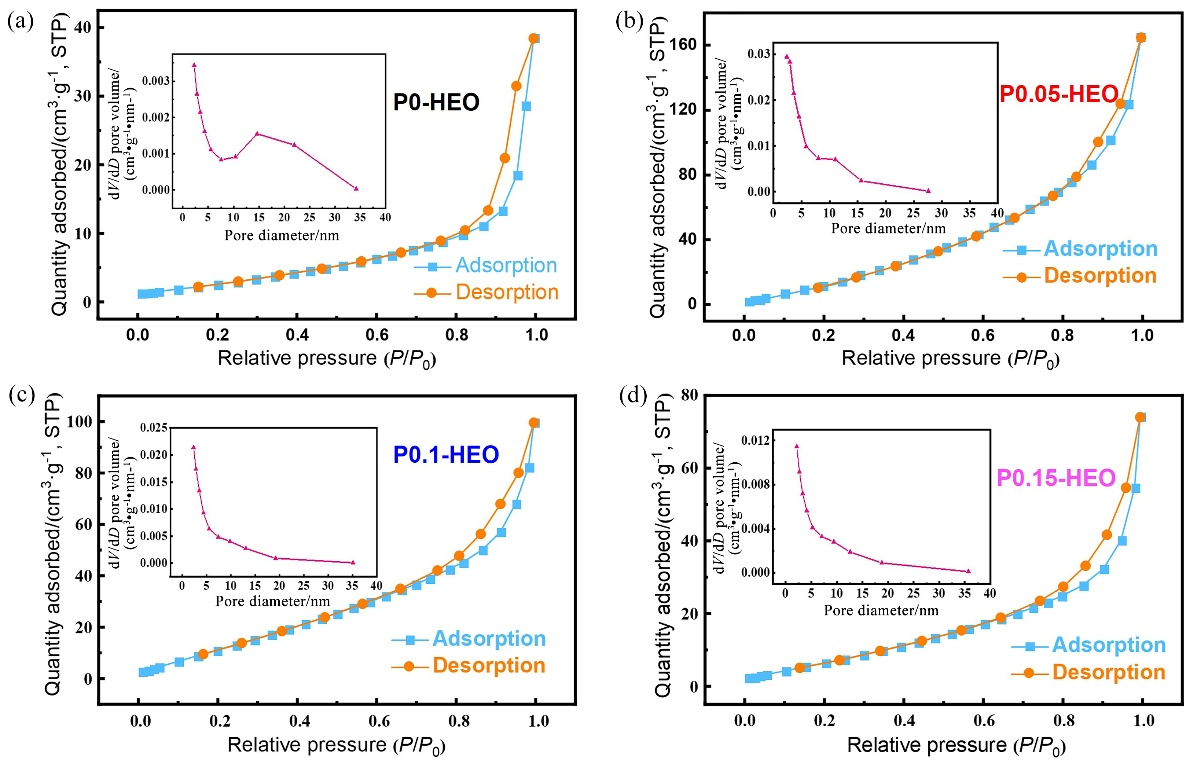
| Samples | SBET/(m2•g-1) | VBJH/(cm3•g-1) | Daver./nm | Dmost/nm |
|---|---|---|---|---|
| P0-HEO | 11.31 | 0.06 | 19.74 | 2.59 |
| P0.05-HEO | 89.18 | 0.24 | 10.82 | 2.56 |
| P0.1-HEO | 60.85 | 0.14 | 9.48 | 2.57 |
| P0.15-HEO | 31.27 | 0.11 | 13.52 | 2.60 |
| Samples | SBET/(m2•g-1) | VBJH/(cm3•g-1) | Daver./nm | Dmost/nm |
|---|---|---|---|---|
| P0-HEO | 11.31 | 0.06 | 19.74 | 2.59 |
| P0.05-HEO | 89.18 | 0.24 | 10.82 | 2.56 |
| P0.1-HEO | 60.85 | 0.14 | 9.48 | 2.57 |
| P0.15-HEO | 31.27 | 0.11 | 13.52 | 2.60 |
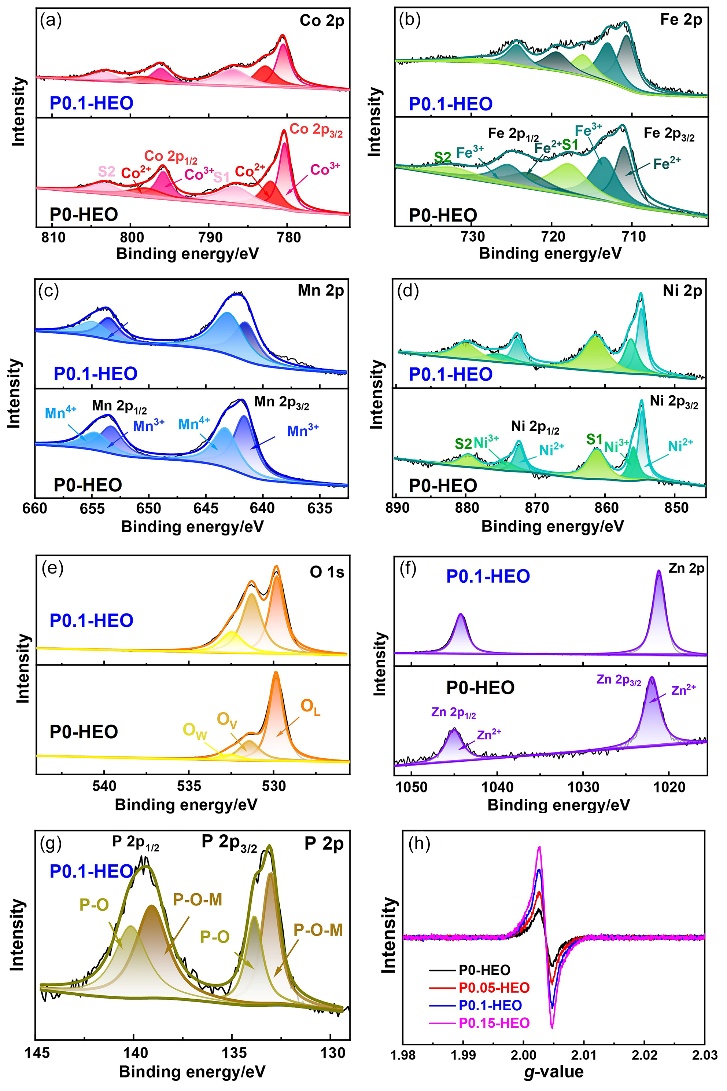
| Samples | Co2+/Co3+ | Fe2+/Fe3+ | Mn3+/Mn4+ | Ni2+/Ni3+ | OV/(OV+OL) |
|---|---|---|---|---|---|
| P0-HEO | 32.9/67.1 | 47.5/52.5 | 54.3/45.7 | 54.9/45.1 | 25.8% |
| P0.1-HEO | 44.1/55.9 | 54.9/45.1 | 40.8/59.2 | 55.3/44.7 | 50.1% |
| Samples | Co2+/Co3+ | Fe2+/Fe3+ | Mn3+/Mn4+ | Ni2+/Ni3+ | OV/(OV+OL) |
|---|---|---|---|---|---|
| P0-HEO | 32.9/67.1 | 47.5/52.5 | 54.3/45.7 | 54.9/45.1 | 25.8% |
| P0.1-HEO | 44.1/55.9 | 54.9/45.1 | 40.8/59.2 | 55.3/44.7 | 50.1% |
| [1] |
|
| [2] |
|
|
(王朋朋, 贾洋刚, 邵霞, 程婕, 冒爱琴, 檀杰, 方道来, 化工学报, 2022, 73, 5625.)
|
|
| [3] |
|
| [4] |
|
| [5] |
|
| [6] |
|
| [7] |
|
| [8] |
|
| [9] |
|
| [10] |
|
| [11] |
|
|
(张威龙, 李桦林, 庞刚, 安徽工业大学学报(自然科学版), 2024, 41, 248.)
|
|
| [12] |
|
| [13] |
|
| [14] |
|
|
(贾洋刚, 陈诗洁, 邵霞, 程捷, 林娜, 方道来, 冒爱琴, 李灿华, 化学学报, 2023, 81, 486.)
|
|
| [15] |
|
| [16] |
|
| [17] |
|
| [18] |
|
| [19] |
|
| [20] |
|
| [21] |
|
| [22] |
|
|
(薛兰, 刘爽, 章硕, 伽龙, 化学学报, 2025, 83, 853.)
|
|
| [23] |
|
| [24] |
|
| [25] |
|
| [26] |
|
| [27] |
|
| [28] |
|
| [29] |
|
| [30] |
|
| [31] |
|
| [1] | 姚志豪, 张巍, 周昭仪, 李丹聪, 张凯凯, 刘涛, 胡文凯, 程守安, 胡铭轩, 刘昱佳. Sr/Fe协同调控LaMnO3电子结构及CO选择性催化还原反应机理研究[J]. 化学学报, 2026, 84(1): 30-42. |
| [2] | 韦正兵, 鲍梦凡, 徐世彪, 程怡, 陈诗洁, 林娜, 冒爱琴. 氟掺杂诱导岩盐型高熵氧化物本征缺陷调控及其储锂性能优化[J]. 化学学报, 2025, 83(8): 868-877. |
| [3] | 徐梦鑫, 杨智健, 孙径, 邹文强, 徐忠宁, 郭国聪. Pd/Pr-CeO2催化剂载体氧空位调控CO酯化制碳酸二甲酯选择性[J]. 化学学报, 2025, 83(7): 655-660. |
| [4] | 张娜娜, 李静. 氧空位增强PdNi/HfO2催化剂在乙二醇电催化氧化中的活性[J]. 化学学报, 2025, 83(7): 709-715. |
| [5] | 孙伟, 辛国祥, 刘飞, 鞠藤, 程宇通, 宋金玲, 包金小, 布林朝克. 三维石墨烯/富含氧空位Fe2O3复合材料的构建实现超级电容器超高能量密度[J]. 化学学报, 2025, 83(3): 256-265. |
| [6] | 何璐, 王硕, 陈宇辉. 媒介体催化在锂-空气电池中的应用与挑战★[J]. 化学学报, 2025, 83(11): 1414-1423. |
| [7] | 张帆帆, 蔡元韬, 陶剑波, 常国菊, 郭欣辰, 郝仕油. Zn, C引入量和煅烧温度对ZnO/C/CeO2光催化还原Cu2+效率的影响[J]. 化学学报, 2024, 82(8): 871-878. |
| [8] | 王国景, 陈永辉, 张秀芹, 张俊笙, 徐俊敏, 王静. 氧空位控制BiVO4晶面异质结的磁性和光电催化性能[J]. 化学学报, 2024, 82(4): 409-415. |
| [9] | 鲍梦凡, 陈诗洁, 邵霞, 邓慧娟, 冒爱琴, 檀杰. 低共熔溶剂辅助制备空心球状钙钛矿型高熵氧化物及高倍率储锂性能[J]. 化学学报, 2024, 82(3): 303-313. |
| [10] | 税子怡, 于思乐, 陆伟, 许留云, 刘庆叶, 赵炜, 刘益伦. Mn掺杂Co3O4双功能电催化剂在碱性介质下氧还原和析氧反应中的应用[J]. 化学学报, 2024, 82(10): 1039-1049. |
| [11] | 贾洋刚, 陈诗洁, 邵霞, 程婕, 林娜, 方道来, 冒爱琴, 李灿华. 高性能无钴化钙钛矿型高熵氧化物负极材料的制备及储锂性能研究[J]. 化学学报, 2023, 81(5): 486-495. |
| [12] | 张国强, 霍京浩, 王鑫, 郭守武. 基于P掺杂TiO2/C纳米管负极的高性能锂离子电容器[J]. 化学学报, 2023, 81(1): 6-13. |
| [13] | 张旭寒, 邓博文, 范海东, 黄文辉, 张彦威. 基于锌锗二元氧化物的光热协同分解CO2研究[J]. 化学学报, 2020, 78(10): 1120-1126. |
| [14] | 许辰宇, 林伽毅, 潘富强, 邓博文, 王智化, 周俊虎, 陈云, 马京程, 顾志恩, 张彦威. Ni离子替位掺杂TiO2增强光热化学循环还原CO2研究[J]. 化学学报, 2017, 75(7): 699-707. |
| [15] | 高成贵, 隆正文, 谭兴凤, 龙波, 龙超云, 秦水介, 张为俊. 大气中单个水分子影响HOBr+OH·反应的理论研究[J]. 化学学报, 2013, 71(05): 849-856. |
| 阅读次数 | ||||||
|
全文 |
|
|||||
|
摘要 |
|
|||||
