

化学学报 ›› 2025, Vol. 83 ›› Issue (9): 1006-1012.DOI: 10.6023/A25050197 上一篇 下一篇
研究论文
徐全印, 石欣阳, 罗锦添, 左彪*( )
)
投稿日期:2025-05-29
发布日期:2025-06-30
作者简介:★ “中国青年化学家”专辑.
基金资助:
Quanyin Xu, Xinyang Shi, Jintian Luo, Biao Zuo*()
Received:2025-05-29
Published:2025-06-30
Contact:
* E-mail: chemizuo@zstu.edu.cn
About author:★ For the VSI “Rising Stars in Chemistry”.
Supported by:文章分享
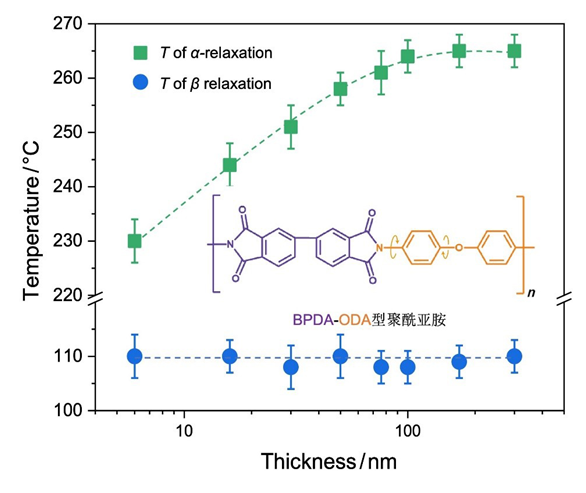
聚酰亚胺(PI)薄膜因优异的耐高温性、绝缘性及化学稳定性, 广泛应用于光电器件与半导体封装领域. 纳米厚度PI薄膜的松弛行为关系到其热稳定性和尺寸稳定性等性质, 是影响PI薄膜应用的重要物理性质. 本工作用介电松弛和动态力学分析研究了PI的多级松弛行为, 明确PI的α和β松弛的温度区间; 利用椭圆偏振光谱表征纳米级厚度PI薄膜的热膨胀和松弛行为, 探究薄膜厚度对PI分子热运动的影响. 结果表明, 当膜厚降低至100 nm以下时, 与链段运动关联的α松弛温度(Tα)随膜厚降低而减小, 而与芳环振动相关的β松弛温度(Tβ)保持不变; 同时, 薄膜的热膨胀系数随厚度减小显著增大. 本研究揭示了PI本体及超薄膜的松弛行为, 为开发高稳定、低膨胀的超薄封装材料提供了理论指导.
徐全印, 石欣阳, 罗锦添, 左彪. 纳米聚酰亚胺超薄膜的多级松弛与热转变★[J]. 化学学报, 2025, 83(9): 1006-1012.
Quanyin Xu, Xinyang Shi, Jintian Luo, Biao Zuo. Relaxation and Thermal Transition of Nanoscale Polyimide Ultrathin Films★[J]. Acta Chimica Sinica, 2025, 83(9): 1006-1012.


| [1] |
|
|
(丁孟贤, 聚酰亚胺—化学、结构与性能的关系及材料, 第二版, 科学出版社, 北京, 2012.)
|
|
| [2] |
|
| [3] |
|
|
(刘金刚, 倪洪江, 高鸿, 杨士勇, 航天器环境工程, 2014, 31, 470.)
|
|
| [4] |
|
| [5] |
|
| [6] |
|
|
(牛海军, 白续铎, 黄玉东, 汪成, 化学学报, 2005, 63, 1391.)
|
|
| [7] |
|
|
(杨进, 詹怀宇, 周雪松, 胡健, 刘辕, 顾宜, 刘向阳, 化学学报, 2009, 67, 875.)
|
|
| [8] |
|
| [9] |
|
|
(范振国, 刘四委, 池振国, 张艺, 许家瑞, 高分子学报, 2021, 52, 750.)
|
|
| [10] |
|
| [11] |
|
| [12] |
|
|
(罗锦添, 徐全印, 徐文生, 左彪, 高分子学报, 2025, 56, 539.)
|
|
| [13] |
|
| [14] |
|
| [15] |
|
|
(陈咏萱, 周东山, 胡文兵, 高分子学报, 2021, 52, 423.)
|
|
| [16] |
|
| [17] |
|
| [18] |
pmid: 11046459 |
| [19] |
|
| [20] |
|
| [21] |
|
|
(阳禹辉, 沈华琦, 左彪, 化学通报, 2024, 87, 258.)
|
|
| [22] |
|
| [23] |
|
| [24] |
|
| [25] |
|
| [26] |
|
| [27] |
|
| [28] |
|
| [29] |
|
| [30] |
|
| [31] |
|
| [32] |
|
| [33] |
|
|
(白帆, 江怡雯, 李琇廷, 董杰, 赵昕, 张清华, 高分子学报, 2024, 55, 1393.)
|
|
| [34] |
|
| [35] |
|
| [36] |
|
| [37] |
|
| [38] |
|
| [39] |
|
| [40] |
|
| [41] |
|
| [42] |
|
|
(汪称意, 赵辉鹏, 李光, 江建明, 化学学报, 2010, 68, 449.)
|
|
| [43] |
|
|
(黄卫, 颜德岳, 路庆华, 高等学校化学学报, 2002, 23, 2005.)
|
|
| [44] |
|
|
(赵亮, 黄玉东, 朴艳梅, 孟祥丽, 宋元军, 龙军, 化学学报, 2009, 67, 1013.)
|
|
| [45] |
|
| [46] |
|
| [47] |
|
| [48] |
|
| [49] |
|
| [50] |
|
|
(王粉粉, 孙平川, 高分子学报, 2021, 52, 840.)
|
|
| [51] |
|
|
(袁琦璐, 杨镇岳, 徐文生, 中国科学(化学), 2023, 53, 616.)
|
|
| [52] |
|
| [53] |
|
| [54] |
|
| [55] |
doi: 10.1039/c7cp05357f pmid: 29086788 |
| [56] |
pmid: 15267922 |
| [57] |
|
| [58] |
|
|
(王畅鸥, 翟磊, 高梦岩, 贾妍, 莫松, 何民辉, 范琳, 中国科学, 2022, 52, 437.)
|
| [1] | 雷冬, 陆丹. 介电松弛谱法用于高分子链动力学行为的研究[J]. 化学学报, 2018, 76(8): 605-616. |
| [2] | 高才, 陈开松, 叶斌, 杨锁, 刘向农, 江斌. 基于位形熵模型的山梨醇玻璃焓松弛的量热分析[J]. 化学学报, 2011, 69(01): 37-45. |
| [3] | 汪称意, 赵辉鹏, 李光, 江建明. 一种高可溶、高光学透明含氟聚酰亚胺的合成与表征[J]. 化学学报, 2010, 68(05): 449-452. |
| [4] | 赵亮,黄玉东,朴艳梅,孟祥丽,宋元军,龙军. 新型磺化聚酰亚胺膜的合成与表征[J]. 化学学报, 2009, 67(9): 1013-1018. |
| [5] | 杨进,詹怀宇,周雪松,胡健,刘辕. 新型苯并噁唑侧基聚酰亚胺的合成、结构与性能研究[J]. 化学学报, 2009, 67(8): 875-878. |
| [6] | 汪称意,李光,江建明. 一种含三氟甲基取代不对称芳香二胺及其可溶性透明聚醚酰亚胺 的合成与表征[J]. 化学学报, 2008, 66(22): 2569-2573. |
| [7] | 高才,王铁军,周国燕,华泽钊. 用DSC研究1,2-丙二醇及其水溶液的协同松弛行为[J]. 化学学报, 2007, 65(21): 2393-2400. |
| [8] | 牛海军,白续铎,黄玉东,汪成. 含有p-n单元的苝聚酰亚胺的合成及其敏化光电池的性能研究[J]. 化学学报, 2005, 63(15): 1391-1396. |
| [9] | 汪静, 林保平, 袁春伟. 模板技术制备有序大孔含硅聚酰亚胺薄膜[J]. 化学学报, 2004, 62(11): 1019-1023. |
| [10] | 雷惊雷,李凌杰,张胜涛,蔡生民,李荻,杨迈之. 铜电极在弱碱性介质中腐蚀行为的研究[J]. 化学学报, 2001, 59(8): 1216-1221. |
| [11] | 余正坤,徐筠,廖世健,余道容,杨少华,赵永魁,范荫恒,蹇锡高,孟跃中. 有机高分子固载钯催化剂的羰基化和加氢催化性能[J]. 化学学报, 1996, 54(3): 253-260. |
| 阅读次数 | ||||||
|
全文 |
|
|||||
|
摘要 |
|
|||||
