

化学学报 ›› 2025, Vol. 83 ›› Issue (9): 1035-1045.DOI: 10.6023/A25050144 上一篇 下一篇
研究展望
吕海峰a, 李星星a,b,*( )
)
投稿日期:2025-05-07
发布日期:2025-07-14
作者简介: |
吕海峰, 中国科学技术大学副研究员. 2019年获中国科学技术大学博士学位. 研究方向为理论与计算化学, 主要从事低维功能材料理论设计与模拟, 近五年来在Nat. Phys.、Nat. Chem.、J. Am. Chem. Soc.、PRL等SCI期刊发表第一/通讯(含共同)作者论文40余篇. |
 |
| 李星星, 中国科学技术大学特任教授. 2015年于中国科学技术大学获博士学位. 2023年获基金委优秀青年基金资助. 长期致力于低维自旋材料和分子器件的第一性原理研究. 迄今为止在Nature Nanotech.、Nat. Commun.、Sci. Adv.、JACS、Angew、PRL等SCI期刊发表第一/通讯(含共同)作者论文60余篇. 曾获中国化学会青年化学奖、中国科学院院长特别奖等奖励. |
★ “中国青年化学家”专辑.
基金资助:
Haifeng Lva, Xingxing Lia,b,*()
Received:2025-05-07
Published:2025-07-14
Contact:
* E-mail: lixx@ustc.edu.cn
About author:★ For the VSI “Rising Stars in Chemistry”.
Supported by:文章分享
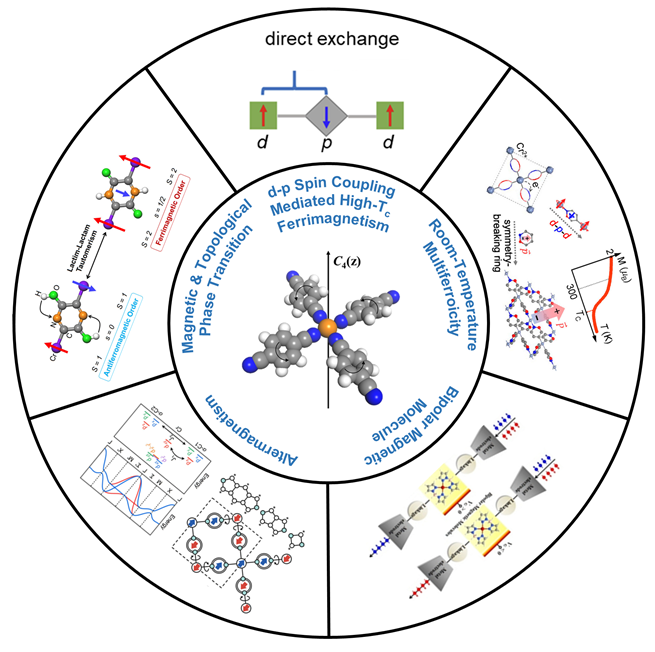
低维磁性材料能够同时利用电子的自旋和电荷自由度进行信息的存储、处理和传递, 在下一代高速信息技术中展现出重要应用前景. 然而, 低维磁性材料发展面临着实验合成和表征困难、居里温度低、功能单一等问题. 针对这一现状, 通过第一性原理计算方法对低维磁性材料进行性能定制是解决上述问题的重要途径之一. 在此背景下, 金属有机配位体系凭借其独特的结构可设计性受到广泛的关注, 其丰富的过渡金属中心和多样化的有机配体库为低维磁性材料设计提供了广阔空间. 其中, 可精确调控的配位化学环境能有效地调制金属/配体的电荷态和自旋态, 从而诱导产生自旋极化. 而且, 金属和配体之间为配位键, 轨道耦合形式多样且可调, 为实现高居里温度、多样的磁相互作用提供了理想平台. 此外, 有机配体方便进行化学修饰和构象调控, 有利于实现磁性相变体系和多功能集成的自旋电子器件. 为此, 系统总结了低维磁性金属有机材料第一性原理设计的最新研究进展, 重点阐述了金属有机体系实现特定功能性磁体的几个关键设计策略, 包括: 室温稳定亚铁磁体的构筑方法、磁性相变的化学调控策略、多铁磁体设计方法、具有显著Rashba效应的金属有机材料设计方案、双极磁性分子的设计原理、新型交变磁体的创制途径, 以及电场调控磁性的微观机制等. 最后, 探讨了结合机器学习方法实现具有高磁晶各向异性能的低维金属有机磁体的研究进展. 通过系统总结金属有机体系在低维磁性材料设计中的独特优势与现存挑战, 该展望期待能为后续相关研究提供前瞻性的理论指导与技术路线.
吕海峰, 李星星. 新型功能性低维金属有机磁体的第一性原理设计★[J]. 化学学报, 2025, 83(9): 1035-1045.
Haifeng Lv, Xingxing Li. First-Principles Design of Low-Dimensional Organometallic Magnets with Novel Functions★[J]. Acta Chimica Sinica, 2025, 83(9): 1035-1045.







| [1] |
|
| [2] |
(a)
doi: 10.1038/nmat2133 pmid: 31065072 |
|
(b)
pmid: 31065072 |
|
|
(c)
doi: 10.1038/s41565-019-0438-6 pmid: 31065072 |
|
| [3] |
(a)
doi: 10.1039/c0cs00166j pmid: 21479292 |
|
(b)
pmid: 21479292 |
|
|
(c)
pmid: 21479292 |
|
|
(d)
pmid: 21479292 |
|
|
(e)
pmid: 21479292 |
|
| [4] |
(a)
pmid: 33630582 |
|
(b)
pmid: 33630582 |
|
|
(c)
pmid: 33630582 |
|
|
(d)
pmid: 33630582 |
|
|
(e)
doi: 10.1039/c8nr03442g pmid: 33630582 |
|
|
(f)
pmid: 33630582 |
|
|
(g)
doi: 10.1021/acs.chemrev.0c01049 pmid: 33630582 |
|
|
(h)
pmid: 33630582 |
|
|
(刘治鲁, 李玮, 刘昊, 庄旭东, 李松, 化学学报, 2019, 77, 323.)
doi: 10.6023/A18120497 pmid: 33630582 |
|
| [5] |
(a)
pmid: 32045215 |
|
(b)
doi: 10.1021/acs.chemrev.9b00666 pmid: 32045215 |
|
|
(c)
pmid: 32045215 |
|
|
(d)
pmid: 32045215 |
|
|
(e)
pmid: 32045215 |
|
|
(f)
pmid: 32045215 |
|
| [6] |
|
| [7] |
|
| [8] |
(a)
doi: 10.1021/jacs.2c10916 pmid: 38953583 |
|
(b)
doi: 10.1021/jacs.4c04102 pmid: 38953583 |
|
| [9] |
|
| [10] |
(a)
|
|
(b)
|
|
| [11] |
(a)
doi: 10.1021/jacs.7b00705 pmid: 28230984 |
|
(b)
pmid: 28230984 |
|
|
(c)
pmid: 28230984 |
|
| [12] |
|
| [13] |
(a)
|
|
(b)
|
|
| [14] |
|
| [15] |
|
| [16] |
|
| [17] |
|
| [18] |
|
| [19] |
|
| [20] |
|
| [21] |
|
| [22] |
|
| [23] |
|
| [24] |
|
| [25] |
|
| [26] |
|
| [27] |
|
| [28] |
|
| [29] |
|
| [30] |
|
| [31] |
|
| [32] |
|
| [33] |
|
| [34] |
|
| [35] |
(a)
pmid: 10062328 |
|
(b)
doi: 10.1103/PhysRevLett.77.3865 pmid: 10062328 |
|
| [36] |
(a)
doi: 10.1038/s41524-024-01503-3 pmid: 39872025 |
|
(b)
pmid: 39872025 |
|
| [37] |
(a)
|
|
(b)
|
| No related articles found! |
| 阅读次数 | ||||||
|
全文 |
|
|||||
|
摘要 |
|
|||||
