

化学学报 ›› 2026, Vol. 84 ›› Issue (2): 248-256.DOI: 10.6023/A25090323 上一篇 下一篇
研究论文
汪庆辉a,†( ), 任正a,†(), 张凯b,*(), 周东营a,*(), 樊健a,c,*()
投稿日期:2025-09-27
发布日期:2025-11-10
基金资助:
Qinghui Wanga(), Zheng Rena(), Kai Zhangb,*(), Dongying Zhoua,*(), Jian Fana,c,*()
Received:2025-09-27
Published:2025-11-10
Contact:
*E-mail: 15692312996@163.com;dyzhou@suda.edu.cn;jianfan@suda.edu.cn
About author:Supported by:文章分享
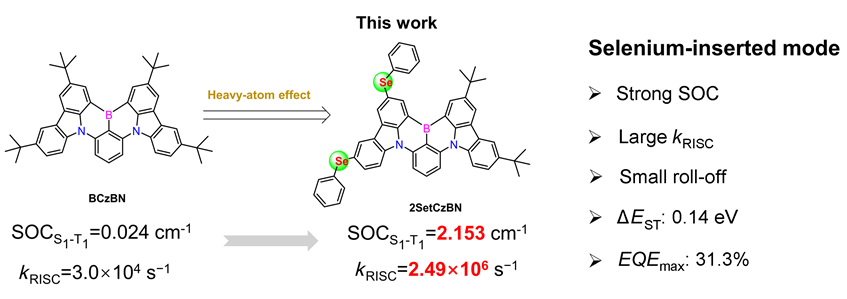
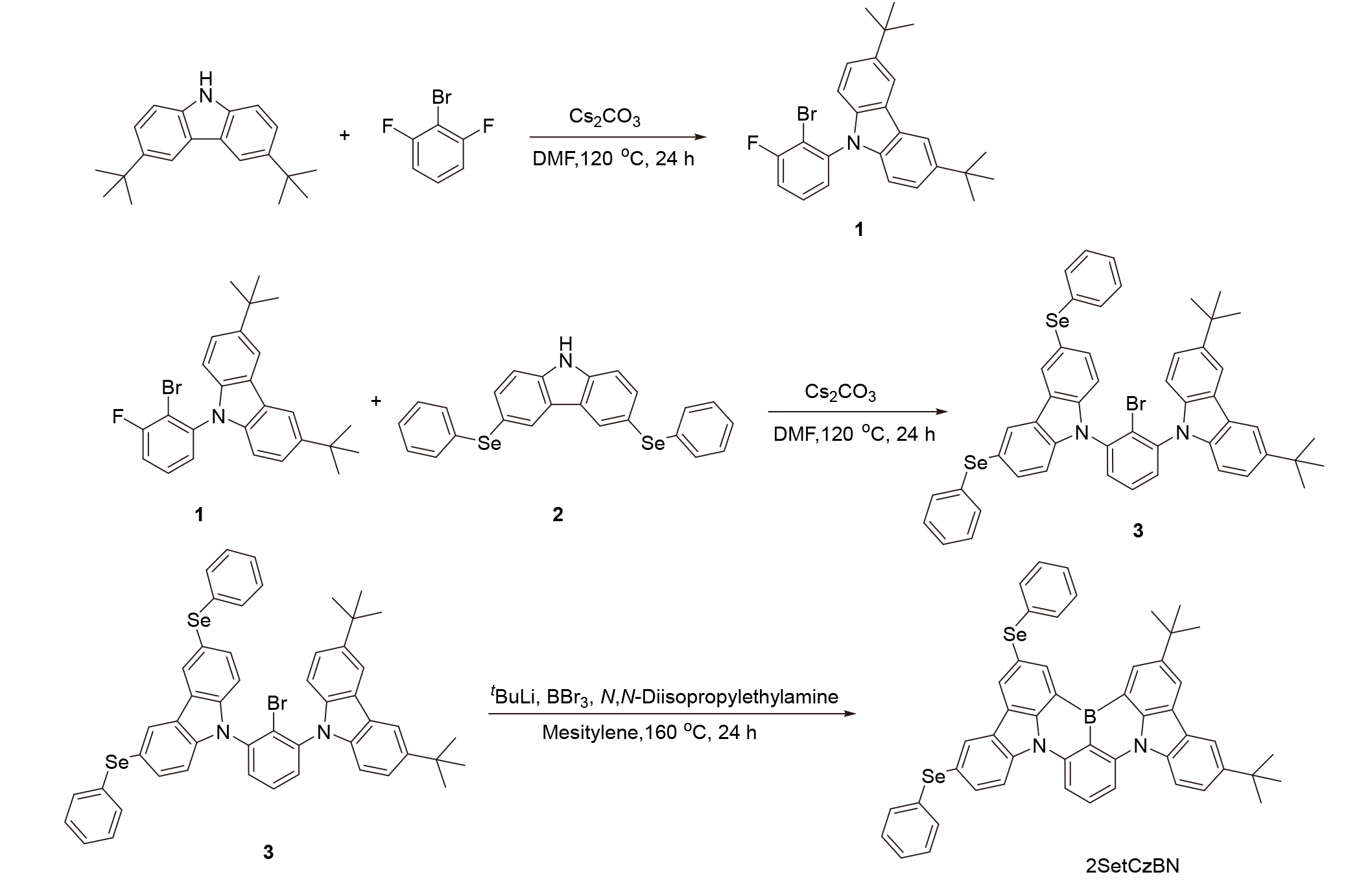
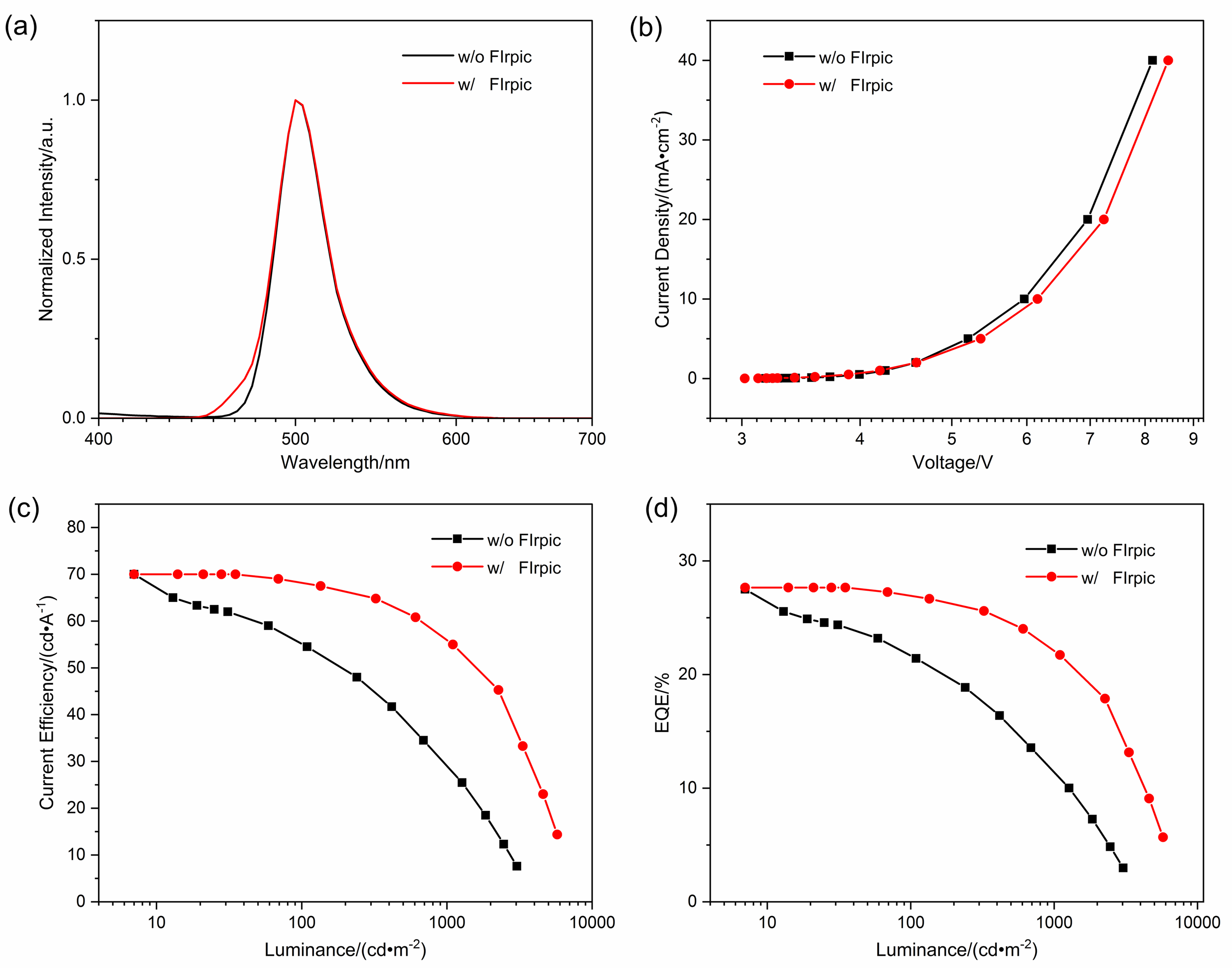
传统的多重共振热活化延迟荧光材料(MR-TADF)的反向系间窜越速率(kRISC)低, 器件在高亮度下效率滚降明显. 因此, 本工作利用硒的重原子效应, 增强S1与T1的自旋轨道耦合, 提高三线态激子反向系间窜越速率, 从而降低器件在高亮度下的效率滚降. 在经典的硼氮类多重共振热活化延迟荧光材料BCzBN的基础上, 设计并合成了一种将硒原子引入咔唑的3, 6号位上的分子即2SetCzBN. 2SetCzBN在稀甲苯溶液中的半峰宽为26 nm, ΔEST仅有0.14 eV, 并且分子具有大的自旋轨道耦合, 最终实现了高达2.49×10⁶ s−1的反向系间窜越速率. 将2SetCzBN分子掺杂在主体材料9-(2-(9-苯基-9H-咔唑-3-基)苯基)-9H-3,9'-双咔唑(PhCzBCz)中制备的器件具有绿色发光, 当掺入15% (w) Firpic敏化时, 器件的最大外量子效率(EQEmax)可达到27.6%, 并且在1000 cd/m2的高亮度下, 器件的EQE为22.2%, 具有很低的效率滚降; 通过调控电子传输层厚度为50 nm时器件最大EQE达到了31.3%.
汪庆辉, 任正, 张凯, 周东营, 樊健. 基于3,6-二苯硒基咔唑的多重共振热活化延迟荧光分子[J]. 化学学报, 2026, 84(2): 248-256.
Qinghui Wang, Zheng Ren, Kai Zhang, Dongying Zhou, Jian Fan. Multiple Resonance Thermally Activated Delayed Fluorescence Molecule Based on 3,6-Diphenylselenylcarbazole[J]. Acta Chimica Sinica, 2026, 84(2): 248-256.

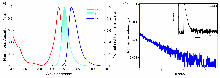

| 化合物 | λabsa/nm | λema/nm | FWHMa/nm | S1b/eV | T1b/eV | ΔESTc/eV |
|---|---|---|---|---|---|---|
| 2SetCzBN | 474 | 496 | 26 | 2.61 | 2.47 | 0.14 |
| 化合物 | λabsa/nm | λema/nm | FWHMa/nm | S1b/eV | T1b/eV | ΔESTc/eV |
|---|---|---|---|---|---|---|
| 2SetCzBN | 474 | 496 | 26 | 2.61 | 2.47 | 0.14 |
| 化合物 | ФPL/% | Фd/% | τp/ns | τd/μs | Kp/108 s−1 | Kd/105 s−1 | KrS/107 s−1 | KIC/107 s−1 | KISC/108 s−1 | KRISC/106 s−1 | |
|---|---|---|---|---|---|---|---|---|---|---|---|
| 2SetCzBN | 70 | 63.98 | 1.30 | 3.27 | 7.69 | 2.14 | 4.63 | 1.98 | 7.03 | 2.49 | |
| 化合物 | ФPL/% | Фd/% | τp/ns | τd/μs | Kp/108 s−1 | Kd/105 s−1 | KrS/107 s−1 | KIC/107 s−1 | KISC/108 s−1 | KRISC/106 s−1 | |
|---|---|---|---|---|---|---|---|---|---|---|---|
| 2SetCzBN | 70 | 63.98 | 1.30 | 3.27 | 7.69 | 2.14 | 4.63 | 1.98 | 7.03 | 2.49 | |
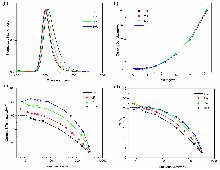
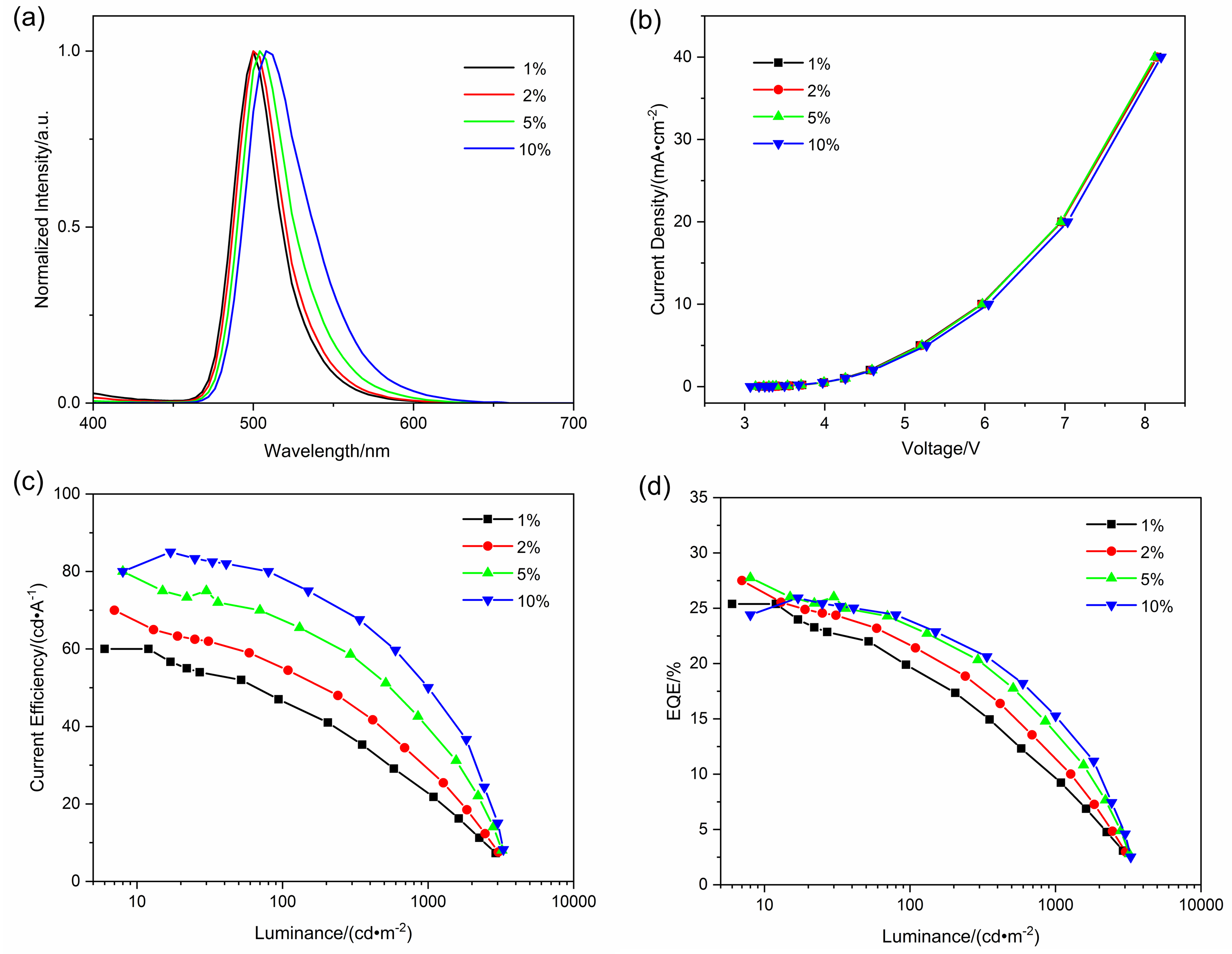
| 发光材料 | Dop (w/%) | Vona/V | EQEb/% | CEmaxc/(cd•A−1) | λem/nm | FWHM/nm | ||
|---|---|---|---|---|---|---|---|---|
| Max | @103 cd/m2 | |||||||
| 2SetCzBN | 1 2 5 10 | 3.2 3.2 3.1 3.1 | 25.4 27.5 27.7 25.9 | 9.8 11.7 13.9 15.2 | 60 70 80 85 | 500 500 504 508 | 32 32 36 44 | |
| 发光材料 | Dop (w/%) | Vona/V | EQEb/% | CEmaxc/(cd•A−1) | λem/nm | FWHM/nm | ||
|---|---|---|---|---|---|---|---|---|
| Max | @103 cd/m2 | |||||||
| 2SetCzBN | 1 2 5 10 | 3.2 3.2 3.1 3.1 | 25.4 27.5 27.7 25.9 | 9.8 11.7 13.9 15.2 | 60 70 80 85 | 500 500 504 508 | 32 32 36 44 | |
| 发光材料 | Dop (w/%) | Von/V | EQE/% | CE/(cd•A−1) | λem/nm | FWHM/nm | ||||
|---|---|---|---|---|---|---|---|---|---|---|
| Max | @103 cd/m2 | Max | @103 cd/m2 | |||||||
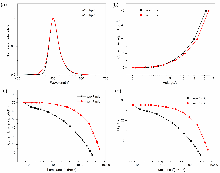
| 2SetCzBN 2SetCzBN:Firpic | 2 2 | 3.2 3.1 | 27.5 27.6 | 11.7 22.2 | 70.0 70.0 | 29.7 56.2 | 500 500 | 32 32 | ||
| 发光材料 | Dop (w/%) | Von/V | EQE/% | CE/(cd•A−1) | λem/nm | FWHM/nm | ||||
|---|---|---|---|---|---|---|---|---|---|---|
| Max | @103 cd/m2 | Max | @103 cd/m2 | |||||||
| 2SetCzBN 2SetCzBN:Firpic | 2 2 | 3.2 3.1 | 27.5 27.6 | 11.7 22.2 | 70.0 70.0 | 29.7 56.2 | 500 500 | 32 32 | ||

| [1] |
doi: 10.1126/science.abc8530 |
| [2] |
doi: 10.6023/A23020051 |
|
(葛凤洁, 张开志, 曹清鹏, 徐慧, 周涛, 张文浩, 班鑫鑫, 张晓波, 李娜, 朱鹏, 化学学报, 2023, 81, 1157.)
doi: 10.6023/A23020051 |
|
| [3] |
doi: 10.1002/jsid.v29.6 |
| [4] |
doi: 10.1038/s41377-020-0341-9 |
| [5] |
|
|
(刘彭义, 唐振方, 孙汪典, 暨南大学学报, 2002, 23, 66.)
|
|
| [6] |
doi: 10.1039/C5CC03114A |
| [7] |
doi: 10.1021/ja306538w |
| [8] |
|
|
(郑贤, 杨朝龙, 发光学报, 2022, 43, 1027.)
|
|
| [9] |
doi: 10.1038/nature11687 |
| [10] |
doi: 10.1039/D3CC05460H |
| [11] |
doi: 10.6023/A24100310 |
|
(马金珠, 李阳, 高珊, 赵越, 丁磊, 周东营, 樊健, 化学学报, 2025, 83, 17.)
doi: 10.6023/A24100310 |
|
| [12] |
doi: 10.6023/A24040148 |
|
(张登朝, 贾吉慧, 梁栋, 蔡显宝, 赵雨晴, 胡祥龙, 江钰冰, 卢灿忠, 化学学报, 2024, 82, 887.)
doi: 10.6023/A24040148 |
|
| [13] |
doi: 10.6023/A25010010 |
|
(方素琴, 童恺宁, 陈思浛, 张千峰, 童碧海, 冯敏强, 孔辉, 化学学报, 2025, 83, 471.)
doi: 10.6023/A25010010 |
|
| [14] |
doi: 10.7536/PC160520 |
|
(姜贺, 靳继彪, 陈润锋, 郑超, 黄维, 化学进展, 2016, 28, 1811.)
doi: 10.7536/PC160520 |
|
| [15] |
doi: 10.6023/A23040186 |
|
(王一诺, 邵世洋, 王利祥, 化学学报, 2023, 81, 1202.)
doi: 10.6023/A23040186 |
|
| [16] |
doi: 10.1002/adma.v28.14 |
| [17] |
doi: 10.1002/adma.v36.48 |
| [18] |
doi: 10.1038/s41467-023-38086-4 |
| [19] |
doi: 10.1021/acs.jpclett.3c03317 |
| [20] |
doi: 10.1038/nature09887 |
| [21] |
doi: 10.1063/1674-0068/cjcp2406082 |
| [22] |
|
| [23] |
doi: 10.1021/acsami.2c12017 |
| [24] |
doi: 10.1038/s41566-022-01083-y |
| [25] |
|
| [26] |
doi: 10.1002/anie.v58.47 |
| [27] |
doi: 10.1002/adom.v8.9 |
| [28] |
doi: 10.1002/adma.v35.6 |
| [29] |
doi: 10.1002/adfm.v30.35 |
| [30] |
|
|
(朱彤珺, 李来运, 半导体技术, 2007, 04, 358.)
|
|
| [31] |
|
|
(季兴桥, 黎威志, 钟志有, 王涛, 蒋亚东, 量子电子学报, 2006, 23, 416.)
|
|
| [32] |
|
| [33] |
|
| [34] |
doi: 10.3866/PKU.WHXB201201163 |
|
(王健, 张福俊, 徐征, 王永生, 物理化学学报, 2012, 28, 949.)
|
|
| [35] |
|
|
(王琪, 黄天宇, 张东东, 段炼, 发光学报, 2023, 44, 77.)
|
|
| [36] |
doi: 10.1109/JDT.2007.895354 |
| [37] |
doi: 10.1002/advs.v9.25 |
| [38] |
doi: 10.1039/D5TC01782C |
| [1] | 方素琴, 童恺宁, 陈思浛, 张千峰, 童碧海, 冯敏强, 孔辉. 基于呫吨酮电子受体的高效圆偏振热活化延迟荧光材料[J]. 化学学报, 2025, 83(5): 471-478. |
| [2] | 朱韵飞, 郭可威, 王子路, 李昊, 朱爱云, 马靖尧, 祝守加, 冯全友, 解令海. 芴基功能化D-A型可拉伸电致发光聚合物及其发光二极管[J]. 化学学报, 2025, 83(11): 1300-1308. |
| [3] | 闫安, 许世攀, 杜旭洋, 刘文平, 赵堃翔, 李胜利, 钟道昆, 周桂江, 杨晓龙, 孙源慧. 位阻诱导扭曲结构的蓝光材料合成及其在蓝色有机发光二极管(OLED)中的应用[J]. 化学学报, 2025, 83(11): 1317-1323. |
| [4] | 马金珠, 李阳, 高珊, 赵越, 丁磊, 周东营, 樊健. 基于吩嗪受体单元的高效近红外热激活延迟荧光[J]. 化学学报, 2025, 83(1): 17-24. |
| [5] | 王一诺, 邵世洋, 王利祥. 窄谱带多重共振有机高分子荧光材料研究进展★[J]. 化学学报, 2023, 81(9): 1202-1214. |
| [6] | 葛凤洁, 张开志, 曹清鹏, 徐慧, 周涛, 张文浩, 班鑫鑫, 张晓波, 李娜, 朱鹏. 柔性芴基嵌段型延迟荧光二聚体的设计、合成及电致发光性能[J]. 化学学报, 2023, 81(9): 1157-1166. |
| [7] | 刘振宇, 饶俊峰, 祝守加, 王兵洋, 余帆, 冯全友, 解令海. 溶液加工型自主体热活化延迟荧光材料的研究进展[J]. 化学学报, 2023, 81(7): 820-835. |
| [8] | 王银凤, 李猛, 陈传峰. 基于手性三蝶烯的红光热激活延迟荧光聚合物及其有机发光二极管研究★[J]. 化学学报, 2023, 81(6): 588-594. |
| [9] | 张少秦, 李美清, 周中军, 曲泽星. 多共振热激活延迟荧光过程的理论研究[J]. 化学学报, 2023, 81(2): 124-130. |
| [10] | 周路, 陈嘉雄, 籍少敏, 陈文铖, 霍延平. 喹喔啉类红光热活化延迟荧光材料研究进展[J]. 化学学报, 2022, 80(3): 359-372. |
| [11] | 周静, 田雪迎, 王斌凯, 张沙沙, 刘宗豪, 陈炜. 低温原子层沉积封装技术在OLED上的应用及对有机、钙钛矿太阳能电池封装的启示[J]. 化学学报, 2022, 80(3): 395-422. |
| [12] | 周涛, 钱越, 王宏健, 冯全友, 解令海, 黄维. 热活化延迟荧光蓝光小分子取代基效应的研究进展[J]. 化学学报, 2021, 79(5): 557-574. |
| [13] | 梁志鹏, 唐瑞, 邱雨晨, 王阳, 陆洪彬, 吴正光. 基于八氢联萘酚的大位阻手性发光材料构建及光电性质研究[J]. 化学学报, 2021, 79(11): 1401-1408. |
| [14] | 巫友雄, 任泓扬, 吴义芳, 王炳喜. 萘酰亚胺类电荷转移化合物能隙的理论研究[J]. 化学学报, 2015, 73(1): 53-59. |
| 阅读次数 | ||||||
|
全文 |
|
|||||
|
摘要 |
|
|||||
