

化学学报 ›› 2026, Vol. 84 ›› Issue (2): 257-263.DOI: 10.6023/A25090309 上一篇 下一篇
研究评论
甘定伟a, 周儒森a, 应见喜b,*( ), 周仁武a,*()
投稿日期:2025-09-12
发布日期:2025-10-14
作者简介: |
甘定伟, 西安交通大学在读博士研究生, 中国化学会会员、中国空间科学学会、国际深空探测学会学生会员, 于2023年宁波大学获得工学硕士学位, 目前在西安交通大学攻读博士学位, 研究方向为等离子体化学与生命起源. 主持国家自然科学基金青年学生基础研究项目(博士研究生). 已在 Earth. Planet. Sci. Lett., Adv. Sci., Green Chem., Chem. Commun.等期刊累计发表SCI论文15篇, 其中第一作者发表7篇, 入选封面论文1篇, H指数6, 申请国家发明专利2项. |
 |
周儒森, 西安交通大学电气工程学院特聘研究员、副教授, 博士生导师, 西安交通大学青年拔尖人才, 研究方向为气液放电、功能生物材料制备与改性等, 2021年2月于澳大利亚昆士兰科技大学获电气工程博士学位. 2021年3月至2024年1月历任澳大利亚悉尼大学博士后、研究员, 以第一/通讯作者在 J. Am. Chem. Soc., Carbon Energy, J. Energy Chem., Energy Convers. Manage., Green Chem., Appl. Phys. Lett., J. Phys. D Appl. Phys.等期刊发表SCI论文20余篇, SCI他引2000余次, H指数24; 累积入选ESI高被引论文6篇, 热点论文1篇. |
 |
应见喜, 宁波大学新药技术研究院研究员, 硕士生导师, 现任中国空间科学学会生命起源与进化专委会青年委员及秘书长. 于2018年7月获得化学生物学博士学位. 2018年11月, 加入宁波大学新药技术研究院, 主要从事生命化学起源, 天体生物学等研究工作. 先后在 Earth. Planet. Sci. Lett., Chem. Commun., Chin. Chem. Lett., Chin. J. Chem.等国内外期刊发表学术论文20余篇, 获得中国授权发明专利2项. 从2018年以来先后承担国家自然科学基金、中科院空间科学与应用总体部项目子课题、省部重点实验室基金和宁波市基金等9项科研任务. |
 |
周仁武, 教授, 国家高层次人才青年计划入选者. 研究方向为等离子体能源转化, 等离子体氮化学与生命起源等. 于2019年澳大利亚昆士兰科技大学获电气工程博士学位. 担任Frontiers of Chemical Science and Engineering客座主编、Nano-Micro Lett., Eco-Energy等期刊青年编委及Sci. Adv.等期刊审稿人. 主持国家高层次人才青年项目、国家自然科学基金面上项目等科研项目, 以第一/通讯作者在Adv. Mater., JACS, Green Chem.等期刊上发表SCI论文60余篇, 入选ESI高被引论文10篇, 热点论文1篇, SCI他引6000余次. 授权中国发明专利5项和申请国际专利4项, 2022~2024年入选美国斯坦福大学发布的“全球前2%科学家榜单”. 指导学生获得首届IOP Publishing中国区高被引作者奖、国际权威期刊亮点论文奖等. |
基金资助:
Dingwei Gana, Rusen Zhoua, Jianxi Yingb,*(), Renwu Zhoua,*()
Received:2025-09-12
Published:2025-10-14
Contact:
*E-mail: yingjianxi@nbu.edu.cn;renwu.zhou@xjtu.edu.cn
Supported by:文章分享
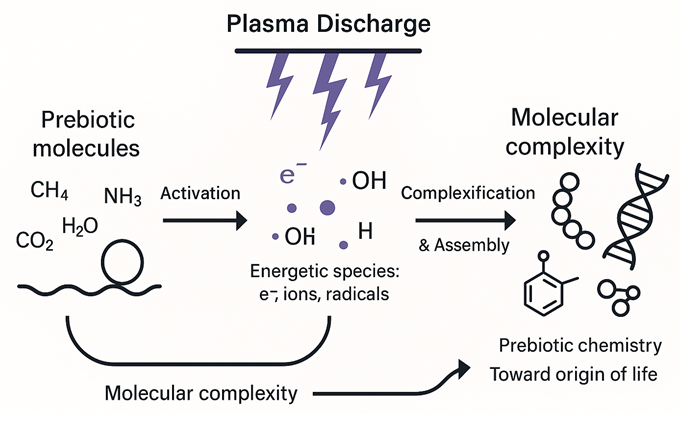
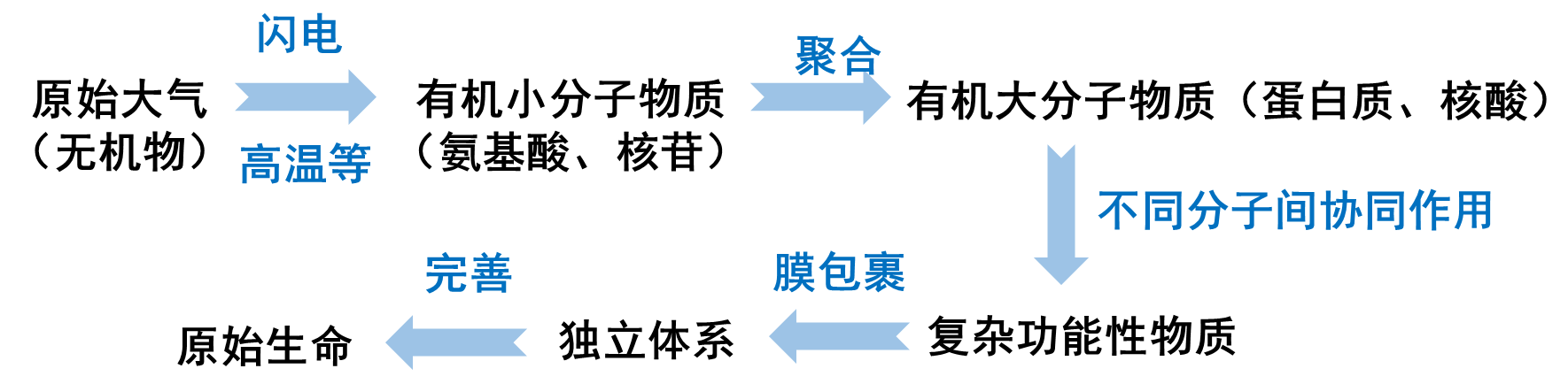
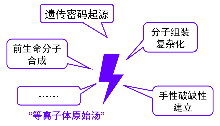
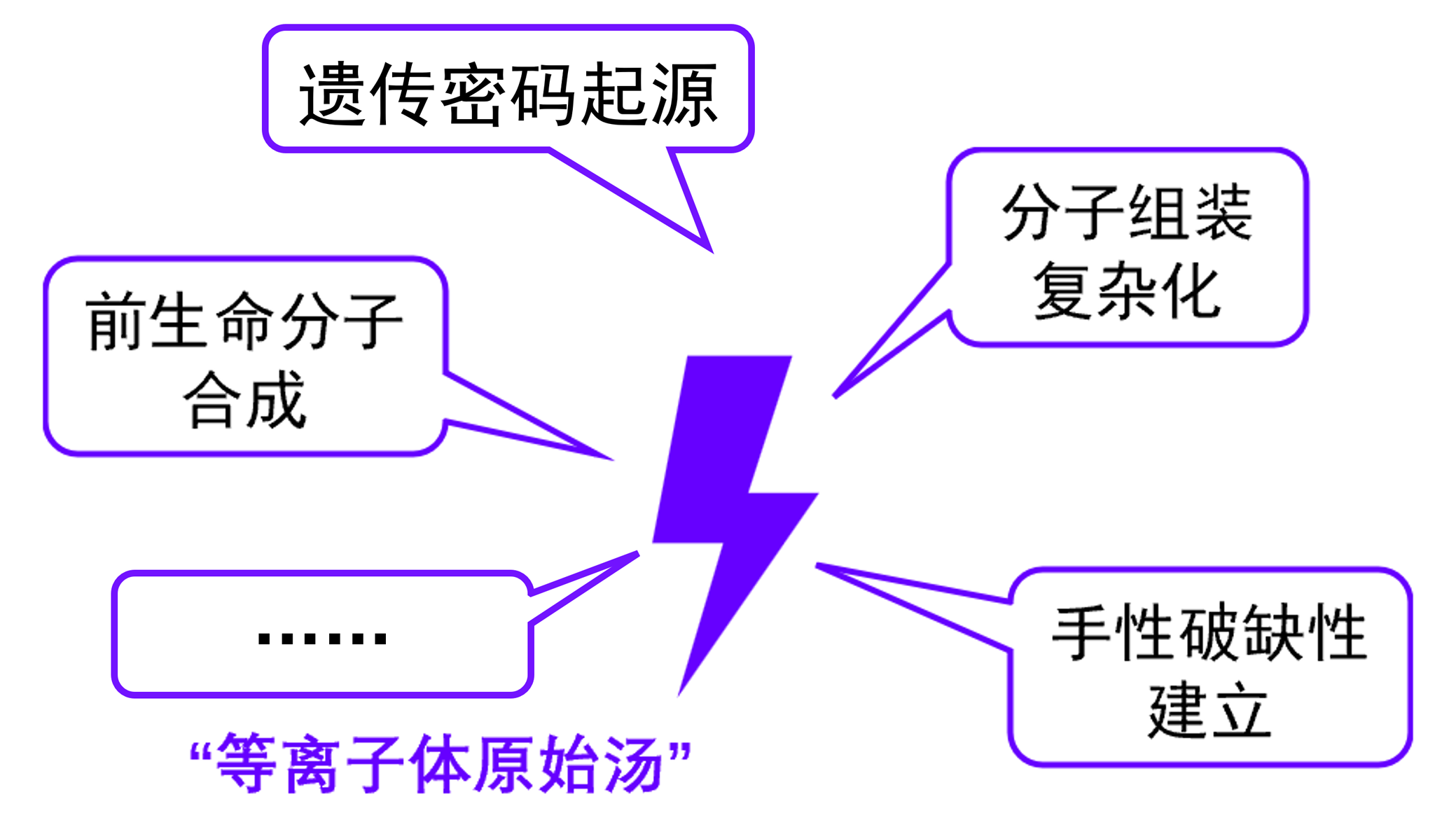
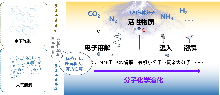
生命的起源和演化是人类面临的终极谜题之一. 传统化学起源学说涉及惰性气体分子活化、简单分子向复杂功能分子演化、生物分子同手性以及遗传密码起源等关键问题. “米勒-尤里”放电实验以来, “等离子体放电”被认为是生命分子起源的可能场景之一. 等离子体作为一种非平衡态的高能环境, 可通过高能电子、离子和自由基等活性物种驱动分子裂解与重组, 为复杂有机分子的形成、分子复杂化等过程提供重要的物理化学基础. 此外, 特定的物理化学界面(如气液界面)可为等离子体场景下分子的富集、组装等提供关键微环境. 本文综述了等离子体放电在生命化学起源中的研究进展, 旨在为探索生命起源的复杂化学过程提供新的研究视角.
甘定伟, 周儒森, 应见喜, 周仁武. 等离子体放电在生命化学起源中的研究进展[J]. 化学学报, 2026, 84(2): 257-263.
Dingwei Gan, Rusen Zhou, Jianxi Ying, Renwu Zhou. Research Progress of Plasma Discharge in the Chemical Evolution of Life[J]. Acta Chimica Sinica, 2026, 84(2): 257-263.
| 大气气氛 | 模拟环境 | 检测产物种类 | 文献 |
|---|---|---|---|
| H2、CH4、NH3和H2O | 地球还原性大气闪电 | 氨基酸 | [ |
| CO2、N2和H2O | 地球中性大气闪电 | 氨基酸 | [ |
| CO和NH3 | 陨石撞击地球大气 | 氨基酸和碱基 | [ |
| N2、CH4和CO | 土卫六大气闪电 | 氨基酸和碱基 | [ |
| N2、CO和H2O | 地球还原性大气闪电 | 碱基 | [ |
| 甲醛 | 陨石撞击甲醛溶液 | 糖类 | [ |
| CO2、N2和H2O | 地球中性大气闪电 | (亚)硝酸盐、有机酸 | [ |
| 空气 | 紫外照射尿素、氨基酸混合溶液 | 氨甲酰氨基酸 | [ |
| N2、CO2和H2O | 闪电击打液面 | 甘氨酸多肽 | [ |
| CH4、N2和NH3 | 地球还原性大气闪电 | 二肽 | [ |
| CH4、N2和H2O | 地球大气闪电 | 氰化氢及膜结构 | [ |
| 大气气氛 | 模拟环境 | 检测产物种类 | 文献 |
|---|---|---|---|
| H2、CH4、NH3和H2O | 地球还原性大气闪电 | 氨基酸 | [ |
| CO2、N2和H2O | 地球中性大气闪电 | 氨基酸 | [ |
| CO和NH3 | 陨石撞击地球大气 | 氨基酸和碱基 | [ |
| N2、CH4和CO | 土卫六大气闪电 | 氨基酸和碱基 | [ |
| N2、CO和H2O | 地球还原性大气闪电 | 碱基 | [ |
| 甲醛 | 陨石撞击甲醛溶液 | 糖类 | [ |
| CO2、N2和H2O | 地球中性大气闪电 | (亚)硝酸盐、有机酸 | [ |
| 空气 | 紫外照射尿素、氨基酸混合溶液 | 氨甲酰氨基酸 | [ |
| N2、CO2和H2O | 闪电击打液面 | 甘氨酸多肽 | [ |
| CH4、N2和NH3 | 地球还原性大气闪电 | 二肽 | [ |
| CH4、N2和H2O | 地球大气闪电 | 氰化氢及膜结构 | [ |

| 等离子体种类 | 反应底物 | 关键产物 | 文献 |
|---|---|---|---|
| 气泡等离子体 | CO2和N2 | 尿素 | [ |
| 气泡等离子体 | CO2 | 甲酸、乙二酸 | [ |
| 气泡等离子体 | CO2和CH4 | 长链烃类 | [ |
| 气泡等离子体 | 氨基酸溶液 | 二肽 | [ |
| 液滴等离子体 | NH3和CO2 | 尿素 | [ |
| 液滴等离子体 | 氨基酸 | 异构化多肽 | [ |
| 液滴等离子体 | 氨基酸 | 多肽 | [ |
| 液滴等离子体 | CO2 | 三羧酸循环产物 | [ |
| 等离子体种类 | 反应底物 | 关键产物 | 文献 |
|---|---|---|---|
| 气泡等离子体 | CO2和N2 | 尿素 | [ |
| 气泡等离子体 | CO2 | 甲酸、乙二酸 | [ |
| 气泡等离子体 | CO2和CH4 | 长链烃类 | [ |
| 气泡等离子体 | 氨基酸溶液 | 二肽 | [ |
| 液滴等离子体 | NH3和CO2 | 尿素 | [ |
| 液滴等离子体 | 氨基酸 | 异构化多肽 | [ |
| 液滴等离子体 | 氨基酸 | 多肽 | [ |
| 液滴等离子体 | CO2 | 三羧酸循环产物 | [ |
| [1] |
Science 2005, 309, 78.
|
| [2] |
|
| [3] |
|
| [4] |
|
| [5] |
doi: 10.1088/0370-1301/62/10/301 |
| [6] |
pmid: 1115436 |
| [7] |
doi: 10.1007/s11084-009-9172-7 |
| [8] |
doi: 10.1360/N972016-00551 |
| [9] |
|
| [10] |
|
| [11] |
|
|
( 赵玉芬, 华跃进, 李一良, 孙野青, 姚伟, 郑慧琼, 郝记华, 应见喜, 陈宇综, 田兵, 空间科学学报, 2024, 44, 387.)
|
|
| [12] |
doi: 10.1360/TB-2022-0667 |
|
(吴伟仁, 王赤, 刘洋, 秦礼萍, 林巍, 叶生毅, 李晖, 沈芳, 张哲, 科学通报, 2023, 68, 606.)
|
|
| [13] |
doi: 10.1360/N972016-00959 |
|
(何永健, 科学通报, 2017, 62, 2465.)
|
|
| [14] |
doi: 10.1126/science.935852 |
| [15] |
doi: 10.6023/A21070334 |
|
(赵钊, 程时文, 毛岳忠, 应见喜, 田师一, 赵玉芬, 化学学报, 2021, 79, 1372.)
doi: 10.6023/A21070334 |
|
| [16] |
doi: 10.1021/cr2004844 pmid: 24171674 |
| [17] |
doi: 10.1039/C8CC04767G |
| [18] |
doi: 10.26464/epp2024050 |
| [19] |
doi: 10.1002/anie.v60.23 |
| [20] |
doi: 10.3389/fchem.2022.941228 |
| [21] |
doi: 10.1016/j.gsf.2018.09.011 |
| [22] |
doi: 10.1073/pnas.1412072111 |
| [23] |
doi: 10.1038/s41467-021-21849-2 |
| [24] |
doi: 10.1126/science.117.3046.528 |
| [25] |
|
| [26] |
|
| [27] |
doi: 10.1109/27.125031 |
| [28] |
doi: 10.26464/epp2024066 |
| [29] |
doi: 10.1073/pnas.69.3.765 |
| [30] |
doi: 10.1002/anie.v43:14 |
| [31] |
doi: 10.1007/s11084-007-9115-0 |
| [32] |
doi: 10.1073/pnas.1412072111 |
| [33] |
doi: 10.1073/pnas.1700010114 |
| [34] |
doi: 10.1017/S147355041000008X |
| [35] |
doi: 10.1089/ast.2011.0623 pmid: 22917035 |
| [36] |
doi: 10.1023/A:1026587607264 |
| [37] |
doi: 10.1038/srep23199 |
| [38] |
doi: 10.1007/s11084-007-9120-3 |
| [39] |
doi: 10.1016/j.epsl.2023.118072 |
| [40] |
pmid: 16805704 |
| [41] |
|
| [42] |
doi: 10.3390/chemengineering2020017 |
| [43] |
doi: 10.1038/s41598-021-00235-4 pmid: 34697338 |
| [44] |
|
| [45] |
|
| [46] |
doi: 10.1103/PhysRev.104.254 |
| [47] |
pmid: 10689289 |
| [48] |
pmid: 8771235 |
| [49] |
doi: 10.1002/anie.v44:35 |
| [50] |
doi: 10.1070/RCR4444 |
| [51] |
doi: 10.1039/D5GC02193F |
| [52] |
doi: 10.1039/D5GC00080G |
| [53] |
doi: 10.1021/acssuschemeng.5c06219 |
| [54] |
|
| [55] |
doi: 10.1039/D1GC00198A |
| [56] |
doi: 10.1021/jacs.3c11102 |
| [57] |
doi: 10.1021/jacs.4c01641 |
| [58] |
|
| [59] |
doi: 10.1080/1478422X.2015.1110373 |
| [60] |
doi: 10.1039/c6an02225a pmid: 28332662 |
| [61] |
doi: 10.1002/anie.v55.42 |
| [62] |
doi: 10.1146/physchem.2020.71.issue-1 |
| [63] |
doi: 10.1021/jacs.9b03227 |
| [64] |
doi: 10.1021/jacsau.3c00191 |
| [65] |
doi: 10.1038/s41467-020-14877-x |
| [66] |
doi: 10.1039/D5SC00638D |
| [67] |
|
| [68] |
|
| [69] |
doi: 10.1126/science.adv2362 |
| [70] |
doi: 10.1073/pnas.1714896114 |
| [71] |
|
| [72] |
doi: 10.1021/acs.jpclett.1c01083 |
| [73] |
doi: 10.1038/s41559-023-02193-8 |
| [1] | 陆宇韬, 郑园园, 张一弛, 周子豪, 吴景霞, 彭慧胜, 陈培宁. 用于织物显示器件的高性能银纳米线/热塑性聚氨酯透明导电纤维★[J]. 化学学报, 2025, 83(10): 1142-1149. |
| [2] | 彭红超, 陈胜, 阎斌. 基于聚苯胺和银纳米线基局部表面等离子体共振的电致变色电极[J]. 化学学报, 2024, 82(7): 797-804. |
| [3] | 毕文超, 张琳锋, 陈健, 田瑞雪, 黄昊, 姚曼. 单斜ZnP2负极材料的锂化机理及性能[J]. 化学学报, 2022, 80(6): 756-764. |
| [4] | 马进越, 黄露霏, 周宝文, 姚琳. 无机手性纳米结构的可控构筑及其催化研究进展[J]. 化学学报, 2022, 80(11): 1507-1523. |
| [5] | 赵钊, 程时文, 毛岳忠, 应见喜, 田师一, 赵玉芬. 基于电子舌技术的氨基酸与密码子关系的初步研究[J]. 化学学报, 2021, 79(11): 1372-1375. |
| [6] | 徐姝雅, 刘治宏, 张淮, 于金冉. 压电增强的等离激元光催化材料Ag/BaTiO3的制备及性能研究[J]. 化学学报, 2019, 77(5): 427-433. |
| [7] | 王猛, 闫昕, 韦德泉, 梁兰菊, 王岳平. Au/Ag复合纳米笼在表面增强拉曼光谱中的应用[J]. 化学学报, 2019, 77(2): 184-188. |
| [8] | 苏莹莹, 彭天欢, 邢菲菲, 李迪, 樊春海. 纳米等离子体生物传感及成像[J]. 化学学报, 2017, 75(11): 1036-1046. |
| [9] | 苑琪, 陈雪景, 王京涛, 翟锦. 不同结构的氧化钛纳米金复合薄膜的光伏特性[J]. 化学学报, 2014, 72(5): 624-629. |
| [10] | 严春芳, 余思扬, 蒋艳, 何巧红, 陈恒武. 基于等离子体技术制作微流控纸芯片及其在血糖检测中的应用研究[J]. 化学学报, 2014, 72(10): 1099-1104. |
| [11] | 吕江涛, 杨琳娟, 李志刚, 魏永涛, 张宝健, 梁丽勤, 王凤文, 司光远. 纳米柱表面等离子体共振的调制及其红外光谱增强特性研究[J]. 化学学报, 2013, 71(9): 1275-1280. |
| [12] | 吴星怡, 张磊, 吕丹, 刘艳华, 陈亚南, 苏位君, 罗娜, 向荣. 表面等离子体共振传感器在癌症早期诊断中的应用[J]. 化学学报, 2013, 71(03): 299-301. |
| [13] | 刘晓庆, 刘倩, 谢凯信, 曹烁晖, 蔡伟鹏, 李耀群. 多色量子点表面等离子体耦合荧光发射性质[J]. 化学学报, 2012, 70(21): 2220-2225. |
| [14] | 王青, 朱红志, 羊小海, 王柯敏, 杨丽娟, 丁静. 纳米金颗粒增强信号的表面等离子体共振生物传感器用于甲氧檗因高灵敏检测的研究[J]. 化学学报, 2012, 70(13): 1483-1487. |
| [15] | 李迎, 林钊, 李蓉卓, 刘霞. 纳米金增强SPR 检测产毒赭曲霉中PKS 基因的特异性碱基[J]. 化学学报, 2012, 70(11): 1304-1308. |
| 阅读次数 | ||||||
|
全文 |
|
|||||
|
摘要 |
|
|||||
