

化学学报 ›› 2026, Vol. 84 ›› Issue (2): 264-273.DOI: 10.6023/A25090315 上一篇
研究展望
赵德偲a,*( ), 康乃馨a,b, 王丹c,*()
投稿日期:2025-09-18
发布日期:2025-11-12
作者简介: |
赵德偲, 中国科学院过程工程研究所副研究员. 2022年于中国科学院过程工程研究所获得工学博士学位. 主要从事中空多壳层结构生物材料的设计合成及应用研究, 近五年以第一/通讯作者在Nat. Commun.、Angew. Chem. Int. Ed.、Adv. Mater.等期刊发表论文. |
 |
王丹, 深圳大学特聘教授. 从事无机多功能结构体系的合成化学研究. 获国家基金委杰出青年基金, 国务院特殊津贴专家, 中组部万人计划科技创新领军人才, 科技部中青年科技创新领军人才等. 现任中国化学会会士、英国皇家化学会会士、国际溶剂热水热协会理事. 在Nature, Nat. Rev. Chem., Nat. Energy, Nat. Chem., Nat. Commun., Chem, J. Am. Chem. Soc., Angew. Chem. Int. Ed., Adv. Mater., Energy Environ. Sci.等期刊发表学术论文250余篇, SCI他引2.3万余次, H因子81, 连续6年入选科睿唯安高被引科学家. |
基金资助:
Decai Zhaoa,*(), Naixin Kanga,b, Dan Wangc,*()
Received:2025-09-18
Published:2025-11-12
Contact:
*E-mail: dczhao@ipe.ac.cn;danwang@szu.edu.cn
Supported by:文章分享
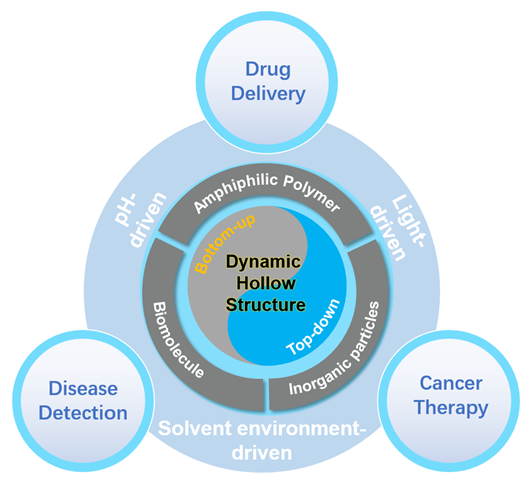
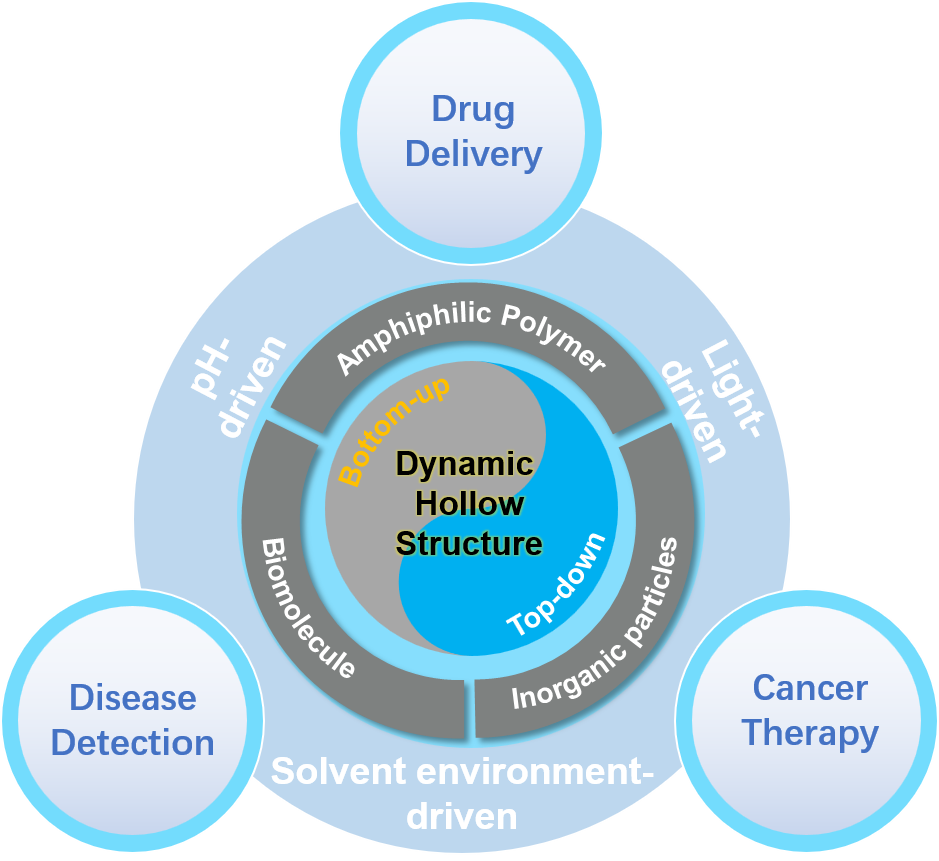
生命体的动态演变过程为多级动态组装材料的研究带来了重要启发. 动态智能的中空结构凭借其空腔构造的多样性、壳壁组成的丰富性以及表面修饰的多功能性等特性, 在生物医药领域展现出极具潜力的应用前景. 本文梳理了动态中空结构多功能体系的实现策略, 按照自上而下和自下而上两种路径分类, 总结该体系的动态基元和驱动机制; 此外, 阐述了其在药物递送、疾病检测及疾病治疗三大领域的具体应用; 最后对动态智能的中空多壳层结构的设计优化和未来应用方向进行了展望.
赵德偲, 康乃馨, 王丹. 动态智能的中空结构多功能体系[J]. 化学学报, 2026, 84(2): 264-273.
Decai Zhao, Naixin Kang, Dan Wang. Dynamic Intelligent Multi-functional System Based on Hollow Structure[J]. Acta Chimica Sinica, 2026, 84(2): 264-273.



| [1] |
doi: 10.1002/adma.v33.46 |
| [2] |
doi: 10.1021/acs.chemrev.0c00938 pmid: 33393759 |
| [3] |
doi: 10.1038/s41578-020-0202-4 |
| [4] |
doi: 10.1002/adfm.v33.31 |
| [5] |
doi: 10.1038/s41578-021-00412-x |
| [6] |
doi: 10.1021/jacs.1c10359 pmid: 34990126 |
| [7] |
|
| [8] |
doi: 10.1038/s41467-022-35434-8 pmid: 36509757 |
| [9] |
|
| [10] |
doi: 10.1002/adma.v35.12 |
| [11] |
doi: 10.1038/s41570-020-0161-8 |
| [12] |
doi: 10.1007/s40843-024-2936-3 |
| [13] |
|
| [14] |
doi: 10.1021/acs.macromol.2c02309 |
| [15] |
doi: 10.6023/A22030128 |
|
(
doi: 10.6023/A22030128 |
|
| [16] |
doi: 10.1038/nnano.2011.121 |
| [17] |
doi: 10.1038/s41557-023-01391-y pmid: 38049652 |
| [18] |
doi: 10.1038/s41467-022-34263-z |
| [19] |
doi: 10.1002/adfm.v30.17 |
| [20] |
doi: 10.34133/research.0490 pmid: 39351072 |
| [21] |
|
| [22] |
|
| [23] |
doi: 10.1021/jacs.2c00823 |
| [24] |
doi: 10.6023/A20080339 |
|
(李荣烨,
doi: 10.6023/A20080339 |
|
| [25] |
doi: 10.1016/j.cclet.2018.11.009 |
| [26] |
doi: 10.31635/ccschem.020.202000238 |
| [27] |
doi: 10.1038/nchem.2641 |
| [28] |
doi: 10.1038/s41557-025-01929-2 |
| [29] |
doi: 10.1038/nchem.2303 |
| [30] |
doi: 10.1016/j.jconrel.2022.09.036 |
| [31] |
doi: 10.1021/ja3123015 pmid: 23496255 |
| [32] |
doi: 10.1021/acs.nanolett.2c04229 |
| [33] |
|
|
(王慧, 赵德偲, 杨乃亮, 王丹, 高等学校化学学报, 2023, 44, 20220237.)
doi: 10.7503/cjcu20220237 |
|
| [34] |
|
| [35] |
doi: 10.1021/jacs.1c10391 |
| [36] |
doi: 10.1016/j.chempr.2019.05.023 |
| [37] |
doi: 10.1007/s40242-024-4053-1 |
| [38] |
doi: 10.1002/smll.v15.50 |
| [39] |
doi: 10.1038/s41578-023-00589-3 |
| [40] |
doi: 10.1007/s40242-024-3264-9 |
| [41] |
doi: 10.1038/s41467-021-27932-y |
| [42] |
doi: 10.1007/s40242-021-1403-0 |
| [43] |
doi: 10.1007/s40242-024-3267-6 |
| [44] |
doi: 10.1002/adma.v31.25 |
| [45] |
doi: 10.1021/nn402201w |
| [46] |
doi: 10.1021/acscentsci.9b01139 |
| [47] |
doi: 10.1002/adma.v28.34 |
| [48] |
doi: 10.1002/anie.v60.44 |
| [49] |
doi: 10.1038/s41467-023-40474-9 |
| [50] |
doi: 10.1007/s40242-024-4070-0 |
| [51] |
doi: 10.1002/adma.v31.38 |
| [52] |
|
| [53] |
|
| [54] |
doi: 10.1038/s41467-020-18177-2 |
| [55] |
|
| [1] | 钟越文, 钱希宁, 马超, 刘凯, 张洪杰. 稀土生物制造及其高附加值材料应用★[J]. 化学学报, 2023, 81(11): 1624-1632. |
| [2] | 高至亮, 李梦琦, 郝京诚, 崔基炜. 胶体粒子的机械性能调控及其在药物递送中的应用[J]. 化学学报, 2022, 80(7): 1010-1020. |
| [3] | 刘若湄, 冯艳辉, 李卓, 卢珊, 关天用, 李幸俊, 刘䶮, 陈卓, 陈学元. 基于cypate光裂解的新型近红外光响应稀土上转换纳米载药系统※[J]. 化学学报, 2022, 80(4): 423-427. |
| [4] | 岳华, 马光辉. 基于石墨烯独特生物界面效应的功能化载体研究进展[J]. 化学学报, 2021, 79(10): 1244-1256. |
| [5] | 张留伟, 陈麒先, 王静云. 活性氧响应型抗肿瘤前药研究进展[J]. 化学学报, 2020, 78(7): 642-656. |
| [6] | 张留伟, 钱明, 王静云. 光控释药型药物递送系统的研究进展[J]. 化学学报, 2017, 75(8): 770-782. |
| [7] | 杨川, 彭春望, 廖晨伊, 周健. 纤连蛋白在石墨烯修饰二氧化钛表面吸附的计算机模拟[J]. 化学学报, 2014, 72(3): 401-406. |
| [8] | 梁滢, 俞瀚, 黄清明, 张新奇, 俞建长. 硅藻土辅助制备有序介孔碳及其电催化性能[J]. 化学学报, 2012, 70(18): 1939-1944. |
| [9] | 高立爽, 窦玲玲, 杨晓辉, 宋秀芹. ZrO2 中空微球的模板法制备及吸附性能研究[J]. 化学学报, 2012, 0(05): 530-536 . |
| [10] | 江霞蓉, 管娟, 陈新, 邵正中. 具有定向形貌的丝蛋白支架的制备[J]. 化学学报, 2010, 68(18): 1909-1914. |
| [11] | 王荔军,王运华,范明生,张朝春,夏青,张文绪,张福锁,杨文胜,李铁津. 有序的介观尺寸生物SiO2针的合成[J]. 化学学报, 2001, 59(12): 2213-2216. |
| 阅读次数 | ||||||
|
全文 |
|
|||||
|
摘要 |
|
|||||
