

化学学报 ›› 2026, Vol. 84 ›› Issue (6): 871-878.DOI: 10.6023/A26010013 上一篇 下一篇
研究论文
赵紫璞a, 孙雨涵a, 张静洁b, 郭文迪a, 鲍晓冰a, 罗巧梅a, 苟蕾a, 樊小勇a,*( )
)
投稿日期:2026-01-11
发布日期:2026-05-06
基金资助:
Zipu Zhaoa, Yuhan Suna, Jingjie Zhangb, Wendi Guoa, Xiaobing Baoa, Qiaomei Luoa, Lei Goua, Xiaoyong Fana,*()
Received:2026-01-11
Published:2026-05-06
Contact:
E-mail: Supported by:文章分享
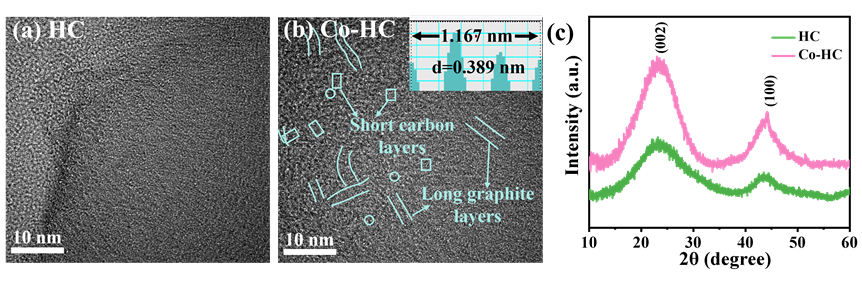
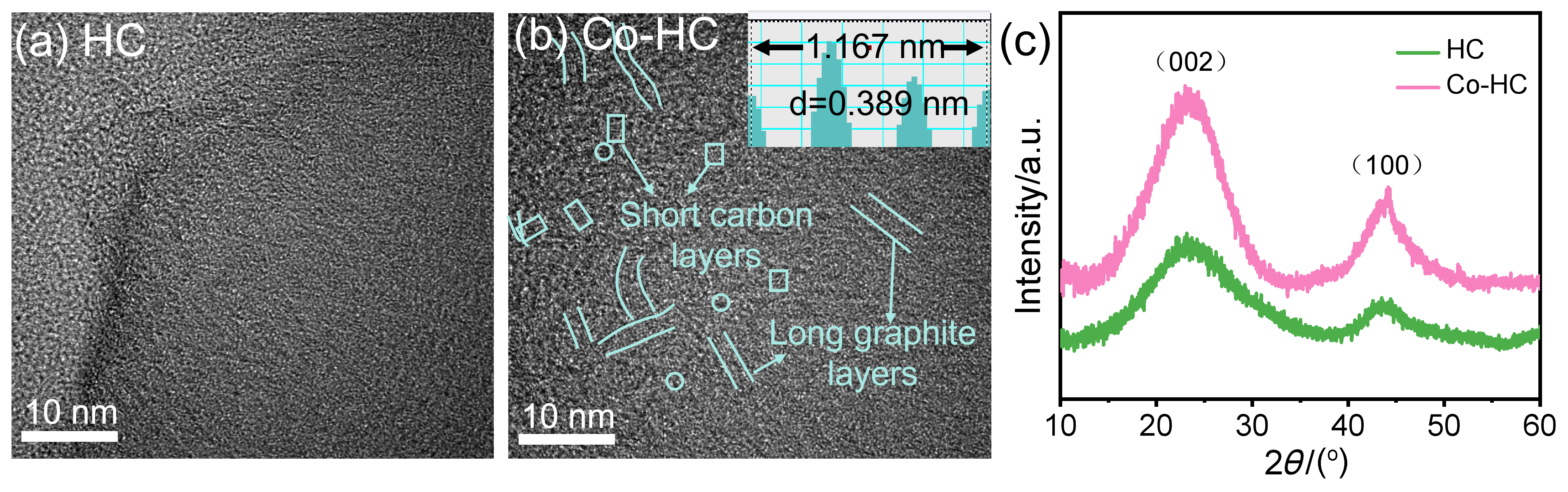
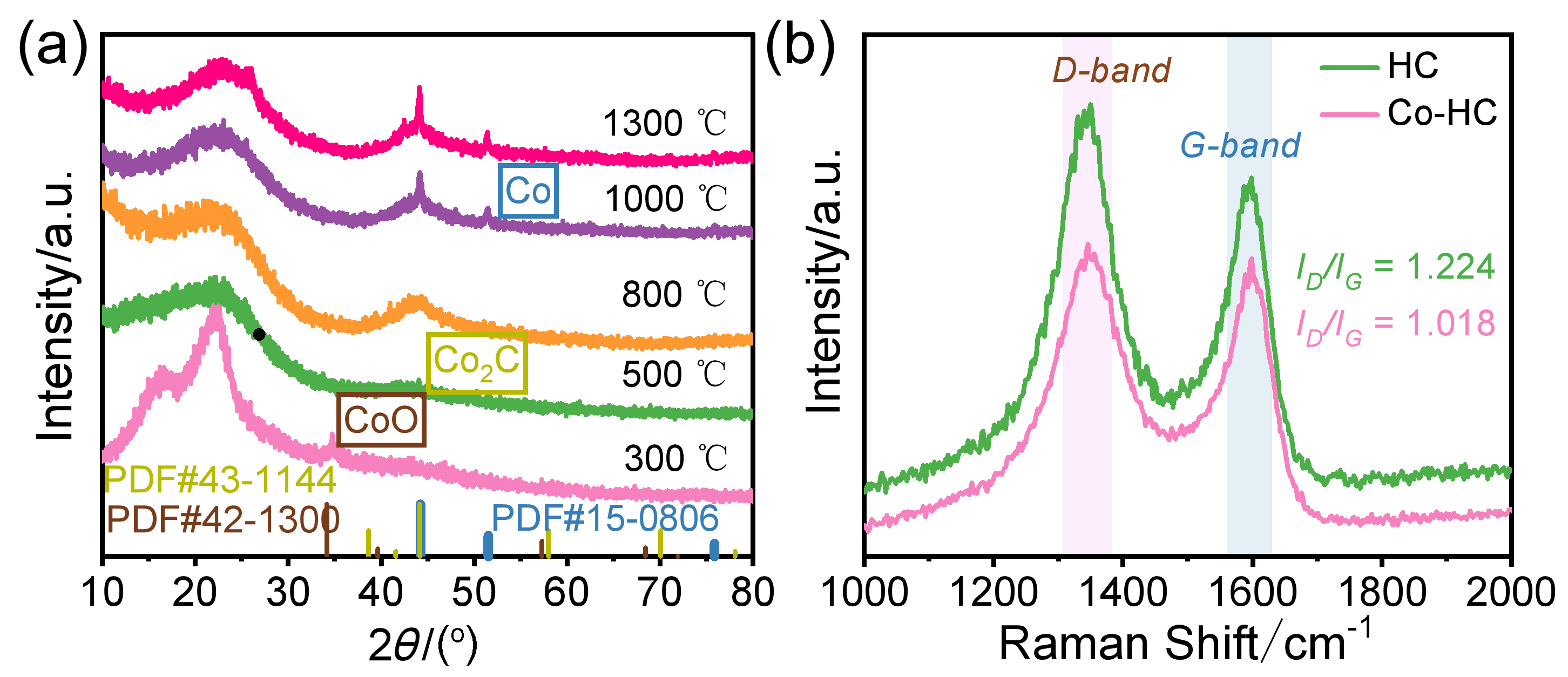
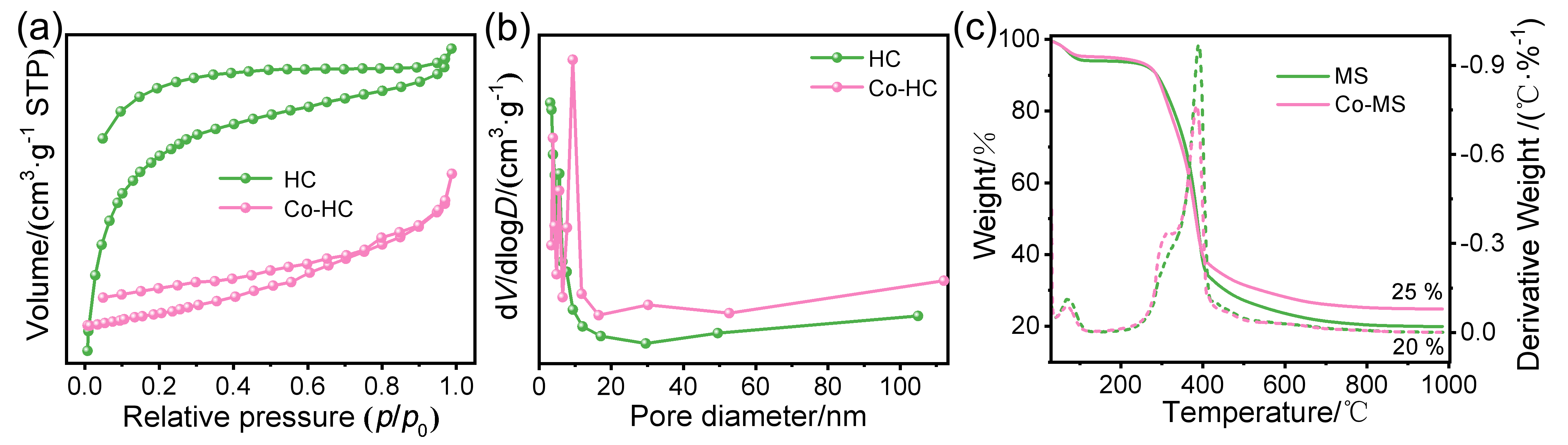
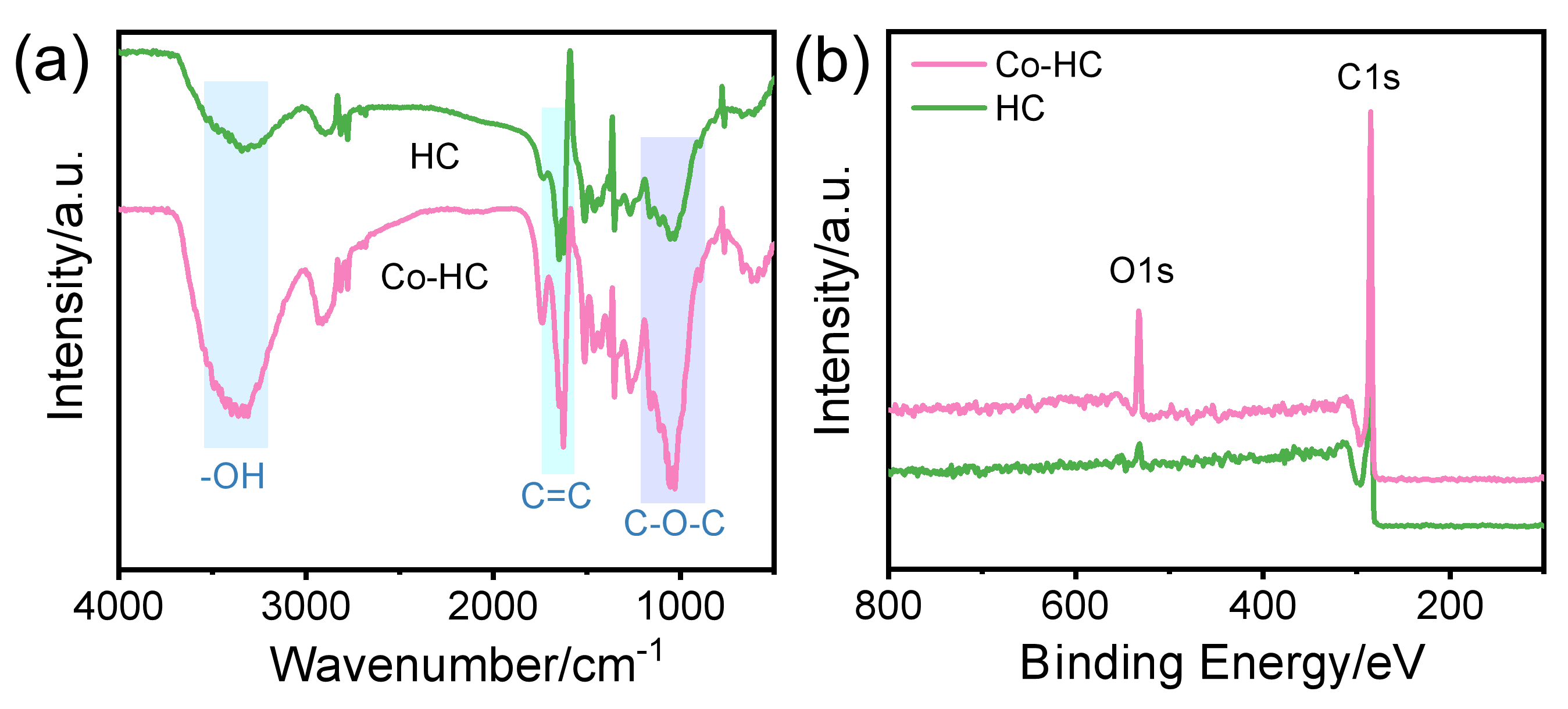
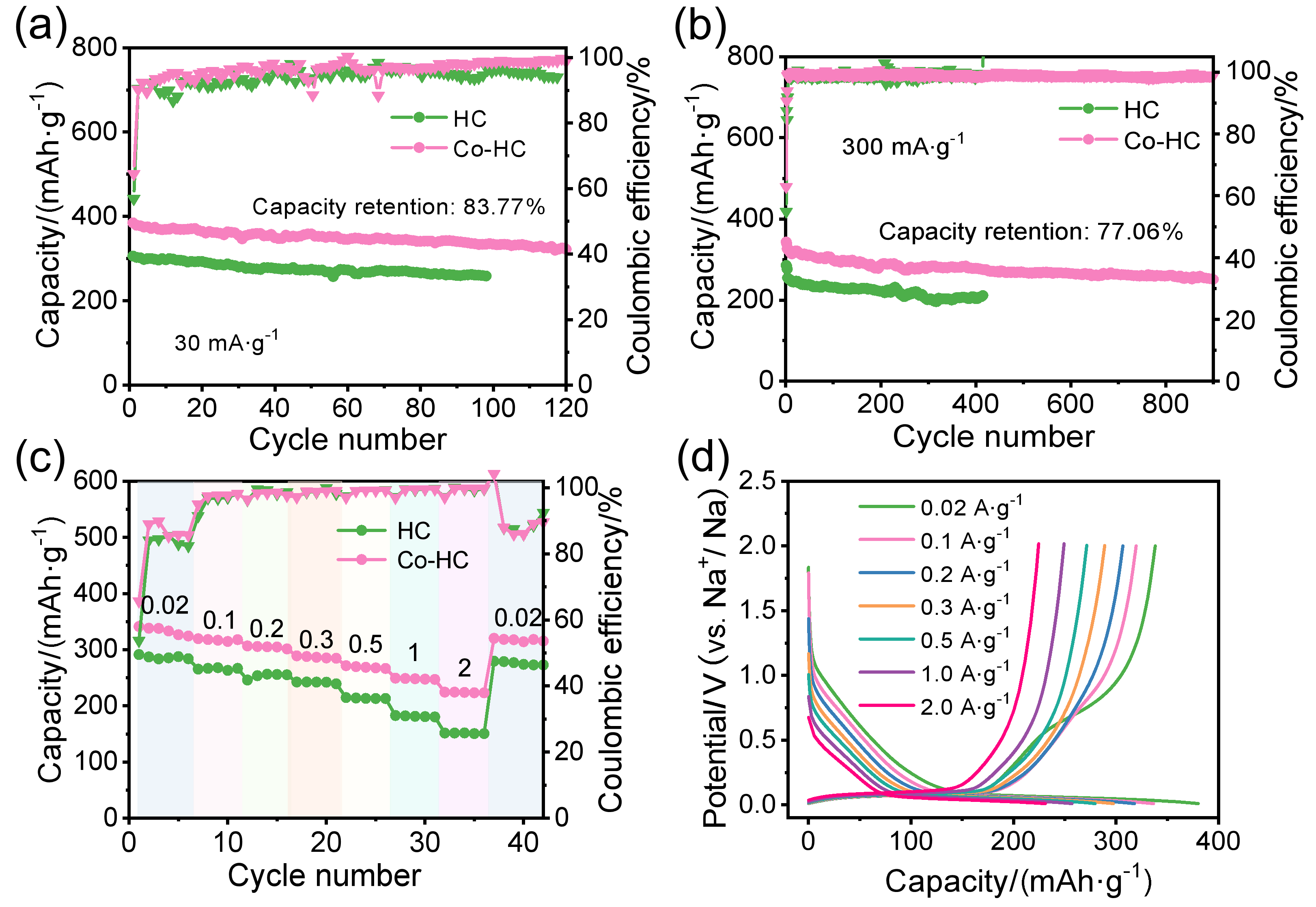
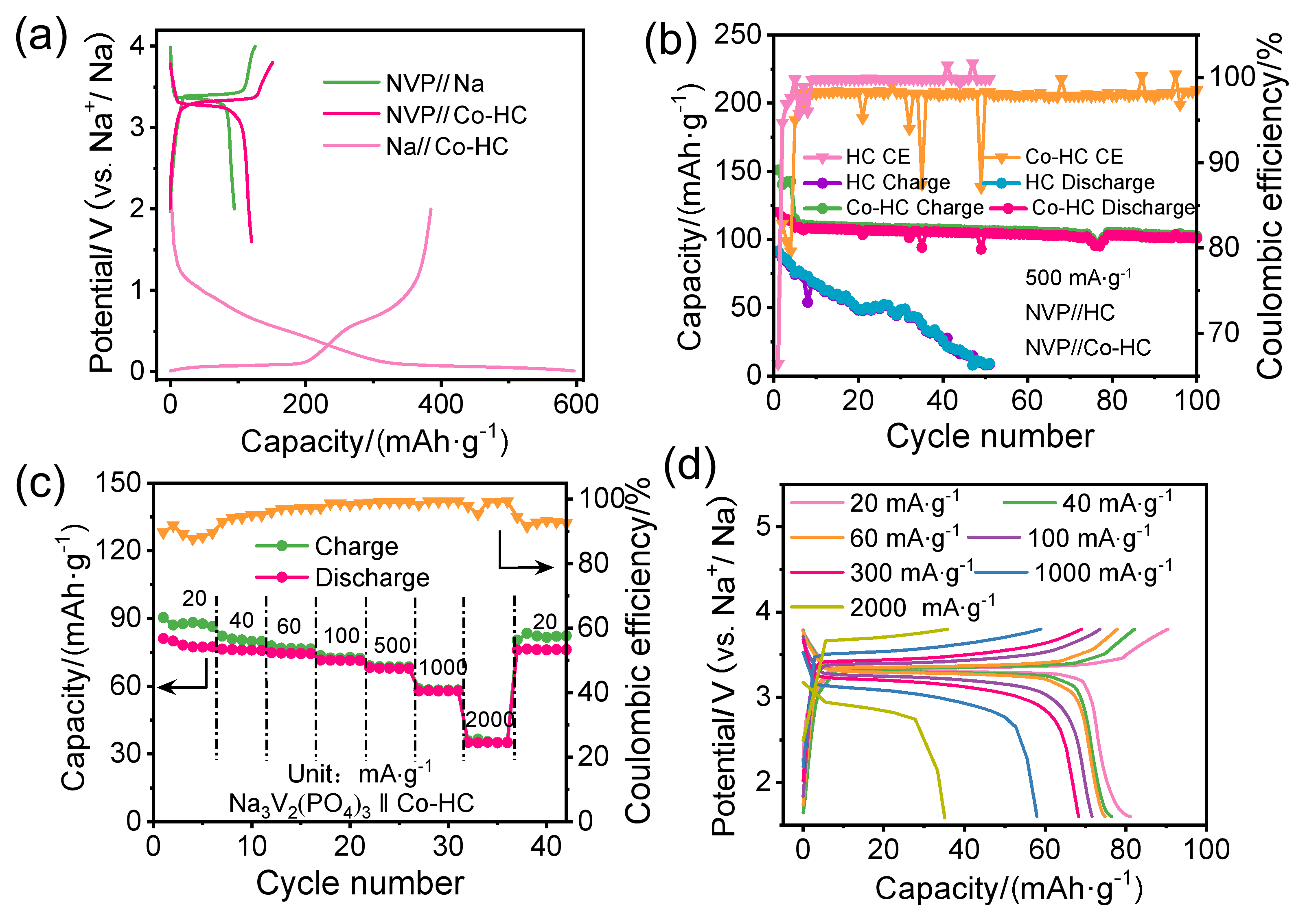
生物质硬碳凭借原料来源丰富、成本低和环境友好等优点, 已成为钠离子电池负极的研究热点. 然而, 其层间距小, 导致钠离子嵌入/脱出困难、结构坍塌, 最终造成其循环稳定性差及高倍率容量低, 限制其商业化应用. 本研究以夏威夷果壳为前驱体, 通过调节掺杂钴离子浓度与合成工艺, 制备了钴掺杂硬碳负极材料(Co-HC). 钴掺杂不仅增大层间距, 促进石墨化, 提升离子扩散动力学和电子导电性; 还能将孔隙结构从微孔主导转变为介孔主导, 大幅降低比表面积, 促进Na+快速扩散, 显著提升材料的倍率性能; 并且Co-HC中相互连接的膨胀石墨结构可加速电子传输, 石墨层周围的无定形碳以及含氧缺陷也为离子吸附提供了丰富的活性位点. 电化学测试表明, Co-HC电极在30 mA•g−1的电流密度下持续循环120圈仍显示322.4 mAh•g−1的高稳定容量, 即使在300 mA•g−1大电流下循环900圈仍维持251.1 mAh•g−1. 倍率性能显示, 即使提升到2000 mA•g−1的超大电流, 容量也能达到224.46 mAh•g−1, 容量保持率仍可达65.8%; 当电流密度恢复到20 mA•g−1时, Co-HC电极的容量可恢复到320.2 mAh•g−1, 充分证明了其卓越的循环寿命和高倍率容量.
赵紫璞, 孙雨涵, 张静洁, 郭文迪, 鲍晓冰, 罗巧梅, 苟蕾, 樊小勇. 钴掺杂提升夏威夷果壳基硬碳的储钠稳定性和高倍率容量[J]. 化学学报, 2026, 84(6): 871-878.
Zipu Zhao, Yuhan Sun, Jingjie Zhang, Wendi Guo, Xiaobing Bao, Qiaomei Luo, Lei Gou, Xiaoyong Fan. Cobalt-Doping Enhancing the Cyclability and High-rate Capacity of Macadamia Nut Shell-Based Hard Carbon[J]. Acta Chimica Sinica, 2026, 84(6): 871-878.
| [1] |
|
|
doi: 10.1007/s41918-024-00215-y |
|
| [2] |
|
|
(孙雨涵, 敬茂森, 赵宝雁, 鲍晓冰, 罗巧梅, 苟蕾, 樊小勇, 高等学校化学学报, 2025, 46, 20250034.)
doi: 10.7503/cjcu20250034 |
|
| [3] |
doi: 10.1016/j.isci.2023.108470 |
| [4] |
doi: 10.6023/A18040129 |
|
(王玲, 杨国锐, 王嘉楠, 王思岚, 彭生杰, 延卫, 化学学报, 2018, 76, 666.)
doi: 10.6023/A18040129 |
|
| [5] |
doi: 10.1002/aenm.v14.15 |
| [6] |
doi: 10.1002/aesr.v3.7 |
| [7] |
doi: 10.1021/acsnano.4c03484 |
| [8] |
doi: 10.6023/A21060284 |
|
(董瑞琪, 吴锋, 白莹, 吴川, 化学学报, 2021, 79, 1461.)
doi: 10.6023/A21060284 |
|
| [9] |
doi: 10.1002/batt.v8.12 |
| [10] |
|
| [11] |
doi: 10.1016/j.est.2024.113864 |
| [12] |
|
| [13] |
|
| [14] |
doi: 10.1016/j.envres.2025.121854 |
| [15] |
|
| [16] |
doi: 10.1016/j.cej.2025.164774 |
| [17] |
doi: 10.1039/D5NJ00105F |
| [18] |
doi: 10.1021/acsami.4c08082 |
| [19] |
|
| [20] |
doi: 10.1016/j.jpowsour.2025.237786 |
| [21] |
doi: 10.1016/j.jallcom.2022.164979 |
| [22] |
doi: 10.1002/smll.v21.17 |
| [23] |
doi: 10.1016/j.enchem.2024.100117 |
| [24] |
doi: 10.1016/j.mattod.2025.02.014 |
| [25] |
doi: 10.1016/j.cej.2024.156115 |
| [26] |
doi: 10.1016/j.surfin.2025.106522 |
| [27] |
doi: 10.1039/D5CC03565A |
| [28] |
doi: 10.1016/j.jpowsour.2025.237369 |
| [29] |
doi: 10.1039/D5TA02023A |
| [30] |
doi: 10.26599/NR.2025.94907462 |
| [31] |
doi: 10.1021/acsaem.5c01173 |
| [32] |
doi: 10.1016/j.jaap.2025.107549 |
| [33] |
doi: 10.1016/j.cclet.2025.111210 |
| [34] |
doi: 10.3390/nano15100734 |
| [35] |
doi: 10.1016/j.est.2025.118743 |
| [36] |
doi: 10.1007/s10118-025-3461-0 |
| [37] |
doi: 10.1016/j.est.2024.112986 |
| [38] |
doi: 10.1016/j.cej.2022.135678 |
| [39] |
doi: 10.1039/D4EE05305B |
| [40] |
doi: 10.1088/2752-5724/ad5d7f |
| [41] |
doi: 10.1016/j.jpowsour.2022.231862 |
| [42] |
|
| [43] |
doi: 10.1021/acsenergylett.5c01780 |
| [44] |
doi: 10.1016/j.jpowsour.2025.239076 |
| [45] |
doi: 10.1016/j.carbon.2024.119733 |
| [46] |
doi: 10.1016/j.est.2025.120098 |
| [47] |
doi: 10.1016/j.cej.2025.163768 |
| [48] |
doi: 10.1016/j.carbon.2025.120597 |
| [49] | |
| [50] |
doi: 10.1016/j.est.2025.117731 |
| [1] | 张庆堂, 杜纯阳, 高鹏飞, 王晓梅. 富锰P2/P3双相Na0.67Mn0.9Ni0.1O2自蔓延燃烧合成与储钠性能[J]. 化学学报, 2026, 84(1): 64-72. |
| [2] | 韦正兵, 鲍梦凡, 徐世彪, 程怡, 陈诗洁, 林娜, 冒爱琴. 氟掺杂诱导岩盐型高熵氧化物本征缺陷调控及其储锂性能优化[J]. 化学学报, 2025, 83(8): 868-877. |
| [3] | 张贤碧, 项爽, 唐有根, 孙旦, 李欢欢, 王海燕. 钠离子电池硫酸铁钠正极的关键问题及设计策略★[J]. 化学学报, 2025, 83(8): 947-961. |
| [4] | 班渺寒, 双亚洲, 杨安平, 郑长勇, 张伟, 徐飞. 共价有机框架的设计及质子传导性能研究进展[J]. 化学学报, 2025, 83(11): 1435-1540. |
| [5] | 谭可莹, 方平, 丁杜鹏, 袁诗晨, 刘辰, 杨诗羽, 魏昌庭, 徐勃. 基于蒽基电子传输材料设计及蓝光钙钛矿QLED性能研究[J]. 化学学报, 2025, 83(1): 1-9. |
| [6] | 鲍梦凡, 陈诗洁, 邵霞, 邓慧娟, 冒爱琴, 檀杰. 低共熔溶剂辅助制备空心球状钙钛矿型高熵氧化物及高倍率储锂性能[J]. 化学学报, 2024, 82(3): 303-313. |
| [7] | 杨蓉婕, 周璘, 苏彬. 基于共价有机框架修饰电极的维生素A和C的选择性检测★[J]. 化学学报, 2023, 81(8): 920-927. |
| [8] | 贾洋刚, 陈诗洁, 邵霞, 程婕, 林娜, 方道来, 冒爱琴, 李灿华. 高性能无钴化钙钛矿型高熵氧化物负极材料的制备及储锂性能研究[J]. 化学学报, 2023, 81(5): 486-495. |
| [9] | 毕文超, 张琳锋, 陈健, 田瑞雪, 黄昊, 姚曼. 单斜ZnP2负极材料的锂化机理及性能[J]. 化学学报, 2022, 80(6): 756-764. |
| [10] | 梁广玲, 叶晓亮, 王观娥, 徐刚. 原位烷基化调控无机-有机杂化类钙钛矿材料的结构及其性能※[J]. 化学学报, 2022, 80(4): 460-466. |
| [11] | 闫腾飞, 刘盛达, 罗逸尘, 邹应萍, 刘俊秋. 大环分子衍生物在人工跨膜离子通道领域中的研究进展[J]. 化学学报, 2021, 79(8): 999-1007. |
| [12] | 马慧, 张桓荣, 薛面起. 水系钠离子电池的研究进展及实用化挑战[J]. 化学学报, 2021, 79(4): 388-405. |
| [13] | 董瑞琪, 吴锋, 白莹, 吴川. 钠离子电池硬碳负极储钠机理及优化策略[J]. 化学学报, 2021, 79(12): 1461-1476. |
| [14] | 谢佶晟, 肖竹梅, 左文华, 杨勇. 钠离子电池钴酸钠正极材料研究进展[J]. 化学学报, 2021, 79(10): 1232-1243. |
| [15] | 闫腾飞, 刘俊秋. 新型共价交联纳米胶囊的构筑、调控与功能[J]. 化学学报, 2020, 78(8): 713-718. |
| 阅读次数 | ||||||
|
全文 |
|
|||||
|
摘要 |
|
|||||
