

化学学报 ›› 2026, Vol. 84 ›› Issue (7): 1121-1128.DOI: 10.6023/A25120416 上一篇 下一篇
研究论文
马文杰, 汤佳栋, 王辰*( )
)
投稿日期:2025-12-23
发布日期:2026-06-02
基金资助:
Wenjie Ma, Jiadong Tang, Chen Wang*()
Received:2025-12-23
Published:2026-06-02
Contact:
* E-mail: cwang@chem.ecnu.edu.cn
Supported by:文章分享
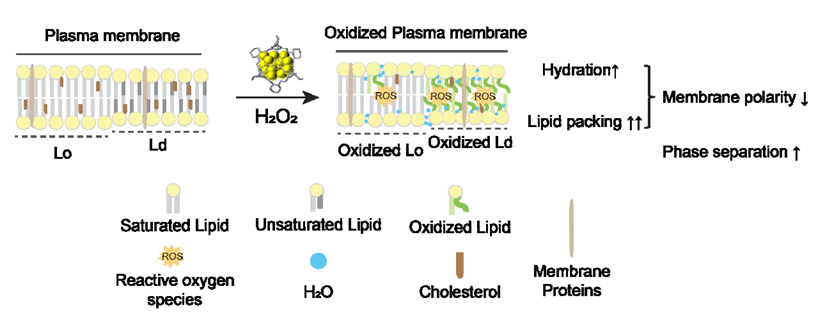
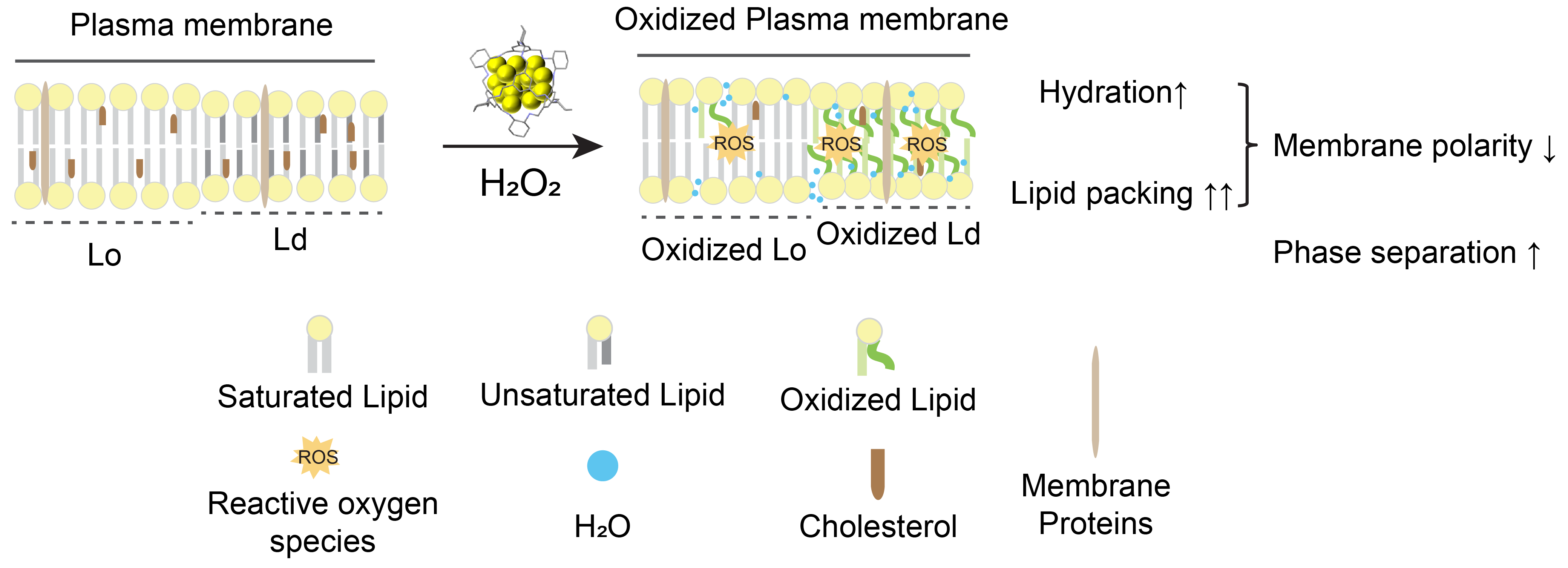
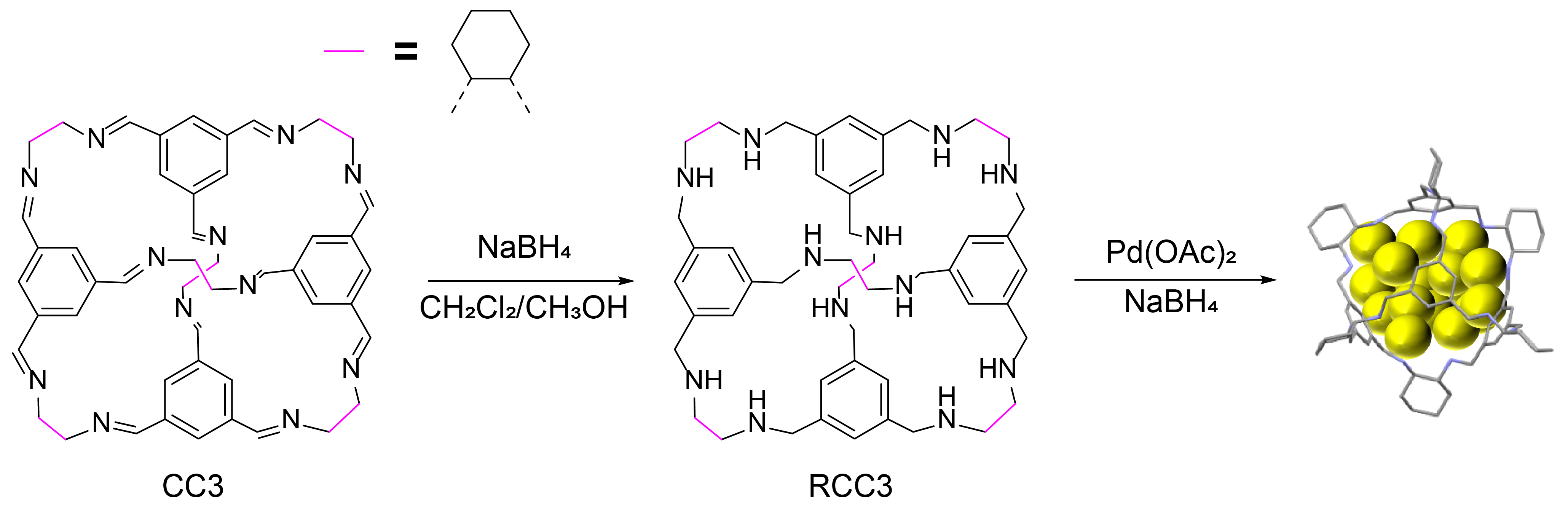
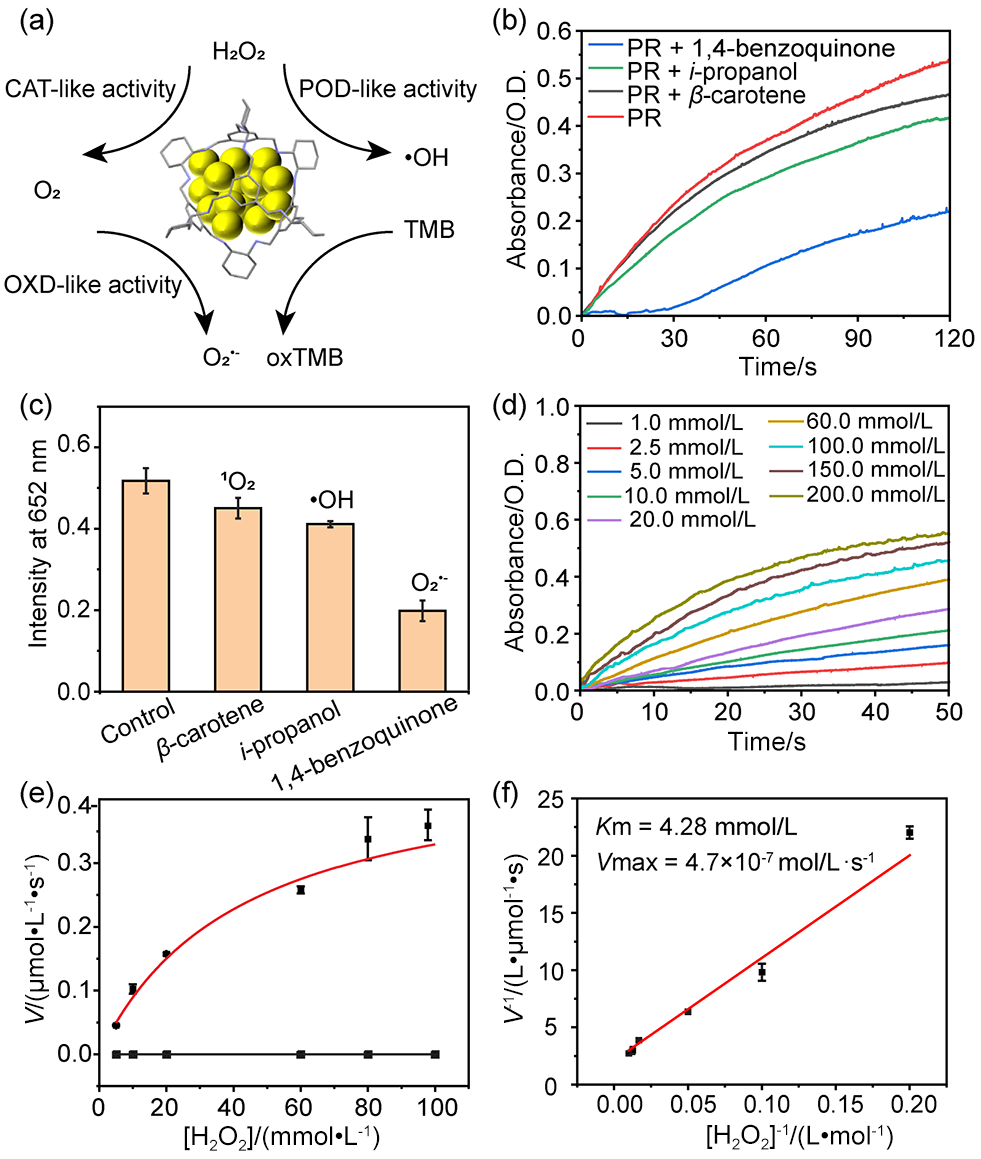
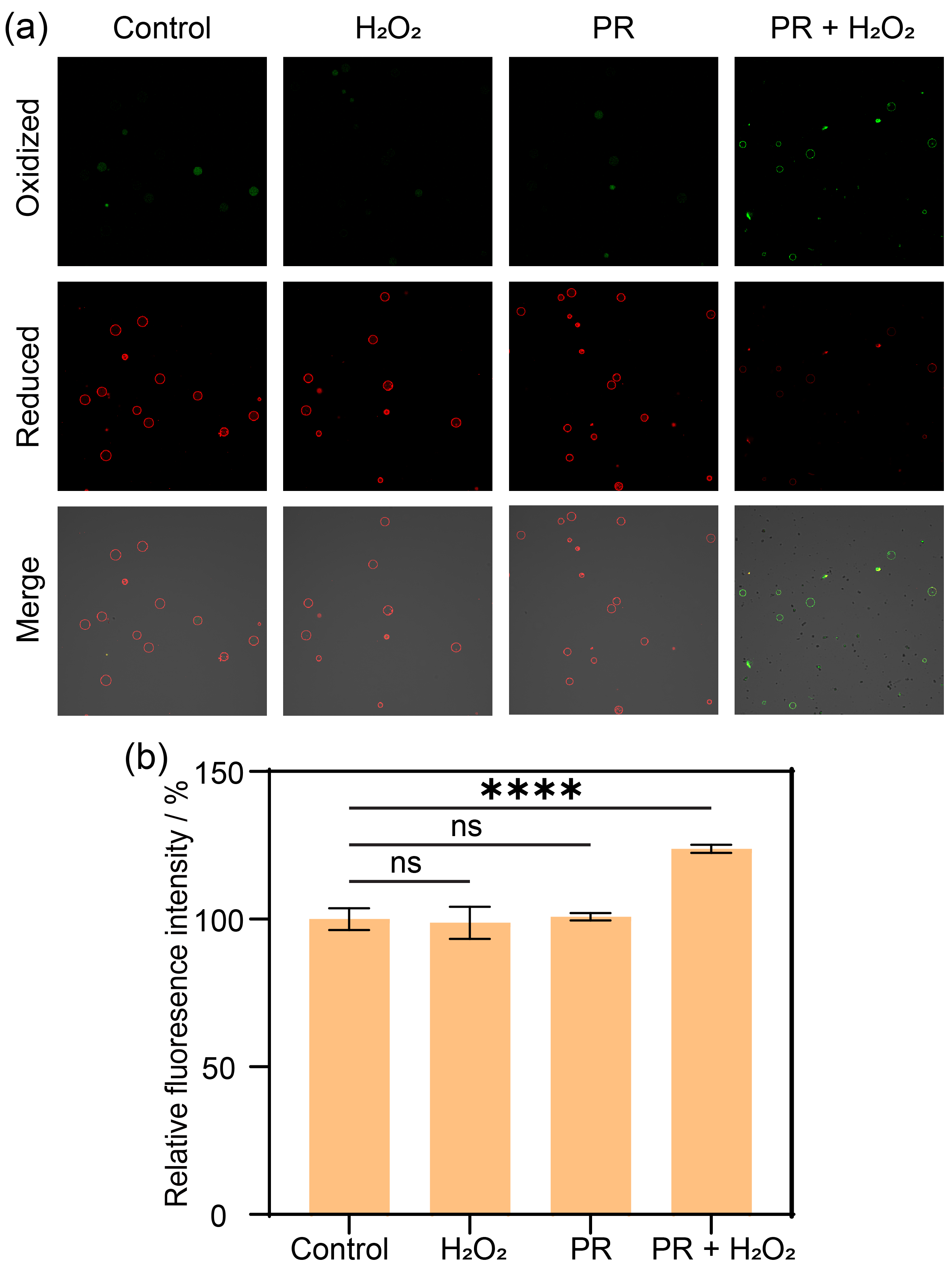
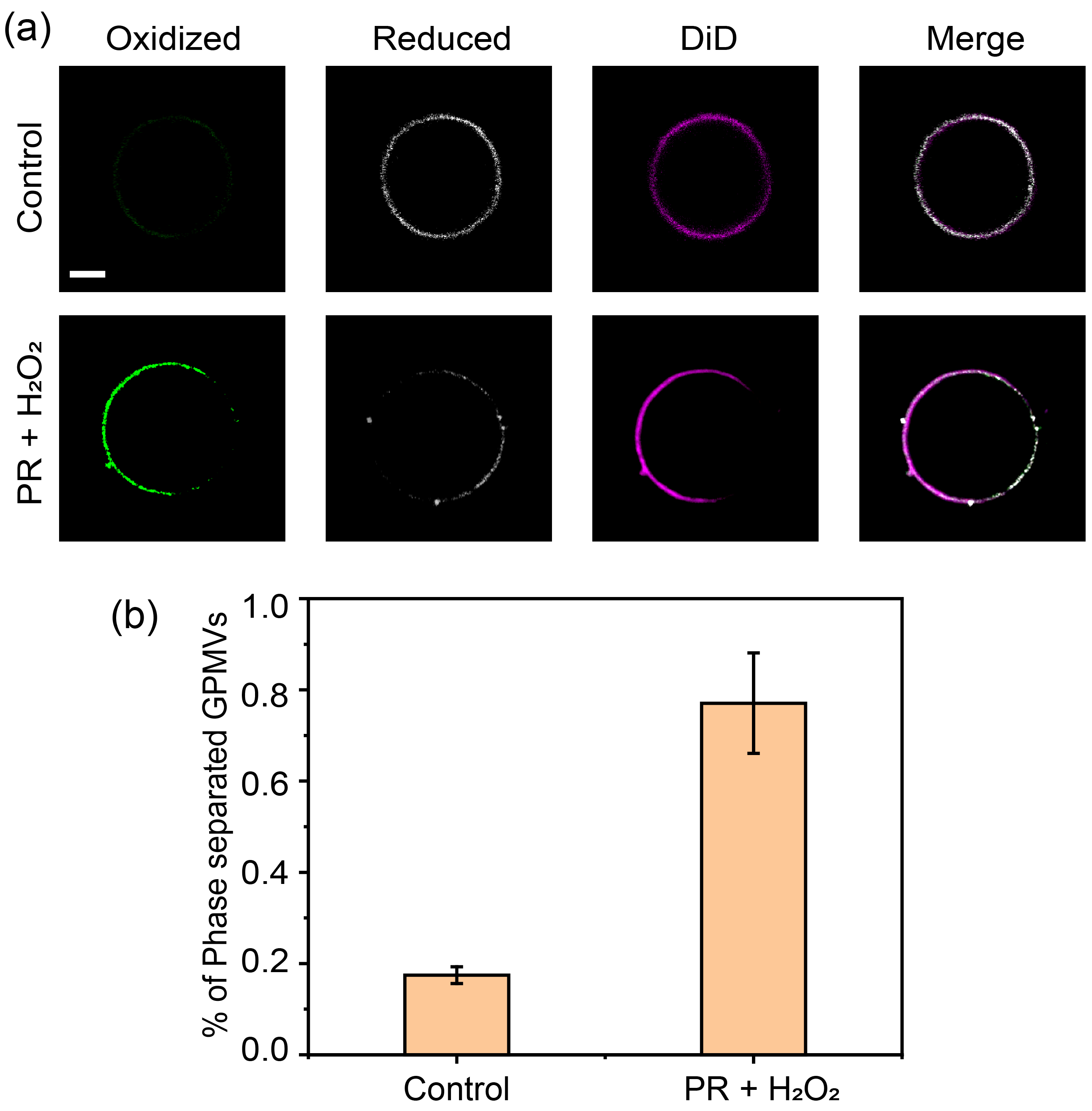
以共价有机笼为模板合成限域钯团簇, 展现出独特多重类酶催化特性, 高效催化产生超氧阴离子($\text{O}_{\text{2}}^{\centerdot }$)与羟基自由基(•OH)等活性氧物种. 以能够保留天然膜复杂组成和结构特征的巨型质膜囊泡(GPMVs)为模型体系, 系统揭示了该限域纳米团簇产生的活性氧(ROS)对生物膜界面的调控作用. 研究发现, ROS优先作用于富含多不饱和脂肪酸的液态无序区, 引发空间选择性的脂质过氧化反应. 该过程显著重塑膜的物理化学性质: 一方面, 脂质过氧化产物促进膜相分离行为增强; 另一方面, 膜内部极性显著降低. 上述变化的本质源于脂质堆积方式与局域膜微环境的动态重构. 本研究阐明了ROS介导的脂质过氧化过程在空间维度上的非均一性特征, 揭示了脂质过氧化与膜极性及相分离行为之间的内在关联, 为基于膜物理化学性质精准调控的催化治疗策略提供了新的设计思路和理论依据.
马文杰, 汤佳栋, 王辰. 钯纳米团簇诱导脂质过氧化和膜物理特性变化[J]. 化学学报, 2026, 84(7): 1121-1128.
Wenjie Ma, Jiadong Tang, Chen Wang. Palladium Nanoclusters Induce Lipid Peroxidation and Alter Membrane Physical Properties[J]. Acta Chimica Sinica, 2026, 84(7): 1121-1128.

| [1] |
doi: 10.1038/s41580-020-0230-3 |
| [2] |
doi: 10.1021/cr200084z |
| [3] |
doi: 10.1016/j.redox.2015.01.002 |
| [4] |
doi: 10.1155/omcl.v2017.1 |
| [5] |
doi: 10.1016/j.bbrc.2005.08.072 |
| [6] |
doi: 10.6023/A20120583 |
|
(蔡政, 张颖雯, 姜立萍, 朱俊杰, 化学学报, 2021, 79, 481.)
doi: 10.6023/A20120583 |
|
| [7] |
doi: 10.6023/A25040139 |
|
(何远芳, 刘芳, 魏岚, 王永芳, 杜江锋, 化学学报, 2025, 83, 1530.)
doi: 10.6023/A25040139 |
|
| [8] |
doi: 10.3390/life11010042 |
| [9] |
doi: 10.2741/s131 |
| [10] |
doi: 10.1016/j.bbamem.2012.02.002 pmid: 22342938 |
| [11] |
|
|
(邓燕, 何农跃, 许利剑, 曾新, 李智洋, 马超, 傅娟, 化学学报, 2010, 68, 2457.)
|
|
| [12] |
doi: 10.1016/j.chemphyslip.2019.03.011 |
| [13] |
|
| [14] |
doi: 10.3389/fphys.2013.00242 pmid: 24027536 |
| [15] |
doi: 10.6023/A24010035 |
|
(李燕, 王玮, 张毓婷, 肖述章, 兰海闯, 耿鹏, 化学学报, 2024, 82, 443.)
doi: 10.6023/A24010035 |
|
| [16] |
|
| [17] |
doi: 10.1016/j.bbamem.2012.05.020 pmid: 22634274 |
| [18] |
pmid: 10962288 |
| [19] |
doi: 10.1016/0009-3084(87)90049-1 pmid: 3311416 |
| [20] |
doi: 10.1074/jbc.M707348200 pmid: 18045864 |
| [21] |
doi: 10.1007/s12551-013-0128-9 |
| [22] |
doi: 10.1039/C4SM01478B |
| [23] |
doi: 10.1021/acs.langmuir.5b02980 |
| [24] |
doi: 10.1016/j.jcis.2018.12.007 |
| [25] |
pmid: 1333207 |
| [26] |
doi: 10.1038/nprot.2012.059 |
| [27] |
|
| [28] |
doi: 10.1016/j.bbamem.2021.183857 |
| [29] |
doi: 10.1016/j.addr.2023.114730 |
| [30] |
pmid: 17057844 |
| [31] |
doi: 10.1021/acs.chemrev.0c00237 |
| [32] |
doi: 10.20517/cs |
| [33] |
doi: 10.1038/s41929-018-0030-8 |
| [34] |
doi: 10.1002/anie.v64.23 |
| [35] |
doi: 10.1039/D0CS00659A |
| [36] |
doi: 10.1186/s12951-020-00761-9 |
| [37] |
|
|
(于千水, 戚聪, 顾顺心, 杨欣达, 姜琴, 魏荣斌, 施鹏飞, 化学学报, 2025, 83, 579.)
doi: 10.6023/A24120380 |
|
| [38] |
|
|
(罗倩钰, 汪诚艳, 张天龙, 夏培元, 张潇, 杨明, 化学学报, 2024, 82, 772.)
doi: 10.6023/A24030085 |
|
| [39] |
doi: 10.1039/D5NJ00138B |
| [40] |
doi: 10.1021/acsami.2c03952 |
| [41] |
doi: 10.1021/jacs.3c01532 pmid: 37277963 |
| [42] |
doi: 10.1021/acs.nanolett.4c01568 |
| [43] |
doi: 10.1021/acs.nanolett.1c00147 |
| [44] |
doi: 10.1021/ja311739v pmid: 23391267 |
| [45] |
|
| [46] |
doi: 10.1016/j.chembiol.2013.11.009 |
| [47] |
doi: 10.1021/acs.langmuir.1c00830 pmid: 34374545 |
| [48] |
doi: 10.1088/1361-6463/aa5dbc |
| [49] |
pmid: 9717713 |
| [50] |
doi: 10.1016/S0891-5849(97)00101-9 |
| [51] |
doi: 10.2741/4454 |
| [52] |
doi: 10.1021/jacs.3c10132 pmid: 38171000 |
| [1] | 徐慧妍, 王爱珠, 丁龙华, 于欣. 基于苝二酰亚胺的光催化抗菌体系及其应用进展[J]. 化学学报, 2026, 84(7): 1197-1210. |
| [2] | 于千水, 戚聪, 顾顺心, 杨欣达, 姜琴, 魏荣斌, 施鹏飞. 基于胸腺嘧啶三联吡啶的双核铱配合物的发光及抗肿瘤活性研究[J]. 化学学报, 2025, 83(6): 579-587. |
| [3] | 施寒竹, 高雅宁, 陈昭玉, 戴陈伟, 周秀红, 张颖颖. 具有多酶活性CuO/ZnO复合纳米球的制备及其抗菌性能研究[J]. 化学学报, 2025, 83(11): 1363-1371. |
| [4] | 车飞达, 赵晓茗, 张馨, 丁琪, 王昕, 李平, 唐波. 抑郁症相关活性分子的荧光成像★[J]. 化学学报, 2023, 81(9): 1255-1264. |
| [5] | 张媛, 郑贝宁, 符美春, 冯守华. 尖晶石氧化物在肿瘤诊疗应用领域研究进展★[J]. 化学学报, 2023, 81(8): 949-954. |
| [6] | 李瑶, 陈丙年, 罗丹, 雷珊, 王力. 多酸型α-葡萄糖苷酶抑制剂的抗氧化性能研究[J]. 化学学报, 2023, 81(10): 1318-1326. |
| [7] | 赵晋源, 张乾, 王坚, 张琦, 李恒, 杜亚平. 活性氧捕获材料的研究进展[J]. 化学学报, 2022, 80(4): 570-580. |
| [8] | 李嫣然, 王子贵, 汤朝晖. 水溶性IR-780聚合物用于线粒体靶向的光动力治疗※[J]. 化学学报, 2022, 80(3): 291-296. |
| [9] | 韩旭, 张留伟, 张强, 睢晞航, 钱明, 陈麒先, 王静云. 活性氧响应的新型阳离子共聚物构建及其基因递送性能研究[J]. 化学学报, 2021, 79(6): 794-802. |
| [10] | 张留伟, 陈麒先, 王静云. 活性氧响应型抗肿瘤前药研究进展[J]. 化学学报, 2020, 78(7): 642-656. |
| [11] | 齐野, 任双颂, 车颖, 叶俊伟, 宁桂玲. 金属有机框架抗菌材料的研究进展[J]. 化学学报, 2020, 78(7): 613-624. |
| [12] | 穆毅, 贾法龙, 艾智慧, 张礼知. 纳米零价铁活化分子氧原理及降解有机污染物性能增强策略[J]. 化学学报, 2017, 75(6): 538-543. |
| [13] | 赵德胜, 陈媚莎, 吴为辉, 郭莹, 陈永湘, 赵玉芬, 李艳梅. 阻断铜离子介导神经毒性的小分子抑制剂研究[J]. 化学学报, 2015, 73(8): 799-807. |
| [14] | 李天予, 易宇, 许华平. 具有选择性抗癌活性的含硒配位组装体: 活性氧物种的调控[J]. 化学学报, 2014, 72(10): 1079-1084. |
| [15] | 崔光, 付云飞, 罗军, 刘培生, 丁爱中. 氧化铝负载多孔沸石球的制备及其在As 吸收中的应用[J]. 化学学报, 2012, 70(9): 1059-1065. |
| 阅读次数 | ||||||
|
全文 |
|
|||||
|
摘要 |
|
|||||
