

Acta Chimica Sinica ›› 2025, Vol. 83 ›› Issue (5): 535-550.DOI: 10.6023/A24120390 Previous Articles
Review
胡博a, 肖霞a,*( ), 王鹏a,b, 束小龙a, 卞梦琪a, 王健捷a, 赵震a,b,*()
投稿日期:2024-12-31
发布日期:2025-04-16
作者简介: |
胡博, 本科生, 就读于沈阳师范大学化学化工学院, 主要从事分子筛多孔材料合成、二氧化碳烷烃耦合转化方面的研究工作. |
 |
肖霞, 博士, 沈阳师范大学化学化工学院副教授, 硕士研究生导师, 主要从事分子筛多孔材料的合成及其能源催化方面的研究工作. 主持国家自然科学基金、辽宁省自然科学基金等各类科研项目7项, 参与科技部重点研发计划、国家自然科学基金重大重点项目、中石油重大科技专项等5项. 已在ACS Catal., Chem. Commun., Micropor. Mesopor. Mat.和中国科学: 化学等国内外学术期刊上发表论文30余篇, 参编《炼油稀土催化》、《化学: 中心科学》和《Heterogeneous Catalysis for Sustainable Energy》著作3部. 荣获辽宁省研究生教学成果奖特等奖、辽宁省高等学校本科教学成果二等奖和沈阳市自然科学学术成果奖等. 入选辽宁省“百千万人才工程”万人层次, 沈阳市中青年科技创新人才支持计划, 沈阳市拔尖人才. |
 |
赵震, 教育部国家级高层次人才; 中国石油大学(北京)教授, 博士生导师; 沈阳师范大学特聘教授、沈阳师范大学化学化工学院院长, 能源与环境催化研究所所长. 中国科协“一带一路”国际联合能源与环境催化研究中心主任; 辽宁省高校重大科技平台“能源与环境催化工程技术研究中心”主任. 现兼任中国化学会催化专业委员会委员; 中国稀土学会常务理事和催化专业委员会副主任; 中国能源学会副会长和能源与环境专业委员会主任等多个学术兼职. 入选国际先进材料协会(IAAM)Fellow、国际VEBLEO学会组织Fellow、教育部“长江学者奖励计划”特聘教授、“新世纪百千万人才”国家级人选、“国务院政府特殊津贴”专家、辽宁杰出科技工作者、辽宁省高校攀登学者、辽宁省普通高等学校本科教学名师、辽宁省教书育人模范、辽宁省学术头雁、辽宁省优秀科技工作者、辽宁省课程思政教学名师、沈阳市十大科技英才、沈阳市优秀专家、沈阳市杰出人才等荣誉称号. 主要从事能源与环境催化、稀土催化、催化新材料等方面的研发工作. 主持科技部重点研发计划项目、863主题(专题)项目课题、国家自然科学基金重大研究计划集成、重点项目、国家自然科学基金重点项目等国家级项目(课题)19项; 省市级各类项目30余项; 已在Nature Commun., PNAS, Angew. Chem. Int. Ed., Energy & Environment. Science, AICHE J., Appl. Catal. B: Environment, ACS Catal., J. Catal.和中国科学: 化学等国内外知名学术期刊上发表SCI论文600余篇, 引用23300多次, H因子81 (Scopus); 2014~2024年连续11年入选爱思唯尔公司公布的中国高被引学者榜单(化学工程与技术). 荣获国际纯粹与应用化学联合会(IUPAC)新材料及其合成杰出贡献奖、湖北省科学技术自然科学奖二等奖、中国稀土科学技术奖一等奖、中国化工学会基础研究成果一等奖、侯德榜化工科技奖创新奖、辽宁省高等学校本科教学成果一等奖、二等奖及辽宁省研究生教学成果奖特等奖等多项教学科研奖励. |
基金资助:
Bo Hua, Xia Xiaoa,*(), Peng Wanga,b, Xiaolong Shua, Mengqi Biana, Jianjie Wanga, Zhen Zhaoa,b,*()
Received:2024-12-31
Published:2025-04-16
Contact:
* E-mail: Supported by:Share
Bo Hu, Xia Xiao, Peng Wang, Xiaolong Shu, Mengqi Bian, Jianjie Wang, Zhen Zhao. Advances in Fe-based Catalysts for the Hydrogenation of CO2 to Light Olefins[J]. Acta Chimica Sinica, 2025, 83(5): 535-550.
| Entry | Catalysts | CO2 Conversion/% | CO Selectivity/% | Hydrocarbon distributiona/% | GHSV/ (mL•g-1•h-1) | Temperature./℃ | Pressure/ MPa | Ref. | |||
|---|---|---|---|---|---|---|---|---|---|---|---|
| CH4 | C20~C40 | C2=~C4= | C5+ | ||||||||
| 1 | Co-Fe | 31.4 | — | 20.4 | 57.3 | 22.3 | 9600 | 320 | 1 | [ | |
| 2 | Na/Fe@CoCo-3 | 50.3 | 4.6 | 13.9 | 41.3 | 44.8 | — | 330 | 3 | [ | |
| 3 | Fe-Co(0.17)/K(1.0) | 31.0 | 18.0 | 15.9 | 84.1 | 3600 | 300 | 1.1 | [ | ||
| 4 | Ni/Fe=1:99 | 32.6 | 89.1 | 57.0 | 7.4 | 35.6 | 0 | 5000 | 350 | — | [ |
| 5 | CM-Al2O3 | 41.0 | 12.4 | 33.7 | 6.4 | 41.1 | 18.7 | — | 320 | 2 | [ |
| 6 | Fe/CeO2 rods | 20.6 | 61.2 | 80.6 | 6.2 | 12.3 | 0.6 | 1600 | 390 | — | [ |
| 7 | Fe(12.9) | 12.8 | 49.5 | 67.7 | 28.5 | 1.4 | 2.4 | 18000 | 320 | 3 | [ |
| 8 | Fe/ZrO2 | 42 | 15 | 20.0 | 8.2 | 46.0 | 26.8 | 1200 | 340 | 2 | [ |
| 9 | N-600-0 | 46 | 17.5 | 32.2 | 17.6 | 23.3 | 26.9 | 3600 | 400 | 3 | [ |
| 10 | Fe/C-K@NC-350/500 | 35.1 | 28.1 | 23.8 | 7.9 | 37.7 | 30.6 | 5000 | 340 | 3 | [ |
| 11 | 40FeK/SMC | 44.7 | 85.5 | 4.8 | 6.5 | 13.6 | 75.1 | — | 260 | 2 | [ |
| 12 | Fe-K/HPCMs1 | 33.4 | 38.9 | 22.1 | 18.8 | 29.5 | 29.6 | 3600 | 400 | 3 | [ |
| 13 | IO@gC-1.0 | 21.9 | 78.3 | 50.5 | 46.3 | 3.2 | — | 370 | — | [ | |
| 14 | FeNa/EG-A | 42.4 | 8.3 | 12.6 | 7.8 | 38.0 | 41.6 | 2000 | 320 | 3 | [ |
| 15 | Fe-Cu-K/ZSM-5(Si/Al=25) | 37.7 | 80.7 | 18.3 | 24.9 | 56.8 | 2000 | 300 | 1 | [ | |
| 16 | Mn15Na32im | 31.9 | 97.2 | 12.4 | 6.2 | 33.0 | 48.4 | 11000 | 320 | 1.5 | [ |
| 17 | IWI200 | 22.4 | 17.8 | 46.3 | 33.0 | 7.8 | 12.9 | 36000 | 300 | — | [ |
| 18 | 3% (w) Rb/Fe3O4 | 39.7 | 8.1 | 19.5 | 4.4 | 47.4 | 28.7 | 2500 | 300 | 0.5 | [ |
| 19 | FeMnZr4K | 39.0 | 81.5 | 15.4 | 4.7 | 28.4 | 51.5 | 12000 | 320 | 1 | [ |
| 20 | 1Fe-1Zn-K | 51.0 | 6.0 | 34.9 | 7.8 | 53.6 | 3.7 | 1000 | 300 | 0.5 | [ |
| 21 | 5Mn-Na/Fe | 38.6 | 11.7 | 13.5 | 4.6 | 34.6 | 47.2 | 2040 | 320 | 3 | [ |
| 22 | 0.14Mn/Fe3O4-NaAc | 27.0 | 26.8 | 14.4 | 6.4 | 40.3 | 38.9 | — | 320 | 0.5 | [ |
| 23 | FeMnNd | 49.3 | 74.9 | 20.2 | 9.1 | 36.0 | 34.3 | 4000 | 300 | 1 | [ |
| 24 | 20Fe0.5Cu0.5Nd/MOR | 23.3 | 28.3 | 34.9 | 27.1 | 25.4 | 12.6 | — | 350 | 1 | [ |
| 25 | 35Fe-7Zr-1Ce-K | 57.34 | 3.05 | 20.64 | 7.86 | 55.62 | 15.87 | 1000 | 320 | 2 | [ |
| 26 | Fe@C-1.0 | 52.3 | 92.6 | 8.5 | 4.2 | 26.0 | 61.3 | 3000 | 300 | 2 | [ |
| Entry | Catalysts | CO2 Conversion/% | CO Selectivity/% | Hydrocarbon distributiona/% | GHSV/ (mL•g-1•h-1) | Temperature./℃ | Pressure/ MPa | Ref. | |||
|---|---|---|---|---|---|---|---|---|---|---|---|
| CH4 | C20~C40 | C2=~C4= | C5+ | ||||||||
| 1 | Co-Fe | 31.4 | — | 20.4 | 57.3 | 22.3 | 9600 | 320 | 1 | [ | |
| 2 | Na/Fe@CoCo-3 | 50.3 | 4.6 | 13.9 | 41.3 | 44.8 | — | 330 | 3 | [ | |
| 3 | Fe-Co(0.17)/K(1.0) | 31.0 | 18.0 | 15.9 | 84.1 | 3600 | 300 | 1.1 | [ | ||
| 4 | Ni/Fe=1:99 | 32.6 | 89.1 | 57.0 | 7.4 | 35.6 | 0 | 5000 | 350 | — | [ |
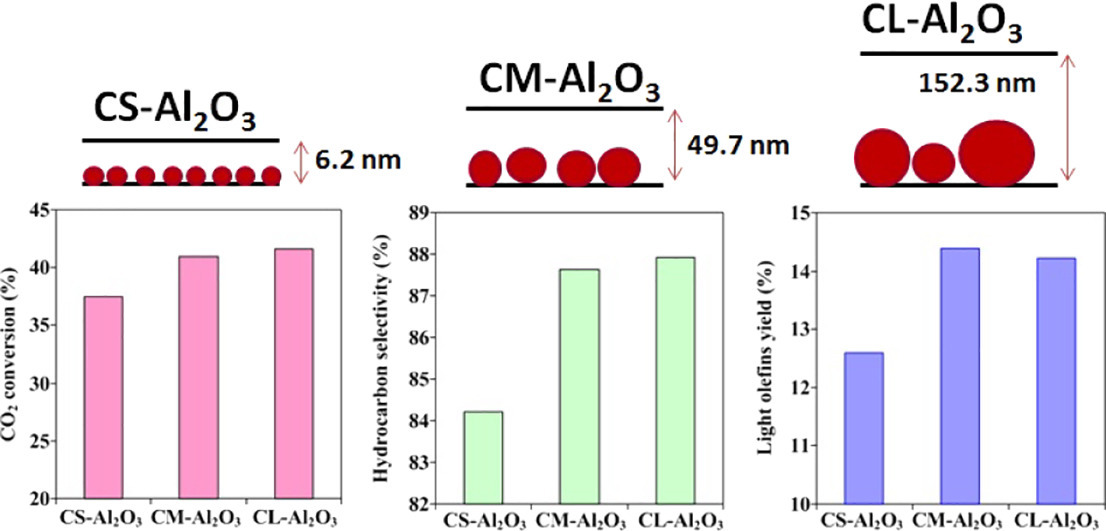
| 5 | CM-Al2O3 | 41.0 | 12.4 | 33.7 | 6.4 | 41.1 | 18.7 | — | 320 | 2 | [ |
| 6 | Fe/CeO2 rods | 20.6 | 61.2 | 80.6 | 6.2 | 12.3 | 0.6 | 1600 | 390 | — | [ |
| 7 | Fe(12.9) | 12.8 | 49.5 | 67.7 | 28.5 | 1.4 | 2.4 | 18000 | 320 | 3 | [ |
| 8 | Fe/ZrO2 | 42 | 15 | 20.0 | 8.2 | 46.0 | 26.8 | 1200 | 340 | 2 | [ |
| 9 | N-600-0 | 46 | 17.5 | 32.2 | 17.6 | 23.3 | 26.9 | 3600 | 400 | 3 | [ |
| 10 | Fe/C-K@NC-350/500 | 35.1 | 28.1 | 23.8 | 7.9 | 37.7 | 30.6 | 5000 | 340 | 3 | [ |
| 11 | 40FeK/SMC | 44.7 | 85.5 | 4.8 | 6.5 | 13.6 | 75.1 | — | 260 | 2 | [ |
| 12 | Fe-K/HPCMs1 | 33.4 | 38.9 | 22.1 | 18.8 | 29.5 | 29.6 | 3600 | 400 | 3 | [ |
| 13 | IO@gC-1.0 | 21.9 | 78.3 | 50.5 | 46.3 | 3.2 | — | 370 | — | [ | |
| 14 | FeNa/EG-A | 42.4 | 8.3 | 12.6 | 7.8 | 38.0 | 41.6 | 2000 | 320 | 3 | [ |
| 15 | Fe-Cu-K/ZSM-5(Si/Al=25) | 37.7 | 80.7 | 18.3 | 24.9 | 56.8 | 2000 | 300 | 1 | [ | |
| 16 | Mn15Na32im | 31.9 | 97.2 | 12.4 | 6.2 | 33.0 | 48.4 | 11000 | 320 | 1.5 | [ |
| 17 | IWI200 | 22.4 | 17.8 | 46.3 | 33.0 | 7.8 | 12.9 | 36000 | 300 | — | [ |
| 18 | 3% (w) Rb/Fe3O4 | 39.7 | 8.1 | 19.5 | 4.4 | 47.4 | 28.7 | 2500 | 300 | 0.5 | [ |
| 19 | FeMnZr4K | 39.0 | 81.5 | 15.4 | 4.7 | 28.4 | 51.5 | 12000 | 320 | 1 | [ |
| 20 | 1Fe-1Zn-K | 51.0 | 6.0 | 34.9 | 7.8 | 53.6 | 3.7 | 1000 | 300 | 0.5 | [ |
| 21 | 5Mn-Na/Fe | 38.6 | 11.7 | 13.5 | 4.6 | 34.6 | 47.2 | 2040 | 320 | 3 | [ |
| 22 | 0.14Mn/Fe3O4-NaAc | 27.0 | 26.8 | 14.4 | 6.4 | 40.3 | 38.9 | — | 320 | 0.5 | [ |
| 23 | FeMnNd | 49.3 | 74.9 | 20.2 | 9.1 | 36.0 | 34.3 | 4000 | 300 | 1 | [ |
| 24 | 20Fe0.5Cu0.5Nd/MOR | 23.3 | 28.3 | 34.9 | 27.1 | 25.4 | 12.6 | — | 350 | 1 | [ |
| 25 | 35Fe-7Zr-1Ce-K | 57.34 | 3.05 | 20.64 | 7.86 | 55.62 | 15.87 | 1000 | 320 | 2 | [ |
| 26 | Fe@C-1.0 | 52.3 | 92.6 | 8.5 | 4.2 | 26.0 | 61.3 | 3000 | 300 | 2 | [ |








| [1] |
|
| [2] |
|
| [3] |
|
| [4] |
|
| [5] |
|
| [6] |
|
|
(倪泽南, 郭玉鑫, 张启俭, 应用化工, 2023, 52, 2443.)
|
|
| [7] |
|
| [8] |
|
| [9] |
|
| [10] |
|
|
(刘伊伟, 黄健, 陈云霞, 精细石油化工, 2024, 41, 65.)
|
|
| [11] |
|
|
(史建公, 刘志坚, 刘春生, 中外能源, 2019, 24, 59.)
|
|
| [12] |
|
| [13] |
|
| [14] |
|
| [15] |
|
|
(刘歆颖, 邓国才, 郭先芝, 陈荣悌, 燃料化学学报, 1999, 5, 447.)
|
|
| [16] |
|
| [17] |
|
| [18] |
|
| [19] |
|
| [20] |
|
| [21] |
doi: 10.1039/c5cp07788e pmid: 26867109 |
| [22] |
|
| [23] |
|
| [24] |
|
| [25] |
|
| [26] |
|
| [27] |
|
| [28] |
|
| [29] |
|
| [30] |
|
| [31] |
|
|
(黄杰, 艾培培, 郭立升, 孙松, 洁净煤技术, 2025, 31, 145.)
|
|
| [32] |
|
| [33] |
|
| [34] |
|
| [35] |
|
| [36] |
|
| [37] |
|
| [38] |
|
| [39] |
|
| [40] |
doi: 10.1038/s41467-021-26090-5 pmid: 34625554 |
| [41] |
|
| [42] |
|
| [43] |
|
| [44] |
|
| [45] |
doi: 10.1021/acscatal.9b01466 |
| [46] |
|
| [47] |
|
| [48] |
|
| [49] |
|
| [50] |
|
| [51] |
|
| [52] |
|
| [53] |
|
| [54] |
|
| [55] |
|
| [56] |
|
| [57] |
|
| [58] |
|
| [59] |
|
| [60] |
|
| [61] |
|
| [62] |
|
| [63] |
|
| [64] |
|
| [65] |
doi: 10.1016/j.cattod.2020.03.007 |
| [66] |
|
| [67] |
|
| [68] |
|
| [69] |
|
| [70] |
|
| [71] |
|
| [72] |
|
| [73] |
|
| [74] |
|
| [75] |
|
| [76] |
|
| [77] |
|
|
(成康, 张庆红, 康金灿, 王野, 中国科学:化学, 2020, 50, 743.)
|
|
| [78] |
|
|
(梁兵连, 段洪敏, 侯宝林, 苏雄, 黄延强, 王爱琴, 王晓东, 张涛, 化工进展, 2015, 34, 3746.)
doi: 10.16085/j.issn.1000-6613.2015.10.035 |
|
| [79] |
|
| [80] |
|
| [81] |
|
| [82] |
|
|
(贾亦静, 陶金泉, 黄文斌, 刘昊然, 李蓉蓉, 姚荣鹏, 白天瑜, 魏强, 周亚松, 化工进展, 2025, 44, 820.)
doi: 10.16085/j.issn.1000-6613.2024-0201 |
|
| [83] |
|
| [84] |
|
| [85] |
|
| [86] |
|
| [87] |
|
| [88] |
|
| [89] |
|
| [90] |
|
| [91] |
|
| [92] |
|
|
(何孝祥, 顾雄毅, 范琛, 朱贻安, 华东理工大学学报(自然科学版), 2011, 37, 424.)
|
|
| [93] |
|
| [94] |
|
| [95] |
|
| [96] |
|
| [97] |
|
| [1] | Shanshan Liu, Weiwei Dong, Zhenzhen Li, Yaoyao Zhang, Chao Li, Linyu Jiao. Ionic Liquids Controlled Switchable Synthesis of Diverse Bio-Based N-Heterocycles via Tandem Dehydrogenative Cyclization [J]. Acta Chimica Sinica, 2025, 83(5): 479-487. |
| [2] | Yingqi Wang, Jiayi Chang, Min Li, Hong Liang, Zhiheng Li, Wenfu Xie, Qiang Wang. Photoelectrocatalytic Urea Synthesis via co-Reduction of CO2 and $NO_{2}^{-}$ over Metallic Surface Modified TiO2 [J]. Acta Chimica Sinica, 2025, 83(3): 247-255. |
| [3] | Ying Ma, Weixi Chen, Yuchen Liu, Ziyi Liu, Tao Wu, An-Hui Lu, Dongqi Wang. Density Functional Theory Study of Hexagonal Boron Nitride Oxidation Mode [J]. Acta Chimica Sinica, 2025, 83(1): 52-59. |
| [4] | Xingxing Jiang, Weilong Wu, Huiying Ren, Feng Zhang, Wenzhi Mo, Zhiqiang Lu. Novel Chiral Tridentate PNN Ligand Manganese Complex for Enantioselective Hydrogenation of Aromatic Ketones [J]. Acta Chimica Sinica, 2024, 82(7): 736-741. |
| [5] | Haicheng Wang, Haiyan Ma. Ring-opening Copolymerization of Epoxides and Anhydride Mediated by Claw-type Aminophenolate Zinc Chlorides [J]. Acta Chimica Sinica, 2024, 82(6): 577-588. |
| [6] | Hexin Zhou, Qingyun Cui, Xuemin Hu, Wenxiu Yang, Xiao Tian, Shuo Wang. Transfer Hydrogenation of Nitro Compounds Catalyzed by Co Atom Cluster Confined in Metal-Organic Frameworks Derived Nitrogen Doped Carbon [J]. Acta Chimica Sinica, 2024, 82(5): 503-510. |
| [7] | Cheng-Qiang Wang, Chao Feng. Applications of Nucleophilic Fluorine Sources in the Selective Fluorofunctionalization of Unsaturated Carbon-Carbon Bonds [J]. Acta Chimica Sinica, 2024, 82(2): 160-170. |
| [8] | Yaning Li, Xiaoyan Wang, Yong Tang. The Regulation of Stereoselectivity in Radical Polymerization★ [J]. Acta Chimica Sinica, 2024, 82(2): 213-225. |
| [9] | Jingyan Wang, Haiyan Ma. Syntheses of Sodium and Potassium Complexes Based on Pyridine-2,6-diyl-bis(methylene)-bridged Bis(aminophenolate) Ligands and Catalytic Ring-opening Polymerization of rac-Lactide [J]. Acta Chimica Sinica, 2024, 82(10): 1058-1068. |
| [10] | Xianting Huang, Hongliang Han, Jing Xiao, Fan Wang, Zhong-Quan Liu. An I2O5/KSCN-Mediated Iodothiocyanation of Alkynes [J]. Acta Chimica Sinica, 2024, 82(1): 5-8. |
| [11] | Yuhan Wu, Dongdong Zhang, Hongyu Yin, Zhengnan Chen, Wen Zhao, Yuhua Chi. Density Functional Theory Study of Janus In2S2X Photocatalytic Reduction of CO2 under “Double Carbon” Target [J]. Acta Chimica Sinica, 2023, 81(9): 1148-1156. |
| [12] | Rongjie Yang, Lin Zhou, Bin Su. Selective Detection of Vitamins A and C based on Covalent Organic Framework Modified Electrodes★ [J]. Acta Chimica Sinica, 2023, 81(8): 920-927. |
| [13] | Guoqing Cui, Yiyang Hu, Yingjie Lou, Mingxia Zhou, Yuming Li, Yajun Wang, Guiyuan Jiang, Chunming Xu. Research Progress on the Design, Preparation and Properties of Catalysts for CO2 Hydrogenation to Alcohols [J]. Acta Chimica Sinica, 2023, 81(8): 1081-1100. |
| [14] | Qiwen Chen, Xianzheng Zhang. Reserach Advances on Nanozyme-Guided Therapy of Inflammatory Bowel Diseases★ [J]. Acta Chimica Sinica, 2023, 81(8): 1043-1051. |
| [15] | Yandong Zhang, Shoufei Zhu. Perspective for Phosphine Ligands with Cyclopropane Backbone★ [J]. Acta Chimica Sinica, 2023, 81(7): 777-783. |
| Viewed | ||||||
|
Full text |
|
|||||
|
Abstract |
|
|||||
