

Acta Chimica Sinica ›› 2026, Vol. 84 ›› Issue (8): 1343-1354.DOI: 10.6023/A26060209 Previous Articles Next Articles
Review
戴枫荣, 陈忠宁*( )
)
投稿日期:2026-06-19
发布日期:2026-07-27
作者简介: |
戴枫荣, 中国科学院福建物质结构研究所研究员, 博士生导师, 主要从事功能配合物化学相关的研究工作. |
 |
陈忠宁, 中国科学院福建物质结构研究所研究员, 博士生导师, 国家自然科学基金杰出青年科学基金获得者, 入选新世纪百千万人才工程国家级人选. 主要从事配位化学相关的研究工作. |
★“纪念兰州大学化学学科创建80周年”专辑.
基金资助:
Fengrong Dai, Zhongning Chen*()
Received:2026-06-19
Published:2026-07-27
Contact:
E-mail: About author:★For the VSI “Celebration of 80th Anniversary of Chemistry in Lanzhou University”.
Supported by:Share
Fengrong Dai, Zhongning Chen. Catalytic Applications of Sulfonylcalix[4]arene-Based Coordination Cages★[J]. Acta Chimica Sinica, 2026, 84(8): 1343-1354.
| 催化体系 | 催化活性中心来源 | 核心结构/策略 | 催化应用 | 关键性能指标 | 文献 |
|---|---|---|---|---|---|
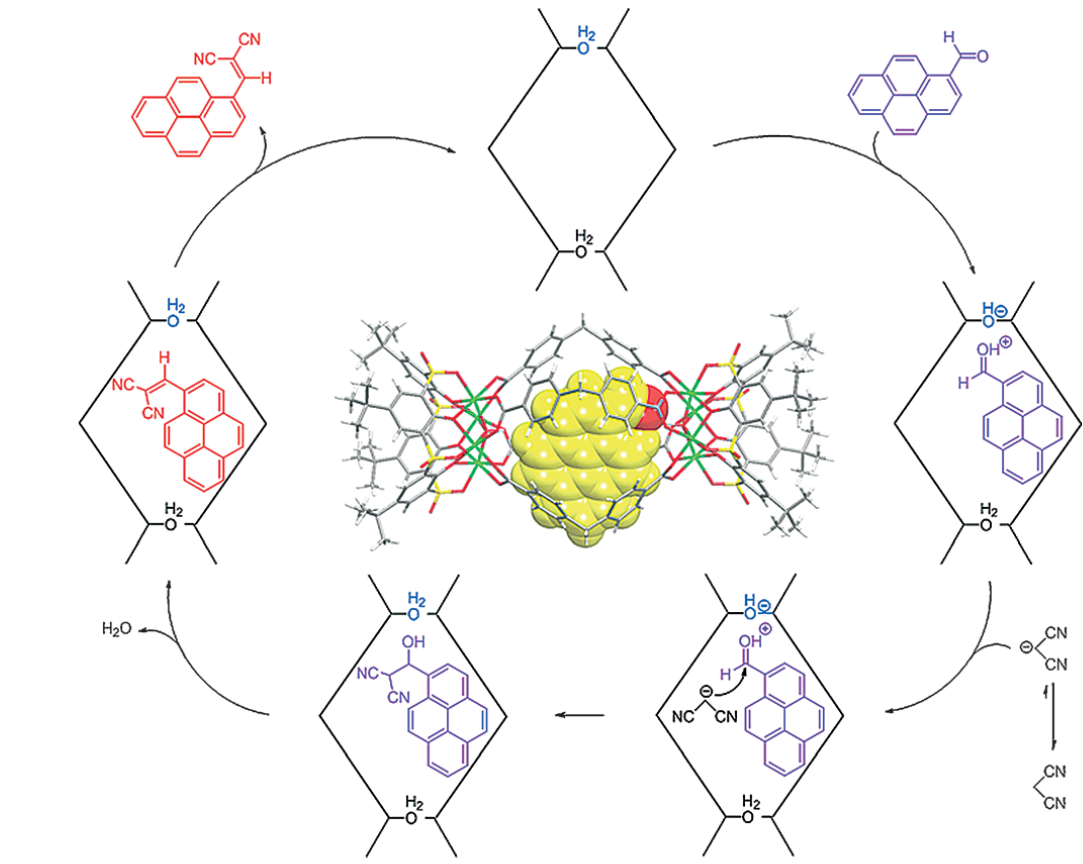
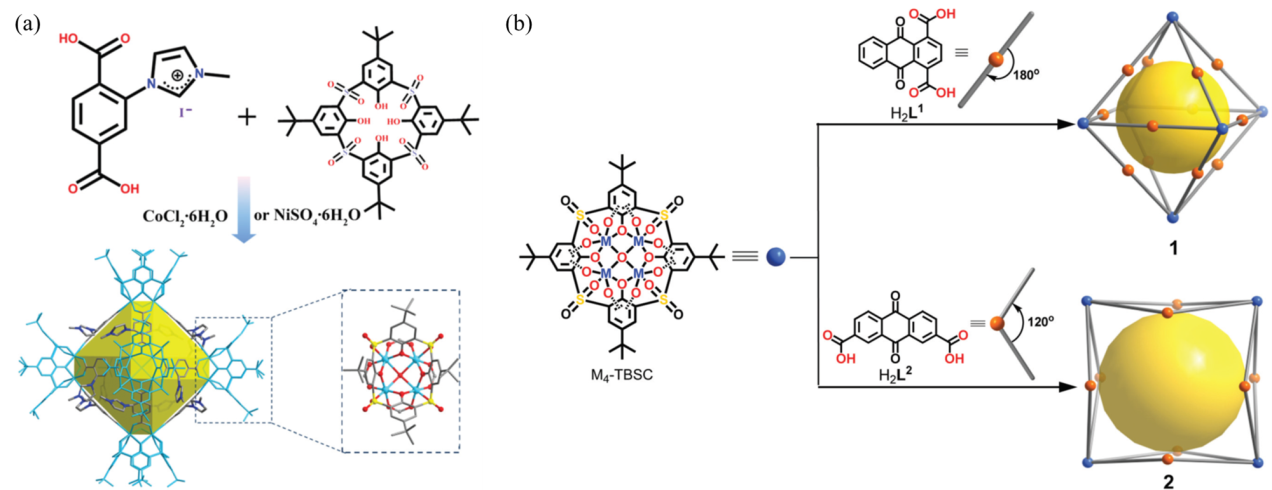
| MOSC-1, MOSC-2 | 金属簇节点: Brønsted酸性μ4-H2O | 空腔限域 静电别构调控 | Knoevenagel缩合 | 底物选择性: 1-芘甲醛, 产率67% vs 2-萘甲醛, 产率5% | [ |
| 1-Co, 1-Ni | 金属簇节点: M4TBSC, M=Co, Ni; 配体功能化: 吡啶鎓功能化 | 骨架离子化 静电微环境调控 | 电化学析氧反应(OER) | 过电位: 0.290 V @10 mA•cm-2 (1-Co); Tafel斜率: 75 mV•dec-1; 稳定性: 48 h连续电解无显著衰减 | [ |
| Cu4TBSC基分子笼 | 金属簇节点: 配位不饱和Cu(II)位点) | 结构缺陷 开放金属位点 | 伯醇选择性氧化(醇→羧酸) | 底物选择性: 4-甲氧基苄醇99%产率(4 h)、4-硝基苄醇仅得19%羧酸+74%醛(中间体); 循环性: 4次循环后活性保持>90% | [ |
| {M20V8} (M=Fe, Co, Ni)方锥纳米笼 | 金属簇节点: M20V8簇 | 金属替换 能带调控 | 可见光光热催化硫醚氧化脱硫 | 光热转换效率: Fe20V8 85.87%; 催化转化率: Fe20V8>99%; 性能排序: Fe20V8>>Co20V8>Ni20V8 | [ |
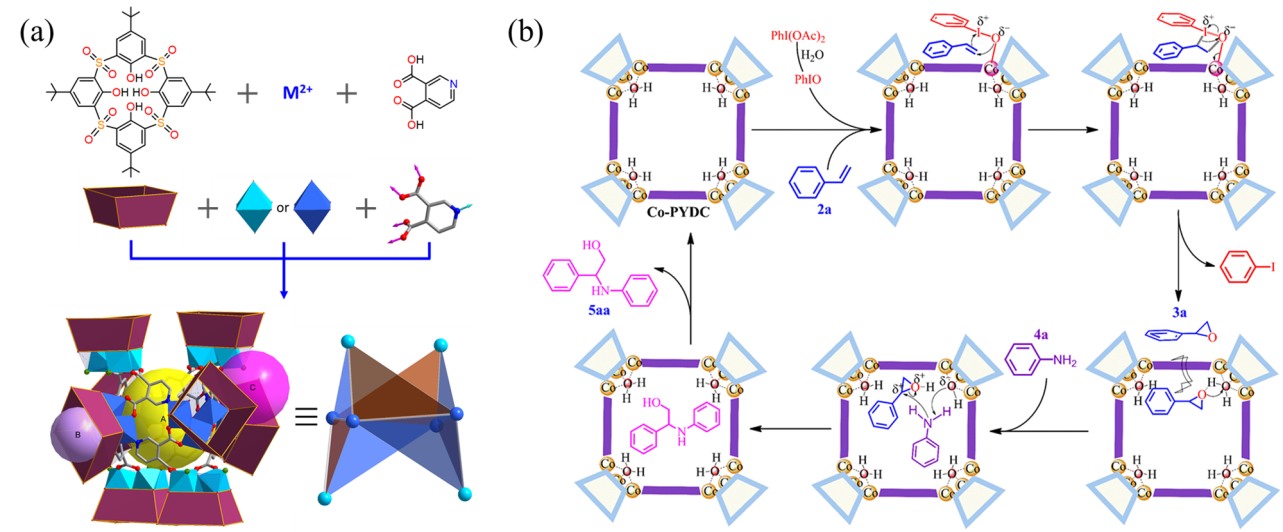
| Co-PYDC | 金属簇节点: 开放Co(II)位点+Brønsted酸性μ3-H2O | 缺陷工程 双活性区域(外腔/内腔) | 串联催化: 烯烃→β-氨基醇 | 一锅法转化率: 苯乙烯衍生物) 96%; 区域选择性: 仅生成β-位开环产物 | [ |
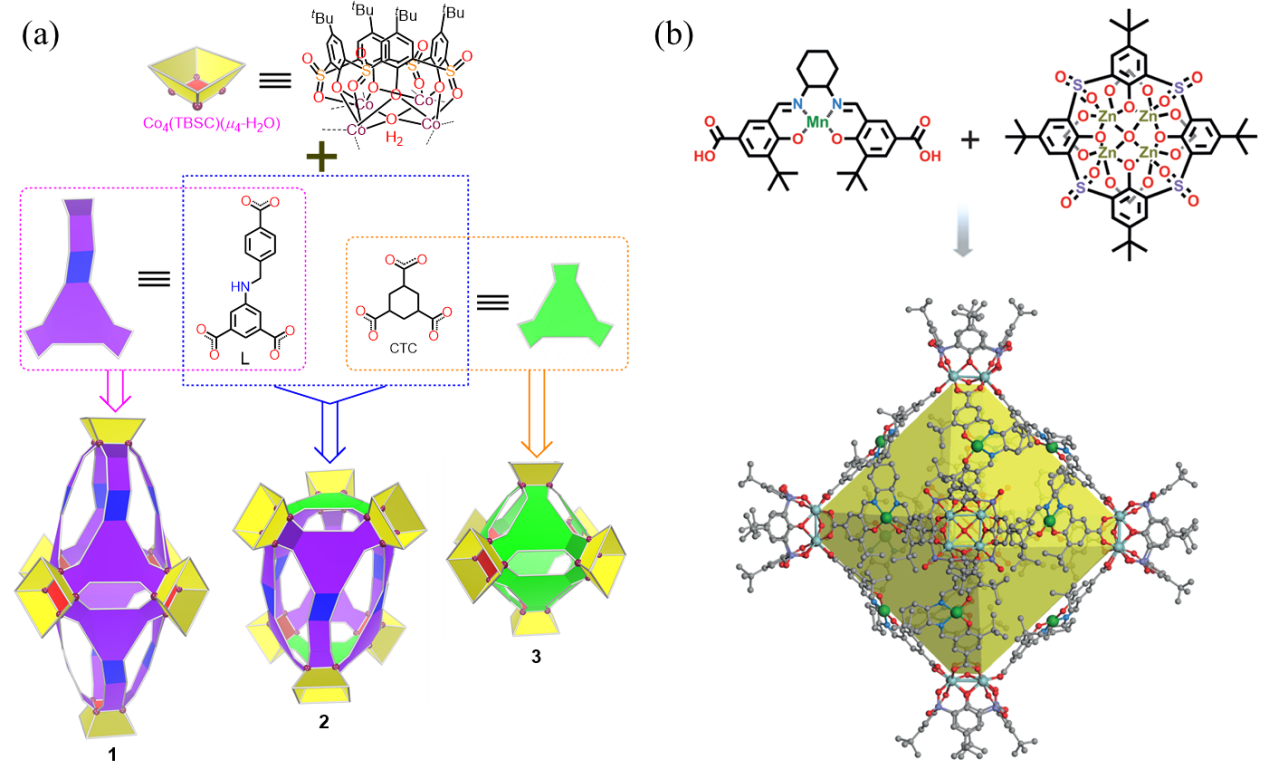
| 延长型八面体笼 | 配体功能化: -CH2NH- Brønsted碱 金属簇节点: Brønsted酸性μ4-H2O | 几何操纵(空腔拉伸) 酸碱双功能协同 | Knoevenagel缩合 | 底物1-芘甲醛, 产率89% | [ |
| 手性Mn(salen)笼 | 配体功能化: 手性Mn(salen)活性中心 | 骨架隔离 空腔限域 | 氧化动力学拆分 (仲醇)/烯烃环氧化 | 对映选择性(ee): 1-苯乙醇>99% (拆分产物); 选择性因子(krel): 最高35.0 (vs游离Mn(salen) 10.3~26.9); | [ |
| ImBDC-Co, ImBDC-Ni | 配体功能化: 咪唑鎓Lewis酸/卤素抗衡离子 | 离子型功能化配体 均相/异相结合 | CO2环加成反应 | 产物选择性:>99% (环氧氯丙烷); 底物范围: 脂肪族环氧化物产率>97%, 芳香族环氧化物>80%; 循环性: 3次循环无明显活性损失 | [ |
| 蒽醌基光催化笼 | 配体功能化: 蒽醌光敏剂 | 光活性骨架 空腔预组织 | 光催化[2+2]环加成(查尔酮) | 非对映选择性(dr): syn-HH∶anti-HT=13∶1; 转化率: 96% (12 h) | [ |
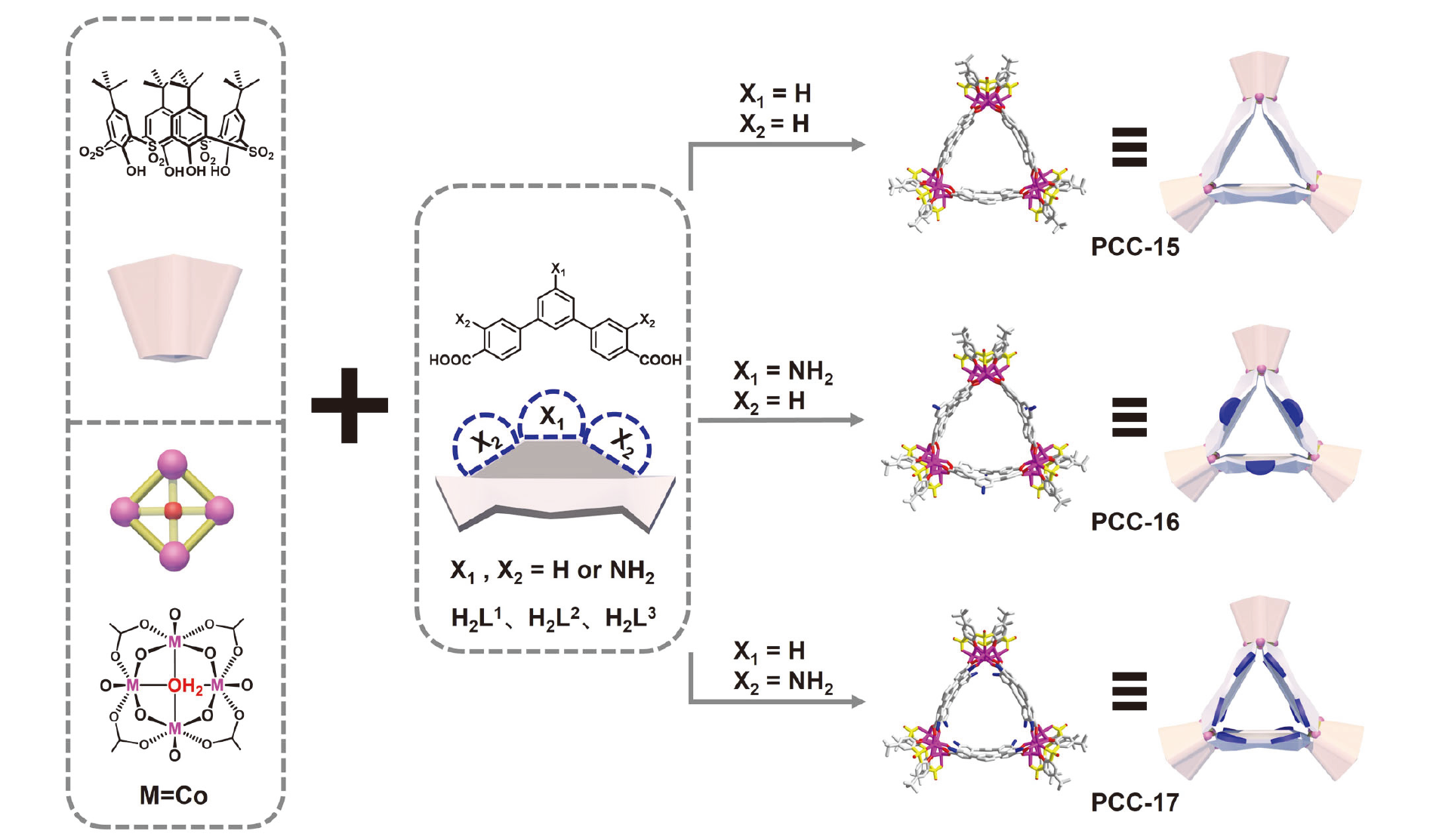
| PCC-15/16/17 | 配体功能化: -NH2- Brønsted碱) 金属簇节点: Brønsted酸性μ4-H2O | 活性位点间距精确调控: 调节-NH2-与μ4-H2O距离(从5.6 Å至12.4 Å) | Knoevenagel缩合 | 间距-活性关系: PCC-17 (5.6 Å) 96%产率>PCC-16 (12.4 Å) 21% 产率>PCC-15 (无-NH2)<5%产率; 底物范围: 多种芳香醛产率>95% | [ |
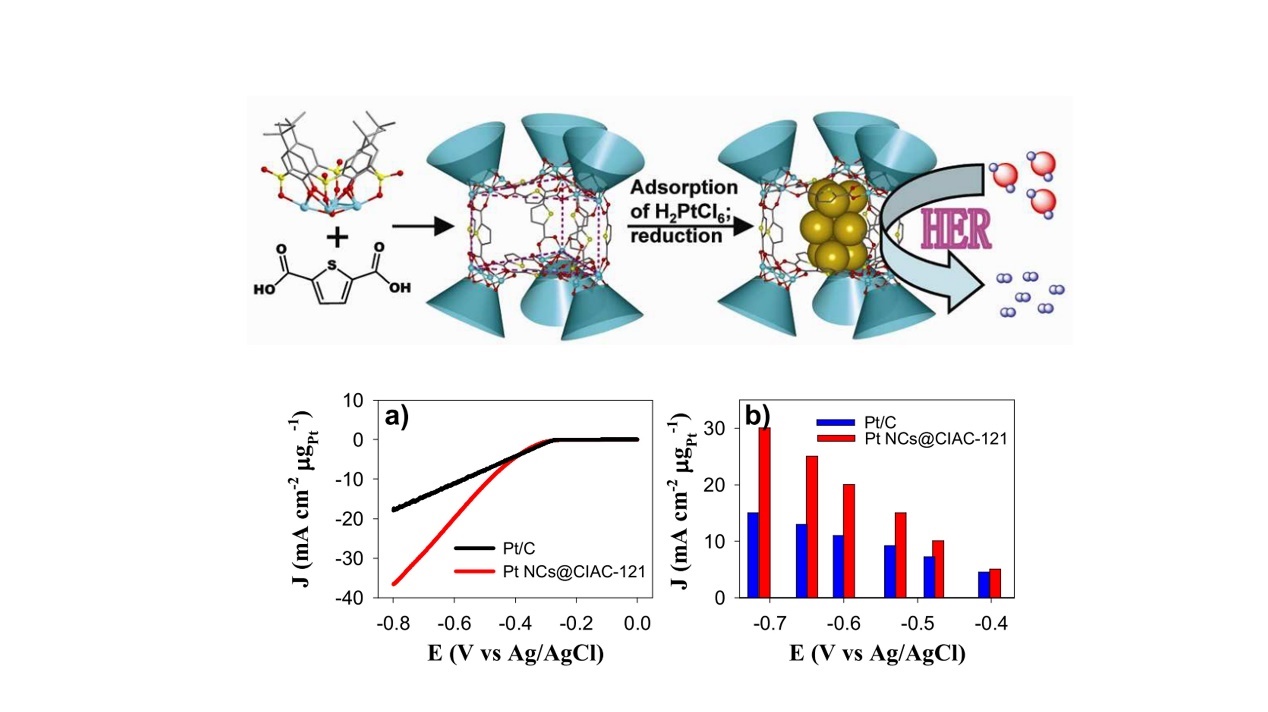
| Pt@CIAC-121 | 封装客体: Pt纳米簇 | S-锚点(化学) 空腔限域(物理) | 电解水析氢反应(HER) | 起始电位: -0.24 V (vs Ag/AgCl, 略正于Pt/C); 电流密度: 在-0.60 V时, Pt@CIAC-121为 20 mA•cm-2•µg-1 (Pt/C的2倍) | [ |
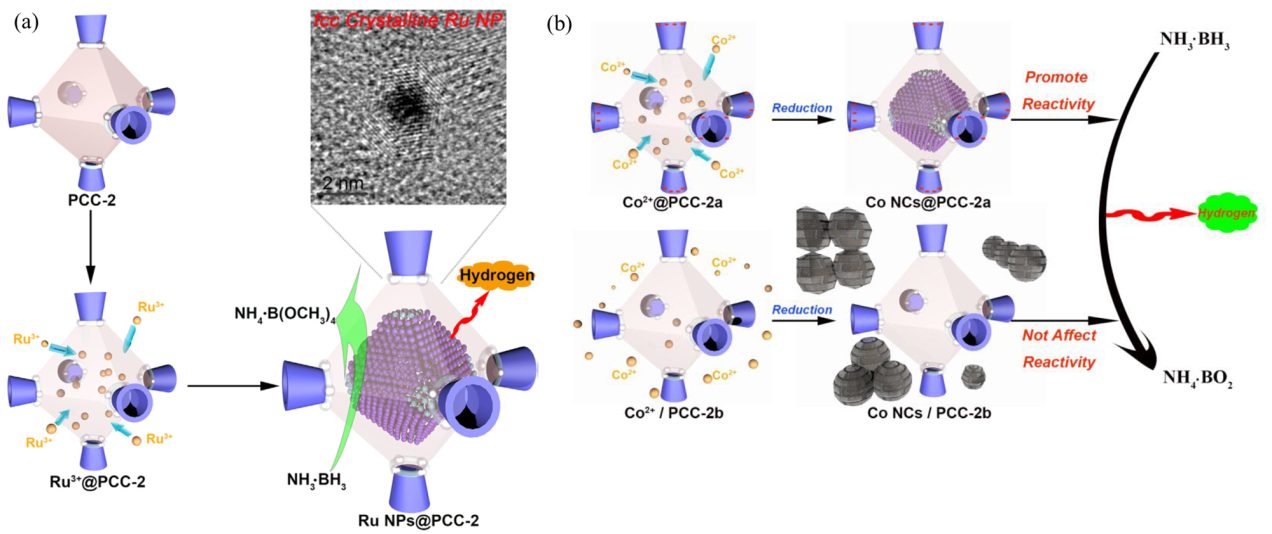
| Ru NPs@PCC-2a | 封装客体: Ru纳米颗粒 | 高负电荷笼(-30) 静电排斥/空间限域 | 氨硼烷甲醇解脱氢 | TOF: 304.4 min-1 (当时金属基催化剂最高值); 反应时间: 4.5 min内完成[n(H2)∶n(AB)=3.0∶1] | [ |
| Co NCs@PCC-2a, Co NCs@PCC-2b | 封装客体: Co 纳米簇 | 高负电荷笼(-30, PCC-2a) vs 低负电荷笼(-6, PCC-2b) (对比论证电荷效应关键作用) | 氨硼烷水解 | TOF (PCC-2a): 90.1 min-1 (第一过渡系金属最高); TOF (PCC-2b): 22.5 min-1 (严重聚集) | [ |
| Ru(bpy)3@PCC-2a | 封装客体(Ru(bpy)32+ 分子催化剂 | 共封装(催化剂+底物) | 光催化降解亚甲基蓝(MB) | 降解率(4 h): 94.9% (Ru(bpy)3@PCC-2a) vs 19.8% (游离Ru(bpy)32+); 循环性: 5次循环后活性保持>90% | [ |
| 催化体系 | 催化活性中心来源 | 核心结构/策略 | 催化应用 | 关键性能指标 | 文献 |
|---|---|---|---|---|---|
| MOSC-1, MOSC-2 | 金属簇节点: Brønsted酸性μ4-H2O | 空腔限域 静电别构调控 | Knoevenagel缩合 | 底物选择性: 1-芘甲醛, 产率67% vs 2-萘甲醛, 产率5% | [ |
| 1-Co, 1-Ni | 金属簇节点: M4TBSC, M=Co, Ni; 配体功能化: 吡啶鎓功能化 | 骨架离子化 静电微环境调控 | 电化学析氧反应(OER) | 过电位: 0.290 V @10 mA•cm-2 (1-Co); Tafel斜率: 75 mV•dec-1; 稳定性: 48 h连续电解无显著衰减 | [ |
| Cu4TBSC基分子笼 | 金属簇节点: 配位不饱和Cu(II)位点) | 结构缺陷 开放金属位点 | 伯醇选择性氧化(醇→羧酸) | 底物选择性: 4-甲氧基苄醇99%产率(4 h)、4-硝基苄醇仅得19%羧酸+74%醛(中间体); 循环性: 4次循环后活性保持>90% | [ |
| {M20V8} (M=Fe, Co, Ni)方锥纳米笼 | 金属簇节点: M20V8簇 | 金属替换 能带调控 | 可见光光热催化硫醚氧化脱硫 | 光热转换效率: Fe20V8 85.87%; 催化转化率: Fe20V8>99%; 性能排序: Fe20V8>>Co20V8>Ni20V8 | [ |
| Co-PYDC | 金属簇节点: 开放Co(II)位点+Brønsted酸性μ3-H2O | 缺陷工程 双活性区域(外腔/内腔) | 串联催化: 烯烃→β-氨基醇 | 一锅法转化率: 苯乙烯衍生物) 96%; 区域选择性: 仅生成β-位开环产物 | [ |
| 延长型八面体笼 | 配体功能化: -CH2NH- Brønsted碱 金属簇节点: Brønsted酸性μ4-H2O | 几何操纵(空腔拉伸) 酸碱双功能协同 | Knoevenagel缩合 | 底物1-芘甲醛, 产率89% | [ |
| 手性Mn(salen)笼 | 配体功能化: 手性Mn(salen)活性中心 | 骨架隔离 空腔限域 | 氧化动力学拆分 (仲醇)/烯烃环氧化 | 对映选择性(ee): 1-苯乙醇>99% (拆分产物); 选择性因子(krel): 最高35.0 (vs游离Mn(salen) 10.3~26.9); | [ |
| ImBDC-Co, ImBDC-Ni | 配体功能化: 咪唑鎓Lewis酸/卤素抗衡离子 | 离子型功能化配体 均相/异相结合 | CO2环加成反应 | 产物选择性:>99% (环氧氯丙烷); 底物范围: 脂肪族环氧化物产率>97%, 芳香族环氧化物>80%; 循环性: 3次循环无明显活性损失 | [ |
| 蒽醌基光催化笼 | 配体功能化: 蒽醌光敏剂 | 光活性骨架 空腔预组织 | 光催化[2+2]环加成(查尔酮) | 非对映选择性(dr): syn-HH∶anti-HT=13∶1; 转化率: 96% (12 h) | [ |
| PCC-15/16/17 | 配体功能化: -NH2- Brønsted碱) 金属簇节点: Brønsted酸性μ4-H2O | 活性位点间距精确调控: 调节-NH2-与μ4-H2O距离(从5.6 Å至12.4 Å) | Knoevenagel缩合 | 间距-活性关系: PCC-17 (5.6 Å) 96%产率>PCC-16 (12.4 Å) 21% 产率>PCC-15 (无-NH2)<5%产率; 底物范围: 多种芳香醛产率>95% | [ |
| Pt@CIAC-121 | 封装客体: Pt纳米簇 | S-锚点(化学) 空腔限域(物理) | 电解水析氢反应(HER) | 起始电位: -0.24 V (vs Ag/AgCl, 略正于Pt/C); 电流密度: 在-0.60 V时, Pt@CIAC-121为 20 mA•cm-2•µg-1 (Pt/C的2倍) | [ |
| Ru NPs@PCC-2a | 封装客体: Ru纳米颗粒 | 高负电荷笼(-30) 静电排斥/空间限域 | 氨硼烷甲醇解脱氢 | TOF: 304.4 min-1 (当时金属基催化剂最高值); 反应时间: 4.5 min内完成[n(H2)∶n(AB)=3.0∶1] | [ |
| Co NCs@PCC-2a, Co NCs@PCC-2b | 封装客体: Co 纳米簇 | 高负电荷笼(-30, PCC-2a) vs 低负电荷笼(-6, PCC-2b) (对比论证电荷效应关键作用) | 氨硼烷水解 | TOF (PCC-2a): 90.1 min-1 (第一过渡系金属最高); TOF (PCC-2b): 22.5 min-1 (严重聚集) | [ |
| Ru(bpy)3@PCC-2a | 封装客体(Ru(bpy)32+ 分子催化剂 | 共封装(催化剂+底物) | 光催化降解亚甲基蓝(MB) | 降解率(4 h): 94.9% (Ru(bpy)3@PCC-2a) vs 19.8% (游离Ru(bpy)32+); 循环性: 5次循环后活性保持>90% | [ |
| [1] |
doi: 10.1126/science.1159747 |
| [2] |
doi: 10.1021/cr0503106 pmid: 16895325 |
| [3] |
doi: 10.1038/nchem.2461 |
| [4] |
doi: 10.1038/nchem.744 pmid: 20651721 |
| [5] |
doi: 10.1039/C3CS60037H |
| [6] |
doi: 10.1039/c3cs35486e |
| [7] |
doi: 10.1002/chem.v19.20 |
| [8] |
doi: 10.1021/cs200171u |
| [9] |
doi: 10.1002/anie.v42:40 |
| [10] |
|
| [11] |
doi: 10.1016/j.ccr.2007.10.010 |
| [12] |
pmid: 11749254 |
| [13] |
doi: 10.1016/j.ccr.2025.216726 |
| [14] |
doi: 10.1021/cr200345v pmid: 22251425 |
| [15] |
doi: 10.1039/c2cs35254k pmid: 23032789 |
| [16] |
doi: 10.1021/cr200077m pmid: 21863792 |
| [17] |
doi: 10.1002/cjoc.v43.20 |
| [18] |
doi: 10.1016/j.ccr.2019.01.023 |
| [19] |
doi: 10.1002/chem.v25.3 |
| [20] |
doi: 10.1021/ja402630g |
| [21] |
doi: 10.1038/nchem.2452 pmid: 26892554 |
| [22] |
doi: 10.1021/acs.accounts.8b00261 |
| [23] |
doi: 10.1002/cjoc.v43.6 |
| [24] |
doi: 10.1002/cjoc.v43.9 |
| [25] |
doi: 10.6023/A23120538 |
|
(王敏, 陈帮塘, 陈桥林, 王俊, 陈名钊, 蒋志龙, 王平山, 化学学报, 2024, 82, 336.)
doi: 10.6023/A23120538 |
|
| [26] |
pmid: 17165689 |
| [27] |
doi: 10.1002/ejic.v2006:9 |
| [28] |
doi: 10.3390/molecules29061220 |
| [29] |
|
| [30] |
doi: 10.1016/j.ccr.2020.213656 |
| [31] |
doi: 10.1039/b614961h pmid: 18197342 |
| [32] |
doi: 10.1039/c9cs00091g pmid: 31339148 |
| [33] |
doi: 10.1016/j.ccr.2026.217842 |
| [34] |
doi: 10.1021/acs.jchemed.5c01732 |
| [35] |
doi: 10.1002/anie.v55.41 |
| [36] |
doi: 10.1039/C5QI00212E |
| [37] |
doi: 10.1039/C7TA05797K |
| [38] |
doi: 10.1007/s11426-023-1584-y |
| [39] |
doi: 10.1039/D5CC02007G |
| [40] |
doi: 10.1007/s11426-025-3004-8 |
| [41] |
doi: 10.1021/acs.accounts.4c00467 |
| [42] |
doi: 10.1016/S1872-2067(26)65001-2 |
| [43] |
doi: 10.31635/ccschem.021.202100987 |
| [44] |
doi: 10.1002/anie.v57.8 |
| [45] |
doi: 10.1039/D0CC08098E |
| [46] |
doi: 10.1039/D1DT00652E |
| [47] |
doi: 10.1002/sstr.v7.3 |
| [48] |
doi: 10.1039/D4SC08729A |
| [49] |
doi: 10.1007/s11426-024-2168-4 |
| [50] |
doi: 10.1021/jacs.6b11218 |
| [51] |
doi: 10.1016/j.chempr.2018.01.004 |
| [52] |
doi: 10.1002/anie.v57.19 |
| [53] |
doi: 10.1039/c8sc05315d pmid: 30996944 |
| [1] | Zhang, Hong-Hao, Yu, Shouyun. Advances on Transition Metals and Photoredox Cooperatively Catalyzed Allylic Substitutions [J]. Acta Chimica Sinica, 2019, 77(9): 832-840. |
| [2] | Jiao Yang, Zhang Xi. Supramolecular Free Radicals: Fabrication, Modulation and Functions [J]. Acta Chim. Sinica, 2018, 76(9): 659-665. |
| [3] | Khan Ijaz, Li Hongfang, Wu Xue, Zhang Yong Jian. Asymmetric Decarboxylative Cycloaddition of Vinylethylene Carbonates with Aldehydes by Cooperative Catalysis of Palladium Complex and Chiral Squaramide [J]. Acta Chim. Sinica, 2018, 76(11): 874-877. |
| [4] | Zhou Qiang, Lu Ping. Recent Advances in Cooperative Catalysis of Chiral Lewis Base and Transition Metal Catalyst [J]. Acta Chim. Sinica, 2018, 76(11): 825-830. |
| [5] | Yu Sifan, Fu Xiang, Liu Gengxin, Qiu Huang, Hu Wenhao. Efficient and Facile Synthesis of Chiral Sulfonamides via Asymmetric Multicomponent Reactions [J]. Acta Chim. Sinica, 2018, 76(11): 895-900. |
| [6] | Lu Hong, Liu Jin-Yu, Li Hong-Yu, Xu Peng-Fei. Recent Developments in N-Heterocyclic Carbene and Transition-Metal Cooperative Catalysis [J]. Acta Chim. Sinica, 2018, 76(11): 831-837. |
| [7] | Qiu Huang, Zhang Dan, Liu Shunying, Qiu Lin, Zhou Jun, Qian Yu, Zhai Changwei, Hu Wenhao. Asymmetric C—H Functionalization of Indoles via Enantioselective Protonation [J]. Acta Chimica Sinica, 2012, 70(24): 2484-2488. |
| [8] | GAO Zi-Wei, SUN Ping, GAO Ling-Xiang, HAN Li, YUAN Wen-Quan, LIU Yu, ZHANG Jun-Feng, LÜ Ming. Preparation of Titanocene Derivatives by Interfacial Supramolecular Catalytic Reactions [J]. Acta Chimica Sinica, 2004, 62(10): 979-985. |
| Viewed | ||||||
|
Full text |
|
|||||
|
Abstract |
|
|||||
