

Acta Chimica Sinica ›› 2026, Vol. 84 ›› Issue (9): 1418-1427.DOI: 10.6023/A26060214 Previous Articles Next Articles
Article
孙士博a, 王胜a, 王翰洋a, 蓝晨栝a, 马静a, 王其召b, 孙振丽a,*( ), 王祥科a,*()
投稿日期:2026-06-20
发布日期:2026-09-05
通讯作者:
孙振丽, 王祥科
作者简介:★“纪念兰州大学化学学科创建80周年”专辑.
基金资助:
Shibo Suna, Sheng Wanga, Hanyang Wanga, Chenkuo Lana, Jing Maa, Qizhao Wangb, Zhenli Suna,*(), Xiangke Wanga,*()
Received:2026-06-20
Published:2026-09-05
Contact:
Zhenli Sun, Xiangke Wang
About author:★For the VSI “Celebration of 80th Anniversary of Chemistry in Lanzhou University”.
Supported by:Share
Shibo Sun, Sheng Wang, Hanyang Wang, Chenkuo Lan, Jing Ma, Qizhao Wang, Zhenli Sun, Xiangke Wang. Machine Learning-Assisted Elucidation of the Adsorption Structure-Mechanism Relationship of Uranyl on Covalent Organic Frameworks★[J]. Acta Chimica Sinica, 2026, 84(9): 1418-1427.
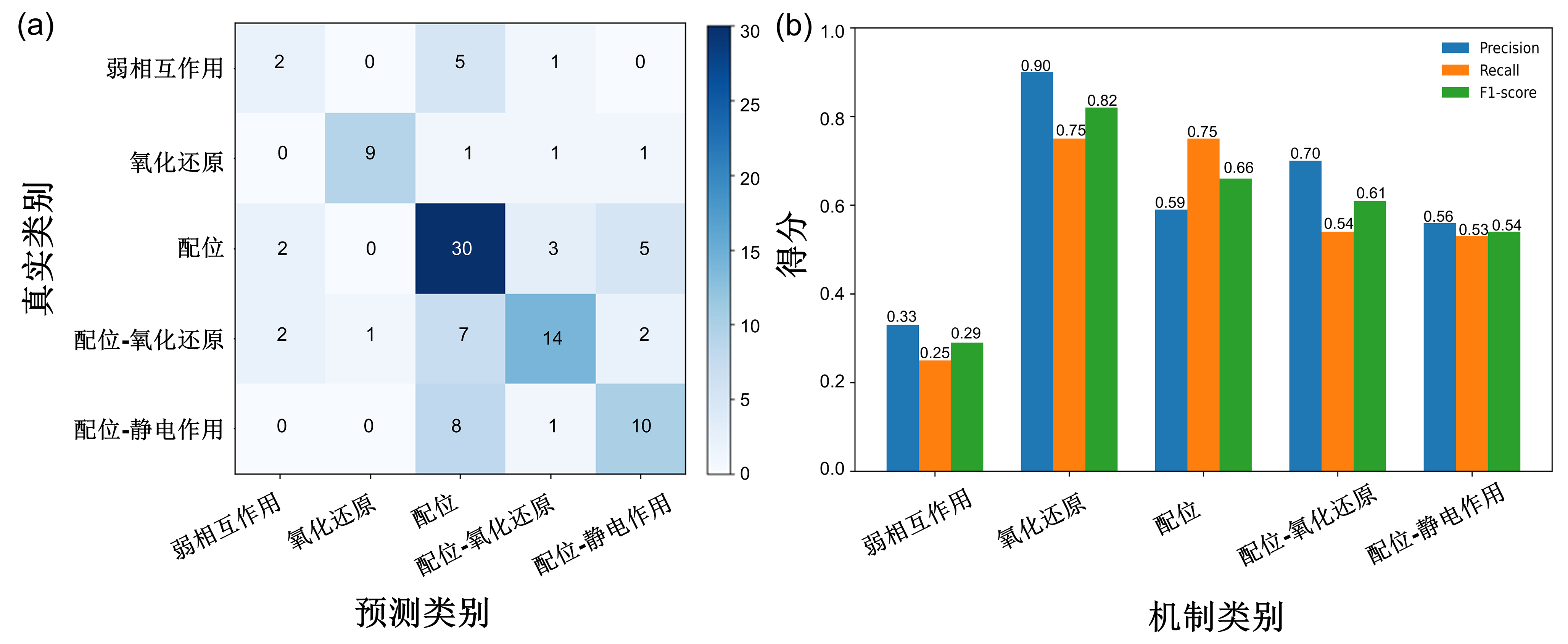
| 机制类别 | 原始机制标签 | 判定依据 | 典型证据 |
|---|---|---|---|
| 配位作用 | 配位、螯合、表面 络合、配位键作用 | $\mathrm{UO}_{2}^{2+}$与COFs骨架中的N/O/S/P等 供电子位点形成稳定结合 | 傅里叶变换红外光谱法(FTIR)/X射线光电子能谱(XPS)中N, O, S和P等官能团峰位或结合能变化; 扩展X射线吸收精细结构(EXAFS)证实U—O/U—N等配位结构; 密度泛函理论(DFT)显示较强结合能或稳定配位构型; 吸附前后官能团特征变化 |
| 氧化还原 作用 | 氧化还原、化学还 原、光催化还原、 电化学还原 | U(VI)发生电子转移, 形成 U(IV)或低价铀物种 | XPS出现U(IV)信号; 光催化或电化学还原证据; 光电流、EPR或能带分析等电子转移证据 |
| 配位-氧化 还原作用 | 配位-氧化还原、 螯合-还原、配位- 化学还原、配位- 光催化还原 | $\mathrm{UO}_{2}^{2+}$先通过配位作用实现界面 富集, 随后发生电子转移或价态转化 | 配位证据与U(IV)或低价铀证据同时存在; 或光/电催化还原过程伴随明显官能团络合证据 |
| 配位-静电 作用 | 配位-静电、配位- 离子交换、静电- 离子交换-配位 | 配位结合同时伴随表面电荷吸引、 离子交换或pH依赖富集过程 | Zeta电位变化; pH依赖吸附行为; 离子竞争实验; 表面电荷分析; FTIR/XPS配位证据 |
| 弱相互作用 | 物理吸附、物理嵌 合、氢键、范德华 力、π-π作用、非特 异性吸附 | 缺乏明确强配位或价态变化证据, 吸附主要依赖孔结构匹配或弱界 面作用 | 孔结构匹配分析; 氢键、范德华力或π-π作用讨论; 较弱光谱变化; 非特异性吸附现象 |
| 机制类别 | 原始机制标签 | 判定依据 | 典型证据 |
|---|---|---|---|
| 配位作用 | 配位、螯合、表面 络合、配位键作用 | $\mathrm{UO}_{2}^{2+}$与COFs骨架中的N/O/S/P等 供电子位点形成稳定结合 | 傅里叶变换红外光谱法(FTIR)/X射线光电子能谱(XPS)中N, O, S和P等官能团峰位或结合能变化; 扩展X射线吸收精细结构(EXAFS)证实U—O/U—N等配位结构; 密度泛函理论(DFT)显示较强结合能或稳定配位构型; 吸附前后官能团特征变化 |
| 氧化还原 作用 | 氧化还原、化学还 原、光催化还原、 电化学还原 | U(VI)发生电子转移, 形成 U(IV)或低价铀物种 | XPS出现U(IV)信号; 光催化或电化学还原证据; 光电流、EPR或能带分析等电子转移证据 |
| 配位-氧化 还原作用 | 配位-氧化还原、 螯合-还原、配位- 化学还原、配位- 光催化还原 | $\mathrm{UO}_{2}^{2+}$先通过配位作用实现界面 富集, 随后发生电子转移或价态转化 | 配位证据与U(IV)或低价铀证据同时存在; 或光/电催化还原过程伴随明显官能团络合证据 |
| 配位-静电 作用 | 配位-静电、配位- 离子交换、静电- 离子交换-配位 | 配位结合同时伴随表面电荷吸引、 离子交换或pH依赖富集过程 | Zeta电位变化; pH依赖吸附行为; 离子竞争实验; 表面电荷分析; FTIR/XPS配位证据 |
| 弱相互作用 | 物理吸附、物理嵌 合、氢键、范德华 力、π-π作用、非特 异性吸附 | 缺乏明确强配位或价态变化证据, 吸附主要依赖孔结构匹配或弱界 面作用 | 孔结构匹配分析; 氢键、范德华力或π-π作用讨论; 较弱光谱变化; 非特异性吸附现象 |


| 类别 | 参数 | 单位 | 缩写 | 数据范围 | 样本数 |
|---|---|---|---|---|---|
| 吸附剂结构 | 比表面积 | m2/g | SA | 0.80~1713.00 | 98 |
| 孔径 | nm | pore_size | 0.40~7.49 | 68 | |
| 孔容 | cm³/g | pore_vol | 0.02~0.90 | 33 | |
| 带隙 | eV | bandgap | 1.25~3.58 | 35 | |
| 结晶有序性 | — | crystallinity | 高/中/低 | 102 | |
| 实验条件 | 初始浓度 | mg/L | C0 | 0.0033~500.00 | 105 |
| pH | — | pH | 1.50~9.00 | 105 | |
| 温度 | K | T | 293.00~318.00 | 105 | |
| 平衡时间 | h | eq_time | 0.03~288.00 | 98 |
| 类别 | 参数 | 单位 | 缩写 | 数据范围 | 样本数 |
|---|---|---|---|---|---|
| 吸附剂结构 | 比表面积 | m2/g | SA | 0.80~1713.00 | 98 |
| 孔径 | nm | pore_size | 0.40~7.49 | 68 | |
| 孔容 | cm³/g | pore_vol | 0.02~0.90 | 33 | |
| 带隙 | eV | bandgap | 1.25~3.58 | 35 | |
| 结晶有序性 | — | crystallinity | 高/中/低 | 102 | |
| 实验条件 | 初始浓度 | mg/L | C0 | 0.0033~500.00 | 105 |
| pH | — | pH | 1.50~9.00 | 105 | |
| 温度 | K | T | 293.00~318.00 | 105 | |
| 平衡时间 | h | eq_time | 0.03~288.00 | 98 |
| [1] |
|
| [2] |
doi: 10.1016/j.ccr.2026.217641 |
| [3] |
doi: 10.6023/A18090404 |
|
(王宁, 庞宏伟, 于淑君, 顾鹏程, 宋爽, 王宏青, 王祥科, 化学学报, 2019, 77, 143.)
doi: 10.6023/A18090404 |
|
| [4] |
doi: 10.1038/s41893-021-00792-6 |
| [5] |
doi: 10.1021/acs.chemrev.9b00550 |
| [6] |
doi: 10.1007/s11426-025-2784-1 |
| [7] |
|
| [8] |
doi: 10.1016/j.cej.2024.156783 |
| [9] |
doi: 10.1021/jacs.5c10932 |
| [10] |
doi: 10.1038/s41467-023-40169-1 |
| [11] |
|
| [12] |
doi: 10.1016/j.apcatb.2021.120250 |
| [13] |
doi: 10.1002/anie.v58.45 |
| [14] |
doi: 10.1021/acs.est.0c05591 |
| [15] |
|
| [16] |
doi: 10.1021/acs.est.1c06157 |
| [17] |
doi: 10.6023/A23100473 |
|
(李珺卿, 宋千禧, 刘子义, 王东琪, 化学学报, 2024, 82, 387.)
doi: 10.6023/A23100473 |
|
| [18] |
doi: 10.1007/s11426-025-3233-y |
| [19] |
|
| [20] |
doi: 10.1002/smll.v17.6 |
| [21] |
doi: 10.1016/j.cej.2021.129550 |
| [22] |
doi: 10.31635/ccschem.022.202201897 |
| [23] |
doi: 10.1021/jacsau.2c00614 |
| [24] |
doi: 10.1039/d0nr06854c pmid: 33295920 |
| [25] |
|
| [26] |
doi: 10.1098/rsta.2015.0202 |
| [1] | Yuming Zhang, Shitao Sun, Shijia Zhou, Junqing Li, Lei He, Dongqi Wang. Value-added Transformation of Ethanol to n-Butanol: a Machine Learning Study [J]. Acta Chimica Sinica, 2026, 84(9): 1464-1474. |
| [2] | Zhongsheng Chen, Tianhao Lei, Wei Peng, Xianlin Chen, Chunpei Yan, Feng Luo. Recent Progress and Prospects of Covalent-organic Frameworks Materials for Uranium Extraction from Seawater★ [J]. Acta Chimica Sinica, 2026, 84(5): 736-754. |
| [3] | Huiqiong Weng, He Huang, Wenfei Wang, Heguo Li, Xiaopeng Li, Shouxin Zhang, Shuhua Li, Yue Zhao, Yufang Wu, Zhiwei Qiao. AI Big-Data Mining Empowered by MOFid for High-Performance Chemical Warfare Agent Adsorbents [J]. Acta Chimica Sinica, 2026, 84(1): 8-19. |
| [4] | Shengrong Yan, Wenhao Liu, Fang Duan, Mingqing Chen, Weifu Dong, Shuanglong Lu, Mingliang Du. Constructing of sp2-Carbon Linked Covalent Organic Frameworks with D-A Structure and Evaluating Their Photocatalytic Performance towards Hydrogen Peroxide Production [J]. Acta Chimica Sinica, 2025, 83(7): 685-693. |
| [5] | Yunhe Mo, Weigang Cao, Lequan Zhao, Zhenqiang Tang, Long Zheng, Zongying Cai. Screening Vanadium-Based Electrode Materials for Lithium-Ion Batteries Based on Machine Learning and First-Principles [J]. Acta Chimica Sinica, 2025, 83(5): 518-526. |
| [6] | Ban Miaohan, Shuang Yazhou, Yang Anping, Zheng Changyong, Zhang Wei, Xu Fei. Advances in Covalent Organic Frameworks Design for Proton Conduction [J]. Acta Chimica Sinica, 2025, 83(11): 1435-1540. |
| [7] | Junqing Li, Qianxi Song, Ziyi Liu, Dongqi Wang. Machine Learning for Predicting Band Gap in Boron-containing Materials [J]. Acta Chimica Sinica, 2024, 82(4): 387-395. |
| [8] | Han Xu, Congzhi Wang, Zhirong Liu, Weiqun Shi. Advances in Adsorption Materials and Coordination Mechanism of Functional Groups for Uranium Extraction from Seawater [J]. Acta Chimica Sinica, 2024, 82(4): 458-470. |
| [9] | Jianchuan Liu, Cuiyan Li, Yaozu Liu, Yujie Wang, Qianrong Fang. Highly-Stable Two-Dimensional Bicarbazole-based sp2-Carbon-conjugated Covalent Organic Framework for Efficient Electrocatalytic Oxygen Reduction★ [J]. Acta Chimica Sinica, 2023, 81(8): 884-890. |
| [10] | Junchang Chen, Mingxing Zhang, Shuao Wang. Research Progress of Synthesis Methods for Crystalline Porous Materials [J]. Acta Chimica Sinica, 2023, 81(2): 146-157. |
| [11] | Xingyi Qi, Yaofeng Hu, Ruoyu Wang, Yaqing Yang, Yufei Zhao. Recent Advance of Machine Learning in Selecting New Materials [J]. Acta Chimica Sinica, 2023, 81(2): 158-174. |
| [12] | Yizhi Han, Jianhui Lan, Xue Liu, Weiqun Shi. Advances in Molecular Dynamics Studies of Molten Salts Based on Machine Learning [J]. Acta Chimica Sinica, 2023, 81(11): 1663-1672. |
| [13] | Min Cheng, Shihui Wang, Lei Luo, Li Zhou, Kexin Bi, Yiyang Dai, Xu Ji. Large-Scale Computational Screening of Metal-Organic Framework Membranes for Ethane/Ethylene Separation [J]. Acta Chimica Sinica, 2022, 80(9): 1277-1288. |
| [14] | Yuze Liu, Kunhua Li, Jiaxing Huang, Xi Yu, Wenping Hu. Accurate Prediction of the Boiling Point of Organic Molecules by Multi-Component Heterogeneous Learning Model [J]. Acta Chimica Sinica, 2022, 80(6): 714-723. |
| [15] | Shihui Wang, Xiaoyu Xue, Min Cheng, Shaochen Chen, Chong Liu, Li Zhou, Kexin Bi, Xu Ji. High-Throughput Computational Screening of Metal-Organic Frameworks for CH4/H2 Separation by Synergizing Machine Learning and Molecular Simulation [J]. Acta Chimica Sinica, 2022, 80(5): 614-624. |
| Viewed | ||||||
|
Full text |
|
|||||
|
Abstract |
|
|||||
