有机化学 ›› 2025, Vol. 45 ›› Issue (7): 2480-2485.DOI: 10.6023/cjoc202411015 上一篇 下一篇
研究论文
令小鹏, 陶绍平, 林奇, 史兵兵, 姚虹, 魏太保*( ), 陈进发*()
收稿日期:2024-11-15
修回日期:2025-01-21
发布日期:2025-02-14
基金资助:
Xiaopeng Ling, Shaoping Tao, Qi Lin, Bingbing Shi, Hong Yao, Taibao Wei*(), Jinfa Chen*()
Received:2024-11-15
Revised:2025-01-21
Published:2025-02-14
Contact:
*E-mail: weitaibao@126.com; chenjinfa@nwnu.edu.cn
Supported by:文章分享

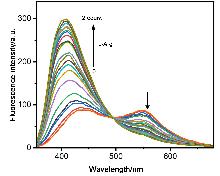
近十年来, 人们对各种功能化柱芳烃的合成和应用特性进行了广泛的研究. 由于柱芳烃具有丰富的主客识别能力, 因此在传感器领域具有良好的应用前景. 然而, 柱芳烃的非共轭结构导致其极差的荧光效率. 通过在柱[5]芳烃骨架中引入供电子的三芳基胺(Ar3N)和缺电子的三芳基硼(Ar3B), 得到了一种π-共轭电荷转移体系P5BN, 显著改善了其发光性能, 并进一步用于荧光检测应用. 分子结构显示, P5BN提供了一个大环空腔, 可封装适当大小的氨基酸分子. P5BN作为一种荧光传感器, 可以选择性检测L-精氨酸(L-Arg), 最低检测浓度为2.21×10⁻⁸ mol/L. 实验和密度泛函理论(DFT)计算证明了识别机制.
令小鹏, 陶绍平, 林奇, 史兵兵, 姚虹, 魏太保, 陈进发. 基于π-共轭柱[5]芳烃的荧光传感器用于L-精氨酸识别[J]. 有机化学, 2025, 45(7): 2480-2485.
Xiaopeng Ling, Shaoping Tao, Qi Lin, Bingbing Shi, Hong Yao, Taibao Wei, Jinfa Chen. A Pillar[5]arene-Based π-Conjugated Dye Used for Fluorescence Sensing of L-Arginine[J]. Chinese Journal of Organic Chemistry, 2025, 45(7): 2480-2485.






| [1] |
|
| [2] |
|
| [3] |
doi: 10.1161/hq0901.096582 pmid: 11557674 |
| [4] |
|
| [5] |
|
|
( 刘飞冉, 敬静, 张小玲, 有机化学, 2023, 43, 2053.)
doi: 10.6023/cjoc202209005 |
|
| [6] |
|
| [7] |
|
| [8] |
|
| [9] |
|
| [10] |
|
| [11] |
|
| [12] |
|
| [13] |
|
| [14] |
|
| [15] |
|
| [16] |
doi: 10.1016/j.chroma.2008.07.043 pmid: 18752800 |
| [17] |
doi: 10.1016/j.talanta.2012.01.041 pmid: 22385808 |
| [18] |
|
| [19] |
|
| [20] |
|
| [21] |
|
| [22] |
|
| [23] |
doi: 10.1039/c1cs15028f pmid: 21491036 |
| [24] |
|
| [25] |
|
| [26] |
Xu, W. X.; H, M.; Zhao, W. W.; Huang, C. H.; Redshaw, C.; Tao, Z.; Xiao, X. Anal. Chim. Acta 2020, 1135, 142.
|
| [27] |
|
|
( 杨伟青, 付海燕, 马梦林, 有机化学, 2024, 44, 180.)
|
|
| [28] |
|
| [29] |
|
| [30] |
(a)
|
|
(b)
|
|
|
(c)
|
|
|
(d)
|
|
|
(e)
|
|
| [31] |
(a)
|
|
(b)
|
|
|
(c)
|
|
|
(d)
|
|
|
(e)
|
|
|
(f)
|
|
|
(g)
|
|
|
(h)
|
|
|
( 尹晓璇, 李进杰, 禚可欣, 牟蔚鑫, 黄灵丽, 陈健壮, 林绍梁, 化学学报, 2024, 82, 790.)
doi: 10.6023/A24040123 |
|
|
(i)
|
|
|
( 马长顺, 金苇航, 童非, 顾睿锐, 曲大辉, 化学学报, 2023, 81, 572.)
doi: 10.6023/A23040169 |
|
| [32] |
(a)
|
|
(b)
|
|
|
(c)
|
|
| [33] |
(a)
|
|
(b)
|
|
|
(c)
|
|
|
(d)
|
|
|
( 王银凤, 李猛, 陈传峰, 化学学报, 2023, 81, 588.)
doi: 10.6023/A23040153 |
|
| [34] |
(a)
|
|
(b)
|
|
| [35] |
(a)
|
|
(b)
|
|
| [36] |
(a)
doi: 10.1039/c9cs00153k pmid: 31070642 |
|
(b)
pmid: 31070642 |
|
| [37] |
(a)
|
|
(b)
|
|
|
(c)
|
|
|
(d)
|
|
|
( 吕鑫, 吴仪, 张勃然, 郭炜, 化学学报, 2023, 81, 359.)
doi: 10.6023/A22120487 |
|
| [38] |
(a)
|
|
(b)
|
|
| [39] |
|
| [40] |
(a)
|
|
(b)
|
|
| [41] |
|
| [42] |
|
| [1] | 陈学伟, 于方彩, 田传洪. 1,1'-亚甲基二咪唑鎓多氢键供体催化剂促进常压下CO2与环氧化物的环加成反应[J]. 有机化学, 2024, 44(10): 3198-3205. |
| [2] | 刘婷婷, 胡宇才, 沈安. 亚胺配体协同氮杂环卡宾钯配合物催化碳碳偶联反应的作用机制[J]. 有机化学, 2023, 43(2): 622-628. |
| [3] | 鞠立鑫, 邵琦, 陆临川, 陆鸿飞. 基于嘌呤席夫碱荧光探针检测Al3+及细胞实验应用[J]. 有机化学, 2022, 42(6): 1706-1712. |
| [4] | 马学林, 韩利民, 张骁勇, 郝占忠, 杨威, 张玉恒, 王丽. 多响应锆基金属有机框架荧光传感器对Fe3+,Cr2O72-离子和有机小分子的识别[J]. 有机化学, 2020, 40(9): 2938-2948. |
| [5] | 张继东, 詹妍, 李胡月雯, 齐怡, 王瑞鹏, 孟莉. 硒化合物荧光传感器研究进展[J]. 有机化学, 2020, 40(7): 1847-1859. |
| [6] | 马学林, 韩利民, 张骁勇, 张玉恒, 王丽, 杨坤, 冀婕. 三嗪衍生物荧光探针对Zr4+,Fe3+和丙酮的识别[J]. 有机化学, 2020, 40(6): 1745-1751. |
| [7] | 曹西颖, 罗时荷, 杨崇岭, 肖颖, 李晓燕, 张钧如, 汪朝阳. 有机聚合物荧光传感器的研究进展[J]. 有机化学, 2020, 40(12): 4046-4059. |
| [8] | 李英俊, 赵月, 靳焜, 高立信, 盛丽, 刘雪洁, 杨鸿境, 林乐弟, 李佳. 含咔唑/苯并咪唑环的2,5-二取代-1,3,4-噻二唑酰胺衍生物的合成及对PTP1B/TCPTP抑制活性的评价[J]. 有机化学, 2019, 39(9): 2599-2608. |
| [9] | 常永新, 李白, 郭淼, 蔡永红, 徐括喜. 一种新型连续检测镉离子和焦磷酸阴离子的逻辑门荧光传感器及其细胞成像研究[J]. 有机化学, 2019, 39(9): 2485-2491. |
| [10] | 张继东, 张俊, 严瞻, 谢娟平. 基于有机小分子的三磷酸腺苷荧光传感器研究进展[J]. 有机化学, 2019, 39(11): 3051-3064. |
| [11] | 朱文博, 朱伟, 丁金东, 马小强, 姚红, 张有明, 林奇, 魏太保. 基于芳基糠醛功能化巴比妥酸衍生物识别和分离Hg 2+/Fe 3+的新型荧光传感器[J]. 有机化学, 2019, 39(10): 2829-2834. |
| [12] | 付怡, 唐辉, 刘泽, 张万轩, 任君. 一种氟离子荧光传感器分子的合成及性能研究[J]. 有机化学, 2018, 38(7): 1806-1810. |
| [13] | 李翔, 林奇, 曲文娟, 李乔, 程晓斌, 李文婷, 张有明, 姚虹, 魏太保. 一种咪唑并吩嗪内酰胺反应型识别氰离子的荧光探针[J]. 有机化学, 2017, 37(4): 889-895. |
| [14] | 肖立伟, 任萍, 景学敏, 任丽磊, 李政, 戴富才. 1,2,3-三唑类化合物在分子识别中的应用[J]. 有机化学, 2017, 37(12): 3085-3095. |
| [15] | 何源, 冯若昆, 易云瑞, 刘占祥. 氟硼二吡咯亚甲基类荧光探针在离子检测中的应用进展[J]. 有机化学, 2014, 34(11): 2236-2248. |
| 阅读次数 | ||||||
|
全文 |
|
|||||
|
摘要 |
|
|||||


