有机化学 ›› 2025, Vol. 45 ›› Issue (11): 4202-4209.DOI: 10.6023/cjoc202503027 上一篇 下一篇
研究论文
罗婷a,b, 肖宇峰b, 李珣b, 夏雯a,b, 张卡卡a,b,*( )
)
收稿日期:2025-03-26
修回日期:2025-04-27
发布日期:2025-06-11
基金资助:
Ting Luoa,b, Yufeng Xiaob, Xun Lib, Wen Xiaa,b, Kaka Zhanga,b,*()
Received:2025-03-26
Revised:2025-04-27
Published:2025-06-11
Contact:
*E-mail: zhangkaka@sioc.ac.cn
Supported by:文章分享
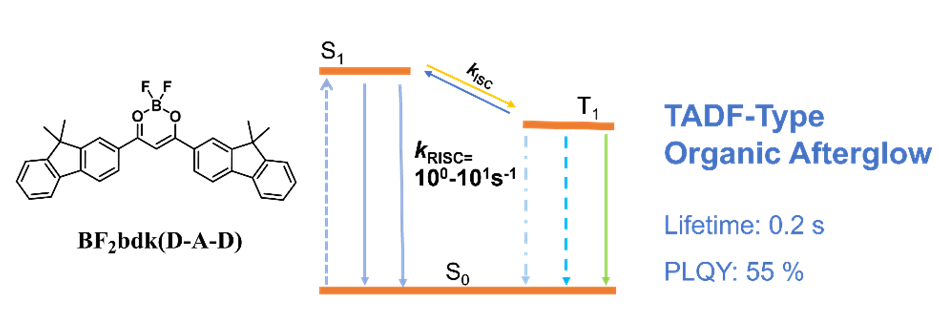
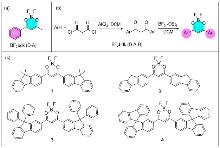
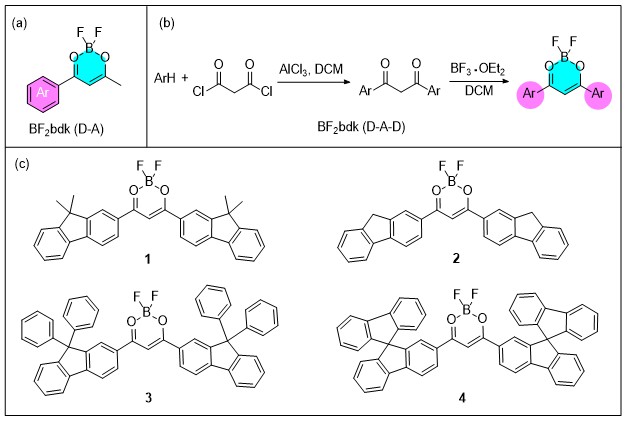
报道了基于热激活延迟荧光(TADF)机制的高效可见光激发余辉材料的构筑, 采用分子内电荷转移技术, 所得的TADF型余辉材料展示了数百毫秒的发射寿命和50%左右的光致发光量子产率, 表现出显著的温度响应特性. 通过在给体-受体(D-A)型二氟化硼β-二酮(BF2bdk)分子中引入额外的电子供体基团, 设计了给体-受体-给体(D-A-D)型化合物, 所得化合物表现出适度的反向系间窜越速率, 促进了BF2bdk在刚性晶体基质中的TADF型余辉的出现. 此外, D-A-D设计方法提高了最高占据分子轨道能级, 从而实现了在可见光激发下的TADF型余辉发射. 研究结果表明分子内电荷转移技术在推进高性能有机TADF型余辉材料设计中的重要性.
罗婷, 肖宇峰, 李珣, 夏雯, 张卡卡. 基于分子内电荷转移技术构建高效热激活延迟荧光型有机余辉材料[J]. 有机化学, 2025, 45(11): 4202-4209.
Ting Luo, Yufeng Xiao, Xun Li, Wen Xia, Kaka Zhang. Fabrication of Highly-Efficient Thermally Activated Delayed Fluorescence-Type Organic Afterglow Materials Based on Intramolecular Charge Transfer Technology[J]. Chinese Journal of Organic Chemistry, 2025, 45(11): 4202-4209.
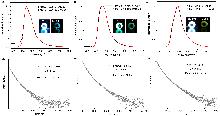

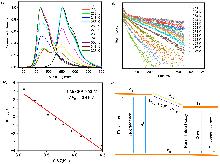

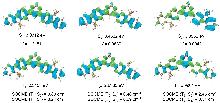

| Entry | λF/nm | λAG/nm | τAG/ms | PLQY/% |
|---|---|---|---|---|
| 1-MeOBP-0.001% | 470 | 470 | 211 | 55.1 |
| 2-MeOBP-0.001% | 470 | 470 | 182 | 52.9 |
| 3-MeOBP-0.001% | 470 | 470 | 248 | 47.8 |
| 4-MeOBP-0.001% | 480 | 480 | 161 | 50.3 |
| Entry | λF/nm | λAG/nm | τAG/ms | PLQY/% |
|---|---|---|---|---|
| 1-MeOBP-0.001% | 470 | 470 | 211 | 55.1 |
| 2-MeOBP-0.001% | 470 | 470 | 182 | 52.9 |
| 3-MeOBP-0.001% | 470 | 470 | 248 | 47.8 |
| 4-MeOBP-0.001% | 480 | 480 | 161 | 50.3 |
| [1] |
doi: 10.1021/acs.chemrev.5b00074 |
| [2] |
doi: 10.1038/s41578-020-0223-z |
| [3] |
doi: 10.1002/adfm.v28.51 |
| [4] |
doi: 10.1021/acs.accounts.8b00620 |
| [5] |
doi: 10.1002/adom.v5.17 |
| [6] |
doi: 10.1039/C8TC01007B |
| [7] |
Kenry; Chen, C.; Liu, B. Nat. Commun. 2019, 10, 2111.
doi: 10.1038/s41467-019-10033-2 pmid: 31068598 |
| [8] |
doi: 10.1002/anie.v59.28 |
| [9] |
doi: 10.1021/acs.accounts.0c00060 |
| [10] |
doi: 10.1016/j.chempr.2023.05.023 |
| [11] |
|
| [12] |
doi: 10.1002/smll.v18.1 |
| [13] |
doi: 10.1002/adom.v9.10 |
| [14] |
doi: 10.1038/s41570-023-00555-1 |
| [15] |
doi: 10.1021/accountsmr.3c00090 |
| [16] |
doi: 10.1002/adfm.v29.10 |
| [17] |
doi: 10.1038/nmat2509 |
| [18] |
doi: 10.1002/anie.v59.37 |
| [19] |
doi: 10.1002/anie.v58.18 |
| [20] |
doi: 10.1039/C5CC09645F |
| [21] |
doi: 10.1038/nature24010 |
| [22] |
doi: 10.1002/adma.v32.45 |
| [23] |
doi: 10.1002/anie.v60.31 |
| [24] |
doi: 10.1038/s41563-021-01150-9 |
| [25] |
doi: 10.1002/adma.v32.22 |
| [26] |
doi: 10.1002/adma.v33.18 |
| [27] |
doi: 10.1021/jacs.4c05531 |
| [28] |
doi: 10.1002/anie.v60.31 |
| [29] |
doi: 10.1002/adfm.v32.14 |
| [30] |
|
| [31] |
|
| [32] |
doi: 10.1021/acs.chemmater.4c00161 |
| [33] |
doi: 10.1016/j.orgel.2024.107128 |
| [34] |
|
| [35] |
doi: 10.1021/jp909388y |
| [36] |
doi: 10.1038/nchem.984 pmid: 21336325 |
| [37] |
|
| [38] |
doi: 10.1002/anie.v53.51 |
| [39] |
doi: 10.1016/j.chempr.2016.08.010 |
| [40] |
doi: 10.1021/jacs.8b11224 |
| [41] |
doi: 10.1039/D2CC06601G |
| [42] |
doi: 10.1016/0022-2313(70)90029-3 |
| [43] |
|
| [44] |
doi: 10.1021/cr60240a004 |
| [45] |
doi: 10.1021/ar50001a002 |
| [46] |
doi: 10.1002/adfm.v23.27 |
| [47] |
doi: 10.1002/adma.v31.12 |
| [48] |
doi: 10.1038/s41467-022-28011-6 |
| [49] |
doi: 10.1021/jacs.1c05213 |
| [50] |
|
| [51] |
doi: 10.1021/acsami.1c20331 |
| [52] |
doi: 10.1002/adom.v10.4 |
| [53] |
doi: 10.1038/s41467-023-37662-y |
| [54] |
|
| [55] |
doi: 10.31635/ccschem.020.202000158 |
| [56] |
doi: 10.1038/s41563-020-0797-2 |
| [57] |
doi: 10.1002/adma.v30.38 |
| [58] |
|
| [59] |
doi: 10.1038/s41563-019-0465-6 |
| [60] |
doi: 10.1063/1.3273407 |
| [61] |
doi: 10.1021/jacs.9b13704 |
| [62] |
doi: 10.6023/A23040186 |
|
(王一诺, 邵世洋, 王利祥, 化学学报, 2023, 81, 1202.)
doi: 10.6023/A23040186 |
|
| [63] |
doi: 10.6023/A23040119 |
|
(刘振宇, 饶俊峰, 祝守加, 王兵洋, 余帆, 冯全友, 解令海, 化学学报, 2023, 81, 820.)
doi: 10.6023/A23040119 |
|
| [64] |
doi: 10.6023/A23040153 |
|
(王银凤, 李猛, 陈传峰, 化学学报, 2023, 81, 588.)
doi: 10.6023/A23040153 |
|
| [65] |
doi: 10.6023/A24040148 |
|
(张登朝, 贾吉慧, 梁栋, 蔡显宝, 赵雨晴, 胡祥龙, 江钰冰, 卢灿忠, 化学学报, 2024, 82, 887.)
doi: 10.6023/A24040148 |
|
| [66] |
doi: 10.1021/jacs.6b12124 pmid: 28244314 |
| [1] | 高玉兰, 龙江琴, 王秋生. 9-芴基甲氧基羰基-酪氨酸掺杂聚乙烯醇室温磷光薄膜性质研究[J]. 有机化学, 2025, 45(4): 1261-1267. |
| [2] | 吴建荣, 宋敏, 刘釜铭, 周东营, 廖良生, 蒋佐权. 双功能修饰策略构建蓝光发射的硼基多重共振热激活延迟荧光材料[J]. 有机化学, 2025, 45(11): 4152-4162. |
| [3] | 李楠, 王雲生, 李振. 三苯胺-吩噻嗪衍生物掺杂聚合物的光诱导室温磷光[J]. 有机化学, 2024, 44(8): 2487-2494. |
| [4] | 黄凯航, 尹理, 姜青云, 汪乾, 石光, 许炳佳. 具有聚集诱导发光性质的高效热激活延迟荧光材料用于脂滴成像[J]. 有机化学, 2024, 44(8): 2479-2486. |
| [5] | 崔怡静, 朱天文, 张强, 袁望章. 共晶提升纯有机材料室温磷光余辉性能[J]. 有机化学, 2024, 44(8): 2588-2594. |
| [6] | 张惟, 李庚辰, 苏昊, 戴文博, 孙鹏, 石建兵, 佟斌, 蔡政旭, 董宇平. 基于主客体掺杂室温磷光材料的氧气传感材料[J]. 有机化学, 2024, 44(8): 2523-2529. |
| [7] | 齐云鹏, 刘伟, 王俊龙, 杜涛, 矫淞霖. 二氟化硼β-二酮类近红外荧光染料的设计、合成及细胞成像[J]. 有机化学, 2024, 44(11): 3357-3364. |
| [8] | 赵洋, 陈盼盼, 韩立志, 王恩举. 三苯基咪唑衍生物的聚集诱导发光性质及其细胞成像应用[J]. 有机化学, 2023, 43(7): 2454-2461. |
| [9] | 何佳伟, 解正峰, 薛松松, 刘宇程, 石伟, 陈鑫. 高选择性快速检测Cu2+的水杨酰腙型探针的合成及在逻辑门和吸附中的应用[J]. 有机化学, 2021, 41(7): 2839-2847. |
| [10] | 严子昂, 邹雷, 马骧. 纯有机超分子发光材料的研究进展[J]. 有机化学, 2020, 40(7): 1814-1822. |
| [11] | 张亮, 李猛, 高庆宇, 陈传峰. 基于卤素取代邻苯二甲酰亚胺新型有机发光材料的合成及其性能研究[J]. 有机化学, 2020, 40(2): 516-520. |
| [12] | 程晓红, 徐可, 屈少华, 阮志军. 基于香豆素的比率荧光传感器对同型半胱氨酸/半胱氨酸的检测及生物成像[J]. 有机化学, 2019, 39(10): 2835-2842. |
| [13] | 吴云英, 苟高章, 伍贤学, 杨丽君, 傅文甫. 新型N,O-配位吡啶氟硼化合物的合成及其光谱性质[J]. 有机化学, 2017, 37(3): 704-710. |
| [14] | 郑月游, 谢琼琳, 王炳喜. 10-甲基-10H-吩噻嗪-5,5-二氧化物衍生物的合成及其光物理和电化学性质[J]. 有机化学, 2016, 36(4): 803-811. |
| [15] | 张鹏, 张有明, 林奇, 姚虹, 魏太保. 金属离子响应型荧光传感分子的设计原理及研究进展[J]. 有机化学, 2014, 34(7): 1300-1321. |
| 阅读次数 | ||||||
|
全文 |
|
|||||
|
摘要 |
|
|||||


