有机化学 ›› 2025, Vol. 45 ›› Issue (11): 4210-4219.DOI: 10.6023/cjoc202505006 上一篇 下一篇
研究论文
赵瑜a,b, 张紫越a, 许书伟a, 胡华伟a, 吴宏伟b,*( ), 张琳萍b,*(), 陈丰坤a,*()
收稿日期:2025-05-06
修回日期:2025-05-21
发布日期:2025-06-06
基金资助:
Yu Zhaoa,b, Ziyue Zhanga, Shuwei Xua, Huawei Hua, Hongwei Wub,*(), Linping Zhangb,*(), Fengkun Chena,*()
Received:2025-05-06
Revised:2025-05-21
Published:2025-06-06
Contact:
*E-mail: wuhongwei@dhu.edu.cn; zhang_lp@dhu.edu.cn; fkchen@dhu.edu.cn
Supported by:文章分享
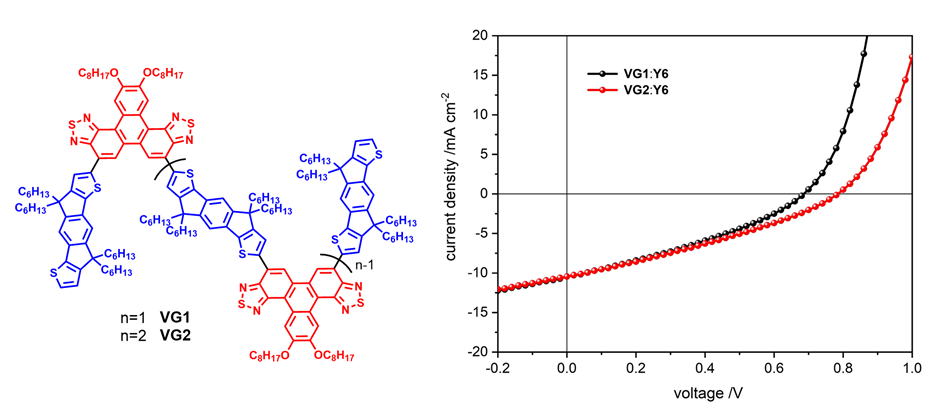
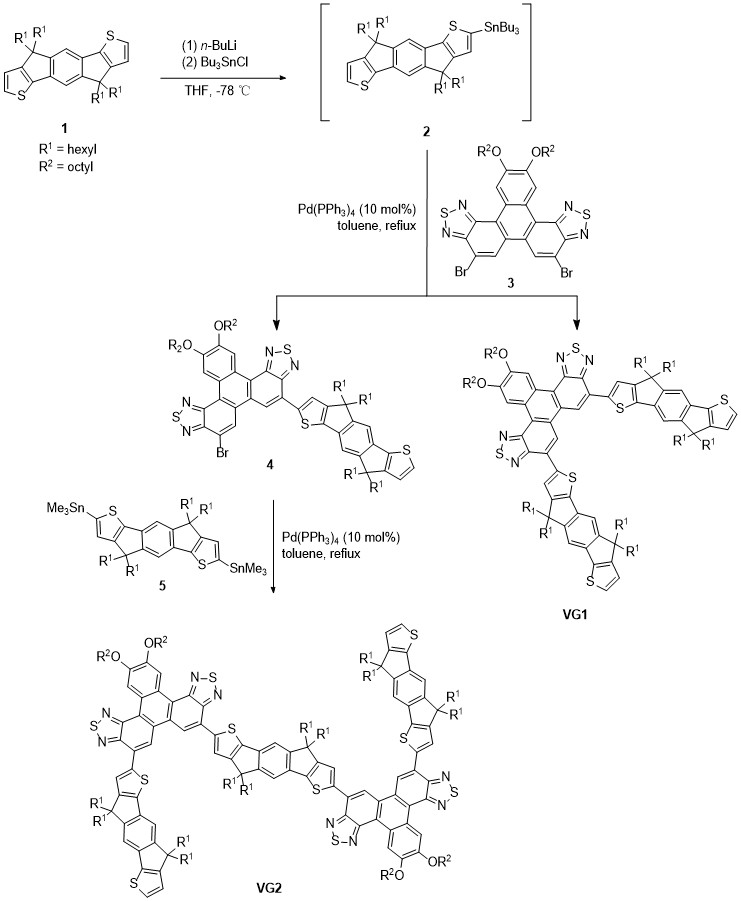
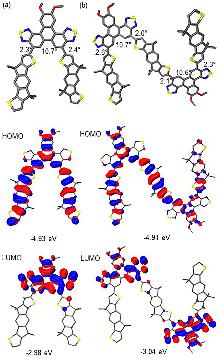
给体-受体(D-A)型共轭齐聚物因其明确的分子结构及易纯化等特性在光电材料领域展现出独特优势. 当前, 以苯并噻二唑(BTz)和萘并二噻二唑(NTz)为缺电子单元的D-A型齐聚物多局限于线性共轭构型. 本工作基于引达省并二噻吩(IDT)与三亚苯并二噻二唑(TPTz), 设计并合成了两种具有锯齿形拓扑结构的D-A齐聚物VG1与VG2. 研究表明, 由于TPTz基团的V形结构, 随着共轭长度的增加, VG2的带隙略微降低0.04 eV, 但其摩尔吸光显著提升. 进一步将二者应用于有机光伏器件发现, 基于VG2:Y6的器件获得较高的能量转换效率, 达2.56%. 这归因于VG2:Y6器件中更低的带隙以下的辐射复合损失和更低的非辐射能量损失. 本研究为调控共轭齐聚物拓扑结构与光电性能关系提供了新思路.
赵瑜, 张紫越, 许书伟, 胡华伟, 吴宏伟, 张琳萍, 陈丰坤. 锯齿形给体-受体齐聚物的设计、合成及光伏性能研究[J]. 有机化学, 2025, 45(11): 4210-4219.
Yu Zhao, Ziyue Zhang, Shuwei Xu, Huawei Hu, Hongwei Wu, Linping Zhang, Fengkun Chen. Zigzag-Shaped Donor-Acceptor Oligomers: Synthesis, Properties and Photovoltaic Applications[J]. Chinese Journal of Organic Chemistry, 2025, 45(11): 4210-4219.

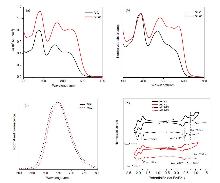
| Compd. | λsolutiona/ nm | λfilma/ nm | λemb/ nm | Egopt c/ eV | EHOMOd/ eV | ELUMOd/ eV | ΦFL-solidf/ % | ΦFL-solutiong/ % | τse/ns | kr h/ (108 s-1) | knr h/ (108 s-1) |
|---|---|---|---|---|---|---|---|---|---|---|---|
| VG1 | 380, 457, 535 | 387, 469 | 647 | 2.05 | -5.10 | -3.09 | 0.8 | 45.3 | 4.3 | 1.05 | 1.27 |
| VG2 | 383, 469, 515 | 389, 483, 572 | 650 | 2.01 | -5.07 | -3.09 | 1.8 | 41.3 | 3.4 | 1.21 | 1.72 |
| Compd. | λsolutiona/ nm | λfilma/ nm | λemb/ nm | Egopt c/ eV | EHOMOd/ eV | ELUMOd/ eV | ΦFL-solidf/ % | ΦFL-solutiong/ % | τse/ns | kr h/ (108 s-1) | knr h/ (108 s-1) |
|---|---|---|---|---|---|---|---|---|---|---|---|
| VG1 | 380, 457, 535 | 387, 469 | 647 | 2.05 | -5.10 | -3.09 | 0.8 | 45.3 | 4.3 | 1.05 | 1.27 |
| VG2 | 383, 469, 515 | 389, 483, 572 | 650 | 2.01 | -5.07 | -3.09 | 1.8 | 41.3 | 3.4 | 1.21 | 1.72 |

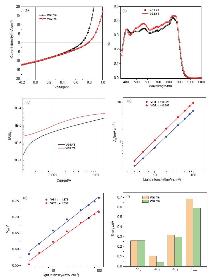
| Device | Voc/V | Jsc/(mA•cm-2) | FF/% | PCE/% | Eg/eV | ΔE1/eV | ΔE2/eV | ΔE3/eV | Eloss/eV | EQEEL/% |
|---|---|---|---|---|---|---|---|---|---|---|
| VG1:Y6 | 0.68 | 10.49 | 32.95 | 2.37 | 1.382 | 0.261 | 0.105 | 0.318 | 0.684 | 4.36×10⁻⁴ |
| VG2:Y6 | 0.78 | 10.44 | 31.33 | 2.56 | 1.371 | 0.260 | 0.035 | 0.298 | 0.592 | 9.78×10⁻⁴ |
| Device | Voc/V | Jsc/(mA•cm-2) | FF/% | PCE/% | Eg/eV | ΔE1/eV | ΔE2/eV | ΔE3/eV | Eloss/eV | EQEEL/% |
|---|---|---|---|---|---|---|---|---|---|---|
| VG1:Y6 | 0.68 | 10.49 | 32.95 | 2.37 | 1.382 | 0.261 | 0.105 | 0.318 | 0.684 | 4.36×10⁻⁴ |
| VG2:Y6 | 0.78 | 10.44 | 31.33 | 2.56 | 1.371 | 0.260 | 0.035 | 0.298 | 0.592 | 9.78×10⁻⁴ |

| [1] |
(a)
doi: 10.1039/c2ee02613a |
|
(b)
doi: 10.1021/accountsmr.4c00054 |
|
| [2] |
(a)
|
|
(b)
doi: 10.1002/adfm.v29.15 |
|
|
(c)
doi: 10.1039/c9tc01712g |
|
|
(d)
doi: 10.1002/adfm.v29.21 |
|
|
(e)
doi: 10.6023/cjoc201807006 |
|
|
(叶中华, 杨佳丽, 凌志天, 赵艺, 陈果, 郑燕琼, 魏斌, 施鹰, 有机化学, 2019, 39, 449.)
doi: 10.6023/cjoc201807006 |
|
| [3] |
(a)
pmid: 9624049 |
|
(b)
doi: 10.1038/nature20102 pmid: 9624049 |
|
|
(c)
doi: 10.1002/adfm.v30.20 pmid: 9624049 |
|
|
(d)
doi: 10.1002/adfm.v34.41 pmid: 9624049 |
|
| [4] |
(a)
doi: 10.1002/adma.v31.10 |
|
(b)
doi: 10.1039/D3CS00492A |
|
|
(c)
doi: 10.1039/C9EE02531F |
|
|
(d)
doi: 10.1002/adma.v30.35 |
|
|
(e)
doi: 10.6023/cjoc1105142 |
|
|
(何俊杰, 陈舒欣, 王婷婷, 曾和平, 有机化学, 2012, 32, 472.)
doi: 10.6023/cjoc1105142 |
|
| [5] |
(a)
doi: 10.1021/acsami.0c19033 pmid: 28348399 |
|
(b)
doi: 10.1007/s11426-021-9988-6 pmid: 28348399 |
|
|
(c)
doi: 10.1038/ncomms14047 pmid: 28348399 |
|
|
(d)
doi: 10.1002/aenm.v8.2 pmid: 28348399 |
|
|
(e)
doi: 10.1002/adma.v25.46 pmid: 28348399 |
|
|
(f)
doi: 10.6023/cjoc202005023 pmid: 28348399 |
|
|
(戴学新, 成晓东, 阚志鹏, 肖泽云, 段泰男, 胡超, 陆仕荣, 有机化学, 2020, 40, 4031.)
doi: 10.6023/cjoc202005023 pmid: 28348399 |
|
| [6] |
(a)
doi: 10.1021/acsapm.0c00748 |
|
(b)
doi: 10.1016/j.nanoen.2022.108017 |
|
|
(c)
doi: 10.6023/cjoc201907032 |
|
|
(王丽辉, 白锁柱, 李东勇, 周宏, 有机化学, 2020, 40, 748.)
doi: 10.6023/cjoc201907032 |
|
| [7] |
(a)
doi: 10.1021/ja201131h |
|
(b)
doi: 10.1021/ja210687r |
|
| [8] |
(a)
doi: 10.1021/acsami.1c19708 |
|
(b)
doi: 10.1039/D2QM00479H |
|
|
(c)
doi: 10.1016/j.matchemphys.2022.125849 |
|
|
(d)
doi: 10.1021/acsapm.3c02772 |
|
| [9] |
doi: 10.1007/s42765-024-00421-9 |
| [10] |
doi: 10.1021/acs.accounts.5b00363 |
| [11] |
(a)
doi: 10.1002/adma.v27.7 |
|
(b)
doi: 10.1016/j.synthmet.2021.116736 |
|
|
(c)
doi: 10.1016/j.progpolymsci.2024.101804 |
|
|
(d)
doi: 10.6023/cjoc201604052 |
|
|
(翟文超, 周二军, 有机化学, 2016, 36, 2786.)
|
|
| [12] |
(a)
doi: 10.1002/adom.v11.12 |
|
(b)
doi: 10.1021/ja8040493 |
|
|
(c)
doi: 10.1021/acsnano.0c07527 |
|
| [13] |
(a)
doi: 10.1063/1.2147707 |
|
(b)
doi: 10.1002/adma.v29.29 |
|
| [14] |
(a)
doi: 10.1063/1.2821368 |
|
(b)
doi: 10.1063/1.1889240 |
|
| [15] |
(a)
|
|
(b)
doi: 10.1103/PhysRevApplied.4.014020 |
|
| [16] |
(a)
doi: 10.1038/s41560-021-00843-4 |
|
(b)
|
|
| [17] |
(a)
doi: 10.1038/s41566-019-0573-5 |
|
(b)
doi: 10.1038/nenergy.2017.53 |
| [1] | 郭浩哲, 李玉银, 汤培琛, 樊江莉. 机器学习设计有机荧光诊疗分子的研究进展★[J]. 有机化学, 2025, 45(9): 3203-3212. |
| [2] | 赵友学, 李兮若, 孟洛冰, 李春秀, 范贵生, 许建和. 醇脱氢酶/羰基还原酶与多底物分子适配性研究的进展★[J]. 有机化学, 2025, 45(9): 3175-3185. |
| [3] | 孙翠萍, 薛雨婷, 陈磅宽. 杂螺烯圆偏振发光材料的研究进展[J]. 有机化学, 2025, 45(11): 4048-4069. |
| [4] | 田海平, 刘东东, 裴鸿艳, 叶家麟, 郑子锐, 高一星, 李昌兴, 田欢, 张静, 张立新. 新型苯基吡唑类衍生物的设计、合成和杀虫活性研究[J]. 有机化学, 2025, 45(1): 227-239. |
| [5] | 秦丽清, 林桂汕, 段文贵, 崔玉成, 杨卯芳, 李芳耀, 李典鹏. 新型长叶烯基萘满并N-酰基吡唑化合物的合成、抗增殖活性、三维定量构效关系及分子对接研究[J]. 有机化学, 2024, 44(6): 1967-1977. |
| [6] | 刘吉永, 吴明慧, 相君成, 庞怀林, 李斌, 吕亮. 新型含(卤代)烷氧基类双酰胺化合物的合成、杀虫活性及构效关系研究[J]. 有机化学, 2024, 44(5): 1584-1591. |
| [7] | 涂开槐, 江雪, 段泰男, 肖泽云. 高性能有机小分子光伏给体材料研究进展[J]. 有机化学, 2024, 44(11): 3282-3298. |
| [8] | 杨家强, 吴学姣, 卢子聪, 陈阳密, 佘慧娴, 刘海军. 含噻唑片段的蛇床子素衍生物的设计、合成及抗菌活性[J]. 有机化学, 2024, 44(11): 3541-3549. |
| [9] | 霍海波, 李桂霞, 王世军, 韩春, 师宝君, 李健. 新型γ-咔啉衍生物的合成及其抑菌活性研究[J]. 有机化学, 2024, 44(1): 204-215. |
| [10] | 左鑫, 许诗诺, 陈忠洋, 鄢剑锋, 袁耀锋. 茂铁类单分子结电子传输性质的研究进展[J]. 有机化学, 2023, 43(7): 2313-2322. |
| [11] | 何金燕, 田富云, 吴青青, 郑月明, 陈玉婷, 许海燕, 金正盛, 詹丽, 程新强, 顾跃玲, 高召兵, 赵桂龙. 基于[3.3.3]螺桨烷的电压门控钙离子通道α2δ亚基配体的合成和生物活性研究[J]. 有机化学, 2023, 43(6): 2226-2238. |
| [12] | 钟玉梅, 邹小颖, 卓小丫, 王逸涵, 申佳奕, 郑绿茵, 郭维. 4-氧代-2-亚胺基噻唑烷-5-亚基乙酸乙酯类化合物的设计、合成及抗癌活性[J]. 有机化学, 2023, 43(4): 1452-1461. |
| [13] | 刘兴周, 于明加, 梁建华. 原小檗碱骨架的合成及其抗炎活性研究进展[J]. 有机化学, 2023, 43(4): 1325-1340. |
| [14] | 张雨杉, 桓臻, 杨金东, 程津培. 氮杂环磷氢试剂的氢转移活性研究进展[J]. 有机化学, 2023, 43(11): 3806-3825. |
| [15] | 张蓉, 郜祥, 陈玲玲, 南发俊. 噻唑-噁唑串联杂环类RNA剪接抑制剂的发现及构效关系研究[J]. 有机化学, 2022, 42(9): 2925-2939. |
| 阅读次数 | ||||||
|
全文 |
|
|||||
|
摘要 |
|
|||||


