有机化学 ›› 2026, Vol. 46 ›› Issue (6): 2442-2449.DOI: 10.6023/cjoc202510016 上一篇 下一篇
研究论文
闫艳梅a, 霍瑞萍a,*( ), 何迎春b,*()
收稿日期:2026-01-21
修回日期:2026-03-03
发布日期:2026-03-27
基金资助:
Yanmei Yana, Ruiping Huoa,*(), Yingchun Heb,*()
Received:2026-01-21
Revised:2026-03-03
Published:2026-03-27
Contact:
* E-mail: ruipinghuo@tynu.edu.cn;heyingchun@sxu.edu.cn
Supported by:文章分享
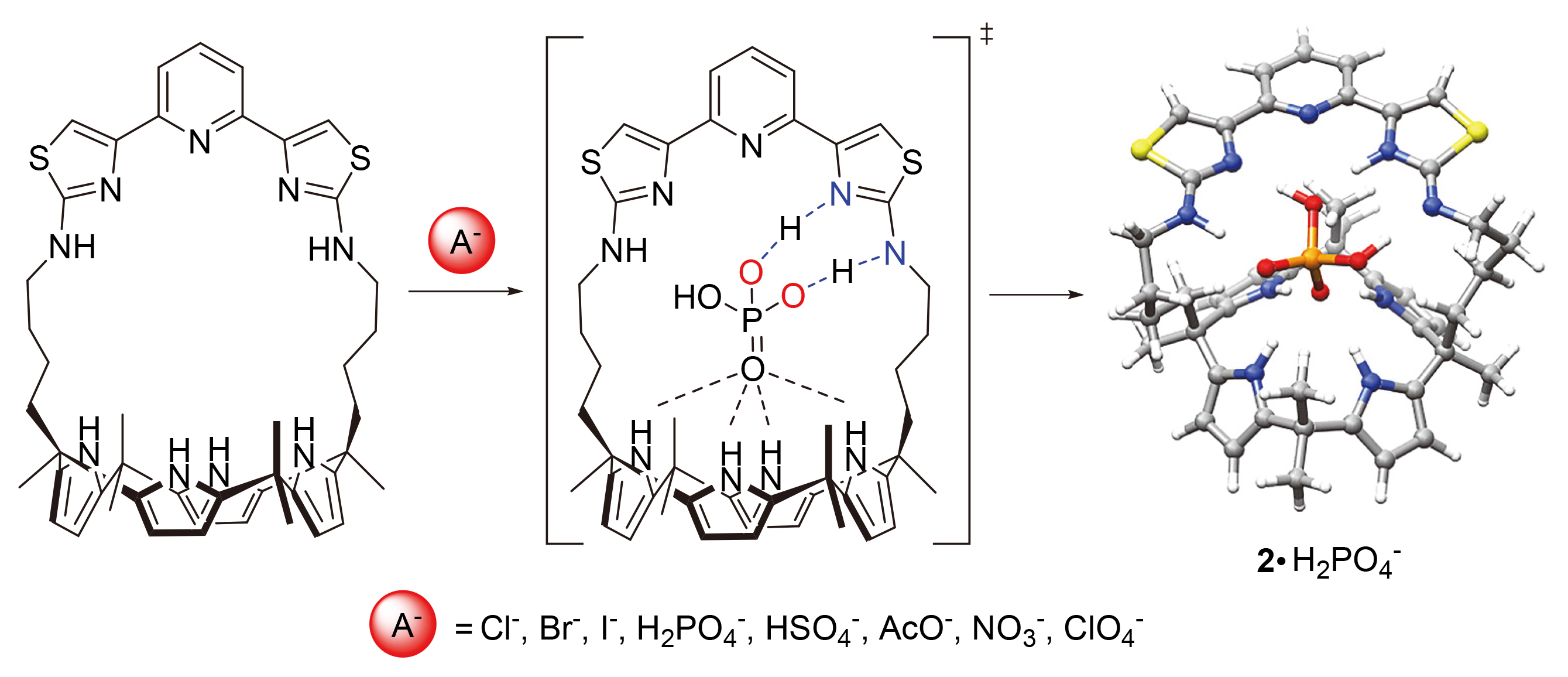
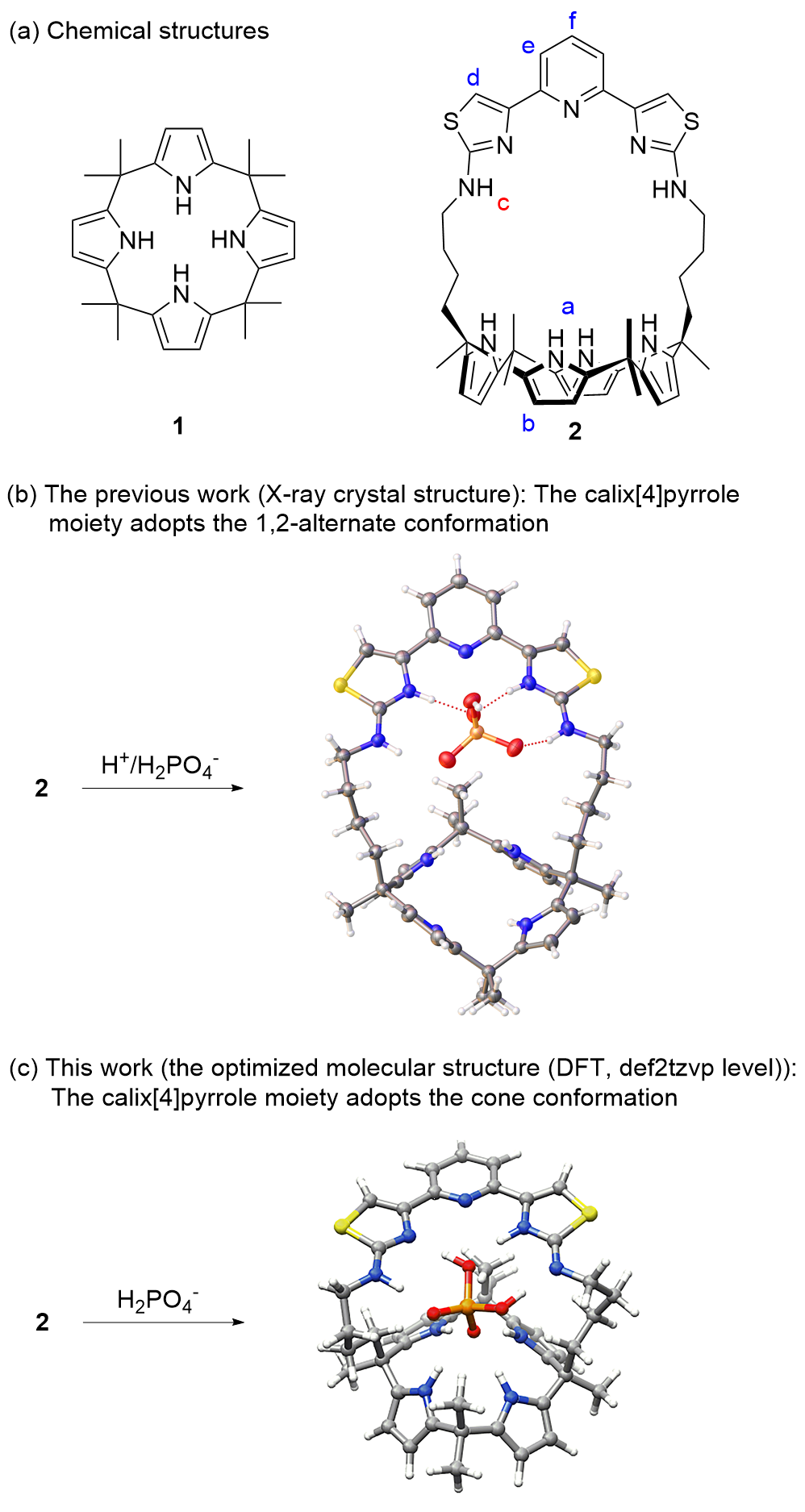
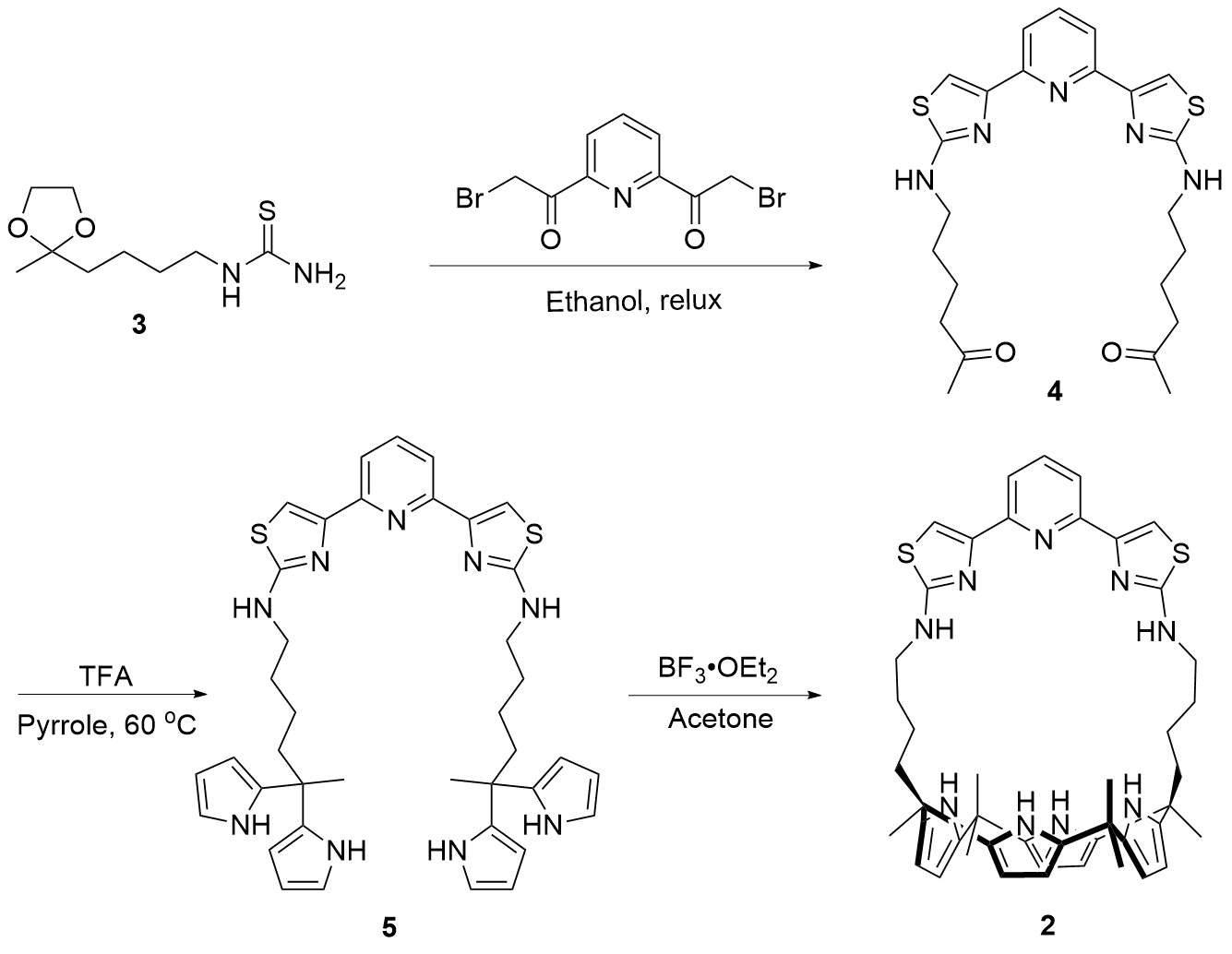
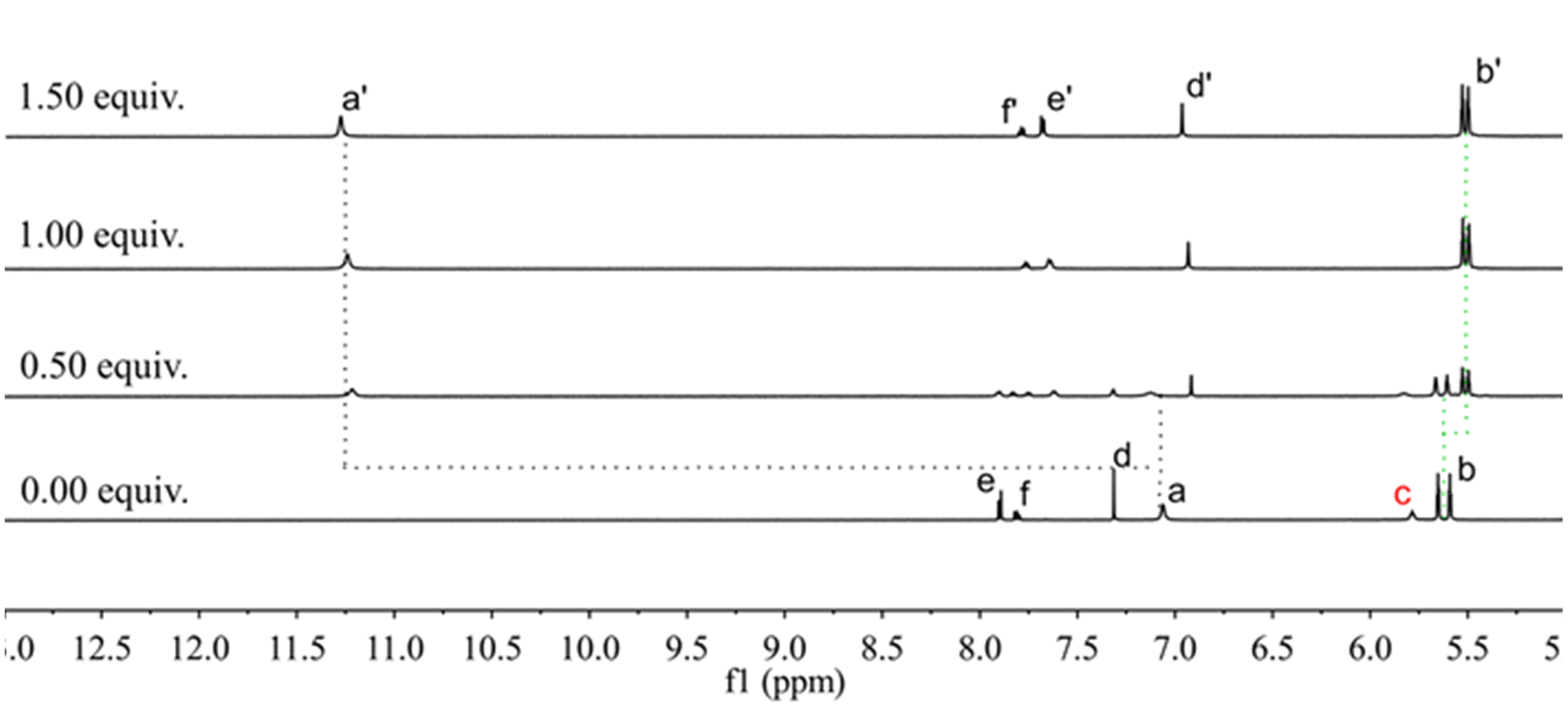
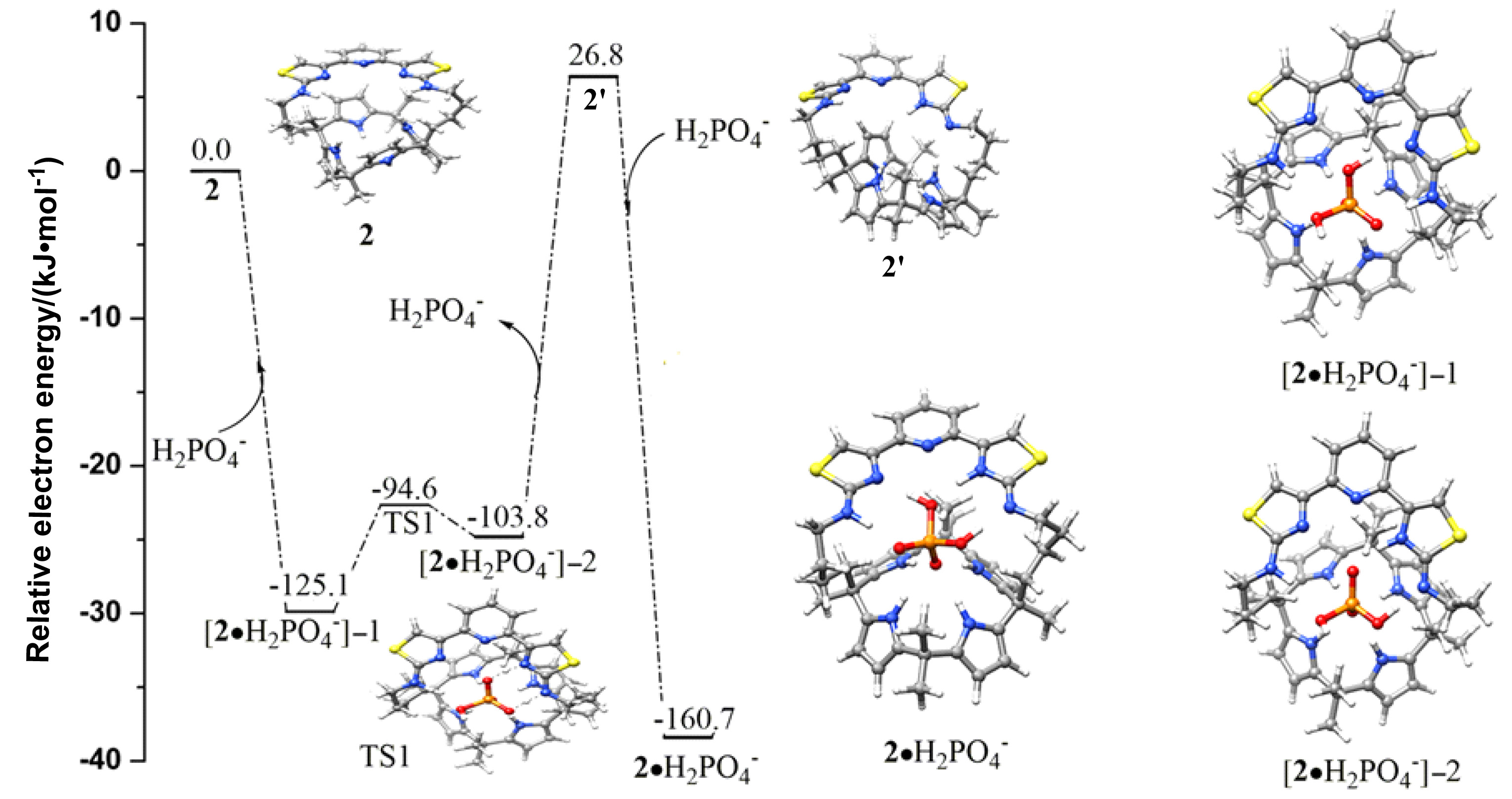
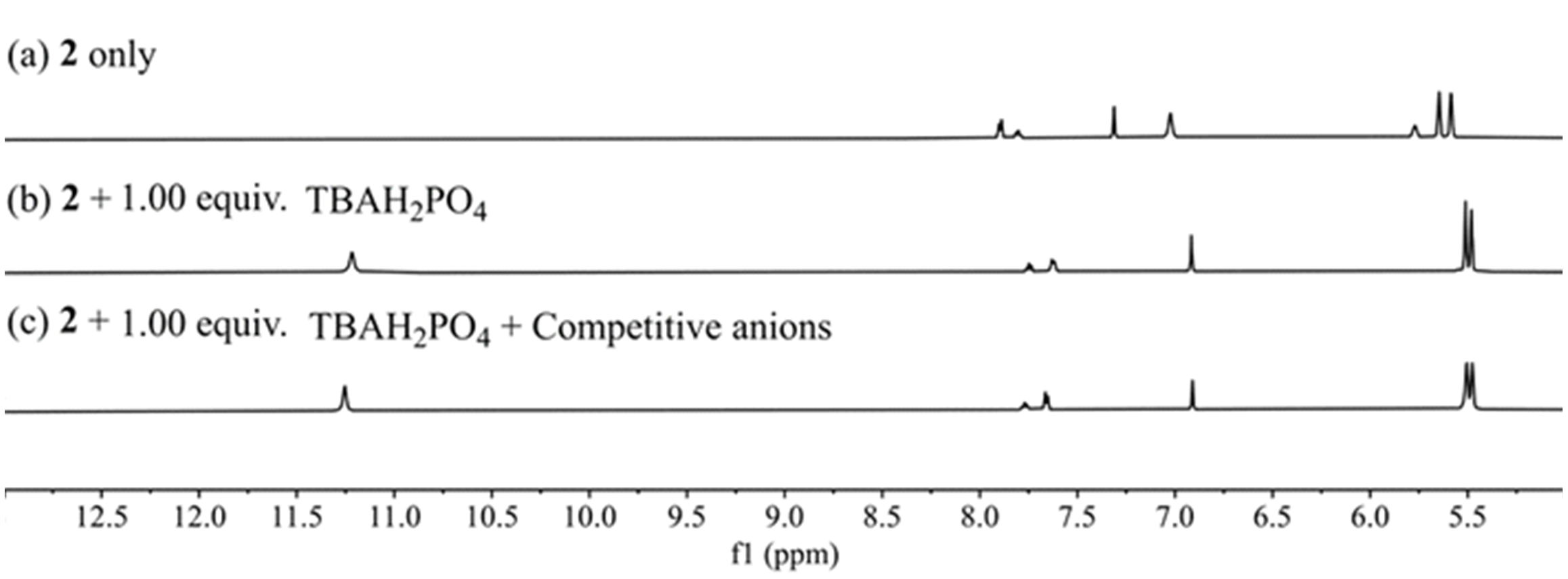
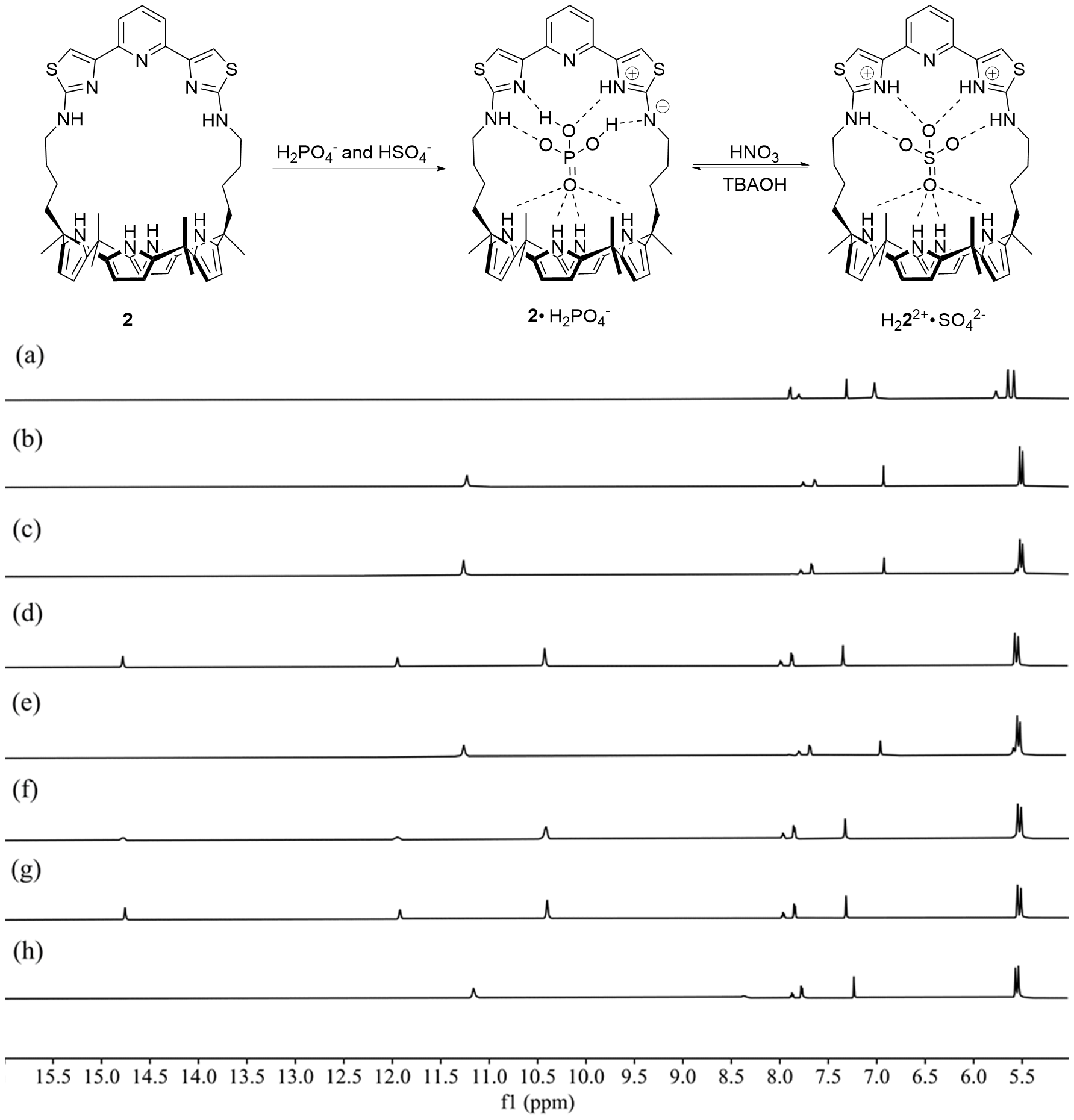
通过1H NMR和UV-Vis光谱分析, 系统探究了溶液体系中多种阴离子与吡啶基双噻唑胺桥联杯[4]吡咯(2)的相互作用. 结果表明, 在乙腈介质中, 受体2对磷酸二氢根离子展现出高度的选择性和强结合能力. 结合1H NMR光谱分析及密度泛函理论(DFT)计算证实, 在受体2对磷酸二氢根离子的识别过程中, 同步发生了质子转移行为: 即一个噻唑氮原子质子化形成氢键供体, 而噻唑连接的NH去质子化形成氢键受体. 此外, 受体2可作为阴离子识别的pH调控分子开关: 中性条件下选择性结合${{\text{H}}_{2}}\text{PO}_{4}^{}$, 酸性条件下则切换为结合硫酸氢根($\text{HSO}_{4}^{}$), 这一特性由桥联结构中噻唑基团的pH响应型质子化/去质子化过程调控实现.
闫艳梅, 霍瑞萍, 何迎春. 同步质子转移驱动的吡啶基双噻唑胺桥联杯[4]吡咯对磷酸二氢根的选择性识别[J]. 有机化学, 2026, 46(6): 2442-2449.
Yanmei Yan, Ruiping Huo, Yingchun He. Pyridinebisthiazolamine-Strapped Calix[4]pyrrole: An Anion Receptor Selectively Binding Dihydrogenphosphate via Simultaneous Proton Transfer Events[J]. Chinese Journal of Organic Chemistry, 2026, 46(6): 2442-2449.
| [1] |
|
| [2] |
doi: 10.1007/s00467-014-2759-x |
| [3] |
pmid: 826271 |
| [4] |
doi: 10.1177/000456329603300502 |
| [5] |
doi: 10.1126/science.171.3975.1008 pmid: 4993386 |
| [6] |
(a)
pmid: 4343749 |
|
(b)
doi: 10.1016/j.taap.2008.01.006 pmid: 4343749 |
|
|
(c)
doi: 10.1080/08958370590885672 pmid: 4343749 |
|
| [7] |
doi: 10.1055/s-0032-1317162 |
| [8] |
doi: 10.1016/j.ccr.2019.213128 |
| [9] |
(a)
pmid: 17705541 |
|
(b)
pmid: 17705541 |
|
|
(c)
doi: 10.1002/anie.v44:45 pmid: 17705541 |
|
|
(d)
doi: 10.1021/ja0522938 pmid: 17705541 |
|
|
(e)
pmid: 17705541 |
|
|
(f)
doi: 10.1021/jo401504f pmid: 17705541 |
|
|
(g)
doi: 10.1039/c3sc22201b pmid: 17705541 |
|
|
(h)
doi: 10.1002/anie.v58.12 pmid: 17705541 |
|
| [10] |
doi: 10.1021/acssensors.0c00619 |
| [11] |
(a)
doi: 10.1016/S0010-8545(01)00346-0 |
|
(b)
doi: 10.1016/j.ccr.2006.09.001 |
|
|
(c)
|
|
| [12] |
doi: 10.1021/ja960307r |
| [13] |
(a)
doi: 10.1021/jo101882r pmid: 29385284 |
|
(b)
doi: 10.1126/science.1192044 pmid: 29385284 |
|
|
(c)
doi: 10.1021/ja4015748 pmid: 29385284 |
|
|
(d)
pmid: 29385284 |
|
|
(e)
pmid: 29385284 |
|
|
(f)
doi: 10.1002/chem.201705387 pmid: 29385284 |
|
| [14] |
(a)
doi: 10.1039/D0CC03655B |
|
(b)
|
|
|
(c)
doi: 10.1038/nchem.2021 |
|
|
(d)
doi: 10.1039/C9CS00528E |
|
|
(e)
doi: 10.1016/j.tet.2019.130491 |
|
|
(f)
doi: 10.1021/ja411391c |
|
| [15] |
doi: 10.1039/D0SC03445B |
| [16] |
doi: 10.1021/acs.orglett.3c00422 |
| [17] |
doi: 10.1021/acs.orglett.9b01515 |
| [18] |
doi: 10.1021/j100119a050 |
| [19] |
|
| [20] |
doi: 10.1007/s00214-007-0310-x |
| [21] |
doi: 10.1039/b508541a |
| [22] |
doi: 10.1021/jp810292n |
| [23] |
doi: 10.1007/s002140050244 |
| [1] | 刘依雨, 胡喻栋, 张清伟. 金属催化的非活化炔烃氢膦酰化反应的机理研究进展[J]. 有机化学, 2024, 44(12): 3678-3685. |
| [2] | 刘梦, 黄延茹, 孙小飞, 汤立军. 一种基于“聚集诱导发光+激发态分子内质子转移”机制的苯并噻唑衍生物荧光探针及其对次氯酸根的识别[J]. 有机化学, 2023, 43(1): 345-351. |
| [3] | 郭钺甜, 潘永鑫, 汤立军. 聚集诱导发光(AIE)和激发态分子内质子转移(ESIPT)结构融合的反应型荧光探针的研究进展[J]. 有机化学, 2022, 42(6): 1640-1650. |
| [4] | 王瑞祥, 赖晓静, 邱观音生, 刘晋彪. 基于激发态分子内质子转移(ESIPT)原理的反应型荧光探针研究进展[J]. 有机化学, 2019, 39(4): 952-960. |
| [5] | 刘钰, 汤永星, 罗月阳, 朱叶婷, 杨进, 魏欣雨, 刘雄, 赵云辉. 含巴比妥结构荧光探针的合成及其应用研究[J]. 有机化学, 2019, 39(10): 2980-2984. |
| [6] | 李翔, 林奇, 曲文娟, 李乔, 程晓斌, 李文婷, 张有明, 姚虹, 魏太保. 一种咪唑并吩嗪内酰胺反应型识别氰离子的荧光探针[J]. 有机化学, 2017, 37(4): 889-895. |
| [7] | 谭赞, 杜欢, 吕新阳, 鲍小平. 含氨基蒽醌信号单元的咔唑磺胺类阴离子受体的合成及识别性能研究[J]. 有机化学, 2016, 36(6): 1389-1394. |
| [8] | 赵飞飞, 伍宏伟, 刘传祥, 毛海舫. 基于芳基炔醛共轭延伸的1,8-萘酰亚胺的高选择性比色和荧光氰离子探针[J]. 有机化学, 2016, 36(11): 2689-2694. |
| [9] | 蹇军友, 闫柏任, 潘顶伍, 谭赞, 吕新阳, 杜欢, 鲍小平. 含苯胺基硫脲单元的咔唑衍生物的合成及其对阴离子的识别传感研究[J]. 有机化学, 2015, 35(5): 1069-1074. |
| [10] | 卓继斌, 晏希泉, 王小雪, 谢莉莉, 袁耀锋. 双核开链茂铁咪唑受体的合成与阴离子识别研究[J]. 有机化学, 2015, 35(5): 1090-1096. |
| [11] | 晏希泉, 卓继斌, 王吉成, 谢莉莉, 袁耀锋. 苯并香豆素硫脲类受体分子的设计、合成与阴离子识别研究[J]. 有机化学, 2015, 35(10): 2184-2190. |
| [12] | 马拓, 张瑾, 刘龙珠, 贺云, 张尊听. Al3+可视化水溶性分子荧光探针的合成及其作用研究[J]. 有机化学, 2014, 34(9): 1780-1785. |
| [13] | 张鹏, 张有明, 林奇, 姚虹, 魏太保. 金属离子响应型荧光传感分子的设计原理及研究进展[J]. 有机化学, 2014, 34(7): 1300-1321. |
| [14] | 刘瑞源, 勇雪, 杨小东, 严轶琛, 路新卫, 瞿金清. 基于2-硫代海因的氟离子探针[J]. 有机化学, 2014, 34(3): 561-565. |
| [15] | 黄志斌, 刘学成, 胡明华, 林伟, 史达清. 吡啶并[2,3-d]嘧啶衍生物受体的合成及对阴离子识别研究[J]. 有机化学, 2014, 34(2): 382-386. |
| 阅读次数 | ||||||
|
全文 |
|
|||||
|
摘要 |
|
|||||