有机化学 ›› 2026, Vol. 46 ›› Issue (6): 2310-2326.DOI: 10.6023/cjoc202512023 上一篇 下一篇
综述与进展
张桂苹a,b, 丁昌华a, 郭勇b,*( ), 李遥b,*(), 薛小松b,*()
收稿日期:2025-12-17
修回日期:2026-01-27
发布日期:2026-02-13
基金资助:
Guiping Zhanga,b, Changhua Dinga, Yong Guob,*(), Yao Lib,*(), Xiaosong Xueb,*()
Received:2025-12-17
Revised:2026-01-27
Published:2026-02-13
Contact:
* E-mail: yguo@sioc.ac.cn;liyao@sioc.ac.cn;xuexs@sioc.ac.cn
Supported by:文章分享
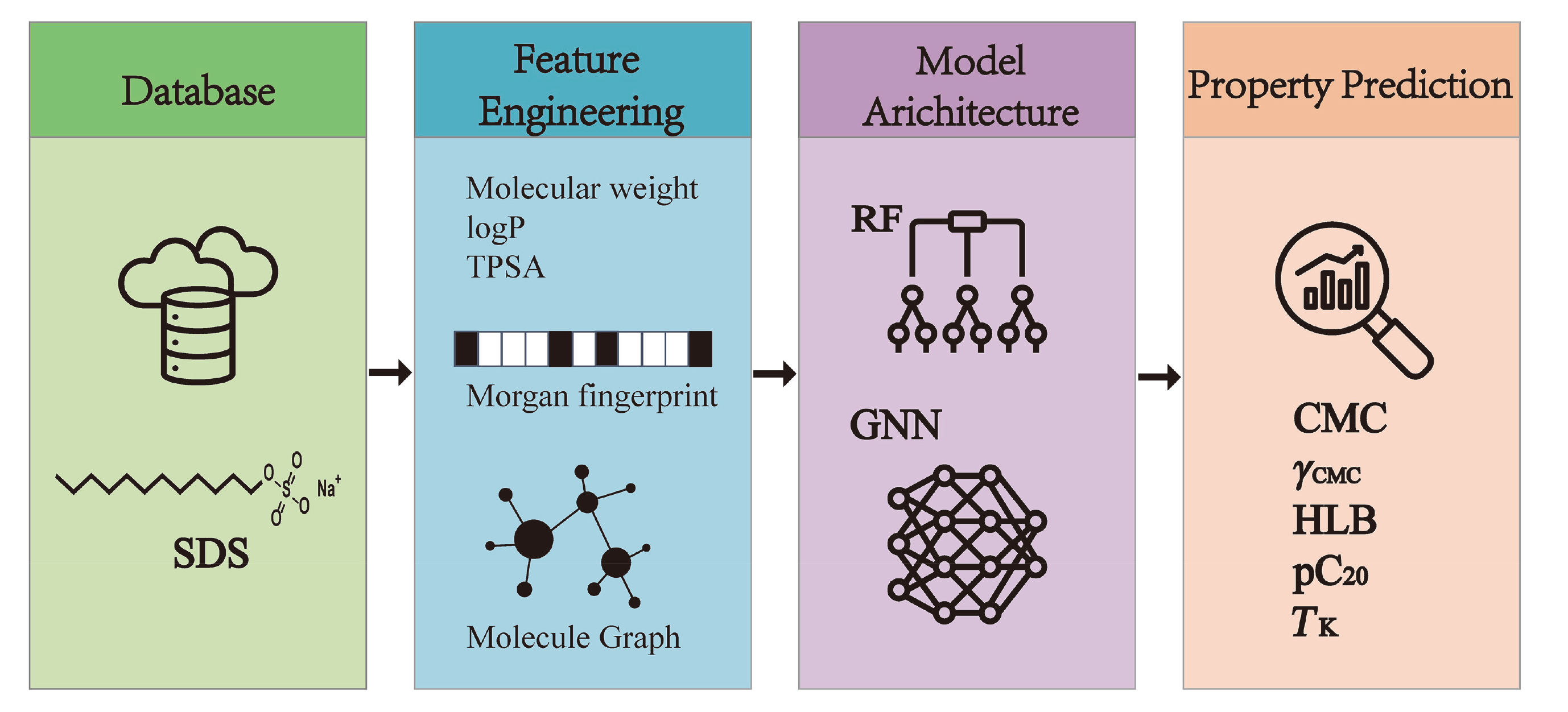
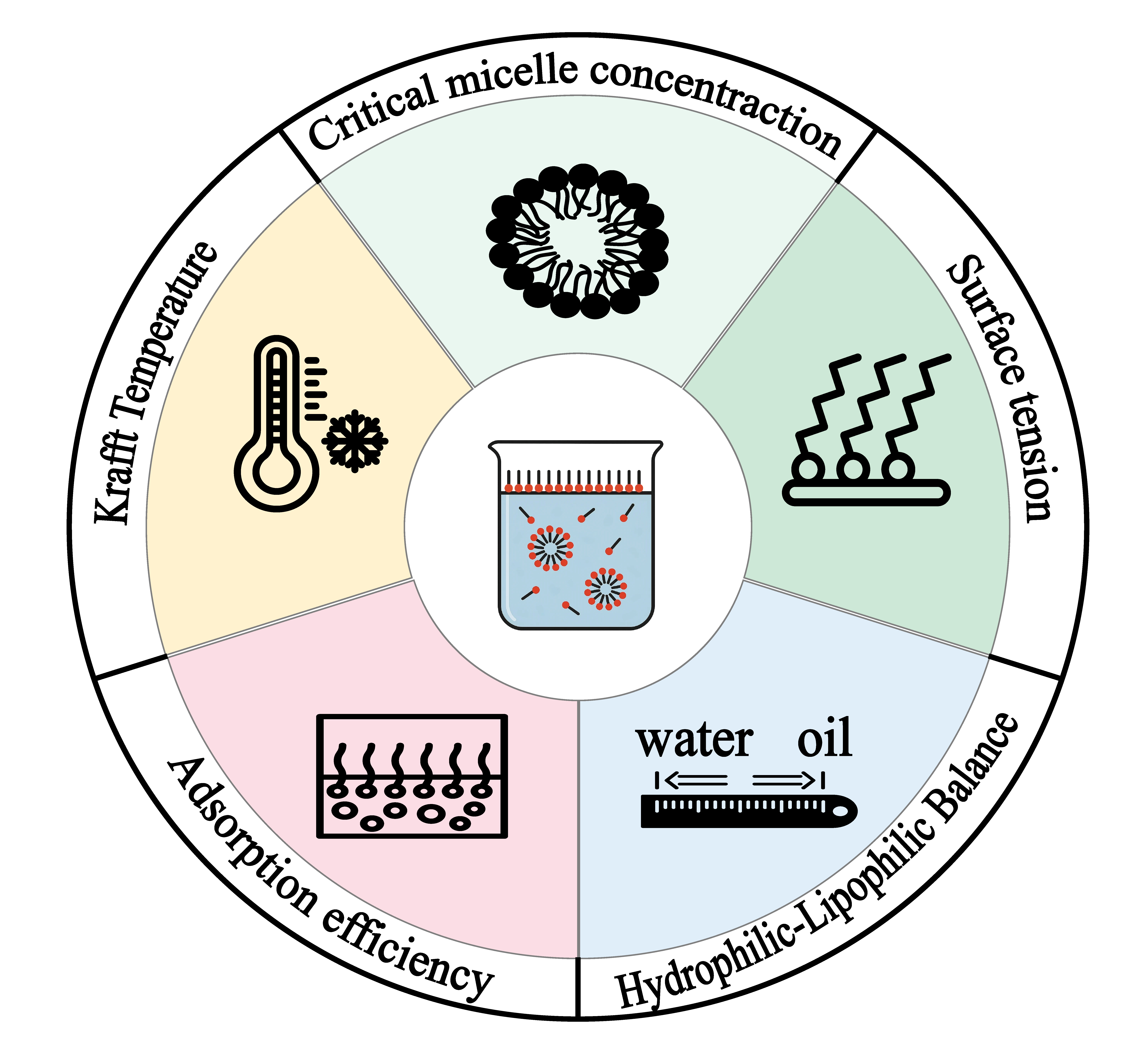
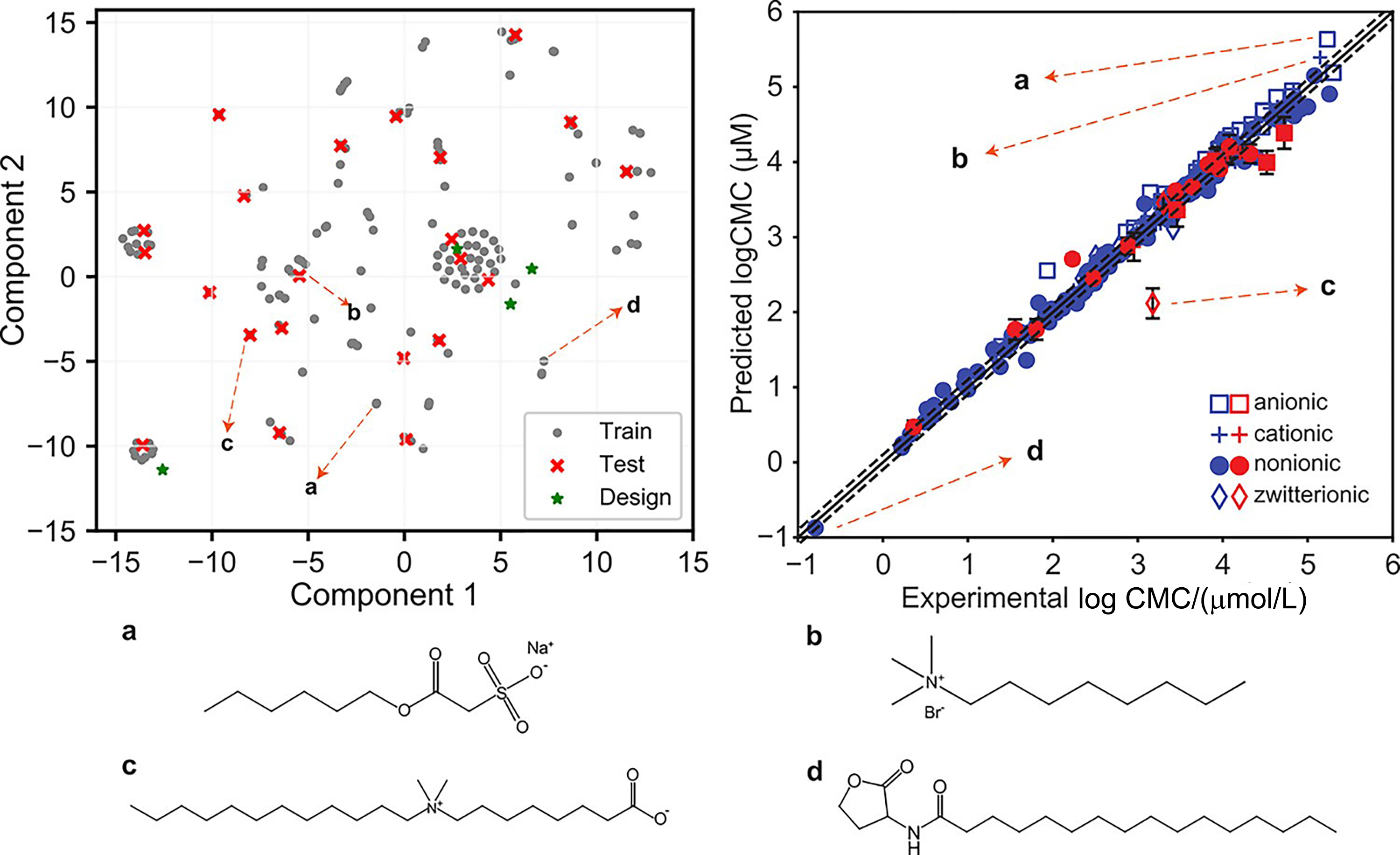
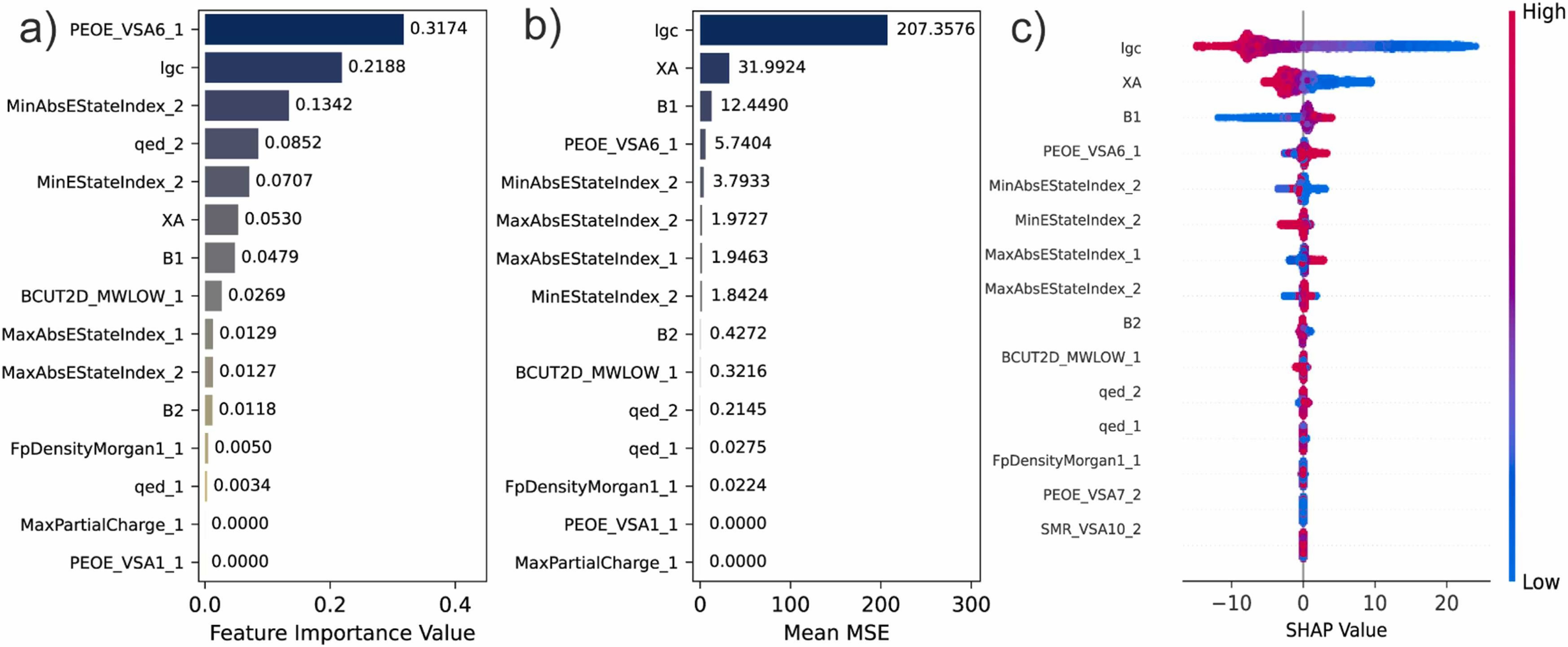
表面活性剂作为一类重要的功能性化合物, 在日用化工、生物医药及石油开采等领域应用广泛. 然而, 其传统研发依赖于试错实验的模式, 不仅难以满足新型表面活性剂在极端条件下的性能需求, 且缺乏对环境归宿和生物安全性的系统性评估. 机器学习作为一种数据驱动的研究范式, 为表面活性剂的高效开发提供了新途径, 尤其在分子性质预测方面展现出巨大潜力. 系统综述了机器学习在预测表面活性剂关键物性(如临界胶束浓度、表面张力、亲水亲油平衡值、吸附效率及克拉夫特点)中的研究进展. 此外, 探讨了该技术在预测其生物降解性与生态毒性等环境安全属性方面的初步应用与前景. 现有研究多集中于临界胶束浓度、表面张力与亲水亲油平衡值的预测, 而对吸附效率、克拉夫特点及环境安全参数的建模研究相对有限. 通过将预测范围拓展至这些尚未被充分研究的性质, 机器学习有望成为表面活性剂理性设计、性能优化与绿色评估的关键工具, 从而推动高性能、绿色环保表面活性剂的开发.
张桂苹, 丁昌华, 郭勇, 李遥, 薛小松. 机器学习在表面活性剂性能预测和设计方面的研究进展[J]. 有机化学, 2026, 46(6): 2310-2326.
Guiping Zhang, Changhua Ding, Yong Guo, Yao Li, Xiaosong Xue. Research Progress of Machine Learning in Surfactant Performance Prediction and Design[J]. Chinese Journal of Organic Chemistry, 2026, 46(6): 2310-2326.
| Authors | Year | Algorithm | Features/Descriptors | Dataset size | Surfactant type | R2 (Test) | RMSE (log CMC, mol/L) (Test) |
|---|---|---|---|---|---|---|---|
| Specific-type models | |||||||
| Gaudin et al.[ | 2016 | MLR | Integral; topological, compositional, and fragment descriptors | 83 | Sugar-based | 0.910 | 0.320 |
| Wang et al.[ | 2019 | MLR | Norm descriptors | 101 | Anionic | 0.913 | 0.257 |
| Jiao et al.[ | 2020 | PLS | Holographic fragment fingerprints | 120 | Gemini (anionic/ cationic) | 0.980 | 0.176 |
| Setiawan et al.[ | 2021 | Consensus | Dragon/CDK/ISIDA descriptors | 231 | Gemini cationic | 0.870 | 0.350 |
| Creton et al.[ | 2022 | SVM | Functional group descriptors | 254a | PFAS+conven- tional surfactants | 0.899 | 0.273 |
| General models | |||||||
| Zavala et al.[ | 2021 | GCN | Molecular graphs | 202 | All typesᵈ | 0.920 | 0.300 |
| Seddon et al.[ | 2022 | XGB | 3D descriptors+physical constraints | 154 | All types | 0.870 | - |
| Striolo et al.[ | 2023 | GPs-GNN | Molecular graphs | 202+43 | All types | - | 0.210 |
| Boukelkal et al.[ | 2024 | DA-SVR | Dragon/Mordred descriptors+temperature | 593 | All types | 0.986 | 0.144 |
| Mitsos et al.[ | 2024 | GNN | Molecular graphs | 429 | All types | 0.940 | 0.280 |
| Mitsos et al.[ | 2024 | GNN | Molecular graphs+ temperature | 1375b | All types (multi-task) | 0.950 | 0.240 |
| Ge et al.[ | 2024 | LGBM (ionic)+ GBDT (nonionic) | Descriptors+ temperature+PCA classification | 779 | All types | 0.944 | 0.284 |
| Robinson et al.[ | 2025 | AttentiveFP | Molecular graphs | 1395 | All types (multi-task) | — | 0.346 |
| Complex conditions & mixture systems | |||||||
| Ham et al.[ | 2024 | GNN | Molecular graphs, MD simulations, geometric descriptors | 92 | All types (multi-task) | 0.900 | 0.280 |
| Barbosa et al.[ | 2025 | FNN | DFT-derived features+ temperature | 1377 | All types | 0.950 | 0.380 |
| Mitsos et al.[ | 2025 | Combined-GNN | Hybrid graphs, mole fraction, temperature | 1924c | Binary mixtures | 0.930 | 0.249 |
| Choudhary et al.[ | 2025 | ANN | Descriptor fusion | 979 | Binary mixtures | 0.941 | 0.315 |
| Authors | Year | Algorithm | Features/Descriptors | Dataset size | Surfactant type | R2 (Test) | RMSE (log CMC, mol/L) (Test) |
|---|---|---|---|---|---|---|---|
| Specific-type models | |||||||
| Gaudin et al.[ | 2016 | MLR | Integral; topological, compositional, and fragment descriptors | 83 | Sugar-based | 0.910 | 0.320 |
| Wang et al.[ | 2019 | MLR | Norm descriptors | 101 | Anionic | 0.913 | 0.257 |
| Jiao et al.[ | 2020 | PLS | Holographic fragment fingerprints | 120 | Gemini (anionic/ cationic) | 0.980 | 0.176 |
| Setiawan et al.[ | 2021 | Consensus | Dragon/CDK/ISIDA descriptors | 231 | Gemini cationic | 0.870 | 0.350 |
| Creton et al.[ | 2022 | SVM | Functional group descriptors | 254a | PFAS+conven- tional surfactants | 0.899 | 0.273 |
| General models | |||||||
| Zavala et al.[ | 2021 | GCN | Molecular graphs | 202 | All typesᵈ | 0.920 | 0.300 |
| Seddon et al.[ | 2022 | XGB | 3D descriptors+physical constraints | 154 | All types | 0.870 | - |
| Striolo et al.[ | 2023 | GPs-GNN | Molecular graphs | 202+43 | All types | - | 0.210 |
| Boukelkal et al.[ | 2024 | DA-SVR | Dragon/Mordred descriptors+temperature | 593 | All types | 0.986 | 0.144 |
| Mitsos et al.[ | 2024 | GNN | Molecular graphs | 429 | All types | 0.940 | 0.280 |
| Mitsos et al.[ | 2024 | GNN | Molecular graphs+ temperature | 1375b | All types (multi-task) | 0.950 | 0.240 |
| Ge et al.[ | 2024 | LGBM (ionic)+ GBDT (nonionic) | Descriptors+ temperature+PCA classification | 779 | All types | 0.944 | 0.284 |
| Robinson et al.[ | 2025 | AttentiveFP | Molecular graphs | 1395 | All types (multi-task) | — | 0.346 |
| Complex conditions & mixture systems | |||||||
| Ham et al.[ | 2024 | GNN | Molecular graphs, MD simulations, geometric descriptors | 92 | All types (multi-task) | 0.900 | 0.280 |
| Barbosa et al.[ | 2025 | FNN | DFT-derived features+ temperature | 1377 | All types | 0.950 | 0.380 |
| Mitsos et al.[ | 2025 | Combined-GNN | Hybrid graphs, mole fraction, temperature | 1924c | Binary mixtures | 0.930 | 0.249 |
| Choudhary et al.[ | 2025 | ANN | Descriptor fusion | 979 | Binary mixtures | 0.941 | 0.315 |
| Authors | Year | Algorithm | Features/Descriptors | Dataset size | Data description | R2 (Test) | RMSE (mN/m) (Test) |
|---|---|---|---|---|---|---|---|
| Gaudin et al.[ | 2018 | MLR | Quantum chemical descriptors | 70 | Sugar-based nonionic surfactants (cyclic/non-cyclic head groups; linear/branched/unsaturated chains) | 0.780 | 2.400 |
| Hemmati-Sarapardeh et al.[ | 2023 | GBRT | Temperature, n-alkane molecular weight, concentration, HLB, PIT | 390 | Five ionic surfactants (C10TAB, C12TAB, C14TAB, C16TAB, SDS) | 0.985 | 1.628 |
| Pradilla et al.[ | 2023 | RF | 37 manually defined molecular descriptors | 691+9 | 691 conventional surfactants+ 9 amino acids | 0.550 | 4.720 |
| Saeedi Dehaghani et al.[ | 2023 | SGBT | Temperature, mole fraction, molecular weight, density, boiling point, etc. | 4010 | 122 binary mixtures (48 ionic liquids+20 nonionic liquids) | 0.993 | 0.001 |
| Ham et al.[ | 2024 | GNN | Molecular graphs, MD simulations, geometric descriptors | 92 | Anionic, cationic, nonionic, and zwitterionic surfactants | 0.900 | 2.640 |
| Robinson et al.[ | 2025 | Attentive FP | Molecular graphs | 972 | Anionic, cationic, nonionic, and zwitterionic surfactants | – | 3.407 |
| Ge et al.[ | 2025 | XGBoost | Mole fraction, log concentration, interaction parameters, molecular descriptors | 1135 | Polyether nonionic surfactants+four representative surfactants (SDS, CTAB, TX100, BS12) | 0.999 | 0.260a |
| Authors | Year | Algorithm | Features/Descriptors | Dataset size | Data description | R2 (Test) | RMSE (mN/m) (Test) |
|---|---|---|---|---|---|---|---|
| Gaudin et al.[ | 2018 | MLR | Quantum chemical descriptors | 70 | Sugar-based nonionic surfactants (cyclic/non-cyclic head groups; linear/branched/unsaturated chains) | 0.780 | 2.400 |
| Hemmati-Sarapardeh et al.[ | 2023 | GBRT | Temperature, n-alkane molecular weight, concentration, HLB, PIT | 390 | Five ionic surfactants (C10TAB, C12TAB, C14TAB, C16TAB, SDS) | 0.985 | 1.628 |
| Pradilla et al.[ | 2023 | RF | 37 manually defined molecular descriptors | 691+9 | 691 conventional surfactants+ 9 amino acids | 0.550 | 4.720 |
| Saeedi Dehaghani et al.[ | 2023 | SGBT | Temperature, mole fraction, molecular weight, density, boiling point, etc. | 4010 | 122 binary mixtures (48 ionic liquids+20 nonionic liquids) | 0.993 | 0.001 |
| Ham et al.[ | 2024 | GNN | Molecular graphs, MD simulations, geometric descriptors | 92 | Anionic, cationic, nonionic, and zwitterionic surfactants | 0.900 | 2.640 |
| Robinson et al.[ | 2025 | Attentive FP | Molecular graphs | 972 | Anionic, cationic, nonionic, and zwitterionic surfactants | – | 3.407 |
| Ge et al.[ | 2025 | XGBoost | Mole fraction, log concentration, interaction parameters, molecular descriptors | 1135 | Polyether nonionic surfactants+four representative surfactants (SDS, CTAB, TX100, BS12) | 0.999 | 0.260a |
| [1] |
|
| [2] |
doi: 10.1007/s10311-013-0432-4 |
| [3] |
doi: 10.1002/anie.v62.5 |
| [4] |
doi: 10.1063/1.457829 |
| [5] |
doi: 10.1021/la0105578 |
| [6] |
pmid: 16584226 |
| [7] |
doi: 10.1002/aic.v63.11 |
| [8] |
|
| [9] |
doi: 10.1021/jz400066k pmid: 26281935 |
| [10] |
doi: 10.1021/acs.jpcb.0c00496 |
| [11] |
doi: 10.1021/acs.langmuir.4c04293 pmid: 40085480 |
| [12] |
doi: 10.1006/jcis.1996.4680 |
| [13] |
doi: 10.1021/acs.iecr.6b02890 |
| [14] |
doi: 10.1021/ci800021p |
| [15] |
|
| [16] |
doi: 10.1021/acsmedchemlett.0c00088 pmid: 32832015 |
| [17] |
doi: 10.1021/acs.jcim.2c00042 |
| [18] |
doi: 10.1038/s42256-024-00843-5 |
| [19] |
doi: 10.1021/acs.jcim.4c00747 pmid: 39136669 |
| [20] |
doi: 10.1016/j.cocis.2024.101847 |
| [21] |
doi: 10.6023/cjoc202409001 |
|
(陈维明, 戴静芳, 李英勇, 周俊红, 高犇, 赵英莉, 徐挺军, 薛小松, 有机化学, 2025, 45, 2189.)
doi: 10.6023/cjoc202409001 |
|
| [22] |
doi: 10.1039/D3DD00113J |
| [23] |
|
| [24] |
|
| [25] |
doi: 10.1039/d4cs00913d pmid: 39703015 |
| [26] |
|
| [27] |
doi: 10.1038/s41467-024-45563-x pmid: 38360817 |
| [28] |
|
|
(周志华, 机器学习, 清华大学出版社, 北京, 2019.)
|
|
| [29] |
RDKit: Open-source cheminformatics.
|
| [30] |
doi: 10.1021/acs.jctc.3c00868 |
| [31] |
doi: 10.1002/cjoc.v43.12 |
| [32] |
doi: 10.1016/j.jhazmat.2023.133355 |
| [33] |
doi: 10.1021/acs.chemrev.3c00189 |
| [34] |
|
| [35] |
doi: 10.1021/acs.jcim.9b00587 pmid: 31860296 |
| [36] |
|
| [37] |
doi: 10.1016/j.cell.2020.01.021 |
| [38] |
doi: 10.1021/acs.jcim.3c01250 |
| [39] |
|
| [40] |
doi: 10.1039/D5SC08461J |
| [41] |
doi: 10.1021/la950581j |
| [42] |
|
| [43] |
doi: 10.1080/10916466.2016.1221963 |
| [44] |
doi: 10.1016/j.chemphyslip.2018.05.008 |
| [45] |
doi: 10.1016/j.colsurfa.2019.123967 |
| [46] |
doi: 10.1016/j.colsurfa.2019.124226 |
| [47] |
|
| [48] |
doi: 10.1080/1062936X.2024.2337011 |
| [49] |
doi: 10.1021/acs.jpcb.1c05264 |
| [50] |
doi: 10.1016/j.jcis.2022.06.034 |
| [51] |
doi: 10.1016/j.jmgm.2024.108757 |
| [52] |
doi: 10.1016/j.colsurfa.2024.134133 |
| [53] |
doi: 10.1021/acs.jctc.4c00314 |
| [54] |
doi: 10.1016/j.colsurfa.2024.135276 |
| [55] |
doi: 10.1039/D4DD00393D |
| [56] |
doi: 10.3390/colloids8060063 |
| [57] |
doi: 10.1021/acs.jced.5c00388 |
| [58] |
doi: 10.1016/j.compchemeng.2025.109085 |
| [59] |
doi: 10.1186/s13321-025-01112-2 |
| [60] |
doi: 10.1016/j.cis.2019.06.003 |
| [61] |
doi: 10.1002/jsde.v28.1 |
| [62] |
doi: 10.1016/j.molliq.2018.01.037 |
| [63] |
doi: 10.1016/j.jcis.2009.04.002 |
| [64] |
doi: 10.1021/ci600462d pmid: 17497845 |
| [65] |
|
| [66] |
doi: 10.2298/CICEQ200907048L |
| [67] |
doi: 10.1016/j.ces.2022.118208 |
| [68] |
doi: 10.1186/s13321-025-00949-x |
| [69] |
doi: 10.1016/j.molliq.2016.04.030 |
| [70] |
|
| [71] |
doi: 10.1081/DIS-120023810 |
| [72] |
doi: 10.1081/DIS-200054572 |
| [73] |
doi: 10.1016/j.jcis.2018.01.051 |
| [74] |
doi: 10.1038/s41598-023-41448-z pmid: 37644073 |
| [75] |
doi: 10.1021/je700171f |
| [76] |
doi: 10.1038/s41598-023-37933-0 pmid: 37407692 |
| [77] |
doi: 10.1016/j.colsurfa.2025.138427 |
| [78] |
doi: 10.1073/pnas.76.9.4175 |
| [79] |
doi: 10.1007/BF02635155 |
| [80] |
|
| [81] |
|
| [82] |
doi: 10.1016/j.colsurfa.2025.136400 |
| [83] |
|
| [84] |
|
| [85] |
doi: 10.1080/01932690701808353 |
| [86] |
doi: 10.1080/01932690903123338 |
| [87] |
doi: 10.1016/j.colsurfa.2020.125812 |
| [88] |
|
| [89] |
doi: 10.1006/jcis.1997.5053 |
| [90] |
|
| [91] |
doi: 10.1081/DIS-200063127 |
| [92] |
doi: 10.1002/jsde.2018.21.issue-6 |
| [93] |
|
|
(戚兴怡, 胡耀峰, 王若愚, 杨雅清, 赵宇飞, 化学学报, 2023, 81, 158.)
doi: 10.6023/A22110446 |
|
| [94] |
doi: 10.1016/j.drudis.2022.03.017 |
| [95] |
doi: 10.1016/j.compbiomed.2022.105403 |
| [96] |
doi: 10.6023/cjoc202006051 |
|
(刘伊迪, 杨骐, 李遥; 张龙, 罗三中, 有机化学, 2020, 40, 3812.)
doi: 10.6023/cjoc202006051 |
|
| [97] |
doi: 10.6023/A20070306 |
|
(朱博阳, 吴睿龙, 于曦, 化学学报, 2020, 78, 1366.)
doi: 10.6023/A20070306 |
|
| [98] |
doi: 10.1021/acs.iecr.4c00401 |
| [99] |
doi: 10.1002/wcms.1395 |
| [100] |
|
| [101] |
doi: 10.1021/acssuschemeng.5c04112 |
| [102] |
doi: 10.1063/5.0250310 |
| [103] |
|
| [104] |
doi: 10.1016/j.cis.2022.102634 |
| [105] |
doi: 10.1021/acs.jcim.2c00374 |
| [1] | 郭在翔, 邹昀, 程沛浩, 李富军, 陶胜洋. Ullmann反应条件的高通量筛选及其规律性研究[J]. 有机化学, 2026, 46(3): 993-999. |
| [2] | 郭浩哲, 李玉银, 汤培琛, 樊江莉. 机器学习设计有机荧光诊疗分子的研究进展★[J]. 有机化学, 2025, 45(9): 3203-3212. |
| [3] | 常淏森, 杨黎明, 王冠, 顾星桂. 具有聚集诱导发光特性的蒽醌衍生物的合成及其指纹显影应用[J]. 有机化学, 2024, 44(8): 2571-2580. |
| [4] | 谭胖, 刘旭红, 谌彤童, 秦智慧, 杨涛, 刘晓彤, 刘秀磊. 机器学习设计新型有机分子研究进展[J]. 有机化学, 2021, 41(7): 2666-2675. |
| [5] | 刘伊迪, 杨骐, 李遥, 张龙, 罗三中. 机器学习在有机化学中的应用[J]. 有机化学, 2020, 40(11): 3812-3827. |
| [6] | 林超, 潘仁明, 邢萍, 姜标. 新型支链型氟碳表面活性剂的合成及性能研究[J]. 有机化学, 2018, 38(12): 3260-3269. |
| [7] | 蔡璐, 郭建维, 刘卅, 朱乐杰, 关念云, 崔英德, 孙保兴. 金刚烷基甜菜碱型和季铵盐阳离子型表面活性剂的合成研究[J]. 有机化学, 2011, 31(08): 1290-1294. |
| [8] | 孙焕泉, 刘敏, 张瀛溟, 曹绪龙, 崔晓红, 石静, 陈湧, 刘育. 不同电荷基团修饰环糊精与离子型表面活性剂的键合行为研究[J]. 有机化学, 2011, 31(05): 762-767. |
| [9] | 袁先友,阳年发,罗和安,刘跃进. 1,3-二噁烷环的双磺酸盐表面活性剂的微波合成[J]. 有机化学, 2005, 25(9): 1049-1052. |
| [10] | 王永灿,叶金星,梁鑫淼. 水悬浮体系中α,β-环氧酮类化合物的合成研究[J]. 有机化学, 2005, 25(08): 969-971. |
| [11] | 蒋晓慧, 周丽梅. 溴化-1,4/1,6-二(α-辛基吡啶)丁烷/己烷的合成及表征[J]. 有机化学, 2004, 24(5): 563-566. |
| [12] | 施邑屏,李江云,李祖义. 槐糖内酯的脂酶修饰[J]. 有机化学, 1999, 19(2): 181-183. |
| [13] | 张永敏,孙培培. 手性胶束的不对称诱导作用不对称苯偶姻缩合反应[J]. 有机化学, 1997, 17(4): 362-364. |
| [14] | 秦合法,李萱荣. 阴离子相转移催化的Friedel-Crafts烷基化反应[J]. 有机化学, 1992, 12(3): 309-312. |
| [15] | 周青山,范伟强,张永敏,吴华悦,张存敏. 胶束模似酶的研究1.手性胶束中酮的不对称还原[J]. 有机化学, 1986, 6(5): 386-388. |
| 阅读次数 | ||||||
|
全文 |
|
|||||
|
摘要 |
|
|||||