有机化学 ›› 2026, Vol. 46 ›› Issue (9): 3731-3736.DOI: 10.6023/cjoc202603023 上一篇 下一篇
研究论文
吕明†, 赵博迪†, 徐铭昊, 戚孝天*( )
)
收稿日期:2026-03-19
修回日期:2026-04-09
发布日期:2026-05-07
作者简介:† 共同第一作者.
基金资助:
Ming Lü, Bodi Zhao, Minghao Xu, Xiaotian Qi*()
Received:2026-03-19
Revised:2026-04-09
Published:2026-05-07
Contact:
About author:Dedicated to the 100th anniversary of the birth of Professor Xikui Jiang.
† The authors contributed equally to this work
Supported by:文章分享
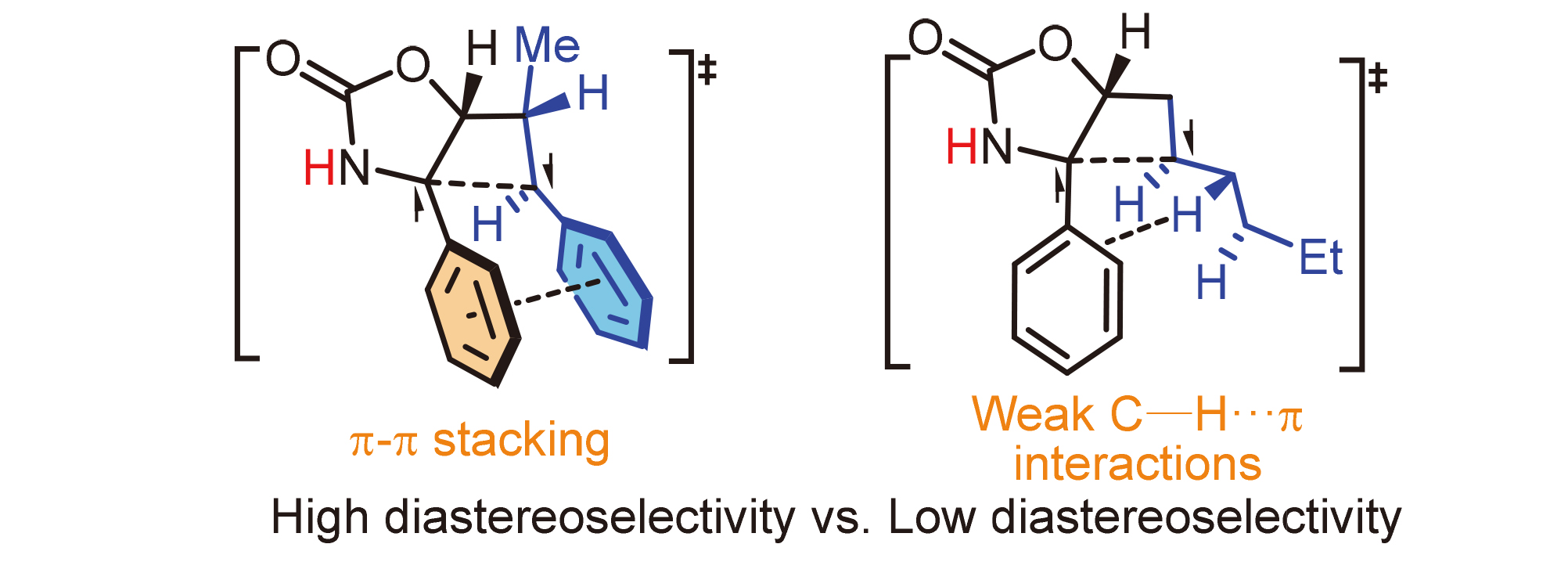
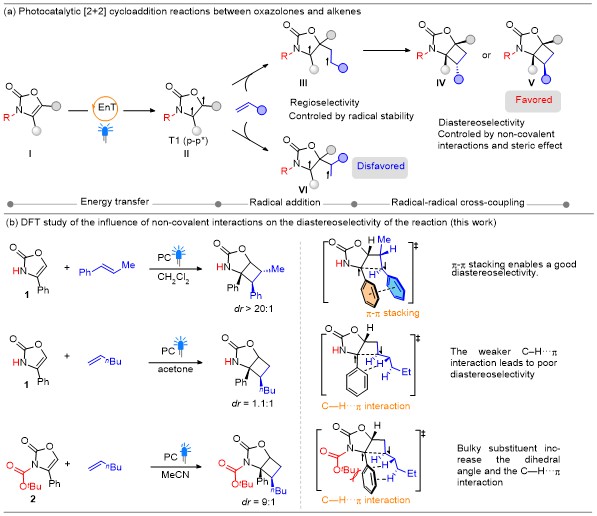
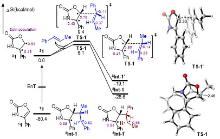
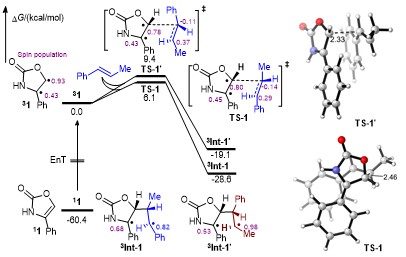
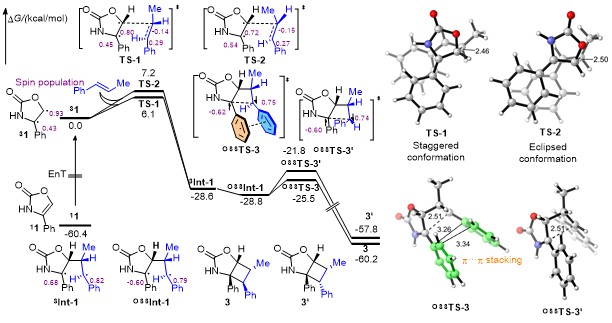
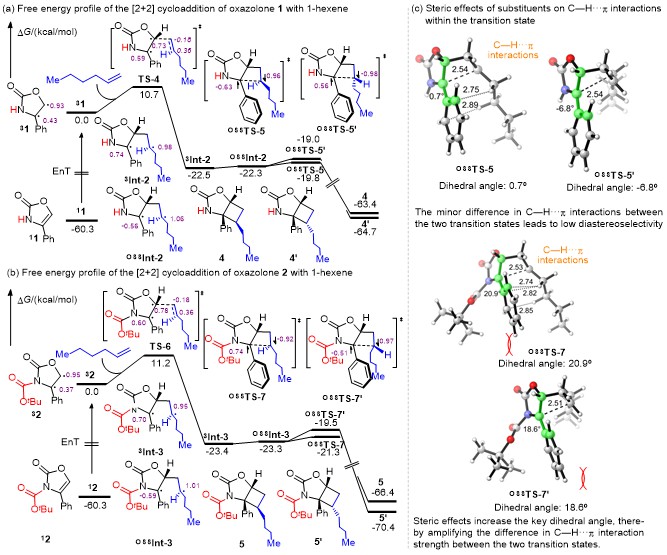
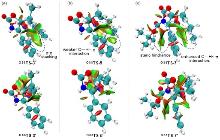
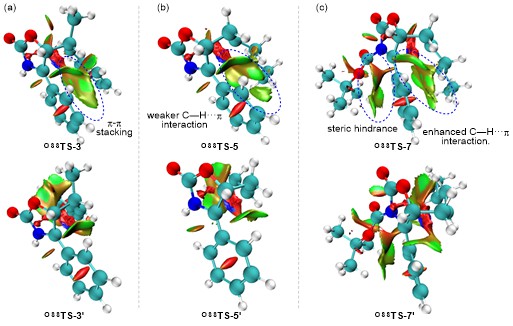
在有机合成中, 碳碳双键之间的[2+2]环加成反应是构筑环丁烷骨架的一类重要合成策略. 其中, 区域选择性与非对映选择性的控制是该类反应的核心问题之一. 采用密度泛函理论计算, 系统研究了噁唑酮类化合物经能量转移激发生成双自由基中间体后, 与烯烃发生加成并最终关环生成环丁烷类产物的反应过程. 计算结果表明, 区域选择性由三重态噁唑酮底物与烯烃的自由基加成步骤决定, 自由基的稳定性在此过程中起着关键作用. 此外, 非对映选择性的控制步骤为自由基-自由基偶联关环过程. 对比分析发现, 非对映选择性由π-π堆积等非共价相互作用与取代基的位阻效应协同控制.
吕明, 赵博迪, 徐铭昊, 戚孝天. 非共价相互作用对噁唑酮与烯烃分步[2+2]环加成反应非对映选择性的调控效果研究[J]. 有机化学, 2026, 46(9): 3731-3736.
Ming Lü, Bodi Zhao, Minghao Xu, Xiaotian Qi. Diastereoselectivity Control in Stepwise [2+2] Cycloadditions of Oxazolones with Alkenes: A Theoretical Study of Non-covalent Interactions[J]. Chinese Journal of Organic Chemistry, 2026, 46(9): 3731-3736.
| [1] |
(a)
|
|
(b)
|
|
|
(c)
|
|
|
(d)
doi: 10.1002/(ISSN)1521-3773 |
|
| [2] |
(a)
doi: 10.1038/s41557-020-0541-1 pmid: 38935726 |
|
(b)
doi: 10.1002/anie.201411409 pmid: 38935726 |
|
|
(c)
doi: 10.1021/jacs.2c09690 pmid: 38935726 |
|
|
(d)
doi: 10.1002/anie.v57.21 pmid: 38935726 |
|
|
(e)
doi: 10.1002/anie.v51.41 pmid: 38935726 |
|
|
(f)
doi: 10.1002/anie.v59.24 pmid: 38935726 |
|
|
(g)
doi: 10.1021/acs.joc.0c02547 pmid: 38935726 |
|
|
(h)
doi: 10.1021/acs.chemrev.5b00723 pmid: 38935726 |
|
|
(i)
doi: 10.1021/acs.chemrev.6b00005 pmid: 38935726 |
|
|
(j)
doi: 10.1002/ejoc.v2020.10 pmid: 38935726 |
|
|
(k)
doi: 10.1016/j.chempr.2019.06.004 pmid: 38935726 |
|
|
(l)
doi: 10.1126/science.adj6771 pmid: 38935726 |
|
|
(m)
doi: 10.1002/anie.v54.41 pmid: 38935726 |
|
|
(n)
doi: 10.1021/jacs.8b12965 pmid: 38935726 |
|
|
(o)
doi: 10.1016/j.tet.2012.06.011 pmid: 38935726 |
|
| [3] |
(a)
doi: 10.1039/D3CS00190C pmid: 30088504 |
|
(b)
doi: 10.1039/c8cs00054a pmid: 30088504 |
|
|
(c)
doi: 10.1002/anie.v58.6 pmid: 30088504 |
|
|
(d)
doi: 10.1021/acs.accounts.2c00412 pmid: 30088504 |
|
| [4] |
(a)
doi: 10.1002/anie.v56.39 |
|
(b)
doi: 10.1021/acs.orglett.7b02881 |
|
|
(c)
doi: 10.1021/jacs.4c08290 |
|
| [5] |
doi: 10.1021/jacs.5c20071 |
| [6] |
(a)
doi: 10.1002/chem.v21.29 |
|
(b)
doi: 10.1021/jacs.1c01173 |
|
|
(c)
|
|
|
(d)
doi: 10.1021/jacs.6b03221 |
|
| [7] |
(a)
doi: 10.1021/jacs.8b08100 |
|
(b)
doi: 10.1016/j.tet.2013.02.063 |
|
|
(c)
doi: 10.1021/jacs.9b04643 |
|
|
(d)
doi: 10.1021/ar50038a003 |
|
|
(e)
doi: 10.1021/jo00973a017 |
|
|
(f)
doi: 10.1002/anie.v63.25 |
|
|
(g)
doi: 10.1021/ar50095a001 |
|
|
(h)
doi: 10.1002/anie.v56.48 |
|
|
(i)
doi: 10.1021/jacs.3c08105 |
|
|
(j)
doi: 10.1021/acscatal.9b00146 |
|
|
(k)
doi: 10.1016/j.tet.2025.134706 |
|
|
(l)
doi: 10.1021/jacs.4c01557 |
|
|
(m)
doi: 10.1063/1.468773 |
|
|
(n)
doi: 10.6023/cjoc202300021 |
|
|
(o)
doi: 10.1016/j.cclet.2019.08.010 |
|
|
(p)
doi: 10.6023/cjoc202200020 |
|
| [8] |
|
| [9] |
(a)
doi: 10.1063/1.2838987 |
|
(b)
doi: 10.1007/s00214-007-0310-x |
|
|
(c)
doi: 10.1021/ar700111a |
|
| [10] |
doi: 10.1021/jp810292n |
| [11] |
|
| [12] |
doi: 10.1002/jcc.v33.5 |
| [13] |
doi: 10.1016/0263-7855(96)00018-5 pmid: 8744570 |
| [1] | 张鹛媚, 王璐, 陈世贵. 卤键驱动超分子自组装: 从维度调控到功能应用[J]. 有机化学, 2026, 46(9): 3328-3337. |
| [2] | 陈安, 王泽艺, 李万梅, 徐骏. 光驱动一步法合成双碳取代双环[1.1.1]戊烷研究进展[J]. 有机化学, 2026, 46(6): 2177-2192. |
| [3] | 陈梓桐, 王力为, 沈晓, 戚孝天. 钼催化羰基氧化加成步骤的密度泛函理论(DFT)方法评估研究[J]. 有机化学, 2026, 46(2): 507-514. |
| [4] | 令小鹏, 陶绍平, 林奇, 史兵兵, 姚虹, 魏太保, 陈进发. 基于π-共轭柱[5]芳烃的荧光传感器用于L-精氨酸识别[J]. 有机化学, 2025, 45(7): 2480-2485. |
| [5] | 陈学伟, 于方彩, 田传洪. 1,1'-亚甲基二咪唑鎓多氢键供体催化剂促进常压下CO2与环氧化物的环加成反应[J]. 有机化学, 2024, 44(10): 3198-3205. |
| [6] | 刘婷婷, 胡宇才, 沈安. 亚胺配体协同氮杂环卡宾钯配合物催化碳碳偶联反应的作用机制[J]. 有机化学, 2023, 43(2): 622-628. |
| [7] | 雷盼盼, 陈沁琳, 陈航, 周洋, 敬林海, 汪伟, 陈芬儿. 可见光促进N-氟代酰胺的1,5-氢迁移和自由基偶联反应合成联苄基衍生物[J]. 有机化学, 2023, 43(1): 254-264. |
| [8] | 许丽梅, 卢林燕, 蔡尽忠, 冯亚栋, 崔秀灵. 紫外光引发胺基苯酚与胺的自由基偶联反应构筑二胺基苯醌亚胺类化合物[J]. 有机化学, 2022, 42(4): 1210-1215. |
| [9] | 吕进强, 曾竟, 阿布都热西提·阿布力克木. 原位产生二氧化锰催化构建S—S键[J]. 有机化学, 2020, 40(8): 2483-2490. |
| [10] | 董道青, 李光辉, 陈德茂, 孙媛媛, 韩晴晴, 王祖利, 徐鑫明, 于贤勇. 无金属条件下通过与醚的自由基偶联反应实现N-氧化物的C-2烷基化反应[J]. 有机化学, 2020, 40(6): 1766-1771. |
| [11] | 杨阳, 李若梅, 王炜, 许子文, 谢光辉, 鲁郑全, 李靖靖, 宋力平, 李维实. 聚合物对单壁碳纳米管增溶及选择性分离的机理研究进展[J]. 有机化学, 2020, 40(10): 3249-3261. |
| [12] | 赵亚婷, 曾俊杰, 夏吾炯. 可见光促进三级胺α位C(sp3)—H键的胺化反应研究[J]. 有机化学, 2020, 40(1): 133-139. |
| [13] | 李英俊, 赵月, 靳焜, 高立信, 盛丽, 刘雪洁, 杨鸿境, 林乐弟, 李佳. 含咔唑/苯并咪唑环的2,5-二取代-1,3,4-噻二唑酰胺衍生物的合成及对PTP1B/TCPTP抑制活性的评价[J]. 有机化学, 2019, 39(9): 2599-2608. |
| 阅读次数 | ||||||
|
全文 |
|
|||||
|
摘要 |
|
|||||


